Showing posts with label CYNTHIA LUMMIS (R-WY). Show all posts

Saturday, December 24, 2022

Senate Banking Hearing on FTX Collapse Pits a Courageous Law Professor Against Paid Shill Kevin O’Leary


SUBSCRIBE TO THIS NEWSLETTER

Senate Banking Hearing on FTX Collapse Pits a Courageous Law Professor Against Paid Shill Kevin O’Leary

By Pam Martens and Russ Martens: December 15, 2022 ~
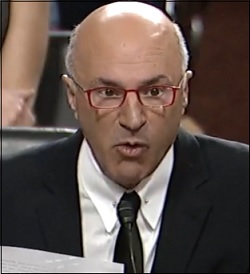
Kevin O'Leary Testifying at Senate Banking Committee Hearing, December 14, 2022

Kevin O’Leary Testifying at Senate Banking Committee Hearing, December 14, 2022

If you are an average American without insider knowledge of how Congress works these days, you might have felt that you had stepped onto the set of Alice in Wonderland while watching the Senate Banking Committee hearing yesterday.

The hearing was convened to examine the sudden collapse of the crypto exchange, FTX; its tentacles that reach into the federally-insured banking sector; and legislation that may be required to rein in the mushrooming risks that crypto poses to U.S. financial stability.

Given that more than one million customers of FTX cannot get access to the money or crypto “investments” in their potentially worthless accounts; that the kingpin of this operation, Sam Bankman-Fried, was indicted on Tuesday by the U.S. Department of Justice on eight criminal counts; and that a federally-insured bank, Silvergate Bank, that held FTX customer deposits, has seen its publicly traded parent (Silvergate Capital Corp., ticker SI) lose 87 percent of its market value year-to-date, one might have expected that serious consideration would have gone into the selection of the four witnesses that appeared at yesterday’s hearing.

Instead, the Republican crypto shills on the Senate Banking Committee made the public suffer through the alternative-reality ruminations of Kevin O’Leary, a cast member of the TV program, “Shark Tank,” who admits to receiving $15 million from FTX to be its “ambassador.” O’Leary is a named defendant, along with other celebrities who took money to promote FTX, in multiple class action lawsuits. He thus has an incentive to spin the narrative away from fraudulent conduct. In his opening remarks at the hearing, O’Leary also admitted to being “a shareholder in multiple companies involved in crypto.”

Along with multiple Republican Senators on the Senate Banking Committee, O’Leary attempted to push the narrative that the collapse of FTX has nothing to do with crypto itself; that crypto continues to offer great promise. O’Leary told the Committee that if legislation were passed to ban banks from engaging in crypto activities, he would “short every American bank stock.” (To “short” means to bet on a decline in price.) O’Leary also insisted that once crypto is regulated, it “is going to be profound in terms of how it changes the cost, the efficiency, the audit ability, the productivity of the banking sector.”

There is, in fact, zero evidence to suggest that crypto offers any productive use for the financial sector, as more than 1,600 scientists and software engineers have already explained in a detailed letter to the Senate Banking Committee and as was detailed by a serious witness at yesterday’s hearing — Hilary J. Allen, Professor of Law at American University Washington College of Law.
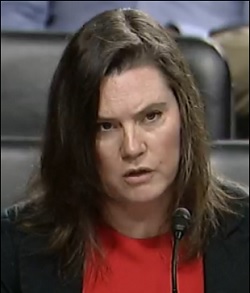
Hilary J. Allen, Professor of Law, American University Washington College of Law

Hilary J. Allen, Professor of Law, American University Washington College of Law

Professor Allen’s research focus is in the area of financial stability regulation. She is the author of Driverless Finance: Fintech’s Impact on Financial Stability, released by Oxford University Press in January. Professor Allen also worked in 2010 with the Financial Crisis Inquiry Commission to study the causes of the financial crisis of 2007-2008. She made the following key points at yesterday’s hearing, either in her verbal or written testimony:

“The problems at FTX were not a one-off, but part of a cascade of interconnected failures in the highly leveraged crypto financial system.”

“Another key flaw in the ‘this wasn’t about crypto’ narrative is that many of the problems at FTX arose because of a feature that is unique to the crypto industry: cryptoassets (like the FTT token) can be created out of nothing by anyone with computer programming abilities. I have previously explained that this unlimited supply of cryptoassets allows for significant leverage, making the crypto ecosystem very fragile. The unlimited supply of cryptoassets also ensures that frauds are particularly easy to perpetuate: when an entire industry is built on an asset type that can be manufactured at zero cost, has no fundamentals, and trades entirely on sentiment, traditional checks on fraud (like valuation methodologies and financial accounting) will inevitably break down.”

Crypto tokens “are minted out of thin air.”

“What the public actually needs is protection – individual investors need protection from crypto frauds, and our broader financial system also needs protection from crypto’s booms and busts.”

“A ban on crypto would be the most straight-forward way of protecting both investors and the financial system: it would end the uncontrolled creation of cryptoassets and also ensure that cryptoassets never require a bail-out. If policymakers don’t wish to proceed with a ban, then they will need to be careful to ensure that any laws they do adopt don’t inadvertently encourage the proliferation of cryptoassets or bring those cryptoassets closer to the core of our financial system.”

“Crypto should also not have the CFTC [Commodity Futures Trading Commission] as its primary regulator. The CFTC has no statutory investor protection mandate, has limited experience regulating retail-dominated markets, and the application of the CFTC’s self-certification regime to crypto would allow an unlimited supply of cryptoassets to proliferate.”

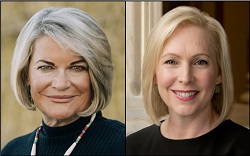
Professor Allen’s slap down of the idea of allowing the CFTC to regulate crypto seemed to age Senator Cynthia Lummis (R-WY) by about 20 years. When Lummis took her turn at questioning the witnesses later in the hearing, her face showed serious signs of stress. That might be because the legislation she has co-introduced with Senator Kirsten Gillibrand (D-NY) to allow the CFTC to oversee crypto, was just exposed in the hearing as a sell-out to crypto interests. (See our earlier report: After Crypto Money Piled into Campaign Coffers of Senators Lummis and Gillibrand, They Introduced a Sweetheart Legislative Bill for Crypto.)

Another witness at yesterday’s hearing was Ben McKenzie, the actor and crypto researcher who has a book coming out next year with journalist Jacob Silverman, Easy Money: Cryptocurrency, Casino Capitalism, and the Golden Age of FraudMcKenzie demonstrated an acute understanding of the fraudulent aspects of crypto, stating:

“ ‘Cryptocurrencies’ are not currencies by any reasonable economic definition, as they are unable to fulfill any of the three functions of money. They are a poor medium of exchange, unit of account, and store of value. Bitcoin cannot work as a medium of exchange because it cannot scale. The Bitcoin network can only process 5 to 7 transactions a second. By comparison, Visa can handle tens of thousands. To facilitate that relatively trivial amount of transactions, Bitcoin uses an enormous amount of energy. In 2021, Bitcoin consumed 134 TWh in total, comparable to the electrical energy consumed by the country of Argentina. Bitcoin simply cannot ever work at scale as a medium of exchange.”

The fourth witness, Jennifer J. Schulp, was another crypto-friendly narrator from a suspect nonprofit – the Cato Institute, which was previously secretly owned by the fossil fuel billionaires, the Koch brothers, and a handful of other men.

You can watch the full hearing at this link


LINK


Tuesday, July 19, 2022

A Headline at Politico Declares that the U.S. Can’t Be a Financial Leader without Crypto; The Headline Was Written by a Crypto Firm


SUBSCRIBE TO THIS NEWSLETTER


A Headline at Politico Declares that the U.S. Can’t Be a Financial Leader without Crypto; The Headline Was Written by a Crypto Firm

Politico Conference on Crypto -- Funded by Crypto

(Left to right): Politico Reporters, Sam Sutton and Ben Schreckinger, Interviewing
Senators Kirsten Gillibrand and Cynthia Lummis

By Pam Martens and Russ Martens: July 18, 2022 ~

Yesterday we spotted a headline at the news outlet, Politico, that read: “Meeting the Moment: Without cryptocurrency regulatory approval, the U.S. risks its status as a financial leader.” Posing as actual journalism with a byline by a person named Jennifer Gregory, the article provides a lengthy interview with Michael Sonnenshein, the CEO of Grayscale Investments, a peddler of Bitcoin. Sonnenshein uses the interview to whine about a recent Securities and Exchange Commission decision that didn’t go his way and tout how his powerful outside law firm, Davis Polk, plans to appeal the decision.

In small print, the article notes that it is actually “Sponsored by Grayscale Investments.” In other words, it’s an advertisement posing as real journalism.

Unfortunately, this co-branding between the Bitcoin company, Grayscale, and the news outlet, Politico, goes much deeper than just this one headline.

On March 24 of this year, Politico held a conference titled “Regulating the Digital Gold Rush,” a conference which was financially underwritten by Grayscale. The conflicted financial backing for the event didn’t stop Politico from placing two of its reporters, Sam Sutton and Ben Schreckinger, on the stage at the conference with their interviewees, Senators Kirsten Gillibrand (D-NY) and Cynthia Lummis (R-WY).

Both Gillibrand and Lummis have received an influx of donations to their political campaigns from crypto interests and were at the conference to promote a crypto-friendly bill they were planning to introduce in the Senate.

As the Politico reporters asked softball questions of the two Senators in front of a backdrop showing the words “Politico” and “Grayscale” side by side, the Senators gushed over their desire to help the crypto industry “innovate.” Gillibrand explained that New York “is the financial services capitol of the world” and “this is one of the greatest, growing industries that New York definitely wants to have a part of.”

In reality, 1,600 of the smartest minds in technology sent a letter to Congress on June 1 explaining why both crypto and blockchain are a sham and harmful to U.S. interests. Bill Gates, the founder of Microsoft, one of the most valuable tech companies in the U.S., stated in June that crypto is based “on the greater fool theory,” adding that “I’m used to asset classes… like a farm where they have output, or like a company where they make products.” Legendary investor, Warren Buffett, called Bitcoin “rat poison squared” in 2018, the same year that Bill Harris, the former CEO of Intuit and PayPal, wrote a detailed critique of Bitcoin for Vox, under the headline: “Bitcoin is the greatest scam in history.”

Harris explained:

“In my opinion, it’s a colossal pump-and-dump scheme, the likes of which the world has never seen. In a pump-and-dump game, promoters ‘pump’ up the price of a security creating a speculative frenzy, then ‘dump’ some of their holdings at artificially high prices. And some cryptocurrencies are pure frauds. Ernst & Young estimates that 10 percent of the money raised for initial coin offerings has been stolen.”

The Federal Trade Commission reported in June that “since the start of 2021, more than 46,000 people have reported losing over $1 billion in crypto to scams. That’s about one out of every four dollars reportedly lost to fraud during that period.”

None of this stopped Gillibrand and Lummis from introducing their crypto-friendly legislation on June 7. On the same day it was released, two financial services watchdog groups savaged the bill.

Americans for Financial Reform released the following statement:

“A bill introduced by Sens. Kirsten Gillibrand and Cynthia Lummis to revamp regulation of cryptocurrencies is little more than a giveaway to an industry that wraps itself in the mantle of innovation but poses serious risks to investors, consumers, and possibly even financial stability…

“Notably, the bill proposes an approach to classifying digital assets as securities that are linked to underlying ancillary assets, or tokens. This approach would cede more regulatory power to the Commodity Futures Trading Commission while undermining existing securities law and oversight by the Securities and Exchange Commission. The measure could even create a loophole that traditional securities issuers could exploit to avoid more robust disclosure requirements. Additionally, the bill would exempt small transactions from being reported as taxable income and allow cryptocurrency miners to defer tax payments for some activities, perhaps indefinitely. This step would incentivize an increase in wasteful, climate-harming mining activities, but the bill itself does nothing to address those environmental impacts, save authorizing a study.”

Dennis Kelleher, the President and CEO of  Better Markets, issued the following critique of the proposed legislation:

“The bipartisan crypto bill with the Orwellian name of ‘Responsible Financial Innovation Act’ released today will likely result in crypto being largely unregulated, even though it is an extremely volatile financial product with a limited track record, which itself is mostly bad.  Worse, it appears to be designed to disarm the public by making them think crypto will be properly regulated while the industry and the insiders know that is simply not true. The tell is that the bill gives the industry what it wants most: the Commodities Futures Trading Commission (CFTC) as its primary regulator, even though it exists to police markets where physical producers and purchases of commodities like corn, wheat, oil, natural gas, hogs, and cattle hedge their price risk to facilitate the delivery of everyday goods to the American people.

“Of course, crypto is nothing like corn or hogs or oil, but the industry wants the CFTC as its regulator because it is the smallest financial regulator with the smallest budget.  The financial industry and its allies in Congress have made sure that the CFTC has been chronically underfunded for decades…

“Giving the CFTC jurisdiction over crypto is like New York City outsourcing crime fighting to a small-town police force. You might see a cop every now and then and they might even make the occasional arrest, but by and large the criminals will be running the place.

“By doing this, Congress is playing with fire, and it should know better because that’s exactly what they did in the 1990s by first repealing the Glass-Steagall Act and then prohibiting the regulation of derivatives with the 2000 Commodities Futures Modernization Act (CFMA), including credit default swaps (CDS). Those Congressional actions, which were also broadly bipartisan, resulted in gigantic banks that were too-big-to-fail and trillions in dangerous derivatives that were unregulated. In 2008, that caused the biggest taxpayer-funded bailouts in history, the worst financial crash since 1929, and the worst economy since the Great Depression, devastating tens of millions of Americans who lost jobs, homes, savings and so much more.

“Now, just 14 years after that horrific crash, Congress is again listening to the financial industry’s Siren song of innovation, which was also the tune they played for repealing Glass-Steagall, enacting the CFMA, and unleashing CDS on the global financial system.  In a world that wasn’t run by lobbyists, awash in campaign cash, greased by the revolving door, and dominated by secret, backroom deals, this bill would never be filed…”

This shilling for the crypto industry by two elected members of the U.S. Senate is only the latest of the nauseating tactics crypto peddlers have used. Crypto pushers hired themselves Trump’s outgoing SEC Chairman, Jay Clayton; celebrities like Matt Damon, LeBron James, Spike Lee, Tom Brady, Alec Baldwin, and numerous others have taken money to shill for crypto; and high-priced lobbyists have been used to sway Congress and state legislatures to back off any regulatory push. Crypto even slapped its name on sports stadiums and arenas – similar to Enron and Citigroup just before they blew up.

Like any other pump and dump scheme, crypto mania worked for a while. Insiders grabbed their windfall profits early and left the unsophisticated with the losses. Now it’s all coming unwound as crypto firms are locking out investors from making withdrawals; filing bankruptcy; and crypto founders disappearing.

What the American people are not likely to forget, however, are the names of those who shilled for this industry instead of taking a timely, principled stand.

LINK


Monday, June 20, 2022

After Crypto Money Piled into Campaign Coffers of Senators Lummis and Gillibrand, They Introduced a Sweetheart Legislative Bill for Crypto


SUBSCRIBE TO THIS NEWSLETTER


After Crypto Money Piled into Campaign Coffers of Senators Lummis and Gillibrand, They Introduced a Sweetheart Legislative Bill for Crypto

By Pam Martens and Russ Martens: June 20 , 2022 ~

Senator Cynthia Lummis and Senator Kristen Gillibrand

Senator Cynthia Lummis (left) and Senator Kirsten Gillibrand (right)

On June 7, Senator Kirsten Gillibrand, a Democrat from New York who sits on the Senate Agriculture Committee which oversees commodities, and Senator Cynthia Lummis, a Republican from Wyoming who sits on the Senate Banking Committee which oversees Wall Street and trading, introduced a bill as an early Christmas present to the crypto industry. It carries the Alice in Wonderland title of the Responsible Financial Innovation Act.

In reality, it is an irresponsible piece of legislation whose sponsorship by these two women only makes sense when you understand that their campaign coffers are being stuffed with money from the crypto industry.

Let’s start with Lummis. A $5800 donation is not a big deal to every member of Congress. But it is a big deal to a Senator from Wyoming, a state whose population is less than 600,000.

According to data from the Federal Election Commission, one of the largest donations to the Lummis campaign last year was $5800 from Jesse Powell, the CEO of cryptocurrency exchange, Kraken (a/k/a Payward). Powell was profiled in a New York Times article last week for creating a sick culture at his company where he discusses “who can refer to another person as the N word,” and has “told workers that questions about women’s intelligence and risk appetite compared with men’s were ‘not as settled as one might have initially thought.’ ”

Kraken was fined a measly $1.25 million last September by the crypto-captured Commodity Futures Trading Commission (CFTC) for committing two rather large crimes. According to the CFTC, Kraken engaged in “illegally offering margined retail commodity transactions in digital assets, including Bitcoin” and failed “to register as a futures commission merchant (FCM).”

Powell wasn’t the only crypto titan stuffing $5800 into the Lummis campaign. FEC records show that the two co-founders and Managing Partners of Multicoin Capital, Pyahm (Kyle) Samani and Tuschar Jain, each contributed $5800 on July 29, 2021. Multicoin runs both a hedge fund and a venture capital fund that are involved in crypto.

Another of the top six donors to the Lummis campaign last year was Michelle Bond of an outfit listed simply as “ADAM.” Bond donated $5800 to the Lummis campaign on July 27, 2021, just two days before the Multicoin Capital donations came in from the co-founders.

Upon closer scrutiny, it turns out that ADAM stands for Association for Digital Asset Markets, a crypto trade group. Multicoin Capital has a representative on ADAM’s Board of Directors, as do numerous other crypto exchanges and crypto interests. Michelle Bond is its CEO.

Bond’s bio says she previously worked “as international counsel at the U.S. Securities and Exchange Commission for the implementation of the Dodd-Frank Act.” Dodd-Frank was another piece of sell-out legislation to trading interests. Bond’s bio also notes that she “launched her legal career at the Financial Industry Regulatory Authority (FINRA)….” FINRA is Wall Street’s captured self-regulator that runs Wall Street’s private justice system that locks customers and employees out of the nation’s courts.

Also among the top six donors to the Lummis campaign last year was a $5800 contribution from Kristin McKenzie Smith, who lists her job on the FEC form as a lobbyist for law firm Thompson Coburn. That law firm brags on its website as follows:

“In March 2018, the state of Wyoming signaled its fervent support for the growth and development of blockchain and cryptocurrency by enacting into law a flurry of legislation intended to make the state a haven for certain types of ICOs and blockchain-related businesses. Of the five bills recently signed into law by Governor Mead, three relax the state’s regulatory framework for cryptocurrency and two amend the state’s corporations code so as to better facilitate the development of blockchain and cryptocurrency businesses.”

To read a summary of these freakish laws, see here.

Gillibrand’s two largest campaign donors are lawyers at two law firms heavily involved in crypto: Boies, Schiller Flexner and Latham & Watkins.

Three law partners at Boies gave the maximum $5800 to Gillibrand’s campaign last year: Amy Neuhardt, Jonathan Sherman, and Lee Wolosky. (Wolosky, who spent 19 years at Boies, has since moved on to become partner and co-chair of the litigation department at Jenner & Block.)

A Boies law partner, Matt Schwartz, was named a “Cryptocurrency Trailblazer” in 2018 by the National Law Journal. The publication noted his work for Ripple Labs, creators of a cryptocurrency and the target of proceedings by the Justice Department, FinCEN, and the Securities and Exchange Commission.

In 2020, 12 lawyers left Boies to form a boutique law firm specializing in crypto legal matters.

Latham & Watkins describes its crypto practice as follows:

“Latham, named Band 1 for FinTech by Chambers USA, regularly serves emerging and blockchain-enabled technology companies, investors, crypto exchanges, broker-dealers, and leading global financial institutions that are revolutionizing the delivery of financial services…

“A dedicated global team of more than 80 lawyers focuses on tracking and analyzing developments affecting the blockchain and cryptocurrency industry, spanning multiple practice areas within the firm. The Latham team includes former enforcement supervisors and prosecutors from the US Commodity Futures Trading Commission, US Securities and Exchange Commission, UK Serious Fraud Office, UK Financial Conduct Authority and the Securities & Commodities Fraud Task Force of the US Attorney’s Office for the Southern District of New York, as well as former senior US Department of Justice officials.

“Latham serves on and partners with: The Enterprise Ethereum Alliance’s Legal Industry Working Group; The Global Blockchain Business Council; The Fintech Association of Hong Kong; The Fintech Working Group of the Asia Securities Industry & Financial Markets Association (ASIFMA); The Global Blockchain Council of the United Arab Emirates; The World Economic Forum’s Centre for the Fourth Industrial Revolution.”

Lawyers at Latham & Watkins contributed $14,500 to Gillibrand’s political campaign account last year. Other Big Law firms with heavy involvement in crypto matters are also regular donors to Gillibrand’s campaign coffers.

Two financial services watchdog groups, Better Markets and Americans for Financial Reform, have separately released  scathing assessments of the Lummis/Gillibrand legislative bill.

On June 7, the day the Lummis-Gillibrand bill was introduced in the Senate, Dennis Kelleher, the President and CEO of  Better Markets, issued the following critique of the proposed legislation:

“The bipartisan crypto bill with the Orwellian name of ‘Responsible Financial Innovation Act’ released today will likely result in crypto being largely unregulated, even though it is an extremely volatile financial product with a limited track record, which itself is mostly bad.  Worse, it appears to be designed to disarm the public by making them think crypto will be properly regulated while the industry and the insiders know that is simply not true. The tell is that the bill gives the industry what it wants most: the Commodities Futures Trading Commission (CFTC) as its primary regulator, even though it exists to police markets where physical producers and purchases of commodities like corn, wheat, oil, natural gas, hogs, and cattle hedge their price risk to facilitate the delivery of everyday goods to the American people.

“Of course, crypto is nothing like corn or hogs or oil, but the industry wants the CFTC as its regulator because it is the smallest financial regulator with the smallest budget.  The financial industry and its allies in Congress have made sure that the CFTC has been chronically underfunded for decades…

“Giving the CFTC jurisdiction over crypto is like New York City outsourcing crime fighting to a small-town police force. You might see a cop every now and then and they might even make the occasional arrest, but by and large the criminals will be running the place.

“By doing this, Congress is playing with fire, and it should know better because that’s exactly what they did in the 1990s by first repealing the Glass-Steagall Act and then prohibiting the regulation of derivatives with the 2000 Commodities Futures Modernization Act (CFMA), including credit default swaps (CDS). Those Congressional actions, which were also broadly bipartisan, resulted in gigantic banks that were too-big-to-fail and trillions in dangerous derivatives that were unregulated. In 2008, that caused the biggest taxpayer-funded bailouts in history, the worst financial crash since 1929, and the worst economy since the Great Depression, devastating tens of millions of Americans who lost jobs, homes, savings and so much more.

“Now, just 14 years after that horrific crash, Congress is again listening to the financial industry’s Siren song of innovation, which was also the tune they played for repealing Glass-Steagall, enacting the CFMA, and unleashing CDS on the global financial system.  In a world that wasn’t run by lobbyists, awash in campaign cash, greased by the revolving door, and dominated by secret, backroom deals, this bill would never be filed…”

Americans for Financial Reform, was equally harsh in their assessment of the proposed legislation, writing:

“A bill introduced by Sens. Kirsten Gillibrand and Cynthia Lummis to revamp regulation of cryptocurrencies is little more than a giveaway to an industry that wraps itself in the mantle of innovation but poses serious risks to investors, consumers, and possibly even financial stability…

“Notably, the bill proposes an approach to classifying digital assets as securities that are linked to underlying ancillary assets, or tokens. This approach would cede more regulatory power to the Commodity Futures Trading Commission while undermining existing securities law and oversight by the Securities and Exchange Commission. The measure could even create a loophole that traditional securities issuers could exploit to avoid more robust disclosure requirements. Additionally, the bill would exempt small transactions from being reported as taxable income and allow cryptocurrency miners to defer tax payments for some activities, perhaps indefinitely. This step would incentivize an increase in wasteful, climate-harming mining activities, but the bill itself does nothing to address those environmental impacts, save authorizing a study.”


LINK


Trump's Friday Meltdown: Begging Iran, Ditching Ukraine, and Blaming Everybody But Himself – 7/31/26

                                               LOTS OF POSTS IGNORED BY BLOGGER..... OR REMOVED ON THEIR WHIM! ALL POSTS ARE AVAILABLE ON MI...