Showing posts with label BANK COLLAPSES. Show all posts

Tuesday, September 12, 2023

The Warning Bell at the Federal Agency Created to Monitor Systemic Bank Risk Failed to Ring


FROM APRIL BURIED IN SPAM FOLDER 
SUBSCRIBE TO THIS NEWSLETTER TO RECEIVE TIMELY REPORTS 


The Warning Bell at the Federal Agency Created to Monitor Systemic Bank Risk Failed to Ring
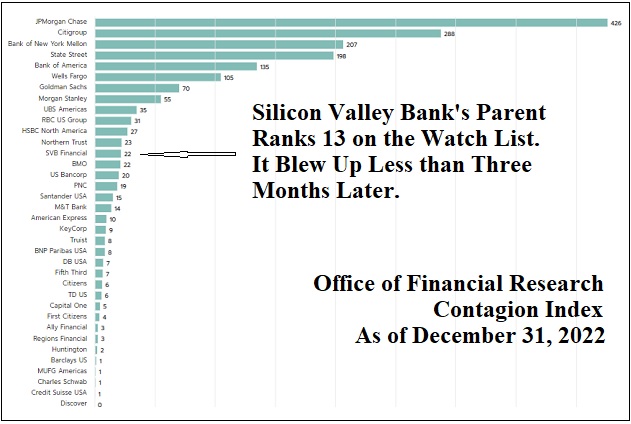
Office of Financial Research Contagion Index as of December 31, 2022

By Pam Martens and Russ Martens: April 25, 2023

For years Wall Street On Parade saluted the work of the Office of Financial Research (OFR) in sounding the alarms about the risks building up in the U.S. banking system – even when it was politically unpalatable for the OFR to do so. Then the Trump/Koch administration took over and gutted OFR and put a crony in charge.

It does not appear that the damage to staffing and talent under the former Trump/Koch administration has been adequately repaired under the Biden administration.

The OFR was created after the near collapse of the U.S. financial system in 2008. It derives its statutory role from the Dodd-Frank financial reform legislation of 2010. Its key job is to issue timely alerts and research reports to keep the Financial Stability Oversight Council (F-SOC) informed of emerging financial threats or weaknesses that have the potential to crater the U.S. financial system again.

Unfortunately, there was no loud warning issued (at least publicly) by OFR prior to three banks blowing up in the span of five days in March and rapidly spreading panic among uninsured bank depositors.

According to H.8 data from the Federal Reserve, as of the week ending March 1 there was $17.636 trillion in deposits at U.S. banks, not seasonally adjusted. There was just a negligible drop in deposits of $20 billion over the next week that ended March 8. (The H.8 is based on Wednesday to Wednesday data.)

Then the following occurred:

On Wednesday, March 8, Silvergate Capital Corporation, parent of Silvergate Bank, which had gotten in bed with crypto companies (including Sam Bankman-Fried’s house of frauds) announced it was winding down and would “voluntarily liquidate the Bank.” That sent depositors fleeing from other banks with crypto exposure and the share prices of those banks plunging.

On Friday, March 10, Silicon Valley Bank, headquartered in Santa Clara, California, was put into receivership by the Federal Deposit Insurance Corporation (FDIC).

On Sunday, March 12, the New York headquartered Signature Bank was also put into receivership by the FDIC.

Silicon Valley Bank and Signature Bank, respectively, were the second and third largest bank failures in U.S. history – a point not lost on depositors reading those facts in newspaper headlines. (The largest bank failure was Washington Mutual in 2008.)

After this series of events in a 5-day span, deposit flight got into gear. At the close of the week ending March 15, deposits were down to $17.486 trillion. By the close of the week ending March 22, deposits had plunged to $17.307 trillion.

From the week ending March 1 to the week ending March 22, deposits in U.S. commercial banks had declined by an astounding $328 billion dollars – in a span of just three weeks.

As of the most recent H.8 data for the week ending April 12, deposits stood at $17.380 trillion – still down $256 billion from the week ending March 1.

Only one of the banks that imploded was on the OFR’s Contagion Index list. Per the chart above, that was Silicon Valley Bank and it ranked 13 on the OFR’s watch list for the period ending December 31, 2022.

The other two banks which helped spread panic and contagion, Silvergate Bank and Signature Bank, were not on OFR’s Contagion Index at all. That’s very troubling because on August 1 of last year, we published an article headlined as follows: Brace Yourself for Federally-Insured Bank Failures Caused by Crypto. We specifically mentioned Silvergate Bank and Signature Bank in the article.

OFR explains its Contagion Index as follows:

“[It] measures the loss that could spill over to the rest of the financial system if a given bank were to default. It depends on the size of the bank, its leverage, and how connected it is to other financial institutions:

OFR Contagion Index = Connectivity X Net Worth X (Outside Leverage).

Connectivity is defined by OFR as “the share of the bank’s unsecured liabilities that are held by other financial institutions. It is the ratio of the bank’s liabilities within the financial system to the bank’s total liabilities. With higher connectivity, a bank’s failure has a potentially broader impact on the rest of the financial system.”

OFR defines a bank’s net worth as “the difference between a bank’s assets and its liabilities. A larger bank’s failure can have a broader impact on the financial system, other things being equal.”

Outside leverage is defined by OFR as “the vulnerability of the bank to shocks from the real side of the economy. It is the ratio of a bank’s claims on nonfinancial entities to its net worth.”

What OFR has not captured in its Contagion Index is panic spreading because of reputational damage to the banking system itself. Silvergate Bank was federally-insured but had been in the headlines as potentially facilitating the looting of customer funds at Sam Bankman-Fried’s crypto exchange, FTX. That reputational damage then spilled over to other federally-insured banks involved in any manner with crypto companies. That crypto had gained a foothold in taxpayer-backstopped, federally-insured banks drained confidence in the U.S. banking system.

In the case of Silicon Valley Bank, its regulators had also allowed it to set itself up for reputational damage by effectively becoming a Wall Street IPO pipeline in drag as a federally-insured bank. Also, a large percentage of its deposits were uninsured, meaning they were larger than the $250,000 cap per depositor, per bank set by the FDIC. When the bank announced on March 8 that it had taken a loss of $1.8 billion on the sale of underwater securities and would be raising additional capital through a secondary stock offering of common as well as mandatory convertible preferred stock (which would dilute existing shareholders) that set those uninsured deposits into serious motion out of the bank.

Signature Bank had also become tainted by rubbing its elbows too close to crypto and had a large percentage of uninsured deposits. A bank run ensued there as well.

On March 29, the Vice Chair for Supervision at the Federal Reserve, Michael Barr, indicated during his testimony before the Senate Banking Committee that his office would be conducting a review of what went wrong at Silicon Valley Bank and releasing a report on May 1. The FDIC is conducting a similar review of the failure of Signature Bank and will also release a report on May 1.

The FDIC is also slated to release a report on May 1 regarding the deposit insurance system, options for consideration related to deposit insurance coverage levels, excess deposit insurance, and the adequacy of DIF, the Deposit Insurance Fund.

https://wallstreetonparade.com/2023/04/the-warning-bell-at-the-federal-agency-created-to-monitor-systemic-bank-risk-failed-to-ring/

Friday, May 19, 2023

The Banking Crisis Has Produced Extraordinary Testimony about Land Mines Lurking in the U.S. Banking System


SUBSCRIBE TO THIS NEWSLETTER TO RECEIVE TIMELY REPORTS

The Banking Crisis Has Produced Extraordinary Testimony about Land Mines Lurking in the U.S. Banking System

By Pam Martens and Russ Martens: May 18, 2023 ~

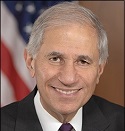
Martin Gruenberg, Chair, Federal Deposit Insurance Corporation (FDIC)

Martin Gruenberg, Chair, Federal Deposit Insurance Corporation (FDIC)

On Wednesday, March 8 of this year, the holding company for the federally-insured Silvergate Bank announced it was winding down the bank. It had little choice but to do so. It was experiencing a bank run and had incinerated its reputation by focusing on deposits from crypto companies, including those majority-owned by indicted crypto kingpin, Sam Bankman-Fried.

According to testimony from the Chairman of the Federal Deposit Insurance Corporation (FDIC), Martin Gruenberg, before the Senate Banking Committee on March 28, “in the fourth quarter of 2022, Silvergate Bank experienced an outflow of deposits from digital asset customers that, combined with the FTX deposits, resulted in a 68 percent loss in deposits – from $11.9 billion in deposits to $3.8 billion.”

Silvergate Bank’s primary regulator was the San Francisco Fed.

Two days later, on Friday, March 10, Silicon Valley Bank was put into receivership at the FDIC following an unprecedented bank run that saw $42 billion in deposits leave the bank on just the day of March 9, with another $100 billion in deposits queued up to leave the next day – which would have represented the vast majority of its deposits taking flight in 48 hours. That testimony was delivered to the Senate Banking Committee on March 28 by the Vice President for Supervision at the Fed, Michael Barr.

Silicon Valley Bank’s primary regulator was also the San Francisco Fed.

Two more bank failures followed in short order: Signature Bank on March 12 and First Republic Bank on May 1. Both were experiencing bank runs as a result of a loss of confidence by their customers. The primary regulator of both was the FDIC.

First Republic Bank, Silicon Valley Bank, and Signature Bank were the second, third and fourth largest bank failures in U.S. history, respectively. The largest failure was Washington Mutual during the financial crisis of 2008. JPMorgan Chase, officially the riskiest U.S. bank, was allowed by its regulators to take over Washington Mutual in 2008 and First Republic Bank on May 1 of this year.

Senator Elizabeth Warren at May 17, 2023 Hearing on Fed Accountability

Yesterday, the Senate Banking Subcommittee on Economic Policy, which is chaired by Senator Elizabeth Warren (D-MA), held a hearing on the lack of accountability at the Fed and proposals to reform its structure. Senator Warren said this in her opening remarks:

“The rapid collapse of three banks — Silicon Valley Bank, Signature Bank and First Republic Bank — was a shock. These three bank failures together put more assets at risk than the 25 bank failures in the 2008 crash.

“Silicon Valley Bank’s failure was another symptom of what has become a predictable string of failures in the governance of the Federal Reserve. SVB’s collapse and other bank failures it triggered forced the FDIC, the Treasury Department, and other regulators to rush to the rescue to avoid implosion of our banking system. So far, the FDIC Insurance Fund has suffered billions of dollars of losses, and, as a result of the bailouts, America’s biggest too-big-to-fail bank just got $200 billion bigger.” (Senator Warren is referring to JPMorgan Chase’s takeover of First Republic Bank.)

During yesterday’s hearing, the Fed’s support of 2018 legislation that resulted in the rollback of prudential regulation on banks with assets under $250 billion was examined as contributing to the recent bank collapses. In written testimony, Dr. Peter Conti-Brown, Associate Professor of Financial Regulation, Associate Professor of Legal Studies and Business Ethics at The Wharton School of the University of Pennsylvania, offered this analysis:

“In 2018, after many months of debate, President Trump signed the Economic Growth, Regulatory Relief, and Consumer Protection Act. In an era of omnibus bills, often hundreds or thousands of pages long, one of the most impressive feats of the EGRRACPA (or S. 2155, as it is more commonly known), is its length: the entire bill is just 75 pages long. The part that is relevant to the present banking crisis, Title IV of that act, is just five pages long. In those five pages, entitled ‘Tailoring Regulations for Certain Bank Holding Companies,’ Congress changed the $50 billion [asset] threshold [for prudential regulation of banks] to $250 billion [in assets]…

“Over the last two months, three of the twenty banks within that band of $100 billion to $250 billion have failed. (In the somewhat absurd vernacular of banking, we call these banks ‘regional banks.’). We do not know how many of the remaining seventeen would have failed but for the emergency declarations and concomitant liquidity support that the federal government’s extraordinary actions facilitated thereafter.

“Thus, while the focus is often on Silicon Valley Bank, the fact is that we have had an intolerable failure of a market segment – when 15% of banks fail within the very class that Congress deregulated in 2018, we have enough smoke to inquire about the presence of fire.”

Another key focus of the hearing was on what Senator Warren calls a “culture of corruption at the Fed.” Over the past two years, under Fed Chair Jerome Powell, the Fed has experienced a string of scandals, including the unprecedented trading scandal by Fed officials, where they were trading in their own brokerage accounts in stocks and other instruments while sitting on confidential market moving information at the Fed.

Powell referred the trading scandal investigation to the Inspector General of the Federal Reserve, Mark Bialek, on October 4, 2021. It took Bialek just nine months to clear Powell and former Fed Vice Chair Richard Clarida of violating “the laws, rules, regulations, or policies” of the Fed. Bialek has remained mum for the past 19 months on the biggest suspect in the trading scandal, former Dallas Fed President Robert Kaplan. (See our reports: Robert Kaplan Was Trading Like a Hedge Fund Kingpin for Five Years while President of the Dallas Fed; a Dozen Legal Safeguards Failed to Stop Him and Dallas Fed President Kaplan Was Making Bold, Market-Moving Statements to Media During 2020 Crisis; the Same Year He Traded Tens of Millions of Dollars in Stocks and S&P 500 Futures.)

Kaplan apparently feels he has nothing to fear from Bialek. Kaplan appeared on Bloomberg TV on May 3, actually giving advice to the Fed on monetary policy.

Mark Bialek, Inspector General, Federal Reserve Board

Mark Bialek, Inspector General, Federal Reserve Board

Under questioning from Senator Warren, Bialek revealed that his salary as Inspector General is $377,800. Warren said that this is the highest salary for any employee of the Federal Reserve Board. It is not higher, however, than what Presidents of the 12 privately-owned Federal Reserve regional banks make. For example, John Williams, the President of the New York Fed – where the Federal Reserve Board serially outsources its bailouts of Wall Street’s mega banks – was making $506,300 in 2020 according to the Fed’s 2020 Annual Report. Williams got a bump up in salary to $513,400 according to the Fed’s 2021 Annual Report. (See Table G.12 at this link.) The President of the United States and Commander in Chief, who is elected by the people, makes $400,000.

Senator Warren and Senator Rick Scott (R-FL) suggested that perhaps Bialek is getting this high salary as an incentive to perpetually wear a blindfold about wrongdoing at the Fed. Scott said this during his questioning of Bialek:

Senator Rick Scott at Senate Hearing May 17, 2023

“There’s 23,000 people I think that work at the Federal Reserve. There’s not a report you’ve done since 2011 that you know of any person that’s been fired; there’s nobody on the Board that’s ever done anything wrong; we don’t have any information – good information – on what happened on these stock trades; and you think that we should be happy that we don’t have an independent, presidentially-appointed Inspector General. This doesn’t make any sense. And it [the Federal Reserve] has a balance sheet of $8.6 trillion…Name another agency that has that big a balance sheet in the federal government.”

The Fed has a balance sheet of $8.6 trillion, which has resulted from its serial Quantitative Easing (QE) programs where it buys up trillions of dollars of government-backed debt securities, creating demand that would not otherwise exist, in order to drive down interest rates to prop up an economy crippled by serial bank crises.

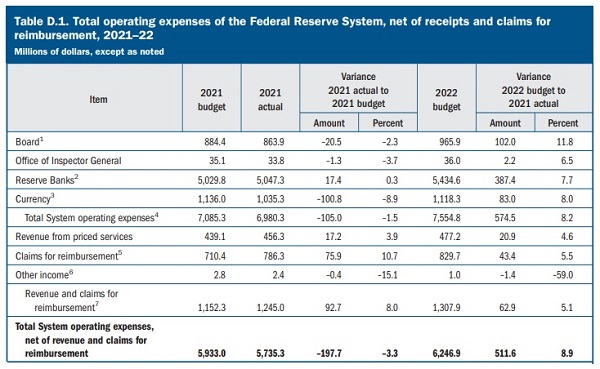
While the Fed has a balance sheet of $8.6 trillion, it actually has an expense budget of $6.2 billion. (See Table D.1 below from the Fed’s 2021 Annual Report. Notes for the chart are available in the 2021 Annual Report.)

That $6.2 billion budget (combined for both the 12 regional banks and the Fed Board of Governors) includes the tiny amount of $36 million to run the Office of Inspector General that is expected to police the activities of 23,000 people.

Bialek testified at yesterday’s hearing that he has a total staff of 130 people to investigate wrongdoing at the Fed. The Fed’s 2022 budget is offering to let him hire three more people.

There is no better insight into the culture of corruption at the Fed than the 2018 tome by one of its own former bank examiners, Carmen Segarra. Her book, Noncompliant: A Lone Whistleblower Exposes the Giants of Wall Street, describes the culture inside the largest of the Fed’s regional banks — the New York Fed – as follows:

“…nothing I had seen during my decade of legal work had prepared me for what I witnessed in just a few short months at the New York Fed.

“In those months I discovered a disorienting world full of hidden clues, where people said one thing but meant another. Beneath the public face of the Fed laid a web of incompetence, corruption, rampant mismanagement, secrets, and lies. In the ‘fake work’ culture of the Fed, where supervision was a job title, not a job, the most important thing was to control the process to serve the ultimate master. The New York Fed was not simply failing to stop the banks; it was actually enabling their bad behavior.”

2021-2022 Expense Budget of the Federal Reserve System


LINK


Monday, May 15, 2023

Former New York Fed Pres Bill Dudley Calls This the First Banking Crisis Since 2008; Charts Show It’s the Third


SUBSCRIBE TO THIS NEWSLETTER TO RECEIVE IT IN A TIMELY MANNER

Former New York Fed Pres Bill Dudley Calls This the First Banking Crisis Since 2008; Charts Show It’s the Third

By Pam Martens and Russ Martens: April 20, 2023

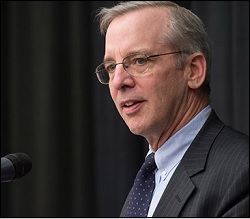
William Dudley, Former President of the New York Fed

The official that oversaw the secret funneling of trillions of dollars of bailout money from the New York Fed to the grossly mismanaged mega banks on Wall Street during the financial crisis of 2008 to 2010, had the temerity yesterday to pen an opinion piece at Bloomberg News pointing his finger at current Fed officials for today’s banking crisis – without once mentioning his role in getting us here.

The article was written by William (Bill) Dudley, who served as President of the New York Fed from January 27, 2009 to June 18, 2018. Prior to that Dudley was Executive Vice President of the Markets Group at the New York Fed, the group that runs its own trading floors in New York and Chicago and trades with the Wall Street mega banks it is also supposed to be supervising.

The New York Fed has become the official money spigot for Wall Street bailouts while being, literally, owned by some of the biggest banks on Wall Street. (See These Are the Banks that Own the New York Fed and Its Money Button.) Prior to joining the New York Fed in 2007, Dudley worked for two decades at – wait for it – Goldman Sachs, becoming a partner, managing director and chief economist.

Dudley’s broader agenda became clear in the opening sentence of his opinion piece yesterday. He writes that this is the “first banking crisis since 2008,” which dovetails nicely with the Wall Street lobbyists’ propaganda that there is nothing significantly wrong with the U.S. banking system so Congress shouldn’t start thinking about separating the Wall Street trading casinos from the federally-insured commercial banks by restoring the Glass-Steagall Act – which prevented systemic banking crises for 66 years until its repeal in 1999.

In fact, this is the third major banking crisis since 2008 and all three have occurred in the span of less than four years – a clear indication that the structure of the U.S. banking system is in desperate need of a major overhaul.

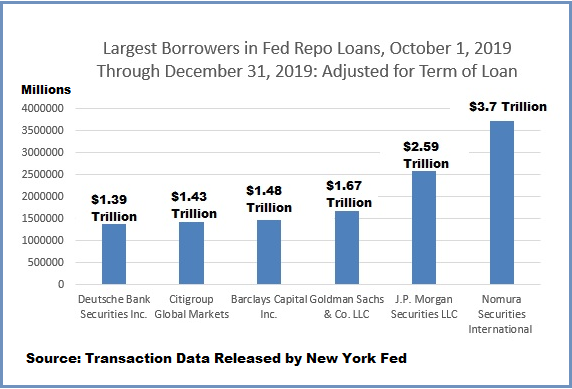
The first banking crisis since 2008 began on September 17, 2019 – for reasons the Fed has yet to explain with any credibility. In the last quarter of 2019, the New York Fed had to shovel emergency repo loans cumulatively totaling (on a term-adjusted basis) $19.87 trillion into Wall Street banks. As the chart below indicates, just six trading units of the mega banks on Wall Street received 62 percent of that amount. (Unadjusted for the term of the loan, the cumulative total was $4.5 trillion.)

Fed's Repo Loans to Largest Borrowers, Q4 2019, Adjusted for Term of Loan

Under the Dodd-Frank financial reform legislation of 2010, the Fed had to release the names of the banks that received these bailouts, and the dollar amounts of each loan, two years after the program began. While mainstream media went to court to get this information in 2008, there was a total mainstream media blackout when the Fed released the data for the 2019 bailouts. (See There’s a News Blackout on the Fed’s Naming of the Banks that Got Its Emergency Repo Loans; Some Journalists Appear to Be Under Gag Orders.)

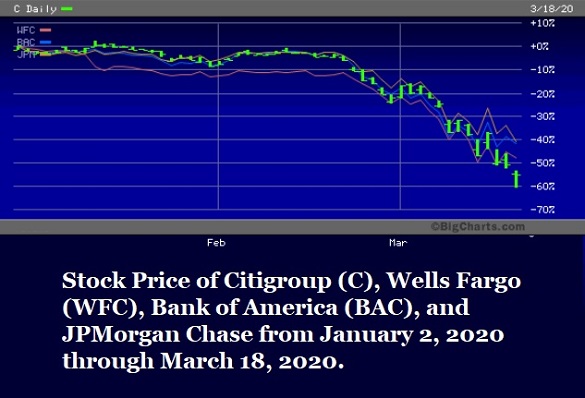
The next banking crisis occurred in March 2020 and was blamed on the pandemic. The share prices of the four largest banks (by deposits) collapsed by as much as 40 to 60 percent between January 2, 2020 and March 18, 2020. (See chart below.) The Fed rolled out the same alphabet soup of emergency lending programs that it had rolled out in 2008 – with the New York Fed once again in charge of the bulk of those programs.

Prices of Four Largest Banks During Early Part of Pandemic in 2020

Three years later, in March of 2023, the second and third largest bank failures in U.S. history occurred: Silicon Valley Bank and Signature Bank, respectively, were put into receivership by the Federal Deposit Insurance Corporation (FDIC). In addition, federal regulators had allowed Silvergate Bank, a federally-insured bank, to immerse itself with crypto outfits (including the crypto house of frauds owned by Sam Bankman-Fried) and it also experienced a bank run and was allowed to quietly wind down in March. It is far from clear that there will not be more bank failures before this latest crisis runs its course.

The good ole Fed is now doing something it has never done before in its 110-year history. It is accepting underwater bonds as collateral for emergency loans to teetering banks and paying 100-cents on the dollar on that collateral for loans of up to one year. (Historically, the Fed has imposed a haircut on collateral and made overnight loans through its Discount Window.) The Fed calls its new program the Bank Term Funding Program (BTFP).

Related Articles:

Is the New York Fed Too Deeply Conflicted to Regulate Wall Street?

The New York Fed Has Contracted JPMorgan to Hold Over $1.7 Trillion of its QE Bonds Despite Two Felony Counts and Serial Charges of Crimes

As Criminal Probes of JPMorgan Expand, Documents Surface Showing JPMorgan Paid $190,000 Annually to Spouse of the Bank’s Top Regulator

New Documents Show How Power Moved to Wall Street, Via the New York Fed 

Intelligence Gathering Plays Key Role at New York Fed’s Trading Desk 


LINK


Saturday, April 22, 2023

Fed’s Beige Book: The Credit Crunch Has Arrived in New York, California and Texas

SUBSCRIBE TO THIS NEWSLETTER TO RECEIVE REPORTS IN A TIMELY MANNER 


Fed’s Beige Book: The Credit Crunch Has Arrived in New York, California and Texas

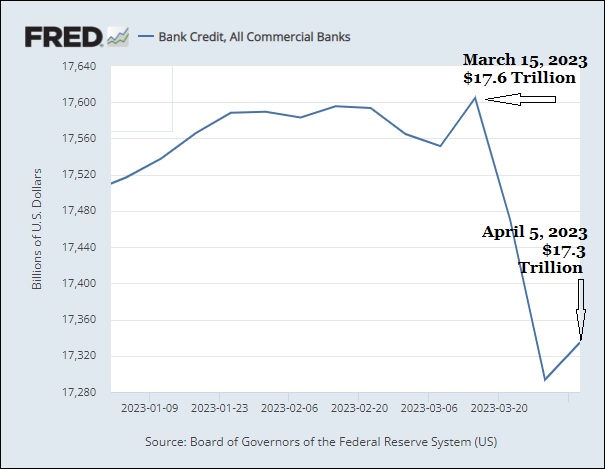
Outstanding Bank Credit Falls Off a Cliff

By Pam Martens and Russ Martens: April 20, 2023

On Wednesday, the Federal Reserve released its Beige Book, a compilation of current economic conditions in each of its 12 Federal Reserve districts. The information that was collected in each of the regional reports was gathered on or before April 10 – so it is relatively current.

It is not a good sign that three of the Fed districts that pump out a significant chunk of U.S. GDP reported that bank credit had tightened noticeably, ostensibly as fallout from the banking collapses in March and depositor runs.

The New York Fed reported that credit conditions in the Second Fed District, which includes New York state, the 12 northern counties of New Jersey, Connecticut’s Fairfield County, Puerto Rico and the U.S. Virgin Islands, “deteriorated sharply.” It summarized the situation as follows:

“Conditions in the broad finance sector deteriorated sharply coinciding with recent stress in the banking sector. Small to medium-sized banks in the District reported widespread declines in loan demand across all loan segments. Credit standards tightened noticeably for all loan types, and loan spreads continued to narrow. Deposit [interest] rates moved higher. Finally, delinquency rates edged up on residential and commercial mortgages.”

One of the banks that failed in March and was put into receivership by the Federal Deposit Insurance Corporation (FDIC) was Signature Bank, which was headquartered in Manhattan. Signature Bank was the third largest bank failure in U.S. history.

The San Francisco Fed, whose District has been the epicenter of collapsing banks and/or their share prices, reported the following regarding credit conditions:

“Lending activity fell significantly in recent weeks amid higher interest rates and elevated uncertainty in the banking sector. Lending standards tightened notably, and several depository institutions opted to reduce loan volumes, especially for new clients, despite reporting ample liquidity. Reports indicated that existing and planned projects across sectors were delayed or cancelled due to higher funding costs, heightened uncertainty, and more limited access to credit. Following recent volatility in deposit levels at regional and community banks, outflows have reportedly stabilized since late March.”

The second largest bank failure in U.S. history, Silicon Valley Bank, occurred in March in this District. See our report: Silicon Valley Bank Was a Wall Street IPO Pipeline in Drag as a Federally-Insured Bank; FHLB of San Francisco Was Quietly Bailing It Out. (The largest bank failure in U.S. history was Washington Mutual, which occurred during the financial crisis of 2008.)

A federally-insured bank that had immersed itself in crypto-related deposits, Silvergate Bank, headquartered in California, also failed in March but was allowed to wind itself down. There continue to be growing concerns about the survivability of San Francisco-based First Republic Bank, whose stock price has lost 90 percent of its value year-to-date. See our report from yesterday: Liquor Sales Will Be Brisk on Wall Street Ahead of First Republic Bank’s Earnings Report on Monday.

Although it was not clear why, the Dallas Fed also reported a particularly dour outlook in its district, writing as follows:

“Loan demand continued to decline in March as bankers reported worsening business activity. Loan volumes fell, driven largely by a sharp contraction in consumer loans. Loan performance worsened slightly overall. Credit standards and terms tightened sharply, and marked increases in loan pricing were noted. Banking outlooks continued to deteriorate, with contacts expecting a contraction in loan demand and business activity and an increase in nonperforming loans over the next six months. Increased uncertainty and lack of confidence resulting from the recent banking issues were cited as concerns.”

The revelations in the Beige Book are compatible with the Fed’s separate data on total bank credit at all commercial banks, which plunged by $300 billion between March 15 and April 5, the latest data available. That is a dramatic decline in the span of three weeks. (See chart above.)

LINK


Wednesday, April 5, 2023

A Growing Lack of Confidence in the Fed Is Spilling Over into a Lack of Confidence in U.S. Banks


SUBSCRIBE TO THIS NEWSLETTER TO RECEIVE IT IN A TIMELY MANNER

A Growing Lack of Confidence in the Fed Is Spilling Over into a Lack of Confidence in U.S. Banks

By Pam Martens and Russ Martens: April 5, 2023

Jerome Powell (Thumbnail)

Jerome (Jay) Powell, Chairman of the Federal Reserve Board

Millions of Americans are beginning to ask themselves this question: Is the Federal Reserve (the “Fed”) a competent central bank or a terminally compromised regulator that simply does the bidding of Wall Street’s mega banks to the peril of average Americans and the U.S. economy? Millions of other Americans have already made up their minds on this point.

These persistent doubts about an institution with an $8.8 trillion balance sheet – that is backstopped by the U.S. taxpayer – is very bad for confidence in the U.S. banking system, especially when the Fed pivots from one banking bailout to the next. (What was the size of the Fed’s balance sheet prior to its serial bailouts? On December 26, 2007, the Fed’s balance sheet stood at $929 billion. It has soared by 847 percent in just over 15 years of serial bailouts.)

Let’s look at the evidence that’s been stacking up against the Fed since the financial crisis of 2008 – the worst economic collapse in America since the Great Depression of the 1930s.

In response to the 2008 financial crisis, the Fed introduced a hodge podge of emergency lending programs to Wall Street’s biggest banks, as well as cranking out its traditional discount window loans. While the Fed released general details of what the programs were created to do, it did not release the names of the Wall Street firms that were doing the bulk of the borrowing, or the sums borrowed by each institution.

A tenacious investigative reporter at Bloomberg News, the late Mark Pittman, filed a Freedom of Information Act (FOIA) request with the Fed for the names of the banks, the amounts borrowed and the terms. Under the law, the Fed had to respond in 20 business days. The Fed stalled Pittman for six months, leading to the parent of Bloomberg News, Bloomberg LP, filing a lawsuit against the Fed in the Federal District Court in Manhattan in November 2008. Bloomberg won that suit. The Fed then appealed the decision to the Second Circuit Court of Appeals. A large number of other mainstream media outlets and groups filed an Amicus brief in the matter, in support of the release of the information.

The Fed also lost at the Second Circuit. The Fed was, apparently, too embarrassed to take the case to the U.S. Supreme Court, because President Obama’s acting Solicitor General, Neal Katyal, planned to file a brief contrary to the Fed’s position, so a group called The Clearing House Association LLC, made up of some of the very same Wall Street banks that were being bailed out by the Fed, filed their own appeal with the Supreme Court. The Supreme Court declined to hear the case in March of 2011, leaving the decision of the Second Circuit standing.

The financial reform legislation known as the Dodd-Frank Act (which was signed into law by President Obama on July 21, 2010) had forced the Fed to release the transaction details of its seven emergency lending facilities in December of 2010. When the Supreme Court declined to hear the court case, the Fed finally released the discount window transactions in March 2011.

On March 21, 2011, then Bloomberg News Editor in Chief Matthew Winkler released this statement:

“At some point long before the credit markets seized up in 2007, financial markets collapsed and the economy plunged into the worst recession since the 1930s, the Federal Reserve forgot that it is the central bank for the people of the United States and not a private academy where decisions of great importance may be withheld from public scrutiny. As only Congress has the constitutional power to coin money, Congress delegates that power to the Fed and the Fed must be accountable to Congress, especially in disclosing what it does with the people’s money.”

The Dodd-Frank legislation, thanks to an amendment by Senator Bernie Sanders, required the Government Accountability Office (GAO) to conduct an audit of the Fed’s emergency lending programs. When that information was released in July of 2011, it revealed that the Fed had sluiced more than $16 trillion in cumulative loans at below-market interest rates to teetering banks. (Just three Wall Street firms, Citigroup, Morgan Stanley and Merrill Lynch, received $5.7 trillion of that.)

The GAO report notes on page two that the audit does not include the Fed’s loans made through its discount window during the financial crisis. Also, in a tiny footnote on page 2 of the GAO audit, there is this statement: “…this report does not cover the single-tranche term repurchase agreements conducted by FRBNY in 2008. FRBNY conducted these repurchase agreements with primary dealers through an auction process under its statutory authority for conducting temporary open market operations.” FRBNY stands for the Federal Reserve Bank of New York – the deeply conflicted and crony regulator of Wall Street’s largest banks, which is, literally, owned by the same banks. (See These Are the Banks that Own the New York Fed and Its Money Button.)

When the Levy Institute of Economics tallied up all of the Fed’s lending programs, including the single-tranche repurchase agreements (called ST OMO or single-tranche open market operations) and added in the Fed’s dollar swap lines, it came up with a cumulative tally of $29 trillion in emergency Fed loans.

Mainstream media’s attitude about holding the Fed accountable to the people has changed dramatically for the worse since the 2008 crisis.

Wall Street On Parade is the only media outlet that continues to demand accountability for the former President of the Dallas Fed, Robert Kaplan, making million dollar plus trades in S&P 500 futures while sitting on inside information as a voting member of the Federal Reserve’s Federal Open Market Committee (FOMC). (See After 16 Months, There Are Still No Arrests in the Fed’s Trading Scandal.) The Chair of the Fed, Jerome (Jay) Powell, had the audacity to refer this investigation to the Fed’s own Inspector General, who reports to the Fed Board of Governors that is chaired by Powell.

Wall Street On Parade is also the only media outlet to crunch the numbers and report on another multi-trillion dollar bailout of the mega banks on Wall Street by the Fed that began on September 17, 2019 – months before there was any COVID-19 pandemic that the Fed could blame for the relaunch of its emergency lending programs.

These were the first emergency repo loans issued by the Fed since the financial crisis of 2008. That fact alone should have galvanized mainstream media to investigate what was going on. Instead, when the Fed was forced (under the Dodd-Frank legislation) to release after two years the names of the banks that borrowed the huge sums and the amounts borrowed, there was a bizarre total news blackout by mainstream media. (See our report: There’s a News Blackout on the Fed’s Naming of the Banks that Got Its Emergency Repo Loans; Some Journalists Appear to Be Under Gag Orders.)

From September 17, 2019 to December 31, 2019, $5.269 trillion was cumulatively doled out by the Fed in emergency repo loans to its primary dealers (the trading houses on Wall Street, most of which have federally-insured banks under the same bank holding company roof). Adjusted for the term of the loan, these figures are even more staggering.

The normal repo loan market is typically an overnight (one-day) loan market. The Fed started out with one-day overnight loans but then periodically also added 14-day, 28-day, 42-day and other term loans – suggesting an extremely serious liquidity crisis. We had to adjust our cumulative tallies to account for these term loans in order to get an accurate picture as to who was grabbing the bulk of these cheap loans from the Fed. For example, let’s say a trading firm took a $10 billion loan for one-day but on the same day took another $10 billion loan for a term of 14 days. The 14-day loan for $10 billion represented the equivalent of 14-days of borrowing $10 billion or a cumulative tally of $140 billion.

If we simply tallied the column the Fed provided for “trade amount” per trading firm, it listed only $10 billion for that 14-day term loan and not the $140 billion it actually translated into. The chart below provides the term-adjusted numbers for emergency repo loan borrowers in the last quarter of 2019.

Fed's Repo Loans to Largest Borrowers, Q4 2019, Adjusted for Term of Loan

The trading unit of the largest bank in the United States, JPMorgan Chase, was one of the largest borrowers under the Fed’s repo loans in 2019, despite its Chairman and CEO, Jamie Dimon, constantly bragging about the bank’s “fortress balance sheet.” The trading unit of the bank that received the largest bailout in global banking history during and after the 2008 financial crisis, Citigroup, was a major borrower. Goldman Sachs, which has a storied history of reckless and irresponsible trading behavior, but is nonetheless allowed to own a federally-insured bank, was a major borrower. And the trading units of numerous foreign banks, such as the Japanese bank, Nomura, and German, Deutsche Bank, were large borrowers. (The share price of Deutsche Bank, a major derivatives counterparty to Wall Street banks, was in a death spiral at the time.)

In some cases, the Fed appeared to be customizing loans for specific borrowers -– something that the Dodd-Frank financial reform legislation of 2010 expressly prohibits. For example, on December 17, 2019, the Fed made a 13-day term loan for $6.1 billion. BNP Paribas Securities received $1 billion of that; Daiwa Capital Markets got $100 million; Deutsche Bank Securities took $3 billion; and Societe Generale took the balance of $2 billion. That’s only four firms while the legal mandate of Dodd-Frank is that the Fed can only lend to “broad-based” programs. On the same date of December 17, 2019, the Fed also made an overnight loan of $52.65 billion. Deutsche Bank took three lots of that loan totaling $6.5 billion, bringing its total borrowing on that date to $9.5 billion.

The Fed’s audited financial statements show that on its peak day in the last quarter of 2019, the Fed’s emergency repo loans outstanding stood at $259.95 billion. The cause of that banking crisis remains unexplained to the American people.

Excluding the banking crisis related to the COVID-19 pandemic in 2020, Americans now find themselves in Banking Crisis 3.0 with a new Fed bailout program called the Bank Term Funding Program (BTFP). That program came on the heels of the second and third largest bank failures in U.S. history in March: respectively, Silicon Valley Bank and Signature Bank, both of which are now in FDIC receivership.

On March 12, the Fed explained its emergency action as follows:

“The additional funding will be made available through the creation of a new Bank Term Funding Program (BTFP), offering loans of up to one year in length to banks, savings associations, credit unions, and other eligible depository institutions pledging U.S. Treasuries, agency debt and mortgage-backed securities, and other qualifying assets as collateral. These assets will be valued at par. The BTFP will be an additional source of liquidity against high-quality securities, eliminating an institution’s need to quickly sell those securities in times of stress.”

The operative words in the above statement from the Fed are “one year” and “valued at par.” The Fed has now morphed from an historic practice of making overnight loans to making long-term loans and is now accepting as collateral debt instruments valued at par (meaning the full face amount), despite the fact that their market value is deeply underwater. Under the Federal Reserve Act, the Fed is mandated to accept only “good” collateral. The collateral the Fed is accepting might be good in 5, 10 or 15 years, but right now it’s underwater — the reason for this new Fed emergency lending program in the first place.

Democrats on the Senate Banking Committee have asked the Government Accountability Office to investigate the supervisory practices of bank regulators in regard to the recent bank failures. That GAO investigation needs to broaden dramatically to focus on the 15-year hubris of the Fed and its bailouts.

LINK


POLITICO Massachusetts Playbook: Massachusetts takes Manhattan


View in browser
 
Massachusetts Playbook logo

BY LISA KASHINSKY

BIG APPLE POLITICAL CIRCUS — Move over, "Family Feud." Former President Donald Trump’s courtroom drama is dominating from the local airwaves to the Boston Globe’s landing page.

Nearly every major Boston-area TV news station sent reporters and cameras to New York for Trump’s historic arraignment. The Globe had a political reporter stationed outside the Manhattan courthouse . And Trump pleading not guilty to 34 felony charges for allegedly falsifying business records led local newscasts through 11 p.m.

Trump remains a ratings driver for TV stations and clickbait for news sites . Articles about the former president’s indictment held five of the 10 spots on the Globe’s most-read list and accounted for four of the top 10 most-read stories on the Herald’s website as of 9 p.m. last night.

Former President Donald Trump is escorted to a courtroom, Tuesday, April 4, 2023, in New York. Trump is set to appear in a New York City courtroom on charges related to falsifying business records in a hush money investigation, the first president ever to be charged with a crime. (AP Photo/Mary Altaffer)

Former President Donald Trump is escorted to a courtroom, Tuesday, April 4, 2023, in New York. | AP

But plenty of other things happened yesterday. Here’s what you missed while watching Trump’s motorcade:

— The state is getting a new Department of Public Health commissioner. The Healey administration tapped CDC senior policy adviser and MGH infectious diseases doctor Robbie Goldstein, a progressive Democrat who primaried Rep. Stephen Lynch in 2020, for the role. The Boston Globe’s Jessica Bartlett and Kay Lazar have more .

— Gov. Maura Healey is establishing a Latino Empowerment council led by Archipelago Strategies Group CEO Josiane Martinez and La Colaborativa executive director Gladys Vega. The 40-member group , which brings together Latino leaders from Beacon Hill and beyond, will advise the governor on expanding economic opportunities for and improving the "overall wellbeing" of the state's growing Latino population.

— The Uber-and-Lyft-backed coalition pushing to keep app-based drivers as independent contractors is out with a new poll fueling its case. More than three-quarters of the 436 active drivers surveyed (from lists provided by the app companies) would “rather be classified” as independent contractors.

And 85 percent support legislation that would keep that classification and provide certain benefits, such as a guaranteed minimum wage and paid sick time. The mid-March poll conducted by Beacon Research (Healey’s favored polling firm) was paid for by the Massachusetts Coalition for Independent Work.

— The congressional delegation continues to probe Silicon Valley Bank’s collapse and its local implications. The FDIC, at Rep. Jake Auchincloss’ request, held a region-specific briefing for members yesterday. Auchincloss also met with Federal Reserve Bank of Boston CEO Susan Collins.

Lawmakers advocated for Massachusetts to “continue having a strong voice in the conversation” about banking regulations, Auchincloss told Playbook. They made the case that the state has a significant stake in the regulatory fallout from SVB’s crash, which affected not just tech startups but also nonprofits and affordable housing projects. And they spoke of the need to keep the small- and medium-sized banks that help prop up these sectors “competitive” against their larger counterparts.

“This is not a cascade of bank runs. The situation is stable,” Auchincloss said. “But there’s no room for complacency. We need the regulators to be issuing recommendations for how they can improve and we need them to remain vigilant.”

GOOD WEDNESDAY MORNING, MASSACHUSETTS. Tips? Scoops? Email me: lkashinsky@politico.com .

TODAY — Healey and Lt. Gov. Kim Driscoll host the first meeting of the Governor’s Advisory Council on Latino Empowerment at 11 a.m. and attend a Gold Star Spouses Recognition Day event at 1:30 p.m., both at the State House. Driscoll chairs a Governor’s Council meeting at noon. Boston Mayor Michelle Wu is on “Java with Jimmy” at 9 a.m.

Sen. Ed Markey tours Community Servings at 10:30 a.m. in Jamaica Plain. Rep. Ayanna Pressley announces federal funding at 10:30 a.m. at Randolph’s Turner Free Library. Rep. Lori Trahan announces federal funding at 11:45 a.m. at Lowell Community Health Center. Rep. Jim McGovern visits Project Just Because at 2 p.m. in Hopkinton and joins the Worcester Zero Fare Coalition at 4 p.m. at the Millbury Senior Center.


STEP INSIDE THE WEST WING : What's really happening in West Wing offices? Find out who's up, who's down, and who really has the president’s ear in our West Wing Playbook newsletter, the insider's guide to the Biden White House and Cabinet. For buzzy nuggets and details that you won't find anywhere else, subscribe today .


DATELINE BEACON HILL

— “Head of Mass. Commission for the Blind steps down following Globe report of turmoil within the agency,” by Elizabeth Koh, Boston Globe: “The head of the Massachusetts Commission for the Blind is stepping down from his post of four years, the state announced Tuesday, just days after a Globe report detailed turmoil within the agency, including allegations of verbal abuse, questionable spending, and subpar services.”

— “Report faults MassHealth for paying claims to dead people,” by Christian M. Wade, Eagle-Tribune: “The report, released by state Inspector General Jeffrey Shapiro’s office, found that between 2017 and 2021 MassHealth paid nearly $17,500 in claims for personal emergency response systems more than 30 days after the recipient’s listed date of death.”

— BUDGET BATTLES: Andrea Campbell is pressing lawmakers for more money to retain and hire lawyers in the attorney general’s office. She’s asking for about $1 million more than Gov. Maura Healey proposed for her old office in her first budget. More from State House News Service’s Chris Lisinski .

— “Treasurer Goldberg wants the state pension fund divested from gun manufacturers,” by Haley Lerner, GBH News: “Massachusetts Treasurer Deborah Goldberg is once again urging the Legislature to divest the state pension fund from gun manufacturers in response to the recent mass shootings across the country. … Just 0.002% of the pension fund is invested in manufacturers that sell assault rifles and ammunition to consumers, Goldberg said, or about $1.5 million of the $92 billion fund.”

— “Magic Mushrooms, MDMA would be legalized under Republican’s plan,” by Matthew Medsger, Boston Herald: “According to [state Rep. Nicholas Boldyga,] the Southwick Republican, who calls himself ‘widely regarded as the most conservative member of the Massachusetts Legislature,’ the so-called war on drugs has led to ‘disastrous consequences’ and prevented society benefiting from what prevailing research has demonstrated are medicinally useful substances.”

— NEW DOG IN TOWN: The State House lost a familiar face when Merrick , the longtime guide dog for State House Americans with Disabilities Act coordinator Carl Richardson , retired in March. Now Richardson is training Tigger, a 2-year-old yellow Lab, for prime time. The Boston Globe’s Kate Armanini has more — with pictures!

FROM THE HUB

— “Boston joins ‘violence reduction’ program amid rising homicides,” by Gayla Cawley, Boston Herald: “Mayor Michelle Wu and Police Commissioner Michael Cox announced Tuesday that Boston was selected for a new ‘Violence Reduction Center Cohort,’ a weeklong training program for law enforcement, community leaders and service providers that aims to reduce gun-driven homicides in cities.”

— “Services for Mel King set for next week in Boston,” by John R. Ellement, Boston Globe.


GO INSIDE THE 2023 MILKEN INSTITUTE GLOBAL CONFERENCE:  POLITICO is proud to partner with the Milken Institute to produce a special edition "Global Insider" newsletter featuring exclusive coverage, insider nuggets and unparalleled insights from the 2023 Global Conference, which will convene leaders in health, finance, politics, philanthropy and entertainment from April 30-May 3. This year’s theme, Advancing a Thriving World , will challenge and inspire attendees to lean into building an optimistic coalition capable of tackling the issues and inequities we collectively face. Don’t miss a thing — subscribe today for a front row seat .


TRUMPACHUSETTS

— UNPACKING THE INDICTMENT: “The new revelations — and key questions — in the Trump indictment,” by Josh Gerstein, POLITICO: “Manhattan prosecutors allege that Trump concealed hush money payments by falsely labeling related transactions as legal expenses and by arranging for a tabloid publisher to bottle up the story of a woman who said she had a sexual relationship with Trump. In doing so, the prosecutors say, Trump repeatedly violated a New York corporate record-keeping law and agreed to break campaign finance laws.”

— THE VIEW FROM MAR-A-LAGO: “With an ‘arraignment party,’ Trump jolts his campaign,” by Meridith McGraw, Natalie Allison and Alex Isenstadt, POLITICO: “Tuesday, in a way, was like a campaign relaunch, still grievance-filled but with Trump world feeling that they are in a better position. The polling that just months ago was used as evidence of his failure to rally the base has dramatically shifted, now showing the former president with leads upward of 20 percentage points over DeSantis. It underscored the central paradox of Trump’s political career: His standing benefits from the crises he endures.”

— REPUBLICANS REACT: MassGOP Chair Amy Carnevale said Trump’s arraignment “appears to be based on contrived legal arguments and discredits the notion of judicial integrity and impartiality.” Former Massachusetts governor and Utah U.S. Sen. Mitt Romney , a frequent Trump critic, said in a statement that Manhattan District Attorney Alvin Bragg “stretched to reach felony criminal charges in order to fit a political agenda.”

— THE LOCAL ANGLE: “Donald Trump arraignment leaves mixed feelings among Massachusetts voters,” by Christina Hager, WBZ.

FROM THE 413

— MAIL ORDER: Agawam is the latest community to opt out of mail-in voting for this year’s municipal elections over cost concerns , the Springfield Republican’s Aprell May Munford reports.

— “Easthampton School Committee meeting shut down after more than 300 try to tune in,” by Luis Fieldman, MassLive: “Several members of the public shouted insults at members of the committee as they tried to figure out how to accommodate the large turnout, presumably drawn by the recent hiring of a superintendent that was rescinded the following week.”

— “City Council President Peter Marchetti kicks off his campaign for mayor with vision of 'One Pittsfield',” by Meg Britton-Mehlisch, Berkshire Eagle: “Marchetti is one of two announced candidates [vying to replace Mayor Linda Tyer]. Former City Council Vice President John Krol, who is also seeking the mayor’s office, [held] his own kickoff event at the Italian-American Club on Tuesday night.”

THE LOCAL ANGLE

— “Civil Rights office closes complaint filed against Newton by conservative parent group,” by Adria Watson, Boston Globe: “The decision addresses a federal civil rights complaint filed by Washington, D.C.-based Parents Defending Education last October against the high school alleging a student-led theater production broke the law by limiting auditions to only students of color.”

— “Union alleges coverup of incident involving gun at Southbridge High School,” by Cyrus Moulton, Telegram & Gazette: “Faculty and staff at Southbridge High School are criticizing school leaders and questioning why the school didn’t go into lockdown after a student posted a video of himself brandishing a gun in the school bathroom last month.”

— “Ex-Worcester City Manager Edward Augustus Jr. leaving Dean College after less than a year,” by Kiernan Dunlop, MassLive.

— “Ballot questions about changing Seekonk town government fail at hands of voters,” by Stephen Peterson, The Sun Chronicle.

— “BU creates standards for chatbots in the classroom,” by Hiawatha Bray, Boston Globe.

HEARD ‘ROUND THE BUBBLAH

TRANSITIONS — Robin Levitt Topol, Timothy M. Murphy and Emily Grannon Fox are now partners at Nutter. Murphy and Fox will be based in Boston.

— Jane Doe Inc. policy director Hema Sarang-Sieminski is taking on the role of deputy director.

HAPPY BIRTHDAY — to Charlie Baker alum and South & Hill Strategies co-founder Lizzy Guyton , and to Aleca Hughes McPherson .

Want to make an impact? POLITICO Massachusetts has a variety of solutions available for partners looking to reach and activate the most influential people in the Bay State. Have a petition you want signed? A cause you’re promoting? Seeking to increase brand awareness among this key audience? Share your message with our influential readers to foster engagement and drive action. Contact Jesse Shapiro to find out how: jshapiro@politico.com .


Follow us on Twitter

Lisa Kashinsky @lisakashinsky


Subscribe to the POLITICO Playbook family

Playbook  |  Playbook PM  |  California Playbook  |  Florida Playbook  |  Illinois Playbook  |  Massachusetts Playbook  |  New Jersey Playbook  |  New York Playbook  |  Ottawa Playbook  |  Brussels Playbook  |  London Playbook

View all our politics and policy newsletters

FOLLOW US

Follow us on FacebookFollow us on TwitterFollow us on InstagramListen on Apple Podcast


 POLITICO, LLC 1000 Wilson Blvd. Arlington, VA, 22209, USA


Top News | 'Totally Crazy': Trump Holds Housing Bill Hostage to Eviscerate Voting Rights

                 LOTS OF POSTS IGNORED BY BLOGGER..... OR REMOVED ON THEIR WHIM! ALL POSTS ARE AVAILABLE ON MIDDLEBORO REVIEW AND SO ON BLOG...