Showing posts with label FDIC. Show all posts

Monday, September 16, 2024

Everything this Book Predicted on Wall Street Megabanks Ruling their Regulators Is Now Unfolding


SUBSCRIBE TO THIS NEWSLETTER TO RECEIVE TIMELY REPORTS!


Everything this Book Predicted on Wall Street Megabanks Ruling their Regulators Is Now Unfolding

By Pam Martens and Russ Martens: September 16, 2024 ~
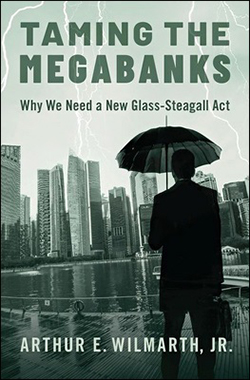
Taming the Megabanks, Book JacketIt is rare for a book to be so comprehensive and insightful that it provides a roadmap for the future – especially when its cast of characters are the lawyered-up megabanks on Wall Street and their legions of lobbyists and public relations flacks. We’re referring to Taming the Megabanks: Why We Need a New Glass-Steagall Act by Arthur E. Wilmarth, Professor Emeritus of Law at George Washington University.

Last Tuesday, the Federal Reserve completely capitulated to the demands of the Wall Street megabanks on its plan to dramatically raise capital levels at the megabanks — the so-called Basel III Endgame. The Fed, via its Vice Chair for Supervision, Michael Barr, announced it was cutting the required capital it had formally proposed in July of 2023 by more than half and will continue to allow the megabanks to use their own dodgy internal models to assess market risk.

How did the megabanks achieve such a quick victory on such a critical matter? They threatened to tie the Fed up in court for years and hired a Big Law operative to drive home the point.

Wilmarth’s book presciently saw that occurring – because the megabanks have been gaming and bucking and beating meaningful financial reform since President Obama signed into law the easily manipulated Dodd-Frank financial reform legislation in 2010.

Chapter 12 in Taming the Megabanks is titled “Unfinished Business.” It walks readers through each of the much-touted financial reforms that Obama’s minions told the American people they could count on following the worst megabank-induced financial crisis since the Great Depression. But many of Dodd-Frank’s promised key reforms never happened, as Wilmarth details by naming names and pulling back layers of dark curtains.

Instead of Dodd-Frank’s Volcker Rule ending the megabanks’ ability to bet the house via hedge funds, the rule was stonewalled for years, then ignored, then it essentially disappeared. As we reported earlier this month, the U.S. Treasury’s Office of Financial Research (OFR) revealed that as of March 31, 2024, Global Systemically Important Banks in the U.S. (G-SIBs/megabanks) had loaned out $2.348 trillion to hedge funds. Foreign Global Systemically Important Banks had loaned out another $1.628 trillion to hedge funds; and “Other Lenders” had loaned out an additional $566 billion to hedge funds. That brought the total of margin loans to just hedge funds on March 31, 2024 to a total of $4.542 trillion. (Put your cursor on the graph lines here.)

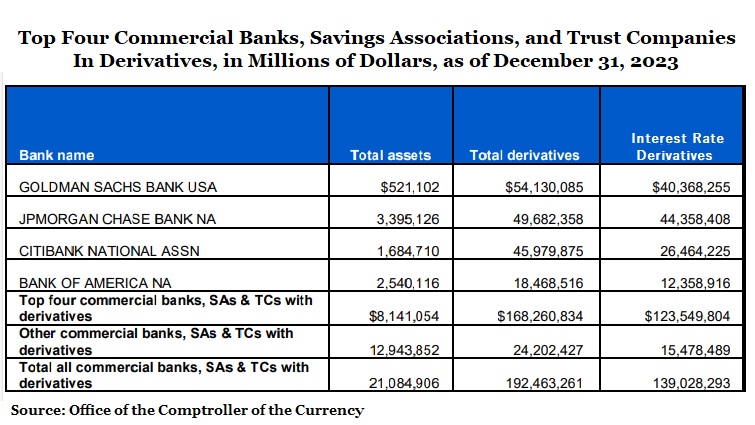
And remember all that talk about the push-out rule for derivatives? That illusion bit the dust in 2014, thanks to Citigroup and two former cronies in Congress. As of December 31, 2023, Goldman Sachs Bank USA, JPMorgan Chase Bank N.A., Citigroup’s Citibank and Bank of America held a staggering total of $168.26 trillion in derivatives out of a total of $192.46 trillion at all federally-insured U.S. banks, savings associations and trust companies. That’s just four banks holding 87 percent of all derivatives at all 4,587 federally-insured financial institutions in the U.S. that existed as of December 31, 2023. This data comes from the quarterly report at the Office of the Comptroller of the Currency (OCC), another of the federal regulators that says it’s going along with the Fed’s plan to scale back capital requirements at the megabanks.

In response to our query last week as to whether the OCC was on board with the Fed’s scaled back capital requirements, the OCC gave us this statement from Acting Comptroller Michael Hsu:

“The changes outlined by Vice Chair Barr reflect the work the three agencies undertook together. To ensure that the capital requirements for the nation’s largest banks are modernized and strengthened, I am committed to working with my peers on next steps to drive the Basel 3 endgame to closure.”

The FDIC is the third federal agency involved in setting the capital levels for the megabanks. It gave us this statement last week from FDIC Chair Martin Gruenberg:

“The Federal Reserve, OCC, and the FDIC have worked cooperatively on the Basel III proposal, including the changes outlined in Vice Chairman Barr’s remarks. I look forward to the agencies working together to bring Basel III to a conclusion that will strengthen bank capital and bolster financial system resilience and stability.”

In July, Wilmarth revealed the illusory nature of yet another promised reform from Dodd-Frank in an opinion piece at the American Banker (paywall) titled: “The FDIC’s resolution plan for failed megabanks is an empty promise.”

Wilmarth explains in the American Banker piece that one of Dodd-Frank’s primary goals was to prevent taxpayers from having to rescue megabanks, as occurred in 2008. A key component of that goal is Title II of Dodd-Frank, which provides an Orderly Resolution Plan to unwind failing megabanks without the need for taxpayer or Federal Reserve bailouts. That Plan, in turn, requires a giant pool of instantly available cash, which Dodd-Frank calls the Orderly Liquidation Fund or OLF. Shockingly, Wilmarth reveals that there hasn’t been a dime in the OLF since its creation in 2010. Wilmarth explains:

“…the FDIC’s sole source of funding for a Title II receivership is the Orderly Liquidation Fund, or OLF, which the Treasury administers. When Congress passed the Dodd-Frank Act, the big-bank lobby defeated proposals that would have required megabanks to pay risk-based premiums to prefund the OLF. As a result, the OLF has a zero balance. The FDIC must therefore borrow from the Treasury to pay the costs of a Title II receivership that cannot be covered by wiping out the holding company’s shareholders and debt-holders.”

Wilmarth correctly concludes in Taming the Megabanks that there is only one way to protect the U.S. economy and the financial stability of the nation’s banking system and that is to break up the megabanks by restoring the Glass-Steagall Act, which would separate Wall Street’s global trading houses from federally-insured banks. Otherwise, the megabanks will continue to dictate government policy, regulate their own regulators, and set the stage for the next destabilizing Wall Street and banking collapse.

WALL STREET ON PARADE


Tuesday, July 9, 2024

The Fund Created to Unwind a Failing Megabank Has a Problem: There’s No Money in It


SUBSCRIBE TO THIS NEWSLETTER TO RECEIVE TIMELY REPORTS!


The Fund Created to Unwind a Failing Megabank Has a Problem: There’s No Money in It

By Pam Martens and Russ Martens: July 9, 2024 ~

Taming the Megabanks, Book JacketLast week the American Banker published an opinion article by Arthur E. Wilmarth, Jr., the Professor Emeritus of Law at George Washington University. Wilmarth is the man who wrote the seminal book on the continuing threat to financial stability posed by U.S. megabanks – the same ones that blew up Wall Street and the U.S. economy in 2008.

The title of Wilmarth’s article (paywall) is: “The FDIC’s resolution plan for failed megabanks is an empty promise.” The thrust of the article is this: the Dodd-Frank Act was passed by Congress and signed into law in 2010 – 14 years ago. One of its primary goals was to prevent taxpayers from having to rescue megabanks, as occurred in 2008. A key component of that goal is Title II of Dodd-Frank, which provides an Orderly Resolution Plan to unwind failing megabanks that does not require taxpayer or Federal Reserve bailouts. That Plan, in turn, requires a giant pool of instantly available cash, which Dodd-Frank calls the Orderly Liquidation Fund or OLF.

Stunningly, Wilmarth reveals that there hasn’t been a dime in the OLF since its creation in 2010. Wilmarth explains:

“…the FDIC’s sole source of funding for a Title II receivership is the Orderly Liquidation Fund, or OLF, which the Treasury administers. When Congress passed the Dodd-Frank Act, the big-bank lobby defeated proposals that would have required megabanks to pay risk-based premiums to prefund the OLF. As a result, the OLF has a zero balance. The FDIC must therefore borrow from the Treasury to pay the costs of a Title II receivership that cannot be covered by wiping out the holding company’s shareholders and debt-holders.

“The FDIC has very strong incentives to avoid borrowing from the Treasury to finance the resolution of a failed megabank. Borrowing from the Treasury would raise political red flags by increasing the federal government’s debt burden and signaling that taxpayers might have to pay additional taxes if the FDIC cannot repay the Treasury.”

Since the financial crash of 2008, the U.S. has experienced three serious banking crises. And not once during those crises was the Orderly Liquidation Fund used. The reason is simple. As long as the megabanks can get trillions of dollars in below-market-rate revolving loans from emergency programs quickly created by an obliging Federal Reserve, why would they settle for billions of dollars that involve approval from the U.S. Treasury and public scrutiny.

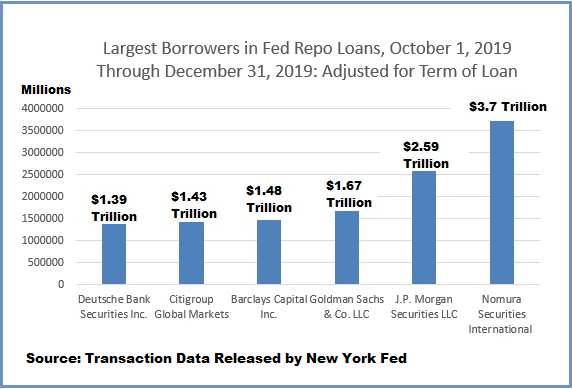
The first banking crisis since 2008 began on September 17, 2019 when the repo market seized up. In the last quarter of 2019, the New York Fed secretly funneled emergency repo loans cumulatively totaling (on a term-adjusted basis) $19.87 trillion into Wall Street megabanks. As the chart below indicates, just six trading units of the megabanks on Wall Street received 62 percent of that amount. (Unadjusted for the term of the loan, the cumulative total was $4.5 trillion.) The names of the banks and the amounts they borrowed were not disclosed to the public for two years. When the Fed did release the loan data, there was a mainstream media news blackout. Only Wall Street On Parade published the charts and tallied the loan amounts.

Fed's Repo Loans to Largest Borrowers, Q4 2019, Adjusted for Term of Loan

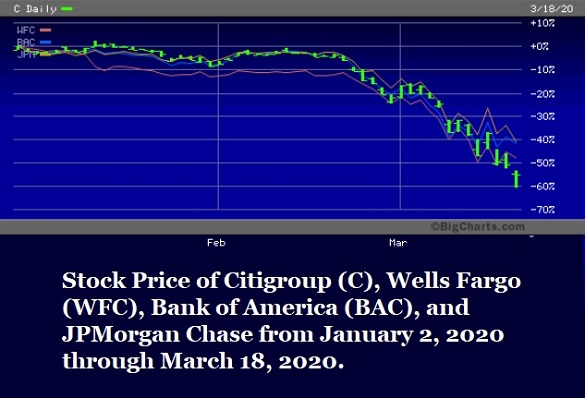
The next banking crisis occurred in March 2020 and was blamed on the COVID-19 pandemic. The share prices of the four largest banks (by deposits) collapsed by as much as 40 to 60 percent between January 2, 2020 and March 18, 2020. (See chart below.) The Fed rolled out the same alphabet soup of emergency lending programs that it had rolled out in 2008 – with the New York Fed once again in charge of the bulk of those programs.

Prices of Four Largest Banks During Early Part of Pandemic in 2020

In the spring of 2023, the second, third and fourth largest bank failures in U.S. history occurred. One of those banks (Silicon Valley Bank) experienced the fastest run on its deposits in U.S. history, showing just how quickly large banks can fail in the digital age. The Fed ran to the rescue again with another emergency bailout program: the Bank Term Funding Program.

Wilmarth correctly concludes his article at the American Banker with this:

“Megabanks continue to exploit implicit subsidies resulting from widely shared expectations of future bailouts. Given the lack of credible strategies for resolving failures of megabanks without publicly funded rescues, we must recognize that megabanks pose grave threats to financial stability and social welfare. Requiring big banks to increase their equity capital significantly would be an important first step in addressing those threats.”

The second critical step would be separating federally-insured banks from the casino trading houses on Wall Street by restoring the Glass-Steagall Act, which provided financial stability in the U.S. for 66 years until its repeal in 1999.


WALL STREET ON PARADE

Monday, June 24, 2024

The Fed and FDIC Wake Up Suddenly to the Threat of Derivatives, Flunking the Four Largest Derivative Banks on their Wind-Down Plans


SUBSCRIBE TO THIS NEWSLETTER TO RECEIVE TIMELY REPORTS!


The Fed and FDIC Wake Up Suddenly to the Threat of Derivatives, Flunking the Four Largest Derivative Banks on their Wind-Down Plans

Four Megabanks' Exposure to Interest Rate Derivatives

By Pam Martens and Russ Martens: June 24, 2024 ~

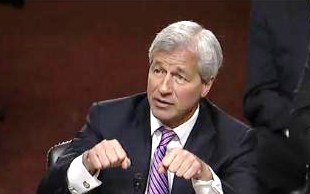
Jamie Dimon, Chairman and CEO of JPMorgan Chase, Testifying at Senate Banking Hearing on the Bank’s London Whale Scandal on June 13, 2012

Since the financial crash of 2008 and the Fed’s multi-trillion dollar bank bailouts that followed, the Office of the Comptroller of the Currency (OCC) has been waving a giant red flag every quarter in its “Bank Trading and Derivatives Activities” reports. For sixteen years the OCC has been reporting that just four megabanks are responsible for more than 80 percent of the trillions of dollars in bank derivatives.

As the chart above shows, as of December 31, 2023, Goldman Sachs Bank USA, JPMorgan Chase Bank N.A., Citigroup’s Citibank and Bank of America held a staggering total of $168.26 trillion in derivatives out of a total of $192.46 trillion at all U.S. banks, savings associations and trust companies. That’s four banks holding 87 percent of all derivatives at all 4,587 federally-insured institutions in the U.S. that existed as of December 31, 2023.

Now, it would appear, some market-savvy bank examiner embedded in one of those megabanks has had an epiphany and decided to ask the question: “How is it possible that all four of these megabanks with trillions of dollars in derivatives happened to be on the correct sides of these trades during the fastest and steepest interest rate increases in 40 years?” Multiple bank counterparties to these trades should be reporting massive losses and yet all we hear are crickets.

This puzzle becomes all the more urgent if you take a closer look at the above chart and notice that $40.368 trillion of Goldman Sachs Bank USA’s $54.13 trillion in derivatives are interest rate derivatives, or 75 percent. JPMorgan Chase’s interest rate derivatives represent 89 percent of its total of $49.68 trillion in derivatives.

The OCC report for the quarter ending December 31, 2023 also shows that $20.8 trillion of these interest rate derivative contracts at these four megabanks have maturities in excess of five years – a very long time to climb out on a limb on interest rate decisions by the Fed.

On Friday, the Federal Deposit Insurance Corporation (FDIC) and the Federal Reserve Board jointly released their findings on the resolution or wind-down plans in a potential bankruptcy of the eight megabanks in the U.S. The plans are also known as “living wills.”

It came as no surprise to us that the four largest U.S. derivative banks — JPMorgan Chase, Citigroup’s Citibank, Bank of America and Goldman Sachs — were faulted on shortcomings in how they planned to wind down their derivatives. The surprise was that the Fed – which has a gold-plated revolving door to these banks – would acknowledge the derivatives problem after years of ignoring it.

The Fed and FDIC wrote the following in their letter to Jamie Dimon, the Chairman and CEO of JPMorgan Chase, which regulators already acknowledge is the riskiest bank in the U.S. (but nonetheless allowed it to get even bigger and riskier in May of last year by rubber-stamping its purchase of the collapsed First Republic Bank):

“The Agencies found the Covered Company’s 2023 Plan to have a shortcoming related to the implementation of its derivatives unwind strategy. An assessment of the Covered Company’s capability to unwind its derivatives portfolio under conditions that differed from those specified in the 2023 Plan revealed some weaknesses in the refresh of and approach to compiling financial results. This, in turn, raises questions about the firm’s ability to implement this aspect of its preferred strategy in an actual resolution event. Specifically, in response to a capabilities test initiated by the Agencies, the response from the firm showed that the firm is unable to update certain economic conditions in its entity-level-resource-needs calculation of resolution capital execution need (RCEN) and resolution liquidity execution need (RLEN) associated with unwinding its derivatives portfolio in a timely manner. Furthermore, the firm did not accurately incorporate funding assumptions as specified by the Amended and Restated Support Agreement dated June 5, 2019, as amended, in the current resolution metrics production process. To remediate this shortcoming, the Covered Company’s 2025 Plan should demonstrate, including through reporting in the 2025 Plan on internal validation and testing conducted by the Covered Company, that the Covered Company has developed the ability to quantify each material legal entity’s RLEN and RCEN for changes in macro/financial market conditions, calculate recapitalization needs for a macro scenario change in a timely way, and provide for downstream liquidity and capital funding needs according to the terms of the Amended and Restated Support Agreement. The Covered Company should develop and submit to the Agencies by September 1, 2024, a description of the key actions needed to remediate this shortcoming and a timeline illustrating the date of their expected completion.”

Adding to the hubris, this is now the second time in eight years that federal regulators have told Dimon to get his act together in dealing with derivatives if the bank has to wind-down operations. In a letter dated April 12, 2016, the Fed and the FDIC faulted the bank on its trading and derivative plans. The letter was apparently so frightening that numerous segments were redacted by the two federal regulators by blacking out the text.

The Fed and FDIC appear like indulgent parents of an out-of-control teen when it comes, particularly, to JPMorgan Chase, Jamie Dimon and derivatives. This is, after all, the bank that triggered an in-depth investigation by the U.S. Senate’s Permanent Subcommittee on Investigations in 2012-2013 for gambling in derivatives in London using deposits from its federally-insured bank and losing $6.2 billion of its depositors’ money. This became infamously known as the bank’s “London Whale” scandal.

Dimon was hauled before the Senate Banking Committee on June 13, 2012 to answer questions about the London Whale scandal. Instead of falling on his sword or taking a humble approach to the bank’s abysmal conduct, he spoke as if he were testifying as an expert witness for the banking industry instead of the man sitting at the center of the scandal. Dimon said this in answer to a question from Senator Jerry Moran:

“We have to get rid of anything that looks like too-big-to-fail. We have to allow our biggest institutions to fail. It is part of the health of the system, and we should not prop them up. We have to allow them to fail.

“And I would go one step further. You want to be sure that they can fail and not damage the American economy and the American public. So a big bank, you want to be in a position where a big bank can be allowed to fail.

“I wouldn’t call it ‘resolution.’ I think that’s the wrong name. I think we should call it ‘bankruptcy.’ Personally, I call it ‘bankruptcy for big dumb banks.’ I think when you have bankruptcy, I’d have clawbacks. I’d fire the management. I’d fire the Board. I’d wipe out the equity and the unsecured [debt holders] should only recover whatever they recover like in a normal bankruptcy.”

Just six years after Dimon’s “bankruptcy for big dumb banks” speech to the Senate Banking Committee, his bank began secretly taking trillions of dollars in emergency bailout loans from the Fed for a financial crisis that has yet to be explained. (See chart below.)

Fed's Repo Loans to Largest Borrowers, Q4 2019, Adjusted for Term of Loan

The four megabanks that were not faulted last Friday by the Fed or FDIC for their wind-down plans were Wells Fargo, Bank of New York Mellon, State Street and Morgan Stanley. (Morgan Stanley’s bank holding company has a monster amount of derivatives according to the OCC, however, its federally-insured banking footprint pales in comparison to JPMorgan Chase, Bank of America and Citigroup’s Citibank.)


WALL STREET ON PARADE


Tuesday, May 21, 2024

POLITICO Nightly: How the debate game is played


POLITICO Nightly logo

BY CHARLIE MAHTESIAN AND CALDER MCHUGH

Donald Trump and Joe Biden debate.

Donald Trump and Joe Biden participate in the final 2020 presidential debate at Belmont University on October 22, 2020 in Nashville. | Jim Bourg-Pool/Getty Images

RULES OF ENGAGEMENT — There’s an ongoing discussion within the political-media industry complex over whether Donald Trump got rolled in his debate agreement with Joe Biden. In his eagerness to debate the president, the argument goes, Trump gave away the farm by agreeing to nearly all the terms that the Biden campaign proposed.

There will only be two debates, one in June and one in September, rather than the three or more the Trump campaign wanted. There won’t be a live audience for Trump to feed off. The criteria laid out by the Biden campaign also managed to eliminate the prospect of a Fox News hosted presidential debate.

The president’s reelect played “Mar-A-Lago like a fiddle ,” said Frank Fahrenkopf Jr., a former Republican National Committee chairman and co-chair of the Commission on Presidential Debates, the longstanding institution rendered obsolete by the agreement.

It’s an arguable point, as long as some key logistical details remain up in the air. Trump might have been a little too quick to accept the terms of engagement, but until all the venues, dates, conditions, rules — and participants — are settled, it won’t be clear if either campaign can claim an advantage.

Third-party candidate Robert F. Kennedy Jr.’s status, for example, remains unresolved. The two-date proposal agreed to by Biden and Trump appears to exclude him because he falls short of several of the thresholds required to qualify for the debate. But that’s not a done deal.

And every last detail matters — particularly in a contest between two bitter rivals, both of whom are seeking to make a point about each other’s fitness for office. In a considerably less toxic campaign, for example, the 2012 debate memorandum of understanding between the Obama and Romney campaigns ran more than 20 pages, covering minutiae such as how the candidates would be addressed by the moderators, TV cut-away shots and scores of other staging and format questions.

The gamesmanship between the campaigns — not to mention the networks — is ongoing. Consider Fox’s play to get in the debate game. Frozen out of the presidential election debates by the Biden campaign, Fox responded by proposing a vice presidential event at Virginia State University.

In December, Virginia State had been selected by the CPD as one of the three debate venues, the first HBCU ever to host a presidential debate. They lost that historic distinction when Biden and Trump sidelined the commission and cut their own deal.

Fox’s proposal sought to force the Biden campaign’s hand. It had already accepted an invitation from CBS News for Vice President Kamala Harris to debate Trump’s running mate; the Fox proposal now places them in the awkward position of possibly having to deny an HBCU an opportunity to host a presidential debate at the very moment Biden is attempting to step up his outreach to Black voters. All of this went down on the eve of Biden’s scheduled commencement address at Morehouse College, the famed HBCU in Atlanta.

Quick to recognize an opportunity to drive a wedge between Biden and Black voters, Trump accepted the Fox proposal the same day. “On behalf of the future Vice President of the United States, who I have not yet chosen, we hereby accept the Fox Vice Presidential Debate, hopefully at Virginia State University, the first Historically Black College or University to host a Debate - Date to be determined. I urge Vice President Kamala Harris to agree to this,” Trump wrote on Truth Social.

The Fox-VSU partnership hasn’t been formalized, according to a source familiar with the discussions. The source said Fox News is “in talks” with VSU, while a VSU spokesperson noted, “Virginia State University continues to work with the Commission on Presidential Debates and at this point have made no commitments, outside of the CPD, regarding a debate.”

The vice presidential standoff has no clear off-ramp yet, with the Biden camp committed to CBS and Trump committed to Fox. And the Trump campaign doesn’t even have a vice presidential nominee yet.

Welcome to POLITICO Nightly. Reach out with news, tips and ideas at nightly@politico.com . Or contact tonight’s authors at cmahtesian@politico.com and cmchugh@politico.com or on X (formerly known as Twitter) at @PoliticoCharlie and @calder_mchugh .


THE GOLD STANDARD OF POLICY REPORTING & INTELLIGENCE: POLITICO has more than 500 journalists delivering unrivaled reporting and illuminating the policy and regulatory landscape for those who need to know what’s next. Throughout the election and the legislative and regulatory pushes that will follow, POLITICO Pro is indispensable to those who need to make informed decisions fast. The Pro platform dives deeper into critical and quickly evolving sectors and industries—finance, defense, technology, healthcare, energy—equipping policymakers and those who shape legislation and regulation with essential news and intelligence from the world’s best politics and policy journalists.

Our newsroom is deeper, more experienced, and better sourced than any other—with teams embedded in the world’s most active legislative and regulatory power centers. From Brussels to Washington, New York to London, Sacramento to Paris, we bring subscribers inside the conversations that determine policy outcomes and the future of industries, providing insight that cannot be found anywhere else. Get the premier news and policy intelligence service, SUBSCRIBE TO POLITICO PRO TODAY .


TRUMP ON TRIAL

AT REST — Prosecutors in Donald Trump’s Manhattan criminal trial rested their case against the former president today, bringing an end to more than four weeks of testimony from witnesses they’ve called in their attempt to convince the jury that he orchestrated a scheme to cover up a payment to a porn star.

The conclusion of the case from the Manhattan district attorney’s office moves the trial one step closer to determining whether Trump will become a convicted felon as he runs for president as the presumptive Republican nominee. Though Trump is indicted in three other criminal cases, the chances that any of those will go to trial before the November election have dwindled in recent weeks.

It’s not clear how long the presentation of Trump’s defense will last, but the judge presiding over the case, Justice Juan Merchan, said he expects closing arguments to take place next Tuesday, after Memorial Day weekend. Then the jury will begin deliberating.

DEFENSIVE POSTURE — The defense called Robert Costello, an ally of Rudy Giuliani who tried to persuade Cohen to stay loyal to Trump in 2018 after the FBI raided Cohen’s properties. Last week, Costello appeared before a GOP-led House subcommittee and accused Cohen of repeatedly lying on the witness stand during the hush money trial.

On the stand, Costello contradicted Michael Cohen’s sworn testimony regarding Trump’s knowledge of the Stormy Daniels hush money payment, saying Cohen told him numerous times that “Trump knew nothing about those payments.”

COURTROOM CLEARED — Justice Juan Merchan ordered the courtroom cleared after he admonished Costello about “proper decorum” in his courtroom. The judge at first cleared the jury from the room and warned Costello not to give side-eye or roll his eyes at him if he didn’t agree with his ruling.

“You don’t say geez,” the judge said. The judge then requested the jury be brought back in, but then snapped: “Are you staring me down right now?” He then said: “clear the courtroom.” Journalists in the gallery were then told to leave the room.

Before kicking reporters out of the courtroom, Merchan admonished Costello: “When there’s a witness on the stand, if you don’t like my ruling you don’t say ‘geez.’ And then you don’t say ‘strike it’ You don’t give me side eye and you don’t roll your eyes.”

COSTELLO CROSS — Prosecutor Susan Hoffinger kicked off the cross-examination of Costello by asking about how and why his firm reached out to Cohen in April 2018 .

He resisted some questions by saying twice that an email she referred to “speaks for itself.” “You were hoping Mr. Cohen would hire you?” she asked. “I wasn’t hoping anything,” Costello said. “I didn’t know him from a hole in the wall.”

He later accused Hoffinger of trying to “push me” into certain answers. “I didn’t want him as a client,” Costello insisted. The prosecution will pick back up their cross-examination of Costello on Tuesday.

STICKY FINGERS — Under aggressive questioning by Trump attorney Todd Blanche, Michael Cohen admitted that he stole from the Trump Organization.

Cohen sought a reimbursement from the company for $50,000 to pay a tech vendor, Red Finch, that attempted to skew online polls in Trump’s favor in 2016. But Cohen gave the owner of the firm only about $20,000 .

“You stole it from the Trump Organization?” Blanche asked about the $30,000 difference.

“Yes, sir,” Cohen responded calmly.

The total theft actually amounted to $60,000, because all the sums were doubled to cover taxes Cohen might owe.

WHAT'D I MISS?

— Senate Banking Chair Brown calls on Biden to replace embattled FDIC head: Senate Banking Chair Sherrod Brown today called on President Joe Biden to replace FDIC Chair Martin Gruenberg , after damning reports of a toxic workplace culture at the bank regulator where Gruenberg has served for nearly two decades. Brown said in a statement that there must be “fundamental change” at the FDIC, which insures more than $10 trillion in bank deposits and oversees thousands of financial institutions, in a move that is likely to turn the tide against the agency head with other Democrats as well.

MAGA REPUBLICANS DEFENDING WAR CRIMES 

& GENOCIDE!

— Republican lawmakers blast ICC over Netanyahu warrant: Republicans are vowing retribution after the International Criminal Court said it would seek an arrest warrant for Israeli Prime Minister Benjamin Netanyahu over his handling of the ongoing conflict in Gaza. ICC chief prosecutor Karim Khan filed applications for warrants against Netanyahu, as well as Hamas leader Yahya Sinwar, the commander of Hamas’ military wing, Mohammed Diab Ibrahim Al-Masri, and Israeli Defense Minister Yoav Gallant. Republicans on key foreign policy panels blasted the decision and warned that they would make good on threats from earlier this month to punish the international tribunal, of which neither the United States nor Israel are members, if it went after Israeli officials.

— Biden’s top military adviser chides Israel for losing ground to Hamas: The Pentagon’s top general offered a rare critique of Israel’s war strategy today, warning Israeli troops’ failure to hold ground they had taken from Hamas in northern Gaza could have long-term effects. “Not only do you have to actually go in and clear out whatever adversary you are up against, you have to go in, hold the territory and then you’ve got to stabilize it,” said Gen. C.Q. Brown, chair of the Joint Chiefs of Staff, drawing on his years in the Middle East. Brown, who rarely chides Israeli forces, stressed that the Israeli tactic of pushing Hamas fighters out of one area and then leaving makes achieving lasting stability more difficult.

NIGHTLY ROAD TO 2024

SPENDING BLITZ — The Human Rights Campaign, the largest LGBTQ rights group in the United States, is launching a $15 million commitment to help Democratic President Joe Biden defeat Republican Donald Trump in the 2024 election. The spending blitz, shared first with NBC News, will cover the six key battleground states of Pennsylvania, Michigan, Wisconsin, Georgia, Arizona and Nevada. The group says it will include paid ads, staff hires, field campaigns and events in those states, which are poised to decide who wins the presidency and Congress.

AROUND THE WORLD

Rescue teams are seen near the site of the crash of the helicopter carrying Iranian President Ebrahim Raisi in northwestern Iran on May 19, 2024.

Rescue teams are seen near the site of the crash of the helicopter carrying Iranian President Ebrahim Raisi in northwestern Iran on May 19, 2024. | Azin Haghighi, Moj News Agency via AP

DEATH IN IRAN — Iran’s hardline President Ebrahim Raisi — once seen as a potential successor to 85-year-old Supreme Leader Ayatollah Ali Khamenei — died after his helicopter crashed into trees in a mountainous northwestern region of the Islamic Republic on Sunday.

The Iranian branch of the Red Crescent humanitarian network said today its search and rescue teams had reached the crash site and “found no signs of the helicopter’s occupants being alive.”

The discovery of the burned-out wreckage of Raisi’s helicopter among blackened trees — with seemingly only the tail surviving the crash — followed hours of searches in the fog-bound mountain valleys of Dizmar forest near the border with Azerbaijan.

Foreign Minister Hossein Amir-Abdollahian was also on board and is presumed dead, along with the head of the presidential guard Mehdi Mousavi, East Azerbaijan Governor Malek Rahmati, Representative of the Iranian Supreme Leader in East Azerbaijan Mohammad Ali Ale-Hashem and the helicopter’s pilot, co-pilot and crew.

Raisi, 63, was a conservative cleric and former judiciary chief who was responsible for decades of vicious crackdowns against his own people’s aspirations for greater personal freedoms and democracy, arresting, torturing and executing tens of thousands of the Islamist regime’s opponents.

Educated in the seminary city of Qom and dubbed “the butcher,” he was alleged to have been involved in the execution of thousands of political prisoners in the late 1980s, according to Iran’s opposition. As judiciary chief, he was also directly responsible for the wave of arrests and executions that followed massive anti-regime protests in 2019-2020.


LISTEN TO POLITICO'S ENERGY PODCAST:  Check out our daily five-minute brief on the latest energy and environmental politics and policy news. Don't miss out on the must-know stories, candid insights, and analysis from POLITICO's energy team. Listen today .


NIGHTLY NUMBER

$1,000

The amount that billionaire philanthropist Rob Hale gave each graduating student at the University of Massachusetts Dartmouth , under the condition that they keep $500 and give $500 away.

RADAR SWEEP

CAPTURE, BABY, CAPTURE — Kern County, California, has been struggling with the transition away from fossil fuels. The town of Taft was once a booming oil producer, bringing jobs and money to the region. But the cash has dried up, and many residents of Taft who once worked on oil-related jobs have been forced to take lower paying jobs elsewhere or go on unemployment. But now, they’re trying a bold new strategy — working together with the oil company California Resources Corporation in order to try to build out a carbon capture industry , creating new manufacturing jobs and becoming one of the leaders in producing renewable energy. For Grist, Jake Bittle reports on the shift, its advocates and its critics.

PARTING IMAGE

On this date in 1970: Participants carry American flags in a rally supporting President Richard Nixon's Vietnam War policy in downtown Manhattan.

On this date in 1970: Participants carry American flags in a rally supporting President Richard Nixon's Vietnam War policy in downtown Manhattan. | AP

Did someone forward this email to you?  Sign up here .


Follow us on Twitter

Charlie Mahtesian @PoliticoCharlie

Calder McHugh @calder_mchugh


FOLLOW US

Follow us on FacebookFollow us on TwitterFollow us on InstagramListen on Apple Podcast


 POLITICO, LLC 1000 Wilson Blvd. Arlington, VA, 22209, USA


Weekend Edition | Despite Midterm Win, Will Dems Help GOP Pass 'Massive Giveaway' to Big Oil and Big Tech?

                                                              LOTS OF POSTS IGNORED BY BLOGGER..... OR REMOVED ON THEIR WHIM! ALL POSTS ARE ...