Showing posts with label GLASS-STEAGALL ACT. Show all posts

Wednesday, March 4, 2026

Donald Trump Is Setting Us Up for Another Financial Crisis


  LOTS OF POSTS IGNORED BY BLOGGER.....

ALL POSTS ARE AVAILABLE ON

MIDDLEBORO REVIEW AND SO ON


Donald Trump Is Setting Us Up for Another Financial Crisis

Private Credit and the Shadow Banking Crisis


By Max from UNFTR

Watch the video report on this topic here and read the full analysis from Max below:

Private Credit and the Shadow Banking Crisis

In this week’s State of the Union address, President Donald Trump played the hits. He demonized immigrants, he lied about the state of the economy, chastised the Supreme Court over tariffs and called Democrats “crazy.” As evidence of his magnificence he of course touted the stock market, not once but three times.

But there is one word that was completely absent from his economic picture. One concept that should be front and center in any honest accounting of where the risks to this economy actually live.

Deregulation.

Because while Trump was taking victory laps about the Dow, his administration has been dismantling the guardrails that were put in place after the last time Wall Street blew up the economy.


Guardrails

To understand what’s at stake today, we have to go back.

In the waning days of the Clinton administration, Congress passed a piece of legislation that would change everything. It was called the Gramm-Leach-Bliley Act, and what it effectively did was repeal the core protections of the Glass-Steagall Act — a law that had been on the books since the Great Depression. Glass-Steagall’s whole purpose was simple but profound: keep consumer banking completely separate from investment banking. Keep the place where regular people put their paychecks and savings away from Wall Street’s casino.

Those guardrails had protected us for more than six decades. Gramm-Leach-Bliley put the nail in the coffin of that protection. To be clear, the cap had been loosened under prior administrations—most notably Reagan but even Jimmy Carter—as the United States endeavored to shift gears from a manufacturing powerhouse to the financial capital of the world.

But after Gramm-Leach-Bliley the big banks almost immediately started using massive leverage on increasingly sophisticated (and deeply misunderstood) financial products called derivatives. The biggest, sexiest, most dangerous of them all? The mortgage-backed security. Thousands of home mortgages bundled into enormous loan packages, sliced into tranches and sold to investors around the world. When rates were low and confidence was high, everybody made money. The bonuses got bigger and the yachts got longer.


And then the music stopped. As rates increased and speculation ran wild — with leverage piled on top of more leverage — these products became highly unstable. When they unraveled, they didn’t just hurt the banks. They took the entire global economy down with them. Eight million Americans lost their jobs. Ten million families lost their homes. Trillions in household wealth evaporated. And the people who caused it? They got bailouts.

When we look back to 2008 there are two important things to remember as a building block for today. The first is about timing.

We romanticize the story of folks like Michael Burry — made famous by Michael Lewis’s book and the movie The Big Short — as this lone genius who saw the crash coming and made a fortune. What the movie touches on is how Burry almost went bankrupt waiting for it. He was early. His investors were furious with him. Some tried to pull their money. He had to restrict withdrawals to keep his fund alive. The point is: when you’re early in identifying a massive structural problem in leveraged financial markets, being right isn’t enough. You have to survive long enough to be proven right. Big financial products take a long time to unwind. The stress builds slowly then falls like an avalanche.

The second lesson is about what we did after.

In the wake of 2008, we put regulations in place to prevent a repeat performance — capitalization requirements, stress tests, transparency rules. Then we sent an ungodly sum of money into the financial system, bought back troubled assets from the big banks, and lowered rates dramatically to allow them to deleverage. Economically speaking, it was a masterclass in crisis management. The financial system survived.

But Main Street got left out in the cold. Foreclosures kept coming. Wages stagnated. The people who caused the crisis were made whole, and the people who suffered from it were told to be patient. That profound political and moral failure is arguably why Donald Trump won in 2016, and why he won again in 2024. We failed to learn the lesson.

So here we are. And the new thing that financial titans, Wall Street observers, and the more astute economic commentators have been whispering about is something called private credit.

It hit the mainstream last year with some very public bankruptcies that revealed shaky lending practices, massive over-leverage, and some genuinely shady dealings. You may remember Jamie Dimon — CEO of JPMorgan Chase, the largest bank in the United States — making his infamous ‘cockroaches’ comment. Where you see one, there’s probably more. That sentiment refuses to die and kind of haunts Wall Street to this day.

To understand what’s at risk, what’s real, and what might be overblown, we have to define private credit. We have to understand how big it is. And we have to ask the really uncomfortable question: does it actually pose what’s known as a ‘systemic risk’ to the financial system? In other words… Could it actually bring down the economy?


What is Private Credit?

Private credit — sometimes called private lending or direct lending — is exactly what it sounds like. It’s lending that happens outside the traditional banking system and outside the public bond markets. Instead of a company going to a bank for a loan, or issuing bonds that get traded on public markets, they go to a private credit fund. A firm that raises capital from institutional investors such as pension funds, endowments, sovereign wealth funds and wealthy individuals, and then deploys that capital by making loans directly to companies.

These are typically middle-market companies. Businesses that are too big for a local community bank but not quite big enough or safe enough to tap the public bond markets at favorable rates. Private equity-backed companies. Software firms. Healthcare businesses. Specialized services. Exactly the kinds of companies that get financed when the regulated banks won’t touch them.

By late 2025, global private credit assets under management were estimated at somewhere between 1.8 trillion and 3.5 trillion dollars, with nearly 600 billion dollars deployed in 2024 alone. For context — the entire U.S. commercial banking system holds about 24.5 trillion dollars in assets. So private credit is material. But it’s still a fraction of the traditional banking system. But that doesn’t mean there isn’t risk to the wider system.

These two worlds are deeply, structurally intertwined. Banks lend to private credit firms to give them leverage. Banks invest in private credit fund equity. Banks co-lend alongside private credit funds in what are called ‘club deals.’ And it’s growing faster than any other category of bank lending.


So when someone says private credit is a ‘shadow banking’ system — separate from the regulated banks — that’s only half right. It is separate in terms of oversight and transparency. But it is absolutely connected to the banking system in terms of money flows, leverage, and ultimately risk. And that means that the firewall regulators attempted to erect after the GFC isn’t completely intact. In fact, it’s pretty leaky.

The post-financial-crisis reforms essentially created a two-tier lending system. The top tier — the A-rated, safest direct loans — stay on commercial bank balance sheets, fully regulated, subject to stress tests and capital requirements. The riskier stuff sits on the balance sheets of private credit firms and outside the regulatory perimeter.

What’s amazing is that we have extremely limited visibility into how those portfolios are actually performing. There are really only two ways we get any meaningful window into this shadow market.

The first is when companies go bankrupt. When a borrower files for bankruptcy, the loan terms come out, the collateral gets scrutinized, and suddenly we can see what was really going on. It’s like lifting a rock and seeing what’s underneath. The second way we get visibility is through the publicly traded private credit firms, specifically a type of company called a Business Development Company, or BDCs, that have to file quarterly and annual reports with the SEC, disclose their portfolio holdings and hold earnings calls.

But there’s a catch: publicly traded BDCs represent only a small, and arguably less risky, slice of the overall market. About 80 percent of private credit assets sit in closed-end private funds — limited partnerships with no public reporting, no standardized disclosure, no requirement to update their marks more than their fund documents require.


Cockroaches

This brings us to current events that have insiders whispering about systemic risk.

Take New Mountain Finance. New Mountain is a publicly traded BDC, one of those visible companies we just alluded to. And what their most recent earnings release tells us is deeply instructive.

In February 2026, New Mountain reported that its net asset value per share had fallen from 12 dollars and six cents to 11 dollars and 52 cents in a single quarter. That’s a five percent decline in one quarter. They announced they were selling 477 million dollars in assets — at 94 percent of fair value. They explicitly stated the purpose was to reduce something called PIK income, increase diversification, and shore up financial flexibility.

Now in English. Selling assets at 94 cents on the dollar means accepting a loss. That’s distress pricing. When a company the size of New Mountain is moving assets at a discount and explicitly trying to reduce a certain type of income (PIK income), it’s telling you the portfolio has some problems it wants to get ahead of.

We’ve talked about PIK before. PIK stands for Payment In Kind. Here’s how it works. Normally when you take out a loan, you pay interest in cash. Every quarter, you write a check. With a PIK arrangement, instead of paying the interest in cash, the borrower simply adds it to the principal balance of the loan. The loan gets bigger. The lender books income on paper. But no cash changes hands. That’s not a healthy borrower. That’s a borrower who is struggling.

According to S&P Global data, nearly 12 percent of loans held by BDCs were making PIK payments as of mid-2024. Industry insiders suggest the real number is probably closer to 15 percent. And by Q3 of 2025, Lincoln International found that 57 percent of PIK arrangements in the deals they reviewed were this problematic kind. The shadow default rate, once you count these, may be closer to 6 percent, several times the official reported rate.

Then there’s Blue Owl. Blue Owl is one of the largest private credit platforms in the world — one of the flagship names in the industry. Earlier this month, news broke that Blue Owl had restricted or halted redemptions in one of its vehicles. The market’s response was to immediately punish Blue Owl’s stock and drag down peers like Apollo, Blackstone and KKR along with it. Because investors immediately started asking the same question: if this is happening at Blue Owl, what’s happening at everyone else?

And hovering over all of this is UBS. UBS sits at a key interface between the traditional banking world and private credit. In February 2026, UBS told clients it had to write down more assets in those credit funds, with one key investment representing about 5 percent of assets getting hit hard, resulting in losses in the millions. Meanwhile, UBS strategists are now openly warning that in a worst-case scenario, private credit default rates could reach 15 percent, several times the projected default rate in public high-yield bonds. Cockroaches under the cabinets. Smoke and fire.


Donald Trump is removing the smoke detectors during a fire

Given what we lived through with Enron after Clinton’s deregulation and after the Global Financial Crisis you might think that regulators would be tightening up and scrutinizing this shadow sector a little more closely. And yet, we’re doing the opposite.

Like, the exact opposite.

There’s something called FSOC — the Financial Stability Oversight Council. It was created after 2008 specifically to monitor system-wide financial risks. Under the Trump administration, Treasury Secretary Scott Bessent has essentially repurposed FSOC to advance a deregulatory agenda. The New York Times reported that the administration directed FSOC to ‘take actions that would alleviate regulations’ viewed as hindering growth. Bessent has argued that ‘true financial stability is most effectively realized through accelerated economic growth.’ FSOC’s 2025 annual report — while it does acknowledge what it calls ‘growing concerns’ around private credit and hedge fund leverage — pivots immediately to emphasize market resilience and, I am not making this up, explicitly endorses efforts to ‘reduce unnecessary regulatory burden.’

And that’s not the only regulatory rollback. The SEC under Biden had passed a significant private fund adviser rule package in 2023 — rules that would have required standardized quarterly reporting from private credit funds, annual audits, and restrictions on the kinds of sweetheart deals that let favored investors get better terms than everyone else. This was exactly the kind of sunlight that might let us see what’s actually in these portfolios before it blows up. The Fifth Circuit struck those rules down in 2024 after an industry challenge. And the Trump-appointed SEC leadership has shown zero interest in re-proposing them in any meaningful form.

On top of that, the Trump administration has been on a crusade to open private credit markets to retail investors, even issuing an executive order directing the Department of Labor to allow private credit and private equity into 401(k) plans. The framing is ‘democratizing access to alternative assets.’ The reality is inviting ordinary Americans into opaque, illiquid, high-risk products at exactly the moment the stress fractures are starting to show.

To be clear, this is not purely a Republican problem. It was a Democratic administration under Bill Clinton that signed Gramm-Leach-Bliley. The Republican administration under George W. Bush watched the mortgage bubble inflate and did nothing because the stock market was going up. We have a bipartisan tradition in this country of amnesia when it comes to financial crises. The banks and their lobbyists chip away at oversight during the good times, politicians from both parties let it happen, and then when it all falls apart the taxpayers get the bill.

What’s different now is the combination of factors. We have clear and accumulating evidence of stress in the private credit market — NAV declines, assets being sold below book value, PIK rates rising, redemption gates being put up. We are at a moment analogous to 2006 or 2007, when Michael Burry and a handful of others could see the structural cracks even as the official narrative was that everything was fine.

And layered on top of all that stress, we have an administration that genuinely doesn’t understand the problem (or doesn’t care) and is actively removing the monitoring systems that might let us detect how serious it’s getting before it’s too late. We have a president who thinks the stock market is the economy. We have regulators who have been explicitly redirected away from constraint and toward ‘capital formation.’

So here’s the “how does this impact us” part of the equation. When banks start absorbing losses on those exposures, the first thing they do is tighten their own lending. They reduce credit. They raise standards. They get cautious. And when traditional bank credit seizes up, it ripples through the entire economy. Businesses can’t borrow to make payroll or expand. Consumers can’t get mortgages or car loans. The whole credit-dependent economy starts to slow, and then contract.

Credit seizing up is the one thing that can truly bring it all down. Not the stock market. Not inflation. Not even a recession in isolation. It’s when the credit markets freeze that things get genuinely dangerous. We know this because we just lived through it less than 20 years ago.

The United States of Amnesia strikes again.

Meidas+ is a reader-supported publication. To receive new posts and support our work, consider becoming a free or paid subscriber.


Max is a contributor to the MeidasTouch Network and Publisher of UNFTR Media.

For deeper dives into economic and socioeconomic stories, visit UNFTR.com or @UNFTR on YouTube.

Sources

https://www.vaneck.com/us/en/blogs/income-investing/bdcs-vs-private-credit-funds-key-differences-for-investors/

https://www.politico.com/news/2025/12/11/treasury-bessent-financial-stability-oversight-council-letter-00686574

https://www.fdic.gov/system/files/2024-06/2023-regulatory-capital-rule-large-banking-organizations-3064-af29-c-211.pdf

https://www.finra.org/rules-guidance/notices/25-08

https://www.moodys.com/web/en/us/insights/data-stories/breakdown-of-banks-annual-reporting-on-private-credit.html

https://www.whitehouse.gov/presidential-actions/2025/08/democratizing-access-to-alternative-assets-for-401k-investors/

https://www.epi.org/publication/trump-is-pushing-to-include-risky-assets-like-crypto-and-private-equity-in-401ks-why-this-endangers-retirement-savers-and-the-economy/

https://www.aima.org/article/press-release-strong-growth-sees-private-credit-market-reach-us-3-5-trillion.html

https://finance.yahoo.com/news/blue-owls-redemption-shift-shakes-165500164.html

Monday, September 16, 2024

Everything this Book Predicted on Wall Street Megabanks Ruling their Regulators Is Now Unfolding


SUBSCRIBE TO THIS NEWSLETTER TO RECEIVE TIMELY REPORTS!


Everything this Book Predicted on Wall Street Megabanks Ruling their Regulators Is Now Unfolding

By Pam Martens and Russ Martens: September 16, 2024 ~

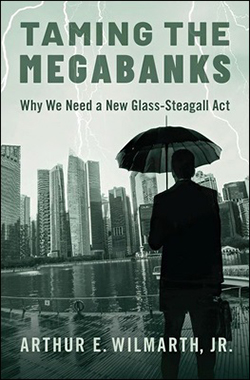
Taming the Megabanks, Book JacketIt is rare for a book to be so comprehensive and insightful that it provides a roadmap for the future – especially when its cast of characters are the lawyered-up megabanks on Wall Street and their legions of lobbyists and public relations flacks. We’re referring to Taming the Megabanks: Why We Need a New Glass-Steagall Act by Arthur E. Wilmarth, Professor Emeritus of Law at George Washington University.

Last Tuesday, the Federal Reserve completely capitulated to the demands of the Wall Street megabanks on its plan to dramatically raise capital levels at the megabanks — the so-called Basel III Endgame. The Fed, via its Vice Chair for Supervision, Michael Barr, announced it was cutting the required capital it had formally proposed in July of 2023 by more than half and will continue to allow the megabanks to use their own dodgy internal models to assess market risk.

How did the megabanks achieve such a quick victory on such a critical matter? They threatened to tie the Fed up in court for years and hired a Big Law operative to drive home the point.

Wilmarth’s book presciently saw that occurring – because the megabanks have been gaming and bucking and beating meaningful financial reform since President Obama signed into law the easily manipulated Dodd-Frank financial reform legislation in 2010.

Chapter 12 in Taming the Megabanks is titled “Unfinished Business.” It walks readers through each of the much-touted financial reforms that Obama’s minions told the American people they could count on following the worst megabank-induced financial crisis since the Great Depression. But many of Dodd-Frank’s promised key reforms never happened, as Wilmarth details by naming names and pulling back layers of dark curtains.

Instead of Dodd-Frank’s Volcker Rule ending the megabanks’ ability to bet the house via hedge funds, the rule was stonewalled for years, then ignored, then it essentially disappeared. As we reported earlier this month, the U.S. Treasury’s Office of Financial Research (OFR) revealed that as of March 31, 2024, Global Systemically Important Banks in the U.S. (G-SIBs/megabanks) had loaned out $2.348 trillion to hedge funds. Foreign Global Systemically Important Banks had loaned out another $1.628 trillion to hedge funds; and “Other Lenders” had loaned out an additional $566 billion to hedge funds. That brought the total of margin loans to just hedge funds on March 31, 2024 to a total of $4.542 trillion. (Put your cursor on the graph lines here.)

And remember all that talk about the push-out rule for derivatives? That illusion bit the dust in 2014, thanks to Citigroup and two former cronies in Congress. As of December 31, 2023, Goldman Sachs Bank USA, JPMorgan Chase Bank N.A., Citigroup’s Citibank and Bank of America held a staggering total of $168.26 trillion in derivatives out of a total of $192.46 trillion at all federally-insured U.S. banks, savings associations and trust companies. That’s just four banks holding 87 percent of all derivatives at all 4,587 federally-insured financial institutions in the U.S. that existed as of December 31, 2023. This data comes from the quarterly report at the Office of the Comptroller of the Currency (OCC), another of the federal regulators that says it’s going along with the Fed’s plan to scale back capital requirements at the megabanks.

In response to our query last week as to whether the OCC was on board with the Fed’s scaled back capital requirements, the OCC gave us this statement from Acting Comptroller Michael Hsu:

“The changes outlined by Vice Chair Barr reflect the work the three agencies undertook together. To ensure that the capital requirements for the nation’s largest banks are modernized and strengthened, I am committed to working with my peers on next steps to drive the Basel 3 endgame to closure.”

The FDIC is the third federal agency involved in setting the capital levels for the megabanks. It gave us this statement last week from FDIC Chair Martin Gruenberg:

“The Federal Reserve, OCC, and the FDIC have worked cooperatively on the Basel III proposal, including the changes outlined in Vice Chairman Barr’s remarks. I look forward to the agencies working together to bring Basel III to a conclusion that will strengthen bank capital and bolster financial system resilience and stability.”

In July, Wilmarth revealed the illusory nature of yet another promised reform from Dodd-Frank in an opinion piece at the American Banker (paywall) titled: “The FDIC’s resolution plan for failed megabanks is an empty promise.”

Wilmarth explains in the American Banker piece that one of Dodd-Frank’s primary goals was to prevent taxpayers from having to rescue megabanks, as occurred in 2008. A key component of that goal is Title II of Dodd-Frank, which provides an Orderly Resolution Plan to unwind failing megabanks without the need for taxpayer or Federal Reserve bailouts. That Plan, in turn, requires a giant pool of instantly available cash, which Dodd-Frank calls the Orderly Liquidation Fund or OLF. Shockingly, Wilmarth reveals that there hasn’t been a dime in the OLF since its creation in 2010. Wilmarth explains:

“…the FDIC’s sole source of funding for a Title II receivership is the Orderly Liquidation Fund, or OLF, which the Treasury administers. When Congress passed the Dodd-Frank Act, the big-bank lobby defeated proposals that would have required megabanks to pay risk-based premiums to prefund the OLF. As a result, the OLF has a zero balance. The FDIC must therefore borrow from the Treasury to pay the costs of a Title II receivership that cannot be covered by wiping out the holding company’s shareholders and debt-holders.”

Wilmarth correctly concludes in Taming the Megabanks that there is only one way to protect the U.S. economy and the financial stability of the nation’s banking system and that is to break up the megabanks by restoring the Glass-Steagall Act, which would separate Wall Street’s global trading houses from federally-insured banks. Otherwise, the megabanks will continue to dictate government policy, regulate their own regulators, and set the stage for the next destabilizing Wall Street and banking collapse.

WALL STREET ON PARADE


Wednesday, August 7, 2024

Former U.S. Labor Secretary Says Billionaires Have No Right to Exist Because their Wealth Comes from Five Illegal or Bad Practices


SUBSCRIBE TO THIS NEWSLETTER TO RECEIVE TIMELY REPORTS!


Former U.S. Labor Secretary Says Billionaires Have No Right to Exist Because their Wealth Comes from Five Illegal or Bad Practices

By Pam Martens and Russ Martens: August 7, 2024 ~

Robert B. Reich, the former U.S. Labor Secretary under President Bill Clinton, a bestselling author and Professor Emeritus at UC Berkeley, penned an essay in May on why billionaires should not exist. Reich declares that there are only five ways someone can become a billionaire.  (Reich narrates his essay in the video below, complete with cool graphics.)

Reich lists the following five methods of becoming a billionaire: (1) exploit a monopoly; (2) exploit inside information; (3) buy off politicians; (4) defraud investors; (5) get money from rich relatives.

You are likely thinking that there is nothing wrong with inheriting wealth from a rich relative. But if the money is inherited from a billionaire relative, it means that he or she likely got that wealth through one of the first four methods. Thus, dirty money is simply moving from generation to generation. That’s our thought; Reich has other thoughts on the matter involving the wealthy using tax loopholes “lobbied for by the wealthy.”

Another way to think about that is the reality that the old Mellon bank wealth, a chunk of which was handed down to Tim Mellon, enabled him to write a check for $50 million in May to a Super PAC supporting Donald Trump for President. That check came on top of tens of millions more that Mellon had already contributed to the same Super PAC in this election cycle. And, it was billionaires who pushed for and won the Citizens United decision in 2010 at the corrupted U.S. Supreme Court that made that $50 million political donation possible from one man.

Super PACs are also a key source of the hate and divisiveness that has engulfed the United States since the ironically-named Citizens United decision was handed down in 2010 because these Super PACs strategically run hateful attack ads against the opponents of the candidate they wish to install in public office.

But what we really want to focus on is how the repeal of the Glass-Steagall Act in 1999 by a fat cat on Wall Street, together with sycophants in President Bill Clinton’s administration, and cheerleading from the New York Times’ Editorial Board, has created a whole new method of becoming a billionaire without any risk of jail time, while undermining the safety and soundness of the U.S. financial system. We’re talking about obscene stock option compensation at the megabanks on Wall Street.

The repeal of the 1933 Glass-Steagall Act in 1999 allowed the trading casinos on Wall Street to merge with deposit-taking commercial banks – a practice which had been banned for 66 years because it was responsible for the 1929 stock market crash, thousands of insolvent banks, and ensuing Great Depression.

Just nine years after the repeal of the Glass-Steagall Act, Wall Street collapsed in the worst crisis since the Great Depression, taking the U.S. economy and housing market along for the ride.

The chief architect of the repeal of Glass-Steagall, Sandy Weill, was still listed as a billionaire by Forbes as of three years ago. This is how he became a billionaire:

Despite it being illegal at the time, in 1998 Weill combined his Travelers Group with Citicorp, the parent of the federally-insured commercial bank, Citibank. Travelers Group consisted of a large insurance company, an investment bank (Salomon Brothers) and a retail brokerage firm, Smith Barney. It would become the first of the megabanks (“universal banks”) on Wall Street.

The New York Times’ Editorial Board heralded the illegal and dangerous combination with this on April 8, 1998:

 “Congress dithers, so John Reed of Citicorp and Sanford Weill of Travelers Group grandly propose to modernize financial markets on their own. They have announced a $70 billion merger — the biggest in history — that would create the largest financial services company in the world, worth more than $140 billion… In one stroke, Mr. Reed and Mr. Weill will have temporarily demolished the increasingly unnecessary walls built during the Depression to separate commercial banks from investment banks and insurance companies.”

The Bill Clinton administration repealed the Glass-Steagall Act the following year and handed Weill a pen from signing the repeal legislation into law.

Weill became the surviving Chairman and CEO of Citigroup after he eventually pushed Reed out. Weill amassed a fortune from the bank through a technique that compensation expert Graef “Bud” Crystal called the Count Dracula stock option plan. You couldn’t kill it; not even with a silver bullet. Nor could you prosecute it, because Citi’s Board of Directors gullibly signed off on it.

The plan worked as follows: every time Weill exercised one set of stock options, he got a reload of approximately the same amount of options, regardless of how many frauds the bank had been charged with during that year.

Crystal detailed in an article for Bloomberg News that between 1988 and 2002, Weill “received 96 different option grants” on an aggregate of $3 billion of stock. Crystal says “It’s a wonder that Weill had time to run the business, what with all his option grants and exercises. In the years 1996, 1997, 1998 and 2000, Weill exercised, and then received new option grants, a total of, respectively, 14, 20, 13 and 19 times.”

By the time Weill stepped down as CEO in 2003, he had received over $1 billion in compensation, the majority of it coming from his reloading stock options. (Weill remained as Chairman of Citigroup until 2006.) One day after stepping down as CEO, Citigroup’s Board of Directors permitted Weill to sell back to the corporation 5.6 million shares of his stock for $264 million. This eliminated Weill’s risk that his big share sale would drive down his own share prices as he was selling. The Board negotiated the price at $47.14 for each of Weill’s shares.

Three years after Weill stepped down as Chairman, Citigroup’s stock was trading at 99 cents as the bank was being propped up with what would become $2.5 trillion in secret revolving loans from the Federal Reserve, according to an audit released in 2011 by the Government Accountability Office.

To window dress the share price of Citigroup for beleaguered shareholders after the financial crisis, the bank did a 1-for-10 reverse stock split on May 9, 2011. (For each 100 shares of stock, the shareholder was left with just 10 shares.)

While Weill has lived the fat cat life with mansions on both coasts, Citigroup’s long-term shareholders have been on a dismal journey as has the U.S. banking system. (See Former New York Fed Pres Bill Dudley Calls This the First Banking Crisis Since 2008; Charts Show It’s the Third.)

Jamie Dimon, who had been Weill’s first lieutenant at Citigroup, is the Chairman and CEO of the largest megabank in the U.S. – JPMorgan Chase. He has become a billionaire on his bank’s stock option compensation as well.

And while other CEOs at the megabanks may not make it to billionaire status, they are becoming obscenely rich despite their banks needing repeated bailouts from the Fed.

As Louis Brandeis said: “We can have democracy in this country, or we can have great wealth concentrated in the hands of a few, but we can’t have both.”


Bookmark the permalink.


WALL STREET ON PARADE


Friday, April 29, 2022

Global Megabanks Are Tanking – The Same Ones the Fed Bailed Out in 2019


SUBSCRIBE TO THIS NEWSLETTER TO FOLLOW THE MEDIA BLACKOUTS OF INFORMATION.


Global Megabanks Are Tanking – The Same Ones the Fed Bailed Out in 2019

By Pam Martens and Russ Martens: April 27, 2022 ~

As long-term readers of Wall Street On Parade know well, we have regularly warned that the failure of Congress to meaningfully reform Wall Street by restoring the Glass-Steagall Act poses a national security threat to our nation in times of crisis.

Instead of meaningful reform, Congress has stood by and watched the Fed bail out the global banks repeatedly since 2008 – either with direct loans or by keeping interest rates artificially low (“administered rates”) or through trillions of dollars in asset purchases from the banks (what the Fed prefers to call Quantitative Easing).

The Fed’s balance sheet has ballooned from less than $1 trillion before the financial crisis in 2008 to $9 trillion today as a result of its willingness to perpetually bail out Wall Street. American taxpayers are on the hook for 98 percent of the Fed’s balance sheet and thus have a critical interest in demanding both transparency and accountability from the Fed.

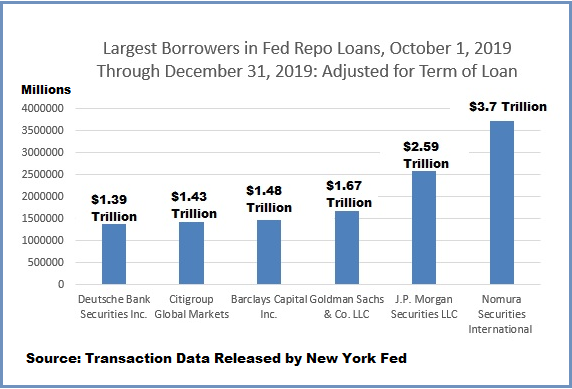
In the fall of 2019 there was no war in Ukraine, there was no pandemic. But for still undisclosed reasons, the Fed decided to funnel trillions of dollars in cumulative repo loans to the trading units of U.S. megabanks and their foreign counterparties. The Fed’s repo loans stretched from September 17, 2019 through July 2, 2020. The Fed has begun releasing the names of the banks and the amounts they had borrowed on a quarterly basis, following a two-year lag. There has been an unprecedented mainstream media news blackout of this information.

As the chart below shows, the six largest borrowers in terms of cumulative repo loans from the Fed’s bailout program in the last quarter of 2019 were the trading units of Nomura, JPMorgan, Goldman Sachs, Barclays, Citigroup, and Deutsche Bank. (The trading unit of the French global bank, BNP Paribas, made it into the top six borrowers for the first quarter of 2020.)

Fed's Repo Loans to Largest Borrowers, Q4 2019, Adjusted for Term of Loan

Flash forward to the present. The U.S. is now dealing, simultaneously, with a pandemic, an illegal bombing campaign and invasion of Ukraine by Russia, soaring inflation at home, and the share prices of Wall Street and foreign global banks tanking.

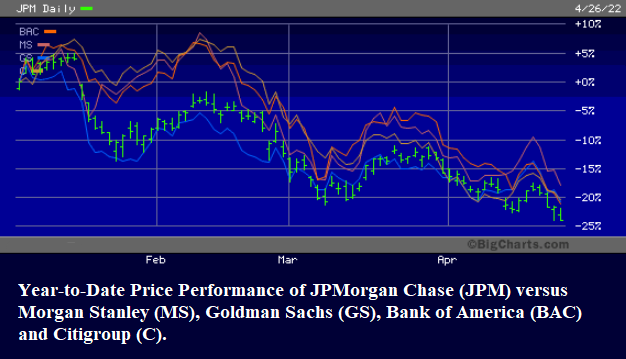
As the two charts below indicate, the same Wall Street banks and their foreign derivative counterparties that the Fed was bailing out in the last quarter of 2019 and the first quarter of 2020 have experienced dramatic deterioration in their share prices year-to-date.

Year-to-Date Price Performance of Megabanks

Year-to-Date Price Performance of Foreign Global Banks

The Office of Financial Research (OFR) has warned since 2016 that the Fed was not paying proper attention to the systemic risk posed by global banks that were heavily interconnected via derivatives. OFR researchers, Jill Cetina, Mark Paddrik, and Sriram Rajan, produced a study in 2016 that illustrated how the Fed’s stress tests failed to capture the systemic risk. The problem, according to the researchers, is not what would happen if the largest counterparty to a specific bank failed but what would happen if that counterparty was also a major counterparty to other systemically important global banks.

The researchers wrote that the Fed’s stress test “looks exclusively at the direct loss concentration risk, and does not consider the ramifications of indirect losses that may come through a shared counterparty, who is systemically important.” The researchers explained:

“A BHC [bank holding company] may be able to manage the failure of its largest counterparty when other BHCs do not concurrently realize losses from the same counterparty’s failure. However, when a shared counterparty fails, banks may experience additional stress. The financial system is much more concentrated to (and firms’ risk management is less prepared for) the failure of the system’s largest counterparty. Thus, the impact of a material counterparty’s failure could affect the core banking system in a manner that CCAR [one of the Fed’s stress tests] may not fully capture.”

Based on the way these global, interconnected banks have been trading since the start of this year, it would appear that the Fed, and Congress, have failed to meaningfully address this critical problem


LINK


This Weekend in Politics, Bulletin 441.

                                                                               LOTS OF POSTS IGNORED BY BLOGGER..... OR REMOVED ON THEIR WHI...