Showing posts with label ALASKA ICE MELT. Show all posts

Sunday, July 7, 2024

Global Heating: Alaska’s Top-Heavy Glaciers are Melting, approaching an Irreversible Tipping Point


ARCTIC

Global Heating: Alaska’s Top-Heavy Glaciers are Melting, approaching an Irreversible Tipping Point

By Bethan Davies, Newcastle University | –

(The Conversation) – The melting of one of North America’s largest icefields has accelerated and could soon reach an irreversible tipping point. That’s the conclusion of new research colleagues and I have published on the Juneau Icefield, which straddles the Alaska-Canada border near the Alaskan capital of Juneau.

In the summer of 2022, I skied across the flat, smooth and white plateau of the icefield, accompanied by other researchers, sliding in the tracks of the person in front of me under a hot sun. From that plateau, around 40 huge, interconnected glaciers descend towards the sea, with hundreds of smaller glaciers on the mountain peaks all around.

Our work, now published in Nature Communications, has shown that Juneau is an example of a climate “feedback” in action: as temperatures are rising, less and less snow is remaining through the summer (technically: the “end-of-summer snowline” is rising). This in turn leads to ice being exposed to sunshine and higher temperatures, which means more melt, less snow, and so on.

Like many Alaskan glaciers, Juneau’s are top-heavy, with lots of ice and snow at high altitudes above the end-of-summer snowline. This previously sustained the glacier tongues lower down. But when the end-of-summer snowline does creep up to the top plateau, then suddenly a large amount of a top-heavy glacier will be newly exposed to melting.

That’s what’s happening now, each summer, and the glaciers are melting much faster than before, causing the icefield to get thinner and thinner and the plateau to get lower and lower. Once a threshold is passed, these feedbacks can accelerate melt and drive a self-perpetuating loss of snow and ice which would continue even if the world were to stop warming.

Two skiers on snowy glacier
Skiing across the flat plateau area of Taku Glacier on Juneau Icefield, in summer 2022.
Bethan Davies

Ice is melting faster than ever

Using satellites, photos and old piles of rocks, we were able to measure the ice loss across Juneau Icefield from the end of the last “Little Ice Age” (about 250 years ago) to the present day. We saw that the glaciers began shrinking after that cold period ended in about 1770. This ice loss remained constant until about 1979, when it accelerated. It accelerated again in 2010, doubling the previous rate. Glaciers there shrank five times faster between 2015 and 2019 than from 1979 to 1990.

Associated Press Video: “Melting of Alaska’s Juneau icefield accelerates, losing snow nearly 5 times faster than in the 1980s”

Our data shows that as the snow decreases and the summer melt season lengthens, the icefield is darkening. Fresh, white snow is very reflective, and much of that strong solar energy that we experienced in the summer of 2022 is reflected back into space. But the end of summer snowline is rising and is now often occurring right on the plateau of the Juneau Icefield, which means that older snow and glacier ice is being exposed to the sun. These slightly darker surfaces absorb more energy, increasing snow and ice melt.

Large glacier goes through valley
Gilkey Glacier, Juneau Icefield: as the glaciers thin, more bare rock is shown, and less heat is reflected back into space.
Bethan Davies

As the plateau of the icefield thins, ice and snow reserves at higher altitudes are lost, and the surface of the plateau lowers. This will make it increasingly hard for the icefield to ever stabilise or even recover. That’s because warmer air at low elevations drives further melt, leading to an irreversible tipping point.

Longer-term data like these are critical to understand how glaciers behave, and the processes and tipping points that exist within individual glaciers. These complex processes make it difficult to predict how a glacier will behave in future.

The world’s hardest jigsaw

We used satellite records to reconstruct how big the glacier was and how it behaved, but this really limits us to the past 50 years. To go back further, we need different methods. To go back 250 years, we mapped the ridges of moraines, which are large piles of debris deposited at the glacier snout, and places where glaciers have scoured and polished the bedrock.

Satellite image + two birds eye view photos
The same area in old aerial photos and a recent satellite image.
Davies et al / Nature Communications

To check and build on our mapping, we spent two weeks on the icefield itself and two weeks in the rainforest below. We camped among the moraine ridges, suspending our food high in the air to keep it safe from bears, shouting to warn off the moose and bears as we bushwhacked through the rainforest, and battling mosquitoes thirsty for our blood.

We used aerial photographs to reconstruct the icefield in the 1940s and 1970s, in the era before readily available satellite imagery. These are high quality photos, but were taken before global positioning systems made it easy to locate exactly where they were taken.

A number also had some minor damage in the intervening years – some Sellotape, a tear, a thumb print. As a result, the individual images had to be stitched together to make a 3D picture of the whole icefield. It was all rather like doing the world’s hardest jigsaw puzzle.

Work like this is crucial as the world’s glaciers are melting fast – all together they are currently losing more mass than the Greenland or Antarctic ice sheets, and thinning rates of these glaciers worldwide has doubled over the past two decades.

Our longer time series shows just how stark this acceleration is. Understanding how and where “feedbacks” are making glaciers melt even faster is essential to make better predictions of future change in this important region

Bethan Davies, Senior Lecturer in Physical Geography, Newcastle University

This article is republished from The Conversation under a Creative Commons license. Read the original article.

About the Author

The Conversation is an independent, not-for-profit media outlet that works with academic experts in their fields to publish short, clear essays on hot topics.


INFORMED COMMENT

Saturday, July 6, 2024

Researchers Warn of Imminent 'Death Spiral' for Rapidly Melting Alaska Ice Field


Researchers Warn of Imminent 'Death Spiral' for Rapidly Melting Alaska Ice Field

The Juneau ice field is melting at a rate of 50,000 gallons per second and is possibly heading "beyond a dynamic tipping point," a new study says.

The melting of Alaska's Juneau ice field—which contains more than 1,000 glaciers—is accelerating and could reach a tipping point much sooner than predicted, according to research published Tuesday.

The study, which was published in the journal Nature Communications, shows that ice loss from the Juneau ice field began accelerating rapidly after 2005.

The paper's authors found that "rates of area shrinkage were five times faster from 2015-2019 than from 1979-1990," while glacier volume loss—which had remained relatively consistent from 1770-1979—doubled after 2010.

"Forty years from now, what is it going to look like? I do think by then the Juneau ice field will be past the tipping point."

"Thinning has become pervasive across the icefield plateau since 2005, accompanied by glacier recession and fragmentation," the study states. "As glacier thinning on the plateau continues, a mass balance-elevation feedback is likely to inhibit future glacier regrowth, potentially pushing glaciers beyond a dynamic tipping point."

Study lead author Bethan Davies, a glaciologist at Newcastle University in England, said in a statement, "It's incredibly worrying that our research found a rapid acceleration since the early 21st century in the rate of glacier loss across the Juneau ice field."

"Alaskan icefields—which are predominantly flat, plateau icefields—are particularly vulnerable to accelerated melt as the climate warms since ice loss happens across the whole surface, meaning a much greater area is affected," Davies continued. "Additionally, flatter ice caps and icefields cannot retreat to higher elevations and find a new equilibrium."

"As glacier thinning on the Juneau plateau continues and ice retreats to lower levels and warmer air, the feedback processes this sets in motion is likely to prevent future glacier regrowth, potentially pushing glaciers beyond a tipping point into irreversible recession," she added.

Study co-author Mauri Pelto, a professor of environmental science at Nichols College in Massachusetts, toldThe Associated Press that the Juneau ice field is melting at a rate of about 50,000 gallons per second.

"When you go there the changes from year to year are so dramatic that it just hits you over the head," Pelto said. "In 1981, it wasn't too hard to get on and off the glaciers. You just hike up and you could you could ski to the bottom or hike right off the end of these glaciers. But now they've got lakes on the edges from melted snow and crevasses opening up that makes it difficult to ski."

As the AP reported:

Only four Juneau ice field glaciers melted out of existence between 1948 and 2005. But 64 of them disappeared between 2005 and 2019, the study said. Many of the glaciers were too small to name, but one larger one, Antler glacier, "is totally gone," Pelto said.

Alaska climatologist Brian Brettschneider, who was not part of the study, said the acceleration is most concerning, warning of "a death spiral" for the thinning ice field.

Pelto said that "the tipping point is when that snow line goes above your entire ice field, ice sheet, ice glacier, whichever one."

"And so for the Juneau ice field, 2019, 2018, showed that you are not that far away from that tipping point," he added. "We're 40 years from when I first saw the glacier. And so, 40 years from now, what is it going to look like? I do think by then the Juneau ice field will be past the tipping point."

It's not just Alaska. Glaciers around the world—from Greenland to Switzerland to Africa and the Himalayas—are melting at an alarming rate. The United Nations Educational, Scientific, and Cultural Organization warned in 2022 that glaciers in one-third of the 50 UNESCO World Heritage sites where they are found are on pace to disappear by 2050—even if planet-heating emissions are curbed.

Another study published last year by researchers at Carnegie Mellon University and the University of Alaska found that even if humanity manages to limit planetary heating to 1.5°C above preindustrial temperatures—the more ambitious goal of the Paris agreement—half of Earth's glaciers are expected to melt by the end of the century.


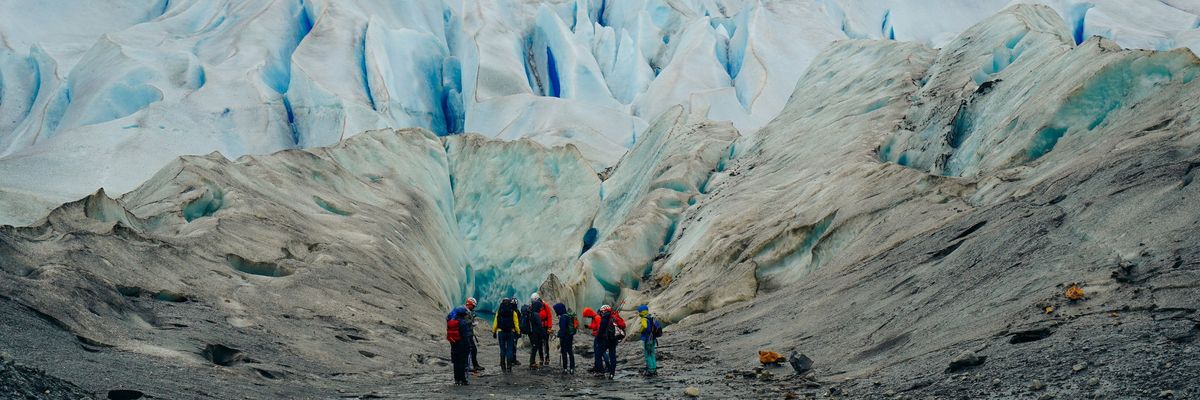
Researchers stand on the Juneau ice field

Researchers traverse the Mendenhall Glacier on the Juneau ice field in Alaska on June 8, 2022.

 (Photo: SNSF Scientific Image Competition/flickr/cc)

Week in Review: Biden Defiant as Calls to 'Pass the Torch' Mount


Saturday, July 6, 2024

■ The Week in Review


As New Campaign Implores Him to 'Pass the Torch,' Biden Rejects Calls to Drop Out

"I don't think anybody's more qualified to be president or win this race than me," the incumbent declared in a televised interview.

By Jake Johnson • Jul 6, 2024


From a Coup to Assassinations, Just How Much Immunity Does the US President Now Have?

"If Trump, as commander-in-chief, ordered his troops to assassinate somebody or stage a coup, that would seem to fall within the absolute immunity provision of the court's decision," said one legal expert.

By Jake Johnson • Jul 3, 2024


'The Land Theft Continues': Israel Announces Biggest West Bank Seizure in Over 30 Years

The Israel-based activist group Peace Now says "2024 is by far the peak year for Israeli land seizure in the occupied West Bank."

By Brett Wilkins • Jul 3, 2024


Former Officials Say US Has 'Undeniable Complicity' in Israeli Killing, Forced Starvation of Palestinians in Gaza

"The administration’s policy in Gaza is a failure and a threat to U.S. national security," said 12 ex-officials who resigned from the Biden administration over its support for Israel's war on Gaza.

By Edward Carver • Jul 3, 2024


Researchers Warn of Imminent 'Death Spiral' for Rapidly Melting Alaska Ice Field

The Juneau ice field is melting at a rate of 50,000 gallons per second and is possibly heading "beyond a dynamic tipping point," a new study says.

By Brett Wilkins • Jul 2, 2024


'Screaming the Quiet Part': Trump Advisers Say He's Ready to Embrace King-Like Powers

The U.S. Supreme Court's immunity decision has reportedly emboldened the presumptive GOP nominee to pursue his far-right agenda and authoritarian aims "without fear of punishment or restraint."

By Jake Johnson • Jul 2, 2024


VIEW ALL NEWS

JOIN THE MOVEMENT


As a people-powered nonprofit news outlet, we cover the issues the corporate media never will.

Your contribution supports this bold media model—free, independent, and dedicated to reporting the facts every day. Stand with us in the fight for economic equality, social justice, human rights, and a more sustainable future.

JOIN WITH US TODAY

■ Opinion


After Biden's ABC Interview, It's Time to Pull the Emergency Cord

It has become clear that only direct intervention by Democrats in Congress, propelled by grassroots pressure, can avert a Biden 2024 train wreck.

By Norman Solomon, Jeff Cohen • Jul 6, 2024


Trump's Far-Right Army Is Threatening Bloodshed. Believe Them.

We must not only resist, but prevail. If we do not, it will be nearly impossible to reverse the course that America’s right-wing billionaires have set us on.

By Thom Hartmann • Jul 5, 2024


The Six Corporate-Owned US Supreme Court Justices Have Completed Their Assigned Mission

The series of devastating rulings over the last week are the consequence of a corporate strategy launched 53 years ago.

By Robert Reich • Jul 3, 2024


Confronting NATO’s War Summit in Washington

Our fellow citizens and political leaders need to hear from us all about the dangers posed by this unaccountable, nuclear-armed war machine.

By Medea Benjamin,Nicolas J.S. Davies • Jul 2, 2024


A Vicious Right-Wing Supreme Court Helps the Neoliberal Empire Strike Back

"With fear for our democracy," said Justice Sonia Sotomayor, "I dissent."

By Chuck Idelson • Jul 2, 2024


VIEW ALL OPINION

Trump admits humiliating defeat in pool debacle

                                                     LOTS OF POSTS IGNORED BY BLOGGER..... OR REMOVED ON THEIR WHIM! ALL POSTS ARE AVAILABLE...