SCRUTINIZE ANY CANDIDATE & DON'T BELIEVE THIS ATTACK AD PROPAGANDA!
SLOW ZONE SHORTSLEEVE FAILED THE MBTA UNDER HIS REIGN & LEFT
AN EXPENSIVE DISASTER GOV. HEALEY WAS FORCED TO ADDRESS!
THE OTHER REPUBLICAN CANDIDATES - ONE A TRUMPER?
SUPER PACs NEED LEASHES & LIMITS!
SCRUTINIZE THE DONORS AS WELL!
Super PAC targets Gov. Healey as Republican race ramps up
Chris Van Buskirk
A no-limit super PAC backing Republican gubernatorial candidate Brian Shortsleeve has raised more than $1 million to oppose Democrat Gov. Maura Healey, records show.
The super PAC, dubbed Commonwealth Unity, was created in May. It has spent just over $34,000 thus far to oppose Healey, who plans to run for reelection next year.
The PAC is the second created to publicly back one of the three conservatives running for the party’s nomination to challenge the governor in 2026.
Lydia Goldblatt, who previously worked as an aide to former U.S. Sen. Scott Brown and is chair of the super PAC, said the spending committee is “energized by the growing wave of support from Massachusetts voters rallying behind Brian Shortsleeve.”
In a statement, she said the fundraising “reflects real momentum from Brian’s vision of a united Commonwealth focused on lowering costs, creating opportunities, and delivering results for working families.”
Shortsleeve, contacted by WBUR, released a statement saying he’s proud of the support his campaign is generating “at all levels, whether it is public opinion polling, campaign fundraising, or the support of independent outside organizations.”
The super PAC, which is barred from directly coordinating with Shortsleeve, raised slightly more than $1 million from businesses and individuals across Massachusetts, according to campaign finance records updated Monday. Many of the donors come from venture capital and real estate.
Records show five businesses contributed $50,000 each: Concord Street Associates in Framingham, Fourteen Walkup in Westborough, Ten Bear in Northborough, Uniave Two in Westwood, and West Park 1800 LLC in Westborough.
Robert Pereira, chief executive of the Middlesex Corp., a construction company that helped build the MBTA’s Green Line Extension, also individually donated $50,000, according to campaign finance records.
Shortsleeve ran the MBTA under former Gov. Charlie Baker when the transit agency’s Fiscal Management and Control Board approved the contract for the Green Line Extension.
Pereira’s daughter, Saige, also works for Shortsleeve’s campaign, according to state records and a spokesperson for the candidate.
A spokesperson for Middlesex Corp. declined to comment.
Six other businesses donated between $30,000 and $45,000 to the super PAC, records show.
The super PAC spent just over $34,000 with Ohio-based Strategic Media Placement for digital advertising and production costs to oppose Healey.
The organization has relentlessly attacked the governor on social media since May, including through a post earlier this month that placed Healey in a sombrero and poncho, holding a bag of money.
"Spirit Halloween called — they’re out of Maura Healey costumes because failure’s been flying off the shelves! Nothing’s scarier than higher bills and blind leadership," the super PAC said.
A spokesperson for Shortsleeve said the super PAC is legally required to operate independently from the campaign. "We have no control over its communications. While Maura Healey’s record of wasting billions of taxpayer dollars on the migrant crisis is fair game, this is not the tone we endorse even if it was intended as humor," the spokesperson said in a statement to WBUR.
A spokesperson for Healey’s campaign declined to comment.
But Massachusetts Democratic Party Chair Steve Kerrigan said no amount of “MAGA money is going to trick the voters who know Brian Shortsleeve failed at the head of the MBTA and know he's going to be at Donald Trump's beck and call as governor.”
A spokesperson for Mike Kennealy, a former cabinet secretary under Baker who is also a Republican running for governor, accused Shortsleeve of mismanaging the T and having “insider relationships and financial ties to powerful Democrats.”
“This isn’t the record of someone ready to challenge Beacon Hill’s backroom politics — it’s the resume of someone who’s thrived on them," said Ben Hincher, Kennealy’s campaign manager. "Massachusetts needs a leader who’s independent, accountable, and willing to take on the entrenched political establishment — not serve it.”
Shortsleeve had nearly $553,000 in cash in his own campaign account as of Oct. 3, according to state records. He raised just over $72,000 and spent more than $90,000 last month, data shows.
The super PAC backing Shortsleeve is not the first to wade into the 2026 race for governor.
Another no-limit spending committee filed paperwork last week to back Michael Minogue, a South Hamilton Republican and major GOP donor who launched a campaign for governor earlier this month.
A spokesperson for Minogue did not respond to a WBUR inquiry.
The super PAC backing Minogue, dubbed Massachusetts First, is led by Rob Neuner, chief executive of Connecticut-based Boost Oxygen.
In an interview with WBUR this week, Neuner said he planned to donate $100,000 to the super PAC and defended Minogue’s contributions to President Trump and national conservatives.
“He's got a, definitely, moral compass that people could say maybe Donald Trump may not have. But he's a much different type of candidate than Donald Trump,” Neuner said. “I think he would support anyone who ran for president as a good Republican. He’s definitely a lot different than that type of MAGA person.”
On August 31, 2018 we broke the news that the fossil fuels conglomerate, Koch Industries, led by billionaire Charles Koch, had purchased i360 – an Orwellian political operation made all the more dangerous by the fact that it was affiliated with a billionaire who had been creating and funding political front groups for decades to push an anti-regulatory agenda and call it “liberty.” We wrote at the time:
“Quietly, and without any corporate press release on such an unusual acquisition, Koch Industries has purchased i360, a vast voter database and data harvesting operation. According to i360’s website, it has ‘1800 unique data points’ on 290 million American consumers as well as detailed information on 199 million voters from all 50 states. It brags that its data ‘shows you everything you need to know including the demographic and psychographic breakdown of your target market.’
“The propriety of a multinational industrial conglomerate with an anti-regulatory agenda having a stranglehold on a highly sophisticated voter data mining platform with unlimited funds to hire Ph.Ds., statisticians and computer scientists trained in artificial intelligence and machine learning, has yet to enter the national discourse.”
We decided to browse the most current Federal Election Commission (FEC) records and see what i360 has been up to lately. We learned that i360 has received $279,401.21 to conduct “surveys” for Americans for Prosperity Action (AFP Action), a Super Pac that hilariously calls itself a “grassroots” movement, notwithstanding that it’s funded by billionaires and multi-millionaires. According to FEC data, Koch Industries gave $25 million to AFP Action on May 19 of last year while Stand Together Chamber of Commerce, successor to the Koch-funded Freedom Partners Chamber of Commerce (which folded its tent in 2019 after too much scrutiny) chipped in another $25 million eight days earlier. Alice, Rob and Jim Walton, billionaire heirs of the Walmart retail chain, each gave $5 million to AFP Action last year while former hedge fund titan, Stanley Druckenmiller, chipped in $1.5 million. (For those who have given $1 million or more thus far in the current election cycle, see here.)
Freedom Partners had a very large footprint in the Donald Trump administration. In a document titled “Roadmap to Repeal: Removing Regulatory Barriers to Opportunity,” the Koch front group listed the laws and regulations it expected to be repealed in the first 100 days of Trump’s tenure as President. The Trump administration dutifully followed the prescribed agenda, repealing the Paris Climate Accord to the horror of our allies; passing tax cuts for the wealthy; and gutting federal regulations and the Environmental Protection Agency.
By the spring of 2018, 12 people who previously worked at Freedom Partners were working in the Trump administration. When we examined the makeup of Freedom Partners in 2018, we found that all but one of Freedom Partners’ 9-member Board of Directors was a current or former Koch company employee. The Board Chair of Freedom Partners at that time was the same Mark Holden that was the General Counsel of Koch Industries.
One of the Senate seats that AFP Action is currently targeting is that of Democrat Sherrod Brown of Ohio, the current chair of the Senate Banking Committee, who regularly calls out the moneyed interests’ attack on the working class. AFP Action is backing Republican Bernie Moreno, a man who has made “dubious claims” about his background in Bogotá, Columbia, according to The Guardian.
AFP Action attack ads against Senator Brown call him out for “a dangerous wide-open border.” What control the Chair of the Senate Banking Committee has over the border is not explained. WACK-A-DING TENNESSEE MARSHA BLACKBURN defines the success of
“Then-Tennessee Rep. Marsha Blackburn aired at least four different television advertisements and a wave of social media advertisements focused on immigration, often with false or inflammatory language. She ended up beating out Tennessee Gov. Phil Bredesen, a Democrat, who had been leading in the polls for months.”
This would be far from a novel tactic by Koch-related groups. In 2010 we broke the story of how Donor’s Capital Fund, the dark money group with Charles Koch’s fingerprints all over it, had donated $17,778,600 to the Clarion Fund to distribute 28 million DVDs of a race-baiting, fear-mongering film just weeks before the 2008 presidential election — when the first black candidate in history, Barack Obama, was the Democratic presidential nominee. The DVD was stuffed into the Sunday edition of some of the biggest newspapers in America as well as distributed through a direct mail campaign.
ROBERT MERCER HAS MAINTAINED A LOW PROFILE IN HIS SUPPORT FOR TRUMP, YET HIS BACK DOOR ACTIONS ARE BECOMING MORE WIDELY KNOWN.
ROBERT MERCER STASHES HIS $$$ OVERSEAS, A TAX DEADBEAT, NOT SUPPORTING LOCAL, STATE OR FEDERAL GOVERNMENTS ACCORDING TO THE PENTAGON PAPERS.
[HE'S GOT PLENTY OF COMPANY: REX TILLERSON, SHELDON ADELSON, THE DIRTY ENERGY KOCH BROTHERS AND OTHERS.]
ROBERT MERCER IS THE ALT-RIGHT BREITBART WITH THEIR BOGUS INFORMATION, DICTATING HIRINGS TO TRUMP INCLUDING KELLYANNE AIRHEAD, STEVE BANNON AND JOHN BOLTON, THE WAR MONGER.
ROBERT MERCER RAN ATTACK ADS AGAINST ELIZABETH WARREN.
PLEASE SEEK OUT THE TRUTH FOR YOUR VOTE!
"R" voters are conspicuously uninformed!
Never figured out that MERCER funded the attack ads!
After SENATOR ELIZABETH WARREN defeated the DIRTY ENERGY KOCH SOCK PUPPET SCOTT BROWN, I encountered local Republicans in mourning.
I would ask 'did you know that he voted against A. B. C?' Invariably, the answer was NO!
I would ask 'did you know that he voter for X, Y, Z?' Invariably, the answer was NO!
The DIRTY ENERGY KOCH SOCK PUPPET SCOTT BROWN went on to carpet bag in NEW HAMPSHIRE and was defeated by another WOMAN!
That's a FIRST IN HISTORY that's ignored!
Even now, some MAGA MIDGET will comment on the content of those attack ads because "R" voters are incapable of comprehension.
The midterm campaign coming to a rancorous close on Tuesday will shatter all spending records for federal and state elections in a nonpresidential year, according to the nonpartisan group Open Secrets, surpassing $16.7 billion in attack ads, salaries and the huge get-out-the-vote operations now underway coast to coast.
The most expensive race is in Georgia, where Senator Raphael Warnock is defending a seat that he won for Democrats in a fateful special election not even two years ago. In his race against Herschel Walker, the Trump-backed former college football star, the two sides combined have spent a whopping $250 million on ads alone for their general-election battle, according to AdImpact.
In the hard-fought Senate contest between Lt. Gov. John Fetterman and Mehmet Oz in Pennsylvania, the two major parties and their allies have spent $221 million on an almost constant barrage of commercials since the primary ended in May.
The air wars have only accelerated since Labor Day, when voters traditionally tune in en masse, with more than $840 million in ads running across just eight Senate battlegrounds.
Republicans have pounded Democrats as out of touch with voters on inflation, crime and immigration — messages that appear to resonate in a year when many Americans are struggling with high prices for gasoline and groceries, and looking for someone to blame.
Democrats have countered by depicting their opponents as extremists on abortion and hitting them on an array of other issues. One recent spot calls Dr. Oz, the celebrity television doctor, a “snake” for promoting questionable medical remedies. An ad this week from Mr. Warnock’s campaign highlights personal allegations about Mr. Walker.
In the races for governor that Democrats have cast as existential for the fate of American democracy, the spending battle has been somewhat smaller in scale — but no less intensely waged.
In the eight most competitive races for governor, ad spending has blown past half a billion dollars, according to AdImpact. The most lopsided governor’s contest has been in Pennsylvania, where Attorney General Josh Shapiro has outspent his opponent, the pro-Trump state Senator Doug Mastriano, by roughly a 20-to-one margin.
Some of the least competitive races for governor have been the most expensive: Gov. Ron DeSantis, Republican of Florida, for instance, has amassed more than $200 million, while Gov. J.B. Pritzker, Democrat of Illinois, has raised at least $132 million, much of it his own money. In Texas, Gov. Greg Abbott has raised more than $113 million, around three times the haul of Beto O’Rourke, the Democratic nominee.
The overall spending projection from Open Secrets, which tracks money in politics, would hurtle past the midterms spending record of $14 billion set in 2018. That money includes everything from ads to office space to campaign salaries to the turnout operations that are now whirring into action.
All told, campaigns and outside groups have spent more than $7.6 billion on advertising this year, according to AdImpact, with the bulk of it devoted to traditional 30- and 60-second commercials.
The biggest ad spenders have been the four outside groups allied with the Democratic and Republican leaders in each wing of Congress: The Senate Leadership Fund and Congressional Leadership Fund, which are close to Senator Mitch McConnell and Representative Kevin McCarthy, the top Republicans in each chamber of Congress; and Senate Majority PAC and House Majority PAC, which are run by allies of Senator Chuck Schumer and Speaker Nancy Pelosi, the top Democratic leaders on Capitol Hill.
The groups have become dominant players in American politics since the Supreme Court rolled back the limits on political giving in Citizens United v. Federal Elections Commission, the landmark 2010 campaign finance case.
Republicans have relied heavily in this election on an array of super PACs bankrolled by megadonors like Richard Uihlein, a cardboard box magnate from Illinois, while Democratic candidates have had more success raising money directly for their campaigns. And while Democrats have often held their own in the hunt for outside cash, as they did to win back the White House in 2020 with a flood of “dark money,” some left-leaning billionaire donors have been less forthcoming this year.
All together, 15.4 percent of the money spent on federal races has come from billionaires, an increase from 11.9 percent in 2020.
Ilhan’s primary is in just 3 days, and we need your support to get out the vote and fight back against the status quo’s last-minute efforts to unseat her.
A Republican-linked group launched false attacks against Ilhan’s record on progressive issues. A conservative super PAC funded by wealthy real estate developers in MN-05 just dropped a $350,000 TV ad buy on behalf of Ilhan’s conservative primary opponent. And there’s no telling what other attacks we’ll see in the final hours of this campaign.
Any amount you can give today will help us counter these attacks and reach voters through get-out-the-vote events, door-knocking, phone-banking, online ads, and campaign literature. Take a look at just a handful of the crucial organizing efforts your donations help make possible:
Thank you for anything you can give today. It makes a huge difference in our work to keep Ilhan in Congress to fight for our shared progressive priorities, from canceling student loan debt to enacting a Green New Deal.
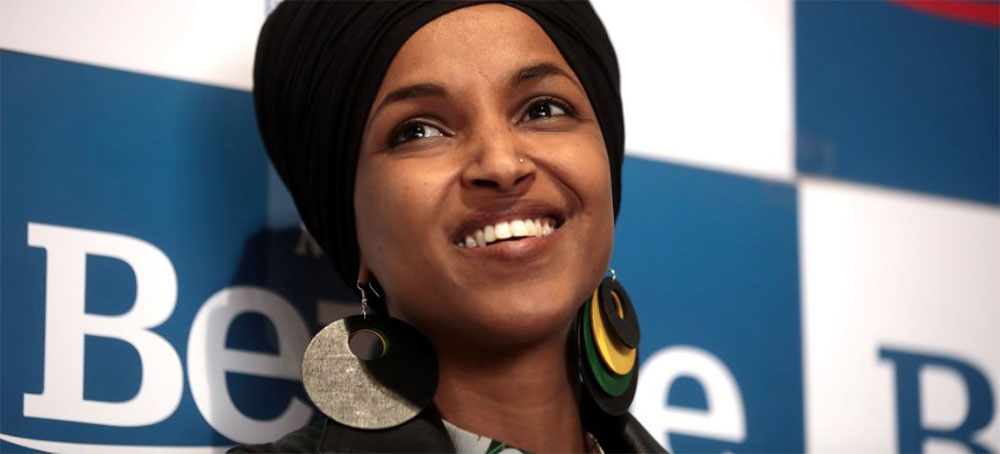
Ilhan Omar speaking with supporters of Senator Bernie Sanders at a canvass launch in Las Vegas, Nevada, on February 9, 2020. (photo: Gage Skidmore/Flickr)
Ilhan Omar, one of the most left-wing members of Congress, faces a primary challenger, Don Samuels, backed by an unsavory circle of right-wing billionaires and cops. Despite being an enemy of public schools, he’s calling himself a progressive.
Representative Ilhan Omar, one of the most left-wing members of Congress and a close ally of democratic socialists in Congress, including Representative Alexandria Ocasio-Cortez and Senator Bernie Sanders, will face a primary challenger on Tuesday. Her opponent, former city council and school board member Don Samuels, is pitching himself to the district’s liberal voters as a “progressive.”
His Twitter account emphasizes his liberalism: gun control, protecting abortion rights, public school advocacy, and green jobs. He also wants to strengthen voting rights and make health care more affordable. But if he’s that progressive, why is he challenging Ilhan Omar at all? As usual, following the money provides an answer: Samuels and his campaign are supported by reactionary billionaires who want to get rid of Omar.
When Samuels first ran for Minneapolis School Board in 2014, he was backed by a coalition of billionaires — Michael Bloomberg, Arthur Rock, and Jonathan Sackler — supporting charter schools. In an effort to deceive voters who might otherwise oppose their school privatization schemes, these moguls called their PAC the Minnesota Progressive Education Fund and poured what In These Times magazine called an “unprecedented” amount of money (some $290,000) into two school board candidates. One of these was Samuels.
In the current race, Samuels is backed by even worse interests, including several Republican super PACs funded by the same billionaires that support Marjorie Taylor Greene, Josh Hawley, Laura Loomer, and Kelly Loeffler.
He’s also backed by the same police PACs that support Senator Tom Cotton and Lee Zeldin (the far-right zealot seeking to unseat New York governor Kathy Hochul). (These groups also donated to candidates trying to unseat Omar’s Squad-mates AOC, Rashida Tlaib, and Ayanna Pressley.)
It’s not hard to see why. Samuels has been a staunch opponent of local campaigns to shift funding from the police into other priorities, efforts Omar has supported. Indeed, in the wake of George Floyd’s murder at the hands of Minneapolis cops, when millions of Americans were pouring into the streets to protest racist police violence, Samuels and his wife were suing the city of Minneapolis to demand that the city hire one hundred additional police officers. (That lawsuit is ongoing.)
Right-wing donors have been hosting fundraisers for Samuels. These include Andy Brehm (a prominent critic of progressive attorney general Keith Ellison), Steve Cramer of the Minneapolis Downtown Council (a prominent opponent of police accountability), and several of Minneapolis’s worst landlords — including one family of billionaires who faced state investigation in 2020 for creating an atmosphere of racial discrimination, harassment, and hostility for their tenants, who were Somali women with children.
The conservative National Review magazine published a fawning profile of Samuels on Thursday, noting that even though he is a Democrat, “there are reasons for conservatives and others on the right to wish him well on Tuesday.” In addition to Samuels’s die-hard police fandom, the National Review writer appreciated his support for charter schools and vouchers and, “most importantly,” emphasized that Samuels had, of any opponent, the best chance of defeating Omar.
The teachers’ union has not fallen for Samuels’s claims to the progressive mantle. (The United Steelworkers and a couple of building trades unions unfortunately are backing him, though Service Employees International Union, the American Federation of State, County and Municipal Employees, and other unions are behind Omar.) Greta Callahan, president of the Minneapolis Federation of Teachers and Education Support Professionals, in an op-ed for the Star Tribune, pointed to Omar’s support for public school teachers and students — from pushing for universal free school lunch during the pandemic, cancellation of school lunch debt, and a permanent end to punitive school lunch policies to standing with striking Minneapolis teachers on the picket line in the freezing winter. (The strike, which called for caps on class sizes and increased mental health support for students, as well as higher teacher pay, was successful.)
In her op-ed, Callahan contrasted the congresswoman’s allegiances with those of her opponent: Samuels not only failed to support the striking teachers but has said he would never send his children to public school and memorably called for burning down one of Minneapolis’s high schools.
Since her election to Congress in 2018, Omar has been an effective fighter not only on education but also on climate, health care, affordable housing, food justice, and greater accountability for the military and military contractors. Among elected officials serving at the federal level, she has also been one of the few outspoken opponents of Israel’s occupation of Palestine.
For all these reasons and many more (including, of course, the fact that Omar is Muslim), she has received countless death threats and been singled out for violent harassment by Donald Trump’s followers. She has been the target of knuckle-draggingly ignorant bigotry from her own colleagues, with Representative Lauren Boebert calling her a member of the “jihad Squad.”
Omar’s last primary challenge was animated by Islamophobic elements of this kind. That’s not where Samuels is coming from, but the ruling class and organized cops supporting him are equally dangerous and deserving of defeat.
Given Omar’s courageous positions, it’s easy to understand why right-wing billionaires would want to stop her. But the Democratic voters of Minneapolis should not be fooled by their faux-progressive campaign.
Brittney Griner, the WNBA superstar, has been detained by the Russian government since Feb. 17. On Friday, a trial began in a Moscow suburb on the allegation that she was carrying vape cartridges containing cannabis oil when passing through a Moscow-area airport. But the word “trial” hardly captures what is really happening. Russia is not a state governed by rule of law; it is run by a strongman and his clans, including a powerful security service. They have her in their clutches.
The State Department has already determined that Ms. Griner, twice an Olympic gold medalist, has been “wrongfully detained.” Put simply, Ms. Griner is a hostage, taken by President Vladimir Putin and his sprawling police state. At the State Department, her case has been shifted to the Office of the Special Presidential Envoy for Hostage Affairs, a section that seeks the release of hostages and others classified as being wrongfully detained abroad.
Russian courts rarely acquit the accused; Ms. Griner’s “trial” could drag on for months, or as long as Mr. Putin wishes. He will undoubtedly want to trade her for a Russian incarcerated in the United States, such as convicted arms dealer Viktor Bout. This puts the United States in an extremely difficult position. A trade could win freedom for Ms. Griner but would encourage more hostage-taking; a refusal to trade would consign her to more agony in a Russian prison.
A state based on the rule of law does not seize individuals to use them as bargaining chits. A democracy does not imprison those who speak out. Mr. Putin’s regime thrives on such coarse gambits. Witness the unjust prosecution and jailing of opposition leader Alexei Navalny, or political activist and Post opinion contributor Vladimir Kara-Murza, or Paul Whelan, a U.S. citizen held in prison for what he says is a fictitious charge of espionage. For Mr. Putin, kidnapping a sports icon at an airport or murdering thousands of civilians in Ukraine is all in a day’s crude behavior.
The Russian leader’s repressive security services have for months been sweeping up anyone who protests the war against Ukraine. In recent days, a prominent opposition politician, Ilya Yashin, one of the few remaining voices speaking out against the war, was arrested in a Moscow park, to be held for 15 days on charges of disobeying a police officer. “I am staying in Russia,” Mr. Yashin wrote on Twitter in March. “I have said before and I keep repeating: Russians and Ukrainians should not be killing each other. If I am destined to end up in prison for antiwar speeches, I will accept it with dignity.”
On Thursday, authorities also detained Vladimir Mau, who had been associated with liberal economic reformer Yegor Gaidar in the era of President Boris Yeltsin and more recently had close ties with top officials as a member of the board of Gazprom, the state-run natural gas giant, and as rector of a major university. He was accused of being involved in a fraud. But the real reason is probably connected to Mr. Putin’s shadowy power plays.
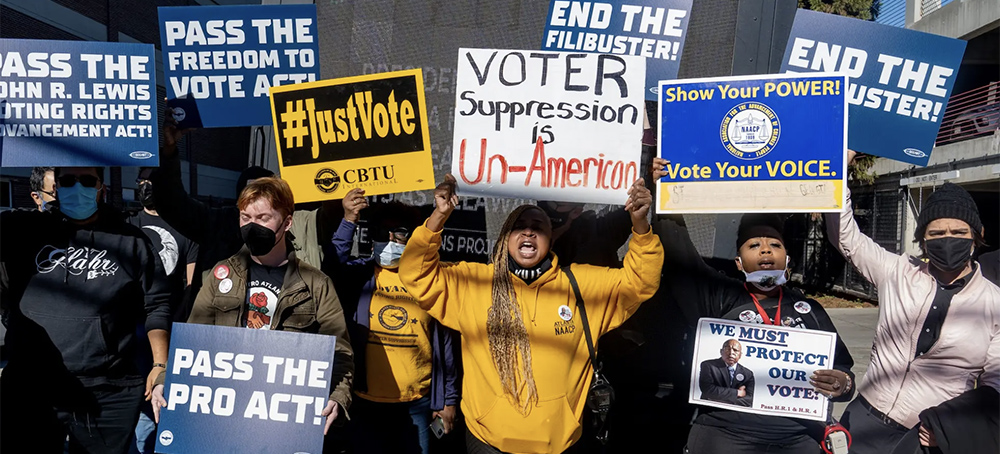
Demonstrators wave signs advocating for voting rights in Atlanta, Georgia, on January 11, before President Biden and Vice President Harris speak. (photo: Megan Varner/Getty Images)
The Supreme Court on Thursday agreed to hear the case of Moore v. Harper, a North Carolina case that concerns gerrymandering, voting districts, and a little-known theory called the independent state legislature doctrine, this coming October.
Should the Court rule in North Carolina's favor, the ruling would reduce voter oversight on state legislatures and likely impact the outcome of various statewide political races — as well as the 2024 presidential election.
The Facts of Moore v. Harper
Moore v. Harper centers around congressional maps drawn by Republican lawmakers in North Carolina following the 2020 census. The maps were challenged in court by Democratic voters and nonprofits who argued the districts were unfairly gerrymandered in favor of Republicans, which violated the state constitution.
"Today, we answer this question: does our state constitution recognize that the people of this state have the power to choose those who govern us, by giving each of us an equally powerful voice through our vote? Or does our constitution give to members of the General Assembly, as they argue here, unlimited power to draw electoral maps that keep themselves and our members of Congress in office as long as they want, regardless of the will of the people, by making some votes more powerful than others?" Justice Robin Hudson wrote in the state supreme court's majority opinion, which blocked the use of the gerrymandered maps. "We hold that our constitution's Declaration of Rights guarantees the equal power of each person's voice in our government through voting in elections that matter."
Republican state lawmakers in February requested in an emergency appeal that the United States Supreme Court halt the state's order to redraw the maps, though the request was denied.
Justices Samuel Alito, Clarence Thomas, and Neil Gorsuch dissented to the denial. In their dissent, the justices wrote that the independent state legislature doctrine was an important question for the court to resolve.
The new maps, drawn by North Carolina Supreme Court-appointed experts, were used in the state's May 17 primary election.
In another appeal to overturn the state Supreme Court's decision, Timothy K. Moore, the Speaker of the North Carolina House of Representatives, filed for a writ of certiorari — a request that the United States Supreme Court review the case.
The review was granted on June 30 with the case to be heard in the Supreme Court session this October.
Independent State Legislature Doctrine
At the heart of the case, according to SCOTUS blog, is the legal theory called "independent state legislature doctrine," which suggests that, under the Constitution's election clause, "only the legislature has the power to regulate federal elections, without interference from state courts."
"The theory would disable state courts from protecting voting rights in federal elections by eliminating state constitutional protections in those elections," Legal experts Leah Litman, Kate Shaw and Carolyn Shapiro wrote of the case in an opinion piece for The Washington Post. "And it would do so at a time when voting rights are under attack, including at the Supreme Court itself."
Under the most strict readings of the doctrine, provisions in state constitutions which restrain lawmakers' from influencing elections would be rolled back. The governor, who could usually veto new election laws, would lose the ability to do so and state courts would be unable to reverse anti-democratic laws or challenge gerrymandered districts.
This interpretation of the constitution "could make it easier for state legislatures to suppress the vote, draw unfair election districts, enable partisan interference in ballot counting," the Brennan Center for Justice tweeted about the case.
Conservative Supreme Court justices Neil Gorsuch, Brett Kavanaugh, Clarence Thomas, and Samuel Alito have all endorsed versions of the legal theory in previous court opinions. Their support signals that they will vote in this case to overturn previous legal precedent which considered such cases highly partisan and thus "unjusticeable" and prevented the country's highest court from weighing in on partisan state issues including gerrymandered election maps.
The Court's forthcoming decision could roll back efforts to combat gerrymandering in battleground states nationwide and give state legislatures unlimited control over how federal elections are conducted.
"This case has the potential to fundamentally rework the relationship between state legislatures and state courts in protecting voting rights in federal elections," election law expert Richard Hasen wrote on his Election Law blog. "It also could provide the path for election subversion."
Alexandria Ocasio-Cortez called the Supreme Court's decision to hear the case "a judicial coup in progress."
"If the President and Congress do not restrain the Court now, the Court is signaling they will come for the Presidential election next," the New York Democrat tweeted. "All our leaders — regardless of party — must recognize this Constitutional crisis for what it is."
In Tuesday’s Democratic primaries, left-wing challengers in Illinois made history, while in New York, progressive incumbents held onto their seats.
This week brought some very welcome news for progressives in Illinois, while left candidates in New York saw more of a mixed bag.
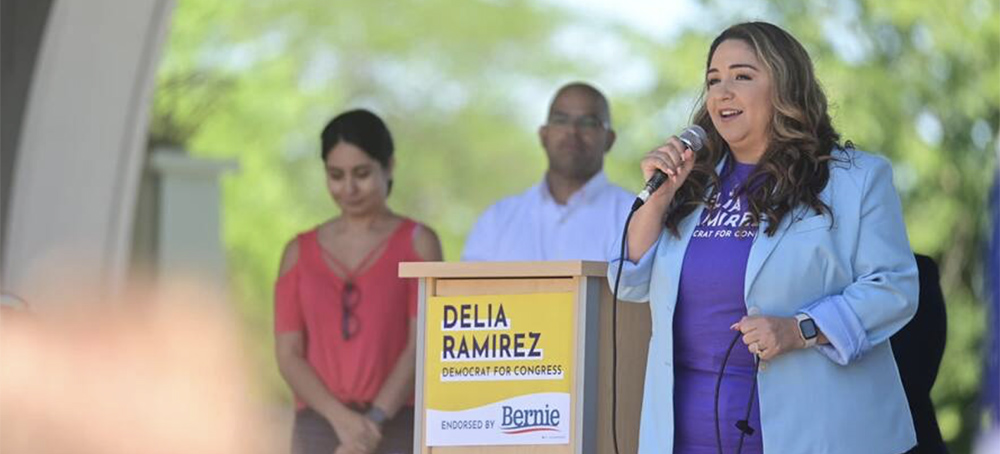
In Tuesday night’s Democratic primary, state Rep. Delia Ramirez, co-chair of the elected officials chapter of United Working Families (UWF), defeated Gilbert Villegas in the newly redrawn 3rd Congressional District by capturing nearly 66 percent of the vote, capping off a night of victories for left-wing groups including UWF, the Illinois partner of the national progressive organization Working Families Party (WFP).
Ramirez, who was endorsed by Sens. Bernie Sanders (D‑VA) and Elizabeth Warren (D‑MA) along with national progressive groups including WFP, the House Progressive Caucus and People’s Action, will face Republican Justin Burau, who ran unopposed in his party’s primary, in the November general election. She would be the first Latina congresswoman elected from the Midwest, and is almost certain to win in the deep-blue district, which stretches from Chicago’s West Side deep into the city suburbs.
“We just broke a thick-ass glass ceiling,” Ramirez said at a victory party Tuesday night, continuing, “the entire state of Illinois has made it loud and clear: it’s time for progressive, authentic good government.”
Villegas, her opponent, benefited from major outside spending from a now-familiar player: Democratic Majority for Israel, which has used its financial heft against progressives in races across the country and spent $157,000 against Ramirez. Villegas also was supported by a charter school committee, the National Association of Realtors, and Mainstream Democrats — a Super PAC founded by venture capitalist and LinkedIn co-founder Reid Hoffman.
At a June 18 rally, Sen. Sanders said Ramirez, “has been a champion of working families in Illinois. As a state legislator, she has expanded Medicaid for all seniors regardless of legal status, has secured millions of dollars for affordable housing, and defended reproductive rights by codifying Roe v. Wade in Illinois.” Ramirez had previously co-sponsored the Reproductive Health Act, which guarantees abortion rights to Illinois residents, and ran on a platform of Medicare for All, cancelling student loan debt, union rights and other progressive priorities.
Ramirez rejected all corporate donations, and was heavily outraised by her opponent. But outside groups like WFP spent big in her favor.
“This was unquestionably a good night for United Working Families,” Emma Tai, UWF’s executive director, told In These Times. “With only one exception, all of our contested candidates triumphed and beat their primary challengers.”
Further down the ballot, Anthony Joel Quezada, a UWF-endorsed member of the Democratic Socialists of America (DSA), won his race for the Cook County Board of Commissioners, and will join two other UWF-affiliated commissioners, Brandon Johnson and Alma Anaya. The board, composed of 17 commissioners serving four-year terms, approves the county’s budget and controls laws governing issues ranging from parks to public health and safety.
“For too long we’ve had absent leadership in the 8th district,” Quezada said Tuesday night. “Right now, in the midst of Covid, a housing crisis, growing wealth inequality, and the threat of climate change, we said that we need to elect leadership that actually reflects our progressive values and is ready to fight for us.” Quezada will be the first open democratic socialist to serve on the Cook County Board.
Lilian Jimenez, who ran for Ramirez’s statehouse seat, won the Democratic nomination for the 4th House District with nearly 80 percent of the vote in a three-person primary. Jimenez was endorsed by Ramirez, unions including the Chicago Teachers Union and Illinois SEIU, as well as the Chicago Tribune’s editorial board, and she previously worked as a labor and immigration lawyer, directing the legislative fight to pass county-wide minimum wage and sick leave laws.
“We’re in a much more serious and rigorous phase of what it means to contest political power electorally,” Tai noted. “The upside of not having the element of surprise is that we have a much deeper bench of people who know what it takes to contest seriously for power.”
It wasn’t all good news for Illinois progressives, however. Kina Collins, the Justice Democrats-endorsed progressive who challenged longtime Rep. Danny K. Davis (D‑Ill.), lost her race in Illinois’ 7th district. Davis received last-minute support from powerful establishment Democrats, including President Joe Biden and Illinois Gov. JB Pritzker, who endorsed Davis last Sunday. Yet, despite the loss, Collins came far closer this round, claiming 45 percent of the vote as compared to the 14 percent she won in 2020.
And incumbent progressive Rep. Marie Newman (D‑Ill.) similarly lost her race to Sean Casten, after redistricting forced her into a contest with a fellow sitting member of Congress. Newman also faced a flood of outside money which funded attacks on her campaign, as did Ramirez and other left-wing candidates.
In New York, meanwhile, progressives saw both setbacks and victories in Tuesday’s primaries. A slate of seven insurgent challengers backed by the Working Families Party of New York and the New York Chapter of the DSA who ran against establishment incumbents in the New York State Assembly were mostly defeated, but no progressive incumbent lost their reelection campaign.
Rep. Alexandria Ocasio-Cortez (D‑NY) endorsed the challengers, while New York Mayor Eric Adams lent his support to the incumbents. Sarahana Shrestha was the one candidate on the WFP’s slate who won their race. The first-time candidate beat 13-term incumbent Assembly-member Kevin Cahill, who represented the Hudson Valley town of Kingston. Shrestha, a first-generation Nepalese-American graphic designer, ran on a platform that prioritized climate justice.
“When I announced my run for the State Assembly last year, I asked the people of District 103 to choose hope over fear, to put our collective imagination into what we stand to gain, and not just what we stand to lose,” Shrestha said in a statement. “This is just the beginning. Next, we must build on our common ground and bring people into the right direction we need not just for the Hudson Valley, and not just for New York, but for the whole country.”
Outside spending from corporate interests was, as has become typical in the Democratic Party’s fight between progressives and moderates, a major factor. Shrestha alone faced at least $80,000 in attack ads funded in part by real estate interests channeled through a pair of Super PACs, Common Sense New Yorkers and Voters of New York. In total, the two PACs raised at least $1 million from corporate donors, and spent heavily on mailers attacking the WFP slate over their alleged support for defunding the police. One mailer described Jonathan Soto, who once worked for Ocasio-Cortez and ran against 10-term incumbent Michael Benedetto in the Bronx, as a “dangerous, reckless, socialist” who was “too extreme for the Bronx.”
A mailer targeting Samy Nemir Olivares, who challenged incumbent Erik Dilan — the son of state Sen. Martin Dilan, who DSA member and State Sen. Julia Salazar ousted in her tumultuous insurgent 2018 campaign — accused Olivares of “threatening public safety.”
And Jeff Coltin, a political reporter for City … State NY, noted on Twitter that a real estate investment firm appeared to be pouring money into targeted Instagram ads supporting the incumbents against their progressive challengers. Committee for a Fair New York, funded by Arel Capital, spent at least $50,000 shoring up moderates — a sizable sum in local races where candidates rarely raise more than one or two hundred thousand dollars.
“The reason they’re pouring money into these races is because they’re afraid, because they know that we can win. We can seize the reins of these institutions and direct them to more just and redistributive ends, and they are very scared of that happening,” Tai said. “That’s the story behind the money pouring into our opposition.”
The outcome of Tuesday’s races show both the challenges faced by the progressive electoral movement, with corporate money flowing into the coffers of centrist Democratic incumbents, as well as the potential of a multiracial working-class politics to triumph in a turbulent political environment.
“That’s how the aphorism goes, right? First they ignore you, then they laugh at you, then they fight you, then you win,” said Tai. “I think we’re definitely at the ‘then they fight you’ phase — and we are, increasingly, in the ‘then you win’ phase.”
Inside an abortion clinic in Albuquerque, New Mexico, on June 23, the day before the Supreme Court overturned Roe v. Wade. (photo: Gina Ferazzi/Los Angeles Times/Getty Images)
Why medical emergency exceptions for abortions aren’t enough.
Even before the Supreme Court overturned Roe v. Wade on June 24, stripping Americans of their right to an abortion, the United States had an abysmally high maternal mortality rate, ranking last in a survey of 10 similarly wealthy countries. For doctors in states implementing restrictive abortion bans, the ruling is a crisis of care: In many cases, the only way to treat life-threatening conditions such as ectopic pregnancies is with medical or surgical termination. The fear among many physicians is that the ruling in Dobbs v. Jackson Women’s Health Organization will make mortality rates creep even higher.
States that are enacting the most stringent abortion bans — like Missouri, where a “trigger law” went into effect the day of the ruling — do make exceptions for medical emergencies. But huge questions remain: How might someone in a medical emergency get a lifesaving abortion in a state with no, or few, providers? And who gets to decide what counts as a “lifesaving” emergency?
Nobody seems to know for sure. But one thing is clear: The ruling raises far more questions than it answers. And while the answers are deliberated, patients around the country stand to suffer unnecessary, debilitating pain or death.
“We’re venturing into unknown territory,” said Lori Freedman, a sociologist and associate professor of obstetrics and gynecology at the University of California San Francisco.
There are a few big categories of unknowns here: how doctors will act if they fear prosecution for providing care, how hospital lawyers will interpret state laws, and who will provide abortions in cases when they are legally allowed to save the life of the pregnant person.
Maternal health care in America is at an inflection point. And with every unknown there is danger.
Fear of prosecution could alter medical decision-making
A pregnancy can be dangerous even in the best of circumstances. “Carrying a pregnancy is more dangerous than not carrying a pregnancy. Birth is riskier than an abortion,” said Jody Steinauer, a physician and director of the Bixby Center for Global Reproductive Health at UC San Francisco. Pregnancy causes a panoply of physiological changes to a person’s body, and problems can arise throughout the process.
The American College of Obstetricians and Gynecologists recommends early abortions for patients with some heart conditions, while patients with diabetes whose fetuses will develop severe anomalies can spend time focusing on controlling their diabetes before trying to get pregnant again. Some complications are apparent far before they begin to affect the vital signs of a pregnant person, Steinauer said. Patients with poorly controlled diabetes are at a higher risk of having fetal anomalies, for example, and patients with mental health issues or cardiac disease can be in serious danger if they carry a pregnancy to term.
The Dobbs ruling will make responding to those problems more difficult. One major source of uncertainty lies in how physicians will respond to the threat of prosecution for performing abortions, even in cases where their patient’s life is in danger. That fear of criminalization could lead doctors to put off care for longer than they would otherwise.
For doctors, a big component of that fear is that determining what’s “lifesaving” isn’t perfectly cut and dried.
“At what point do we say that danger has been triggered?” asked Carmel Shachar, executive director of the Petrie-Flom Center for Health Policy Law, Biotechnology, and Bioethics at Harvard Law School. “That’s really unclear, and it’s very hard for providers because they want to provide timely medical care.”
What constitutes danger, and when, varies patient by patient. If a patient has a missed miscarriage, for example, where the fetus has stopped developing but the pregnant person hasn’t experienced any symptoms such as bleeding, they can develop sepsis, which is when their body starts damaging itself as an extreme response to an infection. The treatment for a missed miscarriage is removing the fetal tissue — in other words, an abortion — and is best done as early as possible.
But without the protections of Roe, doctors may be forced to wait to take action until their patient’s condition deteriorates. “Do you need to wait for the patient to become septic before you can act?” Shachar asked.
As Anna North wrote for Vox in 2019, some abortion opponents argue that complications like missed miscarriages and ectopic pregnancies should be left to “resolve on their own.” Doctors in states with abortion bans may feel they have no choice but to stand back and wait.
“What’s really important and sad is that you really can’t keep the patient’s best interest in mind,” said Freedman. “Her suffering is not accounted for at all. Even if they can keep her from having long-term harm, she’s still going to have worse care. She’s still going to be stalled and scared for longer.”
Do doctors get to make the call, or do lawyers?
Even before the Dobbs ruling, deciding whether to perform an abortion, especially in states with restrictive abortion laws, would often become a discussion that went beyond the physician and patient to include a hospital’s legal team and sometimes even a department chair or board of administrators. But those discussions happened with the knowledge that, fundamentally, Roe v. Wade guaranteed that patients had a right to an abortion and doctors faced minimal risk of prosecution for performing them in response to a medical emergency. Now hospitals will be left on their own to interpret the laws of their states, which could lead to even more confusion.
Physicians and hospital lawyers have a difficult job ahead in figuring out how to comply with the law, partly because the language used in the abortion debate and the laws that come out of it have little basis in medical science, said Louise Perkins King, a physician at Brigham and Women’s Hospital in Boston and director of reproductive bioethics at Harvard Medical School’s Center for Bioethics.
When lawmakers talk about heartbeats and fetal viability, for example, they do so in a way that is totally different from how physicians use those words. Texas law, for example, mentions the “dead, unborn child,” but “that’s a word that means nothing to me as an obstetrician, because I deal in the words of ‘embryo,’ ‘fetus,’ and perhaps ‘neonate,’” King said.
That disconnect between medical science and policy means that without clarification from state attorneys general, hospital lawyers will have to make case-by-case decisions on whether their physicians can provide abortions — and they’ll probably err on the side of extreme caution, delaying or denying patients the care they need. Many of these debates may simply come down to a matter of personality: If a hospital has a director who strongly supports abortion rights, for example, they could be more permissive. This is, of course, ludicrous — a patient’s right to care should not depend on the whims of hospital management.
Even if there is legal clarity, there may not be ethical clarity. “It may be that in your state, what is legal is in direct conflict with providing the best health outcomes for your patients,” said Shachar. “I think it’s going to be really complicated and really hard for providers to work through what happens when they know what the standard of care is, but they’re legally not able to provide it.”
Where will abortions even occur?
Before the Dobbs ruling, doctors at hospitals with restrictive abortion policies had the option to send their patients to other facilities, like abortion clinics or different hospitals, that could perform emergency abortions instead. That’s what would happen at Catholic hospitals, said Freedman, who has extensively studied abortion policies in Catholic hospital systems. “But that was a very different context,” she said. Before June 24, those doctors were protected by Roe; even if they ran the risk of losing their jobs, they were never at risk of being criminally prosecuted for doing their jobs.
That has changed.
Some doctors have already indicated they’re willing to provide abortions to their patients, even if it means they risk being prosecuted, said King. But that could present even more problems: If a doctor is charged with a crime, their license will be suspended, which means their patients — even those who might not need abortions — won’t get the care they need.
Steinauer is also concerned about what will happen if and when freestanding abortion clinics are forced to close. “Many communities have these great independent abortion clinics that are providing wonderful care for our patients, and the local hospital does not necessarily need to be involved, especially in earlier abortion care,” Steinauer said.
In the past, those clinics would often handle abortion care in the first trimester of pregnancy, including cases where patients had to get abortions for conditions like cardiac disease, while hospitals and academic institutions would usually take patients in their second or third trimesters. Without those clinics providing support, hospitals might become overloaded with patients they aren’t used to seeing. Care for those patients could then be delayed or even denied, based on the decisions a hospital’s legal team comes to.
The Food and Drug Administration has approved drugs that can be used to induce an abortion, and it may be possible to continue receiving them via telehealth across state lines even if states pass sweeping bans on surgical abortions (an ongoing federal lawsuit may provide more clarity on this soon). US Attorney General Merrick Garland has promised to protect Americans’ access to these medications, which means it could remain a good option for many patients and may help reduce the burden of those clinics closing, but it’s still not a perfect solution.
Abortion pills can cause complications in rare circumstances, and King worries patients may choose to delay care or be afraid to tell their doctors about what medicines they took. That’s going to disproportionately affect people of color, who already face medical bias. “My biggest fear is that somebody’s going to take those meds at home because they don’t have any other choice and then have a hemorrhage and be too scared to come in,” said King.
It’s likely many of these questions will only be answered once they make their way back to the Supreme Court, which Shachar says is an inevitability. But that will take months, if not years.
It’s hard to predict what kind of damage will be done in the meantime. “It’s hard to imagine Americans will tolerate women dying,” said Freedman. “I feel like doctors will get loud if it’s truly causing deaths. But there’s so much we don’t know. We never thought we would see this day.”
Yellow tape marks bullet holes on a tree and a portrait and flowers create a makeshift memorial on May 19, 2022, at the site where Palestinian-American Al-Jazeera journalist Shireen Abu Akleh was shot and killed in the West Bank city of Jenin. (photo: Majdi Mohammed/AP)
U.S. officials have concluded that gunfire from Israeli positions likely killed Al-Jazeera journalist Shireen Abu Akleh but that there was "no reason to believe" her shooting was intentional, the State Department said Monday.
The finding, in a statement from State Department spokesman Ned Price, came after what the U.S. said was inconclusive tests by independent ballistics experts under U.S. oversight of the bullet fragment recovered from Abu Akleh's body.
"Ballistic experts determined the bullet was badly damaged, which prevented a clear conclusion" as to who fired the shot, Price said in the statement.
Abu Akleh, a veteran correspondent and U.S and Palestinian citizen who was well known throughout the Arab world, was shot and killed while covering an Israeli military raid on May 11 in the Jenin refugee camp in the occupied West Bank. Palestinian eyewitnesses, including her crew, say Israeli troops killed her and that there were no militants in the immediate vicinity.
Israel says she was killed during a complex battle with Palestinian militants and that only a forensic analysis of the bullet would confirm whether it was fired by an Israeli soldier or a Palestinian militant. It has strongly denied she was deliberately targeted, but says an Israeli soldier may have hit her by mistake during an exchange of fire with a militant.
U.S. security officials had examined results of both Palestinian and Israeli investigations and "concluded that gunfire from IDF positions was likely responsible for the death of Shireen Abu Akleh," Price said.
The U.S. "found no reason to believe that this was intentional but rather the result of tragic circumstances during an IDF-led military operation against factions of Palestinian Islamic Jihad," Price said.
Less than a day’s worth of fuel remains, says the energy minister, as the cash-strapped nation extends school closures.
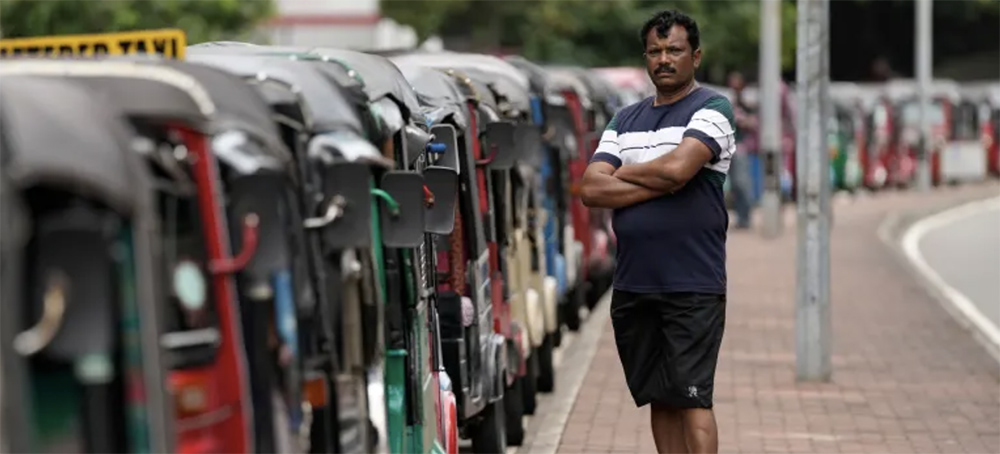
Sri Lanka has less than a day’s worth of fuel left, the energy minister says, with public transport grinding to a halt as the country’s economic crisis deepens.
Power and energy minister Kanchana Wijesekera on Sunday said petrol reserves were about 4,000 tonnes, just below one day’s worth of consumption, as queues snaked through the main city of Colombo for kilometres.
The cash-strapped nation on Sunday extended school closures because there is not enough fuel for teachers and parents to get children to classrooms, with most pumping stations being without fuel for days.
Sri Lankan Prime Minister Ranil Wickremesinghe told Al Jazeera last week the petrol shortage will last until July 22 when the next oil shipment is expected. He said a gas deal has been secured which will ensure supplies for the next four months.
“It [fuel shortage] is a big setback to the economy and has caused lot of hardship to people. When we came in, the shortage of dollars actually contributed to this situation. We have been taking steps since then especially to get gas which will be available in the next few days, diesel and furnace oil as well,” he said.
“The issue has been petrol … and that will take a bit of time. We are hoping to get shipment of petrol by July 22 but I have asked the [concerned] minister to try to get the shipment earlier.”
‘Huge challenge’
Wijesekera told reporters on Sunday the government has ordered new fuel stocks and the first ship with 40,000 metric tonnes of diesel is expected to arrive on Friday.
The minister said the main problem is the lack of dollars and appealed to some two million Sri Lankans working abroad to send their foreign exchange earnings home through banks instead of informal channels. He said workers’ remittances, which usually stood at $600m per month, had declined to $318m in June.
“Finding money is a challenge. It’s a huge challenge,” he said.
Last week, Sri Lanka announced a two-week halt to all fuel sales except for essential services to save petrol and diesel for emergencies.
Local media reported there had been sporadic clashes outside fuel stations. Last week, troops opened fire to disperse a mob protesting against the military jumping the queue.
The economic meltdown has triggered a political crisis with widespread anti-government protests erupting across the country. Protesters have blocked main roads to demand gas and fuel, and television stations showed people in some areas fighting over limited stocks.
In Colombo, protesters have been occupying the entrance to the president’s office for more than two months to demand President Gotabaya Rajapaksa’s resignation.
They accuse him and his powerful family, including several siblings who hold top government positions, of plunging the country into the crisis through corruption and misrule.
A shortage of foreign currency to finance even the most essential imports has led to the country’s worst economic crisis, with its 22 million people facing severe hardships daily.
The country has also faced record-high inflation and lengthy power blackouts since late last year.
All non-essential government institutions and schools have been ordered shut until July 10 to reduce commuting and save energy.
Authorities also announced countrywide power cuts of up to three hours a day from Monday because they cannot supply enough fuel to power generating stations.
Sri Lanka has has been getting most of its fuel needs from neighbouring India, which provided it with a credit line.
“We are buying fuel either using Indian credit lines and the foreign exchanges that we get from remittances. It [remittances] is a small amount, but nevertheless, sometime we get a billion dollar or a billion and a half. The rest of the reserves from what we got from creditors have already been busted,” Wickremesinghe told Al Jazeera.
The government said it was also negotiating with fuel suppliers in Russia and Malaysia.
The International Monetary Fund (IMF) will continue to hold talks with Sri Lanka for a possible $3bn bailout package, the global lender said last week, after wrapping up a 10-day visit to Colombo.
However, an immediate release of funds from the IMF is unlikely because the country has first to get its debt on to a sustainable path.
Redwoods are one of North America's most iconic trees, but are also found elsewhere as in this forest planted in Victoria, Australia. (photo: James Yu/Getty Images)
Even as we discover the incredible benefits of the world's most ancient trees, we are losing them to climate change, writes Jim Robbins. But cloning could offer an answer.
In 2005, several of the centuries-old ponderosa pine trees on my 15 acres (0.06 sq km) of forest in the northern Rocky Mountains in Montana suddenly died. I soon discovered they were being brought down by mountain pine beetles, pernicious killers the size of the eraser on a pencil that burrow into the tree.
The next year the number of dying trees grew exponentially. I felt powerless and grief-stricken as I saw these giant, sky-scraping trees fading all around me, realising there was nothing I could do to stop it.
While the native bugs were the proximate cause, the underlying reason for the unprecedented mortality in my home state and throughout the Rockies was that winters had stopped getting really cold. When I first moved to Montana in the late 1970s, temperatures of -34C (-30F) or even below -40C (-40F) were common in winter, sometimes for weeks at a time. The coldest temperature on record in Montana is –57C (-70F). These days wintertime minimum temperatures rarely get below -18C (0F) or so. If they do, it is usually just for a day or two. That's not nearly cold enough to kill pine beetles, which make their own natural antifreeze.
Within three years, more than 90% of my forest had died. We hired loggers to cut the trees down and truck them to a factory, where they were pulped and turned into cardboard.
The experience of watching my forest die sparked in me a renewed interest in what was happening to trees, both in Montana and globally. I began a now two decade-long inquiry into the lives, and deaths, of trees and forests.
Trees clean our water, affect our climate, provide wood for building and supply sources of food for us and many of the animals we eat. They even, somehow, seem to be connected to the stars. Yet we know astonishingly little about their role in our world.
We also lack knowledge about the genetics of trees: especially the effects on the gene pool of cutting down virtually all of the biggest, most robust trees for lumber over many centuries. And we are also mainly in the dark about how those trees that have survived will fare in a hotter and drier world.
In the last few years, however, scientists have started to unpack the importance of ancient tree genetics, with mounting evidence showing they will play a critical role in the future of the Earth's forests. This research follows efforts by one group of tree enthusiasts to attempt to replicate and plant the largest of these giants to protect their ancient DNA in what they call "living libraries". It appears to be prescient.
Craig D Allen has been on forest death-watch for much of his career. He has been dubbed as a "tree coroner" due to his desire to understand how trees are dying from climate change. Despite recently retiring from the US Geological Survey, he is now busier than ever researching the crisis in the world's forests and serving as an adjunct professor of ecology at the University of New Mexico.
Years ago now, I walked with him through acre upon acre of dying pinyon pine forests on the sere landscapes around Santa Fe, killed by prolonged drought and heat. When I saw him again recently, he told me that forest die-off is accelerating globally.
Allen is one of a small group of researchers meticulously unpacking what climate change is doing globally to ancient forests – forests which are at least several centuries old, the ones we know and love, especially old growth forests. It's a complex subject, but Allen points to research results published in the past decade which to him sum up the egregious impacts of a warmer planet on these ecosystems.
The first of these, a 2012 paper co-authored by Allen, combined tree ring data, climate records and future climate projections in the south-west of the US. It found that future megadroughts caused by climate change could have a devastating impact on the forests of the region. The crux of the issue is that even as air temperatures rise linearly, the atmosphere's ability to hold water increases exponentially. This means that the atmosphere is growing thirstier at a breakneck pace, and droughts snatch an ever increasing amount of water from the soil, trees and other plants.
A second study published in 2012 by an Australian research team gathered data about the water columns – the routes that water takes within the tree from the roots to the crown – in hundreds of tree species. It found that hotter droughts are pulling water out of forests at an accelerating pace and in many places trees can no longer keep up with the stress of increased pumping, which causes something akin to an embolism.
The third is a 2015 study looking at the vulnerability of trees around the world to drought. "It says that every major forest type, from Arizona and Algeria to Alberta and Argentina, wet and dry, is dying in ways that are historically unusual, from heat and drought events," Allen tells me.
The bottom line is that hot droughts, which are becoming more frequent and hotter, stress trees to the breaking point.
Because the warming atmosphere can hold more precipitation, in places that are both warmer and wetter, some forests are doing extremely well, better than ever, say Allen and William Hammond, a plant ecophysiologist and global change ecologist at the University of Florida. But where there are hot droughts, they are dying in increasing numbers. "Extreme events kill trees," Allen says. "And the worse periods are getting worse." Unprecedented extreme events are being seen, such as the 49C (120F) reached in British Columbia this past summer.
"One of the reasons big old trees are at risk is they have a really high cost to continue survival: bigger bills to pay," says Hammond. They need more water, and more energy to pump this water to their crown. They can be done in by drought, or weakened so much that they fall prey to insects, disease or fire.
More frequent hot droughts also means trees have less time to recover. "After a drought event has ended and the trees are well watered again, they have a chance to regrow and recover some of their damaged organs," says Anna Trugman, an assistant professor at the University of California in Santa Barbara, where she studies the effect of climate change on forests. "But if you get more frequent droughts, back to back, that can result in a longer term decline because they are not able to recover."
This dire future for trees comes even we are still learning basic things about them. Suzanne Simard, an ecologist at the University of British Columbia, has found that there are family relationships between trees and that, through their roots and fungus, they communicate with each other and shuffle resources around. Author and researcher Diana Beresford Kroeger has argued that the abundant aerosols that trees emit, such as terpenes and limonenes, are natural antibiotics, antivirals and chemo-preventatives that help keep the natural world – including humans – healthy.
Hammond and Allen predict widespread die-off of the world's biggest trees and historical forests. And research shows the up-and-coming forests of today are very different than historical forests, in part because of the new hotter and drier conditions. "Forests are getting shorter, they are getting younger, and dominant species are shifting," said Hammond. "Trees will persist. They are going to be with us a long time. But they are going to change."
And then there is the mammoth attempt to replicate the largest of these living giants.
Back in the 1990s, a father and son team in rural northern Michigan hatched a plan to clone the largest trees of each species in the US.
It was home-spun scheme called the Champion Tree Project. David Milarch is a fourth-generation farmer who raises shade trees. He looked up the largest tree of every species in the National Register of Big Trees, a list maintained by American Forests, a non-profit in Washington, DC. He and his son Jared would drive to the champion tree and ask the owner if they could take some cuttings.
They'd unload the ladder from the back of their pick-up truck and Jared would climb the tree to take a few small branches. The cuttings were sent to a nursery to have copies grown. Then Milarch and his son would plant the clones in various settings – cemeteries or parks – in what Milarch called a living archival library. The idea was to preserve the genetics of 800, 2,000 or 5,000-year-old trees in places around the world, in case the original tree died.
"The genetics of the big trees is disappearing," he told me when I reported on the scheme back in 2001. "Someone's got to clone them and keep a record. No one knows what they mean."
Milarch's project has come to focus primarily on America's oldest, most iconic trees: the redwoods and sequoias. Over two decades ago now, I watched as his team climbed some of the biggest trees in the world so they could cut needles from high up, the best material for cloning. Among them was the magnificent Waterfall Tree, a sequoia in a privately owned grove in central California, a whale of a tree with reddish-orange bark that dwarfed humans. A photo of it became the cover of my book, which told the story of the shade tree farmer's quixotic efforts to clone the world's largest trees and plant them around the world.
I went on to other things, but in the summer of 2021 my two decade-old experience with Milarch came rushing back. Fires swept through the famous sequoias in California, killing a fifth of them. One of them was the Waterfall Tree – burned to a crisp.
Long thought of as indestructible, these trees have been dying in increasing numbers in recent years. "What we are seeing now is that wildfire is capable of incinerating large giant sequoias in large numbers," said Christy Brigham, chief of resource management and science for Sequoia and Kings Canyon National Parks. "The primary driver is the 100-year history of fire suppression, but it's being made worse by climate change-driven hotter drought."
The disappearance of giant sequoia genetics is also a concern. "We don't know what we may have lost," said Brigham. "But we are talking about a species that has already gone through a genetic bottleneck and is only found in 78 groves. Now we have these wildfires that have burned up 19% of the adult large-tree population. In one grove, 80% of the grove is gone."
Milarch's organisation, now called Archangel Ancient Tree Archive, is still cloning trees, and they are now heading to California to search for, and hopefully clone, a "lost" grove of sequoias that Milarch believes may set a new record for size.
They are also planting old growth groves. "We planted 75 redwoods cloned from old growth trees at the Presdio," he told me recently, referring to a former army base that has since become a park. "And we've planted sequoias in 41 cities in the Puget Sound area as part of assisted migration."
The Archangel Ancient Tree Archive's philosophy is that while these 2,000-year-old trees can't move, their genetics can. While cloning them and planting them to create a new forest doesn't save the trees, it does perpetuate their old growth genetics. In autumn 2021, the organisation, which grows cloned trees in its own greenhouse, planted clones of the Waterfall Tree and others, as well as seedlings, on the site where forests were destroyed by this summer's fires, as well as further north where the climate may be more conducive to sequoias in a warmer future. "A 2,000-year-old tree knows a thing or two about survival," Milarch says.
The potential importance of old growth genetics inspired composer and music producer Timothy Smit to grow 49 clones from the Archangel Ancient Tree Archive sequoia collection at his Eden Project in Cornwall, UK, which houses thousands of plant species from around the world. "They went in as 3ft (0.9m) high babies and are now some 15ft (4.6m) tall," he told me recently. "All have survived."
After two decades of cloning on faith, a study published this year validates Milarch's approach of preserving the genetic of old trees. It concluded that old and ancient trees radically boost genetic diversity and thus contribute to the long-term resilience of the surrounding forest and its ability to adapt.
"These ancient trees represent individuals that established and survived through long cycles," says Chuck Cannon, co-author of the study and the director of the Morton Arboretum's Center for Tree Science in Illinois. "The particular combination of genetics they contain can bridge over the intervening centuries and contribute genes that are beneficial under environmental extremes that have not been present for hundreds of years. They are vital to a forest long-term adaptive capacity."
Despite this, very little research on old trees' genetics has been done, because old trees are both rare and hard to identify, says Cannon. That's why he thinks Archangel Ancient Tree Archive's cloning of old growth trees matters so much.
"Learning to propagate these living materials could be invaluable so that we do not lose the unique genetic combination represented by these trees,” he says. Essentially, creating this ark of old tree material could help other forests to increase their genetic diversity and ability to adapt to our rapidly changing world.
When I walk across my property these days it is heartening to see that the offspring of my departed pine trees are coming back on their own. No replacement for the grandfather trees that once stood here, but the mountain forests in this part of the world are not giving up the ghost, at least not yet.
But forests and trees are something we can no longer take for granted. Their existence is increasingly fragile and their loss would be incalculable.