Showing posts with label FINRA. Show all posts

Thursday, June 15, 2023

As JPMorgan Settles Epstein Victims’ Claims for $290 Million, Bombshell Documents Are Filed in the Other Epstein Case Against the Bank

SUBSCRIBE TO THIS NEWSLETTER TO RECEIVE TIMELY REPORTS 


As JPMorgan Settles Epstein Victims’ Claims for $290 Million, Bombshell Documents Are Filed in the Other Epstein Case Against the Bank

By Pam Martens and Russ Martens: June 13, 2023 ~

Jeffrey Epstein (left); Jamie Dimon (right).

Jeffrey Epstein (left); Jamie Dimon (right).

Yesterday, at 9:33 a.m. ET, JPMorgan Chase and the law firm Boies Schiller Flexner, issued a terse joint statement indicating that they had informed Judge Jed Rakoff’s federal court in Manhattan that claims against the bank for aiding and abetting Jeffrey Epstein’s sex-trafficking of underage girls had been settled by the two sides. The settlement will require court approval.

Law partner David Boies later confirmed to the press that the dollar figure for that settlement was an astonishing $290 million, despite the fact that the lawsuit was brought by just one women, Jane Doe 1.

After Jamie Dimon, the Chairman and CEO of JPMorgan Chase, had argued for months that the bank was not responsible for Epstein’s sex crimes and trafficking of young girls, why would the bank flip on a dime on June 12 and decide to effectively admit its guilt by agreeing to pay $290 million to settle the case?

The answer to that question is what else was happening in Judge Jed Rakoff’s court yesterday – which is actually quite a lot.

For starters, Jane Doe 1 became a lot of Jane Does, all potentially willing to bring more horrific stories and headlines implicating the bank for functioning as a cash conduit for Epstein’s crimes. (The bank had allowed tens of thousands of dollars in cash to be paid out monthly to Epstein from his accounts at the bank despite years of warnings from its own compliance staff that Epstein was a registered sex offender and under investigation for sex trafficking of underage girls, according to internal bank documents submitted to the court.)

Jane Doe 1 was able to become a multiple threat to JPMorgan Chase because yesterday Judge Rakoff entered an Opinion and Order certifying the case as a Class Action. Rakoff’s order explained the broad scope of the class being certified as follows:

“All women who were sexually abused or trafficked by Jeffrey Epstein during the time when JP Morgan maintained [accounts] for Epstein and/or Epstein-related entities, which included January 1, 1998, through on or about August 19, 2013, both dates inclusive, and continuing to the time of Epstein’s death on August 10, 2019.”

To put it bluntly, JPMorgan Chase was now facing the prospect of women from around the globe who had been trafficked or sexually assaulted by Jeffrey Epstein over the span of 21 years coming forward with potentially new and more incriminating evidence implicating the bank.

The second pivotal thing that happened in the court yesterday were filings made by the U.S. Virgin Islands (USVI) in the separate case it has brought against JPMorgan Chase, also over the bank aiding and abetting Epstein’s sex trafficking by functioning as a cash conduit for Epstein. That case is also being heard by Judge Rakoff.

USVI entered a Reply Memorandum that contained the following devastating charges against the bank:

“Plaintiff, the Government of the United States Virgin Islands (‘Government’), claims and will prove that Defendant JPMorgan Chase Bank, N.A. (‘JPMorgan’) violated the Trafficking Victims Protection Act, 18 U.S.C. §§ 1581-1597 (‘TVPA’), by knowingly participating in and benefitting from Jeffrey Epstein’s sex-trafficking and by obstructing investigation through its concealment of Epstein’s suspicious transactions from law enforcement. Discovery confirms that JPMorgan knowingly, recklessly, and unlawfully provided and pulled the levers through which Epstein’s recruiters and victims were paid and was indispensable to the operation and concealment of Epstein’s trafficking. JPMorgan had real-time information on Epstein’s payments that the Government did not and had specific legal duties to report this information to law enforcement authorities, which it intentionally decided not to do.”

The USVI then attached dozens of internal emails as Exhibits, showing the contempt that high level compliance staff held toward Epstein; that they wanted him fired as a client of the bank but were overruled by higher ups for years.

One JPMorgan Chase internal email from December 2010 from a compliance staffer to the Vice President of Anti-Money Laundering Operations referred to Epstein as a “known child sleaze.”

Another devastating email involving the depth of what the bank knew about Epstein was dated January 10, 2011. It came from Maryanne Ryan, the Vice President for Anti-Money Laundering (AML) Operations at JPMorgan Chase. The email was sent to William Langford, the Global Head of Compliance, as well as others.

It read as follows:

“I will dig more on the modeling agency and his personal accounts for potentially interesting activity in 05-08. Seems JPMC never was served a subpoena, which I find odd since we were his #1 bank and actually Bear [Stearns] got one in 07. Rich is getting me the AUSA [Assistant U.S. Attorney for the Justice Department] correspondence and we will compare their ask of Bear (something about $1000 and $100,000 transactions were of interest to them)

“How it came up again was his account alerted in Fortent [a money laundering detection program] for cash activity which it does for [sic] time to time and we went to Jim and he again said PB [Private Bank at JPMorgan Chase] is comfortable with him and that Steve Cutler approved him to stay. I spoke to Phil and given the HT [Human Trafficking] project thought that Steve Cutler may feel differently about Epstein, given the exposure the bank has received on the HT project. I circled back with PB and that was the reason for the RR [Rapid Response] meeting on Friday. Seems PB was not so thrilled with retaining him, it was all due to Jes [Jes Staley, a JPMorgan Chase executive and Senior Relationship Manager to Epstein with an office a few hundred feet from Dimon’s].

“Digging will take a few days, I’ll get back to you when I am done. The guy likes cash so the paper trail could be hard.

“Regards,

“Maryanne Ryan, Vice President, AML Operations”

There is so much to unpack in this email that it deserves its own plaintiff’s brief. First of all, it strongly suggests that the Anti-Money Laundering people at the bank are powerless to root out money laundering because they have to say “May I” to the Private Bank at JPMorgan Chase.

Second, exactly how does one get private subpoena information from the Assistant U.S. Attorney’s Office of the U.S. Department of Justice. Typically, until a case is brought, that information is confidential. Conveniently for JPMorgan Chase, it had purchased Bear Stearns when it collapsed in 2008 so it may have obtained its legal files as part of that transaction.

Third, sirens are going off in an anti-money laundering program called Fortent, about the cold cash Epstein is repeatedly taking from his accounts at the bank, but this is producing no meaningful action against Epstein or reports to law enforcement.

Fourth, Stephen Cutler, the former Director of the Division of Enforcement at the Securities and Exchange Commission, who became General Counsel at JPMorgan Chase in February of 2007, “had approved” Epstein to stay at the bank, according to this email.

In Jamie Dimon’s recent deposition in the case, he stated that Cutler worked in the office next door to Dimon and that Cutler reported to Dimon. But Dimon also stated that he didn’t know Epstein even had accounts at the bank or anything about him until 2019 when Epstein was arrested and charged with sex-trafficking.

For the General Counsel to be aware of huge cash withdrawals from the accounts of a man under investigation for sex trafficking of children and not get the permission of the Chairman and CEO of the bank to keep that man as a client – when he works next door to Dimon every day – might be hard for a jury to swallow.

Jamie Dimon has survived an endless torrent of charges against his bank from the U.S. Department of Justice and other regulators for more than a decade. Dimon is, in fact, the only CEO of a major Wall Street firm to have four separate criminal matters listed on his personal BrokerCheck record at the Wall Street self-regulator, FINRA.

FINRA provides the following explanation as to why those criminal matters against the bank are listed on Dimon’s personal BrokerCheck record:

“Mr. Dimon is disclosing this matter because, in certain respects unrelated to the underlying conduct, he may be deemed to have exercised control over JPMC [JPMorgan Chase] which entered into a deferred prosecution agreement with the Dept. of Justice….”

Indeed, Dimon has to be exercising extraordinary control over JPMorgan Chase – because that’s the only logical explanation as to why the Board of Directors hasn’t sacked him as felony count after felony count was racked up on his watch.

For a more granular understanding of the serial criminal conduct – to which the bank pled guilty – see our report: JPMorgan’s Board Made Jamie Dimon a Billionaire as the Bank Rigged Markets, Laundered Money, and Admitted to Five Felony Counts.

As for the claim that the $290 million settlement represents a great day of justice for Epstein’s victims, we’ll wait until the terms of the settlement are actually filed with the court. If the settlement involves protecting the clients that Epstein referred to JPMorgan Chase by imposing stringent non-disclosure agreements on the victims, or gagging victims on their ability to ever reveal what happened to them, or providing immunity to Epstein’s enablers and co-conspirators, then it will be yet another tragic chapter in the Epstein/JPMorgan saga. 

Related Article:

Jamie Dimon’s Deposition in Epstein Case Reveals Email Stating that Dimon Was to Be Treated to “Heavy Snacks” at Epstein’s Home 

LINK


Tuesday, April 11, 2023

First Republic Bank: Dark Pool Trading by “Rescuers” Exploded in Volume as FRC Tanked

 SUBSCRIBE TO THIS NEWSLETTER TO RECEIVE IT IN A TIMELY MANNER

First Republic Bank: Dark Pool Trading by “Rescuers” Exploded in Volume as FRC Tanked

By Pam Martens and Russ Martens: April 10, 2023

Jamie Dimon Being Sworn In at House Financial Services Committee Hearing, May 27, 2021

Jamie Dimon Being Sworn In at House Financial Services Committee Hearing, May 27, 2021

Jamie Dimon, the Chairman and CEO of JPMorgan Chase, has cranked up his public relations machine since March 16 to promote the narrative that he came to the “rescue” of the plunging regional lender, First Republic Bank. The so-called “rescue” consisted of 11 banks, including JPMorgan Chase, dumping a total of $30 billion in “uninsured” deposits into First Republic.

But one of the bank’s key problems was that it already had too many uninsured deposits. (This was like seeing a house on fire and throwing 11 expensive martinis at it.)

According to First Republic’s regulatory filings, as of December 31, 2022, it had total deposits of $176.25 billion, of which $119.47 billion (or 68 percent) were uninsured. The Federal Deposit Insurance Corporation (FDIC) caps federal deposit insurance at $250,000 per depositor, per bank. But banks such as First Republic, that cater to the very wealthy, have a significant number of customer accounts that dramatically exceed the $250,000 cap. In the digital age, those deposits can rapidly move elsewhere when a bank panic sets in.

The stock market was unpersuaded that this Dimon rescue plan was anything more than a hastily thrown together p.r. stunt. First Republic Bank’s stock closed on March 16 – after the news about the $30 billion hit the wires – at $34.27. It has continued to move lower, hitting $14.03 by the closing bell on Friday. That’s a year-to-date decline of 90 percent – not exactly anyone’s idea of a “rescue.”

S&P Global also wasn’t buying the idea of the “rescue” either. Three days after the p.r. news of the 11 banks tossing $30 billion of uninsured deposits at First Republic, it downgraded the bank’s credit rating by three notches, putting it deeper into junk territory.

Wall Street mega banks have a long history of talking a good game while surreptitiously doing deceitful things behind a dark curtain. Let’s not forget that some of the biggest names on Wall Street, in the leadup to the financial crisis of 2008, were driving the U.S. housing market deeper into despair by shorting (making bets against) the residential mortgage bonds they had sold to their own customers as solid investments.

Our suspicions about the “rescue” of First Republic Bank were aroused further last week when multiple news reports indicated that Morgan Stanley, one of the 11 Wall Street banks that chipped in for the $30 billion “rescue” of First Republic Bank, was now hiring some of its largest advisor teams and providing a home to the billions in assets managed by those teams. (See here and here.)

We decided to take a look behind one of the darkest curtains on Wall Street – the trading that occurs in the Dark Pools owned by these wily mega banks on Wall Street. (See Related Articles below.) Dark Pools are effectively unregulated stock exchanges operating inside the largest trading houses on Wall Street.

Wall Street’s self-regulator, FINRA, after public uproar, began releasing weekly aggregated totals for trading in Dark Pools in 2014. But the data is far from transparent. For example, a number of the Wall Street banks own more than one Dark Pool. There is no way to tell if a two-sided market is occurring between Dark Pools owned by the same parent. There is no hour-by-hour or day-by-day breakdown of trading, just data lumped together for each Dark Pool for an entire week. There is also a multiple-week delay in reporting the data. For example, the most recent data for Dark Pool trading in the shares of First Republic is for the week of March 20.

Despite the Dark Pools continued ability to operate in the shadows, what we could discern from the FINRA Dark Pool data was that there was an absolute explosion in the quantity of shares of First Republic Bank traded by its “rescuers” in their Dark Pools as the bank was plunging in value in mid-March.

The volume of shares traded by Dark Pools went from 2.8 million shares in a little more than 32,000 trades for the week of February 27, 2023; to 13 million shares in more than 123,000 trades for the week of March 6; to an explosion of 70.8 million shares traded in Dark Pools for the week of March 13 in a stunning 653,922 separate trades.

Dark Pools owned by the “rescuers” of First Republic – including JPMorgan Chase, Goldman Sachs, Morgan Stanley, and Bank of America’s Merrill Lynch – were among the largest Dark Pool share traders of First Republic for the weeks of February 27 through March 13.

And this is by no means the full story. As we previously reported, Goldman Sachs Is Quietly Trading Stocks In Its Own Dark Pools on 4 Continents. 

Related Articles:

The SEC Is Allowing 5-Count Felon JPMorgan Chase to Trade Its Own Bank Stock in its Own Dark Pools

A Massive Increase in Trading in GameStop by Dark Pools Owned by the Mega Wall Street Banks Coincided with the Spike in its Share Price

After Charges of Running a Price Fixing Cartel on Nasdaq in the 90s, Wall Street Banks Are Now Trading Their Own Stocks in Darkness

Dark Pools Traded 791% More Boeing Stock During Week of 737 Max Crash

Another Wall Street Inside Job?: Stock Buybacks Carried Out in Dark Pools

Should This Be Illegal – Banks Recommending a Stock to the Public then Secretly Trading It in their own Dark Pool?

Shades of 1930 in Wall Street Banks’ Dark Pools?


LINK


Monday, December 19, 2022

A Sam Bankman-Fried Company that Was Not in Bankruptcy Has Gone Poof; Regulators Are Drawing a Dark Curtain


SUBSCRIBE TO THIS NEWSLETTER 


A Sam Bankman-Fried Company that Was Not in Bankruptcy Has Gone Poof; Regulators Are Drawing a Dark Curtain

By Pam Martens and Russ Martens: December 16, 2022 ~

James L Bromley, Partner at Sullivan & Cromwell

James Bromley, One of the Partners at Sullivan & Cromwell Overseeing FTX Bankruptcy

Over the past week Wall Street On Parade has reached out to a number of individuals connected to FTX Capital Markets, the stock trading platform and SEC-registered brokerage firm that was majority owned by the indicted crypto kingpin, Sam Bankman-Fried. We’ve received two answers to our questions: Either, “I can’t talk about it” or “no comment.” Regulators have been just as tight-lipped. When we emailed one of the lawyers handling the bankruptcy process for FTX, James Bromley of Sullivan & Cromwell, the response came back from a crisis management/public relations firm, Joelle Frank. Their response was “decline to comment.”

Bankman-Fried’s ability to enter the regulated world of stock trading in the U.S. while, according to Justice Department prosecutors, he was operating a vast fraud, raises red flags about what other crypto firms may be doing or contemplating.

Despite all of the stonewalling, Wall Street On Parade has been able to significantly pull back the curtain at FTX Capital Markets. Here’s what we’ve discovered thus far.

The Wall Street self-regulator, FINRA, has documents on file showing that Sam Bankman-Fried is the indirect owner of 50 to 74 percent of FTX Capital Markets, which was purchased outright by an FTX related firm, West Realm Shires.

Despite the fact that the bankruptcy handlers for FTX are supposed to be maximizing value for the defrauded customers and investors, this brokerage firm has “ceased doing business” as of November 30 according to FINRA, just 19 days after the bankruptcy filing, and despite the fact that it was not part of the bankruptcy filing.

FINRA states that FTX Capital Markets had two primary business lines: “retailing corporate equity securities over-the-counter” and “arranging for transactions in listed securities by exchange member.” Bankman-Fried bought this brokerage firm, previously called RJL Capital, in August of last year. It had been in operation since 2011. The price he paid is unknown at this time.

In the declaration that the newly appointed FTX CEO, John Ray, filed with the bankruptcy court on November 17, he stated that “Based on the information that I have reviewed at this time” both FTX Capital Markets and an affiliated company, Embed Clearing LLC, are “solvent.” Neither firm was part of the bankruptcy petition.

If FTX Capital Markets was solvent, why wasn’t it sold quickly so that customer accounts could move easily to another SEC-registered brokerage firm, as is typically the case? If FTX Capital Markets was insolvent and Bankman-Fried used it also as his personal piggy bank, why wasn’t this mentioned in the SEC complaint filed against Bankman-Fried or the indictment filed by the Justice Department?

According to the FTX Capital Markets customer agreement, Embed Clearing was the entity that would execute the stock trades for customers; clear the trades; and custody the securities for the customers. Embed Clearing and its parent, Embed Financial Technologies, Inc., were also not part of the bankruptcy filing. According to a motion filed just yesterday in bankruptcy court, the court is being asked to authorize a quick sale of Embed Clearing and its parent. Notably, those in charge of the bankruptcy want to offer Embed for sale “free and clear of liens, claims, interests and encumbrances.”

notice has been posted on the Embed Clearing website advising FTX Capital Markets’ customers as to how they can gain access to their account records. It reads in part:

“The Account Recovery Portal will let you:

“View current stock and cash balances

“Enter sell orders during market hours to dispose of current holdings at market prices

“Create a funding source to securely disburse funds to your requested bank account

“Retrieve account document such as statements, trade confirmations, and tax forms

“View transaction history*

“We appreciate your prompt action.

“The Embed Clearing Team

*For FTXCM customers: Your transaction history will include the deposits and withdrawals of cash that were settled automatically between your FTX US fiat balance and your brokerage account. Note that portfolio values are calculated using the prior trading day closing price.”

Based on this language, it suggests that only closing “sell” orders are being allowed and continued trading in the account is not being allowed.

Embed Clearing is also an SEC-registered broker-dealer and a member of the Securities Investor Protection Corporation (SIPC), the organization that in case of a brokerage firm failure protects securities in the account up to $500,000, including up to $250,000 protection for cash that is held in the account for the purpose of trading securities. If these Embed Clearing/FTX Capital Markets customer accounts are being processed as a SIPC liquidation, no regulator is willing to discuss it.

According to the FTX Capital Markets customer agreement, cash in the account was to be held by an unnamed, federally-insured bank. The most recent audited financial statement for the period ending March 31 for FTX Capital Markets states this:

“The Company’s cash is held at one financial institution which is insured by the Federal Deposit Insurance Corporation and at times may exceed federally insured limits. The Company has not experienced losses in such accounts and believes it is not subject to any significant credit risk on cash.”

FTX Capital Markets does not appear to have employed many licensed brokers or staff. The audited financial statement shows that the lease on its headquarters was only costing “$722 per month.” That will get you the office space the size of a large closet in lower Manhattan. (At the time of the audit the firm was located on Broad Street in the financial district in lower Manhattan.)

We called the current phone number listed by FINRA for FTX Capital Markets on multiple occasions this week. No one answers the phone and there is no voice message regarding whom to call to retrieve the assets in your account. Even more bizarre, the phone number that FINRA lists for the firm is the same phone number for a cricket company called DreamCricket. The man FINRA lists as the President of FTX Capital Markets, Venu Palaparthi, has a Twitter page listing himself as “Opening Batsman for DreamCricket.com.” Palaparthi’s LinkedIn profile shows him as Founder of DreamCricket.

Palaparthi’s LinkedIn profile indicates that he is a Fellow at the Center for Financial Markets and Policy at Georgetown University McDonough School of Business. We attempted to reach him there via email yesterday. The Center advised he is no longer affiliated with the Center.

While Palaparthi’s LinkedIn page does not show him employed at FTX Capital Markets, FINRA shows him registered at FTX Capital Markets since May 18, 2022 through the present. FINRA files are typically kept up-to-date with little more than a few days lag. We attempted to reach Palaparthi through multiple channels but have yet to receive a return email or phone call.

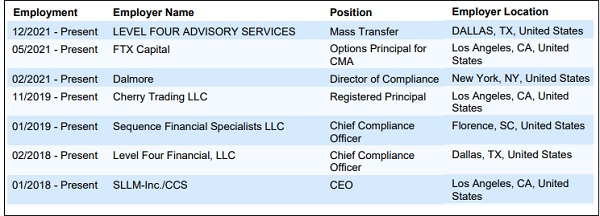
Adding to the bizarre nature of this firm, one licensed broker who FINRA lists as currently employed at FTX Capital Markets is Stacey Lynn Lavender (a/k/a Stacey Lynn Lavender-Mayes; a/k/a Stacey Lynn Mayes). FINRA shows Lavender simultaneously working at seven different firms. This includes serving as Chief Compliance Officer simultaneously at two firms: Sequence Financial Specialists LLC in Florence, South Carolina and Level Four Financial LLC in Dallas, Texas. Lavender is also listed as a Director of Compliance at Dalmore in New York City; as the CEO at a firm called SLLM-Inc./CCS in Los Angeles; as a Registered Principal at Cherry Trading in Los Angeles; and as an Options Principal at FTX Capital Markets.

FINRA records indicate that both Cherry Trading and FTX Capital Markets show recent requests to have SEC terminate their registration as a broker dealer as well as requests to terminate their state licenses. FINRA also shows that Cherry Trading is majority owned by an individual named Seiji Kawajiri through a company called SK World Group 1.

Anyone who has ever held a securities license through a major retail brokerage firm, such as Merrill Lynch, Morgan Stanley or Wells Fargo, knows that one has to get special permission to engage in any employment outside of your brokerage firm. It is highly discouraged because it can lead to conflicts of interest and an inability for your firm to monitor these outside activities. The possibility that someone would be allowed to work in the critical position of Chief Compliance Officer and Director of Compliance simultaneously at three firms while functioning as a CEO of another company, while finding time to be an options principal at a Sam Bankman-Fried operation, is beyond bizarre.

Lavender’s LinkedIn profile shows her working “full time” at Level Four Financial. Attempts to reach her by phone, in order to clarify the situation, failed. An email to her superior at Level Four Financial, inquiring if she is still employed there as Chief Compliance Officer, has yet to elicit a response.

Stacey Lynn Lavender Current Employment History at FINRA's BrokerCheck

Stacey Lynn Lavender’s Present Employers Listed at FINRA

Clearly, the American people still have very limited visibility on what Sam Bankman-Fried was up to in U.S. markets.

Related Articles:

No One Trusts the FTX Bankruptcy Case: News Outlets Intervene; Justice Department Trustee Demands Independent Examiner; SEC Orders Disclosures

Big Law Firm, Sullivan & Cromwell, Did Significant Legal Work for Bankrupt Crypto Exchange, FTX

LINK


Monday, March 30, 2020

Mortgage bankers say SEC needs to save them from wave of margin calls


Mortgage bankers say SEC needs to save them from wave of margin calls


NEW YORK — Mortgage bankers are sounding alarms that the Federal Reserve’s emergency purchases of bonds tied to home loans are unintentionally putting their industry at risk by triggering a flood of margin calls on hedges lenders have entered into to protect themselves from losses.
In a Sunday letter, the Mortgage Bankers Association urged the Securities and Exchange Commission and the nation’s main brokerage regulator to address the problem by telling securities firms not to escalate margin calls to “destabilizing levels.” The MBA, whose members underpin the housing market, asked the watchdogs to direct brokers to work constructively with lenders.
The rally in prices for mortgage-backed securities that’s been fueled by the Fed’s large-scale buying is “leading to broker-dealer margin calls on mortgage lenders’ hedge positions that are unsustainable for many such lenders,” the trade group wrote in its letter to SEC chairman Jay Clayton and Financial Industry Regulatory Authority president Robert Cook.
Finra declined to comment. An SEC spokeswoman didn’t immediately respond to e-mails seeking comment outside of normal business hours.

The Fed initiated its bond purchases earlier this month as the spread of the coronavirus hammered financial markets, causing liquidity to dry up and prices to plummet as the typical buyers of mortgage-backed securities fled. The pain mortgage lenders are now facing from their hedges shows that government intervention can trigger unintended consequences.
The MBA letter, signed by chief executive Robert Broeksmit, said that when lenders issue new loans, they often simultaneously short mortgage-backed securities. This is done because the loans might fall in value before a banker can sell them to Fannie Mae and Freddie Mac. The bet against mortgage bonds helps protect the lender if that happens, Broeksmit wrote.
Now, with lenders getting crushed on these hedges, they’re facing a wave of demands from brokers that they sell holdings or put more money in their trading accounts.
“Broker-dealers’ margin calls on mortgage lenders reached staggering and unprecedented levels by the end of the past week,” Broeksmit wrote. “The inability of a large set of responsibly-managed lenders to meet these margin calls would jeopardize the very objective of the Federal Reserve’s agency MBS purchases — the smooth functioning of both the primary and secondary mortgage markets.”
A surge in margin calls is also inflicting major pain on commercial real estate with the threat of widespread loan defaults prompting a wave of selling of commercial mortgage-backed securities. Colony Capital CEO Tom Barrack on Sunday called for a moratorium on margin calls and Fed buying to halt the sell-off for bonds tied to commercial properties.


This Weekend in Politics, Bulletin 441.

                                                                               LOTS OF POSTS IGNORED BY BLOGGER..... OR REMOVED ON THEIR WHI...