Showing posts with label FAIR. Show all posts

Wednesday, June 23, 2021

RSN: Jeff Cohen | Liberal Media Propaganda Tells the World: America Is First


Reader Supported News
22 June 21


Please Help Ensure That RSN Will Be Around

Reader Supported News: For the 99%.

Most of us know that the mainstream media, primarily owned by the right, rigidly controls information and the message. It’s become increasingly difficult to get the truth, backed by scientific thinking, logic, and common sense.

Reader Supported News provides reliable, factual information and informed opinion – and offers a forum to intelligently discuss the major issues that affect our lives.

Please help ensure that RSN will be around for a long, long time to do its job for us. Please consistently support RSN to the best of your ability, at whatever level you can afford.

Carol, RSN Reader-Supporter

Sure, I'll make a donation!


Update My Monthly Donation


If you would prefer to send a check:
Reader Supported News
PO Box 2043
Citrus Hts, CA 95611


Reader Supported News
22 June 21

It's Live on the HomePage Now:
Reader Supported News


COME ON FOLKS, WORK WITH US ON DONATIONS: We are scratching and clawing for basic funding. What this organization needs to function is extraordinarily minimal. Take a moment to chip in. Your help really does matter. Sincerely. / Marc Ash • Founder, Reader Supported News

Sure, I'll make a donation!


RSN: Jeff Cohen | Liberal Media Propaganda Tells the World: America Is First
President Biden. (photo: Sarah Silbiger/NYT)
Jeff Cohen, Reader Supported News
Cohen writes: "If you get your foreign policy news today from CNN or MSNBC or NPR or similar outlets, then you're bombarded hour after hour with the idea that the United States has the absolute right to impose sanctions on country after country overseas if they violate human rights or are not democratic."

To give just one example: On Sunday, CNN anchor Dana Bash grilled Biden National Security Adviser Jake Sullivan on why the White House is not imposing yet more sanctions on Russia (and China) and why Team Biden was “giving in to Russia” on the gas pipeline to Western Europe. Sullivan was emphatic in insisting that sanctions had been imposed and more were on the way – boasting that Biden had grabbed even more presidential power to sanction Russia through an executive order.

I’m old enough to remember the superiority complex behind the liberal media propaganda during the Cold War with the Soviet Union – while U.S. foreign policy, in the name of democracy, massacred millions of people of color, mostly civilians, across the globe … from Asia to Southern Africa to Latin America.

In the middle of the Cold War, when Martin Luther King Jr. denounced the U.S. government as “the greatest purveyor of violence in the world today” and criticized U.S. hubris fueling the Cold War, liberal outlets like The New York Times and The Washington Post furiously condemned King – in essence, telling him to leave foreign policy to “us white guys.”

When it came to relations between nations, King criticized the “arrogance” of our country and the West in “feeling that it has everything to teach others and nothing to learn from them.”

Jump to the present, and you see the same arrogance in liberal U.S. media: We have everything to teach others – whether Russia or China or Iran or Venezuela or any of the dozens of countries the U.S. is imposing sanctions on, sometimes deadly sanctions.

Let’s do today what MLK urged us to do back then: look at ourselves in the mirror.

There is no more precious human right than the right to be free from jail or prison. So it’s a human rights violation of epic proportions that the United States has more than 2 million people incarcerated, way more than any other country, including China with its much huger population. Our people behind bars are disproportionately Black or Brown people. Liberal media have recently learned how to throw around the term “systemic racism,” but – when lecturing other countries – they deftly forget that mass incarceration is an affront to notions of “democracy” and “human rights.”

It’s a human right to be able to live without the fear of violence. Yet no other major country has so much gun violence, with hundreds shot every day – one of many problems that U.S. “democracy” can’t even address, let alone solve.

One might have hoped that recent U.S. history would have humbled liberal media pundits about their cherished belief in the USA as a “beacon of democracy” to the world – and therefore, our sacred right to punish other countries that don’t measure up.

After four years of Trump and a Trump movement that has captured almost half the electorate … after our corporatized media system lavished massive amounts of free airtime on candidate Trump in 2015 (CNN, CBS, ABC, etc.) because it was good for network profits … after years of a dysfunctional political system in Washington that serves the rich and giant corporations when not in total gridlock … after the Supreme Court got packed with right-wing judges through legislative double-dealing … after ever-increasing voter suppression targeting people of color and young voters … one would hope for some humility about “U.S. democracy.”

Yet liberal media pundits keep propagandizing the public about the USA’s right to lecture foreign countries over their political systems, and to severely punish them (leaving aside allies like Colombia, Saudi Arabia, and Israel, of course). Never mind the horrific consequences to civilians overseas when deprived of life-sustaining imports.

These liberal news outlets may despise Trump, but they sure put “America first” when it comes to policing the rest of the world. And they seem intent on instigating new Cold Wars with Russia and China.

It’s indefensible that Putin has imprisoned and nearly killed opposition figure Alexei Navalny, and it’s important for the U.S. government to publicly and privately speak out against such behavior. The same goes for China’s terrible mistreatment of Uyghur Muslims. But while speaking out with self-awareness and humility about human rights, the U.S. also needs to work collaboratively with Russia on cyber-peace and disarmament (the two nations have 90 percent of the world’s nuclear weapons) and with China on climate change. Without collaboration, the world is doomed.

The liberal view on the original Cold War with Russia is that “WE WON.” The progressive view is that everybody lost, especially Global South countries like Vietnam, Iran, Indonesia, Guatemala, and El Salvador that were victimized by U.S. invasions, coups, and proxy wars supported by both Democrats and Republicans.

I have a bold idea you won’t hear on CNN or MSNBC: Instead of lecturing and sanctioning the rest of the world, let’s get our own house in order. Let’s lead by example. On democracy, instead of sanctioning other countries, Team Biden should rally Democrats to sanction the U.S. Senate by establishing majority rule through an end to that Jim Crow-legacy, the filibuster. And Biden should address the right-wing-packed Supreme Court.

On human rights, let’s cut the U.S. military budget in half, and provide things that other advanced countries already have: universal healthcare and free or near-free higher education. Let’s invest billions of dollars in poor and working-class communities, and end the horrors of mass incarceration. Let’s cancel student debt that burdens 45 million people – and, at long last, seriously tax U.S. oligarchs and corporations to pay for these investments (and perhaps worry less about sanctioning Russian oligarchs).

Joe Biden likes to think of himself as a foreign policy specialist. If he listens to the laptop warriors in the media who want him to “pivot” belligerently toward China and Russia, an adventurist foreign policy will undermine the Democratic domestic agenda and doom his administration quicker than you can say “LBJ.” And Republicans will retake Congress.

Biden can succeed only if he ignores the media hawks and focuses laser-like on domestic policy – galvanizing his party toward a serious FDR-like effort to address human rights and climate change with major federal programs uplifting working class people of all colors.


Jeff Cohen is co-founder of RootsAction.org, a retired journalism professor at Ithaca College, and author of “Cable News Confidential: My Misadventures in Corporate Media.” In 1986, he founded the media watch group FAIR

Reader Supported News is the Publication of Origin for this work. Permission to republish is freely granted with credit and a link back to Reader Supported News.

READ MORE


Contribute to RSN

Update My Monthly Donation


Sunday, March 14, 2021

FAIR: Murdoch Paper Gives Away the Game: Cuomo Is on Their Side


FAIR
View article on FAIR's website

Murdoch Paper Gives Away the Game: Cuomo Is on Their Side


There is certainly a tad of glee in the right-wing media over multiple scandals surrounding New York Gov. Andrew Cuomo. Fox News media critic Howard Kurtz (3/7/21; The Wrap, 3/7/21), who spent years attacking the media for being too tough on the Trump administration (CNN, 1/23/18), lashed out at networks like CNN and MSNBC for coming late to both the sexual harassment allegations and nursing home scandal. He summed up centrist journalists' supposed attitude: "‘Nothing to see here, let’s move right along, and hmm, I wonder what Donald Trump is up to." The National Review (3/6/21) used the Cuomo scandals to paint a picture of a corrupt state ruined by Democratic governance.

Supporters of the Republican Party certainly have an interest in bringing Cuomo, perhaps the best-known Democratic governor, down a notch. Meanwhile, some liberals have reverted to their own conspiracy theories, imagining that Donald Trump is somehow concocting these scandals to his own benefit (Daily News, 3/9/21)—a fantasy we might call Cuo-Anon.

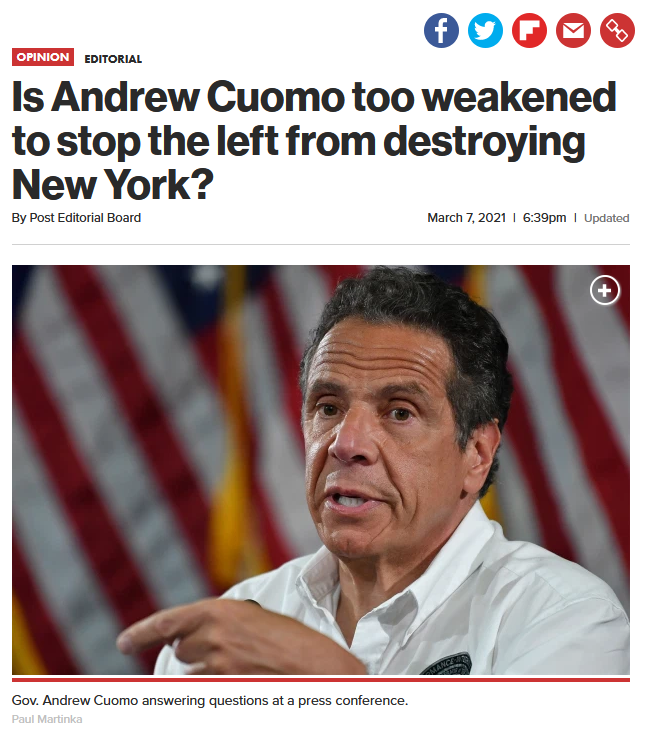
New York Post: Is Andrew Cuomo too weakened to stop the left from destroying New York?

Far from gleeful at Gov. Andrew Cuomo's scandals, the New York Post (3/7/21) seems distraught that the state is losing the "best hope for staving off left-wing lunacy."

But the usually histrionic New York Post editorial board (3/7/21) actually had a counter-intuitive take on the Cuomo scandals that illuminates the complex politics. "Is Andrew Cuomo Too Weakened to Stop the Left From Destroying New York?" the headline declared—suggesting that the editorial writers counted themselves among the "moderate New Yorkers who once bought Cuomo’s argument that he’s their best hope for staving off left-wing lunacy."

The Murdoch-owned paper pointed out that the story is unfolding as the governor maintains his dedication to austerity, while progressive and socialist lawmakers

want higher taxes and other burdens on business—likely triggering a rush to the Empire State’s exits now that the lockdowns have proved that it’s easy to work thousands of miles from Wall Street.

The Post editorial added that it is not a “coincidence that the loudest voices in his own party condemning the governor have been the lefties”—since, as the governor has “resisted their pernicious policies in the past, they want him sidelined.” The Post editorial board can already see the governor caving to the pressure: “Ominously, the governor’s pretending the cash bath from Washington isn’t enough, and already saying tax hikes are on the table,” the editorial said.

The Post (3/8/21) also gave room to E.J. McMahon of the right-wing Manhattan Institute, who worried about the governor losing political power in the face of “pressure from ‘tax the rich’ zealots.” Citing the conventional wisdom that New York's governor is supposed to be a prudent executive who says no to the people’s representatives in the statehouse—“the governor is the only player in this game with the incentive to care about the long-term outlook”—he worried “whether Cuomo will continue to care much about the long term when he is looking more and more like a lame duck.”

Get past the pro-rich rhetoric, and there’s some clear political truth in here. Far too much of the media narrative around Cuomo is whether he is the liberal version of Trump, or if his scandals expose some sort of liberal hypocrisy. But these aren’t the right questions to be asking.

What the Post points out, rightly, is that while Cuomo, the son of former Gov. Mario Cuomo and brother of CNN’s Chris Cuomo, is a well-known figure in US liberalism by familial association, his decade in office has been marked by resisting taxation of the wealthy and an adversarial stance against public sector labor unions. Ask any tenant organizer, Occupy Wall Street activist or member of the socialist caucus in the legislature, and they’ll tell you the story of a governor who has resisted any kind of legislation that would require new state spending.

The Post is letting slip that although the media tend to view the Cuomo scandals as a Democratic problem, the political and economic stakes here involve an aggressively center-right executive against a liberal legislature.

After all, this is the same governor who strongly supported the draconian Taylor Law, which forbids strikes by public employees, threatened public sector workers with layoffs if they did not accept wage freezes, sought to further privatize in-home care for the elderly and disabled and attempted to end the state’s fusion voting system in retribution against the labor-backed Working Families Party after it endorsed his primary opponent, Cynthia Nixon, in 2018.

The New York Daily News (6/3/19) reported that the governor’s “rocky relationship with organized labor has hit a few rough patches early in his third term as tensions boiled over following the breakdown of the Amazon deal, a bitter fight over campaign finance reform and overtime issues at the MTA.” Cuomo was also a huge backer of the controversial plan for a heavily subsidized headquarters for Amazon in Queens, which was ultimately quashed by progressive Democrats and labor activists. “[Cuomo’s] office honed in on the role of the Retail, Wholesale and Department Store Union (RWDSU), accusing the union of overplaying its hand in pushing the ecommerce giant to allow workers to organize,” the Daily News said.

In this sense, Cuomo has been the kind of anti-spending, pro-business executive that moderate Republicans dream about. Cuomo has relied on one of the state’s most powerful business sectors, real estate, for campaign support (New York Times, 1/28/10) and has relied on big business contributions in general (Rochester Democrat and Chronicle, 10/18/18).

That the right-wing Post editorial board fears that a weakened Cuomo would embolden an ascendant left clarifies how Cuomo has governed from the center and center right. Sometimes the Post, though rightly regarded as a sensationalist rag, can get the truth across better than the centrist corporate press.


FAIR: Coverage of Texas' Declaration of Covid Victory Left Out Rapidly Rising Toll


FAIR
View article on FAIR's website

Coverage of Texas' Declaration of Covid Victory Left Out Rapidly Rising Toll


Texas lifted its mask mandate on March 10, allowing all businesses to open at full capacity, one week after Gov. Greg Abbott's March 2 announcement that "it is clear from the recoveries, vaccinations, reduced hospitalizations and safe practices that Texans are using that state mandates are no longer needed."

NPR: Texas And Mississippi To Lift COVID-19 Mask Mandates And Business Capacity Limits

NPR (3/2/21) reported that Texas and Mississippi "have seen declines in the average daily number of new cases of Covid-19"—emphasis on the "have," since the declines had stopped and cases were going back up by the time their governors announced an end to mask mandates.

Mississippi Gov. Tate Reeves made a similar announcement the same day. Both cited declining hospitalizations in their states and vaccine distribution as their rationale, which was repeated uncritically by some corporate media outlets reporting on the decision, including NPR and USA Today.

What these outlets failed to mention is that Covid-19 cases and deaths were rising significantly in Texas and Mississippi in the days leading up to their governors' announcements. In Texas, average daily new cases rose from 4,252 on February 20 to 7,754 on March 1—an increase of 82% in nine days. Average daily deaths went from 127 on February 20 to 230 on March 1, an 81% rise.

Mississippi—whose per capita rate of Covid infection is similar to that of Texas—saw average daily new cases rise 42% in just six days before Reeves' declaration, with deaths rising 68% over the same period.

What's more, the test positivity rate in both states also put them among the 10 worst in the country at the time—as did their vaccination rates. At the time of Abbott’s announcement, Texas ranked last among the states in vaccines administered per capita. (Currently Texas is still last in terms of the proportion of its population fully vaccinated.)

But rather than pointing out that these states' relaxation of Covid restrictions were coming in the midst of an alarming upswing in both cases and deaths, NPR (3/2/21) offered selective numbers that supported the governors' arguments. After quoting both governors and a brief rebuttal from CDC director Rochelle Walensky, the report continued:

Both states have seen declines in the average daily number of new cases of Covid-19. In the past week, the New York Times reports, Texas has seen an average of 7,693 cases per day—down 18% from the average two weeks earlier. The average daily number of deaths has declined by 13% over that period.

In Mississippi, the declines have been more pronounced. The state's average daily number of new cases declined by 27% over the average two weeks earlier, and average daily deaths declined by 34% in that same period.

NPR picked a timeframe that gave the impression that cases were falling at the time the governors made their announcements. While average new cases were indeed lower than they had been at the peak of the pandemic in January, the declines had hit a trough, and case numbers were rising again when the governors announced their elimination of public health measures.

91-DIVOC: Average New Deaths from COVID-19, Texas and Mississippi

By the time the governors of Texas and Mississippi announced an end to mask mandates, both average new cases of Covid-19 and average new deaths (shown in chart from 91-DIVOC) had been rising in both states for roughly a week.


USA Today: Five states are rolling back mask mandates. More could be on the way. Here's what it could mean for all of us.

USA Today (3/3/21) wrote that on March 2, "275 new coronavirus deaths were reported and more than 7,200 people tested positive for the virus." It then noted that positive tests were much higher in January—but didn't point out that Covid deaths were about the same in January.

USA Today (3/3/21) gave more space to public health experts critical of the governors' decision, but still included this data purporting to offer more context:

On Tuesday, 275 new coronavirus deaths were reported and more than 7,200 people tested positive for the virus. That is far less than the 22,000 people a day who were testing positive in January.

But 275 deaths is not many fewer than the 290 people on average who died from Covid per day in Texas in January.

In another brief USA Today article (3/2/21), headlined “Texas Isn't Alone. These 15 States Also Do Not Currently Have a Statewide Mask Mandate,” the paper allowed Abbott's argument to stand without criticism:

Abbott said on Tuesday that it is time for the state to completely reopen, as Covid-19 hospitalizations are declining across the state and more people are being vaccinated against the coronavirus.

Again, readers would never guess that people are being vaccinated in Texas at a slower rate than in any other state.


Wednesday, March 10, 2021

FAIR: UN Rebuke of US Sanctions on Venezuela Met With Stunning Silence


FAIR
View article on FAIR's website

UN Rebuke of US Sanctions on Venezuela Met With Stunning Silence


Alena Douhan

UN investigator Alena Douhan (2/12/21) "urges the US government to end the national emergency regarding Venezuela."

Alena Douhan, the UN special rapporteur on the negative impact of unilateral coercive measures on the enjoyment of human rights, published her preliminary report on February 12 on the impact of US and European sanctions on Venezuela.

The report laid bare how a years-long campaign of economic warfare has asphyxiated Venezuela’s economy, crushing the government’s ability to provide basic services both before and during the Covid-19 pandemic.

“The [Venezuelan] government’s revenue was reported to shrink by 99%, with the country currently living on 1% of its pre-sanctions income,” Douhan found, impeding “the ability of Venezuela to respond to the Covid-19 emergency.”

Douhan thus urged

the governments of the United Kingdom, Portugal and the United States and corresponding banks to unfreeze assets of the Venezuela Central Bank to purchase medicine, vaccines, food, medical and other equipment.

The campaign to overthrow the Venezuelan government, Douhan added, “violates the principle of sovereign equality of states and constitutes an intervention in domestic affairs of Venezuela that also affects its regional relations.”

Douhan’s report follows a Center for Economy and Policy Research (CEPR) paper that estimated that sanctions were responsible for over 40,000 deaths in Venezuela in 2017–18  (FAIR.org, 6/14/19). Though sanctions were not the only factor driving economic hardship, CEPR found that they

exacerbated Venezuela’s economic crisis and made it nearly impossible to stabilize the economy, contributing further to excess deaths. All of these impacts disproportionately harmed the poorest and most vulnerable Venezuelans.

Like the CEPR study, Douhan’s report has been categorically ignored across establishment media.

By omitting the devastating impact of sanctions, corporate media attribute sole responsibility for economic and humanitarian conditions to the Venezuelan government, thereby using the misery provoked by sanctions to validate the infliction of even more misery.

Collective punishment

Darth Vader

Darth Vader: seen by the US as a role model.

US and European officials have long admitted that the sanctions regime against Venezuela is collective punishment by design. Speaking to G20 foreign ministers in May 2018, then–British Foreign Secretary Boris Johnson announced:

The feeling I get from talking to my counterparts is that they see no alternative to economic pressure—and it’s very sad, because obviously the downside of sanctions is that they can affect the population that you don’t want to suffer. But in the end things have got to get worse before they get better—and we may have to tighten the economic screw on Venezuela.

On March 22, 2019, a senior US government official bragged:

The effect of the sanctions [against Venezuela] is continuing and cumulative. It’s sort of like in Star Wars when Darth Vader constricts somebody’s throat, that’s what we are doing to the regime economically.

A year later, as the Covid-19 virus spread globally, US Attorney General William Barr gloated that the pandemic was

good timing, actually.… The [Trump] administration is taking a kind of "kick them while they’re down" approach, seemingly with the hope that by piling on sanctions and other actions, the administration can capitalize on the virus in Iran and Venezuela to spur greater public opposition to the incumbent governments and perhaps regime change.

“Although sanctions do not seem to be physical warfare weapons,” the Lancet (3/18/20) noted, “they are just as deadly, if not more so. Jeopardising the health of populations for political ends is not only illegal but also barbaric.”

Media silence

Many Western journalists, however, appear not to have seen these overt declarations of collective punishment against the Venezuelan population—a crime against humanity under Article 7 of the Statute of the International Criminal Court, according to former UN Expert Alfred de Zayas.

Guardian: 'Mask, gown, gloves – none of that exists': Venezuela's coronavirus crisis

The Guardian (3/17/20) gets blame for Maduro into the subhead--but doesn't mention sanctions until the penultimate paragraph.

Loath to abandon belief in the fundamentally benign nature of Western foreign policy, corporate scribes have typically presented the devastating effects of sanctions as a mere accusation of Nicolás Maduro. "Maduro...said US sanctions were hurting his administration’s ability to buy medicines and foodstuffs" was the next-to-last paragraph of a Guardian piece (3/17/20) on Covid in Venezuela whose subhead read, "Continuing chaotic situation under Nicolás Maduro leaves hospitals and health services desperately unprepared."

Often, they fail to mention sanctions at all. In June 2019, for instance, the Guardian’s Tom Phillips reported that “more than 4 million Venezuelans have now fled economic and humanitarian chaos,” citing would-be coup leader Juan Guaidó’s claim that the country’s economic collapse “was caused by the corruption of this regime,” without making any reference to Washington’s campaign of economic warfare.

Keeping with tradition, Douhan’s damning report has been met with stunning silence by establishment media outlets. Neither the Guardian, New York Times,  Washington Post nor BBC reported on Douhan’s findings, leaving the task primarily to alternative media (Venezuelanalysis, 2/15/21; Canary, 2/13/21).  (CNN—2/13/21—had an exceptional report focused on the UN report, which noted Douhan's statement that sanctions "constitute violations of international law.")

The issue is not that Western media are uninterested in Venezuela. In February 2019, the month after Juan Guaidó declared himself president, the Guardian published 67 separate articles about Venezuela, regularly citing the UN on Venezuela's economic and humanitarian conditions—signaling Maduro’s sole responsibility for a crisis about which something must surely be done.

For example, the Guardian (2/27/19) reported in 2019, “The UN’s political and peace building chief, Rosemary DiCarlo, depicted a devastating collapse in Venezuela’s health system”—while making no reference to sanctions.

Similarly, the New York Times, whose editorial board had supported 10 out of 12 US-backed coups in Latin America since 1954, has regularly covered the deteriorating economic situation in Venezuela with—at best—only fleeting reference to US and European sanctions.

The New York Times (12/5/20), for instance, described how “Yajaira Paz, 35, has lost nearly everything" to the Venezuelan economic crisis: “her mother, dead from a heart problem she could not afford to treat; her brothers, to migration; her faith in democracy, to the nation’s crippled institutions” — omitting any mention of sanctions.

WaPo: To Survive Pandemic Food Shortages, Venezuelans Go Back to the Land

The Washington Post Magazine (3/3/21) reports that "most Venezuelans eat fewer than two meals a day"--but doesn't mention that it's US government policy to make their lives worse.

The Washington Post Magazine (3/3/21) ran a similarly emotive article, noting how “the pandemic wore away even more access to basic necessities in a country racked by deepening poverty and crisis,” blaming “the national mismanagement of resources” and, again, ignoring the existence of sanctions.

Corporate media thus consistently emphasizes the gravity of Venezuela’s humanitarian situation while overlooking crucial evidence on the catastrophic impact of sanctions, fortifying the very narratives deployed to justify the economic siege against Venezuela.

The collective silence over Douhan’s report is only the most recent case of propaganda by omission on Venezuela. By refusing to acknowledge Washington and London’s fundamental role in making Venezuela’s “economy scream,” corporate media play a key part in manufacturing consent for regime change.


Thursday, March 4, 2021

FAIR: Humanitarian Imperialism


FAIR
View article on FAIR's website

Humanitarian Imperialism


Aversion to military intervention has been the default position of the left for at least half a century—certainly since the huge protests against the Vietnam War. Washington planners lamented the development of the so-called “Vietnam Syndrome”—a widespread progressive hostility towards US interventions (invasions, bombings, coups or economic warfare) around the world. A 2018 survey found the public still infected, with over two-thirds in support of limiting military action overseas, including 78% of Democratic voters.

President Joe Biden’s record of support for foreign intervention spurns that progressive tradition. As chair of the Senate Foreign Relations Committee, Biden played a key role in selling the Iraq invasion to both Democratic colleagues and a skeptical public. He was also vice president in an administration that was bombing seven countries simultaneously by its end in 2016, and was a strong voice within the administration in favor of intervention (Foreign Policy, 2/25/11).

Worse, many of Biden's cabinet picks have alarmed antiwar and human rights activists. His director of national intelligence, Avril Haines, was instrumental in covering up the US torture program, while his choice for head of USAID, Samantha Power, supported both the Iraq and Libya wars, arguing that the US must intervene on humanitarian grounds.

CNN: Biden sends a message to Iran, but with a scalpel instead of a sledgehammer

CNN (2/26/21) praises Joe Biden for killing people with restraint.

Earlier this week and barely a month into his presidency, Biden launched an airstrike on Syria, killing a reported 22 people, in supposed response to a rocket attack on a US base near Erbil, Iraq, that killed one US contractor. CNN international security editor Nick Paton Walsh (2/26/21) applauded the move, claiming Biden had successfully “sent a message” to Iran while being as “minimally lethal” as possible. For CNN, Biden had “used a scalpel instead of a sledgehammer.” Bloomberg columnist Bobby Ghosh (2/26/21) was similarly delighted, lauding the president’s unwillingness to tolerate Iranian “aggression,” claiming that this was sure to snap Iran out of its “sense of impunity.”

If history is any judge, further aggressive actions will also be met with approval by corporate media, who have continually found creative ways to pitch such actions to the traditionally anti-interventionist left, primarily through the use of progressive language to justify Washington’s global agenda.

Media are experts in using progressives’ empathy and compassion against them, presenting them carefully selected images and stories of suffering around the world, and suggesting that US military power can be used to alleviate it. As such, intervention is sold to the US left less on the basis of fear than of pity.

But when, as in the examples below, US actions make the situation worse for the peoples affected, the corporate press is careful to ignore or gloss over that suffering, or at least not present it as a direct consequence of US meddling in other nations’ affairs.

Not an invasion, a 'no-fly zone'

PRI: Why Obama should bomb Libya. Now.

PRI (3/8/11): "Military action...must begin quickly to prevent Libya and the world from becoming an even more dangerous place."

In the run up to the 2011 NATO intervention in Libya, media tried hard to sell the concept of a supposedly “humanitarian intervention.” “Why Obama should bomb Libya. Now,” ran Public Radio International’s headline (3/8/11). The US must act immediately to “bring to justice this brutal kleptocrat” (Moammar Gadhafi) who was attacking his own people, it argued. Without NATO action, it insisted, “a humanitarian disaster could soon unfold,” and failing to intervene would constitute a “victory for dictators across the globe.”

The New York Times (3/18/11) reported that three women close to Obama—Hillary Clinton, Susan Rice and Samantha Power—were teaming up to “stop a looming humanitarian catastrophe in Libya.” Pro-intervention human rights lawyers like Geoffrey Robertson waxed lyrical about how the West’s fighter jets and cruise missiles would bring peace and prosperity to Libya (London Independent, 3/5/11, 10/23/11). “The civilised world has the right, and duty, to intervene. Failure may mean the mass murder of innocents,” he insisted (Sydney Morning Herald, 3/7/11).

In an article titled “Libya: The Case for US Intervention,” Time (3/7/11) insisted that any action would be focused not on overthrowing Gadhafi, but merely on establishing a “no-fly zone” to stop Gadhafi killing more civilians. Meanwhile, the Atlantic (3/10/11) published a list of “16 Ways the US Can Help Libya,” which included a number of military options. Doing nothing, it conceded in the final sentence after 1,700 words of regime change propaganda, was “also an option.” But, it told readers, that might be “the riskiest option of all.”

Of course, the “no-fly zone”—sold as an attempt to stop Libyan jets bombing their own country—quickly turned into a full-on military attack, with NATO air power driving Gadhafi into the hands of militia forces that brutally killed him. "We came, we saw, he died," Secretary of State Hillary Clinton laughed to a CBS reporter (10/20/11) when she heard the news.

NATO's intervention left much of the country destroyed and in the hands of ISIS, replete with slave markets. Yet when reporting on this fact, the corporate press were careful to erase NATO’s role in all of this (FAIR.org, 11/28/17), thereby helping make sure the Vietnam Syndrome did not metastasize into the Libya Syndrome. Seven years after NATO destroyed Libya's government and left the country in the hands of feuding warlords, the New York Times (5/3/18) offered a multimedia tour of a ruined Benghazi, ostensibly answering the question, "How did the city come to this?”—and never once mentioned the NATO assault.

Behind closed doors, however, the "humanitarian intervention" crowd championed in media was far more frank about its motives, sounding as crass and bloodthirsty as Donald Trump. Leaked emails show that Neera Tanden, the president of the liberal Center for American Progress, was demanding that the US bomb Libya and make them pay us back for the pleasure: “We have a giant deficit. They have a lot of oil.... Having oil-rich countries partially pay us back doesn’t seem crazy to me,” she wrote (Intercept, 11/5/15). Tanden was Biden’s choice to direct the Office of Management and Budget (FAIR.org, 2/24/21), a nomination now withdrawn due to her history of intemperate tweeting.

If only US intervened more

The Guardian’s editorial board (9/3/15) denounced Western inaction in Syria, while demanding “much more must be done” to help refugees in the Middle East. “Compassion is necessary, and there are hard decisions to be made about Europe’s place in the world,” it argued, before clearly implying what sort of solution it wanted to see. “The refusal to intervene against Bashar al-Assad gave the Syrian president permission to continue murdering his people,” it wrote, suggesting that only “limited air strikes” would be inadequate.

WaPo: The horrific results of Obama’s failure in Syria

Washington Post columnist Michael Gerson (9/3/15) declared that in Syria, "Inaction was a conscious, determined choice on the part of the Obama White House"—despite the fact that Obama's CIA was spending $1 billion a year to overthrown the Syrian government (Washington Post, 6/12/15).

On the same day, the Washington Post (9/3/15) went further. In a column headlined “The Horrific Results of Obama’s Failure in Syria,” columnist Michael Gerson bemoaned that “relatively small actions might have reduced the pace of civilian casualties in Syria.” “How hard would it have been,” he asked, to order one more military intervention or some airstrikes? This would have swung the balance to what he called “more responsible forces.” Whether these “responsible forces” were the same as the “moderate rebels” his newspaper later admitted were “intermingled” with Al Qaeda/Al Nusra (Washington Post, 2/19/16) was not made clear. Instead, Gerson concluded, all we got was four years of a "pantomime of outrage"; a “sickening substitute for useful action.”

In reality, Obama was intervening heavily in Syria. The Post (6/12/15) itself had noted that the CIA was spending $1 billion per year (1/5th of its entire budget) on training, arming and fielding 10,000 of those “moderate rebels.” The Pentagon had also spent around half a billion dollars on a similar endeavor. There were also an estimated 1,000 US troops occupying Syria (FAIR.org, 9/5/15, 4/7/17).

Yet the “Obama did nothing” line continued into the Trump era, with the Associated Press (4/5/17) reporting:

After warning Assad that a chemical attack would cross a red line and trigger US action, Obama failed to follow through. Rather than authorizing military action against Assad in response to a sarin gas attack that killed hundreds outside Damascus, Obama opted instead for a Russia-backed agreement to remove Syria’s chemical weapons stockpiles.

That was seen internationally as a major blow to US credibility and, for Obama’s critics, a prime example of weak leadership.

Thus a decision to favor diplomacy over potentially triggering World War Three was presented as an inherent “failure” of a “weak” Obama administration.

And when Trump took a more warlike stance on Syria, authorizing airstrikes on the country in 2017, corporate media went from resistance to assistance. A FAIR study (4/11/17) found that 39 of the top 100 US newspapers by circulation published editorials praising the decision, with only one (Houston Chronicle, 4/7/17) offering limited pushback on technical grounds. Meanwhile, Brian Williams, anchor on the supposedly adversarial network MSNBC (4/6/17), seemed to reach a higher plain of ecstasy watching Trump commit a major international war crime:

We see these beautiful pictures at night from the decks of these two US Navy vessels in the eastern Mediterranean. I am tempted to quote the great Leonard Cohen: "I am guided by the beauty of our weapons." And they are beautiful pictures of fearsome armaments.

L'impérialisme humanitaire 

Newsweek: France to the Rescue: The Good Things About the Mali Intervention

Bernard-Henri Lévy in Newsweek (1/18/13): "For all those who think that democracy should not stop at the border any more than terrorism does, the French intervention is an undeniable victory."

Media will also promote military intervention by foreign states, if the US government approves of it. A case in point was the French invasion of Mali in 2013. “France Comes to the Rescue of Mali,” thundered a Washington Post editorial (1/11/13). “For months, it has been evident to many global observers that a military intervention would be necessary,” it began, insisting that the country “must be rescued from becoming a failed state and a haven for the Islamic radicals.” It failed to mention that Mali was being overrun by jihadist forces precisely because of the already discussed French and US actions in nearby Libya.

An NPR segment (2/4/13) also implied that France’s actions were unimpeachable. When one guest suggested that a “cynical” position would be that French President François Hollande did it primarily to protect his ally Niger and to boost his ratings, this was denounced. The idea that this could be something more cynical, like a colonialist takeover, was summarily rejected, since France was invited to take action by the Malian government. Indeed, one guest on the program had just written an article called “The End of Neocolonialism.”

Newsweek (1/18/13) also applauded the move, running a piece by Bernard-Henri Lévy claiming it “restates the prominent role of France in the front lines of the struggle for democracy.” Complicating the picture was the bothersome fact that France was actually supporting a military dictatorship that had overthrown a democratically elected government less than a year previously. This conundrum was solved by not mentioning it.

Stop hitting yourself

Venezuela has been the target of more than two decades of US regime change operations, all met with virtually unanimous approval from corporate media (FAIR.org, 11/1/05, 5/16/18, 4/30/19). Chief among the cheerleaders has been the Washington Post. Its board puts out a constant flow of pro-regime change editorials (e.g., 4/14/02, 6/2/16, 6/30/17, 12/7/20), ignoring the effect US sanctions have had in devastating the country.

WaPo: Venezuela’s lawless regime staggers toward a coup

The Washington Post's caption (7/27/17) translates graffiti calling President Nicolás Maduro a "murderer," but not the homophobic slur that follows it.

A typical example of this was a 2017 editorial (Washington Post, 7/27/17) that claimed that the “once-prosperous oil-producing nation has descended into political chaos and humanitarian crisis over the past several years.” The culprit, for the Post, was clear: it was the “Maduro regime”—that is, the government of President Nicolás Maduro—that “bears exclusive blame” for the “catastrophic economic conditions it has created.” The US role, it told readers, had been “consistently inadequate—too little and too late,” although it praised Trump for further sanctioning the country, insisting that he was only targeting “senior Venezuelan officials involved in drug trafficking and the suppression of democracy.”

In reality, Trump’s sanctions were aimed at the “poor and most vulnerable classes,” according to the United Nations. A study (4/25/19) by the Washington-based Center for Economic Policy Research (CEPR) later estimated that the new sanctions the Post had cheered about were responsible for the deaths of more than 40,000 Venezuelans between August 2017 and the end of 2018 alone.

The report could have been used by liberal outlets to hammer Trump. But the organizations that reported on CEPR’s findings were few and far between, and mostly limited to small, foreign sources (FAIR.org, 6/26/19).

The humanitarian impact of US sanctions has also been hidden by media when it comes to Lebanon (FAIR.org, 8/26/20) and Iran (FAIR.org, 4/8/20), allowing the corporate press to represent those countries’ struggles as purely a result of their governments, thus further fueling calls for something to be done—that "something" far more likely to be increased intervention than an end to economic warfare. In essence, the sanctions put in place the economic conditions necessary for corporate media to demand intervention on humanitarian grounds.

Amazingly, bombs, missiles, coup attempts and sanctions don’t help foreign countries flourish. On the contrary, they are often the catalysts for political, social or humanitarian situations to worsen. These conditions, in turn, are subsequently used as more justification for increased sanctions or bombings. It is a beautiful system: when the cure causes the disease, you will never run short of demand for your medicine.

The forgotten war

Perhaps the most blatant example of ignoring the effect of US actions is Yemen, the country the United Nations has called, for some years now, the “world’s worst humanitarian crisis.” Some 24 million people (80% of the population) require   assistance, as cholera and other diseases run rampant. If humanitarian intervention is necessary anywhere, it is here.

Unfortunately, the US is already intervening—to make matters much worse. For years, the US has been arming, training and supporting the Saudi-led coalition’s onslaught, largely aimed at the civilian population, signing a reported $350 billion arms deal with Riyadh, and even helping with target acquisition for Saudi bombers. The Saudis have deliberately targeted civilian infrastructure; since the war began in 2015, they have carried out an attack on medical or water facilities once every ten days, on average. The US has defended its ally at the UN, and even pressured member states into reducing their donations to the relief effort. As a result, aid to Yemen halved to just 25 cents per person per day in 2020.

Yet outlets with comparatively progressive audiences have not been informing their audiences of these facts, let alone calling for a humanitarian intervention. In fact, MSNBC went over one year without mentioning US involvement in the world’s bloodiest ongoing war. For comparison, over the same period, it ran 455 segments on Trump’s connections to porn star Stormy Daniels (FAIR.org, 7/23/18). Yemeni journalists complain that the West sees Iraq and Syria as more “newsworthy” than the conflict raging further south, making it harder to find publishers for their work. A search for “Syria” on the websites of the New York Times, CNN or Fox News will elicit 3-4 times more results than one for “Yemen” over the same time period.

NBC

NBC (2/5/21) reported that "Saudi Arabia...has long been an important ally of the United States in the region, cooperating on counterterrorism, acting as a bulwark against Iran and presiding over crucial oil reserves."

Biden has announced a withdrawal of support for the Saudi offensive, a sign of what he modesty labelled America’s “moral leadership” of the world. “We shine the light, the lamp, of liberty on oppressed people,” the president said in a speech publicizing his new position, a stance that generated considerable praise (e.g., NBC News, 2/5/21; New York Times, 2/5/21; The Hill, 2/6/21).

Yet as Yemen-born academic Shireen Al-Adeimi (In These Times, 2/4/21) pointed out, Biden only committed to stopping support for “offensive operations,” while doubling down on Saudi Arabia’s right to “defend” itself from supposed Houthi aggression. This appears to be only a repositioning of Obama’s Yemen stance. Furthermore, helping Saudi Arabia “defend” itself could de facto support the offensive, as it will free up more Saudi units for offensive duties.

The point of the language of humanitarian intervention is to try to manufacture consent for regime change, war or sanctions on foreign countries among progressive audiences who would normally be skeptical of such practices. This is done through selective outrage, naked deception and the use of a new language of humanitarian intervention, pulling on the heartstrings of readers to get them to support fundamentally illiberal actions. Once it is no longer politically expedient, interest in the rights of others is dropped and the press turns its attention to the next story, leaving the survivors to pick up the pieces of their lives.


Next: The Tropes of Humanitarian Imperialism


Top News | 'He’s Not Going to Run Unopposed': Sanders Rejects Schumer for Majority Leader

                                                               LOTS OF POSTS IGNORED BY BLOGGER..... OR REMOVED ON THEIR WHIM! ALL POSTS ARE...