Showing posts with label KHMER ROUGE. Show all posts

Sunday, December 31, 2023

Henry Kissinger’s bombing campaign likely killed hundreds of thousands of Cambodians − and set path for the ravages of the Khmer Rouge

 
Henry Kissinger’s bombing campaign likely killed hundreds of thousands of Cambodians − and set path for the ravages of the Khmer Rouge


Henry Kissinger, who died on Nov. 29, 2023 at the age of 100, stood as a colossus of U.S. foreign policy. His influence on American politics lasted long beyond his eight-year stint guiding the Nixon and Ford administrations as national security adviser and secretary of state, with successive presidents, presidential candidates and top diplomats seeking his advice and approval ever since.

But his mark extends beyond the United States. Kissinger’s policies in the 1970s had immediate impact on countries, governments and people across South America, the Middle East and Southeast Asia. Sometimes the fallout – and it was that – lasted decades; in some places it continues to be felt today. Nowhere is that more true than Cambodia.

I’m a scholar of the political economy of Cambodia who, as a child, escaped the brutal Khmer Rouge regime with four siblings, thanks in large part to the cunning and determination of my mother. In both a professional and personal sense, I am aware of the near 50-year impact Kissinger’s policies during the Vietnam War have had on the country of my birth.

The rise of the murderous regime that forced my family to leave was, in part, encouraged by Kissinger’s policies. The cluster bombs dropped on Cambodia under Kissinger’s watch continue to destroy the lives of any man, woman or child who happens across them. Indeed, when the current U.S. administration announced its intention in 2023 to provide cluster bombs to Ukraine, the prime minister of Cambodia was quick to call out the lingering damage the munition causes.

‘Island of peace’

Counterfactuals are not the best tool of the historian; no one can say how Cambodia would have developed were it not for the Vietnam War and U.S. intervention in Southeast Asia.

But prior to the U.S. bombing of Cambodia, the country was touted as an “Island of Peace” by then-leader Prince Norodom Sihanouk, with a developing economy and relative stability.

After Cambodia gained independence from its French colonial masters in 1953, Sihanouk presided over what was seen as a golden age for Cambodia. Even Lee Kuan Yew, the founder of modern-day Singapore, visited Cambodia to learn lessons on nation-building.

The country’s independence from France did not require any hard fight. Neighboring Vietnam, meanwhile, gained independence only after the bitter anti-colonial First Indochina War, which concluded with a rout of French troops at Điện Biên Phủ in 1954.

However, Cambodia’s location drew it into the subsequent war between the newly independent communist North Vietnam and U.S.-backed South Vietnam.

Cambodia wasn’t officially a party in the Vietnam War, with Sihanouk declaring the country neutral. But Washington looked for ways to disrupt communist North Vietnamese operations along the Ho Chi Minh Trail – which cut across Cambodia’s east, with Sihanouk’s blessing, and allowed the resupply of North Vietnamese troops on Cambodian soil.

Kissinger’s ‘menu’

Kissinger was the chief architect of the plan to disrupt that supply line, and what he came up with was “Operation Menu.” The secret carpet-bombing campaign – with breakfast, lunch, dinner, snack, dessert and supper representing different targets and missions within Cambodia – was confirmed at a meeting in the Oval Office on March 17, 1969. The diary entry of Richard Nixon’s chief of staff, H. R. Haldeman, reads: “ … Historic day. K[issinger]‘s 'Operation Breakfast’ finally came off at 2:00 pm our time. K really excited, as is P[resident].”

The following day, Haldeman wrote: “K’s ‘Operation Breakfast’ a great success. He came beaming in with the report, very productive.”

And so began four years of Kissinger’s legally dubious campaign in Cambodia.

To Kissinger, Cambodia was a “sideshow,” to use the title of William Shawcross’ damning book exposing the story of America’s secret war with Cambodia from 1969 to 1973.

During that period, the U.S. bombing of neutral Cambodia saw an estimated 500,000 tons  of ordnance dropped on 113,716 targets in the country.

Secret and illegal war?

Kissinger and others in the White House tried to keep the campaign from the public for as long as they could, for good reason. It came as public opinion in the U.S. was turning against American involvement. The bombing campaign is also considered illegal under international law by many experts.

But to Kissinger, the ends – containing communism – seemingly justified the means, no matter the cost. And the cost to Cambodians was huge.

It resulted in the direct deaths of hundreds of thousands of Cambodians. With the U.S. government keeping the bombings secret at the time, comprehensive data and documentation are limited. But estimates on the number of deaths range from as few as 24,000 to as many as a million. Most estimates put the death toll in the hundreds of thousands.

Kissinger’s campaign also destabilized Cambodia, leaving it vulnerable for the horrors to come. The capital, Phnom Penh, ballooned in population because of the displacement of more than a million rural citizens fleeing U.S. bombs.

Meanwhile, the bombing of Cambodian citizens contributed to an erosion of trust in Camodia’s leadership and put at question Sihanouk’s policy of allowing the North Vietnamese access through the country’s east. On March 18, 1970, Sihanouk was ousted in a coup d’etat and replaced by the U.S.-friendly Lon Nol. Direct U.S. involvement in the coup has never been proven, but certainly opponents to Lon Nol saw the hand of the CIA in events.

The ousted Sihanouk called on the country’s rural masses to support his coalition government in exile, which included the Khmer Rouge. Until then, the Khmer Rouge had been a ragtag army with only revolutionary fantasies. But with Sihanouk’s backing, they grew. As journalist Philip Gourevitch noted: “His name became the Khmer Rouge’s greatest recruitment tool.”

But Kissinger’s bombs also served as a recruitment tool. The Khmer Rouge were able to capitalize on the anger and resentment of Cambodians in the areas being shelled. Rebel leaders portrayed themselves as a force to protect Cambodia from foreign aggression and restore order and justice, in contrast to the ruling government’s massive corruption and pro-American leanings.

Kissinger’s bombing campaign was certainly not the only reason for the Khmer Rouge’s rise, but it contributed to the overall destabilization of Cambodia and a political vacuum that the Khmer Rouge was able to exploit and eventually seize power – which it did in 1975, overthrowing the government.

Led by Pol Pot, the Khmer Rouge inflicted unimaginable atrocities upon the Cambodian people. Its genocidal campaign against political opponents, Cambodian minorities and those deemed counterrevolutionaries saw between 1.6 and 3 million people killed through executions, forced labor and starvation – a quarter of the country’s then population.


The scars from that period are still felt in Cambodia today. Recent research even points to the economic impact Kissinger’s bombs continue to have on farmers, who avoid richer, darker soil over fears that it hides unexploded ordnance.

Anti-Americanism is no longer prevalent at the everyday level in Cambodia; indeed, the opposite is increasingly becoming true as China’s financial and political embrace becomes suffocating. But anti-Americanism is frequently used in rhetoric by leading politicians in the country.

I don’t agree with some other scholars that Kissinger’s bombing campaign can be definitively proven to have resulted in Khmer Rouge rule. But in my view, it no doubt contributed. Hun Sen, Cambodia’s autocratic leader who ruled for 38 years before passing the prime minister baton to his son in August 2023, has cited the U.S. bombing of his birthplace as the reason he joined the Khmer Rouge. Many others joined for similar reasons.

As such, the devastating impact of Kissinger’s policies in Cambodia cannot be overstated – they contributed to the unraveling of the country’s social fabric and the suffering of its people, leaving behind a legacy of trauma.

This article was amended on Dec. 4, 2023, to revise the estimate of tonnage of ordinance dropped on Cambodia in U.S. bombing campaign.


https://theconversation.com/henry-kissingers-bombing-campaign-likely-killed-hundreds-of-thousands-of-cambodians-and-set-path-for-the-ravages-of-the-khmer-rouge-209353


A young soldier in fatigues props a human skull on top of his rifle.
A young Khmer Rouge soldier. Bettmann/Getty Images


A man in spectacles speaks into a microphone.
Henry Kissinger in 1973. AP Photo


Monday, June 19, 2023

Ugly History: The Khmer Rouge murders - Timothy Williams


Dig into the era of the Khmer Rouge in Cambodia, which perpetuated a genocide that killed a quarter of the country’s population. -- From 1975 to 1979, the Communist Party of Kampuchea ruled Cambodia with an iron fist, perpetrating a genocide that killed one fourth of the country’s population. Roughly one million people were executed as suspected political enemies or due to their ethnicities, and another million died of starvation, disease, or overwork. How did this happen? Timothy Williams details the rise of the Khmer Rouge.

Lesson by Timothy Williams, directed by Héloïse Dorsan-Rachet.


The script for this video has been checked with Plagiarism software and scored 2% on Grammarly. In academia, a score of below 15% is considered good or acceptable. All footage, images and music used in People Profiles Documentaries are sourced from free media websites or are purchased with commercial rights from online media archives.


Tuesday, December 27, 2022

FOCUS: What Ukraine Can Learn From the Khmer Rouge Trial


Reader Supported News
27 December 22

Live on the homepage now!
Reader Supported News

WHY THE PANIC ON DONATIONS? — When we say, “we are 100% reader funded” that means we absolutely are. It a produces a great news presentation, that our readers genuinely trust, but pulling in the necessary donations is a very hard job. December is our most important month of the year. A month we count upon to restore and repair our depleted finances. This is the worst December in our history. When our readers chip-in we do fine. It’s time to do that. Keep RSN strong. You’ll need it in the coming year.
Marc Ash • Founder, Reader Supported News

Sure, I'll make a donation!


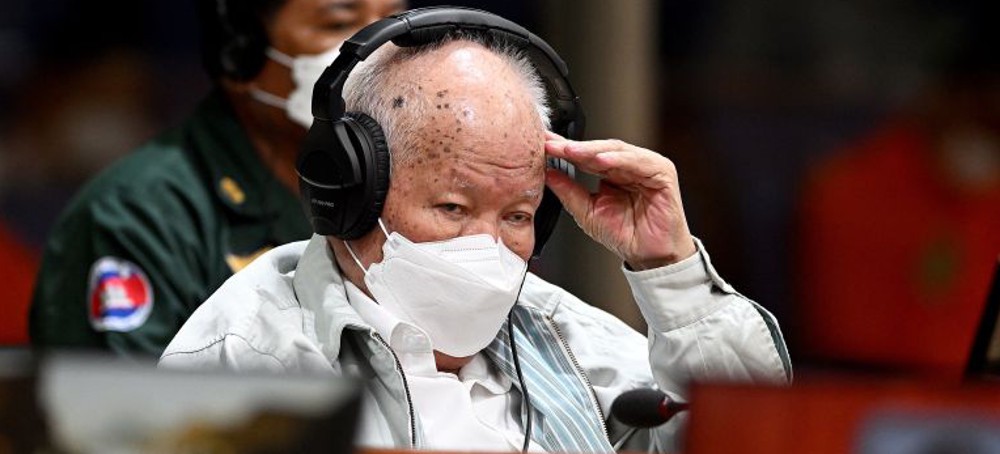
Former Khmer Rouge head of state Khieu Samphan in the courtroom before the Khmer Rouge tribunal in Phnom Penh, which convicted him of genocide and gave him a life sentence. (photo: Mark Peters/AFP)
FOCUS: What Ukraine Can Learn From the Khmer Rouge Trial
Travis Farr, Al Jazeera
Farr writes: "As Ukraine seeks justice for crimes committed by Russia, Cambodia could offer lessons - and cautionary tales."


As Ukraine seeks justice for crimes committed by Russia, Cambodia could offer lessons — and cautionary tales.

On September 23, the Khmer Rouge tribunal in Phnom Penh orally affirmed the convictions against Khieu Samphan, Cambodia’s former head of state, for genocide, crimes against humanity and war crimes. It also confirmed his life sentence, and followed up with a written verdict on December 23.

That decision has ended the tribunal’s judicial work. Now, as it winds down after spending 16 years investigating and prosecuting the senior leaders of the Khmer Rouge, its experiences offer valuable lessons on how best to secure justice in the current conflict that’s shaking the world’s conscience: Russia’s war in Ukraine.

The Khmer Rouge was a Maoist-inspired movement that devastated Cambodia during its brutal four-year rule from 1975 to 1979. The tribunal had the challenging job of investigating events spanning the entire territory of Cambodia over several years and adjudicating some of the most serious crimes known to humanity. It accomplished these tasks, bringing about one of the few convictions of a head of state since World War II. And it did so with an extensive in-person outreach programme that involved hundreds of thousands of Cambodians.

The investigations Ukraine needs

Ukrainian authorities have already prosecuted a small number of cases, several of which have resulted in convictions and sentences, and they are investigating many more. But with tens of thousands of potential cases to investigate, they are overwhelmed, and the situation will only get worse as the war drags on.

The International Criminal Court (ICC) has also opened an inquiry and sent its largest investigative team ever to Ukraine to begin to prepare cases. But the court also faces limitations. Its mandate is to focus on those most responsible for the crimes – in other words, high-level leaders – and it has never indicted more than six individuals from any given situation.

The ICC also has no jurisdiction over the crime of aggression in Ukraine, which is arguably both the most important crime since the invasion led to and facilitated all subsequent crimes and the easiest to link to high-level leaders like Russian President Vladimir Putin.

To help plug these impunity gaps, two additional courts have been proposed. These are a special court for the crime of aggression to be created by agreement between the United Nations and Ukraine and a high war crimes court, which would fall within the Ukrainian domestic court system but have international advisers to assist with investigations and prosecutions.

As these courts set out on the long road to justice for Ukraine, Cambodia’s example shows what they must focus on – and what they cannot afford to forget.

Don’t give up on the “big fish”

The only prosecutions to date in Ukraine have been low-ranking soldiers responsible for crimes that include individual murders and thefts. At the moment, it seems almost inconceivable that Putin and other senior Russian leaders will ever face justice. They are firmly ensconced in power and barricaded behind their nuclear deterrent.

But the lesson of the Khmer Rouge tribunal is that circumstances change. For years after the Khmer Rouge was ousted by a Vietnamese invasion, it was supported by the United States, Australia and China, all of whom saw it as a counterweight to Vietnamese, and therefore, Soviet influence.

It was not until 1997 that the Cambodian government first requested UN assistance in establishing the Khmer Rouge tribunal. By the time the tribunal began its work in 2007, the geopolitical circumstances that had protected the Khmer Rouge leaders for so long had shifted. The Cold War was over, and Vietnam was no longer seen by the Khmer Rouge’s former supporters as an enemy. As a result, the tribunal was able to try and convict two of the most senior members of the regime, including Khieu Samphan.

In the present conflict, the costs of the war in Ukraine have already shattered Putin’s social contract with elite and ordinary Russians alike. As the war drags on, the burdens on all sectors of Russian society will only increase. The results are hard to predict, but Putin may not always be as safe as he looks at the moment.

Massive crimes can be addressed

The scale of the crimes being committed in Ukraine is staggering. Ukrainian authorities have already registered more than 47,000 alleged crimes across a large geographical area. The number of victims is unknown, but the Office of the UN High Commissioner for Human Rights has recorded at least 6,700 civilian deaths since February and believes the true number is considerably higher. The majority of these deaths is likely to be victims of war crimes or crimes against humanity, so it is reasonable to wonder whether this criminal campaign can ever be meaningfully addressed by the justice system.

Here again, the experience of the Khmer Rouge tribunal gives reason for optimism. The Khmer Rouge’s atrocities spanned nearly four years and covered the entire territory of Cambodia. Experts estimate that as many as 1.5 million Cambodians lost their lives during this period, almost a quarter of the population. Despite the scope of the crimes, the Khmer Rouge tribunal succeeded in carrying out a meaningful investigation and trial of senior Khmer Rouge leaders for these atrocities and delivered convictions.

Not every crime committed in Cambodia was investigated, and it is unlikely that every crime committed in Ukraine will be – the number is simply too great – but by organising the Khmer Rouge’s crimes into broad categories – such as torture and execution centres, forced labour sites, forced marriages – the tribunal managed to facilitate more efficient investigations and court proceedings. International advisers with experience with other mass atrocities could assist Ukrainian prosecutors in similarly prioritising cases and organising them thematically.

Location matters

Any trials carried out by the ICC would take place in The Hague, which would also likely to be the seat of the proposed hybrid court for the crime of aggression. Lower-level perpetrators, however, are likely to be tried in Ukraine.

Having court proceedings where crimes occurred is good for accountability. Over the course of 16 years, more than 240,000 Cambodians attended the Khmer Rouge trials in person. The access also meant that the trials were covered extensively by the local media.

Trials conducted in Ukraine would have similar benefits. A court in Ukraine would also be far more accessible to local journalists than one in The Hague. Investigations would also be more efficient and cheaper. Interviewing witnesses would not require plane tickets, hotels and per diems for staff traveling from abroad.

Courts based in Ukraine would also face challenges, though.

During the work of the Khmer Rouge tribunal, the Cambodian government made occasional statements that certain investigations would not be allowed to proceed to trial, resulting in allegations of political interference.

Despite – indeed, because of – the strong emotion triggered by Russia’s campaign of crimes, it is critical that Ukrainian government officials refrain from making any statements that could be interpreted as directing the work of criminal justice officials or pre-judging the merits of any individual cases. War crimes trials in Ukraine would come under intense worldwide scrutiny, and everything possible must be done to ensure that they would be, and would be seen to be, the product of a fair and independent judicial process.

Go where the evidence leads, even if it’s inconvenient

It seems clear that the vast majority of crimes in Ukraine are being committed by Russian forces. But that doesn’t mean that Ukrainian forces haven’t, or won’t, commit crimes as well. The UN already believes that Ukrainian forces have committed war crimes in at least two instances.

Courts based in Ukraine – whether entirely domestic or ones that are aided by international advisers – must be prepared to investigate and prosecute if necessary any credible allegations of war crimes committed by Ukrainian forces, regardless of rank. Carrying out these investigations and prosecutions would be extremely difficult in a country that is still at war and that is clearly the victim of Russian aggression. But applying the law even-handedly would be key to establishing the credibility and legacy of the verdicts delivered.

The pursuit of justice for Ukraine won’t be easy. But the Khmer Rouge tribunal’s work shows that much can be achieved, even against the odds, and that even criminal heads of state can be punished.

READ MORE


Contribute to RSN

Follow us on facebook and twitter!

Update My Monthly Donation

PO Box 2043 / Citrus Heights, CA 95611


Top News | 'He’s Not Going to Run Unopposed': Sanders Rejects Schumer for Majority Leader

                                                               LOTS OF POSTS IGNORED BY BLOGGER..... OR REMOVED ON THEIR WHIM! ALL POSTS ARE...