Showing posts with label Office of Financial Research. Show all posts

Thursday, March 7, 2024

Wall Street Mega Banks Have Created a Circular Firing Squad with Credit Derivatives and Capital Relief Trades – with the Fed’s Blessing
 

SUBSCRIBE TO THIS NEWSLETTER TO RECEIVE TIMELY REPORTS


Wall Street Mega Banks Have Created a Circular Firing Squad with Credit Derivatives and Capital Relief Trades – with the Fed’s Blessing

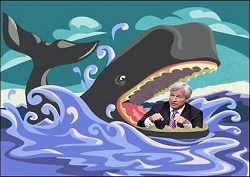
Jamie Dimon Is In a Whale of a MessBy Pam Martens and Russ Martens: March 6, 2024 ~

On June 11, 2015, the Office of Financial Research (OFR) released a sobering report on how banks were reducing their requirements to hold adequate capital against potential losses by engaging in non-transparent “capital relief trades” with potentially questionable counterparties. The OFR researchers summarized the problem as follows:

“Capital relief transactions may have benefits to banks. But, even if real risk transfer is involved, these transactions can pose financial stability concerns by increasing interconnectedness, transforming credit risk into counterparty risk, and obscuring capital adequacy to investors and counterparties. And while bank supervisors have extensive data about banks, they may have less information about the nonbanks who are selling credit risk to those banks and ultimately bearing the risk of loss.”

The Office of Financial Research was created under the Dodd-Frank financial reform legislation of 2010 to make sure that Wall Street mega banks could never again ravage the economy and financial system of the United States — as they did in 2008 – by engaging in reckless derivative trades and toxic bets. OFR describes its mission as follows:

“Our job is to shine a light in the dark corners of the financial system to see where risks are going, assess how much of a threat they might pose, and provide policymakers with financial analysis, information, and evaluation of policy tools to mitigate them.”

Buried in the June 2015 OFR report was a bombshell. When JPMorgan Chase was initiating hundreds of billions of dollars in risky derivative trades in London in 2012, using deposits from its federally-insured bank in the U.S., it was attempting to engage in tricked-up capital relief trades. The insanity of this gamesmanship resulted in $6.2 billion in losses at the bank; an investigation by the FBI; embarrassing Senate hearings; a scathing 300-page report by the U.S. Senate’s Permanent Subcommittee on Investigations; charges of engaging in “unsafe and unsound” banking practices by the Office of the Comptroller of the Currency; and the payment of $920 million in fines to its regulators.

Credit derivatives are frequently used in capital relief trades. In an effort to curb the trillions of dollars in credit derivatives that the Wall Street mega banks are using for non-transparent purposes with non-transparent counterparties, on July 27 of last year the FDIC, the Office of the Comptroller of the Currency (OCC), and the Federal Reserve released a proposal to require higher capital levels at banks with $100 billion or more in assets; (only 37 banks would be impacted). Community banks will not be impacted at all by the new proposals according to the federal regulators.

On September 12, 2023, the banking cartel made its anger and intention to push back known in a 7-page letter. The cartel demanded that the three federal agencies turn over all “evidence and analyses the agencies relied on” in making the proposal.

One of the signatories to the letter was the Bank Policy Institute (BPI), whose Board of Directors consists of the CEOs of the biggest banks. BPI is Chaired by none other than Jamie Dimon, Chairman and CEO of the notorious London Whale bank, JPMorgan Chase.

BPI next launched an ad campaign that grossly distorted what the increase in capital would do, claiming that it would harm working families. (The mega banks that will be most impacted are the same mega banks that blew up the U.S. economy in 2008; put millions of Americans out of work; left millions of working families in foreclosure; got a secret $29 trillion bailout from the Federal Reserve; and then used big chunks of that bailout money to lavish million-dollar bonuses on bank executives.)

Sixteen days after the big bank cartel had posted its September 12, 2023 letter attacking the newly proposed increase in capital rules, the Federal Reserve issued a suspiciously timed announcement of how banks could game the newly-proposed capital rules, with the Fed’s blessing, through the use of a specific style of capital relief trade. The Fed wrote as follows:

“In some synthetic securitizations, a Board-regulated institution transfers the risk of a reference portfolio of on-balance sheet exposures to a special purpose vehicle using a guarantee or credit derivative. The special purpose vehicle issues credit-linked notes to investors, and the Board-regulated institution takes the cash proceeds of the notes as collateral supporting the special purpose vehicle’s performance on the guarantee or credit derivative.

“Under the Board’s capital rule, a Board-regulated institution can recognize the credit risk mitigation of the collateral on the reference portfolio under the rules for synthetic securitizations provided that the requirements in section 41 or 141, as applicable (12 CFR 217.41, .141), are met and that the transactions satisfy the definition of ‘synthetic securitization’ (12 CFR 217.2, ‘synthetic securitization’).”

All you need to know about the above two paragraphs is that the words “synthetic” and “special purpose vehicle” and “credit derivatives” played a central role in crashing Wall Street and the U.S. economy in 2008. The Federal Reserve has apparently learned nothing from the worst financial crash since the Great Depression.

For the most hair-raising part of this story, let us back up to September 29, 2022 – almost exactly one year before the Fed gave its blessing to capital relief trades using credit derivatives. On that date the OFR issued a report that concluded: “When Choosing Counterparties, Banks Tend to Pick Riskier Ones.”

The report was authored by Dasol Kim, a Research Principal at OFR, and Andrew Ellul, a Visiting Fellow at OFR and Professor of Finance at Indiana University’s Kelley School of Business. In a blog post, they summarized their findings as follows:

“In a recent working paper analyzing who banks chose as counterparties in the over-the-counter (OTC) derivatives market, the authors found that banks are more likely to choose riskier nonbank counterparties that are already heavily connected and exposed to other banks, which leads to an even more densely connected network. Furthermore, banks do not hedge these exposures, but rather increase them by selling rather than purchasing credit derivative swaps against these counterparties. Finally, the authors found that common counterparty exposures are correlated with systemic risk measures despite greater regulatory oversight following the 2008 financial crisis.” (Italic emphasis added.)

The only common-sense way to think of this is that Wall Street has once again created a circular firing squad with the U.S. banking system and U.S. economy as collateral damage.

For an idea of what can happen when a mega bank sells credit default swaps, consider how Howie Hubler, a star bond trader at Morgan Stanley, lost $9 billion. Hubler was one of those who made early derivative bets that the lowest-rated subprime bonds would fail during the 2007-2008 financial crisis using credit default swaps. He bought protection by purchasing credit default swaps on subprime debt. But because Hubler had to pay out premiums on these credit default swaps until the price collapse arrived, he sold $16 billion in credit default swaps on higher-rated debt, obviously to collect the premiums to offset what he was paying out while he waited. When the $16 billion turned out to be toxic as well, Morgan Stanley lost at least $9 billion.

According to a government audit of the Fed’s secret loans to the Wall Street mega banks and their trading subsidiaries from December 2007 through early July 2010, Morgan Stanley was the second largest recipient (after Citigroup) of the Fed’s secret bailout loans. Morgan Stanley received a total of $2.04 trillion in cumulative loans from the Fed; Citigroup received $2.5 trillion in cumulative loans from the Fed.

Federal regulators were caught napping in the lead up to the 2008 financial collapse. They are clearly still napping. According to the most recent trading and derivatives report from the Office of the Comptroller of the Currency for the third quarter of 2023, just four commercial banks (JPMorgan Chase, Citigroup’s Citibank, Goldman Sachs Bank USA and Bank of America) hold 94 percent of all credit derivatives held at 4,600 commercial banks. If you want the quintessential definition of concentrated risk, this is it.


https://wallstreetonparade.com/2024/03/wall-street-mega-banks-have-created-a-circular-firing-squad-with-credit-derivatives-and-capital-relief-trades-with-the-feds-blessing/


Tuesday, October 11, 2022

New Study: Wall Street Banks Are Doubling Down on Risk by Selling Credit Default Swaps on their Risky Derivatives Counterparties

SUBSCRIBE TO THIS NEWSLETTER 


New Study: Wall Street Banks Are Doubling Down on Risk by Selling Credit Default Swaps on their Risky Derivatives Counterparties

By Pam Martens and Russ Martens: October 6, 2022 ~

Senator Sherrod Brown

Senator Sherrod Brown, Chair of Senate Banking Committee

Last Thursday, while news outlets focused on videos of the devastating impact of Hurricane Ian on the southwest coast of Florida, two researchers at the Office of Financial Research published a breathtaking and almost surreal analysis of how the mega banks on Wall Street are once again doubling down on unprecedented risk with derivatives and threatening the financial stability of the U.S. The report was ignored by mainstream business media.

The Office of Financial Research was created under the Dodd-Frank financial reform legislation of 2010 to make sure that Wall Street mega banks could never again ravage the economy and financial system of the United States — as they did in 2008 – by engaging in reckless derivative trades and toxic bets. OFR describes its mission as follows:

“Our job is to shine a light in the dark corners of the financial system to see where risks are going, assess how much of a threat they might pose, and provide policymakers with financial analysis, information, and evaluation of policy tools to mitigate them.”

OFR also notes that its research is done “principally to support the Financial Stability Oversight Council and its member agencies.”

The Financial Stability Oversight Council (F-SOC) was also created under Dodd-Frank. It states on its website that its role is to provide “comprehensive monitoring of the stability of our nation’s financial system.” It includes the head of every federal regulator of banks and Wall Street, including the Treasury Secretary who chairs F-SOC, the Fed Chair, and heads of the SEC, OCC, FDIC, etc.

But the new research report from OFR ignites the hair-raising question of how asleep at the switch are the members of the Financial Stability Oversight Council to have allowed a worse derivatives mess to exist today than existed in 2008 when Wall Street banks blew themselves up and required the largest bailouts from the taxpayer and the Fed in global banking history.

The research paper does not provide the names of the banks it studied. But it doesn’t have to. We know from the report published quarterly by the Office of the Comptroller of the Currency that the bank holding companies of JPMorgan Chase, Citigroup, Goldman Sachs, Bank of America and Morgan Stanley hold more than 80 percent of all derivatives held at all banks in the U.S. today.

The report is authored by Dasol Kim, a Research Principal at OFR, and Andrew Ellul, a Visiting Fellow at OFR and Professor of Finance at Indiana University’s Kelley School of Business. In a blog post last Thursday, they summarize their findings as follows:

“In a recent working paper analyzing who banks chose as counterparties in the over-the-counter (OTC) derivatives market, the authors found that banks are more likely to choose riskier nonbank counterparties that are already heavily connected and exposed to other banks, which leads to an even more densely connected network. Furthermore, banks do not hedge these exposures, but rather increase them by selling rather than purchasing credit derivative swaps against these counterparties. Finally, the authors found that common counterparty exposures are correlated with systemic risk measures despite greater regulatory oversight following the 2008 financial crisis.” (Italic emphasis added.)

Let’s pause right there for a moment. The sentence we italicized above is the most frightening thing we have read since the Financial Crisis Inquiry Commission released its report on the 2008 financial crisis.

Selling credit default swaps (the most dangerous form of derivatives) allows the mega banks to collect ongoing payments from the entity that it sold the protection to, very likely hedge funds. But because the mega bank already has exposure to that lower-rated counterparty because it’s on the other side of its own derivative trades, it should be buying credit default swaps on that counterparty to hedge its own risk. This suggests that, once again, the mega banks on Wall Street are taking on catastrophic risks to dress up their profits and deliver fat annual bonuses to traders and top brass while counting on the taxpayer and the Fed to bail them out when they blow up.

For an idea of what can happen when a mega bank sells credit default swaps, consider how Howie Hubler, a star bond trader at Morgan Stanley, lost $9 billion. Hubler was one of those who made early derivative bets that the lowest-rated subprime bonds would fail during the 2007-2008 financial crisis using credit default swaps. He bought protection by purchasing credit default swaps on subprime debt. But because Hubler had to pay out premiums on these credit default swaps until the price collapse came, he sold $16 billion in credit default swaps on higher-rated debt, obviously to collect the premiums to offset what he was paying out while he waited. When the $16 billion turned out to be toxic as well, Morgan Stanley lost at least $9 billion.

According to a government audit of the Fed’s secret loans to the trading houses on Wall Street from December 2007 through early July 2010, Morgan Stanley was the second largest recipient (after Citigroup) of the Fed’s secret bailout loans, receiving a total of $2.04 trillion in cumulative loans from the Fed.

The OFR blog continues:

“Systemically important banks have a greater propensity to choose counterparties with a higher degree of existing connections to other systemically important banks. In densely connected networks, banks are more likely to connect with risky counterparties for their most material exposures. Moreover, the results are resilient to alternative explanations related to counterparty demand factors and changes in the regulatory environment.

“While banks could hedge their credit risk exposures to interconnected counterparties, mitigating the potential impact, if these counterparties were to fail, they often do not. In fact, they double-down on these exposures by selling insurance against those counterparties. This behavior is most pronounced in riskier counterparties.

“Regulatory reforms, such as uncleared margin rules and mandatory clearing, were designed to reduce risk by mitigating the build-up of dense interconnections and systemic feedback. The paper shows that the density of financial market networks has actually increased following the adoption of these reforms in the bilateral derivatives markets. Moreover, interconnectedness due to shared counterparty exposures has a significant association with systemic risk measures in the post-crisis period…

“The question about counterparty choice is central to our understanding of the financial system’s resilience to contagion. The impact of adverse external shocks may be amplified for networks already weakened by riskier connections. Additionally, a system may come under pressure from a network-intrinsic risk rather than an exogenous shock and counterparty risk is one way this could happen.

“Network connections and choice of counterparties is especially important in the derivative markets. Uncleared derivatives account for approximately half of all derivative activities by banks, making them a significant fraction of their trading operations overall. Half of these are represented by nonbank counterparties with multiple bank dealers. Losses on uncleared derivatives are fully borne by the bank, whereas losses for cleared derivatives are mutualized across member firms of the clearinghouse.” (Italic emphasis added.)

According to a June 30, 2022 quarterly report from the Office of the Comptroller of the Currency (see Table 24) a total of $1.6 trillion in credit default swaps have been sold by all commercial banks, savings associations and trust companies in the U.S. The following four mega banks account for more than 99 percent of that $1.6 trillion: JPMorgan Chase has sold $467 billion; Goldman Sachs Bank USA has sold $243 billion; Citigroup’s Citibank has sold an astonishing $717 billion; and Bank of America has sold $169 billion. Morgan Stanley is not listed in this table because it holds its derivatives predominantly at its bank holding company, not at its two federally-insured commercial banks.

Less than one month ago, at a Senate Banking hearing on September 15, Senator Sherrod Brown (D-OH) made this bold statement:

“When Congress wrote Dodd-Frank, we fixed the problems in the oversight of the over-the-counter derivatives market. That’s a lesson we need to remember when it comes to crypto—all our regulators need to work together, and to make sure investors, consumers, and market stability comes first.”

Clearly, that statement is fanciful thinking. There is clearly an urgent need for Chairman Brown to hold a meaningful series of hearings on derivatives. There is no place better to start than by calling these two OFR researchers as witnesses.

LINK


YOU DID THIS. We’re #3 on Audible!

                                                                                  LOTS OF POSTS IGNORED BY BLOGGER..... OR REMOVED ON THEIR ...