Showing posts with label GLASS-STEAGALL. Show all posts

Sunday, December 4, 2022

Credit Default Swaps Blow Out on Credit Suisse as its Stock Price Hits an All-Time Low of $2.82

SUBSCRIBE TO THIS NEWSLETTER 


Credit Default Swaps Blow Out on Credit Suisse as its Stock Price Hits an All-Time Low of $2.82

By Pam Martens and Russ Martens: December 1, 2022 ~
Credit Suisse That $4 billion capital raise that was supposed to shore up confidence in global banking behemoth Credit Suisse turns out to have been too little, too late. Yesterday, 5-year Credit Default Swaps (CDS) on Credit Suisse blew out to 446 basis points. That’s up from 55 basis points in January and more than five times where CDS on its peer Swiss bank, UBS, are trading.

The price of a Credit Default Swap reflects the cost of insuring oneself against a debt default by the bank. Who might be desperate to buy protection against a default by Credit Suisse and driving up the cost of that protection? The mega banks on Wall Street that are counterparties to its derivative trades come to mind, as well as hedge fund speculators.

Things don’t look any brighter this morning for Credit Suisse. Its shares are trading in Europe at 2.67 Swiss Francs or approximately $2.82 – an all-time low. Year-to-date, shares of Credit Suisse have lost 66 percent of their value as of yesterday’s close on the New York Stock Exchange.

Credit Suisse is Switzerland’s second largest bank, after UBS. It has been embroiled in nonstop scandals that suggest incompetent risk controls inside the bank.

In late March and early April of last year, Credit Suisse lost $5.5 billion from the highly-leveraged, highly concentrated stock positions it was financing via tricked-up derivatives for Archegos Capital Management, the family office hedge fund of Sung Kook “Bill” Hwang. Archegos blew up on March 25, 2021 after it defaulted on margin calls to the banks financing its trades. (See our report: Archegos: Wall Street Was Effectively Giving 85 Percent Margin Loans on Concentrated Stock Positions – Thwarting the Fed’s Reg T and Its Own Margin Rules. Also see: Justice Department and SEC Portray Serially-Charged Banks on Wall Street as Hapless Victims of Archegos Fraud. Nobody’s Buying It.)

The Board of Credit Suisse decided to hire the Big Law firm, Paul, Weiss, Rifkind, Wharton & Garrison, to conduct an internal investigation of the matter. On July 29, 2021 Paul Weiss issued a 165-page report on its version of what happened. Paul Weiss generously found that no fraud had occurred — just zombie risk management at a Global Systemically Important Bank (G-SIB).

This is how the Paul Weiss report portrayed the zombie risk managers at Credit Suisse:

“The Archegos-related losses sustained by CS [Credit Suisse] are the result of a fundamental failure of management and controls in CS’s Investment Bank and, specifically, in its Prime Services business. The business was focused on maximizing short-term profits and failed to rein in and, indeed, enabled Archegos’s voracious risk-taking. There were numerous warning signals—including large, persistent limit breaches — indicating that Archegos’s concentrated, volatile, and severely under-margined swap positions posed potentially catastrophic risk to CS. Yet the business, from the in-business risk managers to the Global Head of Equities, as well as the risk function, failed to heed these signs, despite evidence that some individuals did raise concerns appropriately.”

And this:

“…a Prime Services business [lending to hedge funds] with a lackadaisical attitude towards risk and risk discipline; a lack of accountability for risk failures; risk systems that identified acute risks, which were systematically ignored by business and risk personnel; and a cultural unwillingness to engage in challenging discussions or to escalate matters posing grave economic and reputational risk. The Archegos matter directly calls into question the competence of the business and risk personnel who had all the information necessary to appreciate the magnitude and urgency of the Archegos risks, but failed at multiple junctures to take decisive and urgent action to address them.”

Credit Suisse’s reputation took another hit from its involvement in the Greensill Capital scandal and its infamous spy-gate scandal in 2019 where the bank spied on, and followed, various employees.

And if all of this wasn’t enough, on November 2 S&P cut Credit Suisse’s credit rating to one notch above junk. That was followed by more disturbing news on November 23 when the bank reported that its clients had yanked $88.3 billion of their assets out of the bank.

According to an historical timeline on the Credit Suisse website, it was previously known as Schweizerische Kreditanstalt, which was eventually shorted to SKA. The timeline notes that SKA’s New York Branch was granted a license to accept deposits in 1964. Credit Suisse’s New York branch has continued for decades to accept deposits, but they are not insured. In the resolution plan for Credit Suisse that it filed with the Federal Reserve in 2020, it writes:

“Our New York Branch is not a member of, and its deposits are not insured by, the FDIC. CS’ biggest U.S. presence is through its broker-dealer related businesses. Typically broker-dealer activities are resolved with a rapid runoff of the businesses as long as the resolution strategy is supported by adequate operational capabilities, such as the ability to transfer client accounts to peer institutions while causing minimal disruptions to the broader financial markets.”

Wall Street trading houses accepting uninsured deposits resulted in the banking crisis of the early 1930s when thousands of banks failed and people rushed to pull their money from uninsured banks. Congress passed the 1933 Glass-Steagall Act banning the combination of investment banks/brokerage firms with federally-insured banks. (Federal deposit insurance was also created under the Glass-Steagall Act to restore confidence in the U.S. banking system.) The Glass-Steagall Act served the nation well for 66 years until its repeal under the Bill Clinton administration in 1999, allowing trading firms to merge with federally-insured, deposit-taking banks. It took just nine years without Glass-Steagall for Wall Street to collapse in a replay of the crash of 1929.

Despite both Democrats and Republicans promising in their 2016 campaign platforms to restore the Glass-Steagall Act, the idea quickly bit the dust once the Trump administration took office. (See Mnuchin Says Trump Administration Never Intended to Restore Glass-Steagall Act.) Instead of Congress removing the Wall Street trading casino from the nation’s federally-insured banks, Congress has sat back and allowed the crypto circus to spread its risk directly into federally-insured banks. 

It’s time for the American people to pick up the phone and demand better from their elected members of Congress.


 LINK


Monday, November 28, 2022

FTX’s Latest Casualties: Federally Insured Crypto Banks


SUBSCRIBE TO THIS NEWSLETTER


FTX’s Latest Casualties: Federally Insured Crypto Banks

By Pam Martens and Russ Martens: November 21, 2022 ~

On August 1 of this year, we penned this headline at Wall Street On Parade: Brace Yourself for Federally-Insured Bank Failures Caused by Crypto. Our research for that article was so stomach-churning and frightening that we emailed the article to key staff for the Senators who sit on the Senate Banking Committee. One of the banks we researched for that article was Silvergate Bank. We wrote:

“FDIC-insured Silvergate Bank is part of the publicly-traded Silvergate Capital Corp., (ticker SI). Silvergate’s website says this about its hot pursuit of crypto: ‘We began pursuing digital currency customers in 2013 and have been deliberate in our approach to serving this community since then. Today, we have 1,300+ digital currency and fintech customers that are using our platform daily to grow and scale their businesses.’

“Silvergate Capital’s 10-K (annual report) for the year ending Dec 31, 2021 that it filed with the Securities and Exchange Commission acknowledged this about the crypto market that it has so deliberately decided to pursue:

‘The characteristics of digital currency have been, and may in the future continue to be, exploited to facilitate illegal activity such as fraud, money laundering, tax evasion and ransomware scams; if any of our customers do so or are alleged to have done so, it could adversely affect us…’

“Silvergate’s 10-K also states that ‘Deposits from digital currency exchanges represent approximately 58.0% of the Bank’s overall deposits and are held by approximately 94 exchanges.’

“Let’s pause for a moment to digest that last statement: More than half of a federally-insured bank’s deposits are tied to crypto while federal regulators are twiddling their thumbs and letting it happen. This news comes despite the fact that legendary investor Warren Buffet has called the largest cryptocurrency, Bitcoin, ‘rat poison squared’; global economist, Nouriel Roubini, told the Senate Banking Committee in 2018 that ‘Crypto is the Mother of All Scams and (Now Busted) Bubbles While Blockchain Is The Most Over-Hyped Technology Ever, No Better than a Spreadsheet/Database.’ More recently, Bill Gates, co-founder of Microsoft, one of the most valuable tech companies in the world, stated that cryptocurrencies are ‘100% based on greater fool theory.’ And just this past June 1, more than 1,600 scientists and software engineers wrote to Committee chairs in Congress to warn that both crypto and blockchain are shams.”

On November 11 the crypto exchange, FTX, announced it was filing for Chapter 11 bankruptcy, along with its related hedge fund, Alameda Research – which had been using (and losing) billions of dollars of customer funds from FTX to trade without the knowledge of customers. More than 100 opaque affiliates of FTX, many headquartered in offshore locations, also filed for bankruptcy.

Headlines swirling around the world are comparing the management of FTX to that of Madoff, Enron, and blood-testing fraud, Theranos. (Sam Bankman-Fried, the co-founder and now-fired CEO of FTX, learned from news headlines last Friday that the founder and CEO of Theranos, Elizabeth Holmes, was sentenced to 11 years in prison.)

On the same day that FTX made its filing in bankruptcy court in Delaware, the FDIC-insured Silvergate Bank released a statement which included this nugget from its CEO, Alan Lane:

“In light of recent developments, I want to provide an update on Silvergate’s exposure to FTX. As of September 30, 2022, Silvergate’s total deposits from all digital asset customers totaled $11.9 billion, of which FTX represented less than 10%. Silvergate has no outstanding loans to nor investments in FTX, and FTX is not a custodian for Silvergate’s bitcoin-collateralized SEN Leverage loans. To be clear, our relationship with FTX is limited to deposits.”

Why Alan Lane thinks the public would be comforted to know that his bank is connected to FTX – and its potentially wiped-out customers – to the tune of more than $1 billion raises questions about his own mental processes. (Perhaps Lane doesn’t recall that JPMorgan Chase was hit with two felony counts by the U.S. Department of Justice for its role in the Bernie Madoff fraud and forced to pay $1.7 billion to settle the case.) Federally-insured banks must follow “Know Your Customer” rules and report any suspected cases of money laundering to the federal agency, FinCEN. It has been credibly reported that as much as $10 billion was transferred from customer funds at the FTX crypto exchange to Bankman-Fried’s hedge fund, Alameda Research, with a large chunk of that now missing. Federal prosecutors might find that Silvergate Bank’s compliance personnel should have reported the suspicious movement of customer funds to FinCEN.

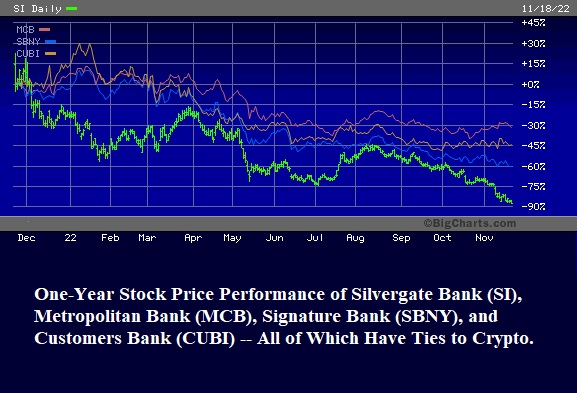
Shareholders of Silvergate have responded by dumping the stock. On November 18, 2021, Silvergate’s stock closed at $198.60 on the New York Stock Exchange. Last Friday, November 18, 2022, exactly one year later, Silvergate closed at $24.90. The stock has lost 28 percent since FTX filed bankruptcy on November 11 and 87 percent of its market value in one year.

How many more FDIC-insured banks are spread across the United States with significant ties to crypto-related firms and the potential to see their share prices sink and/or reputational damage? We know of four FDIC-insured banks whose share prices have already been hit: Silvergate Bank, Customers Bank, Signature Bank and Metropolitan Bank. (See chart below.)

But there may also be very large banks that have slithered below the radar with their involvement in crypto. For example, on June 21 we reported on the shocking ways that State Street has become involved in crypto. State Street is not some little bank that could go under without causing ripples. As of March 31, it was custodian and/or administrator to $41.7 trillion in assets and held $176 billion in deposits.

Allowing crypto to get anywhere near the federally-insured banking system could not have happened without the flow of money from the crypto industry into the campaign coffers of some members of Congress, including some of the members who sit on the Senate Banking and House Financial Services Committees. This reality screams for reform of corporate financing of political campaigns as well as overhaul of banking regulations. (See After Crypto Money Piled into Campaign Coffers of Senators Lummis and Gillibrand, They Introduced a Sweetheart Legislative Bill for Crypto.)

This metastasizing of the crypto contagion into the federally-insured banking system could also not have happened if members of Congress and federal banking regulators were aware of how federal banking insurance came into being in the first place. Following the Dow Jones Industrial Average losing 89 percent of its value from 1929 to 1932, thousands of banks were insolvent from their reckless involvement with Wall Street speculations.

The 1930s banking crisis came to a head on March 6, 1933, just one day after Franklin D. Roosevelt was inaugurated as President. Following a month-long run on the banks, Roosevelt declared a nationwide banking holiday that closed all banks in the United States. On March 9, 1933, Congress passed the Emergency Banking Act which allowed regulators to evaluate each bank before it was permitted to reopen. Thousands of banks were deemed insolvent and permanently closed.

There was no federal deposit insurance on bank deposits at that time, meaning that depositors lost all of their deposits in many cases or were paid just pennies on the dollar.

To restore the public’s confidence in the U.S. banking system, President Roosevelt signed into law the Banking Act of 1933, now popularly known as the Glass-Steagall Act after its authors Senator Carter Glass from Virginia, and House Rep Henry Steagall from Alabama. The legislation created federal deposit insurance for bank accounts for the first time in the U.S., while also banning these federally-insured banks from speculating in, or underwriting, stocks.

The Glass-Steagall Act protected the U.S. banking system for 66 years until its repeal in 1999 during the Wall Street-friendly Bill Clinton administration. The momentum for its repeal came from the announcement in 1998 that Sandy Weill wanted to merge his trading firms, Salomon Brothers and Smith Barney (under the Travelers Group umbrella), with Citicorp, parent of the federally-insured Citibank. (See the Editor of Wall Street On Parade’s testimony before the Federal Reserve in 1998 on that merger proposal and the proposed repeal of the Glass-Steagall Act in this YouTube video.) The Fed approved the merger despite expert witnesses warning it would be a disaster for the country.

Just nine years after Glass-Steagall was repealed in 1999, Wall Street collapsed the U.S. financial system in 2008 in a replay of 1929.

Weill had a self-confessed personal motive for his merger, which created the so-called “universal bank,” Citigroup. Weill told his merger partner, John Reed of Citibank, that his motivation for the deal was: “We could be so rich,” according to Reed in an interview with Bill Moyers.

LINK


WATCH: Sen. Booker questions Jack Smith on Trump investigations

                                  LOTS OF POSTS IGNORED BY BLOGGER..... OR REMOVED ON THEIR WHIM! ALL POSTS ARE AVAILABLE ON MIDDLEBORO REVI...