Showing posts with label TALIBAN. Show all posts

Sunday, September 22, 2024

INFORMED COMMENT: Afghan Women have been robbed of Health Care, Education and now their Voices. But they won’t remain Silent


Afghanistan

Afghan Women have been robbed of Health Care, Education and now their Voices. But they won’t remain Silent

By Susan Hutchinson, Australian National University | –

(The Conversation) – Last month, the Taliban passed a new “vice and virtue” law, making it illegal for women to speak in public. Under the law, women can also be punished if they are heard singing or reading aloud from within their homes.

It was approved by the Taliban’s supreme leader, Mullah Hibatullah Akhundzada, and will be enforced by the Ministry for Promoting Virtue and Preventing Vice.

Ahead of an international conference on the future of Afghanistan in Doha, Qatar, earlier this year, the United Nations’ mission head for Afghanistan, Roza Otunbayeva, said it would “take time” for the Taliban to accept women. The Taliban specifically mandated no women attend the conference, which the UN agreed to.

But as gender experts have been saying for years, Taliban leaders have not – and will not – change. Three years after they regained control of Afghanistan, the Taliban’s efforts to publicly erase women from Afghan society have reached a new low.

Gender apartheid

The Taliban’s burgeoning body of laws and practices restricting the rights of women and girls is a clear case of gender apartheid. Gender apartheid is defined as a regime of systematic gender-based oppression and domination.

Because there is no conventional legal framework in place in Afghanistan, the country is ruled by an increasingly tightly woven patchwork of decrees, policies and systematised practices, some written, others verbal.

Since returning to power in 2021, the Taliban has enacted more than 100 edicts, orders and directives restricting the rights of women and girls. These apply in a range of jurisdictions – nationally, provincially and in specific districts.

The most significant of these edicts prevent women and girls from attending school beyond grade six, working in many organisations, and travelling a certain distance to seek health care.

Restricting girls’ education

The ban on education for Afghan girls has had a dire effect on their wellbeing. Modelling from UN Women shows this has correlated with a 25% increase in child marriage and 45% increase in early childbirth. The loss of hope for young women has been profound.

Civil society groups in Afghanistan and around the world have clapped back at the Taliban’s ban on girl’s education with the hashtag “Let Afghan Girls Learn”.

Myriad small organisations are also running underground schools to continue girls’ education. Sometimes these schools operate under the guise of embroidery classes, or something else the Taliban finds acceptable.

But the ongoing lack of funding to women-led organisations has been a serious barrier to these kinds of programs, despite the fact they are primarily Afghan-led.

A range of internationally certified online programs have also been established, providing important educational and employment opportunities for smaller numbers of Afghan women and girls.

But these online options remain limited, and not just by funding. Data shows only 6% of Afghan women have internet access, and the Taliban is making it increasingly difficult for Afghans to access SIM cards for mobile phones.

Hurting women and children’s health

Women’s health has also suffered due to the brain drain of highly-skilled workers fleeing the country and the sharp reduction in international technical and financial assistance to Afghanistan’s public health system.

Human Rights Watch reports “women and girls have been disproportionately affected by the healthcare crisis” in the country, particularly because of the Taliban’s abuses of women’s rights.

For example, restrictions on women’s movement has meant that maternal and infant mortality rates have skyrocketed in recent years as women are prevented from reaching health facilities.

Data published in the British Medical Journal shows that eight in ten women in urban areas have reported symptoms of depression and/or anxiety living under the Taliban.

Fighting against the silence

Over the past year, the Taliban have also increasingly targeted women’s human rights defenders. Activists have been “disappeared”, arbitrarily detained, and egregiously abused in prison.

The Guardian recently published evidence of a woman being raped in prison.

In my own work, I’ve documented a pattern of Talibs using sexual torture against imprisoned women’s human rights defenders in a bid to shame them out of their activism and isolate them from familial and community support.

Yet, Afghan women continue to push back against the draconian authorities ruling the country.

In response to the latest “vice and virtue” law, for example, women all over the country have taken to social media posting videos of themselves singing and reciting poetry to show they cannot be silenced.

Some recite the Quran. Many wear traditional Afghan dress, while others wear the Taliban’s required burka. But they sing to prove they exist. To show they are Afghan, and that they are not impure, regardless of what the Talibs say.

Activists are also continuing to push for the international recognition of gender apartheid as a crime against humanity, and the International Criminal Court continues its investigations into alleged crimes against humanity perpetrated by the Taliban.

But Afghan women cannot be left alone in their struggle. The international community must follow through on its commitments to protect Afghan women’s rights defenders. It must also maintain long-term support, including through funding pathways, for women-led organisations helping women in Afghanistan.

Susan Hutchinson, PhD Candidate, International Relations, Australian National University

This article is republished from The Conversation under a Creative Commons license. Read the original article.

——

Bonus Video added by Informed Comment:

‘Becoming a doctor is my dream’: Afghan women continue studies in Scotland | AFP

About the Author

The Conversation is an independent, not-for-profit media outlet that works with academic experts in their fields to publish short, clear essays on hot topics.

INFORMED COMMENT

Wednesday, September 11, 2024

The Morass of U.S. Middle East Policy was visible in the Harris-Trump Debate


Afghanistan

The Morass of U.S. Middle East Policy was visible in the Harris-Trump Debate

ABC provided a transcript of the debate between Donald Trump and Kamala Harris. I have some thoughts on the Middle East dimension:

On Gaza, Harris said, “Well, let’s understand how we got here. On Oct. 7, Hamas, a terrorist organization, slaughtered 1,200 Israelis. Many of them young people who were simply attending a concert. Women were horribly raped. And so absolutely, I said then, I say now, Israel has a right to defend itself. We would. And how it does so matters. Because it is also true far too many innocent Palestinians have been killed. Children, mothers. What we know is that this war must end. It must when, end immediately, and the way it will end is we need a cease-fire deal and we need the hostages out. And so we will continue to work around the clock on that. Work around the clock also understanding that we must chart a course for a two-state solution. And in that solution, there must be security for the Israeli people and Israel and in equal measure for the Palestinians. But the one thing I will assure you always, I will always give Israel the ability to defend itself, in particular as it relates to Iran and any threat that Iran and its proxies pose to Israel. But we must have a two-state solution where we can rebuild Gaza, where the Palestinians have security, self-determination and the dignity they so rightly deserve.”

But that isn’t how we got there. The Israelis expelled 250,000 Palestinians to Gaza in 1948 from their homes in what became southern Israel, making Gaza a big refugee camp. The population has grown to 2.2 million. They detached from Gaza its agricultural lands and left it cut off from its markets. From 1967 the Israelis came after the Palestinians in Gaza again and occupied them. In 2007 they slapped an economic siege on the Gaza Strip, imposing 55% unemployment and causing children to be malnourished. So Hamas committed horrific terrorism on on civilians on October 7 last year, for which there can be no justification. But if it had only attacked the Israeli military it might have had grounds in international law, which permits resistance groups to fight foreign military occupation. Harris left out the Nakbah or Palestinian displacement by Israel, and the long decades of military occupation and siege, so she made the story impossible to understand.

She is much better than Biden in at least expressing some empathy for the tens of thousands of innocent civilians Israel has killed in Gaza. But empathy, while better than nothing, won’t stop the killing, which is daily and directly enabled by US supply of weapons and ammunition (the Israelis ran out months ago).

The cease-fire deal she is touting does not exist. It was just a cheap trick pulled on Biden by Israeli Prime Minister Benjamin Netanyahu to giving him breathing space to continue the war, Netanyahu has constantly tacked on new conditions, most recently his occupation of the Philadelphi Corridor south of Rafah, which he knows Hamas (and even Egypt) will never agree to.

There is no two-state solution to be had, and politicians should start being honest about it. Gaza is rubble and there are hundreds of thousands of Israeli squatters in the Palestinian West Bank. Where would you put a state?

Trump’s response was to say that the war would not have happened on his watch because he starved Iran of money. That assertion is not true and it isn’t a policy. It is just a narcissistic boast that he can magically control the world. He can’t.

As usual, what he said is arrant nonsense. The CIA assesses that Hamas did not tell Iran it was planning Oct. 7. Iran had nothing to do with it.

Further, Biden has kept all the Trump sanctions on Iran, which is not a good thing. It puts the US on a war footing with Iran. Washington tries to interfere in Iran’s normal commerce such as selling its oil. There are no grounds in international law for this behavior. The US has even sanctioned the Iranian national bank, making all economic transactions with Iran a form of terrorism, including sending food or medicine. It is unprecedented to call the national bank of a country a terrorist organization.

Trump has no policies, just insults, such as that Harris hates Israel and even hates Arabs because her hatred of Israel will get Arabs killed. I couldn’t follow the argument because of that arrant nonsense thing.

CNN: “Watch the full Second Presidential Debate Hosted by ABC”

Afghanistan was the other country in the greater Middle East that came up.

Harris expressed her agreement with President Biden’s decision to pull out of Afghanistan, noting that four presidents had sought to withdraw, but he was the first to do so, saving the $300 million a day that the fruitless war was costing taxpayers. She said that “And as of today, there is not one member of the United States military who is in active duty in a combat zone in any war zone around the world, the first time this century.”

Harris blamed the debacle of the withdrawal on the “weak deal” negotiated directly with the Taliban by Don Trump, which she implied rather detracted from his reputation as a deal-maker. She said he by-passed the Afghan government and as part of his deal he released 5,000 Taliban terrorists. She expressed outrage that he would invite the Taliban to Camp David.

Harris is correct about the cost of the Afghanistan War, which came to $2.313 trillion over 21 years. That is $110 billion a year. Divided by 365, it comes to $301 million per day. Although al-Qaeda plotted the 9/11 attacks from Afghanistan, it is not clear that they told the Taliban what they were planning, and it was kind of odd that Afghanistan, rather than the al-Qaeda network, should have been though the danger to the U.S.

I’d say her account was accurate regarding the favorability of the deal Trump proposed to the Taliban. It is also true that Trump really wanted out of Afghanistan and kept telling his generals to get out, and they slow-rolled him. In some ways the story shows that on this issue Biden and Trump agreed. It isn’t for sure that Biden could have gotten a better deal than Trump on withdrawal. As for leaving the Afghan government out of the negotiations, that was weird. But given the way it collapsed and its top leaders were implicated in large-scale theft, it is not obvious that if Trump had included them in the talks, they could have obtained more favorable terms.

I don’t agree with her allegation that “there is not one member of the United States military who is in active duty in a combat zone in any war zone around the world.” I think the 800 US troops at Tanf in southeast Syria are in a war zone and that they are actively still fighting al-Qaeda, but also Shiite militias. Although the 2,500 US troops in Iraq are now classified as trainers, they do appear to be providing back up to the Iraqi Army in mopping up operations against ISIL in northern Iraq.

But the statement is also a little misleading because so many U.S. military interventions are aerial. The U.S. has been bombing Yemen regularly because the Houthis have been targeting container ships and oil tankers in the Red Sea in support of the people of Gaza. You can’t just make this mini-war disappear because there are no boots on the ground. The US routinely bombs the al-Shabab extremist fundamentalist movement in Somalia.

In fact, in the past year the US has also bombed Shiite militias in Iraq and Syria in reprisal for their attacks on bases housing US troops in those two countries. The Shiite militias struck at the US in Iraq, Syria and Jordan in an effort to punish it for its heavy support to the Israeli total war on Gaza. When you are actively bombing Yemen, Somalia, Syria and Iraq you can’t be said to be entirely at peace.


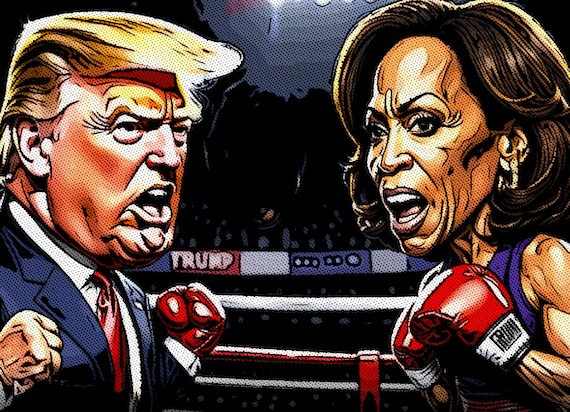
“Prize Fight,” Digital, Dream / Dreamland v3 / Clip2Comic, 2024

Trump boasted that in the 18 months after his deal with the Taliban, no US troops were killed in Afghanistan. This is true, but it is because he promised to get out of Afghanistan shortly if the Taliban ceased the attacks.

Trump said that the leader of the Taliban is “Abdul.” He was probably referring to the Taliban political chief in 2020, Mullah Abdul Ghani Baradar. Abdul is not a name on its own. It means “servant of” and is followed by a name of God. Abdul-Ghani means “servant of the All-Sufficient” (that is, God does not need anything because his essence is intrinsically rich). Baradar signed the deal for a complete US withdrawal from Afghanistan in February 2020.

Biden essentially followed the Trump treaty, though he delayed the promised US withdrawal from April 2021 to August. Although Trump is correct that the withdrawal was done chaotically, he was the one who guaranteed that it would be by his pledge to completely withdraw by a date certain. Trump’s claim that Vladimir Putin invaded Ukraine because of the US withdrawal from Afghanistan is ridiculous.

About the Author

Juan Cole is the founder and chief editor of Informed Comment. He is Richard P. Mitchell Professor of History at the University of Michigan He is author of, among many other books, Muhammad: Prophet of Peace amid the Clash of Empires and The Rubaiyat of Omar Khayyam. Follow him on Twitter at @jricole or the Informed Comment Facebook Page


INFORMED COMMENT

Monday, September 9, 2024

Retired military leaders defend Harris while placing blame on Trump for Afghanistan withdrawal in letter

 IF YOU WERE PAYING ATTENTION, YOU KNOW THAT POMPOUS POMPEO 

NEGOTIATED THE AFGHAN WITHDRAWAL WITH THE TALIBAN, EXCLUDED 

THE AFGHAN GOVERNMENT....EVEN INVITED THE TALIBAN TO CAMP DAVID....

ALL IN AN ATTEMPT TO SABOTAGE INCOMING PRESIDENT BIDEN AND SACRIFICE 

AFGHANS....

MAGA GOP can't stop the LIES!


Retired military leaders defend Harris while placing blame on Trump for Afghanistan withdrawal in letter


Wednesday, August 28, 2024

Trump’s STUNT at Cemetery BACKFIRES in HIS FACE TRUMP OUTRAGEOUS DISREGARD FOR VETERANS - TOTALLY INAPPROPRIATE!


MeidasTouch

2.99M subscribers


Friday, August 16, 2024

3 Years after the Taliban’s Return, Afghanistan is a broken country facing problems of Terrorism Again

          MIKE POMPEO NEGOTIATED WITH THE TALIBAN, EXCLUDED THE                                   GOVERNMENT OF AFGHANISTAN, FREED 5,000 AFGAN PRISONERS, EVEN                   INVITED THE  TALIBAN TO CAMP DAVID, WITHDREW MOST OF THE                                 MILITARY...ALL IN AN EFFORT TO SABOTAGE INCOMING PRESIDENT BIDEN.


          THIS COULD HAVE BEEN AND SHOULD HAVE BEEN DIFFERENT!  


Afghanistan

3 Years after the Taliban’s Return, Afghanistan is a broken country facing problems of Terrorism Again

By Amin Saikal, Australian National University | –

(The Conversation) – This week marks the third year since America’s retreat from Afghanistan and the Taliban’s return to power.

The United States had intervened in Afghanistan in response to the September 11 2001 terror attacks by al-Qaeda. The aim was to combat international terrorism and chart a new global order to make the world safer and more secure.

Yet, as I argue in my new book, How to Lose a War: The Story of America’s Intervention in Afghanistan, the world today is arguably more conflict-ridden and polarised than during the Cold War. It potentially stands on the edge of yet another world war.

America’s goals – and failures

Backed by its NATO and non-NATO allies, as well as extensive global sympathy, the key US objectives in Afghanistan were:

  • eliminate al-Qaeda
  • dismantle the Taliban’s ultra-extremist regime as the protector of al-Qaeda
  • help change Afghanistan so it would never again become a nest of international terrorism.

Success in Afghanistan was intertwined with two other broader US foreign policy goals under the presidency of Republican George W. Bush – the global war on terrorism and promoting democracy. Both of these were means to bring change to the Middle East – and indeed the wider world – in accordance with the interests of the US as the sole post-Cold War superpower.

Ultimately, the US could not achieve any of these objectives.

At first, it prevailed militarily in toppling the Taliban government and dispersing al-Qaeda, with assistance from the anti-Taliban Afghan forces. But the respective leaders of both groups, Mullah Mohammad Omar and Osama bin Laden, and their main operatives escaped to Pakistan.

The Taliban swiftly regrouped. And with Pakistan’s support and its continuing alliance with al-Qaeda, it mounted an insurgency beyond the expectations of the US and its allies, including the fledgling Afghan government in Kabul.

The US had not originally intended to stay in Afghanistan for more than a few years. But its failure to decapitate al-Qaeda in the early days of its intervention resulted in a US hunt for bin Laden that took a decade. It also led to America’s deepening involvement in the difficult task of state-building in a highly socially divided and traditional Afghanistan.

Without ensuring Afghanistan was firmly placed on a stable, secure and democratic trajectory, the Bush administration invaded Iraq in 2003 on the false premises that the Iraqi dictator Saddam Hussein collaborated with bin Laden and possessed weapons of mass destruction.

Iraq was prioritised over Afghanistan. This resulted in a shift of important intelligence and military assets from the latter to the former.

In the absence of a well-thought-out plan of action about how to bring peace to Afghanistan and Iraq, the US found itself entangled in two unwinnable wars. This left it with little choice but to bow out of Iraq by the end of 2011 and Afghanistan by August 2021, without achieving its original objectives.

It also left behind two broken countries. Iraq is still struggling to recover. Afghanistan is in a mess under the Taliban.

The Afghanistan defeat could not be any less humiliating for the US than its devastating Vietnam War five decades earlier.

Sky News Australia Video: “Taliban hold ‘humiliating’ parade three years after returning to power in Afghanistan”

The Taliban’s extremism

The Taliban’s 2.0 minority tribal government has proven to be as dreadfully extremist and discriminatory as its previous reign of terror from 1996-2001.

It has professed a self-centred and self-serving version of Islam, which is not practised anywhere else in the Muslim world. Women are stripped of all basic rights (including to education and work). Any form of opposition is brutally suppressed. Other minorities, along with remnants of the previous US-backed regime, are punished daily. Many have been murdered.

The group has transformed Afghanistan into a protective enclave for al-Qaeda and several other similarly minded groups. These include the Pakistani Taliban (Tehrik-e-Taliban Pakistan, or TTP) and the Islamic State–Khorasan Province (ISKP).

A new survey by the UN Mission in Afghanistan shows only 4% of respondents wanted the Taliban to be recognised internationally. The group’s lack of domestic legitimacy is paralleled by its pariah status in the global community.

Yet the group has been able to consolidate power in Afghanistan and stave off outside pressure, having taken advantage of regional and major power geopolitical rivalries and ambitions.

A more unstable world

The Taliban’s re-empowerment has significantly inspired and emboldened like-minded groups in many parts of the Muslim world, such as the TTP and ISKP. And the US defeat in Afghanistan has heartened America’s chief adversaries – Iran, Russia, China and North Korea.

Washington’s iron-clad commitment to ensure Israel’s security and its inability to end the devastating Gaza war have further stirred radical forces in the Muslim world and boosted America’s foes.

The related growing tensions between Israel and Iran, as well as with Tehran’s allies (most importantly Hezbollah in Lebanon), have seriously imperilled the cause of stability and security in a traditionally volatile region. A potential Israel-Iran war could drag the US in to defend Israel, with Russia and China supporting Iran.

This is not a scenario about which the Middle East and the world can be sanguine.

Amin Saikal, Emeritus professor of Middle Eastern and Central Asian Studies, Australian National University

This article is republished from The Conversation under a Creative Commons license. Read the original article.

About the Author

The Conversation is an independent, not-for-profit media outlet that works with academic experts in their fields to publish short, clear essays on hot topics.


INFORMED COMMENT

Wednesday, October 4, 2023

Informed Comment daily updates (10/03/2023)


Arizona Dems Finally end GOP Sweetheart Deal for Saudis to exploit Arizona Water to Feed the Kingdom’s Cattle

Arizona Dems Finally end GOP Sweetheart Deal for Saudis to exploit Arizona Water to Feed the Kingdom’s Cattle

Ann Arbor (Informed Comment) – The Arizona state government of Democratic Governor Katie Hobbs and Democratic Attorney General Kris Mayes are terminating the license of a Saudi company, Fondomonte, owned by Almirai, which had essentially given the company carte blanche to pump scarce Arizona water to grow alfalfa, which it then exported to Saudi Arabia […]

How White Christian Nationalism Threatens U.S. Democracy

How White Christian Nationalism Threatens U.S. Democracy

By Steve Corbin. | – ( Michigan Advance ) – You may be among the 35% of Americans who have never heard the term “white Christian nationalism.” But of those citizens who are knowledgeable of the concept, it carries a decidedly negative view. The belief is becoming more and more important to understand as cultural […]


MIKE POMPEO withdrew US military, negotiated with the TALIBAN, freed arrested terrorists, excluded the Afghan government...all in an effort to sabotage the incoming President Biden.
The results could have been/should have been different, but POMPEO destroyed AFGHANISTAN!


‘Their Freedoms Have Been Taken Away’: Afghanistan Sees Surge In Female Suicides Under Taliban Rule

‘Their Freedoms Have Been Taken Away’: Afghanistan Sees Surge In Female Suicides Under Taliban Rule

By Ahmad Hanayish and Abubakar Siddique (RFE/RL ) Shabana had a bright future ahead of her. She was studying to become a doctor and preparing to get married. But the Taliban’s takeover of Afghanistan in 2021 turned her life upside down. The militant group’s ban on women attending university forced her to abandon her studies. […]

Old posts you may have missed

Memoirs of an Arab-Jew

Iran’s Women, Digital Rights and Human Freedoms

New Cold War, Ever-Hotter Planet: What could Possibly Go Wrong?

Devastating Earthquake showed Resiliency of Morocco’s Solar and Wind Farms, as it Meets its Paris Commitments

DeSantis betrays Florida, Insists the Solution to Climate Change is Burning more Fossil Fuels

Climate Crisis: How Weather ‘Blocks’ have Triggered more Extreme Heatwaves and Floods across Europe

ISIL Extremists Bomb Mosques in Pakistan, in Bid to outlaw Celebrating the Birth of the Prophet Muhammad (Yes)


Top News | 'He’s Not Going to Run Unopposed': Sanders Rejects Schumer for Majority Leader

                                                               LOTS OF POSTS IGNORED BY BLOGGER..... OR REMOVED ON THEIR WHIM! ALL POSTS ARE...