|


|
|
|

20 April 22
We Can’t Afford the Luxury of Failure
When we said no to the corporations and the moneyed interests we canceled our “option to fail.” The Same could be said of the times in which we live. We finish our funding-drives and we prevail because we must.
In peace and solidarity.
Marc Ash
Founder, Reader Supported News
If you would prefer to send a check:
Reader Supported News
PO Box 2043 / Citrus Heights, CA 95611
Follow us on facebook and twitter!
19 April 22
Live on the homepage now!
Reader Supported News
Affinity Partners boasts of “accelerating transformation through connectivity” in a slide deck obtained by The Intercept.
The slide deck confirms the fund’s reliance on Kushner’s government experience and connections, particularly with regard to Saudi Arabia, to gin up business. The pitch to U.S. investors prominently advertises the team’s experience in the Trump White House, including on the Abraham Accords — a series of agreements that normalized formal diplomatic relations between Israel and some Arab countries — and a key oil production agreement reached with OPEC+, the oil cartel led by Russia and Saudi Arabia. “Aligned economic interests can solve intractable problems and create previously unrealized value,” reads one slide in the deck, which is marked “confidential.”
“Affinity’s unique network and experience makes us a differentiated partner for companies navigating the rapidly evolving global political and economic environment,” reads another. Affinity’s “value add” is depicted as a two-way arrow between “strategic partners/investors” and “target companies/operating businesses.”
The slides describe Kushner as “leading the negotiations on the historic OPEC+ oil agreement in April 2020 among the United States, Saudi Arabia, and Russia, which led to the largest oil production reductions in history as the Covid-19 economic crisis shocked global demand for the commodity.” Beyond smacking of revolving door politics, the reference to the agreement seems to hint at Kushner’s influence with the oil-rich Saudi kingdom. He traveled to the region earlier this year, meeting with Crown Prince Mohammed as well as the CEO of Aramco, Saudi’s national oil company.
It also contrasts sharply with U.S.-Saudi relations under President Joe Biden, who amid skyrocketing gas prices has repeatedly asked Riyadh to increase oil production to no avail. Saudi-Russia collusion to keep the global oil supply low has sent U.S. gas prices soaring to their highest levels in years, as the Intercept has previously reported. This has generated a bonanza of profits for Russia during its costly invasion of Ukraine, as well as punishing inflationary pressures in the U.S. Despite repeated entreaties from Biden for the Saudis to increase oil production, they’ve refused to budge. That’s unlikely to change. “Saudi has been very clear that it’s not increasing production,” Ellen Wald, a nonresident senior fellow at the Atlantic Council, told The Intercept. Riyadh wasn’t always so intransigent. In two election years — 2018 and 2020 — Saudi Arabia complied with then-President Donald Trump’s requests to increase and decrease production, respectively.
A spokesperson for Kushner denied there was anything untoward about Affinity’s pitch. “Jared was very successful in the private sector before he entered government, achieved great success in government, and many are confident he will enjoy continued success in his new venture,” the spokesperson told The Intercept in a statement. “Jared’s track record in government was unprecedented. His leadership and efforts led to the historic Abraham Accords, the [U.S.–Mexico–Canada Agreement] which was the largest trade deal in history, life changing criminal justice reform, Operation Warp Speed among many other achievements.”
The slides make repeated reference to Affinity’s “network,” which includes a bevy of Trump administration appointees depicted in a “Team Members” section. The pitch is light on details of the actual product, with business pablum peppered throughout: “Accelerating transformation through connectivity,” the slide deck begins.
A source in contact with multiple U.S. investors approached by Affinity said the investors were not attracted by the presentation and described their shock at how cavalierly it seemed to suggest influence peddling, a “value add” often handled with more subtlety in the investment world. “They said they’d never seen such a joke of a deck, openly talking about ‘networking’ and ‘networks’ — i.e., our corrupt insider contacts,” the source said on condition of anonymity to describe private discussions. “They’re bragging about ‘networks,’ they’re using cliches, with no serious investment discussion.”
Prior to the Saudi investment in Affinity, the Times reported, officials in the kingdom raised concerns about Affinity’s lack of experience in private equity, and the unsatisfactory results of due diligence reviews. They were also curious as to why the company didn’t yet have U.S. investors, which Saudi staff wrote was because “The Affinity principal would like to avoid media attention at this time.” According to the Times, documents “indicate that at this point Mr. Kushner’s venture depends primarily on the Saudi money.”
“Team Members” listed in the deck who served in the Trump administration include Avi Berkowitz, who served as an adviser to Kushner and helped with negotiations on the Abraham Accords, as well as retired two-star Gen. Miguel Correa, who served on Trump’s National Security Council. Correa, whose close ties to the leadership of the United Arab Emirates have been credited with helping to negotiate the accords, is also a team member in the Global Research and Geoeconomics division. (Correa even coined the phrase “Abraham Accords.”)
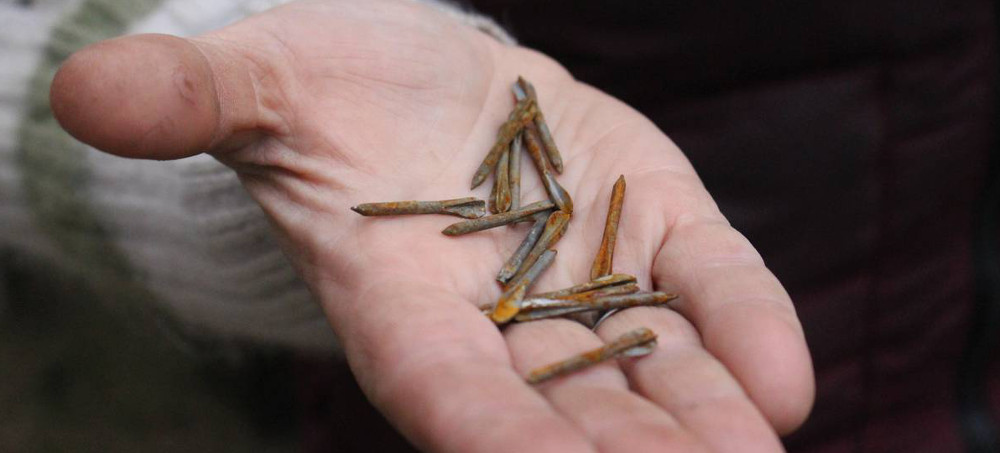 Svitlana Chmut holds fléchettes, small arrow-like projectiles dispersed by a Russian artillery shell, in Bucha, Ukraine, on April 16, 2022. (photo: Alex Horton/The Washington Post)
 Peter Lyoya, center left, and members of his family lead hundreds of protesters through the Boston Square neighborhood during the Justice for Patrick Lyoya march in Grand Rapids on Saturday, April 9, 2022. (photo: Daniel Shular/MLive.com)
 Amazon Labor Union organizers at the LDJ5 Amazon sorting facility on Staten Island, New York, which has a unionization election beginning April 25, 2022. (photo: Amazon Labor Union/Twitter)
 People go through TSA screening as they catch flights at O'Hare International Airport on March 11, 2022, in Chicago, Illinois. (photo: Scott Olson/Getty)
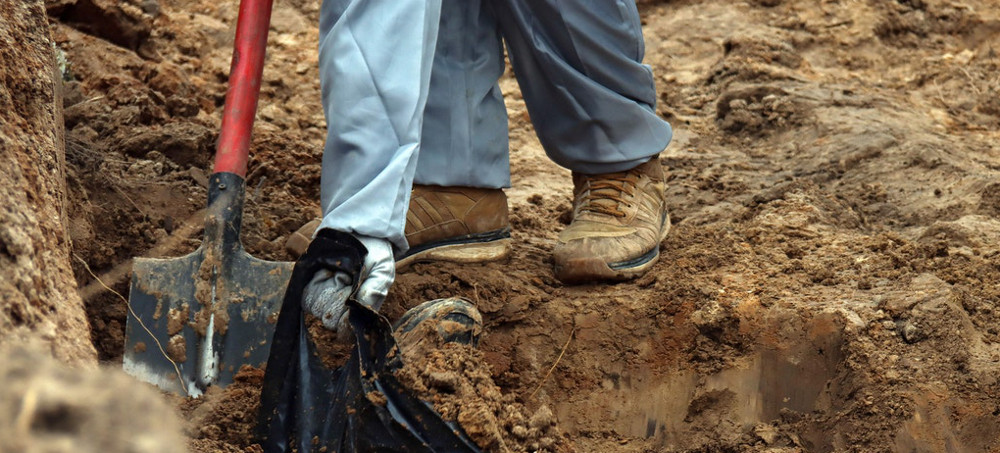 An investigator pulls human remains from a mass grave in Bucha, Ukraine on April 13, 2022. (photo: Anatolii Siryk/Getty)
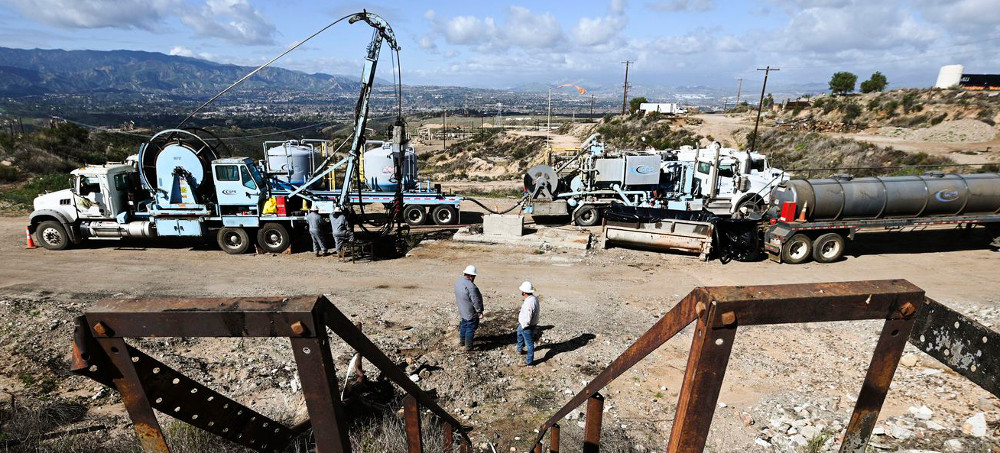 A crew plugs abandoned oil wells at the Placerita Oil Field in Southern California. Abandoned oil and gas wells could be used to generate geothermal energy. (photo: Robyn Beck/Getty)
The US is spending millions to explore a surprising source of untapped power.
Geothermal energy works on a simple premise: The Earth’s core is hot, and by drilling even just a few miles underground, we can tap into that practically unlimited heat source to generate energy for our homes and businesses without creating nearly as many of the greenhouse gas emissions that come from burning fossil fuels. However, drilling doesn’t come cheap — it accounts for half the cost of most geothermal energy projects — and requires specialized labor to map the subsurface, drill into the ground, and install the infrastructure needed to bring energy to the surface.
But the US, in the wake of an oil and gas boom, just so happens to have millions of oil and gas wells sitting abandoned across the country. And oil and gas wells, it turns out, happen to share many of the same characteristics as geothermal wells — namely that they are deep holes in the ground, with pipes that can bring fluids up to the surface. So, the DOE asks, why not repurpose them?
What’s old is new again
That’s exactly what the agency’s pilot program, called Wells of Opportunity: ReAmplify, aims to do, awarding a total of $8.4 million to four projects across the country that will each try to tap into some of those old wells to extract geothermal energy rather than gas or oil. If they work, they could be the key to not only reducing the country’s use of planet-damaging fossil fuels, but also helping answer the question of how to transition many of the more than 125,000 people who work in oil and gas extraction across the country into clean-energy jobs.
“The idea here is basically that you produce oil and gas resources for a couple of decades, and at the end of the production of oil and gas, you don’t completely retire the assets — you turn them toward heat production,” said Saeed Salehi, associate professor of petroleum engineering at the University of Oklahoma and the leader of one of the four groups receiving funding from the DOE. Oil and gas wells have a limited lifespan of a few decades, Salehi explained, after which they become depleted. Geothermal energy, if managed correctly, doesn’t have that problem. “The beauty is that this is a constant source of energy which is not going to change. It’s probably going to be [there] forever, as long as your well is functioning,” Salehi told Recode.
Salehi and his team at the University of Oklahoma want to use four wells owned by Blue Cedar Energy, a local company, for a concept called “direct use” — using hot water to heat nearby buildings. The water can either be extracted from existing underground reservoirs or, as the University of Oklahoma team is doing, pumped into the ground and brought back to the surface. Salehi and his team expect the water they pump into the wells to heat up to temperatures around 150 degrees Fahrenheit, after which it can be used to provide heating and cooling for an elementary and middle school located about a mile away from the wells, in the town of Tuttle.
“There’s a huge opportunity to use these wells for heating and cooling our communities,” said Lauren Boyd, program manager of the Enhanced Geothermal Systems program in the DOE’s Geothermal Technologies Office, which oversees the Wells of Opportunity grants. More than half of the energy used by American households — only 7 percent of which came from renewable sources as of 2020 — goes toward heating and cooling. Using the millions of abandoned wells scattered around the country to switch the source of that heating and cooling to geothermal energy, then, could lead to a decrease in greenhouse gas emissions.
Salehi and his team are focused on heating and cooling because converting energy from one form to another often leads to some energy getting lost in the process. Depending on the temperature of the water underground, “only probably about 10 percent of the energy you take out of the ground is going to come back as electricity,” said Jefferson Tester, a professor of sustainable energy systems at Cornell University. “But if you do it with heat, you can get 90 plus percent, easily.”
That heat wouldn’t only be useful in the winter, either: in the summer, water from a geothermal well could be used to drive a machine called an absorption heat pump to cool buildings, essentially extracting the heat from the building and putting it into the water. That water can then be pumped into underground reservoirs, which will store the extracted heat for the coming winter.
To be considered successful, the University of Oklahoma project has to produce at least one megawatt of energy in one year — which is roughly enough to power a few hundred homes. Salehi is confident they will easily surpass that goal. “Our intention is for these four wells to be used for at least the elementary and middle school,” Salehi said, “but based on the simulations and computational work we have done, it’ll be good enough for three schools.”
Can geothermal go the distance?
Some European countries already rely on direct use of geothermal energy on a large scale; Iceland, which is famously volcanically active (remember Eyjafjallajökull, which shut down European air travel for a few days in 2010?), uses its vast reserves of geothermal energy to heat 90 percent of its homes. But there are some drawbacks to direct use. Heat is quickly lost in transit unless pipes are well-insulated, explained Patrick Fulton, assistant professor of earth and atmospheric sciences at Cornell, so geothermal wells being tapped for direct use have to be near the buildings they’re going to service — usually within a few miles.
That distance limitation is why the three other projects receiving funding from this year’s DOE award are focusing on turning geothermal energy into electricity, which can travel much farther than heat. While wells located close to towns and cities may be better used for supplying heat through direct use, wells in remote areas might be better suited for generating electricity.
Take Transitional Energy, a Colorado-based company that received funding from the DOE to set up an electricity generation facility at the Blackburn oil field in Nevada. Unlike the other projects, Transitional will set up its operations on an oil field that’s still in operation — albeit at wells that have been in use for decades and produce very little oil. Most of what they produce, explained Johanna Ostrum, chief operating officer of transitional energy, is extremely hot wastewater, which is a natural byproduct of all oil and gas operations. “They’re just cycling a bunch of water through the system, trying to strip out negligible amounts of oil,” Ostrum told Recode.
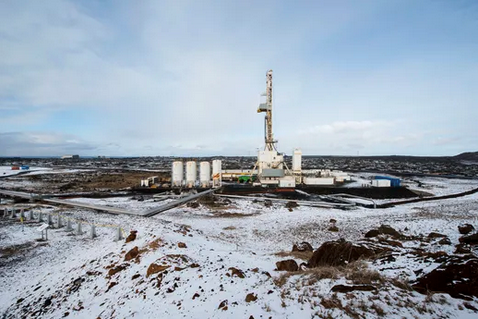
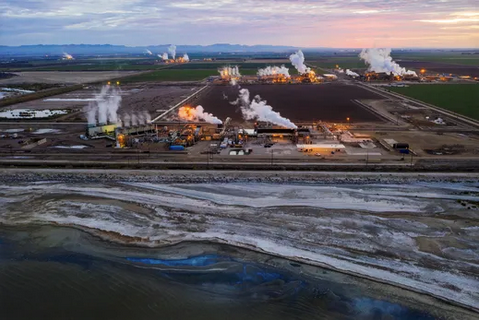
Once they’ve separated out the oil and gas, well operators spend considerable sums cooling and disposing of all that wastewater — and there’s often 10 times more of that water than extracted oil, Ostrum explained. Instead of letting that water — and its heat — go to waste, Transitional Energy plans to install machines called Organic Rankine Cycle Engines at the oil field that will turn that heat into electricity.
Organic Rankine Cycle Engines, which are about the size of walk-in refrigerators, work by passing hot water through a heat exchanger to heat a refrigerant, which then spins a turbine that creates electricity. The water cools down as it transfers its heat to the refrigerant, continuing onward down the path it would usually take out of the generator and into a disposal well; the refrigerant cools as it passes out of the turbine and past an air chiller, so it can be reused as the water keeps passing through the engine. At the Blackburn oilfield, where Transitional Energy is carrying out its test, that water will enter the same reservoir it came from — essentially creating a continuous loop of geothermal energy. “You take the same molecule of water and it just keeps going around and around, using the Earth as a radiator,” Ostrum said.
Like the University of Oklahoma project, Transitional Energy has a goal of generating at least one megawatt in a year — a goal Ostrum expects to hit by using the water from three to five wells. To begin with, the electricity generated will be used to provide power to an electric vehicle charger and operations at the oil field, which usually relies on local utilities or diesel generators to power machinery. It’s an alluring prospect for the operators of the oil and gas fields, Ostrum said; they see it as a way to take advantage of a heat resource that otherwise goes to waste.
In the short term, operating costs for the oil producers could go down, since they won’t have to depend on a utility to power their operations, and switching to geothermal energy would reduce the emissions involved in simply pumping oil and gas out of the ground. In time, Ostrum said, the goal would be for Transitional Energy to simply take over wells that no longer produce enough oil and gas to be economically viable and convert them entirely to geothermal operations.
A geothermal future
Ostrum is especially excited by the broader implications of her project. For one, Transitional Energy plans to connect electric vehicle (EV) chargers to their Rankine Cycle Engines. If scaled up, that could help expand rural EV charging, which is currently very limited — according to the Environmental and Energy Study Institute, the majority of rural areas and small towns have no EV chargers at all. More importantly, however, Ostrum thinks geothermal energy could create a new career path for oil and gas workers as the world transitions away from fossil fuels to clean energy.
“A lot of folks that I know work in oil and gas, and when we look at a decarbonized future, there’s not going to be jobs for those folks,” said Ostrum, who spent 15 years working in the oil and gas industry herself before losing her job during the pandemic. “I think geothermal is a really great place for them to land. Oil and gas workers know how to safely, efficiently, and economically produce fluid. They happen to be focused on the oil and gas part; I’m focused on the water part.”
Brett Dawkins, co-founder of Blue Cedar Energy, which owns the leases for the wells that will be used in the University of Oklahoma’s project in Tuttle, agrees. “All of the expertise that you would have as a petroleum engineer or a geologist will transfer over into the geothermal world,” Dawkins said.
Dawkins isn’t sure quite how much manpower would be needed to transition Blue Cedar Energy’s abandoned oil wells to geothermal energy. Ostrum, on the other hand, is confident workers at oil and gas wells would find new jobs extracting geothermal energy. “To keep the wells pumping or operating, we will need the same manpower that is used every day to run oil wells,” Ostrum wrote in an email. “The same amount of labor is needed to run an oil and gas well as to run a geothermal well.”
The possibility of generating a significant amount of energy from these abandoned wells is exciting. It’s still very much a nascent idea, though, so exploring its potential will take time. First, the projects need to prove their viability; the next year or so will be spent on planning and assessing the feasibility of turning oil wells into geothermal resources, after which energy generation will slowly ramp up. The biggest question is just how scalable these ideas are: One megawatt is, after all, a pittance compared to the country’s energy needs.
There are legislative hurdles to get around, as well. “One of the barriers I’ve been working on is the permitting,” said the DOE’s Boyd, who’s working with the National Renewable Energy Lab on a framework for transitioning an oil and gas lease to a geothermal lease. “Right now, it’s not straightforward,” Boyd told Recode. “There are some states that don’t even have geothermal regulations.”
It’s also unclear how widely those concepts can be applied across the country. Not every abandoned oil and gas well is going to be viable for repurposing to geothermal energy, Boyd said. The infrastructure at some abandoned wells might be too degraded to use for geothermal energy without a significant investment in retrofits, for example, or the underground temperatures at some wells may not be high enough to use for geothermal energy. Then there’s the question of distance: Connecting remote wells to the grid could prove too cumbersome, or there might not be enough wells located close enough to communities to set up for direct use.
Even if everything else falls into place, the final stumbling block, at least for Salehi’s team, could come in the form of homes and businesses that simply aren’t set up to use geothermal energy for direct use. While the end-user experience for someone with a direct use connection is the same as that for someone with a traditional HVAC system — essentially, hot or cold air blowing through vents in rooms — turning geothermal heat into that hot or cold air requires installing heat pumps or heat exchangers, the cost of which could prove prohibitive.
Still, even with all the caveats, the ReAmplify projects hold a lot of promise for cleaner energy and a more equitable clean-energy transition; the point of the pilot, after all, is to be a proving ground. But if they work, said Cornell’s Tester, it’s important not to think of geothermal energy as a magic bullet. “It’s not just a one-size, geothermal can do it all [solution],” Tester told Recode. “I don’t think we should be saying that as a profession, and neither should solar or wind.”
Instead, Tester said, Americans need to start thinking about our energy needs as interconnected systems with multiple parts to the solution. Instead of relying on one power source for everything, we should use solar and wind energy to power our appliances and electric vehicles, for example, while relying on geothermal energy to heat and cool many of our homes.
That’s going to require a shift in how we think about our energy sources, Tester said. In most of the country, the oil and gas extracted from a well can go toward heating and cooling homes, running appliances, and powering our cars; for a decarbonized future, that will have to change. “I don’t think we’ve gotten into a state yet of thinking of these things as systems,” Tester said. “I think that’s what we have to weave into the American mindset. It’s going to be a game, I think, for everybody to get all the renewables working together.”
Special Coverage: Ukraine, A Historic Resistance
READ MORE
Follow us on facebook and twitter!
PO Box 2043 / Citrus Heights, CA 95611
LOTS OF POSTS IGNORED BY BLOGGER..... OR REMOVED ON THEIR WHIM! ALL POSTS ARE...


