Showing posts with label MEDICAL CARE. Show all posts

Monday, August 26, 2024

Life in Gaza is even Harder than it appears on Screen: The Struggles of Daily Life


Israel/ Palestine

Life in Gaza is even Harder than it appears on Screen: The Struggles of Daily Life

Written byUntoldMag
 

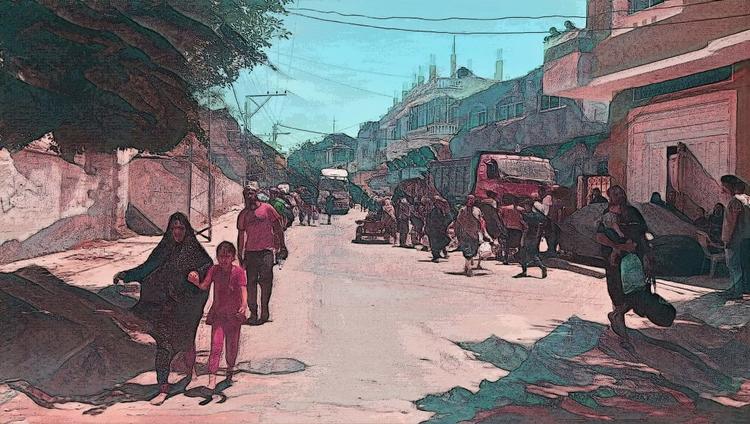
Photo by Issam Hajjaj, illustrated by Zena El Abdallah, used with permission.

This story was written by Issam Hani Hajjaj and originally published in Arabic by UntoldMag. It was translated into English by Walid El Houri and published on Global Voices with permission.

( Globalvoices.org ) – The reality in Gaza is more challenging than one might imagine. Two weeks ago, I drank what was supposed to be potable water. My stomach still aches from time to time, even today. The water is as potable as Gaza is livable.

A week after we were displaced from the European Hospital in Gaza to the Al-Mawasi humanitarian area — an area the Israeli army touts to the world — I was awakened by the sound of a child screaming, “America is nuking Palestine!”

Although it is the Israeli occupation forces that are striking Palestine, with support from the United States, I wondered how such thoughts formed in this child’s mind. How did he come to articulate a sentence like that?

Al-Mawasi is a large area in Khan Yunis and Rafah that the Israeli occupation forces have designated as a zone for displaced citizens before they enter any governorate. The tents here are crowded together, some bearing the names of donor countries. The tents differ in shape and fabric, with some made of leather and others of different materials. The most prominent tents are from the UAE, Saudi Arabia, and Germany due to their size, followed by Pakistani tents known for their distinct geometric shape and fabric.

People here live in a constant state of displacement, forced to move whenever the army decides to enter a new area, each time leaving behind a trail of innocent lives.

In reality, the Mawasi area has become the most dangerous place in the Gaza Strip due to repeated bombings by the Israeli army. Countless people have been killed in an instant, for no reason other than that the army can do so.

The displacement journey begins the moment the army announces the evacuation of a place. People scramble to find vehicles to transport themselves and their belongings, and the suffering of the displaced begins with the war profiteers who demand exorbitant prices for transport. No one has a choice but to pay because survival is the priority.

You dismantle your tent, gather everything you can, and move to a new location where you can set up the tent again. Once there, you start preparing a bathroom. Water is the most important resource, so people seek locations near water sources.

After we found a place to set up our tent in the Mawasi area, specifically in Asdaa City, we bought a tent and set it up with the seller’s help. The next day, we dug a circular hole two meters deep to drain the bathroom. We bought a cement base for the bathroom, extended a plastic pipe to the hole, and thus completed the construction of the ground bathroom, known as the “Arab bathroom.” It’s a small, enclosed space, measuring 1.5 meters (4.9 feet) by 1.5 meters, surrounded by cloth or tarpaulins.

Some people can build a Western-style bathroom, especially in camps supported by certain parties. However, the Arab bathroom is more suitable for displacement, as it uses less water and is healthier for the body’s posture. However, this type of bathroom is difficult for someone like my father, who has injuries to his hand and foot, which should be treated in a hospital.

My father suffers from double fractures in his left hand and right foot, both of which now contain internal plates. He has also lost his left eye, making life unbearable inside the tent under the harsh sun, which further aggravates his condition. He needs three immediate surgeries, but no one sees his suffering except us, and despite his critical condition, we have not been able to get him out of Gaza for treatment.

To create some privacy, you enclose yourself with tarpaulins, covering one side of the tent, and designate corners for the kitchen and laundry.

In Asdaa City, waste disposal is different from other areas in Gaza. People dig holes to bury their waste because garbage trucks cannot reach this place, and building a landfill is impossible here.

The tent is unbearably hot during the day and freezing cold at night. During the day, you feel like stripping off all your clothes, while at night, you shiver under your covers. The sun wakes you up in the morning, drenched in sweat, with flies buzzing around your face. Sand is everywhere — on your body, in your clothes, and even in your food.

Initially, the discomfort is overwhelming, but eventually, you adapt. In the area, there is a large well called “Al-Hawoz,” which supplies water to the entire region. People come from different areas to fill their tanks, transporting them by donkey carts and makeshift carts, or carrying the water by hand over long distances.

As for potable water, sometimes a free truck arrives, and people rush to it, fighting to get water. This is the only chance to get somewhat drinkable water without paying USD 1 for 10 liters (2.6 gallons). In this intense heat and with the pressing need for water, such a small amount is insufficient.

Many people cannot meet their daily needs and survive on whatever little is available. This situation forces people to drink regular water, which often leads to colic and diarrhea. With a lack of proper care, their situation is heartbreaking.

Read more: 

For a family like mine, consisting of eight people, we need about USD 550 per month just for food because of the high prices. Other necessities, such as charging phones, using the internet, and countless other things, come at an additional cost. Life forces you to prioritize what is most important for you and your family according to your income, but you won’t always succeed.

Many people have lost their jobs and have turned to selling goods. Trading has become the most common profession because everything else has ceased — except for the trade of goods, and war profiteering. As dire as life in Gaza looks on screen, the reality is far more difficult than one can imagine.

Two weeks ago, I drank some water, and my stomach still hurts. The water was supposed to be potable just as Gaza is supposed to be liveable.

Globalvoices.org

About the Author

Global Voices is an international community of writers, bloggers and digital activists that aim to translate and report on what is being said in citizen media worldwide. A non-profit, it is incorporated in Amsterdam, the Netherlands.


INFORMED COMMENT

Saturday, July 27, 2024

‘Truly shocking’: New Mexico AG reacts to NBC News investigation into hospital


NBC News

10.2M subscribers


Monday, October 16, 2023

An update on our response to the Israel-Gaza conflict


Americares


Monday, May 30, 2022

RSN: FOCUS: 'This Is Europe's War': The Foreign Volunteer Medics on Ukraine Frontline


Reader Supported News
29 May 22

Live on the homepage now!
Reader Supported News

IN A WORLD AWASH IN LIES ... Dear Marc, It was my pleasure to contribute. In a world awash in lies, RSN is a lighthouse beacon in a hazardous and stormy sea. Keep up the good work.
Bruce • RSN Reader-Supporter

Sure, I'll make a donation!


British medic Martin Wyness cleans an ambulance at a hospital in Bakhmut, Ukraine. (photo: Ed Ram/The Guardian UK)
FOCUS: 'This Is Europe's War': The Foreign Volunteer Medics on Ukraine Frontline
Emma Graham-Harrison, Guardian UK
Graham-Harrison writes: "It was the photo of a young girl, dying in a Mariupol hospital after Russian shelling, that made up Martin Wyness' mind. He had to go and help in Ukraine."


People who feel compelled to help are ferrying casualties from intense fighting in the east to hospitals

It was the photo of a young girl, dying in a Mariupol hospital after Russian shelling, that made up Martin Wyness’ mind. He had to go and help in Ukraine.

Less than three months later, he was in an ambulance racing to save the life of another little girl gravely injured by a Russian attack, as more shells crashed down around them. They turned around and raced back the way they had came, looking for another route to safety and medical care for the eight-year-old, whose body was peppered with shrapnel.

“They didn’t get her the first time so they had another go,” he said, in his hospital base in Donbas region. “As if that little girl wasn’t vulnerable enough.”

Wyness is part of a volunteer medical unit bridging the gap between Ukraine’s eastern frontline – which is experiencing the most intense fighting of the war – and major hospitals where war-injured soldiers and civilians can get long-term treatment for their wounds.

Medbat Pirogov volunteer hospital brings together dozens of Ukrainians, including some who returned from abroad to serve, and a handful of internationals who felt compelled to try to help out in a conflict thousands of miles from home.

“I felt this wasn’t Ukraine’s war, it was Europe’s war, my war,” said Wyness. He has twice made the journey to Ukraine from his Southampton home. The first month of the war he spent in the basement of a Kyiv hospital, patching up those injured in the battle for the city.

After the Russians were defeated he returned home for a break, but in early May returned to the new frontline near the almost-besieged town of Sievierodonetsk.

Ukraine’s president, Volodymyr Zelenskiy, said the battle in Donbas was so intense that up to 100 of the country’s soldiers were dying in combat each day.

It is a gruelling artillery duel in which the enemy is often faceless and unseen, appearing only in the form of shells, rockets and missiles, and visible through the terrible injuries they inflict on the bodies of civilians and soldiers alike.

“Some days I think I’ve got to go, it’s just too much,” Wyness said, in an interview interrupted when shells started landing close to the base and the team had to race down to a basement bunker.

Both the injuries and the constant threat of death are exhausting; the medics are targets for a military that has repeatedly bombed hospitals in Ukraine and in Syria, killing doctors, nurses and patients in defiance of international law.

The medics are fundraising for armoured ambulances that would at least protect medics and patients from the worst of the shrapnel, but the war has sent prices even for secondhand vehicles soaring. So for now the group race towards the frontline in ordinary vehicles that would be ripped to shreds if an artillery round landed too close.

Jennifer spent $4,500 (£3,560) of her own money to travel from California and risk death daily to help out. She does not want her last name published because she told her mum she was only going to Poland to help refugees, although she told her daughters – who are 17 and 23 – the truth.

“The way I’ve raised them, they understand that this is an important thing to do,” she said. “If you know something is wrong and you don’t say or do anything, it’s doubly wrong.”

Jennifer worked as a medic in Afghanistan, on contract with the international mission, so is used to conflict injuries and dangerous environments but the intensity and proximity of the fighting in Ukraine has still shocked her.

“It’s more than I expected. Yesterday morning I was upstairs getting changed, a rocket flew by and landed just close by. The first night we got here we were in the basement, told to get ready to evacuate, because they thought the Russians had breached [Ukrainian lines] and were coming.”

She made up her mind to volunteer when she saw Zelenskiy appealing to the world for assistance in Ukraine’s struggle, and began researching her options before contacting Gennadiy Druzenko, the founder of Medbat. “It’s a struggle for freedom and they need help,” Jennifer said.

Ukrainians have tried to deter foreigners who do not have military experience from trying to go to the frontlines but Martin and Jennifer have practical skills that are needed as the deaths and injuries mount among civilians and soldiers.

There are also Ukrainian medics in the team, some returned from abroad, others unable to get commissions in the oversubscribed military medical corps but determined to serve. Dymtro Rusnak drove back from Germany with a car full of medical aid.

He had been getting ready for this moment for the best part of a decade. In 2014, after Russia seized Crimea and Russian-backed proxy forces took control of parts of Donbas, Rusnak changed his speciality from radiology to acute care.

“I saw I had to prepare myself, because at any moment it was possible that Russia could start a full war,” he said. When they did, he paused only to put his contract on hold – his bosses were very understanding – and gather as much medical supplies as he could from friends and colleagues.

His main worry when the shells start falling is not his own safety but the worry he is bringing his elderly parents. “Although they are proud, it is very traumatic for them, there are no parents who want to see their children’s funeral.”

He is waiting to get his German medical qualifications certified so he can practise as a doctor in Ukraine, so for now works with Wyness as an ambulance paramedic.

“These years of education and preparation, all these skills, should be used,” he said. “I wanted to be an example, you can say thousands of words, make thousands of posts on social media, but this means nothing … you have to act, to do something.”


READ MORE

Special Coverage: Ukraine, A Historic Resistance
READ MORE


Contribute to RSN

Follow us on facebook and twitter!

Update My Monthly Donation

PO Box 2043 / Citrus Heights, CA 95611


Friday, September 11, 2020

Daily News: Trump administration secretly withheld millions from FDNY 9/11 health program


SICK & TIRED OF THESE PEOPLE SHORT-CHANGING AMERICANS IN NEED & CIRCUMVENTING THE CONSTITUTIONAL INTENT OF CONGRESS!
GET RID OF THEM!


The Daily News reports, "The Trump administration has secretly siphoned nearly $4 million away from a program that tracks and treats FDNY firefighters and medics suffering from 9/11 related illnesses." This is so disturbing that it's even prompting some Republicans to speak out. One GOP Congressman calls the move "disgraceful."

The Treasury Department mysteriously started withholding parts of payments meant to cover medical services for FDNY members being treated by the department’s World Trade Center Health Program, documents obtained by The Daily News revealed.

This is the program that Jon Stewart championed for years.


LINK


Tuesday Afternoon Updates – Error 404: President Not Found

                                                                                                                                            ...