
28 February 22
Live on the homepage now!
Reader Supported News
A DAILY STRUGGLE AGAINST FASCISM — Is what our work at RSN has become. It’s real, it’s pervasive and most people would rather not look at it. This is a pretty serious battle against some pretty serious people. A budget would be a big help.
Marc Ash • Founder, Reader Supported News
Sure, I'll make a donation!

RSN: Jeff Cohen | Major US Media Oppose Military Aggression . . . Unless the United States Is Doing It
Jeff Cohen, Reader Supported News
Cohen writes: "Having worked inside mainstream U.S. media during the beginning of the 'War on Terror' and run-up to the U.S. invasion of Iraq, the differences in today's war coverage are dizzying to me."
Having worked inside mainstream U.S. media during the beginning of the “War on Terror” and run-up to the U.S. invasion of Iraq, the differences in today’s war coverage are dizzying to me.
CIVILIANS: While covering Russia’s horrific aggression in Ukraine, there is a real focus -- as there always should be -- on civilian victims of war. Today, the focus on that essential aspect of the Russian invasion is prominent and continuous -- from civilian deaths to the trauma felt by civilians as missiles strike nearby.
Unfortunately, there was virtually no focus on civilian death and agony when it was the U.S. military launching the invasions. After the U.S. invaded Iraq in 2003 on false pretenses -- made possible by U.S. mainstream media complicity that I witnessed firsthand -- civilian deaths were largely ignored and undercounted through the years.
Shortly after the U.S. invaded Afghanistan in October 2001, leaked directives from CNN’s management to its correspondents and anchors showed that the network was intent on playing down and rationalizing the killing and maiming of Afghan civilians by the U.S. military. One memo instructed CNN anchors that if they ever referenced Afghan civilian victims, they needed to quickly announce to their audience: “These U.S. military actions are in response to a terrorist attack that killed close to 5,000 innocent people in the U.S.” Such language was mandatory, said the memo: “Even though it may start sounding rote, it is important that we make this point each time.”
A few weeks after 9/11, what CNN viewer had forgotten it?
Noting the cursory U.S. television coverage of Afghan civilian casualties, a New York Times reporter wrote: “In the United States, television images of Afghan bombing victims are fleeting, cushioned between anchors or American officials explaining that such sights are only one side of the story. In the rest of the world, however, images of wounded Afghan children curled in hospital beds or women rocking in despair over a baby's corpse, beamed via satellite by the Qatar-based network, Al Jazeera, or CNN International, are more frequent and lingering.”
The near-blackout on coverage of the civilian toll continued for decades. In April of last year, NBC anchor Lester Holt did a summing-up report on Afghanistan as “America’s longest war” by offering one and only one casualty figure: “2300 American deaths." There was no mention of the more than 70,000 Afghan civilian deaths since 2001, and no mention of a U.N. study that found in the first half of 2019, due mostly to aerial bombing, the U.S. and its allies killed more civilians than the Taliban and its allies.
As the war on terror expanded to other countries, U.S. mainstream media remained largely uninterested in civilian victims of U.S. warfare and drone strikes.
INTERNATIONAL LAW: Invasions and military force by one country against another are clearly illegal under international law, unless conducted in true self-defense (or authorized by the U.N. Security Council). In coverage of Russia’s invasion of Ukraine, U.S. mainstream media have correctly, repeatedly, and without equivocation, invoked international law and declared it illegal. As they did when Russia invaded Crimea in 2014.
By contrast, when the U.S. illegally invaded or attacked country after country in recent decades, international law has almost never been invoked by mainstream U.S. media. That was surely the case in the lead-up to the Iraq invasion -- unlike in Britain, where major media prominently discussed the reality that invading Iraq would be a crime against international law unless authorized by a U.N. Security Council resolution. On a BBC television special six weeks before the invasion, for example, Tony Blair was cross-examined on that point by antiwar citizens.
In 1989, when the U.S. invaded Panama in perhaps the bloodiest drug bust in history, mainstream U.S. media made a determined effort to ignore international law and its violation -- as well as the slaughter of civilians.
IMPERIALISM: Mainstream media in our country today are outraged by imperialism. On Friday night, MSNBC’s Lawrence O’ Donnell indignantly and repeatedly denounced “Russian imperialism.”
As a lifelong opponent of imperialism, I’m also indignant that a powerful country like Russia is using force to try to impose its will and its own chosen leadership on the Ukrainian people.
But I’ve never heard O’Donnell or anyone at MSNBC denounce U.S. imperialism. Indeed, the existence of something called “U.S. imperialism” is so adamantly denied by mainstream U.S. media that the phrase doesn’t appear in print without scare quotes.
This stubborn unwillingness to recognize U.S. imperialism persists despite the fact that no country (including Russia) has come close to ours in the last 70 years in imposing its will in changing the leadership of foreign governments -- often from good to bad (for example, Iran in 1953; Guatemala in 1954; Congo in 1960; Chile, in 1973; Honduras in 2009). Not to mention other U.S.-led regime changes (for example, Iraq in 2003 and Libya in 2011).
This denial persists despite the fact that our country maintains more than 750 military bases in nearly 80 foreign countries (Russia has about 20 foreign bases in a half-dozen countries); that our military budget dwarfs that of every other country (more than 12 times larger than Russia’s); that the U.S. provides nearly 80 percent of the world’s weapons exports -- including weapons sales and military training to 40 of the 50 most oppressive, anti-democratic governments on earth.
Speaking of U.S. imperialism, former Secretary of State Hillary Clinton has been all over the news in recent days commenting on Ukraine and accurately denouncing Putin as anti-democratic. But her commentary reeks of hypocrisy on many grounds; one is her key role, largely ignored by mainstream U.S. media, in enabling the violent military coup regime that replaced elected Honduran President Manuel Zelaya in 2009. (You can read about it here and here.)
So as we rally to support Ukrainian civilians against great-power aggression from Russia, let’s do so with the understanding that imperialism should always be opposed, that all civilian victims of wars and violent coups are worthy whether Iraqi or Honduran or Ukrainian -- and that all criminals who violate international law should be held accountable whether they’re based in Moscow or Washington, D.C.
Jeff Cohen was an associate professor of journalism at Ithaca College and founder of the media watch group FAIR. In 2011, he co-founded the online activism group RootsAction.org. He is the author of Cable News Confidential: My Misadventures in Corporate Media.
Reader Supported News is the Publication of Origin for this work. Permission to republish is freely granted with credit and a link back to Reader Supported News.
READ MORE
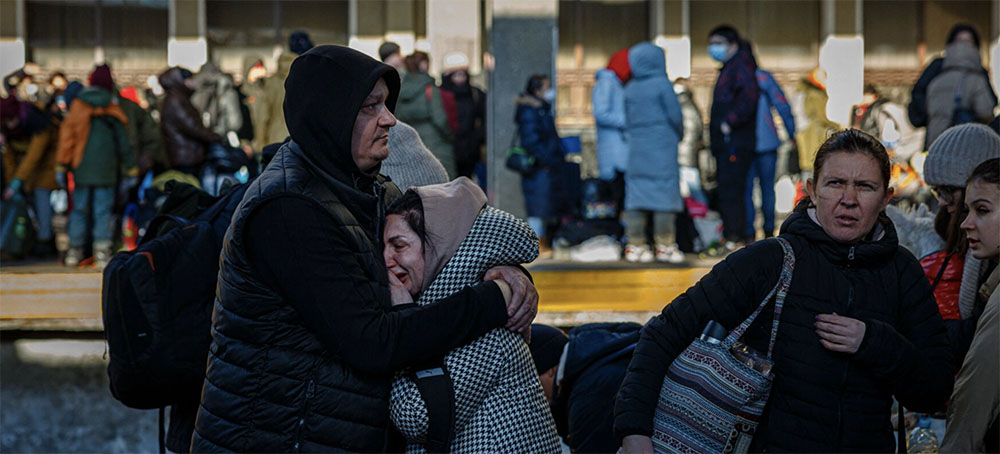 A man hugs his wife before she boards an evacuation train at Kyiv central train station on Monday. (photo: Dimitar Dilkoff/AFP/Getty Images)
Switzerland Breaks Tradition of Neutrality, Freezes Russian Assets
Bill Chappell, NPR
Chappell writes: "Switzerland is joining the European Union in sanctioning Russia and its president, Vladimir Putin, saying the invasion of Ukraine has forced it to break with its longstanding policy of absolute neutrality."
Switzerland is joining the European Union in sanctioning Russia and its president, Vladimir Putin, saying the invasion of Ukraine has forced it to break with its longstanding policy of absolute neutrality.
“Russia’s ongoing military attack on a sovereign European country is an extremely serious violation of international law,” government spokesman Andre Simonazzi said. “The Federal Council is therefore changing Switzerland’s stance on sanctions.”
The EU hit Putin and more than 650 other people with sanctions on Friday, freezing the Russian president’s assets under its jurisdiction along with those belonging to foreign affairs minister Sergey Lavrov. It also targeted politicians who supported Russia’s recognition of two Ukrainian territories as breakaway “republics.”
Switzerland is now joining those sanctions, saying it is freezing assets “with immediate effect.”
“Switzerland reaffirms its solidarity with Ukraine and its people,” the government said, adding that it is sending relief supplies to help Ukrainians who have fled to Poland.
Swiss banks have long been famous for their discretion and security, making the country a haven for stashing wealth. But while today’s decision could alter that perception, it’s unclear how it might impact Putin personally.
Putin relies on Russian oligarchs to store parts of his fortune, according to Bill Browder, a longtime critic of the Russian leader. Browder is the CEO of Hermitage Capital Management; he also leads the Global Magnitsky Justice Campaign. Over the weekend, Browder told NPR how difficult it can be to hold Russia’s super-rich to account, much less to trace their money.
“They hold it in London and New York and Switzerland and France. They buy properties," Browder said. "And so when we're talking about going after Vladimir Putin, it's absolutely great and symbolic and very essential to put him at the top of the sanctions list. But unless you put the people holding his money on the sanctions list as well, it's just a symbolic move, not a practical move.”
READ MORE
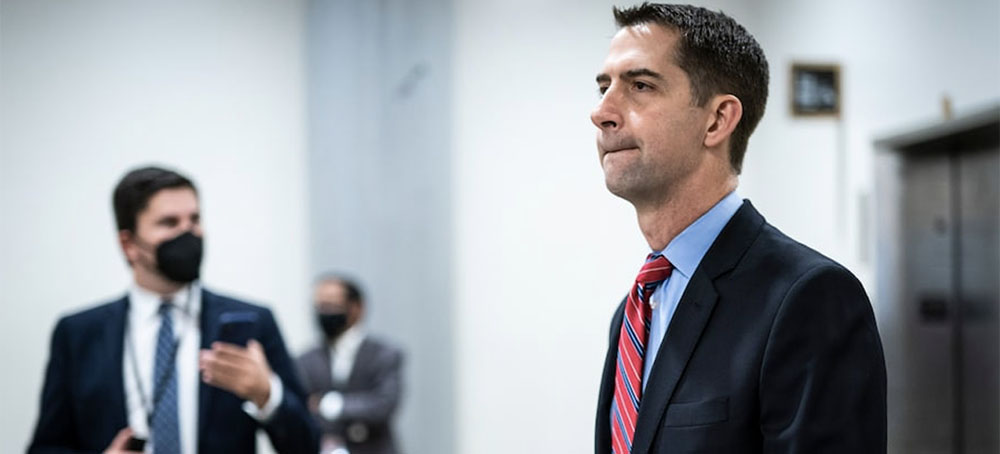 Sen. Tom Cotton (R-Ark.) walks to his office on Capitol Hill in November 2021. (photo: Jabin Botsford/WP)
Putin's War Drives Trump's Personality Cult to New Lows
James Downie, The Washington Post
Downie writes: "Not since the days after Sept. 11, 2001, have Americans been as united on an issue of foreign policy as Russia's invasion of Ukraine."
Not since the days after Sept. 11, 2001, have Americans been as united on an issue of foreign policy as Russia’s invasion of Ukraine. In the new Washington Post-ABC poll, 80 percent of Americans, including more than three quarters of Democrats and Republicans, view Russia as unfriendly or an enemy — the highest level of animosity toward Moscow since the Cold War. But Russian President Vladimir Putin still has one prominent American admirer: former president Donald Trump. And in the United States, Putin’s war has taken Trump’s personality cult to new lows.
Appearing on ABC’s “This Week With George Stephanopoulos,” Sen. Tom Cotton (R-Ark.) denounced Putin, expressed prayers and support for Ukraine and denounced President Biden’s approach to the conflict as “half measures.” Then the host asked Cotton what he thought of Trump praising Putin as “very savvy” and calling his strategy this past week “genius.”
If ever there was a time a Republican could chide Trump, this would be it. Before this past week, die-hard Trumpists were comfortable praising Russia’s president. (“Putin puts Russia first as he should,” Republican Rep. Paul A. Gosar of Arizona tweeted last August.) But as the tanks rolled toward Kyiv this past week, those same voices focused on criticizing President Biden and NATO or downplaying Ukraine’s importance to the United States. Only Trump, even as he condemned the invasion Saturday, still went out of his way to call Putin “smart.”
But even a light criticism was a line Cotton would not cross. “George, you heard what I had to say about Vladimir Putin,” Cotton replied, without a word about the former president.
Three more times, Stephanopoulos repeated the question. Three more times, Cotton refused to answer. “George, if you want to know what Donald Trump thinks about Vladimir Putin or any other topic, I’d encourage you to invite him on your show,” the senator said.
The cowardice is obvious. As Stephanopoulos pointed out, “if a Barack Obama or Joe Biden said something like that, you’d be first in line to criticize him.” And Cotton has had no issues with engaging with Trump through the media. This is the same senator who used Fox News and the New York Times to urge the then-president to deploy troops and “restore order to our streets” during 2020′s racial justice protests. Rather than criticize the president, though, Cotton tried to hide with an answer that will surely satisfy no one — not the millions who rightly detest Putin nor the Trump die-hards who only want full-throated defenses of their hero.
But milquetoast dodges appear to be the standard for most of Cotton’s fellow Republicans. At this past weekend’s Conservative Political Action Conference, CBS reporter Robert Costa had no trouble finding other Republican lawmakers equally scared to address the former president. “Listen, there’s lots of things present in terms of foreign policy,” Sen. Ted Cruz (R-Tex.) stammered. “We clearly all ought to be condemning what’s going on in Ukraine,” Sen. Rick Scott (R-Fla.) said — but when asked whether “we” includes Trump, Scott replied, “That’s a decision” for President Trump.
In recent months, there’s been speculation that Trump’s grip over the Republican Party is loosening. The past few days are a chilling reminder that, no matter how loathsome his utterances, all but a tiny fraction of the GOP lives in terror of crossing him. And for the faithful, the fervor remains ardent. At CPAC, the New York Times reports, “every speaker emphasized personal connections to Mr. Trump, no matter how spurious, while others adopted both his aggrieved tone and patented hand gestures.” No wonder other 2024 hopefuls such as Gov. Ron DeSantis (R-Fla.) are being advised to wait until 2028.
Returning to the White House after losing reelection is no easy task. It’s only happened once in U.S. history (Grover Cleveland in 1892). But never before has our political system experienced a personality cult such as Trump’s. If Democrats aren’t careful, 2024 could mark his ruinous return. And cowards such as Cotton will be of no help.
READ MORE
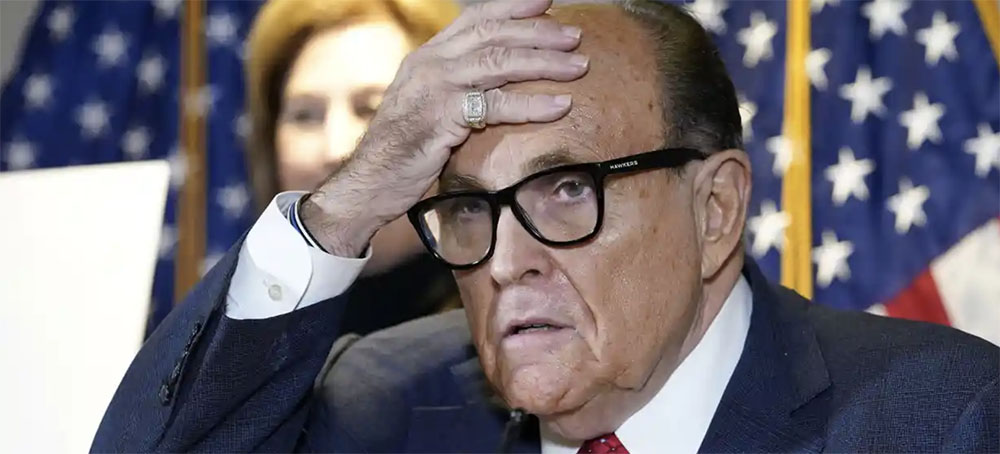 The fake electors stratagem was a part of Trump's fruitless effort to persuade Pence to toss out Biden's electors. (photo: Jacquelyn Martin/AP)
Giuliani's Legal Problems Deepen as 'False Electors' Scheme Investigated
Peter Stone, Guardian UK
Stone writes: "Legal pressures are mounting for Donald Trump's ex-lawyer Rudy Giuliani as the US justice department and the House panel investigating the January 6 assault on Congress are both investigating a 'false electors' scheme which Giuliani reportedly helped lead to overturn Joe Biden's 2020 election."
Ex-prosecutors say possible charges could include falsifying voting documents and even conspiracy to defraud the US
Legal pressures are mounting for Donald Trump’s ex-lawyer Rudy Giuliani as the US justice department and the House panel investigating the January 6 assault on Congress are both investigating a “false electors” scheme which Giuliani reportedly helped lead to overturn Joe Biden’s 2020 election.
Former prosecutors say the justice department inquiry announced last month could pose a serious legal threat to Giuliani, given his role in helping orchestrate an electoral ploy in seven states that Biden won, involving replacing slates of legitimate Democratic electors with bogus Trump slates.
The false-electors scheme is under growing scrutiny by federal and state investigators as one of the avenues Trump, Giuliani and other allies deployed in their aggressive drive to subvert the election result based on debunked charges of widespread voter fraud.
Giuliani, who was subpoenaed by the House panel in January and is in negotiations about providing some testimony and documents, is one of more than a dozen Trump loyalists the committee has subpoenaed who reportedly were central figures in the stealth electors’ plan to nullify Biden’s election.
The fake electors stratagem was a part of Trump’s discredited and fruitless effort to persuade vice-president Mike Pence to toss out Biden’s electors and substitute bogus Republican electors when Congress met on January 6 to tally up the electoral votes.
The phoney pro-Trump electoral certificates involved dozens of Trump loyalists in states such as Arizona, Georgia and Michigan and were sent to Congress in a brazen effort to thwart Biden’s certification.
Some state legislators who had contacts with Giuliani as part of the scam have been subpoenaed by the panel, such as Mark Finchem in Arizona and Doug Mastriano in Pennsylvania, who are, respectively, running in 2022 to be secretary of state and governor in moves that raise fears of future attempts to subvert American democracy.
The false-electors gambit, which the watchdog group American Oversight helped reveal, has been under scrutiny since last year by state attorneys general in Michigan and New Mexico who have looked into the role of the Trump campaign and laws that may have been broken.
Michigan’s Democratic attorney general, Dana Nessel, who spent almost a year investigating 16 Republicans who submitted false certificates alleging they were the state’s presidential electors – notwithstanding Biden’s victory margin of 154,000 votes – asked federal prosecutors in January to start a criminal inquiry. Subsequently, deputy attorney general Lisa Monaco announced an inquiry into “fraudulent elector certifications”.
Former justice officials say that Giuliani now has several legal problems to worry about as federal and state inquiries expand.
“The threats to Giuliani come from multiple directions,” said Michael Bromwich, a former justice department inspector general. “Evidence is growing that he was at the center of a series of schemes to change the election results – by fraud and by force. As the investigations focus more closely on the people Giuliani recruited to change the election results on January 6 and before, his criminal exposure grows as the number of witnesses against him multiplies.”
Other former prosecutors agree that Giuliani may be in serious legal jeopardy as the justice department proceeds with its fake electors inquiry.
“If prosecutors determine that Giuliani improperly influenced or attempted to improperly influence the election, potentially, he could be charged with state and federal crimes including: falsifying voting documents, fraud, false statements, mail/wire fraud or even conspiracy to defraud the United States,” former federal prosecutor Michael Zeldin told the Guardian.
For Giuliani, the latest legal threats come on top of several others that he faces due to his relentless and widely debunked efforts to help Trump win reelection.
Giuliani was hit last year with a $1.3bn defamation lawsuit from Dominion Voting Systems over bogus and conspiratorial claims that Dominion helped rig the election. Dominion told a court in January there was “no realistic possibility” that it could reach a settlement with Giuliani.
Separately, a Georgia special grand jury inquiry into Trump’s high pressure call on 2 January 2021 to secretary of state Brad Raffensperger asking him to just “find’ 11,780 votes to reverse Biden’s win, could ensnare Giuliani. The Fulton county district attorney who launched the inquiry has indicated it is looking into false claims that Giuliani made before a Georgia state senate committee.
But the new DOJ inquiry into the fake electors strategy could pose more serious legal threats to Giuliani, say ex-prosecutors, since he served as Trump’s right hand man and was involved with multiple schemes to overturn the election results.
“Giuliani was the cog of Trump’s flywheel to overturn the election, getting other Trump allies to act and leaving his imprint for investigators to find,” said former federal prosecutor Dennis Aftergut.
“He’s reportedly key in the bogus slate scheme. That’s dangerous for Giuliani, because forgeries disprove innocent intent. In a conspiracy, which DOJ could charge as to the fake electors, a conviction doesn’t require that he solicited, or even knew about the forgeries, but only that he participated in a conspiratorial plot involving fake electors to help overturn the election.”
The drive to assemble illegitimate electors occurred in December 2020 and was conducted state by state with the involvement of some Trump campaign officials and supporters, and reportedly spearheaded by Giuliani.
Michigan attorney general Nessel told Rachel Maddow of MSNBC that under state law “you have a forgery of a public record, which is a 14-year offense, and election law forgery, which is a five-year offense.” She alleged a “coordinated effort” by Republican parties in several states which prompted her request to DOJ to open a federal inquiry. “Obviously this is part of a much bigger conspiracy,” Nessel said.
The House January 6 panel seems to share those views. Last month the committee subpoenaed Giuliani and three other Trump allies he worked closely with on multiple fronts to overturn the election results by promoting baseless charges of widespread voter fraud.
“The four individuals we’ve subpoenaed today advanced unsupported theories about election fraud, pushed efforts to overturn the election results, or were in direct contact with the former President about attempts to stop the counting of electoral votes,” Democratic representative Bennie Thompson of Mississippi, who chairs the committee, said in a January statement.
Congressman Adam Kinzinger, one of two Republican members on the House panel, in February told CBS’ Face the Nation that “we fully expect that, in accordance with the law, we’ll hear from Rudy.”
Giuliani’s lawyer Robert Costello told the Guardian that talks with the panel are ongoing, but would not offer any details, and scoffed at the justice department investigation into the fake elector certificates.
Facing a subpoena and the prospect of a criminal referral to DOJ from the House panel if he doesn’t cooperate, Giuliani could wind up as a crucial witness.
“Giuliani’s information about various schemes that Trump promoted to block Biden’s win could potentially be very helpful to the House inquiry,” Zeldin noted. “If Rudy provides significant cooperation (which is unlikely) he could help the panel unravel some of the major ways that Trump tried to thwart Biden’s election victory including, most significantly, whether there was any coordination or pre-planning between Trump and those who stormed the US Capitol.”
Still, other ex-prosecutors say the fake electors scheme offers a rich target for investigators to unravel that could spell significant trouble for Giuliani.
“For Giuliani and his crew to have legal trouble, you don’t have to get much more into the facts than to understand that he was orchestrating fake slates of electors, based on fake reports of fraud, using faked documents, to fake the outcome of the election, and then submitting those fake documents to government officials,” said Michael Moore, a former US attorney in Georgia.
“That is a conspiracy that a kindergartener could unravel,” Moore added. “The submission of the pro-Trump fake elector certificates to the National Archives was about as smart as taking the note that you used to rob the bank to the frame shop.”
READ MORE
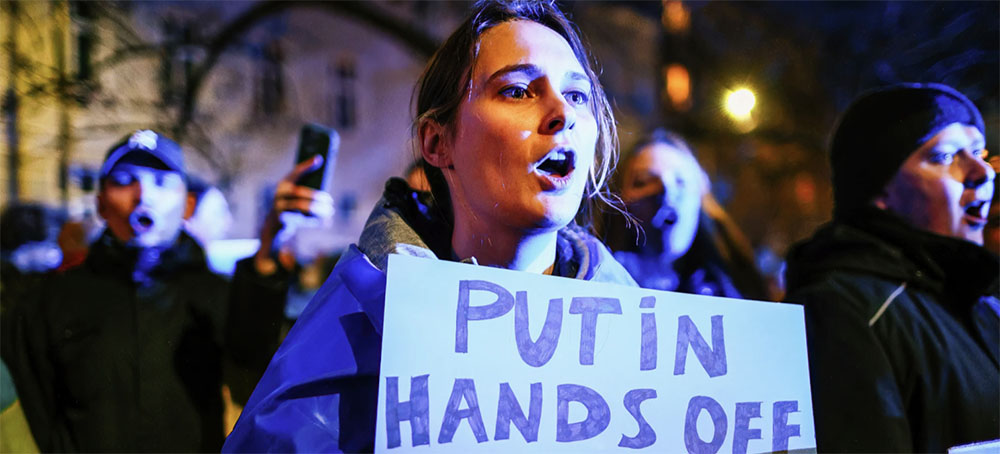 A protest against the Russian invasion of Ukraine. (photo: Sipa USA/AP)
US's Netflix to Be Forced to Broadcast Putin Propaganda
Samuel Stolton, POLITICO
Stolton writes: "U.S. streaming giant Netflix is facing the prospect of being forced to broadcast Kremlin propaganda from as early as next week as part of new obligations in Russia."
Netflix comes under new rules in Russia on March 1.
U.S. streaming giant Netflix is facing the prospect of being forced to broadcast Kremlin propaganda from as early as next week as part of new obligations in Russia.
The move comes as fears increase in the West over how Moscow is leveraging media to sow confusion amid its ongoing war on Ukraine.
On March 1, Netflix will fall under a series of new obligations in Russia after it was added to a register of "audiovisual services" overseen by the country’s communications regulator, Roskomnadzor, last year.
The register applies to streaming services available to the Russian market with at least 100,000 daily users and comes with requirements to broadcast streams of 20 Russian federal television stations. This includes the likes of Channel One, NTV and a channel run by the Russian Orthodox Church, Spas, according to the Moscow Times.
Russia’s Channel One in particular is closely linked to the Kremlin, with a miscellany of some of Putin’s most intimate political allies on the board of the station set to be broadcast across Netflix screens.
This includes the likes of Putin’s top spy Chief Sergey Naryshkin and Alexey Gromov, Putin’s first deputy chief of staff. Gromov’s responsibilities include overseeing the production of state propaganda and Moscow’s broad program of censorship. He had previously served as Putin’s press secretary.
The new broadcast requirements are applicable only to Netflix’s services in Russia, where it has an estimated subscriber base of close to 1 million, based on figures from the firm that manages Netflix's affairs in Russia.
When pressed as to whether they would comply with the new rules, Netflix did not respond to POLITICO’s request for comment. However, experts say that the U.S streaming giant is unlikely to withdraw from the Russian market, owing to commercial interests.
“It seems unlikely they will reject the new rules and leave,” said Catalina Iordache, a researcher specializing in Netflix’s business. She added that this could be due to the partnerships Netflix has already in place with Russia’s National Media Group (NMG), as well as the money it has bankrolled into the production of Russian content such as the drama series "Anna K."
In 2020, Netflix announced a partnership with NMG that was brokered by American-British law firm Hogan Lovells. The company at the time had praised the deal as a “game-changer” that would “set new standards for foreign streaming services in Russia.” NMG owns nearly a 20 percent stake in Russia’s Pro-Putin Channel One.
Iordache added that Netflix’s market share steadily increased in 2021, but that there is still a lot of space to grow. “Russia is a large subscriber market which could prove very profitable if that happens,” she said.
Moscow probing Netflix 'gay propaganda'
More broadly, Netflix’s business in Russia is facing increasing constraints.
In November last year, the Russian interior ministry confirmed that it would examine a complaint leveled by Olga Baranets, the public commissioner for protecting families, regarding the dissemination of “gay propaganda” on Netflix.
If found to be in breach of Russia’s draconian laws against the dissemination of “non-traditional sexual relations,” the company may face fines or a possible suspension of its service.
Elsewhere, Netflix has regularly faced the ire of the Russian administration, which in the past has claimed that the streaming service represents an instrument of U.S. policy. Former Culture Minister Vladimir Medinsky said in 2016 that the White House understands “how to enter every home” through Netflix.
While Netflix examines the cost-risk analysis of remaining in Russia, there is the possibility of other Western streaming services coming under the scope of the country’s broadcasting obligations in the future.
Amazon Prime Video is available in Russia, but is unlikely to meet the required thresholds in terms of subscriber numbers to register as an audiovisual service with the Roskomnadzor. Amazon did not to respond to POLITICO when asked about its future in Russia.
HBO Max, meanwhile, has penned a deal with the Russian streaming service Amediateka, which since 2021 has provided an exclusive platform for HBO productions. Disney Plus is not available in Russia.
Despite the anticipated reticence of Netflix to abandon the Russian market, other authoritarian jurisdictions worldwide have deterred the streaming giant from entering local markets. As Netflix publicly discloses, its services are unavailable in China, Crimea, North Korea and Syria.
READ MORE
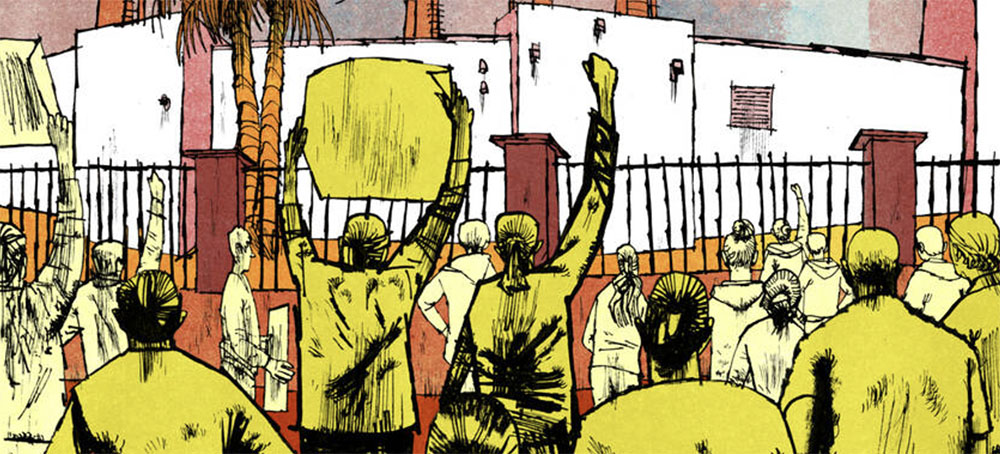 An artist's rendering of a workers' rally in maquiladoras. (image: Matt Rota)
"Queremos Vivir": The Workers Who Wouldn't Die for the Pentagon
Maurizio Guerrero, In These Times
Guerrero writes: "Workers in the Mexican border city of Mexicali, many of them young migrant women, were fighting for their lives."
Maquiladora workers in the border city of Mexicali strike against working conditions.
Workers in the Mexican border city of Mexicali, many of them young migrant women, were fighting for their lives. It was the deadliest point of the pandemic in 2020 in one of the hardest-hit states in Mexico, Baja California.
By May 2020, a local news outlet reported that 432 of the 519 Covid-19 fatalities to date had been workers in maquiladoras—assembly plants on the border that mostly supply the United States.
On April 8, 2020, the Mexicali workers forced two maquiladoras of Gulfstream — a U.S. aerospace company with several active contracts with the Department of Defense— to shutter for nearly a month. Though it was temporary, workers saw the closure of a prime Pentagon supplier as a victory.
By May 4, under pressure from the Pentagon, Mexico allowed these factories to reopen as “essential businesses.”
Mexicali, a city with a population of 1 million just across the border from Calexico, Calif., is home to maquiladoras that employ a total of 70,000 workers making parts and products for U.S. medical, automotive, telecommunications and electronics industries, among others. Mexicali and Tijuana, both in Baja California, together host most of the aerospace maquiladoras in Mexico, at least four of which are current Pentagon contractors.
Hundreds of workers across 90 of Mexicali’s 124 maquiladoras staged work stoppages in April 2020.
“The fact is that workers managed to close the maquiladoras,” says Jesús Casillas, an organizer with the workers’ rights group Organización Política del Pueblo y los Trabajadores (“Political Organization of People and Workers,” or OPT). “Nobody can take that [win] away from them.”
That victory hinged on the use of social media. Facebook pages of various labor organizations, including OPT, were crucial to amplifying the workers’ concerns — by posting anonymous testimonials that workers sent in.
“We helped workers by giving them a platform,” says Liliana Plumeda, an OPT organizer. “Many of them were afraid of being fired. After seeing that there was solidarity, workers had the courage to organize.”
CHAIN LINKS
When Mexican President Manuel López Obrador issued a decree March 30, 2020, declaring the pandemic a health emergency and closing all businesses except essential economic activities such as agricultural work and medical manufacturing, many maquiladoras in Mexicali ignored it.
And Gulfstream, which employs 2,200 workers to produce electrical wire harnesses, sheet metal components, sub-assemblies and machined parts in its two Mexicali plants, remained open. By then, Gulfstream was working on a U.S. Department of Defense contract to build G280 and G550 aircraft (known by the U.S. Air Force as C‑37B planes), components of which are assembled in its Mexicali factories. At least three other U.S. companies with maquiladoras in Mexicali had active contracts with the Pentagon in the spring of 2020: the engine and electrical manufacturer Honeywell, the sheet metal assemblies manufacturer Jonathan Engineered Solutions (JES), and the aircraft electronics manufacturer Collins Aerospace.
They all kept operating despite the mandated lockdowns.
None of these four companies provided a public explanation of why their factories’ work was essential. Spokespeople for Honeywell and Gulfstream told In These Times that their aerospace factories in Mexicali were deemed critical enterprises by the Baja California state government. The March 30 presidential decree, however, does not refer to the aerospace industry as essential, and in early April the Baja California secretaries of health and labor issued a public statement saying maquiladora workers should have been at home since April 1, but the factories had refused to close.
It is possible to trace the successful efforts of Mexicali workers to temporarily disrupt the supply chain of the U.S. war machine by reading dozens of April 2020 testimonies, documented separately by OPT, the local civil society organization Mexicali Resiste (“Mexicali Resists”), and the independent union Sindicato Bajacaliforniano de Trabajadores de Empresas Maquiladoras (“Baja California Union of Maquiladora Company Workers,” or Sibatrem) — and shared exclusively with In These Times. The workers’ testimonies showcase the spontaneous resistance to dangerous working conditions in a region where the coronavirus was spreading faster than anywhere else in Mexico.
“Workers have not been sent home regardless of the positive cases of Covid-19,” a Gulfstream worker’s wife wrote to Mexicali Resiste by Facebook message April 8, 2020. “Many workers like my husband are still locked up there,” she said. (Messages have been translated from their original Spanish.)
Four days later, another Gulfstream worker wrote to OPT: “They have us working without [protective] measures, last night they found a [Covid-19] case and they don’t want to send us home.”
“There have been cases of Covid patients and they do not even take the necessary measures or inform us so we can take care of ourselves,” a Gulfstream worker wrote on April 6, 2020, to Mexicali Resiste. On a post made public by OPT, another Gulfstream worker wrote: “The truth is, for fear of being fired, people do not do work stoppages because they have us very threatened.” The worker added: “In my area on Tuesday, a colleague tested positive for Covid-19 and, do you know what they did? They made us go back in.”
According to a worker’s message to OPT on April 8, 2020, Gulfstream managers said both their Mexican and American lawyers concluded the company was essential because it supported “U.S. Army manufacturing, in addition to doing logistics at airports.”
SHUTTING IT DOWN
Some of these anonymous workers granted the workers’ rights organizations permission to post the complaints on Facebook. The organizations also encouraged workers to defend their right to remain home if they were not doing essential labor and denounced companies that violated the presidential emergency decree. None of the groups, however, directly organized any labor action.
Yet workers staged strikes in about 90 Mexicali maquiladoras in April 2020, according to the news website La Izquierda Diario (“The Left Journal”), which noted the role of social media platforms in amplifying the workers’ struggle. Women were crucial to the resistance as they comprise most of the workers at the plants. They tend to be young, single and with some level of elementary education; many come from elsewhere in Mexico or are migrants from Central America. Their rallying cry during the pandemic was simple: “Queremos vivir,” or, “We want to live,” according to a July 2020 op-ed by maquiladora worker María Guadalupe in La Izquierda Diario.
The stoppages took place without a central organizing group and apart from the official Mexican unions. Most “unions” in Mexico are actually “company unions” — subservient to owners and employers.
On April 9, workers began to halt labor at the Honeywell maquiladora, a Mexicali producer of aircraft heat exchangers manufactured under military contract in April 2020. Soon after, workers at JES organized a work stoppage. Work at the two Gulfstream factories continued, but workers posted dozens of complaints on the Facebook pages of local organizations throughout the month.
Gulfstream forced its workers to keep showing up for work or go home without pay, according to the testimonies of two workers. When workers denounced Gulfstream on social media for putting their health at risk by refusing to close, the company pressured them to take vacation days, according to an internal company memo posted by Mexicali Resiste on April 7, 2020. Gulfstream also tried to deter workers from organizing, says Luciana Benítez, an attorney at Sibatrem, which gave legal advice to more than 100 Gulfstream employees. Managers told workers to leave earlier than usual so they would not have a chance to communicate and organize with the next shift as workers arrived, according to Benítez.
Also on April 7, 2020, Baja California Sen. Alejandra del Carmen León Gastélum denounced several maquiladoras for operating even though their activities were not essential. Among those named were Collins Aerospace and Gulfstream.
After the public pressure, Gulfstream temporarily suspended activities April 8, 2020, although managers told workers to return to work the following Monday. On April 10, however, Baja California Gov. Jaime Bonilla Valdez officially shut down 12 maquiladoras in Mexicali, including the Gulfstream and JES plants.
The closure notice was posted at the gates of Gulfstream, and the company issued a memo acknowledging the suspension until April 14, 2020.
The company stated workers would still receive full wages and benefits.
Workers took the memo as a victory: Their facebook posts read, “Sí se pudo” (“Yes we could”). “Justice was served,” one worker wrote.
The challenges workers had to overcome in order to stand together were significant. Labor organizing in the maquiladoras at the Mexican border is very difficult, says Margarita Ávalos, founder of Ollin Calli, a workers’ rights organization in Tijuana. Many workers are Indigenous women who arrive at the maquiladoras having already faced a history of violence and abuse and are afraid to lose their jobs, focused completely on sending money home.
All told, a number of maquiladoras, including Honeywell and Collins Aerospace, shut down for varying periods in April, under government orders or worker pressure.
By the end of the month, the Pentagon had retaliated forcefully. That intervention ended what Juan Carlos Vargas, an OPT organizer, calls “the rebellion in the maquiladoras.”
PENTAGON’S BACKLASH
The Pentagon made clear its intentions to reopen its supply chain. In an April 20, 2020, press briefing, Ellen Lord, then-undersecretary of defense for acquisition and sustainment, said that companies in Mexico were “impacting many of our major primes,” referring to the military’s primary contractors, which include Lockheed Martin, Boeing, Raytheon, General Dynamics and Northrop Grumman. General Dynamics, which wholly owns Gulfstream as a subsidiary, amassed military contracts in 2020 worth $21.8 billion, making it the Pentagon’s third-largest contractor.
Lord said she had spoken with the U.S. ambassador to Mexico and the Mexican foreign minister “to ask for help to reopen international suppliers,” who were “especially important for our U.S. airframe production.” Pentagon officials were also calling industry associations, she said. “Mexico right now is somewhat problematical for us,” Lord added.
Vargas, from OPT, said the Pentagon’s statement meant “a very drastic change” in how the Mexican government was managing the 2020 lockdowns and reopenings. Vargas said the Baja Californian secretaries of health and labor had regularly appeared in the media to advise workers to file complaints against employers that violated the health emergency decree, for example — but after the Pentagon’s statement, there were no news clips of state officials advocating for workers’ rights. The administration of new Baja California Gov. Marina del Pilar Ávila Olmeda, who took office in November 2021, had no comment on the actions of its predecessor.
Demands from U.S. officials piled up. Christopher Landau, then‑U.S. ambassador to Mexico, wrote on Twitter on April 21, 2020: “I’m doing all I can to save supply chains between Mexico, the United States and Canada.” A day later, the National Association of Manufacturers, with 14,000 company members, sent a letter to President López Obrador stating its concerns about the health emergency decrees, which threatened “our companies’ essential manufacturing facilities.”
Chus, an organizer from Mexicali Resiste who asked to be identified by his first name only in order to keep attention on the workers, says, “At first, there was at least an attempt by the [Mexican] federal government to stop the flow of people to the work centers.” However, he added, when pressure mounted from the United States, “the federal and the state governments folded.”
Just three days after the Pentagon’s statement, President López Obrador said he expected an agreement “in due course” to allow factories on the border to begin operating normally again.
On May 4, 2020, the state government allowed 100 maquiladoras in Baja California — Gulfstream among them — to resume activities. Company managers communicated that the facilities would reopen that same day, despite the Covid-19 spike.
The price paid for those aircraft parts, in lives, is huge. By the end of 2020, Baja California was tied for the highest rate of Covid-19 deaths in Mexico. In Mexico City, the main cause of death for women in 2020 was heart failure; in Baja California, the main cause for women (and men) was Covid-19, reflected in the toll the pandemic took on female maquiladora workers.
An internal memo from Gulfstream, dated May 20, 2020, said the company would lay off workers and suspend bonuses for productivity, among other benefits, to preserve its “long- term health” following the pandemic disruptions. Workers estimated that 50 individuals were laid off. Benítez, of Sibatrem, claims the company “took advantage of the Covid-19 situation to get rid of people with seniority and those with chronic illnesses,” though in many cases the workers received severance, as required by Mexican labor law. Gulfstream spokesperson Christian Flathman says the layoffs were part of “company-wide cost-cutting measures … to address challenges caused” by Covid-19.
The struggle in the maquiladoras marked a sequel to another massive demonstration in Mexicali; in 2017, the U.S. company Constellation Brands (producer of Corona and Modelo beer for the U.S. market) planned to acquire exclusive rights to water in the drought-stricken Mexicali Valley. Tens of thousands of people successfully prevented the company from installing a facility in the region.
The experience of that resistance seemingly bore more fruit in 2020, inspiring “the rebellion in the maquiladoras” — which also provided lessons for Mexicali’s civil society, says OPT’s Vargas. Ultimately, labor organizing in Mexicali — fueled in good measure by migrant women — offered some protection for workers in dangerous conditions, at least temporarily, and despite disrupting the supply chain for prime Pentagon contractors.
Like the defense of water in 2017, the rebellion in the maquiladoras, Vargas says, is helping people imagine how to organize and face future challenges.
READ MORE
 A 30-foot monument dubbed "turn off the plastic tap" by Canadian activist and artist Benjamin von Wong, made with plastic waste collected from Kibera slums, is seen at the venue of the Fifth Session of the United Nations Environment Assembly (UNEA-5), at the United Nations Environment Programme (UNEP) Headquarters in Gigiri, Nairobi, Kenya February 25, 2022. (photo: John Geddie/Reuters)
UN Plastic Treaty to Tackle Production, Packaging Design - Draft Resolution
John Geddie and Joe Brock, Reuters
Excerpt: "United Nations negotiators have agreed a roadmap for a global plastic treaty that would address plastic production and design, according to a draft resolution seen by Reuters, in what delegates said was a key step to agreeing an ambitious deal."
United Nations negotiators have agreed a roadmap for a global plastic treaty that would address plastic production and design, according to a draft resolution seen by Reuters, in what delegates said was a key step to agreeing an ambitious deal.
U.N. member states are meeting this week in Nairobi to agree plans for the first global agreement to tackle plastic pollution, a soaring environmental crisis that is destroying marine habitats and contaminating the food chain.
They hope to agree a full treaty within the next two years.
Going into the summit, the main sticking points were whether any agreement would be legally binding or voluntary, and if it would address plastic production and single-use packaging design or be confined to improving waste management and recycling.
A draft resolution, entitled "End plastic pollution: Towards an internationally legally binding instrument", said that the treaty should address "the full lifecycle of plastic", meaning production and design, as well as waste.
The draft text was finalised by technical experts in the early hours of Monday morning after a week of late-night negotiations. Government ministers and high-level officials joined the talks on Monday and were set to give final approval to the framework on Wednesday.
If the current draft were approved, it would be a setback for powerful oil and chemicals companies that manufacture plastic and had been working behind-the-scenes in an effort to keep talks focused on waste.
The draft resolution also recommended the treaty promote the sustainable design of plastic packaging so it can be reused and recycled, which would be significant for big consumer goods companies that sell their goods in single-use packaging.
An intergovernmental negotiating committee would be formed to agree the details of a full treaty with the goal of having an agreement ready for ratification in 2024, the draft said.
Inger Anderson, the Executive Director of the United Nations Environment Programme (UNEA), said on Monday that the informal talks had "yielded very significant results".
"I have complete faith that once endorsed by this assembly we will have something truly historic on our hands," Anderson told delegates at the official opening of the UNEA 5.2 summit.
"We all know that an agreement will only count if it is legally binding. If it adopts a full lifecycle approach, stretching from extraction to production to waste."
READ MORE
Contribute to RSN
Follow us on facebook and twitter!
Update My Monthly Donation
PO Box 2043 / Citrus Heights, CA 95611


