Showing posts with label MARKET RIGGING. Show all posts

Friday, March 17, 2023

JPMorgan’s High Risk Footprint; Bloomberg News as PR Agent for Jamie Dimon; and the Untold Story of the Failed “Rescue” of First Republic by the Mega Banks


SUBSCRIBE TO THIS NEWSLETTER TO RECEIVE TIMELY REPORTS

JPMorgan’s High Risk Footprint; Bloomberg News as PR Agent for Jamie Dimon; and the Untold Story of the Failed “Rescue” of First Republic by the Mega Banks

By Pam Martens and Russ Martens: March 17, 2023 ~
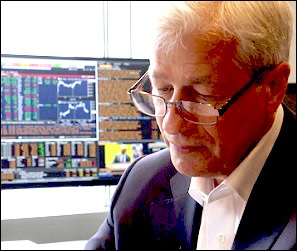
Jamie Dimon Sits in Front of Trading Monitor in his Office (Source -- 60 Minutes Interview, November 10, 2019)

Jamie Dimon Sits in Front of Trading Monitor in his Office (Source: 60 Minutes Interview, November 10, 2019)

At 6:33 a.m. this morning, this big, bold headline appeared at the very top of Bloomberg News web page: “How Dimon and Yellen Helped Secure $30 Billion Lifeline for First Republic.” This headline is part of a very long, highly questionable promotion of Jamie Dimon by Bloomberg News as the wunderkind of Wall Street banking.

In reality, under Dimon’s tenure as Chairman and CEO, JPMorgan Chase has been on an unprecedented crime spree, including being charged with five felony counts by the U.S. Department of Justice, and his bank is annually ranked by U.S. banking regulators as well as the Basel Committee on Banking Supervision as the riskiest bank on the planet. (See charts at this link at the U.S. Treasury’s Office of Financial Research. Give the page time to load the charts.)

This morning’s headline at Bloomberg News was clearly meant to suggest that Dimon was the modern reincarnation of John Pierpont (J.P.) Morgan, who famously came to the rescue during the financial panic of 1907 with a private pool of money. The Bloomberg headline refers to the fact that JPMorgan Chase, along with Bank of America, Citigroup and Wells Fargo, each ponied up $5 billion to place as uninsured deposits into the teetering First Republic Bank, which has lost 72 percent of its market value year-to-date (as of yesterday’s close). The balance of the $30 billion came from seven additional banks.

The Federal Deposit Insurance Corporation (FDIC) caps federal deposit insurance at $250,000 per depositor, per bank. The stock market looked at the teacup of $30 billion in rescue money, weighed it against the tsunami of facts in First Republic’s regulatory filings which showed, among other things, that the bank at year end had total deposits of $176.25 billion, of which $119.47 billion (or 68 percent) were uninsured by the FDIC, and said to itself, the last thing First Republic Bank needs is more uninsured deposits. The stock of First Republic Bank (ticker FRC) fell 14.7 percent in after-hours trading.

Another troubling detail is that the securities units of JPMorgan Chase and Bank of America were among the book-running underwriters of a secondary stock offering of 2 million shares of First Republic on or around February 10 of this year. First Republic closed at $135.45 on February 10 versus $34.27 yesterday – meaning these underwriters may have legal exposure. In addition, the same underwriters led an August 1, 2022 sale of shares of First Republic Bank to the public, raising over $400 million for the bank. First Republic’s shares were even higher then, priced at $155.48.

Units of Goldman Sachs and Morgan Stanley were the other two underwriters in both the August and February secondary offerings. Both banks were part of yesterday’s $30 billion “rescue,” contributing $2.5 billion each in uninsured deposits to First Republic.

Michael Bloomberg, the former Mayor of New York, is the majority owner of the publishing and data terminal empire that keeps publishing these slobbering headlines about Jamie Dimon. In 2016, Michael Bloomberg even co-authored an opinion piece with Dimon for the opinion section of Bloomberg News. The same year, the New York Post reported that JPMorgan Chase was the second largest customer of Bloomberg’s data terminal business with 10,000 leases of Bloomberg’s terminals. At the time, the terminals cost around $21,000 each per year or approximately $210 million being forked over by JPMorgan Chase to Michael Bloomberg’s company. Bloomberg’s data terminals are the cash cow of the company.

During JPMorgan Chase’s London Whale scandal in 2012 and 2013, where the bank gambled with bank depositors’ money in exotic derivative trades in London and lost at least $6.2 billion, Michael Bloomberg was Mayor of New York City. Instead of condemning this outrageous risk-taking with federally-insured deposits, Bloomberg was quoted in the Wall Street Journal calling Dimon “a very smart, honest, great executive,” adding “The controls failed. He’ll look at that and fix it.” That statement appeared in May of 2012. The five felony counts followed from 2014 to 2020.

On September 16, 2019, for the first time that anyone on Wall Street can remember, RICO charges were brought against traders at JPMorgan Chase by the U.S. Department of Justice. Its precious metals trading desk was characterized at the time as a racketeering enterprise by the Justice Department. The DOJ couldn’t bring itself to state the name of the bank where the traders were located, calling JPMorgan Chase simply “Bank A.”

On September 29, 2020, the Justice Department brought the fourth and fifth felony counts against JPMorgan Chase. One count involved traders rigging the precious metals markets and the other count was for rigging the U.S. Treasury market.  As the Justice Department had done in all the previous felony charges against the bank, it settled the charges with large fines, deferred prosecution agreements, and a probation period. (The bank has had three probation periods since 2014 for criminal activity.) But the Justice Department did one thing on September 29, 2020 that was unprecedented for a felony charge involving the rigging of the U.S. Treasury market. The Justice Department announced the charges without holding its usual press conference and taking questions from reporters.

The Justice Department’s deal was so sweet for a criminal recidivist that it wrote in its deal with the bank that “an independent compliance monitor was unnecessary” despite also revealing that the bank “did not voluntarily and timely disclose to the Fraud Section and the Office the conduct described in the Statement of Facts.”


LINK


Tuesday, November 1, 2022

Three 2nd Circuit Judges, all in their 80s, Decide Traders Rigging Libor Wasn’t Really a Crime


SUBSCRIBE TO THIS NEWSLETTER


Three 2nd Circuit Judges, all in their 80s, Decide Traders Rigging Libor Wasn’t Really a Crime

By Pam Martens and Russ Martens: November 1, 2022 ~

Life in the United States of America increasingly feels like a bad translation of a Kafka novel. We are specifically referring today to the arbiters of justice in our society – the men and women appointed as lifetime judges on the U.S. Supreme Court, federal appellate courts and federal district courts. These courts have now become Kafkaesque with no apparent means for the public to hold these judges accountable for their actions.

There is Justice Clarence Thomas on the U.S. Supreme Court making rulings in matters impacting Donald Trump while his wife, Ginni Thomas, was one of the people plotting to help Trump overturn the election of President Joe Biden. (Also see our report: The Money Trail to the Ginni Thomas Emails to Overturn Biden’s Election Leads to Charles Koch.)

We have Judge Aileen M. Cannon, appointed by Donald Trump, who sits on the Federal District Court for the Southern District of Florida, inserting herself in a case involving Trump’s purloining of Top Secret documents from the U.S. government and initially ruling that the Department of Justice could not get access to those documents to pursue a criminal investigation.

We have five justices on the U.S. Supreme Court effectively ruling that a woman’s right to control her own body will now require local politicians to be involved. (Four of the five Supreme Court justices who overturned the right of women to control their own bodies are men.)

Which brings us to the latest news that federal prosecutors asked a federal court to dismiss a criminal indictment against Tom Hayes, a former Wall Street trader charged by the Justice Department with rigging the interest rate benchmark known as Libor. Federal prosecutors say that they had no choice but to ask for the dismissal of the case because three federal judges on the Second Circuit Appellate Court ruled that (despite successful jury trials on the Libor issue, convictions and billions of dollars in fines paid by the banks for the illegal Libor activity) it wasn’t really illegal at all.

The Tom Hayes case is a textbook example of how to bring a market rigging case. The Justice Department prosecutors had reams of chat room messages where Hayes requested other traders to move Libor in a specific direction in order to make profits for himself and UBS, the global bank where he worked. The unit of UBS that was involved, UBS Japan, pled guilty to felony wire fraud and admitted its role in manipulating Libor. UBS paid more than $1.5 billion to settle the charges with prosecutors and regulators in the U.S., the U.K. and Switzerland.

UBS is represented by legions of lawyers from the most prestigious law firms around the world. Does anyone really think it paid $1.5 billion when its traders did nothing wrong?

On December 19, 2012, when the Justice Department first unsealed its criminal complaint against Hayes and Roger Darin, another UBS trader, it explained the case as follows:

“Beginning in September 2006, UBS Japan and Hayes orchestrated a sustained, wide-ranging and systematic scheme to move Yen LIBOR in a direction favorable to Hayes’ trading positions, defrauding UBS’ counterparties and harming others with financial products referencing Yen LIBOR who were unaware of the manipulation. Between November 2006 and August 2009, Hayes or one of his colleagues endeavored to manipulate Yen LIBOR on at least 335 of the 738 trading days in that period, and during some periods on almost a daily basis. Because of the large size of Hayes’ trading positions, even slight moves of a fraction of a percent in Yen LIBOR could generate large profits. For example, Hayes once estimated that a 0.01 percent movement in the final Yen LIBOR fixing on a specific date could result in a $2 million profit for UBS.

“According to the charging documents, UBS Japan and Hayes employed three strategies to execute the scheme: from November 2006 through September 2009, Hayes conspired with Darin and others within UBS to cause the bank to make false and misleading Yen LIBOR submissions to the BBA [British Bankers Association]; also, Hayes caused cash brokerage firms, which purported to provide market information regarding LIBOR to panel banks, to disseminate false and misleading information about short-term interest rates for Yen, which those banks could and did rely upon in formulating their own LIBOR submissions to the BBA; and Hayes communicated with interest rate derivatives traders employed at three other Yen LIBOR panel banks in an effort to cause them to make false and misleading Yen LIBOR submissions to the BBA.

“As alleged in the charging documents, Hayes, Darin and other co-conspirators often executed their scheme through electronic chats. On Nov. 20, 2006, for example, Hayes asked a UBS Yen LIBOR submitter who was substituting for Darin, ‘hi . . . [Darin] and I generally coordinate ie sometimes trade if ity [sic] suits, otherwise skew the libors a bit.’ Hayes went on to request, ‘really need high 6m [6-month] fixes till Thursday.’ The submitter responded, ‘yep we on the case there . . . will def[initely] be on the high side.’ The day before this request, UBS’s 6-month Yen LIBOR submission had been tied with the lowest submissions included in the calculation of the LIBOR fix. Immediately after this request for high submissions, however, UBS’s 6-monthYen LIBOR submissions rose to the highest submission of any bank in the contributor panel and remained tied for the highest, precisely as Hayes had requested.

“Another example of such an alleged accommodation occurred on March 29, 2007, when Hayes asked Darin, ‘can we go low 3[month] and 6[month] pls? . . . 3[month] esp.’ Darin responded ‘ok’, and the two had the following exchange:

Hayes: what are we going to set?

Darin: too early to say yet . . . prob[ably] .69 would be our unbiased contribution

Hayes: ok wd really help if we cld keep 3m low pls

Darin: as i said before – i [don’t] mind helping on your fixings, but i’m not setting libor 7bp away from the truth. . . i’ll get ubs banned if i do that, no interest in that.

Hayes: ok obviousl;y [sic] no int[erest] in that happening either . . . not asking for it to be 7bp from reality anyway any help appreciated[.]

Hayes received the help he requested.

“In addition, the criminal complaint charges Hayes with colluding with a trader employed at another LIBOR panel bank in May 2009, in violation of the Sherman Antitrust Act. Hayes allegedly engaged in the collusive scheme to fix the price of derivative instruments whose price was based on Yen LIBOR. In electronic chats, Hayes asked the trader to move 6-month Yen LIBOR up due to a ‘gigantic’ position Hayes had taken. For the trade in question, UBS trading records confirmed that each 0.01 percent movement in LIBOR would generate profits of approximately $459,000 for Hayes’ book. The trader at the other bank responded that he would comply, and his bank’s submission moved by 0.06 percent compared to its submission the previous day, for which Hayes thanked him.”

The Justice Department released the transcripts of these chat room messages, which illustrated the market rigging in real time.

Prosecutors in the United Kingdom also brought criminal charges against Hayes and he served about half of an 11-year sentence. He was released in February of 2021. Since then, he has sought to have his indictment in the U.S. dismissed.

Hayes’ desires were bizarrely fulfilled on January 27 of this year when the Second Circuit Court of Appeals issued a jaw-dropping decision and threw out the Justice Department’s case against two Deutsche Bank traders similarly charged with rigging Libor and ordered the lower District Court that had conducted the jury trial to issue acquittals to the two traders, Matthew Connolly and Gavin Campbell Black.

The three Second Circuit judges that rendered this bizarre decision were Judge Amalya L. Kearse, 85 years old; Judge José A. Cabranes, 81 years old; and Judge Rosemary S. Pooler, 84 years old. Kearse and Cabranes were appointed by President Jimmy Carter; Pooler was appointed by President Bill Clinton.

The three judges ignored the government’s overwhelming evidence of how the traders had used chat messages to rig the Libor rates, profit from the deception, and harm the people on the other sides of those derivative trades. Instead, the three judges focused on whether the rules of the British Bankers Association had been violated.

Clearly, an association’s rules are not the same as laws governing criminal rigging of markets.

Deutsche Bank, which also has the most prestigious law firms at its disposal to argue its case, entered into a deferred prosecution agreement with the Justice Department, agreed to have a subsidiary (DB Group Services) plead guilty to wire fraud involving its role in rigging Libor, and paid $775 million in criminal penalties to the Justice Department. Does that really sound like a global bank that did nothing wrong?

It’s long past the time for an independent special counsel to open a serious probe into what is happening in the nation’s federal courts.


LINK


Trump RIDICULED as DOJ tells Appeals Court Trump is allowed to sell Presidential Records on EBAY!!

                                                                                                                                            ...