Showing posts with label UNINSURED DEPOSITS. Show all posts

Wednesday, March 6, 2024

New York Community Bancorp Was JPMorgan’s Top Regional Bank Pick for 2024; It’s Lost 73 Percent Y-T-D and Had Its Deposit Rating Downgraded to Junk


SUBSCRIBE TO THIS NEWSLETTER & RECEIVE TIMELY REPORTS!


New York Community Bancorp Was JPMorgan’s Top Regional Bank Pick for 2024; It’s Lost 73 Percent Y-T-D and Had Its Deposit Rating Downgraded to Junk

By Pam Martens and Russ Martens: March 5, 2024 ~

New York Community Bancorp’s tumultuous share price descent began on January 31 when the bank filed an 8K form with the SEC indicating a $260 million net income loss in the fourth quarter; a dividend cut from 17 cents to 5 cents; and a $552 million provision for credit losses on commercial real estate. (Year-to-date, the company’s share price has lost 73 percent of its market value. Yesterday, its shares closed at $2.73, down 23 percent from the prior trading session on Friday, when the shares had lost 26 percent. )

Somehow, JPMorgan banking analyst Steven Alexopoulos was able to swat the gargantuan warning signs of January 31 away like a pesky gnat on an otherwise perfect day. On February 1, Alexopoulos penned a missive recommending that investors “take advantage of this valuation and accumulate shares on this weakness.” To drive home his strong buy recommendation, he wrote: “Not only do we maintain our Overweight rating, but NYCB remains our top pick for 2024.”

JPMorgan’s bank analyst call on NYCB is turning out to be another embarrassing black mark at JPMorgan Chase, a bank that seems to have enshrined scandals and felony charges as an integral part of its mega bank business model.

JPMorgan’s strong buy rating on New York Community Bancorp came a mere 34 days ago. Here’s what has happened since then:

On February 6, Moody’s downgraded the bank’s credit rating to junk. Moody’s also warned that a third of the bank’s deposits lack FDIC insurance.

On February 29, NYCB made new filings with the SEC, this time announcing that its President and CEO, Thomas R. Cangemi, was being replaced by the Executive Chairman of the Board, Alessandro (Sandro) DiNello. In a separate filing, NYCB announced alarming “material weaknesses,” writing as follows:

“…as part of management’s assessment of the Company’s internal controls, management identified material weaknesses in the Company’s internal controls related to internal loan review, resulting from ineffective oversight, risk assessment and monitoring activities. Although assessment of the Company’s internal controls is not yet complete, the Company expects to disclose in the 2023 Form 10-K that its disclosure controls and procedures and internal control over financial reporting were not effective as of December 31, 2023. The Company’s remediation plan with respect to such material weaknesses is expected to be described in the 2023 Form 10-K.”

“Material weaknesses” are two words that credit rating agencies never want to read in a deposit-taking bank’s filings with the Securities and Exchange Commission. After markets closed last Friday, Moody’s cut the deposit rating on NYCB’s commercial bank by four notches, moving it deep into junk territory.

That can’t have gone over well with the folks holding large amounts of uninsured deposits at the bank. (The Federal Deposit Insurance Corporation (FDIC) insures commercial bank accounts up to $250,000 per depositor, per bank. Corporations and institutions frequently hold sums much greater than that at commercial banks.)

On March 28 of last year, the Chair of the FDIC, Martin Gruenberg, delivered a report to the Senate Banking Committee on why Silicon Valley Bank and Signature Bank had failed last year. Among numerous problems, he noted the following:

“In the immediate aftermath of the failure of SVB [Silicon Valley Bank] and Signature Bank, some preliminary lessons can be identified. A common thread between the failure of SVB and the failure of Signature Bank was the banks’ heavy reliance on uninsured deposits. As of December 31, 2022, Signature Bank reported that approximately 90 percent of its deposits were uninsured, and SVB reported that 88 percent of its deposits were uninsured. The significant proportion of uninsured deposit balances exacerbated deposit run vulnerabilities and made both banks susceptible to contagion effects from the quickly evolving financial developments. One clear takeaway from recent events is that heavy reliance on uninsured deposits creates liquidity risks that are extremely difficult to manage, particularly in today’s environment where money can flow out of institutions with incredible speed in response to news amplified through social media channels.”

Yesterday, we wrote about the insightful investigation by financial watchdog, Better Markets, into how New York Community Bancorp ended up in such a mess. Better Markets’ researchers found the following:

“In late 2022 and early 2023, the federal banking regulators inexplicably approved not one, but two, mergers for NYC Bancorp in rapid succession. First, in December 2022, Flagstar was acquired by NYC Bancorp and at the same time Flagstar acquired [New York Community Bank]. Then, only about 100 days later, Flagstar was selected as the winning bidder by the FDIC to acquire the failed Signature Bank (‘Signature’). A bank acquiring and integrating any one of these transactions in isolation would be challenging under the best of circumstances, it is inexplicable that the banking regulators allowed them in tandem under extremely stressed conditions.”

And this:

“…over the course of just two quarters, Flagstar’s two acquisitions quadrupled its asset size, from $25 billion on September 30, 2022, to $123 billion on March 31, 2023. It also more than doubled its employee count, from about 2,800 in September 2022 to 6,800 in March 2023.”

https://wallstreetonparade.com/2024/03/new-york-community-bancorp-was-jpmorgans-top-regional-bank-pick-for-2024-its-lost-73-percent-y-t-d-and-had-its-deposit-rating-downgraded-to-junk/


Wednesday, November 22, 2023

Six Big Banks Forced to Declare $9.3 Billion in Additional FDIC Expenses; Another Reason Their Talons Are Out for FDIC Chair Gruenberg

SUBSCRIBE TO THIS NEWSLETTER TO RECEIVE TIMELY REPORTS 

Six Big Banks Forced to Declare $9.3 Billion in Additional FDIC Expenses; Another Reason Their Talons Are Out for FDIC Chair Gruenberg


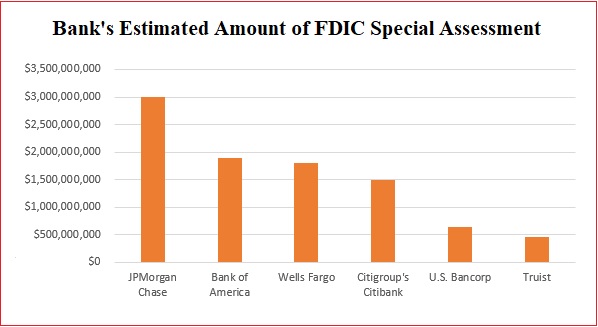
Bank's Estimated Amount of FDIC Special Assessments

By Pam Martens and Russ Martens: November 22, 2023 ~

Bank Logos (Thumbnail)The biggest banks in the U.S. that have been serially bailed out by the Federal Reserve since they blew up the financial system in 2008, are ripping mad at the Chairman of the Federal Deposit Insurance Corporation (FDIC), Martin Gruenberg.

In addition to the FDIC and other federal banking regulators’ proposed rule to increase capital requirements on the largest banks, the FDIC just issued a final rule on November 16 that will force six banks to report an FDIC special assessment expense totaling more than $9.3 billion in the final quarter of this year. (See chart above.)

Jamie Dimon, Chairman and CEO of JPMorgan Chase, is hair-on-fire mad because his bank is getting hit with the whopping figure of approximately $3 billion according to the firm’s most recent quarterly filing (10-Q) with the SEC.

The most recent 10-Q filings with the SEC for the other five banks estimate their FDIC special assessments as follows: $1.9 billion at Bank of America; $1.8 billion at Wells Fargo; $1.5 billion at Citigroup’s Citibank; $650 million at U.S. Bancorp; and $460 million at Truist.

The FDIC’s special assessment results from the failure of Silicon Valley Bank and Signature Bank in March, where banking regulators made a Systemic Risk Determination to cover uninsured deposits at the two banks to stem a spreading banking panic. The FDIC’s Deposit Insurance Fund that protects depositors at the nation’s commercial banks and savings associations experienced a related loss of $16.3 billion attributable to the protection of uninsured depositors. The FDIC’s governing law allows it to impose this special assessment on insured depository institutions to make up for the losses.

What the big banks don’t like is that they are picking up the lion’s share of the losses. The FDIC argues that large amounts of uninsured deposits inherently make the banking system less safe and the banks that had the largest amounts of uninsured deposits as of December 31, 2022 must pay the piper for their imprudent concern for safety and soundness. (See our report: International Bank Study, Using 150 Years of Data, Shows Mega Banks Like the Big Four in the U.S. Produce Financial Instability and More Severe Crises.)

Out of the approximate 4,100 federally-insured commercial banks in the U.S., the FDIC estimates that only 114 banks will be subject to the special assessment. That’s because the vast majority of banks in the U.S. honor the concept of being a federally-insured bank and keep the bulk of their deposits under the FDIC insurance cap of $250,000 per depositor, per bank. (See our report: At Year End, 4,127 U.S. Banks Held $7.7 Trillion in Uninsured Deposits; JPMorgan Chase, BofA, Wells Fargo and Citi Accounted for 43 Percent of That.)

The figures presented in the chart above may actually underestimate the final dollar figures that will be paid by the banks. When the banks published those estimates in their 10-Qs, the FDIC had estimated the losses to the Deposit Insurance Fund at $15.8 billion from covering uninsured deposits at the two banks. As of November 16 when the final rule was passed, those losses had grown to $16.3 billion according to the FDIC.

Another thing that has riled up the mega banks on Wall Street and have them whispering in the ears of their captured members of Congress to sack FDIC Chair Gruenberg, is that the FDIC dismissed out of hand their 12-page letter of objections to the methodology of the special assessment. (What good is paying millions of dollars to lobby  if you don’t get what you paid for?)

The letter was sent by the Bank Policy Institute, whose Board of Directors is Chaired by none other than Jamie Dimon and includes the CEOs of the biggest banks in the U.S.

For how the big banks are lobbying on the still-in-the-works capital rule, see our report: Meet the Banking Cartel that Is Planting the Seeds for the Next Banking Panic and Bailout.

As a prime example of just how casino-like the U.S. banking system has become, Goldman Sachs, the “great vampire squid,” is allowed to own a federally-insured bank. (In October 2020, the vampire squid was criminally charged by the Justice Department for looting the Malaysian sovereign wealth fund, 1MDB in a grand bribery conspiracy.)

Goldman Sachs owns the federally-insured Goldman Sachs Banks USA, which is currently ranked by the Federal Reserve as the 7th largest federally-insured bank in the United States. Never mind that Goldman Sachs is also running an octopus of an international Dark Pool trading operation and has $57 trillion (yes, trillion) in opaque derivatives while its CEO, David Solomon, moonlights as a DJ. (You can’t make this stuff up.)

Goldman Sachs was peculiarly silent in its most recent 10-Q filing on how much its bank expects to pay for its share of the FDIC’s special assessment. But its 10-Q filing for the second quarter of this year estimated its tab at “$400 million (pre-tax).”

PNC Bank’s publicly traded parent has also previously reported to the SEC that it estimates that its special assessment expense, to be taken in full in the fourth quarter, will be approximately $370 million after-tax.

https://wallstreetonparade.com/2023/11/six-big-banks-forced-to-declare-9-3-billion-in-additional-fdic-expenses-another-reason-their-talons-are-out-for-fdic-chair-gruenberg/

Monday, October 16, 2023

JPMorgan Chase Has Lost a Quarter Trillion Dollars in Deposits in Last 7 Quarters — Fortress Balance Sheet or Leaky Sieve?


SUBSCRIBE TO THIS NEWSLETTER TO RECEIVE TIMELY REPORTS


JPMorgan Chase Has Lost a Quarter Trillion Dollars in Deposits in Last 7 Quarters — Fortress Balance Sheet or Leaky Sieve?

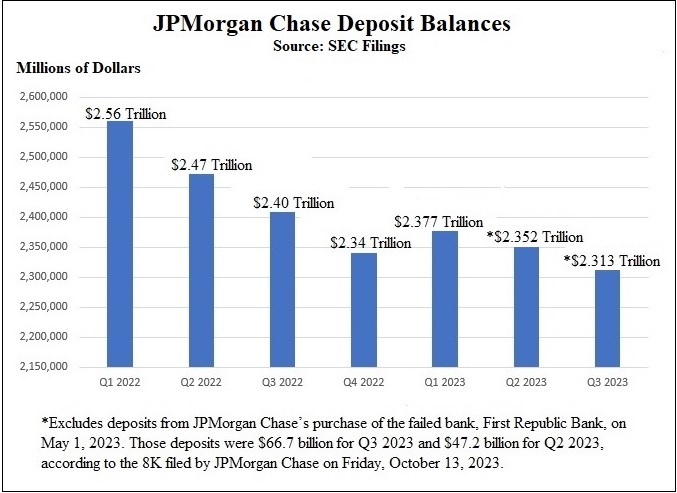
JPMorgan Chase Deposit Balances, Bar Graph 2022 through Q3 2023

By Pam Martens and Russ Martens: October 16, 2023 ~

Jamie Dimon, Chairman and CEO of JPMorgan Chase

Jamie Dimon, Chairman and CEO of JPMorgan Chase

On May 1, the Federal Deposit Insurance Corporation announced that First Republic Bank had failed and that it was being sold to JPMorgan Chase. At the time, JPMorgan Chase was already the largest and riskiest bank in the United States. The sweetheart deal the bank got from the FDIC to take over First Republic included the FDIC eating 80 percent of any losses on single-family residential mortgages for 7 years and 80 percent of any losses on commercial loans, including commercial real estate, for five years. The FDIC also provided JPMorgan Chase with a $50 billion, five-year fixed-rate loan at an undisclosed interest rate.

According to the filing that JPMorgan Chase made with the Securities and Exchange Commission last Friday, the deal also gave JPMorgan Chase something that it desperately needed: deposits. According to the 8-K filing that JPMorgan Chase made with the SEC on October 13, the acquisition of First Republic Bank added $47.2 billion to its deposit base in the second quarter and $66.7 billion in deposits in the third quarter.

As the chart above indicates, JPMorgan Chase suffered outflows of deposits in every quarter of 2022. It got a brief respite from inflows of deposits in the first quarter of 2023, as a result of the March banking panic that impacted smaller banks, then outflows took hold again. Excluding the deposits from First Republic Bank, JPMorgan Chase has lost $248.38 billion in deposits over the span of the last seven quarters. One doesn’t expect that at a bank that continues to trumpet its “fortress balance sheet.”

Even including the large amount of deposits that JPMorgan Chase gained from scooping up First Republic, the bank still bled $19.4 billion in overall deposits between the second quarter of this year and the end of the third quarter on September 30, according to JPMorgan Chase’s SEC filing on Friday, October 13.

Adding to the appearance of desperation at JPMorgan Chase to shore up its deposit base, on September 28 Wall Street Journal reporter Rachel Louise Ensign revealed that JPMorgan Chase was offering a shockingly high 6 percent interest on a 6-month certificate of deposit. There were three catches to get the deal: it had to be new money coming from outside the bank; the minimum investment was $5 million; and the money had to be deposited by September 30. The date of September 30 just happens to be the last day of the quarter, the cutoff for the bank to report its final tally for deposits at quarter end.

There is something else remarkable about that uncharacteristic spurt of generosity from JPMorgan Chase. By soliciting a minimum of $5 million in new outside money to get the 6 percent CD, the bank would appear to be effectively soliciting to grow its already eyebrow-raising amount of uninsured deposits. The FDIC insures deposits up to $250,000 per depositor, per bank. The Wall Street Journal article is silent on how the balance of the $5 million would be protected.

According to the bank’s regulatory filings, as of December 31, 2022, JPMorgan Chase Bank N.A. held $2.015 trillion in deposits in domestic offices, of which $1.058 trillion were uninsured. The bank also held another $418.9 billion in deposits in foreign offices, which were also not insured by the Federal Deposit Insurance Corporation (FDIC). That brought its uninsured deposits as of year-end to a total of $1.48 trillion or 60 percent of its total deposits. (Under federal statute, the deposits held by U.S. banks that are located on foreign soil are not insured by the FDIC. )

After the second, third and fourth largest bank failures in U.S. history over the span of seven weeks this past spring, the FDIC has awakened to the dangers of U.S. banks holding large amounts of uninsured deposits – whether they are uninsured because they exceed the $250,000 insurance cap per depositor/per bank or are uninsured because the deposits reside on foreign soil. Large holdings of uninsured deposits contributed to the bank runs at Silicon Valley Bank and Signature Bank in March, which toppled the banks and forced an FDIC receivership at both banks until they were eventually sold. (First Republic Bank also had a large amount of uninsured deposits.)

Because billions of dollars in domestic uninsured deposits were at risk at the two banks that failed in March, federal regulators issued a “special risk assessment” that allowed the FDIC to cover all uninsured domestic deposits at those two banks. That action resulted in billions of dollars in extra losses to the FDIC’s Deposit Insurance Fund (DIF).

To send a warning to the mega banks on Wall Street about their own vulnerability to uninsured deposits, as well as to cover the DIF’s losses, the FDIC released a proposal on May 11 to levy a special assessment based on the individual bank’s holdings of uninsured deposits as of December 31, 2022. The assessment would amount to a charge of 0.125 percent of a bank’s uninsured deposits above $5 billion. The charge would be spread over eight quarters according to the proposal.

According to the 10-Q filing that JPMorgan Chase made with the SEC on August 3 for the quarter ending June 30, if the FDIC’s rule is finalized as proposed, “the Firm expects to recognize an estimated assessment expense of approximately $3 billion (pre-tax) in the quarter in which the rule is finalized, which is expected to occur in the second half of 2023.”

https://wallstreetonparade.com/2023/10/jpmorgan-chase-has-lost-a-quarter-trillion-dollars-in-deposits-in-last-7-quarters-fortress-balance-sheet-or-leaky-sieve/


Monday, May 15, 2023

At Year End, 4,127 U.S. Banks Held $7.7 Trillion in Uninsured Deposits; JPMorgan Chase, BofA, Wells Fargo and Citi Accounted for 43 Percent of That


SUBSCRIBE TO THIS NEWSLETTER TO RECEIVE IT IN A TIMELY MANNER

At Year End, 4,127 U.S. Banks Held $7.7 Trillion in Uninsured Deposits; JPMorgan Chase, BofA, Wells Fargo and Citi Accounted for 43 Percent of That

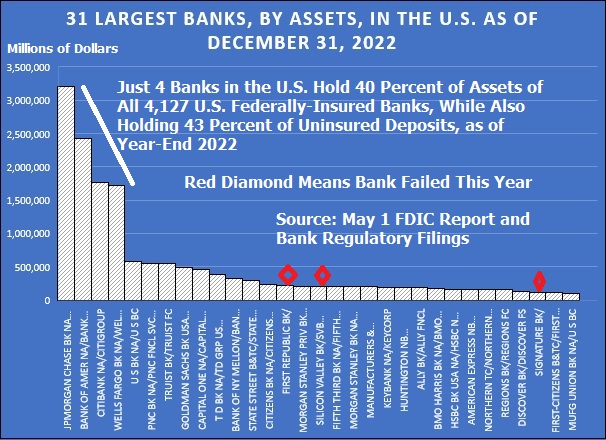
31 Largest Banks By Assets, As Of December 31, 2022

By Pam Martens and Russ Martens: May 11, 2023 ~

If the dark secrets about the U.S. banking system that federal regulators have been keeping since the financial crash of 2008 are allowed to be aired in public Congressional hearings as a result of the current banking crisis – and mainstream media will grow a backbone and cover those hearings – it could help the U.S. avoid a catastrophic financial reckoning down the road.

For years, Wall Street On Parade has been reporting that just four banks in the U.S. control more than 85 percent of all the opaque derivatives in the banking system. We have also regularly reported how federal agencies have singled out these four banks for posing systemic risk to the financial stability of the United States. We’re talking about JPMorgan Chase, Bank of America, Wells Fargo and Citigroup’s Citibank.

On March 30, we crunched the numbers from the regulatory filings made by these banks (call reports) and reported that as of December 31, 2022, these four banks held a combined $3.286 trillion in uninsured domestic deposits. (Federal deposit insurance is capped at $250,000 per depositor per bank. Uninsured deposits taking flight were a key element in the recent bank runs that led to the second, third and fourth largest bank failures in U.S. history.) As of December 31, 2022, JPMorgan Chase Bank N.A. held $2.015 trillion in deposits in domestic offices, of which $1.058 trillion were uninsured; Bank of America held $1.9 trillion in deposits in domestic offices, of which $909.26 billion were uninsured; Wells Fargo held $1.4 trillion in deposits in domestic offices, of which $721.1 billion were uninsured; and Citibank N.A. (parent, Citigroup) held $777 billion in deposits in domestic offices, of which $598.2 billion were uninsured.

We can now put that $3.286 trillion figure into sharper perspective. On May 1, the FDIC released its report on “Options for Deposit Insurance Reform.” Without mentioning that just four banks controlled $3.286 trillion of uninsured deposits at year end, the FDIC report did provide the figure of $7.7 trillion as the total of uninsured domestic deposits held by all banks at the end of 2022.

That means that just these four banks held 43 percent of all uninsured deposits at 4,127 federally insured commercial banks in the U.S. as of year end 2022.

The FDIC report reads as follows:

“Following the 2008-2013 banking crisis, the reliance by the U.S. banking system on uninsured deposits grew dramatically, both in dollar volume and as a proportion of overall deposit funding. From year-end 2009 through year-end 2022, uninsured domestic deposits at FDIC-institutions increased at an annualized rate of 9.8 percent, from $2.3 trillion to $7.7 trillion.”

Give your brain a few moments to thoroughly digest that statement. Federal regulators have known since the 1930s that uninsured deposits are the most likely to bolt in a banking crisis, and yet, after the worst banking crisis in 2008 since the Great Depression, both Congress and federal regulators have allowed uninsured deposits to more than triple at U.S. banks – as well as to become concentrated at just four banks.

If ever there was a screaming call to dramatically restructure federal oversight of banks – this is it.

The average American has no idea of just how dangerously concentrated banking has become in the United States. That’s because mainstream media never puts this information on the front pages of newspapers or reports it on the evening TV news.

We decided to help fill in this void by creating the graphic above, using data from regulatory filings. Our graphic shows the consolidated assets of the 31 largest banks in the U.S., which total $16.012 trillion.

The same four banks discussed above, JPMorgan Chase, Bank of America, Wells Fargo and Citigroup’s Citibank, represent 0.0969 percent of the total 4,127 federally-insured commercial banks in the U.S. – and yet they are allowed by federal regulators and Congress to control a mind-boggling $9 trillion in consolidated assets.

All 4,127 federally-insured commercial banks in the U.S. held $22.3 trillion in assets as of December 31, 2022 according to the Federal Deposit Insurance Corporation’s Statistics at a Glance. The $9 trillion in assets held by just these four banks represents 40 percent of the total assets of all 4,127 banks.

Also disturbing, the 31 banks on the graph above held $16.012 trillion in assets, or 72 percent of the total assets of all 4,127 banks in the U.S. Three of those banks have failed this year.

How did this happen? See our article: In 16 Years, the Fed Has Approved 4,506 Bank Mergers and Denied One.

Against this backdrop, it is nothing short of gross incompetence (and/or regulatory capture) that federal regulators allowed JPMorgan Chase, already the largest bank by assets, deposits, derivatives and riskiness, to purchase the failed bank, First Republic, on May 1. 


LINK 


Tuesday Afternoon Updates – Error 404: President Not Found

                                                                                                                                            ...