Showing posts with label ZOMBIE FORESTS. Show all posts

Tuesday, March 14, 2023

Bernie Sanders' Light in the Darkness


Reader Supported News
14 March 23

Live on the homepage now!
Reader Supported News

RSN FIGHTS. SUPPORT IT. — We stand tall in the face of authoritarianism and injustice every day. We do it with the support of the community we serve alone. Funding could not be more critical at this point in time. Stand with Reader Supported News. In peace and solidarity.
Marc Ash • Founder, Reader Supported News

Sure, I'll make a donation!


Bernie Sanders. (photo: Antonella Crescimbeni)
Bernie Sanders' Light in the Darkness
Molly Ball, TIME
Ball writes: "The bar is open, but the venue's floor is full of orderly rows of chairs, the air is uncharacteristically free of pot smoke, and the merch tables feature no T-shirts or posters, only stacks of the 81-year-old left-wing senator's latest book, It's OK to Be Angry About Capitalism. Still, to the overwhelmingly young crowd that has paid $55 to $95 per ticket, they might as well be seeing a rock star - the Mick Jagger of Medicare-for-All." 

Bernie Sanders is here to answer a question nobody in this room was asking: Is it okay to be angry about capitalism?

It’s late on a weeknight at The Anthem, a 3,000-seat concert hall on the trendy, upscale D.C. waterfront that recently hosted Bush and the Disco Biscuits. The bar is open, but the venue’s floor is full of orderly rows of chairs, the air is uncharacteristically free of pot smoke, and the merch tables feature no T-shirts or posters, only stacks of the 81-year-old left-wing senator’s latest book, It’s OK to Be Angry About Capitalism. Still, to the overwhelmingly young crowd that has paid $55 to $95 per ticket, they might as well be seeing a rock star—the Mick Jagger of Medicare-for-All.

Callie Whicker, an 18-year-old student at American University, arrived an hour early and settled into her front-row seat, wearing a BERNIE sweatshirt and clutching a knit Bernie doll she got on Etsy. He’s her only source of hope in a coming-of-age that has otherwise been unrelentingly dark: “For Gen Z, coming up through Covid and Trump, we’ve given up,” she says. “Everything’s really bad. But knowing that there are people like him, people with decent hearts fighting for everybody, it’s so inspiring.”

Whicker has pink-dyed hair and wears a mask. Her homemade earrings dangle the words GENDER IS A CONSTRUCT from each lobe. When I ask her if it’s okay to be angry about capitalism, she looks at me like I might have the wrong number of heads. Isn’t it obvious? “Oh yes,” she says with conviction. “Of course, always.”

Sanders’s previous books were titled Our Revolution and Where We Go From Here—hopeful titles that looked to the future. The current one, with its combination of radicalism and neurosis, seems to signal a shift, not just in Sanders but in the ardent following he’s built over the last eight years and two near-miss presidential primary campaigns. His young followers are angry, yes, but they need to be reassured that it’s okay; they want to be comforted, to be affirmed in their feelings.

“We are very, very screwed,” says Farah T., a 30-year-old economist at the World Bank who declines to give her last name. “Angry is a nice word. It’s outrageous. It’s fucked up.” She paid $95 for her primo seat, which, yes, is capitalism—but why are people attacking Sanders for selling tickets when capitalism is responsible for so much worse? Sanders has been her lodestar for as long as she’s been politically conscious. Yet things have only seemed to get worse and worse. “He represents an America I would like to see, but probably never will, unfortunately,” she says.

Sanders’ fans have long admired his consistency, the way he’s been fighting for the same principles since he marched with Martin Luther King Jr. in the 1960s. But it has perhaps started to dawn on them that that’s another way of saying he hasn’t made much headway in all that time.

“I first got involved in climate activism in eighth grade,” says 19-year-old sociology student Jackie Wells. “Nothing significant has happened since then, and I’m going to another climate rally on Friday. Radical change is absolutely necessary, but I don’t know if our generation is up to it.” She worries that her peers are too complacent, too willing to mistake social-media posturing for activism. But Wells, who considers herself an anarcho-socialist, views the whole political system as a distracting spectacle. “I haven’t posted, like, ‘I’m at the Bernie thing,’ because it’s kind of embarrassing to like a politician,” she says.

“It’s not okay to not be angry about capitalism,” says Nicole Wilder, a 26-year-old editorial assistant. “If you’re not angry, I think you’re just not paying attention, or you’re a selfish person.” Older people, she says, shouldn’t disdain young people’s idealism and fervor for change: “Maybe that’s because a lot of young people actually give a s–t about things other than themselves.”

Chelsea Ihnacik, a 38-year-old stay-at-home mom, has been organizing a new Democratic Socialists of America chapter in her rural southern Maryland town. She worries that a Democratic Party that snubs Sanders in favor of milquetoast centrists like Joe Biden is destined to continue losing white working-class voters to Trumpism. “As much as Bernie woke us up to political engagement, the larger system is a monolith that’s not moving,” she says. “Biden betrayed the rail workers and undermined the solidarity of the working class. We’re going to lose those voters to fascism as a result.”

When Sanders comes on, the lights go all the way down, and he stands at the front of the stage in his usual hunched posture, gesturing with his right hand as he holds the microphone with his left. His rap has many of the same themes I remember from his 2016 campaign—the evils of oligarchy and super PACs, the billionaires robbing us blind and never paying a price. But there’s a new emphasis on capitalism’s emotionally taxing nature. “The bottom line, and we don’t talk about this at all, is that the working class of this country is under enormous emotional stress,” he says. “And stress kills.”

Gone, too, is Sanders’ onetime call for “political revolution,” perhaps because he’s become more enmeshed in the system he once sought to overthrow. After 16 years in the Senate, Sanders’ status as the pied piper of the resurgent young left has earned him real credibility—and power—in Washington. This year, he became the chairman of the Health, Education, Labor and Pensions committee, a position he intends to make the most of, hauling in pharmaceutical CEOs to testify about high drug prices, holding hearings on the plight of the working class. Next Tuesday, he tells the crowd, he plans to have the committee vote to subpoena Starbucks CEO Howard Schultz for his efforts to suppress unionization—a move that, if successful, would be the committee’s first-ever subpoena of a witness, according to Punchbowl News.

“The American people are standing up, and if I have anything to say about it—and as chairman of the relevant committee, I do have something to say about it—this is just going to be the start,” Sanders says to cheers. Audience members hold up their phones and record snippets of him speaking, like they would at a concert.

At the end, Sanders takes questions. The first one comes from a high schooler named Max who volunteered for his 2020 campaign. “What is your advice to the young people in this progressive movement on how we can keep the momentum of the movement you helped start alive?” Max wants to know.

Sanders looks out at the sea of eager faces, and I wonder if he’s thinking of his legacy—the ideals he’s seeded that will surely outlive him, the fresh-faced students who will keep fighting these fights long after he’s gone. “People often ask the question, what keeps me going?” he says, turning uncharacteristically sentimental. He recalls the millions of people he’s met, the places he’s been, the massive crowd of young people who turned out to see him as the sun set over a small town in rural California, hungry for a message of change.

“So I want to say that, as somebody who gets around the country and has the opportunity to meet with so many people, I don’t want you to become depressed about this country,” Sanders says. “There are millions of wonderful people who are trying to do the right thing. And our job is to educate and organize and create the kind of movement that will breed the kind of transformational change this country desperately needs.”

The lights come back on and Sanders departs, trailed by a lengthy standing ovation. And then the next generation trickles out of the theater, out into the night, out into the despair of the broken world they can’t escape.

READ MORE 
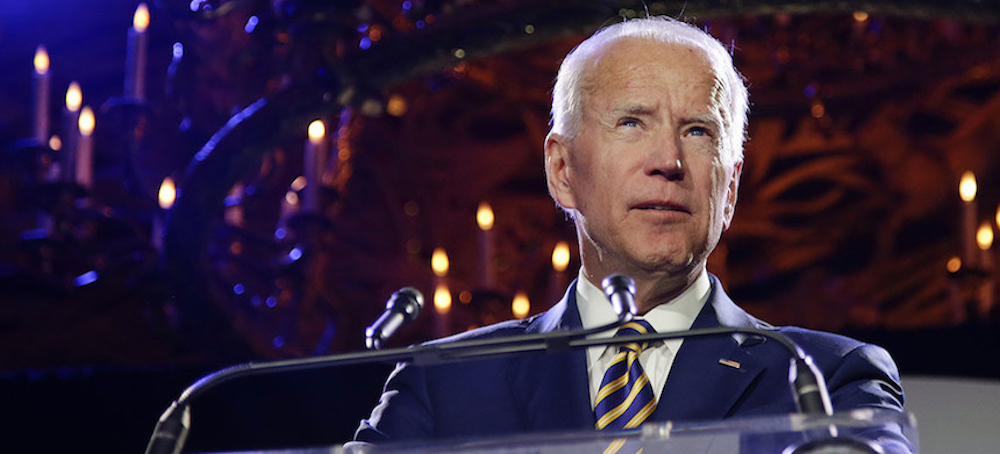

Biden Is Betraying a Climate Promise and Democrats Won't Let Him Forget ItJoe Biden. (photo: Frank Franklin II/AP)

Nikki McCann Ramirez | Biden Is Betraying a Climate Promise and Democrats Won't Let Him Forget It
Nikki McCann Ramirez, Rolling Stone
Ramirez writes: "Democratic lawmakers are condemning the Biden administration's approval of ConocoPhillips' massive Willow oil drilling project on Alaska's North Slope. The decision represents a clear reversal of Biden's 2020 campaign promise to end the approval of new oil and gas permits on federal lands and waters." 


The Biden administration has approved ConocoPhillips massive Willow oil drilling project, a reversal of his 2020 promise to eliminate new drilling permits


Democratic lawmakers are condemning the Biden administration’s approval of ConocoPhillips’ massive Willow oil drilling project on Alaska’s North Slope. The decision represents a clear reversal of Biden’s 2020 campaign promise to end the approval of new oil and gas permits on federal lands and waters.

In a joint statement released through the House Natural Resources Committee, several Democratic lawmakers — including Sen. Ed Markey (D-Mass.), committee ranking member Raúl M. Grijalva (D-Ariz.), Alexandria Ocasio-Cortez (D-N.Y.), and Jared Huffman (D-Calif.) said the decision “ignores the voices of the people of Nuiqsut, our frontline communities, and the irrefutable science that says we must stop building projects like this to slow the ever more devastating impacts of climate change.”

Alongside its approval of the Willow project, the Biden administration announced that it will be placing more than 16 million acres of Alaskan Arctic land and water under federal protection from future drilling projects. Lawmakers expressed their disappointment with the Willow project’s exemption from these new protections. “Split decisions in the face of the climate crisis are not good enough,” read the statement from the Natural Resources Committee. “The only acceptable Willow project is no Willow project.”

The “split decision” wasn’t received well by Democrats on social media, either. Sen. Jeff Merkley (D-Ore.) called the approval a “complete betrayal of Biden’s promise not to allow more drilling and a complete catastrophe to rein in climate chaos.” The senator pointed to the hypocrisy in the decision, writing that the United States “can’t ask other countries to forego their fossil fuels if we keep greenlighting projects here in America.”

Rep. Rashida Tlaib wrote on Twitter that the project would have “devastating consequences on our planet, frontline communities, and wildlife.” Tlaib’s claim is bolstered by the Department of the Interior’s own analysis of the $8 billion project, which found “substantial concerns” regarding the project’s impact on wildlife in the region, and potential risk to freshwater sources.

Sen. Maria Cantwell (D-Wash.) expressed concerns regarding the continued delay of large scale investments in renewable energy sources. “We should be doubling down on energy solutions that can rapidly provide Americans with cleaner and more affordable alternatives,” Cantwell wrote.

Others argued that the promise to freeze new drilling permits in other federal lands would not offset the environmental impact of approving one of the largest fossil fuel projects in modern history, and that the carve-out for ConocoPhillips was a win for the oil industry. “Trading the huge Willow carbon bomb for conservation in other parts of the Arctic is a bad deal. I am not appeased by this split decision, and more importantly, neither is the climate crisis,” wrote Rep. Huffman.

Sen. Markey called for the administration to put “people and our planet ahead of Big Oil profits.”

“This decision not only leaves an oil stain on the administration’s climate accomplishments and the President’s commitment not to permit new oil and gas drilling on federal land, but slows our progress in the fight for a more livable future,” Markey wrote in a statement released on Twitter.

Days earlier, as rumors of the project’s approval leaked from the White House, Markey wrote that the decision was “a complete betrayal of Biden’s promise not to allow more drilling and a complete catastrophe to rein in climate chaos. You can’t ask other countries to forego their fossil fuels if we keep green lighting projects here in America.”

The Department of the Interior indicated on Monday that two of the five drilling sites proposed by ConocoPhillips had been rejected, thus reducing the scale of the project. “The actions will create an additional buffer from exploration and development activities near the calving grounds and migratory routes for the Teshekpuk Lake caribou herd, an important subsistence resource for nearby Alaska Native communities,” the department wrote in a statement. “They significantly scale-back the Willow Project within the constraints of valid existing rights under decades-old leases issued by prior Administrations.”

Those constraints are the fact that ConocoPhillips has owned the drilling rights of the land for decades, a position legal experts say makes it difficult for the president to outright block the project from moving forward.

But as Jamal Raad, co-founder of the climate group Evergreen Action told The Washington Post, “this does not negate or discount the climate impacts of the Willow project in any way, shape or form.”

“It’s lipstick on a pig,” he added.

READ MORE 

Silicon Valley Bank Collapse 'Could Force Central Banks to Stop Interest Rate Rises'Silicon Valley Bank (SVB), over decades, became the go-to bank for startups. (photo: Bloomberg)

Silicon Valley Bank Collapse 'Could Force Central Banks to Stop Interest Rate Rises'
Richard Partington, Guardian UK
Partington writes: "The world's most powerful central banks may stop raising interest rates after the Silicon Valley Bank crisis, economists have said, amid growing signs of financial stress linked to rapid increases in borrowing costs over the past year." 


Analysts say US Federal Reserve will probably reject further increase in borrowing costs next week

The world’s most powerful central banks may stop raising interest rates after the Silicon Valley Bank crisis, economists have said, amid growing signs of financial stress linked to rapid increases in borrowing costs over the past year.

Analysts said the US Federal Reserve would probably leave interest rates on hold at its decision next week, as the meltdown at the California-based technology lender rippled through global financial markets.

Against a backdrop of concern over contagion spreading through the wider global banking industry, financial market expectations for significant further rate increases from the Bank of England and the European Central Bank also eased on Monday.

Goldman Sachs said the Fed would probably keep rates on hold at the current level of 4.5% to 4.75%, after previously expecting another rise.

“In light of the stress in the banking system, we no longer expect the FOMC [federal open markets committee] to deliver a rate hike at its next meeting on 22 March (v our previous expectation of a 25 basis point hike),” analysts at the bank wrote in a note to clients.

It said the US central bank would probably raise rates by 0.25 percentage points in May, June and July as it sought to counter high levels of inflation, before a peak in rates of 5.25% to 5.5%. “Though we see considerable uncertainty about the path,” they added.

Analysts at financial services group Nomura went as far as to predict that the Fed would cut rates at its meeting next week.

“We expect a 25 basis point rate cut and a halt of balance sheet reduction in March, while a new lending facility is possible,” they wrote in a newsletter.

As recently as last week, before the failure of SVB, a rate increase of 0.5 percentage points had been expected in financial markets, after the Fed chair, Jerome Powell, warned that more increases would be required to cool inflation.

The Bank of England had been given an almost 100% probability by traders in financial markets of raising rates by 0.25 percentage points at its next meeting on 23 March. However, that has since fallen to a 71% chance as City traders assess the consequences of SVB’s failure.

Economists said financial stability concerns after SVB’s collapse would probably force banks to act more cautiously when issuing loans – in effect doing some of the same job as higher borrowing costs. However, they also said SVB’s failure showed delayed impacts from the most aggressive rate-rising cycle in decades were feeding through.

“The Fed is starting to break things,” said John Briggs, the global head of economics and markets strategy at NatWest. He said he expected the Fed to lean towards a 25 basis point rise rather than 50 basis points that was previously expected.

“If tightening to date is starting to break things, then the Fed may not want to pile on more,” Briggs said.

SVB’s collapse came after the bank invested heavily in US government bonds two years ago, at a time when it had healthy deposit levels concentrated in the tech sector and among venture capital investors. With a fall in US government bond prices as the Fed raised interest rates, the value of its investments dropped. It also faced rising demands to return cash to depositors as the tech sector came under pressure.

On Monday morning it was announced that HSBC would buy SVB’s UK operations for £1, after a weekend of emergency talks between the UK government, the Bank of England and potential suitors.

“They were super exposed to tech venture capital depositors who had been seeing cash burn as the tech bubble burst, while previously having loaded up their balance sheet with positive carry trades into bonds when deposits soared during the tech boom and ultra low rate environment circa 2021,” analysts at Deutsche Bank wrote in a note to clients.

Suggesting that “something always, always breaks when the Fed hikes”, they said three factors had hit the bank: tech companies requirements for cash, higher deposit rates on offer than SVB could provide elsewhere as interest rates rose, and finally “fear” over the stability of SVB after it sold about $21bn (£17bn) of its bond portfolio for a steep loss last week. “Ultimately we saw an irreversible bank run.”


READ MORE 
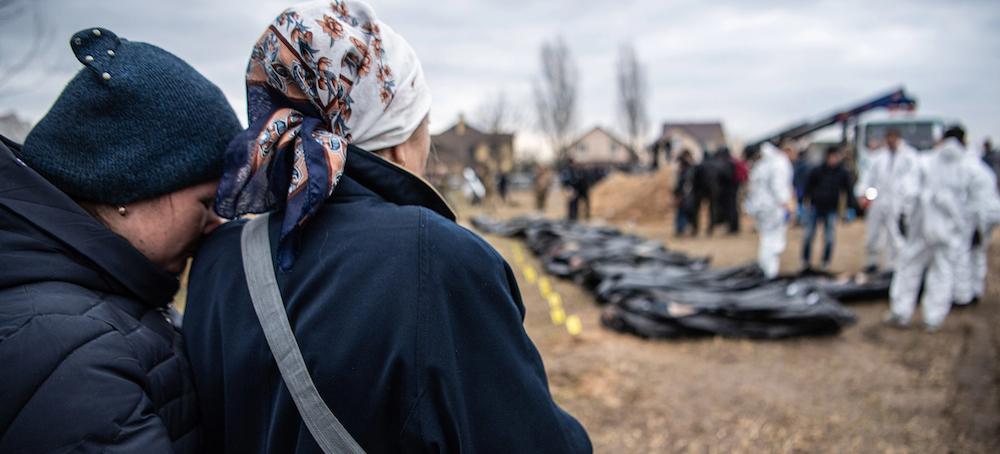
ICC Expected to Launch War Crimes Cases Against Russians Over UkraineWomen watch and embrace each other as bodies are exhumed from a mass grave and inspected by the authorities for possible war crimes in Bucha. (photo: Laurel Chor/SOPA Images/Sipa USA)

ICC Expected to Launch War Crimes Cases Against Russians Over Ukraine
Anthony Deutsch and Mike Collett-White, Reuters
Excerpt: "The International Criminal Court is expected to seek the arrest of Russian officials for forcibly deporting children from Ukraine and targeting civilian infrastructure, a source said on Monday, in what would be the first international war crimes cases arising from Moscow's invasion." 

The International Criminal Court is expected to seek the arrest of Russian officials for forcibly deporting children from Ukraine and targeting civilian infrastructure, a source said on Monday, in what would be the first international war crimes cases arising from Moscow's invasion.

The source said the arrest warrants could include the crime of genocide, and were expected to arrive in the "short term" if the court prosecutor's request was approved by a pre-trial judge at the Hague-based court. It was unclear which Russian officials the prosecutor might seek warrants against.

The office of the prosecutor at the ICC declined to comment.

Russia's defence ministry did not immediately respond to a request for comment.

Moscow would be certain to reject any arrest warrants against any of its officials. But an international war crimes prosecution could deepen Moscow's diplomatic isolation and make it difficult for those accused to travel abroad.

Konstantin Kosachyov, deputy speaker of Russia's upper house of parliament, said the ICC had no jurisdiction over the country since Moscow withdrew its backing in 2016. "The ICC is an instrument of neo-colonialism in the hands of the West," he said.

Russia denies deliberately targeting civilian infrastructure in Ukraine, saying its attacks are all intended to reduce Kyiv's ability to fight. It has not concealed a programme under which it has brought thousands of Ukrainian children to Russia, but presents it as a humanitarian campaign to protect orphans and children abandoned in the conflict zone.

Kyiv says thousands of deported Ukrainian children are being adopted into Russian families, housed in Russian camps and orphanages, given Russian passports and brought up to reject Ukrainian nationality.

The U.N. genocide convention defines "forcibly transferring children of the group to another group" as one of five acts that can be prosecuted as genocide. Asked if the ICC charges against the Russian officials could include genocide, the source said: "It looks that way."

'THERE IS A LOT OF ARTILLERY'

On the ground, both sides described relentless fighting in and around Bakhmut, a small ruined city in eastern Ukraine that has become the main focus of a Russian winter campaign.

Near Kreminna, north of Bakhmut, Ukrainian soldiers said they were repelling intensified attacks by increasingly professional soldiers, while heavy equipment was being brought closer to the frontline by the Russians.

In a forest some 8 km (5 miles) from the front, cannons boomed, targeting enemy positions to the northeast. Explosions rumbled constantly in the distance, a sign of heavy fighting.

Reuters reporters saw a soldier being brought from the front with a badly wounded leg. He was stabilised in a van with a splint and painkillers before being taken to a medical centre further from the front.

"Two or three weeks ago the fighting was at its peak but it has calmed down a bit," said Mykhailo Anest, a 35-year-old medic. "There is a lot of artillery and mortar fire."

On a bad day he would see 20 wounded troops in a single day from his battalion, he told Reuters.

The months-long fight for Bakhmut has become Europe's bloodiest infantry battle since World War Two.

Russian forces led by the Wagner private army have captured the city's eastern part but so far failed to encircle it.

"All enemy attempts to capture the town are repelled by artillery, tanks, and other firepower," Ukraine's Colonel general Oleksandr Syrskyi, the commander of ground forces who has vowed not to withdraw, was quoted as saying by Ukraine's Media Military Centre.

Wagner founder Yevgeny Prigozhin said on Sunday the situation was "tough, very tough".

Moscow says taking it would be a major success, opening a path to capture the rest of the surrounding Donetsk region, a central war aim.

Kyiv says it has decided not to pull out because it is inflicting huge losses on the Russian assault force which will make it easier to stage a counterattack later this year.

CHINA DIPLOMACY

As the fighting ground on in eastern Ukraine, Moscow appeared on the cusp of one long-sought diplomatic breakthrough: several sources told Reuters that China's President Xi Jinping could visit Russia as soon as next week, an earlier-than-expected response to a long-standing invitation.

The Chinese foreign ministry did not immediately respond to requests for comment. The Kremlin said it had nothing to announce yet.

President Vladimir Putin has touted such a visit as a show of support, but it could be overshadowed by plans for Xi to speak by video link to Ukraine's President Volodymyr Zelenskiy for the first time since the invasion.

The plans for talks between Zelenskiy and Xi were reported by the Wall Street Journal. Reuters could not immediately confirm them and Ukraine's president's office did not immediately respond.

A visit by Xi to Russia would be a major event for Putin, who portrays the war in Ukraine as a conflict with the combined might of the West. Russia relies on China to buy oil and gas it can no longer sell in Europe.

But a video meeting with Zelenskiy could be an even bigger coup for the Ukrainians, who want Beijing to remain neutral rather than firm up support for Moscow.

U.S. national security adviser Jake Sullivan told reporters aboard Air Force One that Ukraine had not confirmed a call between Xi and Zelenskiy.

Sullivan said Washington has been publicly and privately encouraging Xi to talk to Zelenskiy so that they hear "not just the Russian perspective" on the war.

China has declined to ascribe blame for the war while opposing Western sanctions against Russia. It unveiled a proposal in February for a peace plan, met with scepticism in the West but praised in Moscow and cautiously welcomed by Zelenskiy.

China and Russia struck a "no limits" partnership in February of 2022, weeks before Russia invaded Ukraine, and the two sides have reaffirmed the strength of their ties in public.

READ MORE 
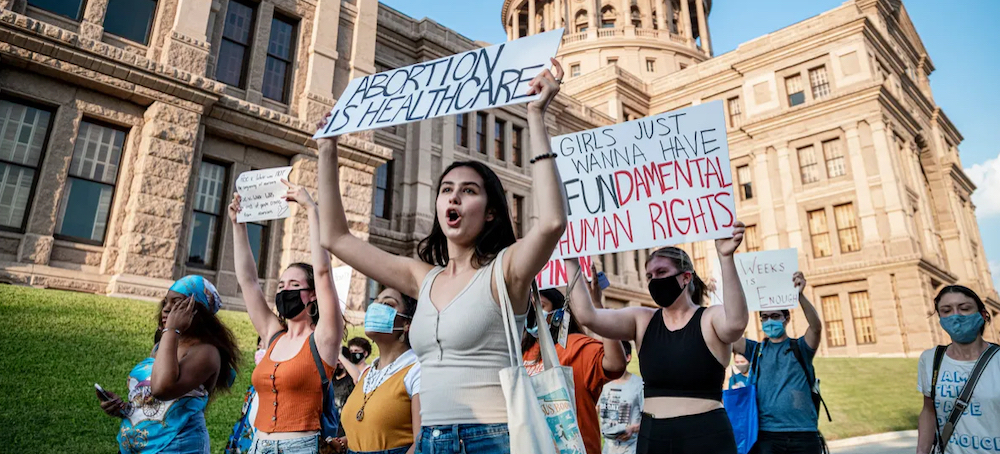
The Texas-Sized Loophole That Brought the Abortion Pill to the Brink of DoomPro-choice protesters march outside the Texas State Capitol in Austin. (photo: Sergio Flores/WP)

The Texas-Sized Loophole That Brought the Abortion Pill to the Brink of Doom
Dennis Aftergut and Laurence H. Tribe, Slate
Excerpt: "On Friday, District Judge Matthew Kacsmaryk, who is among the most reactionary of former President Donald Trump's appointees, signaled a desire to conduct the judicial process around a momentous decision before him with the shades drawn." 

On Friday, District Judge Matthew Kacsmaryk, who is among the most reactionary of former President Donald Trump’s appointees, signaled a desire to conduct the judicial process around a momentous decision before him with the shades drawn. According to the Washington Post, Kacsmaryk scheduled for Wednesday a hearing on his case to decide the future of the abortion pill, but sought to delay putting it on his public calendar until Tuesday to avoid public attention and possible protest.

Transparency is among the most important features of our judiciary. “Sunlight,” Supreme Court Justice Louis D. Brandeis wrote before joining the court, “is said to be the best disinfectant.” Decades later, Chief Justice Warren Burger applied that principle to the courts: “The crucial prophylactic aspects of the administration of justice cannot function in the dark.”

Dimmed light may be what Kacsmaryk prefers as he conducts his judicial process, but the outcome in this fraught action—which anti-abortion groups maneuvered into his courtroom—will not escape the people’s attention. The hyper-right Texas judge is expected to rule that the U.S. Food and Drug Administration improperly approved mifepristone, one of the pills in two-part medication abortions, a full 22 years ago. It has been safely used ever since.

What’s worse is that most observers think Kacsmaryk will issue an injunction halting the distribution of the drug, including in states where abortion is legal. That would exceed what the Supreme Court did in last June’s Dobbs decision, overturning Roe v. Wade but at least leaving women’s reproductive rights intact in states that opt to respect them.

The problem here goes beyond a single hearing, or even this single case. The real issue is systemic. Far-right groups have created a judicial pipeline to predictable triumph in one culture war battle after another: from Kacsmaryk in the plains of the Texas panhandle, to the hyperconservative U.S. Court of Appeals for the 5th Circuit, to the radically stacked majority on the Trump-packed U.S. Supreme Court. One Amarillo-based judge with carte blanche, virtually certain his extreme views will prevail on appeal, is apparently planning to curtail abortion access across the country.

What’s happening is not mere “judge-shopping,” as many have called it. That term is traditionally used to describe an individual’s search for a nearby court inclined to rule favorably.

By contrast, here there’s a coordinated national strategy, enabled by a district court federal bench, to bring right-wing legal causes into a single courtroom where a favorable result is a sure thing and where fair-minded appellate review has also been hijacked.

Let’s start with the local bench. In 1988, Congress left an easily closed loophole in the procedure for assigning cases to federal judges that made such gaming of the system possible. In July 2019, the judges of the Northern District of Texas took advantage of that loophole. They issued a special order funneling to Judge Kacsmaryk every case filed anywhere in the 25,914-square-mile area of the Amarillo Division in which he sits.

Groups throughout the country sharing his religious-political ideology have found it easy to establish a plaintiff’s residence within that sprawling 26-county region. Their goal is to ensure that test cases they design will land on his desk, even though the real forces behind the suit are national or global in reach.

Consider the anti-abortion groups that brought this case to Kacsmaryk. They know he previously worked at the First Liberty Institute, a Christian conservative litigation operation that opposes women’s reproductive freedom. Before Kacsmaryk’s appointment to the bench, he wrote that the “erotic desires of liberated adults” had taken priority over marriage and the unborn child.

And so national anti–reproductive rights organizations homed in on his judicial fiefdom. The complaint in the abortion pill case says that the named plaintiff, the Alliance of Hippocratic Medicine—incorporated just months before filing suit—is based near Amarillo. Rolling Stone reports that its mailing address is actually in Tennessee, but that is no impediment to gaining access to Kacsmaryk’s Texas courtroom due to the loophole that Congress left open and that conservatives are driving their truck through.

Kacsmaryk’s views on abortion fit neatly into his right-wing political cosmology. Before this suit was filed, he held that the Affordable Care Act’s prohibition of discrimination “on the basis of sex” does not cover sexual orientation. That case was brought by lawyers for former Trump aide Stephen Miller’s America First Legal Foundation, a group based in Washington, D.C., that also found easy access to Kacsmaryk.

He also vacated the Biden administration’s protections for transgendered persons under Title VII. Texas Republican Attorney General Ken Paxton brought that case in Amarillo, even though it’s 496 miles—a seven-hour drive—from Austin, where Paxton’s main office is located. Never mind that there’s a federal district court for the Western District of Texas in Austin.

That so transparently unprincipled a course is being charted by the newly emboldened ideological juristocrats is a tragedy for human rights—as well as for the broad public respect essential to an independent judiciary and therefore to the rule of law. The nation could easily get stuck in the judicial trench the right wing is digging by way of a single courtroom.

Getting out will take persistent organizing effort within our political system. We need to elect a Congress that will exercise its authority to modify federal court jurisdiction. We need a Congress willing to pass a bill that says, “No more single-judge district courts where parties on either side of the aisle can handpick extremist judges to manipulate national policy.”

Given the extent to which its conservative forces are taking advantage of the loophole, any reform will require that Democrats win a trifecta in 2024—election of a majority in both houses of Congress, including a Senate that is willing to reform the filibuster, and a president committed to the vision of a more perfect union of individual rights.

To be sure, pulling it off is a long shot. But it’s an imperative if we are to keep an ideological juristocracy from destroying our freedom.


READ MORE


California Court Lets Gig Companies Keep Treating Workers as ContractorsAn Uber vehicle in Los Angeles. (photo: LA Times)

California Court Lets Gig Companies Keep Treating Workers as Contractors
Jeremy B. White, POLITICO
White writes: "Gig companies like Uber and Lyft can continue classifying app-dispatched workers in California as independent contractors after a court largely ruled in the companies favor." 


The ruling preserves most of Prop 22, a ballot initiative that Uber, Lyft, and others passed in 2020 to preserve their business models.

Gig companies like Uber and Lyft can continue classifying app-dispatched workers in California as independent contractors after a court largely ruled in the companies favor.

The Monday decision from California’s First District Court of Appeals vindicates tech companies and undercuts organized labor foes who challenged an industry ballot initiative exempting the firms from a sweeping new labor law. Judges reversed most of a lower court decision that had invalidated Proposition 22 in its entirety.

“Today’s ruling is a historic victory for the nearly 1.4 million drivers who rely on the independence and flexibility of app-based work to earn income, and for the integrity of California’s initiative system,” the Protect App-Based Drivers + Services coalition said in a statement.

But the ruling could still hand a significant victory to unions and worker advocates. It invalidated a provision of Prop 22 that sets a high bar for the Legislature to pass laws allowing workers to organize.

“We are grateful that the California Court of Appeal has affirmed that companies like Uber, Lyft, Doordash and Instacart can’t keep drivers from joining together in a union through their deceptive ballot measure,” plaintiff and driver Mike Robinson said in a statement.

The legal battle has extended a long-running fight over the status of gig workers in California. In 2019, the state passed a law that made effectively compelled companies to classify their workers as employees, not contractors, by enshrining a California Supreme Court Decision.

After failing to block the law in Sacramento, tech companies fought back at the ballot box by pouring hundreds of millions of dollars into passing Prop 22. A labor-backed coalition then challenged the law as unconstitutional.


READ MORE 
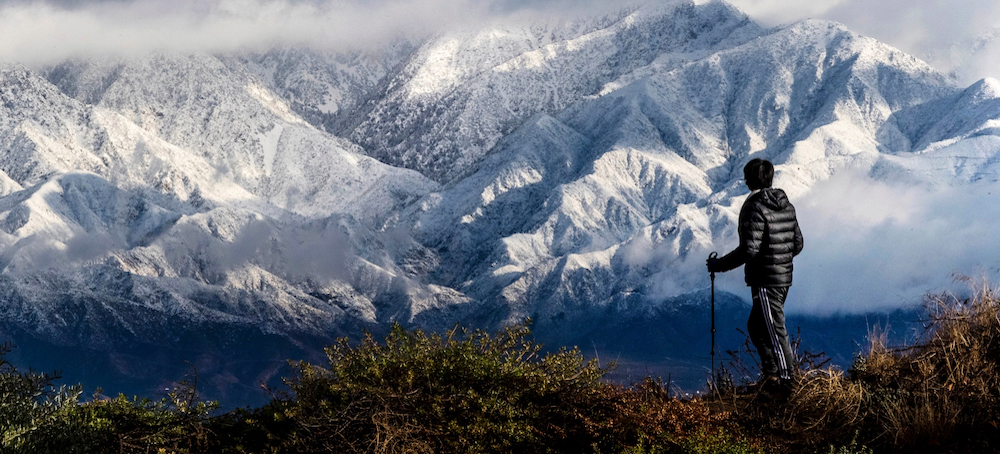
Climate Is Changing Too Quickly for the Sierra Nevada's 'Zombie Forests'Hotter, drier conditions driven by climate change in the mountain range have made certain regions once hospitable to conifers - such as sequoia, ponderosa pine and Douglas fir - an environmental mismatch for the cone-bearing trees. (photo: Watchara Phomicinda/AP)

Climate Is Changing Too Quickly for the Sierra Nevada's 'Zombie Forests'
Joe Hernandez, NPR
Hernandez writes: "Some of the tall, stately trees that have grown up in California's Sierra Nevada are no longer compatible with the climate they live in, new research has shown." 

Some of the tall, stately trees that have grown up in California's Sierra Nevada are no longer compatible with the climate they live in, new research has shown.

Hotter, drier conditions driven by climate change in the mountain range have made certain regions once hospitable to conifers — such as sequoia, ponderosa pine and Douglas fir — an environmental mismatch for the cone-bearing trees.

"They were exactly where we expected them to be, kind of along the lower-elevation, warmer and drier edges of the conifer forests in the Sierras," Avery Hill, who worked on the study as a graduate student at Stanford University, told NPR.

Although there are conifers in those areas now, Hill and other researchers suggested that as the trees die out, they'll be replaced with other types of vegetation better suited to the environmental conditions.

The team estimated that about 20% of all Sierra Nevada conifer trees in California are no longer compatible with the climate around them and are in danger of disappearing. They dubbed these trees "zombie forests."

The environment is changing faster than the trees can adapt

The team scrutinized vegetation data dating back to the 1930s, when all Sierra Nevada conifers were growing in appropriate climate conditions. Now, four out of five do.

That change is largely due to higher temperatures and less rainfall in these lower-elevation areas, as well as human activities, such as logging, and an uptick in wildfires.

The Sierra Nevada conifers aren't standing still. The average elevation of the trees has increased over the past 90 years, moving 112 feet upslope. According to Hill, that's because lower-elevation conifers have died while conifers at higher elevations where the air is cooler have been able to grow.

But the conifers' uphill trek hasn't been able to keep pace with the dramatic increase in temperatures.

The researchers said the number of Sierra Nevada conifers incompatible with their environments could double in the next 77 years.

The new maps can inform forest conservation and management plans

But Hill, who is now a postdoctoral researcher at the California Academy of Sciences, hopes that the maps he and his colleagues developed showing the state's "zombie forests" will help shape people's understanding of the effects of climate change.

"Conservationists know, scientists know, so many people know that ecosystems are changing and expect them to change more, and people are grappling with this," he said.

"These maps are unique, in that you can put your finger on a point and say, 'This area right here is expected to transition due to climate change in the near future,' and this forces some really difficult questions about what we want this land managed for and do we try to resist these impending changes," Hill added.


READ MORE


Contribute to RSN

Follow us on facebook and twitter!

Update My Monthly Donation

PO Box 2043 / Citrus Heights, CA 95611


Monday, March 13, 2023

Bess Levin | Ivanka Trump Awkwardly Implies Her Brothers and Dad May Have Committed Fraud at the Trump Org


Reader Supported News

Live on the homepage now!
Reader Supported News

WE WARNED OF A FUNDING NIGHTMARE, IT’S HERE — The situation is very bad and far worse than it needs to be. Why. Yesterday 22,491 people came to Reader Supported News and 6 donated. That kind of response now has us in panic mode. Assistance needed now.
Marc Ash • Founder, Reader Supported News

Sure, I'll make a donation!


The New York attorney general's case against the Trump Organization, Donald Trump, Donald Trump Jr., Ivanka Trump, and Eric Trump is set to go to trial on October 2, 2023. (photo: Today.com)
Bess Levin | Ivanka Trump Awkwardly Implies Her Brothers and Dad May Have Committed Fraud at the Trump Org
Bess Levin, Vanity Fair
Levin writes: "Feels like this should make for a particularly uncomfortable vibe at the next family gathering!" 


Feels like this should make for a particularly uncomfortable vibe at the next family gathering!

The New York attorney general’s case against the Trump Organization, Donald Trump, Donald Trump Jr., Ivanka Trump, and Eric Trump is set to go to trial on October 2, 2023. Accused last year of committing a decade’s worth of “staggering” fraud, the defendants—who have denied everything—allegedly made over 200 false and misleading valuations from 2011 to 2021, with AG Letitia James charging that “the pattern of fraud that was used by Mr. Trump and the Trump Organization was astounding.” Should the company and family be found liable, the state has asked for a financial penalty of $250 million and for the ex-president, Don Jr., Ivanka, and Eric to be banned from ever running a business in New York again, among other things.

Obviously, that result would be extremely embarrassing for the Trumps, which is probably why both Don Sr. and his eldest daughter have asked for the start date to be delayed. For his part, lawyers for the ex-president (and current presidential candidate) have argued that the evidence would take 11,000 hours to review, and that the trial should be pushed back six months. As for Ivanka? Her legal team took a slightly different approach.

Per The Independent:

In court documents, Ms. Trump’s attorneys argue that the fraud complaint filed last year against her and her codefendants by New York attorney general Letitia James “does not contain a single allegation that Ms. Trump directly or indirectly created, prepared, reviewed, or certified any of her father’s financial statements.”

“Other individuals were responsible for those tasks,” her lawyers wrote.

The “other individuals” accused in the case are her father and brothers, so this comes off…rather awkwardly, and the takeaway from The Independent was that the former first daughter threw her siblings and dad “under the bus.” Setting all that aside, it’s also pretty odd that her lawyers are arguing that the lawsuit does not include a single allegation in which “Ms. Trump directly or indirectly created, prepared, reviewed, or certified any of her father's financial statements,” when the AG’s office has flatly accused her of being in on the alleged scam. To wit, James’s office claims in the suit that all three Trump kids “knowingly participated” in the scheme. Of Ivanka specifically, the lawsuit notes her involvement in securing loans to buy Florida and Chicago properties in 2012, loans that were issued in part due to false financial statements. “On each of those transactions with Deutsche Bank, Ms. Trump was aware that the transactions included a personal guaranty from Mr. Trump that required him to provide annual Statements of Financial Condition and certifications,” the lawsuit reads. (Elsewhere, the suit points to the Trump Organization’s deal obtaining a ground lease for its Washington hotel, noting that project was “captained by Ivanka Trump, and Mr. Trump’s statements were central to their effort to win the bid.“)

Anyway, it’s not clear at this time if the judge overseeing the case will be convinced to delay the trial. In a letter made public on Friday, he wrote: “The core of this case is very simple: plaintiff claims that defendants submitted false financial statements to third-parties…. It is their own alleged documents and acts that are at issue…. October 2, 2023 is more than seven months away.” He added, “And with all that has already been accomplished, I see no reason to alter my determination to start the trial on that day.”


READ MORE


Amanda Zurawski, one of five plaintiffs in Zurawski v. State of Texas, speaks in front of the Texas State Capitol in Austin, Texas, Tuesday, March 7, 2023. (photo: Sara Diggins/AP)

"Sick and Twisted": Women Sue Texas Over Harrowing Medical Episodes Caused by Abortion Bans
Jordan Smith, The Intercept
Smith writes: "The first-of-its-kind lawsuit seeks to affirm that doctors can use their best medical judgment without fear of criminal penalty." 


The first-of-its-kind lawsuit seeks to affirm that doctors can use their best medical judgment without fear of criminal penalty.

Amanda Zurawski stepped up to a podium outside the Texas Capitol. Close your eyes, she began, and picture someone you hold incredibly dear. “Now imagine someone telling you you’re going to lose that person in the very near future, but they can’t tell you exactly when or how,” she said. “On top of that, there’s a very high likelihood that you’ll get extremely sick, maybe even near death, as you wait for that person you love to die.”

“It sounds like a pretty sick and twisted plot to a dystopian novel,” she continued. “But it’s not. It’s exactly what happened to me while pregnant in Texas.”

Zurawski and her husband had known each other since preschool. They married in 2019 and were excited to start a family. After months of fertility treatments, Zurawski learned she was pregnant. The couple was beyond thrilled; they decided to name their daughter Willow. Zurawski was “cruising though” her second trimester, she said, and had just finished the invite list for her upcoming baby shower when everything changed. She developed “unexpected and curious” symptoms. Her obstetrician told her to come in right away. After an examination, the couple received the “harrowing news” that Zurawski’s cervix had dilated prematurely. Later her water broke; because Zurawski’s pregnancy was still weeks from viability, there was no chance Willow would survive.

“I asked what could be done to ensure the respectful passing of our baby and … protect me from a deadly infection,” she recalled. Nothing could be done, she was told, because of Texas’s abortion bans.

Zurawski is one of five Texas women who are plaintiffs in a lawsuit that the Center for Reproductive Rights filed against the state this week. The lawsuit argues that the state’s various abortion bans, which contain only vague exceptions in cases of medical emergency and impose both civil and criminal penalties if violated, have caused confusion and sparked fear among medical professionals, putting pregnant people’s lives in danger.

“What the law is forcing physicians to do is to weigh … very real threats of criminal prosecution against the health and well-being of their patients,” Nancy Northup, CEO of the Center for Reproductive Rights, said during the Tuesday afternoon press conference. The lawsuit seeks to stop the “unnecessary pain, suffering, injury, and life-threatening complications caused by Texas’s abortion ban.”

The lawsuit asks a state district judge to clarify the scope of the medical emergency exception and affirm that physicians can provide abortion care when an emergency condition arises. It is the first lawsuit of its kind, Northup said, “in which individual women have sued a state for the harm that they endured because abortion care has been criminalized in the wake of Roe’s reversal.”

Zurawski’s doctor said her pregnancy could not be terminated until there was no longer fetal cardiac activity or her health had deteriorated enough that the ethics board at the hospital would allow an abortion. “I cannot adequately put into words the trauma and despair that comes with waiting to either lose your own life, your child’s life, or both,” she said. “For days I was locked in this bizarre and avoidable hell.” Zurawski developed life-threatening sepsis; only then did the hospital agree that she was sick enough to qualify for abortion under Texas law. “What I needed was … a standard medical procedure,” she said. “An abortion would have prevented the unnecessary harm and suffering that I endured.”

Confusion and Intimidation

By the time the U.S. Supreme Court issued its ruling in Dobbs v. Jackson Women’s Health Organization last June — which overturned Roe v. Wade and eliminated a half-century of constitutional protection for abortion — Texas politicians had already codified two abortion bans. During their 2021 biennial legislative session, lawmakers passed Senate Bill 8, a six-week ban that sidestepped constitutional oversight by outsourcing enforcement to vigilantes empowered to bring civil suits against health care providers or anyone else they believed might have aided a patient seeking an abortion in violation of the law. Lawmakers also passed a so-called trigger ban, a complete ban on abortion that took effect in August 2022, shortly after Roe’s demise.

Theoretically at least, each of the Texas bans has an exception for cases involving medical emergencies. But according to the new lawsuit, the laws don’t use standard medical terminology, and what exactly counts as a medical emergency is vague. “Inconsistencies in the language of these provisions, the use of non-medical terminology, and sloppy legislative drafting have resulted in understandable confusion throughout the medical profession regarding the scope of the exception,” the lawsuit reads. While the exception appears multiple times in the state’s health and safety code, conflicting language leaves “physicians uncertain whether the treatment decisions they make in good faith, based on their medical judgment, will be respected or will later be disputed.”

And that is a serious problem given the extreme penalties for violating Texas’s abortion bans. Doctors who violate the trigger law, for example, face revocation of their license, a civil penalty of at least $100,000 per violation, and, if criminally charged, up to 99 years in prison.

To date, abortion is banned in 13 states, including Texas. Medical exceptions in those states vary, and some have none at all, providing only a list of possible defenses a physician can assert if they are prosecuted. Physicians have long warned that these exceptions are vague and place patients in danger. Stories of pregnant people denied abortion care despite suffering from serious medical complications or carrying a fetus with a fatal diagnosis have made news across the country, but they have prompted few, if any, attempts to better define exceptions to the bans.

During his 2022 reelection campaign, Texas Gov. Greg Abbott told Inside Texas Politics that he’d seen some situations in which pregnant people were not getting the heath care they needed to protect their lives. “There’s been too many allegations that have been made about ways in which the lives of the mother are not being protected, and so that must be clarified.” Although the Texas Legislature convened in January, no action has been taken to remedy the problem. A spokesperson for Attorney General Ken Paxton told the Associated Press that Paxton is “committed to doing everything in his power” to defend the laws as written.

Meanwhile, anti-abortion groups have pushed back on the notion that the bans they advocated for need any clarification, suggesting that where patients like Zurawski are concerned, doctors are simply being negligent. That’s exactly what the Texas Alliance for Life did in the wake of the center’s lawsuit. “Tragically, some physicians are waiting until their patients are nearly dead before performing a life-saving medical procedure,” Amy O’Donnell, the group’s communications director, said. “We see situations when pregnant women do not promptly receive treatment for life-threatening conditions as potential medical malpractice issues.”

“You Need to Leave the State”

In the face of legislative inaction, the new lawsuit seeks to have a judge step in and declare that doctors have the right to exercise their best medical judgment — and that they won’t face penalties for doing so. It also argues that the Texas Constitution guarantees fundamental rights that don’t disappear simply because a person is pregnant. “Texas law cannot demand that a pregnant person sacrifice their life, their fertility, or their health for any reason, let alone in the service of ‘unborn life,’ particularly where a pregnancy will not or is unlikely to result in the birth of a living child with sustained life,” it reads.

Three additional plaintiffs in the center’s lawsuit were also on the Capitol grounds Tuesday. Like Zurawski, they shared stories of wanted pregnancies that ended in heartbreak amid a nightmare of trying to access necessary abortion care in Texas.

Lauren Hall was nervous about becoming a parent, but excited, she told reporters. Then, when she was 18 weeks pregnant, an anatomy scan revealed anencephaly; her fetus was not growing a skull and had little brain matter. Her husband held back tears when he asked the doctor what they should do. The doctor hesitated. Wait to miscarry or leave Texas for an abortion, the couple was told. The doctor warned that if they chose to leave Texas, they should not tell anyone where they were going or why, and she couldn’t refer Hall to an out-of-state provider or even transfer her medical records; under Senate Bill 8, no one knew how far Texas would go to prosecute people involved in abortion care. Hall and her husband made their way to Seattle, where she finally received the medical intervention she needed. Hall recalled protesters outside the clinic, “calling us killers and waving pictures with dead babies at us.”

Lauren Miller already had a young son when she found out she was pregnant with twins. She and her husband were excited. They started calling the twins “Los Dos,” and every night, her husband would give her two kisses on the belly, “one for each.” But Miller began suffering from debilitating nausea and vomiting. At 12 weeks, she found out that one of the fetuses had two large fluid masses developing where his brain should be. The fetus had an often-fatal genetic abnormality, and later scans revealed “one heartbreaking issue after another.” Miller’s medical providers seemed to be searching for words when trying to counsel her about her options, she said. Finally, one specialist tore off his gloves and threw them in the trash: “I can’t help you anymore,” she recalled him saying. “You need to leave the state.”

That’s what she and her husband decided to do. She wanted to just “curl up and cry and mourn,” but instead, she had to scramble to find care to give the other twin “and myself the best chance of surviving this pregnancy.” She and her husband felt lost, she said, “like we were in a dark room feeling for a door.” She noted that while she had the resources to access the care she needed out of state, others might not be as fortunate. “Layers of privilege should never determine which Texans can get access to the health care they need.”

Anna Zargarian was surprised to find out she was pregnant. It was September 2021, just after S.B. 8 had gone into effect, and she remembered “naively” thinking that it was a good thing she wouldn’t need an abortion. Two months later, Zargarian’s water broke; her amniotic fluid was gone, and she was told the baby would not survive. On the Capitol lawn, Zargarian began to cry as she recalled getting the news. “My heart broke into a million pieces,” she said. “I didn’t even know a pain like that could exist until that moment.” Under the provisions of S.B. 8, she wouldn’t be able to get the care she needed in Texas until “my life was actively in danger,” she said. “I couldn’t understand what was going on.” She fled to Colorado for care. “Where else in medicine do we do nothing and just wait to see how sick a patient becomes before acting?”

A reporter at the press conference asked how the women felt now, filing this case together after going through such an isolating ordeal. To be clear, Zurawski said, none of the women wanted to be there: “We have all become involuntary members of the most horrific club on the planet.” And they were just a small representation of “countless others” in Texas and around the U.S. who have gone through similar trauma. “Being together is powerful, but it’s also traumatic knowing that there are so many people who are going through this,” she said. “And I think that’s why we’re all here.”


READ MORE


Russia Is Firing Hypersonic Missiles Into Ukraine That Are Nearly Impossible to StopIn this 2018 photo made from footage taken from the Russian Defense Ministry's official website, a Russian Kinzhal hypersonic missile flies during a test in southern Russia. (photo: AP)

Russia Is Firing Hypersonic Missiles Into Ukraine That Are Nearly Impossible to Stop
Scott Neuman, NPR
Neuman writes: "Until now, Ukraine's air defenses say they have largely succeeded in destroying a substantial number of the Russian rockets being fired into the country's civilian centers. On Thursday, the Kremlin threw in a new wrinkle."   

ALSO SEE: What Are the Hypersonic Missiles Russia Is Using in Ukraine?

Until now, Ukraine's air defenses say they have largely succeeded in destroying a substantial number of the Russian rockets being fired into the country's civilian centers. On Thursday, the Kremlin threw in a new wrinkle.

In an early morning attack on targets across the country, Russian forces apparently added several hypersonic missiles, known as Kinzhals — or "Daggers" in Russian — to the lethal mix. Ukrainian forces say their defensive capabilities are not up to the task of taking out a Kinzhal.

Six Kinzhals were included in Thursday's attack, according to Ukrainian defense forces. Although Russia has used these weapons before, in the opening weeks of the conflict, Yuriy Ignat, an air force spokesman, told Ukrainian TV that the enemy had never fired so many of them in a single attack. Ignat said only 34 of the 81 total incoming Russia missiles were shot down.

Hypersonics pose a serious challenge to air defenses

Hypersonic missiles such as the Kinzhal are a fairly new breed of weapon that combine superior speed with the ability to maneuver to evade being shot down. Not only are they difficult to detect, but they make radical and unpredictable course changes as they get close to a target.

The Kinzhal, unveiled by Russian President Vladimir Putin five years ago, can accelerate to Mach 4 — four times the speed of sound — and may be capable of speeds of up to Mach 10, with a range to about 1,250 miles. The missile is also believed to be nuclear-capable.

An even more sophisticated weapon, Russia's Avangard hypersonic glide vehicle, can fly at speeds as high as Mach 27, according to the Kremlin. Another hypersonic, the Zircon anti-ship missile, has also reportedly been developed, but there are no reports of the Zircon or Avangard being used in combat.

There's debate over how much of a game changer they are

The Kinzhal "is launched from an aircraft and has a shorter range than Avangard," according to James Acton, co-director of the nuclear policy program at the Carnegie Endowment for International Peace.

But last year, after the first reported use of the Kinzhal in Ukraine, Acton downplayed the significance of the weapons as a "game changer" in the conflict.

"I don't know how much of an advantage Russia is getting from using hypersonic missiles," he told the BBC.

That is a sentiment largely echoed by U.S. Northern Command chief Air Force Gen. Glen VanHerck. Last May, VanHerck told a Senate Armed Services strategic forces subcommittee that Russia was having "challenges with some of their hypersonic missiles as far as accuracy" in Ukraine.

However, Victor Cha, who served on the National Security Council during the George W. Bush administration, told NPR last year that hypersonics could pose a real challenge — even to U.S. missile defense systems. At the time, Cha was referring to hypersonic missiles being developed by North Korea. U.S. missile defense systems are "good," he said, but they are mostly "geared towards stopping a handful of fairly primitive missiles from North Korea." Those systems dwarf the type of defenses that Ukraine is using in the fight against Russia.

"[T]hey would need to be improved to be able to handle more sophisticated sorts of missiles," Cha said.

The Pentagon, too, has expressed some urgency on the subject. Last year, Dee Dee Martinez, comptroller of the U.S. Missile Defense Agency, said hypersonic missiles "pose a new challenge to our missile defense systems."

"The development and deployment of missile defense systems to counter these advanced threats presents unique, but surmountable challenges, which require further development and technology investments," she said.


READ MORE


Arkansas Gov. Sanders Signs a Law That Makes It Easier to Employ ChildrenGov. Sarah Huckabee Sanders, R-AR, waits to deliver the Republican response to President Biden's State of the Union address on Tuesday in Little Rock, Arkansas. Sanders signed a law this week making it easier to employ kids under 16. (photo: Al Drago/AP)

Arkansas Gov. Sanders Signs a Law That Makes It Easier to Employ Children
Kaitlyn Radde, NPR
Radde writes: "Arkansas Gov. Sarah Huckabee Sanders signed a law this week rolling back requirements that the state verify the ages of workers under 16 and provide them with work certificates permitting them to work."   

Arkansas Gov. Sarah Huckabee Sanders signed a law this week rolling back requirements that the state verify the ages of workers under 16 and provide them with work certificates permitting them to work.

Effectively, the new law signed by the Republican governor applies to those who are 14 and 15 years old because in most cases Arkansas businesses can't employ those under 14.

Under the Youth Hiring Act of 2023, children under 16 don't have to get the Division of Labor's permission to be employed. The state also no longer has to verify the age of those under 16 before they take a job. The law doesn't change the hours or kinds of jobs kids can work.

"The Governor believes protecting kids is most important, but this permit was an arbitrary burden on parents to get permission from the government for their child to get a job," Sanders' communications director Alexa Henning said in a statement to NPR. "All child labor laws that actually protect children still apply and we expect businesses to comply just as they are required to do now."

Workers under 16 in Arkansas have had to get these permits for decades.

Supporters of the new law say it gets rid of a tedious requirement, streamlines the hiring process, and allows parents — rather than the government — to make decisions about their children.

But opponents say the work certificates protected vulnerable youth from exploitation.

"It was wild to listen to adults argue in favor of eliminating a one-page form that helps the Department of Labor ensure young workers aren't being exploited," the group Arkansas Advocates for Children and Families wrote about the law in a legislative session recap.

Arkansas isn't the only state looking to make it easier to employ kids in a tight labor market and fill an economic need. Bills in other states, including Iowa and Minnesota, would allow some teenagers to work in meatpacking plants and construction, respectively. New Jersey expanded teens' working hours in 2022.

But the bills are also occurring alongside a rising tide of minors employed in violation of child labor laws, which have more than tripled since 2015, and federal regulators have promised to crack down on businesses that employ minors in hazardous occupations.

There's no excuse for "why these alarming violations are occurring, with kids being employed where they shouldn't even be in the first place," Jessica Looman, principal deputy administrator of the Wage and Hour Division, told NPR in February.

Investigators from the Department of Labor found hundreds of children employed in dangerous jobs in meatpacking plants. Last month, Packers Sanitation Services paid a $1.5 million fine — the maximum amount — for employing 102 children to work in dangerous meatpacking facility jobs.


READ MORE


Joe Biden Is Bringing Back Donald Trump's Asylum Ban at the BorderJoe Biden is refusing asylum to migrants who did not first seek protection in the countries they traveled through to reach the United States. (photo: U.S. Department of the Interior)

Joe Biden Is Bringing Back Donald Trump's Asylum Ban at the Border
Hilary Goodfriend, Jacobin
Goodfriend writes: "The Biden administration's recently announced change to border policy effectively resurrects Donald Trump's asylum ban. It will cause harm or suffering to thousands or millions of migrants seeking survival in the US." 


The Biden administration’s recently announced change to border policy effectively resurrects Donald Trump’s asylum ban. It will cause harm or suffering to thousands or millions of migrants seeking survival in the US.

On February 23, the Biden administration published a “notice of proposed rulemaking” to refuse asylum to migrants who did not first seek protection in the countries they traveled through to reach the US southern border. The change effectively resurrects Donald Trump’s asylum ban, rendering nearly all applicants ineligible for protections.

Even with the low bar for reform set by the Biden White House, the announcement is a betrayal. It’s a cruel, needless decision that will cause harm and suffering to thousands or perhaps millions of people seeking survival in the United States. The United States received over 202,000 asylum affirmative applications in 2022 alone, plus another 68,300 defensive claims from migrants in deportation proceedings.

Biden’s asylum ban appears to be another instance of the Democrats’ cherished strategy of losing to the Republicans by implementing slightly weaker versions of the latter’s policies. But the bipartisan war on migrants points to a more profound crisis, indicating the destabilization of the conditions that, for decades, have structured the uneven movement of capital and labor across the US border.

Changing Enforcement Logics

US recourse to migrant containment, border militarization, and mass deportation is nothing new. In the decades prior to the global financial crisis, however, these methods were deployed more in the service of exploitation than expulsion.

Mass migration has been constitutive of neoliberal restructuring on both sides of the border. The fallout from US-imposed structural adjustment and free trade displaced vast sectors of the Mexican and Central American working class, peasant, and indigenous populations, whose devalued labor fueled the deindustrializing US economy. Migrant remittances, in turn, came to represent up to a quarter of GDP in countries like El Salvador.

In this context, the progressive criminalization of migration since the 1980s did not serve so much to expel or exclude migrant workers as to ensure they would be more severely exploited in segmented US labor markets.

Until recently, this arrangement suited capital just fine. Companies were free to reap extraordinary surplus from criminalized migrant labor in services, construction, and agriculture in the United States, while those workers’ remittances supplemented the poverty wages paid out to their families back home by the multinationals exporting palm oil or subcontracting to the region’s maquiladoras and call centers.

But in the extended period of instability and crisis since the 2007 market crash, this asymmetrical but mutually sustaining relationship between the United States and its neighbors has been unsettled. In the wake of the financial crisis, US deportations have reached unprecedented heights, and Democratic and Republican administrations alike have advanced policies to fortify what Mike Davis called the “Great Wall of Capital” between the United States and its neighbors.

Changing Migrant Populations

The last fifteen years has seen dramatic changes in the material conditions in which working people make their lives on both sides of the border. These transformations are reflected in the numbers, composition, and strategies of migrants arriving at the US southern border.

The Great Recession and its aftermath had a disproportionate impact on the labor markets that long relied heavily on the exploitation of racialized and criminalized migrant labor, such as construction and hospitality. The service sector, especially restaurants and hospitality, took another devastating hit during the COVID-19 pandemic.

Many Mexican migrants, especially undocumented workers, left the United States during the recession. As Mexican migration declined, however, migration from elsewhere in Latin America began to climb, propelled by converging crises of economic downturn, ecological collapse, and the global pandemic.

As a result, the population intercepted at the US-Mexico border is no longer dominated by single, job-seeking Mexican men. Instead, US Customs and Border Protection (CBP) data is increasingly made up of asylum-seeking women, children, and families from Central and South America and the Caribbean.

CBP euphemistically registers those detained or turned away at the border as “enforcement encounters.” “Encounters” with people from the northern Central American nations of Honduras, Guatemala, and El Salvador, on the rise since 2011, surpassed those from Mexico for the first time in 2017. From just under sixteen thousand “unaccompanied minors” intercepted in 2011, CBP registered over seventy-six thousand in 2019, 83 percent of them from northern Central America. Women, who comprised 13 percent of southwest border “encounters” in 2011, made up 63 percent in 2019.

The COVID-19 pandemic further destabilized these trends. Overall numbers spiked, with CBP interceptions topping 2.3 million in 2022 — up from 1.7 million in 2021 and 850,508 in 2019.

The makeup of migrant populations has also shifted in the pandemic’s wake. In 2022, northern Central Americans comprised just under 23 percent of “encounters,” with Mexicans at 34 percent. The largest group, 42.6 percent, came from elsewhere, led by asylum seekers from Cuba, Nicaragua, and Venezuela, where US sanctions have multiplied the destructive effects of the pandemic and impeded recovery.

Two Steps Back

These evolving material realities form the backdrop against which the struggle over US immigration policy has played out in recent years. Each concession wrung out of the government by movements for migrant justice has been accompanied by an uptick in repression at the border.

Title 42 is a case in point. Over 2.5 million asylum seekers have been turned away or deported since the Trump administration initiated Title 42 expulsions under public health pretenses in March of 2020.

The Biden administration worked half-heartedly to terminate the emergency mechanism, finally setting a date for its expiration this spring. Title 42 is scheduled to end on May 11, but now it will be replaced with something more permanent: Biden’s new asylum ban takes effect the same day.

Even as it prepared to abandon Title 42, the White House expanded it in January to include the expulsion of migrants from Venezuela, Haiti, Cuba, and Nicaragua into Mexico, while exempting those from Ukraine. To soften the blow, the administration simultaneously announced a two-year “humanitarian parole” program from migrants from those four countries who could claim financial sponsors in the United States. Monthly applications would be capped at thirty thousand; CBP intercepted 77,034 migrants from Cuba and Nicaragua in December alone.

This humanitarian half-measure joins programs like Deferred Action for Childhood Arrivals (DACA) and Temporary Protected Status (TPS) in a patchwork of provisional executive shields from deportation for an exceptional few. While Joe Biden quietly abandoned modest immigration reform in the Senate, he expanded TPS to include qualified migrants from Afghanistan, Cameroon, Ukraine, Venezuela, Myanmar, Syria, Sudan, South Sudan, and Yemen and renewed the provision for those from El Salvador, Haiti, Honduras, and Nicaragua.

TPS-holders receive lawful work permits but no pathway to legal permanent residency. A matter of Department of Homeland Security discretion, TPS must be renewed every eighteen months. Like DACA recipients, beneficiaries are subject to stringent screening and scrutiny, as well as perpetual uncertainty and instability.

For sociologist David Feldman, these trends suggest a “nascent project of militarized migration management.” This strategy couples scorched-earth tactics at the border with the designation of flexible “pools of authorized — yet ultimately deportable — noncitizen workers subject to a wide array of restrictions and surveillance” that can more rapidly adapt to the changing demands of capital.

The Root of the Problem

In this context of crisis and contradiction, US foreign policy toward Latin America is increasingly framed in terms of addressing the “root causes” of migration.

Root-causes discourse emerged in the context of the US-made Central American child migrant crisis of 2014. The media frenzy spawned a slew of policy proposals for US aid and investment in the region, each less ambitious than the last.

Barack Obama led the charge with the “Alliance for Prosperity.” The plan, which then vice president Biden called a “Plan Colombia for Central America,” incentivized foreign investment and conditioned US aid on Central American border militarization and compliance with deportations. Under Trump, these State Department–led initiatives took a backseat to explicitly military priorities.

Back in the White House again, Biden has now tasked Vice President Kamala Harris with heading up the US approach to Central America. After dispatching the vice president to Guatemala to issue her notorious “Do Not Come” mandate, the White House debuted a “Strategy to Address the Root Causes of Migration in Central America” that identified economic insecurity and inequality, corruption, human and civil rights violations, criminal activity, and gender violence as factors contributing to migration.

Under this framework, Harris’s Partnership for Central America (PCA), an NGO led by a former McKinsey partner, claims to have secured $4.2 billion in commitments for private sector investment in the region from companies like Meta, Microsoft, Nestlé, and Pepsi. PCA initiatives include a “strategic partnership” with the Canadian firm Diversio, “the world’s first AI DEI [diversity, equity, and inclusion] analytics platform” with the goal of furthering “gender parity in supply chains.”

These self-serving efforts fall short of the reparations due to the region for the bloody history of US counterrevolutionary violence. To the contrary, they continue to position Central America as a site for US appropriation and extraction, reproducing the isthmus’s subordinate position in a US-led globalized economy and, by extension, intensifying the very processes of displacement and dispossession that they profess to prevent.

But even the best-intentioned of Democratic policy interventions miss a critical point. Liberal development discourse identifies the “root causes” of mass migration as deficiencies located within Central American societies. This is an old story, with roots in colonization and a pedigree that runs squarely through Walter Whitman Rostow’s 1960 Stages of Economic Growth. This framing posits the conditions associated with underdevelopment as a regrettable stage prior to economic development, which can be overcome through the judicious application of the appropriate public policies.

The reality, however, is that Central America’s so-called underdevelopment is the necessary outcome of development in countries like the United States. These are inseparable histories of accumulation and exploitation that structure the uneven development of the capitalist world system. This is true of the historical relationship between Latin America’s colonization and European industrialization, but it’s also true of the patterns of mass Latin American migration that have powered the US economy throughout the neoliberal period.

Post-pandemic, Central American migrants have been outnumbered by those fleeing crises compounded by US sanctions in Cuba, Venezuela, and Nicaragua. These developments suggest that any efforts to remedy the disparities between the United States and its southern neighbors must also include relief from the suffocating impacts of sanctions. The real root causes of migration lie in these imperialist relations of dependency.

The War on Migrants

Instead of the typical sixty, the Biden administration has limited the public comment period on the asylum ban to thirty days. This move has done nothing to suppress the widespread outcry from migrant justice organizations and advocates, who have unanimously condemned the ban as illegal, racist, and inhumane.

Biden might have acted on his promise to expand asylum criteria to better meet the human rights and humanitarian needs at the border. Instead, he has continued the imperialist assault on the racialized poor, while carving out temporary and contingent categories of relief for a small few.


READ MORE


Ilopango women's prison on the outskirts of San Salvador where women have been held on abortion-related charges. (photo: Ali Rae/Al Jazeera)

"Torture": El Salvador's Abortion Ban Condemned, Highlights Horrors Facing US After Roe Overturned
Democracy Now!
Excerpt: "In El Salvador, dozens of people have been convicted and imprisoned after having miscarriages, stillbirths and other obstetric emergencies." 


As we mark International Women’s Day on March 8, we look at the criminalization of abortion with filmmaker Celina Escher, who directed the award-winning documentary Fly So Far about abortion in El Salvador, which has enforced an abortion ban since 1998, and dozens of people have been convicted and imprisoned after having miscarriages, stillbirths and other obstetric emergencies. On Monday, women’s rights activists called for the Inter-American Court of Human Rights to condemn El Salvador in a case brought a decade ago by a woman, Beatriz, who died after being forced to carry a pregnancy although the fetus could not survive. Escher says El Salvador’s current policies amount to “torture for the women and girls” forced to bring nonviable and dangerous pregnancies to term against their will.

Transcript

This is a rush transcript. Copy may not be in its final form.

AMY GOODMAN: This is Democracy Now!, democracynow.org. I’m Amy Goodman, with Nermeen Shaikh, as we end today’s International Women’s Day special looking at abortion bans. Five women are suing Texas after they were denied abortions, even as their pregnancies posed serious risks to their health and were nonviable, in the first such lawsuit since the Supreme Court overturned Roe v. Wade.

This comes as women’s rights activists Monday called for the Inter-American Court of Human Rights to condemn El Salvador’s total ban on abortions, which has been in place since 1998. The demands center on a case brought a decade ago by a woman, Beatriz, who died after being forced to carry a pregnancy although the fetus could not survive.

For more, we’re joined by Celina Escher, a Salvadoran Swiss filmmaker who directed the award-winning documentary Fly So Far about the criminalization of abortion in El Salvador, where dozens have been convicted and imprisoned after having miscarriages, stillbirths and other obstetric emergencies.

Celina, welcome back to Democracy Now! It is great to have you with us. We look from the United States to El Salvador. Is El Salvador the United States’s future? Talk about the total ban, but also the resistance.

CELINA ESCHER: Hello, Amy. Thank you for having me.

Yes, exactly. In El Salvador, well, abortion is still criminalized. There is no possibility to have an abortion in El Salvador. Women are still criminalized and in prison. But there is a big resistance still happening in El Salvador, although we’re living in a state of exception since one year. People have lost their human rights, and people are being unjustly incarcerated in El Salvador. There’s a big movement who try to legalize abortion in four cases, and also in three cases, but now a feminist leader, Gloria Peña, she’s facing a lawfare. She’s being persecuted. And she’s the woman who was also in my film. She wanted to legalize abortion in four cases, and now she is facing a persecution, political persecution. So, in general, there is an authoritarian regime happening in El Salvador, and feminist activists, journalists, dissident voices, everybody is under threat. Everybody is being persecuted. And yeah, this is really a difficult situation that people are facing in El Salvador right now.

NERMEEN SHAIKH: Celina, could you talk about what happened with the release of your film, which was banned in El Salvador, and the stories that you hear from people who are featured in the film, if you could elaborate on those?

CELINA ESCHER: Yes, exactly. Well, last year in August, we wanted to have the cinema premiere in El Salvador. We have shown our film in 19 international film festivals, so we decided to launch the — to have the cinema premiere. But then, anti-choice organizations, 12 organizations, made a legal threat to the cinema. If they show our film in the cinema, they will make a legal threat. So, then, the cinema had to take down our film, and so we didn’t have the cinema premiere.

They tried to silence the voices and the stories of the women of the 17, but we have shown our film in community screenings together with the protagonist, Teodora Vásquez, and her organization, Mujeres Libres, across the country. So we are trying to show our film in many, many ways. But, as we see, the evangelical anti-choice groups have so much power. They are trying to silence us and trying to silence the stories of the women.

NERMEEN SHAIKH: Talk more, Celina, about the origins of this law. You mentioned, in 1998, this new abortion law. How did it begin? And where do you see it going now?

CELINA ESCHER: Well, abortion was legal in three cases before 1998. Then it was a total ban of abortion in all cases. It was not possible to have an abortion even if your life is in danger, in cases of rape or the fetus will not survive outside the womb. So, in no cases was legal. And feminist organizations have been trying to legalize abortion since more than 30 years, but it has been really difficult and almost impossible to legalize abortion in El Salvador.

Now a feminist organization have brought the case of Beatriz in front of the Inter-American Court, and we are hoping that with this case will open up for the cases of the other women, and it will force El Salvador to change the abortion law. Last year, also the case of Manuela was held in front of the Inter-American Court, and the Inter-American Court ruled in favor of Manuela, saying that El Salvador is guilty for all human rights violations committed against Manuela. But the government has done nothing, and they don’t want the — Bukele doesn’t want to change the abortion law. He already said that he will keep the life that begins — the life begins at conception. So, he only wants to be reelected, but he doesn’t want to change the abortion law. So we will try with this case to open up and to make more pressure to the Salvadoran government.

AMY GOODMAN: Celina, tell us about these cases that are before the Inter-American Court of Human Rights, the case of Manuela, that you just mentioned, and Beatriz.

CELINA ESCHER: Well, Manuela was a woman who lived in the countryside. She could not read and write. And she was pregnant. She had cancer, and then she had a miscarriage because of the cancer. Then she was criminalized in the hospital. She was sentenced to 30 years of prison, and she died in prison, leaving two sons behind.

And what we want is justice for Manuela and justice also for Beatriz. They are both women who lived in a situation of poverty. They needed to have an abortion. For example, the other example, the case of Beatriz, she had lupus, and she was pregnant, but the fetus had no brain, so it didn’t have any chance of survival outside the womb. So she asked the courts to have an abortion, but they denied her, and so the state forced [Beatriz] to keep the pregnancy. And it was torture for her for seven months. It was really torture for her. And then she gave birth with a C-section, and then the fetus died after many — like after three hours. And then she died years later because of the health issues she had.

So, the state is forcing women to keep pregnancy, also forcing young girls who have been raped to keep their pregnancy. This means torture for the women and girls. So, this is these two cases —

AMY GOODMAN: Celina?

CELINA ESCHER: Yes.

AMY GOODMAN: We just have a minute, but I wanted to ask you to put El Salvador in the context of Central America and Latin America overall, where you have, what, Argentina and Colombia legalizing abortion. What’s happening in Central America overall?

CELINA ESCHER: Well, after in Colombia and Argentina abortion was legalized, in El Salvador — well, in Central America happened a major setback, because more and more conservative, right-wing, evangelical politicians who are in power are causing a major setback in reproductive rights. For example, in Honduras, it is not even legal to decriminalize abortion, not even to talk about it in the parliament. In Guatemala, they made a law, a family law, that also said that abortion is totally prohibited. In Nicaragua, abortion is also totally prohibited. And El Salvador is the country that has most extreme law, where women are —

AMY GOODMAN: And Mexico?

CELINA ESCHER: — unjustly criminalized for 30 and 40, 50 years of prison for aggravated homicide.

AMY GOODMAN: And Mexico? We have just 10 seconds.

CELINA ESCHER: And in Mexico — well, in Mexico now, it’s legal to have an abortion, and it’s anti-constitutional to criminalize abortion, though at least this, it’s happening, progressive.

AMY GOODMAN: Well, we want to thank you so much for being with us. Celina Escher is a Salvadoran Swiss filmmaker and the director of the award-winning documentary Fly So Far, speaking to us from Stockholm, Sweden.

That does it for our show. I’m Amy Goodman, with Nermeen Shaikh. Have a productive, successful, happy International Women’s Day.


READ MORE
  

Climate-Fueled Fires, Warming Threaten Western ForestsA Cal Fire firefighter watches over a structure as the Kincade Fire threatens along Chalk Hill Road in Healdsburg, California, Sunday, Oct. 27, 2019. (photo: Anda Chu/Bay Area News Group)

Climate-Fueled Fires, Warming Threaten Western Forests
Climate Nexus
Excerpt: "Two new studies highlight the vulnerability of California forests."

Two new studies highlight the vulnerability of California forests. Climate change, mainly caused by the extraction and combustion of fossil fuels, has heated the atmosphere faster than conifer forests in the Sierra Nevada mountains can adapt, shifting their ideal elevation 600 feet above where it was nearly a century ago, according to a study published in PNAS Nexus.

That heating has left nearly one-fifth of conifer forests in the Sierra Nevada mountains mismatched to the current climate, including 8% that are “severely” mismatched. This mismatch makes the so-called “zombie forests” less, or even completely, unable to recover after wildfires, themselves supercharged by climate change while also releasing massive amounts of carbon into the atmosphere.

Those findings come as a study published in PNAS finds climate-supercharged fires are so destructive that forests across 2.2 million acres across the West may be unable to regrow after fires — a landmass that could more than triple by midcentury to 7 million acres.

Researchers say improved forest management, including low-intensity burns can help, so long as those actions are taken concurrently with action on climate change. “But the longer you wait, the bigger the warming effect gets,” study co-author Phil Higuera told Inside Climate News. “Importantly, the projections only go through 2050, and that seems a lot closer than it used to.”


READ MORE


Contribute to RSN

Follow us on facebook and twitter!

Update My Monthly Donation

PO Box 2043 / Citrus Heights, CA 95611


Idaho hunters killed 12 newborn wolf pups and got paid

                                                                                                                                            ...