The Okefenokee Swamp, in the southeastern corner of Georgia, is a gem of biodiversity, providing lush, marshy habitat for some of our nation's rarest animals.
But a proposed titanium mine risks the loss of hundreds of acres of that habitat.1
The U.S. Fish and Wildlife Service (FWS) just opened a public comment period on a proposal that would expand the Okefenokee Wildlife Refuge by 22,000 acres and create new options for stopping the mine.
The Twin Pines mine would roll the dice on more than 475 acres of wetlands, threatening important habitat for the hundreds of species that call the swamp home -- from owls and frogs to alligators and black bears.2,3
The mine could even increase the likelihood of droughts and wildfires by lowering water levels in the swamp.4All around, this mine could be a disaster.
The FWS's proposal wouldn't stop the mine from being built outright. But it would open up new possibilities for purchasing the land that the mine would be built on. It could also expand critical wildlife habitat for the diverse array of creatures that rely on the swamp for survival.5
Wetlands like the Okefenokee Swamp are critical to the overall health of our environment. They provide drinking water, protect against floods, and naturally filter sediment. And even though they cover only about 5% of land in the continental U.S., they're home to nearly a third of our plant species.6
Yet the frightening reality is that nearly half of the world's wetlands have been lost in the past century.7
Environment America, Inc. 1543 Wazee Street, Suite 410, Denver, CO 80202, (303) 801-0581 Member Questions or Requests: 1-800-401-6511 Facebook | Twitter | Instagram
Rivers, wetlands, and floodplains where beavers live are threatened by construction and structures. And what you may not know is these very same natural habitats that are home to beavers help people and communities survive.
Floodplains and wetlands can often provide storm damage prevention and flood control in place of built structures—but better! Unlike man-made structures, floodplains and wetlands provide vital wildlife habitat while also providing natural flood protection and filtering out pollutants for cleaner water. Beaver-created wetlands can also act as powerhouses for absorbing climate-harming CO2. Around the world, beaver ponds can store up to 470,000 metric tons of carbon each year and perform carbon-capture work worth tens of millions of dollars. There is no time to lose, please send a message in support of safeguarding and re-establishing wetland and floodplain habitats to benefit people, our planet and wildlife.
Your input will also help ensure that the Army Corps better accounts for the impacts of major projects on communities and the environment and fully engages with communities and Tribes during project planning. It is long past time to make environmental protection, restoration, and nature-based solutions fundamental drivers for project planning.
Thank you for stepping up for wildlife, our climate and nature-based solutions.
Sincerely,
Karla Raettig Executive Director National Wildlife Federation Action Fund
‘Death Stars on Sinking Land’: How Liquefied Natural Gas Took Over the Gulf Coast
Lylla Younes and Jake Bittle/Grist
Natural gas and the Gulf Coast. (photo: Grist/Mia Torres)
The U.S. is now the world's top exporter of LNG. Towns in southern Louisiana are paying the price.
To visit the country’s newest hub for exporting liquefied gas to Europe, follow the Mississippi River southeast from New Orleans, past the recently shuttered Phillips 66 refinery in Alliance and deeper into Plaquemines Parish, a ribbon of land that flanks the lower Mississippi River before dropping off into the Gulf of Mexico. There, strip malls and highways give way to wide expanses of cypress and low marshes that are home to white-tailed deer, alligators, and pelicans. The border between land and water, solid ground and swamp, seems to dissolve. In this part of the Louisiana coast, most exit roads lead over levees and into wetlands traversed by local fishermen and pipeline workers. You’ll pass small fishing hamlets, clusters of trailers lining bayous, and carcasses of old houses.
Towering over this patchwork of lowland and swamp is a massive liquefied natural gas export terminal owned by the Virginia-based Venture Global LNG, one of three in Louisiana. Built on 630 acres of former swampland, an area larger than New Orleans’ French Quarter, the facility known as Plaquemines LNG extends along more than a mile of the Mississippi River. It encompasses thousands of feet of coiled steel pipes for supercooling gas, 130-foot cylindrical storage tanks, and flare stacks that expel tall, airborne flames while the plant operates. At a break in the levee wall that surrounds the property, a sign warns of the hazards inside: “WORK THE PLAN. DON’T RUSH. GET HOME SAFE.” A large metal pipe extends out of the facility and over the highway, bound for the river.
Venture Global’s terminal in Plaquemines Parish will cool natural gas down to its liquid form so it can be loaded onto ships and exported around the world. When the facility becomes operational in 2025, tanker ships will be able to plug into it and offload more than 25 million tons of natural gas each year, enough to power more than 15 million homes over the same period. The opening will represent a triumph for gas drillers that have sought to sell more of their product abroad and for President Joe Biden, who has championed American gas exports to ensure “the reliable supply of global energy” as Europe weans itself off gas imported from Russia following that country’s invasion of Ukraine.
In the 18 months since construction on Plaquemines LNG began, Venture Global has transformed the lives of people who have lived in the 23,000-person parish for generations. The streets around the plant became choked with truck traffic, the marsh threaded with pipelines, and the quiet was replaced with the din of construction. Acres of wetland disappeared beneath concrete. The broad ocean skyline of the parish vanished behind a maze of steel. And Venture Global is already working on another plant in the parish, known as Delta LNG.
“I said it would never happen, then you wake up and here it is,” said Henry McAnespy, a fisherman who grew up in the parish and lives down the road from the project. He described the roar of pipeline workers’ airboats at 6 a.m. each morning and the light pollution from the company’s round-the-clock construction. “I live in a place that never gets dark no more.”
Emboldened by a surge in global demand for natural gas, a small group of companies rushed to build an industry along the Gulf Coast, from the southern tip of Texas to southeastern Louisiana, carving up thousands of acres of vulnerable shoreline to clear the way for massive plants and send American fossil fuels overseas. Liquefaction terminals are among the most complex industrial facilities in existence, with footprints that rival those of the largest chemical plants and oil refineries; the first to open — Cheniere Energy’s plant in southwest Louisiana — encompassed an area the size of nearly 700 football fields.
Building them often requires dredging through shorelines and wetlands to build loading docks and lay hundreds of miles of pipelines. Seven of these facilities have started up in the continental United States in as many years, and at least two dozen more are in various stages of planning and construction along the Gulf Coast. A decade ago, the United States had never exported LNG, but earlier this year it became the world’s top exporter of the fuel, surpassing the gas-rich nation of Qatar.
The growth of the LNG industry in the United States has reordered world markets, offering a new energy source to Europe and Asia even as gas exports drive up domestic energy prices. But it’s on the Gulf Coast, and in particular on the rural fringes of the Louisiana coast, that the consequences of the boom have been most visible. Grist reviewed dozens of state and federal records and found that in their haste to greenlight new terminals, regulators are exposing residents of coastal parishes to new and dangerous sources of air pollution from flares and leaks. Louisiana environmental regulators recently cited numerous violations at Venture Global’s LNG terminal in Cameron Parish, but has allowed the company’s project near McAnespy’s home in Plaquemines, on the other side of the state, to move forward. And as gas exporters build their plants on eroding swampland, they are increasing the risk of catastrophic accidents and explosions during floods and hurricanes. People like McAnespy, who live in neighborhoods surrounding the terminals, are right in the blast zone.
“It’s not just that each of these facilities is like a giant death star on sinking land, it’s that there’s so many of them,” said Elizabeth Calderon, a senior attorney at the environmental nonprofit Earthjustice who has worked on cases challenging LNG terminals in south Louisiana. “This is how sacrifice zones are created.”
When John Allaire bought his 300-acre property along the Gulf of Mexico in the 1990s, the southwest coast of Louisiana was a very different place. There was no industry in sight, just wide expanses of wild grasses and wetlands leading to belts of oak trees, known as cheniers, that lined the sandy shore near the Texas state line. Since then, coastal erosion has wiped away almost all those old growth forests, and much of the landscape has been cleared for the construction of new LNG terminals like the one Venture Global built near the border of his property.
Allaire lives in Cameron Parish, a once sleepy area dotted with fishing hamlets that has transformed over the last decade into one of the world’s most important hubs for exporting natural gas. Three terminals currently operate in the 5,000-person parish; another seven are on the way. If Cameron Parish is where gas companies go to set up shop, carving out pipeline networks and erecting massive liquefaction terminals, then the city of Lake Charles an hour to the north is where they broker business deals. Long a site of petrochemical development and its accompanying pollution, Lake Charles is trying to capitalize off the prime coastal real estate to its south, with local politicians luring gas executives from Germany to Japan with events like the so-called “Americas LNG … Gas Summit … Exhibition,” which they’ve hosted two years in a row at the Golden Nugget Hotel and Casino.
Local officials have celebrated the announcement of every new LNG development in the area, calling the industry a boon for economic growth and employment. Some residents like Allaire have a different perspective. As soon as the Venture Global terminal known as Calcasieu Pass began operating near his home in early 2022, Allaire witnessed a string of problems.
“Right away you had black smoke, alarms going off at the plant, and flares going constantly,” he said.
Liquefying gas is a dirty process. Terminals like Calcasieu Pass operate nearly around the clock, sucking in gas from a national network of pipelines and liquefying it so it can be loaded onto ships. When there’s too much gas backed up in the pipes, or when other refrigerant chemicals start to build up, the company prevents explosions by burning off gas, which sends orange flames shooting into the sky from the company’s flare towers.
As a former oil and gas engineer, Allaire knows that a certain level of flaring is to be expected when workers attempt to control pressure variations within their equipment, but too much flaring can be a sign of larger problems. Flaring releases a cocktail of pollutants like carbon monoxide, black carbon, and volatile organic compounds like benzene and formaldehyde. These chemicals are especially dangerous for vulnerable people like pregnant women, whose odds of having a premature birth can double from regular exposure to pollution from flares.
Soon after Calcasieu Pass was up and running last year, Allaire began photographing the flares, which often burned throughout the day and into the night. His kitchen table is now littered with printouts of these timestamped images, which, added together, reveal the frequency of the plant’s mishaps. A report by the Louisiana Bucket Brigade, an environmental nonprofit, found that the facility violated the Clean Air Act by exceeding the pollution thresholds specified in its permit more than 2,000 times last year, according to the facility’s own records reviewed by Grist. This flaring led to the release of numerous chemicals, including between 19,000 and 37,000 pounds of nitrogen dioxide, a greenhouse gas that has been linked to chronic lung disease.
Despite these violations at Venture Global’s first terminal in the state, the Louisiana Department of Environmental Quality has signed off on the construction of Venture Global’s second facility in Plaquemines Parish, which the company itself describes as “technologically identical” to the first one near Allaire’s home in southwest Louisiana.
“Talk about an experiment,” Calderon of Earthjustice said of Venture Global’s two newest enterprises. “They want to be allowed to emit air pollution at the levels of their failed engineering rather than at the levels they promised.”
Last month, in a rare move, the same state agency issued a compliance order against Venture Global for “preventable” and “unauthorized” violations at Calcasieu Pass. In the order, regulators detailed the company’s “failure to timely report” its emissions and alleged that it misrepresented the extent to which its equipment had malfunctioned.
Neither the Louisiana Department of Environmental Quality nor Venture Global responded to multiple requests for comment on the company’s permit violations or any other details in this story. In a written response to the department, Venture Global’s lawyers said they will likely dispute certain portions of the order.
Flaring is just one of multiple ways that LNG terminals release toxic chemicals into their surroundings. Supercooling natural gas until it becomes a liquid at minus 260 degrees Fahrenheit relies on engines known as turbines that burn fuel to produce massive amounts of electricity. The turbines at Calcasieu Pass near Allaire’s house have a generation capacity of 720 megawatts, enough to power more than 500,000 homes at once.
The Environmental Protection Agency considers gas turbines major sources of toxic air pollution, since the combustion process releases a slew of cancer-causing chemicals such as benzene and formaldehyde. That pollution can travel dozens of miles away, diminishing air quality in more densely populated inland areas like Lake Charles. What’s more, enforcement records from the Louisiana Department of Environmental Quality indicate that these machines are prone to malfunctions, sometimes for long stretches of time. Last year, three gas turbines at Calcasieu Pass failed repeatedly over two straight months, emitting thousands of pounds of pollutants into the air.
Emissions from LNG terminals across Louisiana and Texas are putting an outsize burden on lower-income neighborhoods. In Cameron Parish where Allaire lives, the median income is $64,000, but more than 14 percent of people are below the federal poverty line, $30,000 for a family of four. A federal analysis of the Venture Global plant in Plaquemines found that two-thirds of residents in a census block near the terminal live below the poverty line.
Advocates see the LNG buildout as part of a larger industrial expansion that has also disproportionately affected Black people. The cluster of terminals in Cameron Parish is just south of Lake Charles, where nearly half of all residents are Black. There, emissions from LNG terminals are compounded by already high pollution levels drifting in from the nearby town of Westlake, where a maze of chemical complexes emits thousands of pounds of cancer-causing chemicals such as vinyl chloride and 1,3-butadiene every year, causing the air to smell like burnt plastic.
“Our children are dying from asthma,” said Roishetta Sibley Ozane, an activist from Lake Charles who runs the Vessel Project of Louisiana, a local environmental organization. “People have cancer. And yet these industries are allowed to pollute and emit all of this right in our community and nothing is being done about it because it’s going under the radar.”
In a petition sent to the EPA in late May, seven environmental organizations from the Gulf Coast, including Ozane’s, alleged that regulators in Louisiana and Texas are illegally granting permits to oil and gas companies, including LNG operators such as Venture Global. The petition charged that in giving them permits to build new infrastructure without first requiring them to demonstrate through modeling that their facilities will be in compliance with the law, Louisiana has violated the federal Clean Air Act, which prohibits granting a company a permit that will “cause or contribute” to a violation of federal air quality standards. The organizations sent a separate civil rights complaint to the agency in June, arguing that allowing the industrial buildout discriminates against majority-Black communities in Louisiana like Lake Charles.
Regulators in Louisiana and Texas declined to comment on the petition, and the EPA told Grist that it would not comment on an open civil rights complaint.
Allaire said that he plans to continue documenting Venture Global’s flares, and he worried aloud about a new fight on the horizon. Another company, Houston-based Commonwealth LNG, is about to break ground on an export terminal and pipeline network just over his property line. In 2021, Allaire turned away representatives from Commonwealth who offered to buy his land. He said that he refuses to leave, no matter the offer.
“This is a unique spot, all my kids grew up here,” Allaire said, gazing out his truck’s windshield at the bright green widgeon grass floating on the surface of his pond. “They grew up hunting and fishing and stargazing and campfiring. … It’s not for sale.”
Allaire said that after 40 years working in the oil and gas industry, the year and a half that he’s spent living near an LNG terminal has changed his mind about a few things. When he worked at an oil refinery in the 1980s and 1990s, he wasn’t aware that burning all that fuel would cause carbon to build up in the atmosphere, but now he’s certain about the industry’s impact on the climate. Though natural gas is a less carbon-intensive fuel than oil, burning it for electricity still releases carbon dioxide, and drilling for it can also cause significant leaks of methane, a potent greenhouse gas. Yet the companies building LNG terminals in Cameron Parish are assuming that international demand for the fuel will be robust for decades to come.
“They’re selling it abroad to the highest bidder” with full knowledge of what it’s doing to the planet, Allaire said. He now sees oil as a finite resource, bound to dry up eventually, and believes that the country is going to have to switch to renewables at some point.
“It’s just a question of when,” Allaire said. “How much carbon do we put in the atmosphere hoping that it won’t have catastrophic effects?”
Since Venture Global began constructing its first gas hub in Plaquemines Parish in 2022, Henry McAnespy’s life has changed in numerous ways. A commercial fisherman since high school, the 64-year-old laments the way the company dredged the marsh where he goes fishing to lay 36-inch-wide pipelines. The water pressure in his home, already low after Hurricane Ida damaged the parish’s water system two years ago, is even weaker now; McAnespy and other locals think it’s tied to the company using the limited resource to build its terminal.
But the thing that keeps him up at night is the fear that, at any moment, Venture Global’s mile-wide terminal up the road could explode.
“You don’t have a crystal ball, you can’t tell me what’s going to happen to this plant,” McAnespy said. “I don’t want to live by this and I don’t think any investor would move his family here either.”
Of the five liquefied natural gas terminals in operation on the Gulf Coast, at least four have suffered some kind of leak or blast, whether due to extreme weather or a mechanical malfunction. Multiple incidents at LNG facilities on the Gulf have already demonstrated what happens when supercooled gas escapes from pipelines and storage tanks, underscoring the potential for damage like the kind McAnespy fears.
In early 2018, liquefied gas escaped through a crack in one of the storage tanks at a facility in Cameron Parish owned by Cheniere Energy, a Houston-based corporation that was the first American firm to export LNG. Workers discovered and patched the leak before any explosion occurred, but an investigation by the Pipeline and Hazardous Materials Safety Administration, part of the federal Department of Transportation, revealed other cracks in the tank. The regulator fined Cheniere $2.2 million and ordered the company to stop using two faulty tanks, deeming them “hazardous to life, property, or the environment.”
A year later, during a separate, previously unreported incident at the same facility, a leak of an unidentified substance caused three construction workers to lose consciousness, according to a lawsuit filed by the workers against Cheniere in Texas state court. The three workers were on the job near one of the plant’s giant liquefaction machines when they became “overwhelmed with the odor of gas.”
In an incident report provided to the court, one of the workers recalled that he “started to feel weak and [dizzy]” after smelling a “strong odor of unknown chemicals,” and after that he “didn’t remember anything until [he] arrived at the Port Arthur hospital.” Cheniere said it couldn’t figure out the source of the leak, according to court documents, calling its investigation “inconclusive.” (A judge ruled in Cheniere’s favor on procedural grounds last year, but the workers have since filed for a new trial.)
Leaks and malfunctions like these can also trigger explosions. In June 2022, a thunderous blast shook Freeport LNG’s facility in Freeport, Texas, the second-largest export terminal on the Gulf Coast, rattling the town of 10,000. A malfunction in one of the plant’s pressure valves caused gas to back up in a pipeline and leak out into the air, where it formed a dense “vapor cloud” and then ignited. It took eight months for Freeport LNG to repair the damage from the blast and secure permission from the federal government to export gas again.
It hasn’t happened on the Gulf Coast yet, but experts worry that the liquefaction process could lead to much bigger blasts. The Freeport explosion involved a leak of methane, but export terminals also employ a cocktail of chemicals known as refrigerants to condense gas into a liquid, including ethylene, propane, and hexane. They are all even more explosive than gas itself, which means they would cause larger vapor cloud explosions, perhaps large enough to level entire city blocks.
“We have searched high and low to find this answer of how far people would be affected and no one has been able to tell us,” said Naomi Yoder, a staff scientist at the Gulf Coast-based environmental organization Healthy Gulf who studies LNG terminals. “If they don’t have those answers, then what in the world are we doing building these things?”
Venture Global and other gas exporters have promised jobs in cash-strapped parishes that sometimes fail to provide residents with basic services. Officials in Cameron, for instance, are still working to resume medical treatment at the parish’s only hospital, which was damaged by Hurricane Laura in 2020. And in July, Louisiana’s Governor John Bel Edwards, a Democrat, declared a state of emergency in Plaquemines after saltwater from the Mississippi River began seeping into the drinking water supply. In response, the parish and a state agency handed out 200,000 bottles of water.
Some locals are worried that the new terminals won’t improve these conditions even if they deliver on the promise of more jobs. Supporters of the Plaquemines project say the parish badly needs the 250 jobs and 728 indirect jobs that Venture Global promised to create, since almost the same number of positions were eliminated when the Phillips 66 Alliance Refinery up the road shuttered in 2021. In an effort to lure the company to the parish in 2016, the Louisiana Board of Commerce and Industry awarded Venture Global a 10-year property tax break to build the LNG terminal. That break was worth $83.5 million in the first year of the contract, a sum larger than the parish’s 2022 budget of $75 million. The board recently approved another $29.8 million in payroll tax rebates to the company over 10 years.
McAnespy appreciates the economic benefit of the terminals, but says companies like Venture Global often ignore the residents who live closest to the facilities.
“The plant is a wonderful economic boost, not just to Plaquemines or the state of Louisiana, but worldwide,” McAnespy said. “My concern is that it’s such a big project that they’re imposing their will on us. Have a little respect for us.”
Given the chance, McAnespy said, he’d move 10 miles up the road and away from the plant where he would be more confident that his family could easily evacuate if there was an explosion. McAnespy’s house is likely within the blast radius of the plant’s high-powered liquefaction machines, as well as its massive gas storage tanks.
McAnespy said that Venture Global offered to buy the houses of some people living on the east side of Lake Hermitage Road in Plaquemines Parish, which the company considers to be the outer boundary of its blast radius. But people like him just across the street haven’t heard anything from the company.
“I feel like they should come back here and give me an option to buy me out,” he said. “Do your project, just give me fair market value for my property. I’ll pick up my pieces and go live somewhere else.”
On a bright day in April, Travis Dardar stood with his boot heels in the shallows of Calcasieu Lake, a few miles away from John Allaire’s house, surveying the area where he took his boat out to catch shrimp each spring. The 38-year-old Dardar has been fishing all his life, beginning in his hometown of Isle de Jean Charles, an island community in southeast Louisiana.
“Back then, fishing wasn’t really a choice for me, you know?” Dardar said, eyes shaded under his camo Louisiana State University baseball cap. “It was the kind of lifestyle we grew up in. We had to eat.”
Like other residents of Isle de Jean Charles, Dardar is a member of the United Houma Nation, a state-recognized tribe, and his family had a strong connection to the island. He rebuilt his family home there twice after successive hurricanes ripped through. But after many of his neighbors moved away and his grandfather died, the place didn’t feel like home anymore. Other residents of Isle de Jean Charles were taking part in one of one of the first climate resettlement programs in U.S. history, and Dardar decided it was time for him to leave, too. In 2015, he and his wife and kids moved west to Cameron, where he could still make a living by shrimping, the only way he’d ever known.
Dardar quickly got used to life in Cameron, a fishing community just like Isle de Jean Charles. But then came the LNG terminals, one after the other, tearing out patches of wetlands larger than football stadiums and changing the chemistry of the air and water. The export facilities now ring Calcasieu Lake, a gourd-shaped body of water separated from the Gulf of Mexico by a narrow channel that cuts through a stretch of wetlands. Until recently, most of Louisiana’s fossil fuel infrastructure sat well inland from the Gulf. Sitting back from the water gave oil refineries and chemical plants protection from storm surges and easy access to highways and pipelines. LNG export terminals are different: Because they load gas right onto massive tanker ships, these facilities must sit right at the water’s edge, on land that is both undeveloped and especially vulnerable to flooding.
That soon became a problem for people, like Dardar, who caught shrimp on Calcasieu Lake for a living. The massive waves created by gas tankers damaged his boat and forced Dardar and his fellow shrimpers to cluster in a corner of the lake where they all vied for a small share of the catch. Another gas company, Tellurian, had announced plans to open a 1,200-acre terminal on the Calcasieu River, which empties into the lake, and they began to worry that the shipping traffic to that terminal would one day push them out for good.
To Dardar, it seemed like a sort of cosmic joke. He’d survived decades of deadly hurricanes only to leave Isle de Jean Charles, and when he finally achieved some measure of stability, a new industry rose up around him, an outside force challenging his livelihood once again. In fact, the plants came to Cameron for the same reason Dardar did: Calcasieu Lake is an ideal access point for LNG tankers coming in from the Gulf of Mexico.
This summer, Dardar made a choice he’d fought hard to avoid. He took a buyout from Venture Global and used the money to move his family 20 minutes north to the town of Kaplan, where he could continue shrimping in nearby Intracoastal City. Dardar said that in the month since they moved, he sleeps better at night. The air, too, is easier to breathe.
“Kind of feel like we’re at home,” Dardar said of the new property in Kaplan. He described the final months in Cameron as eerily similar to the end of his time on Isle de Jean Charles.
The rapid expansion of the LNG industry in Cameron Parish might have pushed Dardar away from the coastline, but Venture Global and its fellow LNG exporters are incurring their own risks by setting up along the Gulf Coast. The five active LNG terminals bordering the Gulf of Mexico sit at the end of “Hurricane Alley,” a band of warm water that begins off the northwest coast of Africa and stretches across the Atlantic, providing fuel in the form of heat for dangerous hurricanes to form.
In August 2020, Hurricane Laura made landfall in Cameron Parish, driving a 17-foot wall of water onto southwest Louisiana’s coast and exacting damage on a third of the state’s industrial facilities, including multiple LNG terminals. A pressure system failure at Cheniere’s facility led to the release of more than 100 tons of pollutants, and a nearby plant owned by San Diego-based Sempra Energy reportedly flared for days after the storm. Two months later, Hurricane Delta swept through, causing more damage to petrochemical plants across the state.
“These locations can barely handle storms now,” said Jessi Parfait, a native of south Louisiana who works on the Sierra Club’s Beyond Fossil Fuels campaign. “Just imagine 30 years into the future, which is supposed to be the lifetime of these facilities, potentially more. They’re not going to be as protected.”
LNG developers have tried to assure investors and regulators that they’re getting ahead of future hurricanes by weather-proofing their facilities. A representative from Commonwealth LNG, the firm planning to break ground next door to Allaire’s property in Cameron, told Grist that it will build a “storm-surge wall intended to minimize flood damage or disruption of operations.” A representative from Sempra Energy pointed out that its facility is located 18 miles inland and eight feet above sea level, which puts it out of reach of storm surge events. The representative noted that the terminal suffered minimal damage when Hurricane Laura hit in 2020.
But the risks are only increasing. The sea levels off the coast of Louisiana are likely to rise by as much as two feet over the next 30 years, and the waters of the Gulf of Mexico are only getting warmer, which will provide more fuel to hurricanes as they make landfall. By the end of the century, the Gulf Coast region might be as much as 12 degrees F hotter, which will allow rainstorms to hold more moisture.
Last year, the Sierra Club asked Ivor van Heerden, a noted marine scientist and former Louisiana State University professor, to assess the hurricane risk of Venture Global’s Plaquemines LNG terminal. Van Heerden is perhaps best known for predicting the potential devastation of Hurricane Katrina more than a decade before the storm submerged New Orleans in 2005.
When completed, Plaquemines LNG will be surrounded by a 26-foot storm wall and flanked by two separate levee systems. In his report, however, van Heerden determined that a Category 4 or 5 hurricane like Laura or Ida could still flood the facility and cause widespread damage that would spill into surrounding wetlands and nearby communities.
“It is my opinion after years of studying hurricanes and flooding that this LNG site will be flooded, in the not-too-distant future and perhaps even the next hurricane season,” van Heerden wrote in the report. If a flood ever breached the plant’s levee system, he wrote, there would be a high probability of chemicals “being carried off the site and into homes, businesses, farmland, and fragile coastal wetlands.”
The risks are similar at the five other LNG facilities that now line the Gulf Coast, and future export terminals in Louisiana and Texas will be just as prone to devastation during storms. As van Heerden sees it, the gas industry is on a collision course with rising sea levels and ocean temperatures, building explosive infrastructure in an area that is only getting more vulnerable to climate change.
Grist sent questions about air pollution and hurricane risk to all five companies that operate LNG export terminals in Texas and Louisiana, and only two responded. A representative from Sempra Energy, said that the company “put[s] the health, safety and security of our workforce, customers and communities at the center of everything we do.” A representative from Commonwealth LNG said that “the safety of our employees, the public, and the environment … have the highest priority in everything that we do.”
Officials in Louisiana ignored van Heerden’s warnings before Katrina, and the result was the most expensive natural disaster in the history of the United States, costing more than $170 billion. If he’s right about the risks of exporting LNG, coastal Louisiana could see a devastating LNG disaster in the coming years, as soon as the right hurricane strikes, and it will be people like Henry McAnespy who bear the immediate damage from chemical explosions and contamination. The effects would also be felt well beyond coastal Louisiana.
“The average American should recognize that when it all goes to hell in a bucket, they’re the ones who are going to be coughing up the money for the remediation,” van Heerden told Grist. “Katrina cost billions of dollars. The cost [of an LNG disaster] is going to be borne by the American public, and it’s going to be a substantial cost.”
It's obvious that Alito simply doesn't like the law, so he refashions it to his own liking.
It turns out that there were five votes on the Supreme Court to support the notion that the Clean Water Act doesn't say what it clearly says and doesn't mean what it clearly means. The carefully manufactured conservative majority cracked enough to let Justice Brett Kavanaugh, of all people, sneak away. But, on Thursday, Justice Sam Alito was able to corral the other five behind a ludicrous opinion with no basis in any law and even less basis in environmental science. The case was Sackett v. EPA and it dealt with the EPA's power to regulate not only the country's bodies of water, but the wetlands that are, as the Clean Water Act clearly states, adjacent to them. These wetlands play a vital role in the survival of the various rivers and lakes to which they are adjacent. They also are nature's own flood control devices. Hence, the EPA's clear intent to protect the wetlands as well as the main bodies of water. Alas, the authors of the law didn't bank on Alito's gift for the language arts. From The New York Times:
Writing for five justices, Justice Samuel A. Alito Jr. said that the Clean Water Act does not allow the agency to regulate discharges into wetlands near bodies of water unless they have “a continuous surface connection” to those waters. The decision was a second major blow to the E.P.A.’s authority and to the power of administrative agencies generally. Last year, the court limited the E.P.A.’s power to address climate change under the Clean Air Act.
For the benefit of the strict constructionists in our audience, it should be noted that Alito simply dispensed with the word "adjacent" and that the phrase "continuous surface connection" appears nowhere in the Clean Water Act. Alito simply doesn't like the law, so he refashions it to his own liking. It is spectacularly dishonest even by Alito's standards, which are considerable. Which was obvious even to Kavanaugh, who wrote in a concurrence:
By narrowing the act’s coverage of wetlands to only adjoining wetlands,” he wrote, “the court’s new test will leave some long-regulated adjacent wetlands no longer covered by the Clean Water Act, with significant repercussions for water quality and flood control throughout the United States.
...the majority’s non-textualism barred the E.P.A. from addressing climate change by curbing power plant emissions in the most effective way. Here, that method prevents the E.P.A. from keeping our country’s waters clean by regulating adjacent wetlands. The vice in both instances is the same: the court’s appointment of itself as the national decision maker on environmental policy.
As the Times explains:
The decision was nominally unanimous, with all the justices agreeing that the homeowners who brought the case should not have been subject to the agency’s oversight because the wetlands on their property were not subject to regulation in any event.)
This bit of dark legerdemain is deeply ominous, Steve Bannon's "destruction of the administrative state" gussied up in judicial finery. The final blow could fall in the next term. In May, the Court agreed to hear a case called Loper Bright Enterprises, et al. v. Raimondo, Secretary of Commerce., et al in which the power of any and all federal agencies to regulate pretty much anything at all. There clearly are five votes right now for a return to the status quo ante of the Roosevelt administration. The Theodore Roosevelt administration, that is.
Republican lawmakers are refusing to raise the debt ceiling unless Democrats accept sweeping spending cuts and expanded work requirements on social programs — an agenda borrowed from a dark money–funded think tank that has pushed to loosen child labor laws.
Republicans in Washington are threatening to blow up the United States’ economy unless Democrats agree to shrink the social safety net by adding work requirements to programs such as food assistance and health care. They are billing the effort — which would help corporations grow an exploitable workforce — as necessary to end dependency, boost the economy, and reduce the federal deficit.
In doing so, GOP lawmakers are following the agenda pushed by an obscure conservative think tank bankrolled by far-right billionaires and activists that was behind a recent slew of state bills rolling back child labor laws across the country. The effort comes several years after the GOP passed massive, deficit-busting tax cuts benefiting the wealthy and corporations — and as the party pushes to make those tax cuts permanent, at an estimated cost of $3.5 trillion.
In effect, Republicans want to force Americans in poverty to pick up the tab for the tax cuts they gave to their wealthy donors, while giving those donors more vulnerable workers to exploit.
Republicans are attempting to ram through the think tank’s agenda by refusing to raise the debt ceiling, an arbitrary limit set by Congress on how much money the federal government can borrow, unless Democrats accept sweeping spending cuts and expanded work requirements on social programs.
The government is constitutionally required to pay its debts and meet its contractual obligations, and almost every Congress for the past century has voted to raise the debt ceiling without incident. But with divided control of Congress and Joe Biden as president, Republicans want to use the imminent threat of the United States defaulting on its debts and an economic recession as an opportunity to punish the poor.
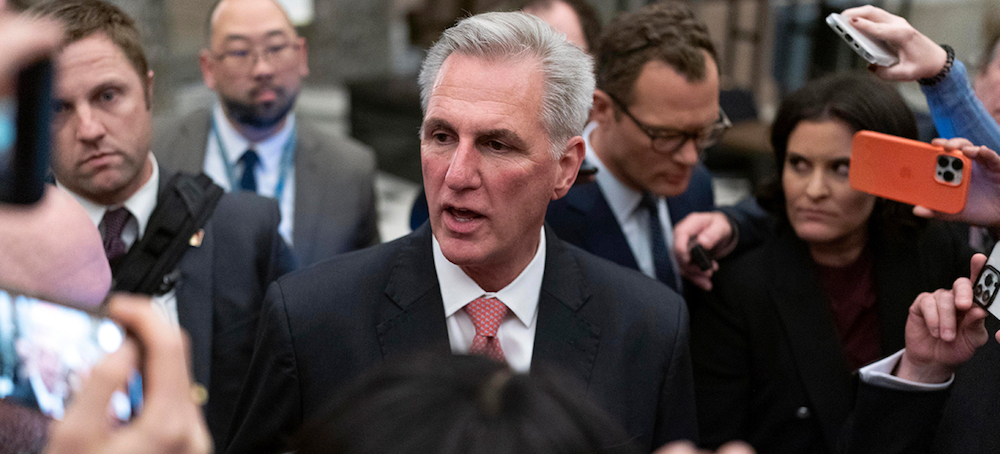
Last month, House Republicans passed debt ceiling legislation proposed by Speaker Kevin McCarthy (R-CA) that would massively cut government spending on social safety net programs — including Medicaid, food stamps, and cash assistance, known as Temporary Assistance to Needy Families (TANF).
The proposal would subject most Medicaid recipients between the ages of nineteen and fifty-five without dependent children to a work requirement, forcing them to work for at least eighty hours a month or earn a minimum monthly salary to remain eligible. The new requirements likely would cause millions of low-income Americans to lose Medicaid coverage.
The plan would also expand food stamp and TANF work requirements to adults aged forty-nine to fifty-five, which could kick one million people off the food assistance program and more than half a million families off cash assistance.
Study after study has shown that work requirements haveno impact on long-term employment outcomes, but they do kick eligible people out of social programs due to administrative burdens and make them poorer.
“When we talk about work requirements, remember, we want to take people from poverty to jobs,” McCarthy told reporters on Monday, adding: “I don’t think it’s right that we borrow money from China to pay somebody that has no dependents, [is] able-bodied, to sit on a couch. What we find is people become more productive.”
McCarthy’s work requirement proposal and his gripes about dependency come straight from the Foundation for Government Accountability (FGA), a conservative think tank that recently made headlines for helping secretly draft several state bills to roll back child labor laws.
One such bill in Iowa would allow fourteen-year-old kids to “perform non-incidental work in meat freezers” and fifteen-year-olds to perform “light assembly work as long as the assembly is not performed on machines or in an area with machines,” NBC News reported. The bill, which has not yet been signed by the governor, “appears to violate” federal labor laws, according to Labor Department officials.
“Work requirements will help get Americans out of dependency and back to work, preserving resources for the truly needy,” said the FGA’s president and CEO, Tarren Bragdon, when House Republicans introduced their debt ceiling proposal. “There has never been a better time to get able-bodied adults back into the workforce.”
Bragdon, a former Maine state legislator, founded the organization in 2011 during the Tea Party’s austerity push as part of the last major debt ceiling standoff, when Republicans demanded significant spending cuts.
One week before Republicans released their current debt ceiling proposal, the FGA released new polling in favor of work requirements. On April 11, the FGA’s polling arm published data showing that more than 70 percent of likely voters support expanded work requirements for cash welfare benefits and food stamps, as well as new work requirements on Medicaid.
The following week, McCarthy proposed expanding work requirements for food stamps and TANF, and imposing new work requirements on Medicaid in his debt ceiling package.
The FGA then put out a white paper claiming that “House Republicans’ proposal for Medicaid and food stamp work requirements will increase the labor force and boost the national economy,” on the basis that “moving just four million able-bodied adults from welfare to work would increase real GDP by an estimated $149 billion.”
Lobbying records show the FGA’s advocacy arm, the Opportunity Solutions Project, started lobbying Congress on work requirements in 2017. In the first quarter of 2023, the group spent $130,000 on lobbying, including on food stamp reform, work requirements, and TANF, according to federal records reviewed by the Lever.
The FGA and its advocacy arm have been bankrolled by right-wing groups in the dark money network built by conservative Supreme Court architect Leonard Leo, and also receive huge money from the family foundation of cardboard box magnate and conservative megadonor Dick Uihlein.
Between 2019 and 2021, Leo’snetworkcontributed nearly $4 million to the FGA and its advocacy arm, according to tax records reviewed by the Lever.
Uihlein’s foundation has contributed nearly $18 million to the FGA since 2014, according to data from the Center for Media and Democracy.
Other major donors to the FGA have included the billionaire Scaife family, heirs to the Mellon aluminum and banking fortune, and DonorsTrust, a donor-advised fund — or pass-through vehicle — long known as conservatives’ “dark money ATM.” (Leo’s network donated $71 million to DonorsTrust in 2021.)
In 2018, the FGA was behind a GOP push to attach work requirements to food stamps — which was passed by House Republicans but failed in the Senate. “Political observers said the inclusion of proposed changes to food stamps was testimony to the FGA’s growing influence in key Republican circles,” the Washington Post reported.
More recently, the FGA and its affiliates have crusaded to eliminate the temporary augmentation of social safety net programs enacted by congressional COVID relief bills — like expanded child tax credits, unemployment benefits, and food stamps.
The FGA noted in its 2021 annual report that it had “leveraged our relationships with governors to help states opt out of the $300 unemployment bonus and build momentum for this federal program to end in September 2021.”
The organization wrote that it had also “capitalized on our work in West Virginia and connections with Sen. Joe Manchin to show 1) the effectiveness of work requirements and 2) how the expanded child tax credit caused dependency, supply chain issues, and inflation problems.”
Manchin, a coal baron turned corporate Democratic senator for West Virginia, reportedly complained to his colleagues that lazy parents would use their expanded child tax credit payments to buy drugs, and demanded that it include a work requirement, before blocking its reauthorization altogether.
Census research found that the expanded child tax credit lifted nearly three million children out of poverty, though temporarily.
This spring, the FGA’s Opportunity Solutions Project was the only group backing legislation in Maine to add work requirements to Medicaid. The FGA also pushed to restart Medicaid redeterminations, or administrative checks on beneficiaries’ eligibility, which often result in people wrongfully losing coverage because they miss a piece of mail. Redeterminations were temporarily paused during the pandemic, but the federal government recently allowed states to start conducting them again.
The family is calling for the officer to be fired and charged.
The family of an unarmed 11-year-old Black boy from Mississippi who was shot in the chest by a cop over the weekend is calling for the officer to be fired and criminally charged.
Aderrien Murry was following his mother’s instructions by calling 911 in response to a domestic disturbance in the early morning hours of May 20, his mother Nakala Murry told reporters.
The Indianola officer who responded came to the door with his gun drawn, Murry said, and instructed everyone in the home to come outside. She said when Aderrien came around a hallway corner, the cop shot him.
“He kept asking, ‘Why did he shoot me? What did I do wrong?’” she said.
According to the Mississippi Bureau of Investigation, which is investigating the shooting, Aderrien “received significant injuries.” Murry said her son had a collapsed lung, fractured ribs and a lacerated liver and was placed on a ventilator.
Murry’s lawyer Carlos Moore tweeted that the officer who shot Murry, Greg Capers, has been placed on administrative leave. Moore said the family wants him to be fired and charged.
“No child in Indianola should be in this terrifying condition because of the actions of someone who’s allegedly the best cop in Indianola,” Moore said in a press conference. “If he’s your best, Indianola, you need to clean house.”
Indianola police did not comment on the case when reached by VICE News.
According to Mississippi Today, Moore is calling for Capers to be charged with attempted murder and for Police Chief Ronald Sampson to be fired. He’s also calling for body camera footage from the incident to be released. Moore and Murry’s supporters planned a sit-in at Indianola City Hall for Thursday morning
The Mississippi Bureau of Investigation said it is currently gathering evidence.
“Upon completing the investigation, agents will share their findings with the Attorney General’s Office” the agency said in a press release.
Moore told Mississippi Today Capers had previously tased a man in handcuffs in December.
In addition to lacking health insurance, DACA recipients cited fears around costs and immigration status as barriers, a report first shared with NBC News found.
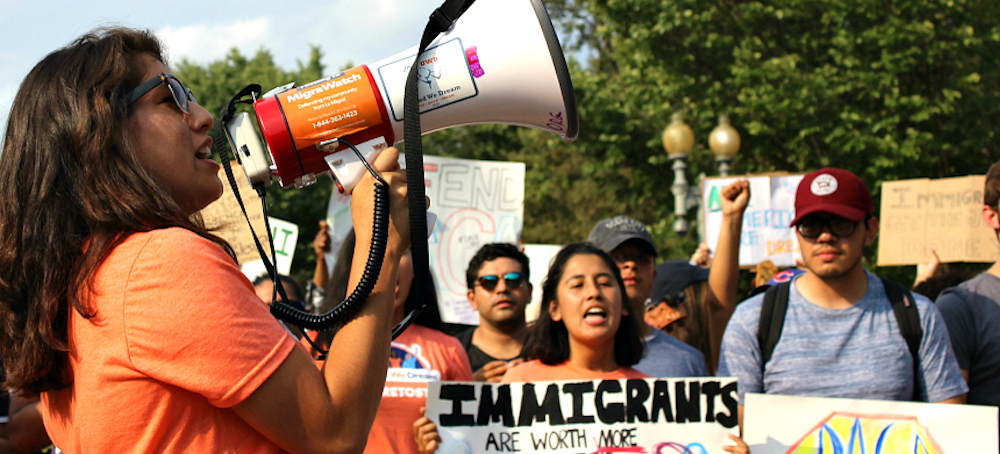
More than a quarter of young immigrants protected by the Deferred Action for Childhood Arrivals program lack health insurance and face burdens preventing them from accessing care, according to new data first shared with NBC News.
A report published Friday by the immigrant rights nonprofit group National Immigration Law Center, documenting the findings of a recent survey, finds that 27% of DACA recipients reported not being covered by any kind of health insurance or other health care plan.
The results suggest that of the more than 580,000 young adults without legal status who are allowed to work and study without fear of deportation under the Obama-era DACA program, almost 157,000 are estimated to be uninsured.
The survey was conducted last year with 817 DACA recipients. It was administered by Tom K. Wong, founding director of the U.S. Immigration Policy Center at the University of California, San Diego, with the help of United We Dream, the nation’s largest immigrant youth-led organization, the Center for American Progress policy institute and the National Immigration Law Center.
A previous version of the survey conducted in 2021 found the DACA uninsured rate to be at 34%. Kica Matos, president of the National Immigration Law Center, attributed the slight dip to "a healthier economic climate."
"The last survey was done when we were still in the middle of the pandemic, so we believe that economic trends have since improved ... This likely means there are more DACA recipients that are employed and therefore have access to health care" through their employers, she said.
Of the DACA recipients who reported having health insurance, 80% said they were covered through an employer or union.
But unlike most in America, if DACA recipients lose their job and with that their health insurance, they can’t fall back on federal health insurance programs, which are often more affordable but are only available to those with legal immigration status.
Because being ineligible for federal health insurance contributes to DACA recipients' high uninsurance rate, the Department of Health and Human Services under President Joe Biden proposed a rule that would expand access to health care coverage to them. Research has found that DACA recipients contributed an estimated $6.2 billion in federal taxes every year that help fund such programs.
The Biden proposal calls for the definition of “lawful presence” to be amended to include DACA recipients for purposes of Medicaid and Affordable Care Act coverage.
“It brings up a lot of hope for many of us to be able to have affordable health care access because a lot of the times we avoid going to a doctor,” DACA recipient Diana Avila said. “The thought of how much is it going to cost is what drives a lot of us to not want to go to the doctor.”
The proposed Biden rule hasn't yet been finalized, meaning that DACA recipients’ access to federal health insurance programs is not yet a done deal.
In response to an email from NBC News, the Centers for Medicare and Medicaid Services, which submitted the proposed rule, stated that, “While we cannot speculate on when the rule will be finalized, note that the proposed rule includes a proposed effective date for all provisions of November 1, 2023."
The CMS will be requesting comment from the public until June 23 on the proposed regulations, “and specifically on the feasibility of this date and whether to consider a different effective date," it stated.
Avila, 22, was born in Honduras and has lived in Indiana since she was a 4-year-old, and was 12 when she got DACA in 2012.
Obstacles to health care access
DACA recipients are awaiting the fate of the proposed rule at a time when they are three times more likely to be uninsured than the general population, according to last year's survey.
"There are still significant disparities in terms of access to health care for this particular population," Matos said.
According to the survey, DACA recipients reported other barriers to accessing health care:
57% of respondents believed they were ineligible to access care due to their immigration status.
51% reported not being aware of any affordable care or coverage options available to them.
21% believed that accessing health care services could negatively affect their immigration status or that of a family member.
Of those surveyed, 71% reported past situations in which they were unable to pay medical bills or expenses.
On top of that, "there are also those memories of families not being able to afford health care and having to deal with bills," Matos added.
Avila remembers growing up in a mixed immigration status family. That meant she and her oldest sibling couldn't access affordable health care while her younger siblings, who were born in the U.S., qualified for care.
As a child, Avila was prone to ear infections, she said. Her mother would use every home remedy possible to evade doctors and hospitals and avoid unaffordable medical costs. In contrast, her younger brothers would go to the doctor more often, even for the most minor of issues.
When Avila was 18, she suffered a concussion while playing soccer at school and needed to visit a specialist. She recalled hesitating to go because she was worried about her and her family's ability to afford the care.
"It's sad to think about that. I considered not getting looked at, taken care of, because of how much it was going to cost," she said.
DACA's uncertainty — and the mental health toll
While DACA has been around for a decade, it's faced legal challenges from the Trump administration and Republican-led states. The program has been closed to new registrants since July 2021 while a lawsuit filed by Texas and other GOP-led states makes its way through the courts.
To improve the chances that DACA will survive legal battles, the Biden administration implemented a rule in October that turned the program into a federal regulation. A federal judge in Texas is expected to rule on the legality of the new rule this year.
"The precarious nature of DACA has brought with it feelings of anxiety, depression and fear related to the future of their status because it's so uncertain," Matos said of DACA recipients.
The new report found that almost half (48%) of DACA recipients who reported experiencing mental or behavioral health issues did not seek care from a mental health professional. The three main barriers were expensive costs, lack of time and limited access to providers able to meet their cultural or language needs.
Avila recently graduated from Marian University in Indianapolis with a degree in psychology and works at a nonprofit organization that serves immigrants.
Despite the uncertainty surrounding DACA, she plans to apply to law school and specialize in immigration law and human rights, hoping that a more permanent solution to her immigration status emerges.
"DACA recipients contribute so much to society that it's time for change," Avila said. "A pathway to citizenship would be the best way to appreciate the work that DACA recipients have been doing since they came to the U.S."
Campaigners take legal route after success against big tobacco and other industries led to change
As America’s gun crisis shows no sign of abating, there is some hope for reducing the number of mass shootings and killings. The emerging wave of lawsuits against gun makers echoes previous successes against the car industry, opioid companies and big tobacco.
In New York, California, Delaware and other states, new laws aim to provide ways around a near 20-year immunity provided to gun manufacturers and distributors. In Indiana, a lawsuit brought by victims of the 2021 mass shooting at a FedEx facility aims to hold a gun manufacturer accountable for the horror wrought by one of its weapons.
Lawsuits like the Indianapolis action, brought by two survivors of the shooting and the family of a man killed, broadly argue that gun manufacturers, gun sellers and gun distributors bear responsibility for gun crimes because of the way they design, market and distribute their products and there is evidence the litigation could work to combat gun violence.
The arguments are similar to some of those brought against car, opioid, asbestos and tobacco industries in recent decades, which led to companies acknowledging the danger of their products and pushed them toward more responsible practices.
Those lawsuits exposed the true extent to which company executives were aware of the harmfulness of their products. Huge financial penalties were imposed which eventually compelled more responsible behavior.
The door was effectively opened for gun litigation last year, when the families of five adults and four children killed in the 2012 Sandy Hook school shooting settled with Remington, which manufactured the AR-15 style rifle used in the massacre, for $73m.
The families argued that Remington had violated a Connecticut trade law by irresponsibly marketing its AR-15 Bushmaster rifle to young, high-risk males, through militaristic marketing campaigns and first-person shooter video games – a similar tactic is seen in the Indianapolis lawsuit.
“Definitely reasonable gun laws need to be passed,” said Philip Bangle, a lawyer representing the FedEx shooting victims.
“[But] that’s a policy issue and that is a different avenue. What we’re trying to do through litigation is just encourage responsible conduct, and make it beneficial for gun manufacturers and dealers to start implementing responsible conduct.”
Lawsuits against gun companies have become rare but in the 1990s a number of them were sued by individuals affected by gun violence and by cities seeing the impact of firearms in neighborhoods.
By 2000 more than 30 cities, and the state of New York, were suing the gun industry, seeking damages and improved gun safety standards.
But that avenue soon closed. Rather than improve their standards, the gun industry, including the National Rifle Association, lobbied hard for protection from such litigation.
That led to the 2005 Protection of Lawful Commerce in Arms Act (PLCAA), which effectively granted gun manufacturers and sellers immunity from lawsuits related to harm “resulting from the criminal or unlawful misuse” of guns.
Unlike other industries, the gun industry was now largely free to act as it chose.
“It would be like if the car industry didn’t have any safety features and then thought that they had this cloak of immunity around them, like the gun industry thinks they do, and just started making things like tanks. Or Formula 1 cars that would fly through the streets,” Bangle said.
“It’s not just acting irresponsibly, like: “We’re selling products, we’re going to make a profit and now we’re going to face some responsibilities so we’re going to make changes’”. It’s: ‘We’re selling a product and now we’ve got a free pass to act anyway we want to make the profit as large as we can.’”
In the last decades, some states have begun to push back against the gun industry’s immunity. PLCAA allows some exceptions for lawsuits when state laws are broken and states including New York and California have used that to allow legal action to proceed.
New York passed a law in 2021 that allows firearm sellers, manufacturers and distributors to be sued by the state, cities or individuals for creating a “public nuisance” that endangers the public’s safety and health. Late last year, Buffalo, New York, took advantage of the new law when it sued gun companies including Beretta, Smith & Wesson, Glock, Remington and Bushmaster “for their conduct in fueling gun violence in the City of Buffalo”.
In April the state of Washington passed a law which similarly cleared the way for lawsuits against gun makers and sellers, while a California law passed in 2022 requires that gun manufacturers adhere to state standards for the safety and marketing of their products, opening the way for lawsuits.
Gun lobbyists are already challenging those laws, and the immunity of gun companies could ultimately end up in the US supreme court. But even if litigation is unsuccessful, it can be beneficial.
Timothy Lytton, distinguished professor at Georgia State University College of Law and editor of the book Suing the Gun Industry: A Battle at the Crossroads of Gun Control and Mass Torts, said litigation can help to push the issue of gun violence to the front of the public’s minds and also “reframe” the discussion of America’s gun crisis.
“Instead of focusing a lot of attention on the criminal shooters or mental health issues this litigation has focused attention on gun manufacturers, in terms of their design decisions, their distribution decisions and their marketing strategies,” Lytton said.
In addition, the litigation process itself could help to expose any egregious or cynical business decisions made by gun manufacturers.
“It compels [gun] industry defendants to disclose information that regulators may not have. The civil discovery system is a powerful way to force companies that do not want to disclose proprietary information to disclose that information,” Lytton said.
“That might include decisions about how they think about gun design, who they think their market is, their awareness of siphoning of their products to illegal markets.”
Lytton said there are comparisons between those lawsuits and the impact of lawsuits on the opioid industry. Victims of opioid addiction – both addicts and their families – began to file lawsuits against opioid companies in the 2000s, Lytton said, as did states and local health departments.
They made the same legal arguments that people suing gun companies are using: that the design, marketing and distribution of opioids was having an impact on people in the US.
“We have now seen both verdicts and settlements in the tens of billions of dollars against pharma companies, they have changed the design of these products, they’ve changed their marketing strategies of these products.
“They’ve scaled back distribution and they police their distribution channels of these products. They’ve completely revolutionized the way they do business with regard to opioids and essentially taken responsibility for a large-scale, nationwide crisis in public health.”
The Giffords Law Center, which was founded by Gabby Giffords, a former Arizona congresswoman who was shot in the head in a shooting that killed six people in 2011, is among the groups that has worked with shooting victims and states to enhance people’s ability to sue the gun industry.
“Guns are the only consumer product that’s not regulated,” said Adam Skaggs, chief counsel and vice-president at the Giffords Law Center.
“Folks that are trying to treat the gun industry just like any other industry. They’re not trying to single it out for special negative treatment or to impose higher standards on the gun industry than any other industry,” Skaggs said.
“There’s simply an effort to say: guns are a product, like cars, like medicine, like cigarettes, and we should have the same tools at our disposal to confront abuses within that industry.”
There is a long way to go, but if lawsuits can have the same impact as litigation against opioid companies, it could be a great leap toward creating something approaching safer gun use in the US.
“People are losing their lives at the same time that the industry is cashing in record-breaking profits. And so these cases are incredibly important,” Skaggs said.
“It’s important that lawsuits achieve judgments, that they win punitive damages awards against companies that are established to be engaging in unlawful and unethical business practices. Because it’s that financial incentive that leads companies to change their behavior,” he said.
“But it’s also important that these lawsuits are used to shine a light on the business practices and the decisions that these companies have made.”
Guatemalan police arrested the country’s prosecutor for crimes against migrants Friday, accusing him of alleged abuse of authority.
Stuardo Campos was formerly an anti-corruption prosecutor in the country during the administration of former President Jimmy Morales. It was not immediately clear whether the accusations pertain to his current position or the former.
The complaint against Campos was made by the far-right Foundation Against Terrorism, a group that started out defending military officers accused of war crimes, but has also targeted members of the justice system who worked corruption cases.
“This complaint is spurious,” Campos said. “I know that my work as an anti-corruption prosecutor earned me animosity in a lot of sectors.”
Campos was known for an investigation related to a government highway project during the Morales administration. A number of officials from that administration were arrested when repeated landslides and other problems were blamed on poor construction.
In recent years, a number of prosecutors and judges who handled anti-corruption cases have been investigated and charged. Many of them have fled the country to avoid prosecution by an Attorney General’s office the United States government and others have accused seeking revenge against members of the justice system.
More recently, as the lead prosecutor of migrant crimes, Campos was credited with dismantling migrant smuggling rings and oversaw the first extradition of Guatemalans to the U.S. accused of migrant smuggling.
Industries ranging from animal agriculture to mining to fossil fuel rallied in support of the Idaho couple behind Sackett v. EPA.
The vast majority of wetlands in the United States — more than 100 million acres — are no longer protected by the Clean Water Act, the Supreme Court ruled yesterday in Sackett v. EPA. Wetlands are critically important to clean drinking water and flood mitigation; they’re also effective at sequestering carbon and a boon to drought resilience, storing water during dry periods. But in a 5-4 vote, the Supreme Court brushed off peer-reviewed science and plain old common sense that you can’t protect the water downstream, which even the majority agreed is covered by the law, if you’re polluting it upstream.
The case was filed by a wealthy Idaho couple, Michael and Chantell Sackett, who were annoyed that they were required to get a special permit from the Environmental Protection Agency to build on their land because of its proximity to Priest Lake. The Sacketts’ land contains wetlands, but because the wetlands are separated from the lake by a road, they argued the permit was unnecessary. It’s almost certain they would have gotten the permit had they applied, but they opted to sue instead. The court took the Sacketts’ case as an opportunity to open up a broader discussion about what exactly the Clean Water Act is meant to protect, changing the law completely and removing protections from any wetland not immediately connected to a body of water.
Even Justice Brett Kavanaugh, who broke with his conservative colleagues, accused the majority of having effectively “rewritten” the Clean Water Act, which was originally passed in 1972 and updated in 1977.
“Since 1977, when Congress explicitly included ‘adjacent’ wetlands within the act’s coverage, the Army Corps has adopted a variety of interpretations of its authority over those wetlands — some more expansive and others less expansive,” Kavanaugh wrote. “But throughout those 45 years and across all eight presidential administrations, the Army Corps has always included in the definition of ‘adjacent wetlands’ not only wetlands adjoining covered waters but also those wetlands that are separated from covered waters by a man-made dike or barrier, natural river berm, beach dune, or the like.”
In the majority opinion, written by Justice Samuel Alito, the court applied a new interpretation of the word “adjacent,” removing protections for any wetlands that are not immediately adjoining lakes, streams, rivers, or oceans, which will have a profound impact on coastal communities around the country. “Wetlands are essential for protecting disadvantaged communities, which are often in low-lying areas, from flooding,” Nick Torrey, senior attorney with the Southern Environmental Law Center, said. Torrey added that wetlands are also critical to the many fishing businesses in the southeast, where he practices. “We have a saying: No wetlands, no seafood,” he said.
“The court’s approach today was to disregard several decades’ worth of precedent interpreting the Clean Water Act,” Sam Sankar, senior vice president at Earthjustice, said. For the past 40 years, the court has interpreted the word “adjacent” to mean what it does to everyone else; in this ruling, five justices said “well actually” adjacent means adjoining, so if there is anything in between a wetland and the water, that wetland doesn’t need to be protected.
It’s not a decision underpinned by science, but rather a legal invention known as the “clear statement rule,” a term the justices use when they want to assert their power to ignore Congress’s wishes and interpret the law solely as written. “The court is increasingly using the clear statement rule to narrow laws written years ago by Congresses that sought to create environmental protections like the Clean Water Act,” Sankar said.
In her dissent, Justice Elena Kagan wrote that the majority used the clear statement rule as a “thumb on the scale for property owners — no matter that the Clean Water Act is all about stopping property owners from polluting.” Referring to conservative justices’ reliance on the rule to weaken environmental regulations, Kagan added, “These pop-up ‘clear statement’ rules give the court a way to cabin the anti-pollution actions Congress thought appropriate by appointing itself as the national decision-maker on environmental policy.”
The clear statement rule is a close cousin of the “major questions doctrine,” another bit of legalcraft that the court has increasingly used to gut regulations on industry. “The Supreme Court maybe invoked it only five times in its whole history before 2021, in cases that were actually quite exceptional,” Richard Revesz, dean emeritus at New York University School of Law and administrator of information and regulatory affairs at the U.S. Office of Management and Budget, said. “But in the last couple of years, it’s a doctrine that’s been invoked promiscuously by opponents of regulation and the court has shown great interest in embracing it. It basically says if an agency decision is going to have vast economic or political significance, it needs to be authorized explicitly by Congress.”
The court invoked the major questions doctrine last year in West Virginia v. EPA to curtail the EPA’s ability to regulate greenhouse gas emissions from power plants. Now in Sackett v. EPA, it has invoked the clear statement rule to apply a narrower interpretation of the Clean Water Act than Congress intended. It’s an interpretation that benefits not only the wealthy couple who brought the case, but also polluting industries. “Mining, oil and gas, development, anyone that pollutes, and a whole lot of them joined or sent in separate briefs in support of the Sacketts,” Jon Devine, director of federal water policy for the Natural Resources Defense Council, said.
According to Sankar, the ruling represents an end run around the legislative process; these interests have been trying to weaken the Clean Water Act for years. “This ruling is the result of a decades-long push by many of these industries,” he said. “They couldn’t cut back on the Clean Water Act by persuading Congress. They tried and failed. … But they succeeded in building a judiciary willing to take this kind of action to rewrite the laws when they’re not able to do so legislatively. What the court has done is rewrite the law in an extraordinarily aggressive way, going beyond even what the Trump administration would have done.”
The Trump administration’s proposed “Waters of the United States” rule would have stripped protection from about half as many wetlands as the Supreme Court’s Sackett ruling did.
In the wake of the decision, environmental advocates are calling on Congress to make explicit that these wetlands are covered by the Clean Water Act. “The court has spoken and now we need to look at ways to restore these protections,” Jim Murphy, director of legal advocacy for the National Wildlife Federation, said. “The primary way is to go back to Congress and have them make clear through legislation that these protections are in place as they were intended to be.”
Murphy said that shouldn’t be a hard sell, as clean water tends to be popular with voters. “Seventy-five percent or so of Americans support strengthening the Clean Water Act across the board,” he said.
States can also act to safeguard wetlands within their borders, thus protecting clean drinking water and improving flood protection for residents. “States are already authorized by federal law to protect more than the limited number of wetlands that the Supreme Court now allows,” Devine said. But nearly half of U.S. states have opted instead to follow the Clean Water Act, so wetlands that are no longer protected due to the Sackett ruling are not protected by those state governments either. Those laws can be changed, but it will take time. “We’re going to need to engage in that fight,” Devine said. “We can’t take as acceptable the gross loss that this opinion would allow.”