Showing posts with label SACRIFICE ZONES. Show all posts

Sunday, September 3, 2023

‘Death Stars on Sinking Land’: How Liquefied Natural Gas Took Over the Gulf Coast


‘Death Stars on Sinking Land’: How Liquefied Natural Gas Took Over the Gulf Coast

Lylla Younes and Jake Bittle/Grist


‘Death Stars on Sinking Land’: How Liquefied Natural Gas Took Over the Gulf CoastNatural gas and the Gulf Coast. (photo: Grist/Mia Torres)

The U.S. is now the world's top exporter of LNG. Towns in southern Louisiana are paying the price.

To visit the country’s newest hub for exporting liquefied gas to Europe, follow the Mississippi River southeast from New Orleans, past the recently shuttered Phillips 66 refinery in Alliance and deeper into Plaquemines Parish, a ribbon of land that flanks the lower Mississippi River before dropping off into the Gulf of Mexico. There, strip malls and highways give way to wide expanses of cypress and low marshes that are home to white-tailed deer, alligators, and pelicans. The border between land and water, solid ground and swamp, seems to dissolve. In this part of the Louisiana coast, most exit roads lead over levees and into wetlands traversed by local fishermen and pipeline workers. You’ll pass small fishing hamlets, clusters of trailers lining bayous, and carcasses of old houses.

Towering over this patchwork of lowland and swamp is a massive liquefied natural gas export terminal owned by the Virginia-based Venture Global LNG, one of three in Louisiana. Built on 630 acres of former swampland, an area larger than New Orleans’ French Quarter, the facility known as Plaquemines LNG extends along more than a mile of the Mississippi River. It encompasses thousands of feet of coiled steel pipes for supercooling gas, 130-foot cylindrical storage tanks, and flare stacks that expel tall, airborne flames while the plant operates. At a break in the levee wall that surrounds the property, a sign warns of the hazards inside: “WORK THE PLAN. DON’T RUSH. GET HOME SAFE.” A large metal pipe extends out of the facility and over the highway, bound for the river.

Venture Global’s terminal in Plaquemines Parish will cool natural gas down to its liquid form so it can be loaded onto ships and exported around the world. When the facility becomes operational in 2025, tanker ships will be able to plug into it and offload more than 25 million tons of natural gas each year, enough to power more than 15 million homes over the same period. The opening will represent a triumph for gas drillers that have sought to sell more of their product abroad and for President Joe Biden, who has championed American gas exports to ensure “the reliable supply of global energy” as Europe weans itself off gas imported from Russia following that country’s invasion of Ukraine.

In the 18 months since construction on Plaquemines LNG began, Venture Global has transformed the lives of people who have lived in the 23,000-person parish for generations. The streets around the plant became choked with truck traffic, the marsh threaded with pipelines, and the quiet was replaced with the din of construction. Acres of wetland disappeared beneath concrete. The broad ocean skyline of the parish vanished behind a maze of steel. And Venture Global is already working on another plant in the parish, known as Delta LNG.

“I said it would never happen, then you wake up and here it is,” said Henry McAnespy, a fisherman who grew up in the parish and lives down the road from the project. He described the roar of pipeline workers’ airboats at 6 a.m. each morning and the light pollution from the company’s round-the-clock construction. “I live in a place that never gets dark no more.”

Emboldened by a surge in global demand for natural gas, a small group of companies rushed to build an industry along the Gulf Coast, from the southern tip of Texas to southeastern Louisiana, carving up thousands of acres of vulnerable shoreline to clear the way for massive plants and send American fossil fuels overseas. Liquefaction terminals are among the most complex industrial facilities in existence, with footprints that rival those of the largest chemical plants and oil refineries; the first to open — Cheniere Energy’s plant in southwest Louisiana — encompassed an area the size of nearly 700 football fields.

Building them often requires dredging through shorelines and wetlands to build loading docks and lay hundreds of miles of pipelines. Seven of these facilities have started up in the continental United States in as many years, and at least two dozen more are in various stages of planning and construction along the Gulf Coast. A decade ago, the United States had never exported LNG, but earlier this year it became the world’s top exporter of the fuel, surpassing the gas-rich nation of Qatar.

The growth of the LNG industry in the United States has reordered world markets, offering a new energy source to Europe and Asia even as gas exports drive up domestic energy prices. But it’s on the Gulf Coast, and in particular on the rural fringes of the Louisiana coast, that the consequences of the boom have been most visible. Grist reviewed dozens of state and federal records and found that in their haste to greenlight new terminals, regulators are exposing residents of coastal parishes to new and dangerous sources of air pollution from flares and leaks. Louisiana environmental regulators recently cited numerous violations at Venture Global’s LNG terminal in Cameron Parish, but has allowed the company’s project near McAnespy’s home in Plaquemines, on the other side of the state, to move forward. And as gas exporters build their plants on eroding swampland, they are increasing the risk of catastrophic accidents and explosions during floods and hurricanes. People like McAnespy, who live in neighborhoods surrounding the terminals, are right in the blast zone.

“It’s not just that each of these facilities is like a giant death star on sinking land, it’s that there’s so many of them,” said Elizabeth Calderon, a senior attorney at the environmental nonprofit Earthjustice who has worked on cases challenging LNG terminals in south Louisiana. “This is how sacrifice zones are created.”

When John Allaire bought his 300-acre property along the Gulf of Mexico in the 1990s, the southwest coast of Louisiana was a very different place. There was no industry in sight, just wide expanses of wild grasses and wetlands leading to belts of oak trees, known as cheniers, that lined the sandy shore near the Texas state line. Since then, coastal erosion has wiped away almost all those old growth forests, and much of the landscape has been cleared for the construction of new LNG terminals like the one Venture Global built near the border of his property.

Allaire lives in Cameron Parish, a once sleepy area dotted with fishing hamlets that has transformed over the last decade into one of the world’s most important hubs for exporting natural gas. Three terminals currently operate in the 5,000-person parish; another seven are on the way. If Cameron Parish is where gas companies go to set up shop, carving out pipeline networks and erecting massive liquefaction terminals, then the city of Lake Charles an hour to the north is where they broker business deals. Long a site of petrochemical development and its accompanying pollution, Lake Charles is trying to capitalize off the prime coastal real estate to its south, with local politicians luring gas executives from Germany to Japan with events like the so-called “Americas LNG … Gas Summit … Exhibition,” which they’ve hosted two years in a row at the Golden Nugget Hotel and Casino.

Local officials have celebrated the announcement of every new LNG development in the area, calling the industry a boon for economic growth and employment. Some residents like Allaire have a different perspective. As soon as the Venture Global terminal known as Calcasieu Pass began operating near his home in early 2022, Allaire witnessed a string of problems.

“Right away you had black smoke, alarms going off at the plant, and flares going constantly,” he said.

Liquefying gas is a dirty process. Terminals like Calcasieu Pass operate nearly around the clock, sucking in gas from a national network of pipelines and liquefying it so it can be loaded onto ships. When there’s too much gas backed up in the pipes, or when other refrigerant chemicals start to build up, the company prevents explosions by burning off gas, which sends orange flames shooting into the sky from the company’s flare towers.

As a former oil and gas engineer, Allaire knows that a certain level of flaring is to be expected when workers attempt to control pressure variations within their equipment, but too much flaring can be a sign of larger problems. Flaring releases a cocktail of pollutants like carbon monoxide, black carbon, and volatile organic compounds like benzene and formaldehyde. These chemicals are especially dangerous for vulnerable people like pregnant women, whose odds of having a premature birth can double from regular exposure to pollution from flares.

Soon after Calcasieu Pass was up and running last year, Allaire began photographing the flares, which often burned throughout the day and into the night. His kitchen table is now littered with printouts of these timestamped images, which, added together, reveal the frequency of the plant’s mishaps. A report by the Louisiana Bucket Brigade, an environmental nonprofit, found that the facility violated the Clean Air Act by exceeding the pollution thresholds specified in its permit more than 2,000 times last year, according to the facility’s own records reviewed by Grist. This flaring led to the release of numerous chemicals, including between 19,000 and 37,000 pounds of nitrogen dioxide, a greenhouse gas that has been linked to chronic lung disease.

Despite these violations at Venture Global’s first terminal in the state, the Louisiana Department of Environmental Quality has signed off on the construction of Venture Global’s second facility in Plaquemines Parish, which the company itself describes as “technologically identical” to the first one near Allaire’s home in southwest Louisiana.

“Talk about an experiment,” Calderon of Earthjustice said of Venture Global’s two newest enterprises. “They want to be allowed to emit air pollution at the levels of their failed engineering rather than at the levels they promised.”

Last month, in a rare move, the same state agency issued a compliance order against Venture Global for “preventable” and “unauthorized” violations at Calcasieu Pass. In the order, regulators detailed the company’s “failure to timely report” its emissions and alleged that it misrepresented the extent to which its equipment had malfunctioned.

Neither the Louisiana Department of Environmental Quality nor Venture Global responded to multiple requests for comment on the company’s permit violations or any other details in this story. In a written response to the department, Venture Global’s lawyers said they will likely dispute certain portions of the order.

Flaring is just one of multiple ways that LNG terminals release toxic chemicals into their surroundings. Supercooling natural gas until it becomes a liquid at minus 260 degrees Fahrenheit relies on engines known as turbines that burn fuel to produce massive amounts of electricity. The turbines at Calcasieu Pass near Allaire’s house have a generation capacity of 720 megawatts, enough to power more than 500,000 homes at once.

The Environmental Protection Agency considers gas turbines major sources of toxic air pollution, since the combustion process releases a slew of cancer-causing chemicals such as benzene and formaldehyde. That pollution can travel dozens of miles away, diminishing air quality in more densely populated inland areas like Lake Charles. What’s more, enforcement records from the Louisiana Department of Environmental Quality indicate that these machines are prone to malfunctions, sometimes for long stretches of time. Last year, three gas turbines at Calcasieu Pass failed repeatedly over two straight months, emitting thousands of pounds of pollutants into the air.

Emissions from LNG terminals across Louisiana and Texas are putting an outsize burden on lower-income neighborhoods. In Cameron Parish where Allaire lives, the median income is $64,000, but more than 14 percent of people are below the federal poverty line, $30,000 for a family of four. A federal analysis of the Venture Global plant in Plaquemines found that two-thirds of residents in a census block near the terminal live below the poverty line.

Advocates see the LNG buildout as part of a larger industrial expansion that has also disproportionately affected Black people. The cluster of terminals in Cameron Parish is just south of Lake Charles, where nearly half of all residents are Black. There, emissions from LNG terminals are compounded by already high pollution levels drifting in from the nearby town of Westlake, where a maze of chemical complexes emits thousands of pounds of cancer-causing chemicals such as vinyl chloride and 1,3-butadiene every year, causing the air to smell like burnt plastic.

“Our children are dying from asthma,” said Roishetta Sibley Ozane, an activist from Lake Charles who runs the Vessel Project of Louisiana, a local environmental organization. “People have cancer. And yet these industries are allowed to pollute and emit all of this right in our community and nothing is being done about it because it’s going under the radar.”

In a petition sent to the EPA in late May, seven environmental organizations from the Gulf Coast, including Ozane’s, alleged that regulators in Louisiana and Texas are illegally granting permits to oil and gas companies, including LNG operators such as Venture Global. The petition charged that in giving them permits to build new infrastructure without first requiring them to demonstrate through modeling that their facilities will be in compliance with the law, Louisiana has violated the federal Clean Air Act, which prohibits granting a company a permit that will “cause or contribute” to a violation of federal air quality standards. The organizations sent a separate civil rights complaint to the agency in June, arguing that allowing the industrial buildout discriminates against majority-Black communities in Louisiana like Lake Charles.

Regulators in Louisiana and Texas declined to comment on the petition, and the EPA told Grist that it would not comment on an open civil rights complaint.

Allaire said that he plans to continue documenting Venture Global’s flares, and he worried aloud about a new fight on the horizon. Another company, Houston-based Commonwealth LNG, is about to break ground on an export terminal and pipeline network just over his property line. In 2021, Allaire turned away representatives from Commonwealth who offered to buy his land. He said that he refuses to leave, no matter the offer.

“This is a unique spot, all my kids grew up here,” Allaire said, gazing out his truck’s windshield at the bright green widgeon grass floating on the surface of his pond. “They grew up hunting and fishing and stargazing and campfiring. … It’s not for sale.”

Allaire said that after 40 years working in the oil and gas industry, the year and a half that he’s spent living near an LNG terminal has changed his mind about a few things. When he worked at an oil refinery in the 1980s and 1990s, he wasn’t aware that burning all that fuel would cause carbon to build up in the atmosphere, but now he’s certain about the industry’s impact on the climate. Though natural gas is a less carbon-intensive fuel than oil, burning it for electricity still releases carbon dioxide, and drilling for it can also cause significant leaks of methane, a potent greenhouse gas. Yet the companies building LNG terminals in Cameron Parish are assuming that international demand for the fuel will be robust for decades to come.

“They’re selling it abroad to the highest bidder” with full knowledge of what it’s doing to the planet, Allaire said. He now sees oil as a finite resource, bound to dry up eventually, and believes that the country is going to have to switch to renewables at some point.

“It’s just a question of when,” Allaire said. “How much carbon do we put in the atmosphere hoping that it won’t have catastrophic effects?”

Since Venture Global began constructing its first gas hub in Plaquemines Parish in 2022, Henry McAnespy’s life has changed in numerous ways. A commercial fisherman since high school, the 64-year-old laments the way the company dredged the marsh where he goes fishing to lay 36-inch-wide pipelines. The water pressure in his home, already low after Hurricane Ida damaged the parish’s water system two years ago, is even weaker now; McAnespy and other locals think it’s tied to the company using the limited resource to build its terminal.

But the thing that keeps him up at night is the fear that, at any moment, Venture Global’s mile-wide terminal up the road could explode.

“You don’t have a crystal ball, you can’t tell me what’s going to happen to this plant,” McAnespy said. “I don’t want to live by this and I don’t think any investor would move his family here either.”

Of the five liquefied natural gas terminals in operation on the Gulf Coast, at least four have suffered some kind of leak or blast, whether due to extreme weather or a mechanical malfunction. Multiple incidents at LNG facilities on the Gulf have already demonstrated what happens when supercooled gas escapes from pipelines and storage tanks, underscoring the potential for damage like the kind McAnespy fears.

In early 2018, liquefied gas escaped through a crack in one of the storage tanks at a facility in Cameron Parish owned by Cheniere Energy, a Houston-based corporation that was the first American firm to export LNG. Workers discovered and patched the leak before any explosion occurred, but an investigation by the Pipeline and Hazardous Materials Safety Administration, part of the federal Department of Transportation, revealed other cracks in the tank. The regulator fined Cheniere $2.2 million and ordered the company to stop using two faulty tanks, deeming them “hazardous to life, property, or the environment.”

A year later, during a separate, previously unreported incident at the same facility, a leak of an unidentified substance caused three construction workers to lose consciousness, according to a lawsuit filed by the workers against Cheniere in Texas state court. The three workers were on the job near one of the plant’s giant liquefaction machines when they became “overwhelmed with the odor of gas.”

In an incident report provided to the court, one of the workers recalled that he “started to feel weak and [dizzy]” after smelling a “strong odor of unknown chemicals,” and after that he “didn’t remember anything until [he] arrived at the Port Arthur hospital.” Cheniere said it couldn’t figure out the source of the leak, according to court documents, calling its investigation “inconclusive.” (A judge ruled in Cheniere’s favor on procedural grounds last year, but the workers have since filed for a new trial.)

Leaks and malfunctions like these can also trigger explosions. In June 2022, a thunderous blast shook Freeport LNG’s facility in Freeport, Texas, the second-largest export terminal on the Gulf Coast, rattling the town of 10,000. A malfunction in one of the plant’s pressure valves caused gas to back up in a pipeline and leak out into the air, where it formed a dense “vapor cloud” and then ignited. It took eight months for Freeport LNG to repair the damage from the blast and secure permission from the federal government to export gas again.

It hasn’t happened on the Gulf Coast yet, but experts worry that the liquefaction process could lead to much bigger blasts. The Freeport explosion involved a leak of methane, but export terminals also employ a cocktail of chemicals known as refrigerants to condense gas into a liquid, including ethylene, propane, and hexane. They are all even more explosive than gas itself, which means they would cause larger vapor cloud explosions, perhaps large enough to level entire city blocks.

“We have searched high and low to find this answer of how far people would be affected and no one has been able to tell us,” said Naomi Yoder, a staff scientist at the Gulf Coast-based environmental organization Healthy Gulf who studies LNG terminals. “If they don’t have those answers, then what in the world are we doing building these things?”

Venture Global and other gas exporters have promised jobs in cash-strapped parishes that sometimes fail to provide residents with basic services. Officials in Cameron, for instance, are still working to resume medical treatment at the parish’s only hospital, which was damaged by Hurricane Laura in 2020. And in July, Louisiana’s Governor John Bel Edwards, a Democrat, declared a state of emergency in Plaquemines after saltwater from the Mississippi River began seeping into the drinking water supply. In response, the parish and a state agency handed out 200,000 bottles of water.

Some locals are worried that the new terminals won’t improve these conditions even if they deliver on the promise of more jobs. Supporters of the Plaquemines project say the parish badly needs the 250 jobs and 728 indirect jobs that Venture Global promised to create, since almost the same number of positions were eliminated when the Phillips 66 Alliance Refinery up the road shuttered in 2021. In an effort to lure the company to the parish in 2016, the Louisiana Board of Commerce and Industry awarded Venture Global a 10-year property tax break to build the LNG terminal. That break was worth $83.5 million in the first year of the contract, a sum larger than the parish’s 2022 budget of $75 million. The board recently approved another $29.8 million in payroll tax rebates to the company over 10 years.

McAnespy appreciates the economic benefit of the terminals, but says companies like Venture Global often ignore the residents who live closest to the facilities.

“The plant is a wonderful economic boost, not just to Plaquemines or the state of Louisiana, but worldwide,” McAnespy said. “My concern is that it’s such a big project that they’re imposing their will on us. Have a little respect for us.”

Given the chance, McAnespy said, he’d move 10 miles up the road and away from the plant where he would be more confident that his family could easily evacuate if there was an explosion. McAnespy’s house is likely within the blast radius of the plant’s high-powered liquefaction machines, as well as its massive gas storage tanks.

McAnespy said that Venture Global offered to buy the houses of some people living on the east side of Lake Hermitage Road in Plaquemines Parish, which the company considers to be the outer boundary of its blast radius. But people like him just across the street haven’t heard anything from the company.

“I feel like they should come back here and give me an option to buy me out,” he said. “Do your project, just give me fair market value for my property. I’ll pick up my pieces and go live somewhere else.”

On a bright day in April, Travis Dardar stood with his boot heels in the shallows of Calcasieu Lake, a few miles away from John Allaire’s house, surveying the area where he took his boat out to catch shrimp each spring. The 38-year-old Dardar has been fishing all his life, beginning in his hometown of Isle de Jean Charles, an island community in southeast Louisiana.

“Back then, fishing wasn’t really a choice for me, you know?” Dardar said, eyes shaded under his camo Louisiana State University baseball cap. “It was the kind of lifestyle we grew up in. We had to eat.”

Like other residents of Isle de Jean Charles, Dardar is a member of the United Houma Nation, a state-recognized tribe, and his family had a strong connection to the island. He rebuilt his family home there twice after successive hurricanes ripped through. But after many of his neighbors moved away and his grandfather died, the place didn’t feel like home anymore. Other residents of Isle de Jean Charles were taking part in one of one of the first climate resettlement programs in U.S. history, and Dardar decided it was time for him to leave, too. In 2015, he and his wife and kids moved west to Cameron, where he could still make a living by shrimping, the only way he’d ever known.

Dardar quickly got used to life in Cameron, a fishing community just like Isle de Jean Charles. But then came the LNG terminals, one after the other, tearing out patches of wetlands larger than football stadiums and changing the chemistry of the air and water. The export facilities now ring Calcasieu Lake, a gourd-shaped body of water separated from the Gulf of Mexico by a narrow channel that cuts through a stretch of wetlands. Until recently, most of Louisiana’s fossil fuel infrastructure sat well inland from the Gulf. Sitting back from the water gave oil refineries and chemical plants protection from storm surges and easy access to highways and pipelines. LNG export terminals are different: Because they load gas right onto massive tanker ships, these facilities must sit right at the water’s edge, on land that is both undeveloped and especially vulnerable to flooding.

That soon became a problem for people, like Dardar, who caught shrimp on Calcasieu Lake for a living. The massive waves created by gas tankers damaged his boat and forced Dardar and his fellow shrimpers to cluster in a corner of the lake where they all vied for a small share of the catch. Another gas company, Tellurian, had announced plans to open a 1,200-acre terminal on the Calcasieu River, which empties into the lake, and they began to worry that the shipping traffic to that terminal would one day push them out for good.

To Dardar, it seemed like a sort of cosmic joke. He’d survived decades of deadly hurricanes only to leave Isle de Jean Charles, and when he finally achieved some measure of stability, a new industry rose up around him, an outside force challenging his livelihood once again. In fact, the plants came to Cameron for the same reason Dardar did: Calcasieu Lake is an ideal access point for LNG tankers coming in from the Gulf of Mexico.

This summer, Dardar made a choice he’d fought hard to avoid. He took a buyout from Venture Global and used the money to move his family 20 minutes north to the town of Kaplan, where he could continue shrimping in nearby Intracoastal City. Dardar said that in the month since they moved, he sleeps better at night. The air, too, is easier to breathe.

“Kind of feel like we’re at home,” Dardar said of the new property in Kaplan. He described the final months in Cameron as eerily similar to the end of his time on Isle de Jean Charles.

The rapid expansion of the LNG industry in Cameron Parish might have pushed Dardar away from the coastline, but Venture Global and its fellow LNG exporters are incurring their own risks by setting up along the Gulf Coast. The five active LNG terminals bordering the Gulf of Mexico sit at the end of “Hurricane Alley,” a band of warm water that begins off the northwest coast of Africa and stretches across the Atlantic, providing fuel in the form of heat for dangerous hurricanes to form.

In August 2020, Hurricane Laura made landfall in Cameron Parish, driving a 17-foot wall of water onto southwest Louisiana’s coast and exacting damage on a third of the state’s industrial facilities, including multiple LNG terminals. A pressure system failure at Cheniere’s facility led to the release of more than 100 tons of pollutants, and a nearby plant owned by San Diego-based Sempra Energy reportedly flared for days after the storm. Two months later, Hurricane Delta swept through, causing more damage to petrochemical plants across the state.

“These locations can barely handle storms now,” said Jessi Parfait, a native of south Louisiana who works on the Sierra Club’s Beyond Fossil Fuels campaign. “Just imagine 30 years into the future, which is supposed to be the lifetime of these facilities, potentially more. They’re not going to be as protected.”

LNG developers have tried to assure investors and regulators that they’re getting ahead of future hurricanes by weather-proofing their facilities. A representative from Commonwealth LNG, the firm planning to break ground next door to Allaire’s property in Cameron, told Grist that it will build a “storm-surge wall intended to minimize flood damage or disruption of operations.” A representative from Sempra Energy pointed out that its facility is located 18 miles inland and eight feet above sea level, which puts it out of reach of storm surge events. The representative noted that the terminal suffered minimal damage when Hurricane Laura hit in 2020.

But the risks are only increasing. The sea levels off the coast of Louisiana are likely to rise by as much as two feet over the next 30 years, and the waters of the Gulf of Mexico are only getting warmer, which will provide more fuel to hurricanes as they make landfall. By the end of the century, the Gulf Coast region might be as much as 12 degrees F hotter, which will allow rainstorms to hold more moisture.

Last year, the Sierra Club asked Ivor van Heerden, a noted marine scientist and former Louisiana State University professor, to assess the hurricane risk of Venture Global’s Plaquemines LNG terminal. Van Heerden is perhaps best known for predicting the potential devastation of Hurricane Katrina more than a decade before the storm submerged New Orleans in 2005.

When completed, Plaquemines LNG will be surrounded by a 26-foot storm wall and flanked by two separate levee systems. In his report, however, van Heerden determined that a Category 4 or 5 hurricane like Laura or Ida could still flood the facility and cause widespread damage that would spill into surrounding wetlands and nearby communities.

“It is my opinion after years of studying hurricanes and flooding that this LNG site will be flooded, in the not-too-distant future and perhaps even the next hurricane season,” van Heerden wrote in the report. If a flood ever breached the plant’s levee system, he wrote, there would be a high probability of chemicals “being carried off the site and into homes, businesses, farmland, and fragile coastal wetlands.”

The risks are similar at the five other LNG facilities that now line the Gulf Coast, and future export terminals in Louisiana and Texas will be just as prone to devastation during storms. As van Heerden sees it, the gas industry is on a collision course with rising sea levels and ocean temperatures, building explosive infrastructure in an area that is only getting more vulnerable to climate change.

Grist sent questions about air pollution and hurricane risk to all five companies that operate LNG export terminals in Texas and Louisiana, and only two responded. A representative from Sempra Energy, said that the company “put[s] the health, safety and security of our workforce, customers and communities at the center of everything we do.” A representative from Commonwealth LNG said that “the safety of our employees, the public, and the environment … have the highest priority in everything that we do.”

Officials in Louisiana ignored van Heerden’s warnings before Katrina, and the result was the most expensive natural disaster in the history of the United States, costing more than $170 billion. If he’s right about the risks of exporting LNG, coastal Louisiana could see a devastating LNG disaster in the coming years, as soon as the right hurricane strikes, and it will be people like Henry McAnespy who bear the immediate damage from chemical explosions and contamination. The effects would also be felt well beyond coastal Louisiana.

“The average American should recognize that when it all goes to hell in a bucket, they’re the ones who are going to be coughing up the money for the remediation,” van Heerden told Grist. “Katrina cost billions of dollars. The cost [of an LNG disaster] is going to be borne by the American public, and it’s going to be a substantial cost.”


https://www.rsn.org/001/death-stars-on-sinking-land-how-liquefied-natural-gas-took-over-the-gulf-coast.html




‘Death Stars on Sinking Land’: How Liquefied Natural Gas Took Over the Gulf Coast

Lylla Younes and Jake Bittle/Grist


Monday, March 14, 2022

RSN: Philip Gourevitch | Is It Time to Call Putin's War in Ukraine Genocide?


Reader Supported News
14 March 22

Right Now the Small Donors are the Only Donors

At this point the only donors coming through are the very small donors. We need some larger donors to match that effort.

That would make a huge difference now.

Marc Ash
Founder, Reader Supported News

Sure, I'll make a donation!


If you would prefer to send a check:
Reader Supported News
PO Box 2043 / Citrus Heights, CA 95611

Follow us on facebook and twitter!

Update My Monthly Donation


Reader Supported News
14 March 22

Live on the homepage now!
Reader Supported News

WAVING HANDS FOR DONATIONS: Super important to get these few donations in. The dollar figures are by no means daunting. Your donation has made the difference in building RSN from day one. Invest in freedom support RSN with a donation. Thank you sincerely.
Marc Ash • Founder, Reader Supported News

Sure, I'll make a donation!


The larger reality is that the world has never before been confronted by a genocidal war waged by a man brandishing nuclear weapons. (photo: Dan Kitwood/Getty Images)
Philip Gourevitch | Is It Time to Call Putin's War in Ukraine Genocide?
Philip Gourevitch, The New Yorker
Gourevitch writes: "In international law, genocide has nothing explicitly to do with the enormity of criminal acts but, rather, of criminal intent."

In international law, genocide has nothing explicitly to do with the enormity of criminal acts but, rather, of criminal intent.


"We have to call this what it is,” Volodymyr Zelensky said, late last month, a few days after Vladimir Putin had ordered the invasion and conquest of Ukraine. “Russia’s criminal actions against Ukraine show signs of genocide.” President Zelensky, who lost family members during the Holocaust, and who also happens to have a law degree, sounded suitably cautious about invoking genocide, and he called for the International Criminal Court in The Hague to send war-crimes investigators as a first step. But such investigations take years, and rarely result in convictions. (Since the I.C.C. was established in 1998, it has indicted only Africans; and Russia, like the United States, refuses its jurisdiction.) The only court that Zelensky can make his case in for now is the court of global public opinion, where his instincts, drawing on deep wells of courage and conviction, have been unerring. And by the end of the invasion’s second week—with Putin’s indiscriminate bombardment of civilian targets intensifying, and the death toll mounting rapidly; with more than two and a half million Ukrainians having fled the country, and millions more under relentless attack in besieged cities and towns; and with no end in sight—Zelensky no longer deferred to outside experts to describe what Ukrainians face in the most absolute terms. “I will appeal directly to the nations of the world if the leaders of the world do not make every effort to stop this war,” he said in a video message on Tuesday. He paused, and looking directly into the camera, added, “This genocide.”

Genocide, the word and the idea, is colloquially understood to describe an effort to exterminate members of a definable identity group through targeted killings. Because the best-known cases involve staggering death tolls—the extirpation of Native Americans and Indigenous peoples in the United States and Canada, of Armenians under the Ottomans, of European Jews in the Holocaust, of Rwandan Tutsis at the hands of Hutu Power in 1994—genocide is often assumed to mean mass slaughter, and to have drastic demographic consequences. But, in international law, genocide has nothing explicitly to do with the enormity of criminal acts. Rather, according to the 1948 United Nations Convention on the Prevention and Punishment of the Crime of Genocide, it is defined by the enormity of criminal intent:

Genocide means any of the following acts committed with intent to destroy, in whole or in part, a national, ethnical, racial or religious group, as such: (a) Killing members of the group; (b) Causing serious bodily or mental harm to members of the group; (c) Deliberately inflicting on the group conditions of life calculated to bring about its physical destruction in whole or in part; (d) Imposing measures intended to prevent births within the group; (e) Forcibly transferring children of the group to another group.

By this standard, Putin’s war of obliteration comes readily into focus as genocidal, if not—to date, anyway—as comprehensive genocide. His apparent objective is to extinguish Ukraine as an independent nation, and to subsume it and its surviving population into Russia, where he claims it naturally belongs. As he prepared to attack, massing his forces on Ukraine’s borders, and pretending to engage in diplomatic brinkmanship, he seemed to imagine that the threat of overwhelming force might inspire Ukraine’s leaders to capitulate and surrender preëmptively to his diktat. In early February, after President Emmanuel Macron, of France, flew to Moscow to try to reason with him, they held a joint press conference in which Putin said, as if addressing Ukraine directly, “Like it or not, take it, my beauty.” The line was immediately recognized as a reference to a luridly menacing song about necrophiliac rape by the punk band Red Mold. The Kremlin and its press organs airbrushed the taunt out of the official transcripts. But Putin had made himself clear: he viewed Ukraine as a corpse, and would have his way with it.

In announcing the start of the war, Putin spoke dismissively of Ukraine as a historical fiction, denying its sovereign existence, and portrayed his invasion, absurdly, as a sort of humanitarian mission to “de-Nazify” the place, to protect its people from humiliation and genocide at the hands of their own popularly elected leaders, and to bring those leaders to trial. Putin’s world-upside-down framing treated questions of genocide and war crimes, as well as of democracy and accountability, as make-believe, and therefore ridiculous; and it gave off a strong whiff of the propaganda tactic known as “accusation in a mirror,” in which a speaker accuses his prospective victims of plotting to do to him what he is plotting to do them. As Jen Psaki, the White House press secretary, recently tweeted, “Russia has a track record of accusing the West of the very violations that Russia itself is perpetrating.” Zelensky put it more succinctly: “If you want to know what Russia is planning, look at what Russia is accusing others of planning.”

Putin evidently anticipated that his military juggernaut would meet little resistance, swiftly take Kyiv, and replace Zelensky’s government with an obliging puppet regime. On the third day of the war, even as his forces began to show their weakness, and Ukraine’s began to show their strength, an essay prematurely hailing Putin’s victory in Kyiv, and the dawn of a new world order, appeared on a Kremlin-controlled news platform. It was promptly taken down, but not before being preserved, and, while it cannot be regarded as direct evidence of Putin’s intent, its rhetoric, which reads in parts as if it were repurposed from the archives of the Third Reich, suggests the attitude among his propagandists:

Vladimir Putin has assumed, without a drop of exaggeration, a historic responsibility by deciding not to leave the solution of the Ukranian question to future generations. After all, the need to solve it would always remain the main problem for Russia. . . . Now this problem is gone—Ukraine has returned to Russia. . . . Russia has not only challenged the West, it has shown that the era of Western global domination can be considered completely and finally over.

Meanwhile, in reality, the prospect of Russian glory looks as diminished as the exchange rate of the ruble. That increases the risk of genocidal atrocities. Putin has no apparent exit strategy; and the worse the war has gone for him, the worse he has made it for Ukraine, raining hellfire on its civilian infrastructure, in what appears to be a determination to reduce it, as his forces previously did in parts of Chechnya and Syria, to lifeless rubble. By his own account, Putin’s fight is, above all, against humiliation, and that is a fight he’s losing badly. The war is only in its third week, and he has repeatedly signalled that he is prepared to use his nuclear arsenal, a threat so grave from a man so given to the use of annihilating force that it would be a folly to assume that he’s bluffing.

Zelensky has spent his days under attack convincingly presenting himself and Ukraine to the rest of the world as standing the ground for the collective interests and future of sovereign self-determination against despotism. He has been received with an immediate and extraordinary unanimity of solidarity and commitment: arms, intelligence-sharing, aid, and crushing economic sanctions against Russia. But that has not been enough to spare the Ukrainians, and Zelensky has now taken to using his Kyiv bunker as a bully pulpit to try and shame the world into joining his fight by imposing a no-fly zone over Ukraine. Russia, he says, is alone to blame for the war and its horrors, but he insists that the rest of the world—and here, he singles out the NATO powers—shares responsibility.

“If the world stands aloof, it will lose itself. Forever,” Zelensky said, on Tuesday. “Because there are unconditional values. The same for everyone. First of all, this is life. The right to life for everyone.” Then, on Wednesday, after Russia bombed a maternity hospital in Mariupol, he asked, “How much longer will the world be an accomplice ignoring terror? Close the sky right now!” Last week, the mayor of Kharkiv and deputy mayor of Mariupol also described Putin’s campaign as genocide, and Zelensky said that the hospital attack was “the final proof—proof that genocide of Ukrainians is taking place.” He called out Europeans collectively, and said: “You saw. You know.”

It is true that we are all aware of what’s happening: the systematic assault on civilians, on hospitals, on refugee-evacuation routes, on holy places and libraries and Holocaust memorials, and the shrugs and denial from the Kremlin, whose only public acknowledgment of the horror has been to make it a crime punishable by fifteen years in prison to speak of what’s happening as “war” or “invasion.” Many of the NATO countries that Zelensky is seeking to draw into the war have ignored genocides and other mass atrocities in the past, and a few had a hand in them. But none of the countries that Zelensky is appealing to now fails to recognize the enormity of either Putin’s actions or his intent, or sees any advantage in aiding or abetting them. Rather, it is Zelensky, in this instance, who is not acknowledging the larger reality: that the world has never before been confronted by a genocidal war waged by a man brandishing nuclear weapons.

On a visit to Poland on Thursday, Vice-President Kamala Harris called for an investigation of “atrocities” by Russian forces, but stopped short of calling them either war crimes or genocide. The Polish President, Andrzej Duda, speaking beside her, did not hesitate. He said that Russia’s invasion is “bearing the features of a genocide—it aims at eliminating and destroying a nation.” Neither leader responded directly to Zelensky’s plea for a no-fly zone, and, on Friday, President Biden effectively rejected the idea, saying, “We will not fight the third World War in Ukraine.” There is, after all, more than one way for the world, as Zelensky put it, to lose itself forever.

READ MORE


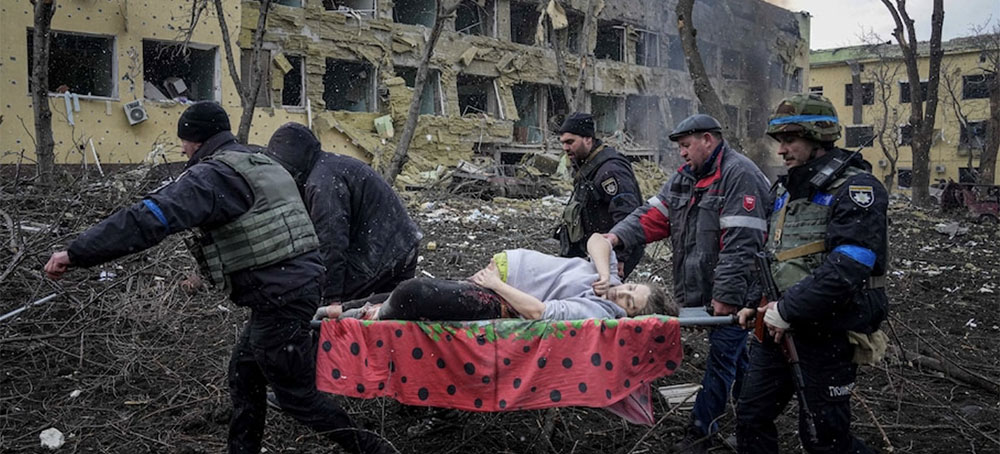
Pregnant Mother Whose Photo Showed Tragedy of Maternity Hospital Bombing in Ukraine Dies With Her BabyA woman is carried from the maternity hospital that was shelled in Mariupol, Ukraine, last week. (photo: Evgeniy Maloletka/AP)

Pregnant Mother Whose Photo Showed Tragedy of Maternity Hospital Bombing in Ukraine Dies With Her Baby
Annabelle Timsit, The Washington Post
Timsit writes: "A pregnant woman, her face pale, lies on a stretcher. Her left hip is covered in blood as she is rushed out of a hospital in the Ukrainian city of Mariupol, which had just been hit by an airstrike."

A pregnant woman, her face pale, lies on a stretcher. Her left hip is covered in blood as she is rushed out of a hospital in the Ukrainian city of Mariupol, which had just been hit by an airstrike.

The gripping picture, captured by photographer Evgeniy Maloletka for the Associated Press, encapsulated the toll on civilians of Russia’s invasion of Ukraine. It was shared, and the strike condemned, around the world — but little was known about the woman herself.

Now, the AP reports that the woman and her baby died in horrific conditions in the aftermath of the attack on the hospital — arriving for surgery with her pelvis crushed and hip detached.

Surgeon Timur Marin told the AP that medics delivered the baby via Caesarean section but that the infant showed “no signs of life.”

Video from besieged Mariupol shows physical and emotional devastation: ‘I don’t know where to run’

The woman, whose name has not been revealed publicly, is part of a civilian death toll from the war in Ukraine that the United Nations puts at 596, although it said it “believes that the actual figures are considerably higher.”

The woman’s story illustrates the perilous situation facing those who are pregnant in Ukraine, where at least 31 attacks on health-care facilities or equipment have been documented by the World Health Organization since the start of Russia’s assault 2½ weeks ago.

According to the United Nations, “80,000 Ukrainian women are expected to give birth in the next three months while oxygen and medical supplies, including for the management of pregnancy complications, are running dangerously low.”

In Mariupol, a southern port in Ukraine that officials say has been under Russian bombardment for days, a maternity hospital was hit Wednesday. Ukrainians blamed Russian forces; Moscow has claimed without evidence that the hospital was emptied of patients and used as a base for Ukrainian military activity.

Videos and photos taken at the scene show children and injured pregnant women being led away from the hospital after the attack. Mariupol’s city council said Thursday that three people, including a child, were killed, while 17 — among them children, women and medical workers — were injured. Ukrainian President Volodymyr Zelensky called the attack an “atrocity.”

“What kind of country is this, the Russian Federation, which is afraid of hospitals and maternity hospitals and destroys them?” Zelensky said in a video address late Wednesday. Global leaders condemned the attack, with Britain’s minister for the armed forces, James Heappey, calling it a “war crime.”

Among the photos and videos that circulated in the aftermath of the attack, one featured the pregnant woman being evacuated on a stretcher amid the rubble.

She was sent to another hospital, the AP reported, drawing on testimony from medics and the surgeon who treated her. The woman reportedly told medics to “kill me now” when she realized that she was losing her baby.

The woman’s surgeon said attempts were made for “more than 30 minutes” to resuscitate her but that in the end, she and her baby “both died.” Her body was picked up from the hospital, medics told the AP, but they were not able to record the woman’s name.

Another injured pregnant woman who was captured by photographers fleeing the maternity hospital gave birth on Friday, according to AP photos. In one, Mariana Vishegirskaya, wearing the same top as when she was pictured walking down the stairs of the Mariupol hospital after the strike, holds her newborn daughter close to her chest as she lies on a hospital bed.

International organizations say the attack on the Mariupol maternity hospital was not the first.

In a joint statement published Sunday, the leaders of the WHO, the United Nations Population Fund and UNICEF demanded an end to attacks on health-care facilities or equipment.

“To attack the most vulnerable — babies, children, pregnant women, and those already suffering from illness and disease, and health workers risking their own lives to save lives — is an act of unconscionable cruelty,” their statement said.

READ MORE


NATO's Polish MiG-29 FiascoA Mikoyan MiG-29 jet fighter of the Polish Air Force in 2016. (photo: Sean Gallup/Getty Images)

NATO's Polish MiG-29 Fiasco
The Wall Street Journal Editorial Board
Excerpt: "The White House divides the alliance and signals weakness to Putin by refusing to let Warsaw send fighter jets to Ukraine."

The White House divides the alliance and signals weakness to Putin by refusing to let Warsaw send fighter jets to Ukraine.

The U.S. and Europe have shown impressive cohesion since Vladimir Putin’s invasion of Ukraine, which makes this week’s fiasco over delivering Poland’s MiG fighters to Kyiv so damaging. The message to Mr. Putin is that his intimidation works and NATO can be divided.

On Tuesday Poland said it could transfer around two dozen MIG-29 jet fighters to a U.S. base in Germany, and then to Ukraine, whose pilots can fly the Soviet-era planes with minimal training. On Sunday Secretary of State Antony Blinken had said the U.S. was working with the Poles on the issue and would try to “backfill anything that they provide to the Ukrainians.” Yet Washington later claimed surprise at Poland’s proposal.

“The decision about whether to transfer Polish-owned planes to Ukraine is ultimately one for the Polish government,” said a Pentagon spokesman in a statement late Tuesday. “The prospect of fighter jets ‘at the disposal of the Government of the United States of America’ departing from a U.S. NATO base in Germany to fly into airspace that is contested with Russia over Ukraine raises serious concerns for the entire NATO alliance.” He added that the plan lacked “substantive rationale” and was not “tenable.”

Untenable how? After a NATO no-fly zone, which the alliance has refused, the MiGs are Ukrainian President Volodymyr Zelensky’s top request. The jets won’t decide the war, but his generals must think they’d help if only to deny Russia control of the skies. Any Russian artillery batteries or jets taken off the battlefield could save Ukrainian lives.

What happened between Mr. Blinken’s endorsement and the Pentagon’s rejection? It’s hard not to conclude that the White House blinked for fear of provoking Mr. Putin, who is demanding that the West stop arming Ukraine.

But NATO countries are already sending all sorts of weapons into Ukraine. Is a Polish MiG with a Ukrainian pilot somehow more provocative than a Turkish drone or an American antitank missile? Transferring planes isn’t the same as NATO aviators directly shooting down Russian jets.

Mr. Putin calls anything beyond Western acquiescence and Ukraine’s surrender a provocation. And NATO Secretary-General Jens Stoltenberg felt obliged to warn Mr. Putin Tuesday that a Russian attack on supply lines in alliance territory would trigger a collective response: “We are removing any room for miscalculation, misunderstanding about our commitment to defend every inch of NATO territory.”

Poland—which shares a border with Russia, Belarus and Ukraine—doesn’t want the transfer of planes directly to Ukraine from its territory to be perceived as a unilateral provocation. Polish Prime Minister Mateusz Morawiecki said Wednesday that the decision “must be unanimous and unequivocally taken by all of the North Atlantic Alliance.”

On Wednesday U.S. Defense Secretary Lloyd Austin formally nixed the MiG transfer to Ukraine. The failure of Team Biden to back up Warsaw is a failure of U.S. leadership.

There is risk of escalation in any war, and needless provocations should be avoided. But the risk of giving Mr. Putin a veto over NATO actions is that it undermines the credibility of deterrence. As Mr. Putin’s frustration grows, he is bombing cities, and Wednesday bombed a maternity hospital. The death toll is rising.

As he escalates, will he use chemical weapons or tactical nukes? Will NATO refuse to respond then because it fears World War III? The MiG mistake may let Mr. Putin believe his threats will make NATO stand down.


READ MORE


Report: Russia Seeks Military Equipment From China After Ukraine InvasionRussian Army military vehicles drive along a street in Armyansk. (photo: Stringer/Reuters)

Report: Russia Seeks Military Equipment From China After Ukraine Invasion
Reuters
Excerpt: "Russia has asked China for military equipment since its Feb. 24 invasion of Ukraine, the Financial Times and Washington Post reported on Sunday, citing U.S. officials."

Russia has asked China for military equipment since its Feb. 24 invasion of Ukraine, the Financial Times and Washington Post reported on Sunday, citing U.S. officials.

U.S. National Security advisor Jake Sullivan will be in Rome on Monday to meet with China's top diplomat Yang Jiechi, the White House said earlier.

Russia, which calls its action in Ukraine a "special operation," and China have tightened cooperation as they have come under strong Western pressure over human rights and a raft of other issues.

Beijing has not condemned Russia's attack and does not call it an invasion, but has urged a negotiated solution.

The White House's National Security Council declined to comment.

The Washington Post said the unidentified U.S. officials did not state the kind of weaponry that had been requested or how China had responded.


READ MORE


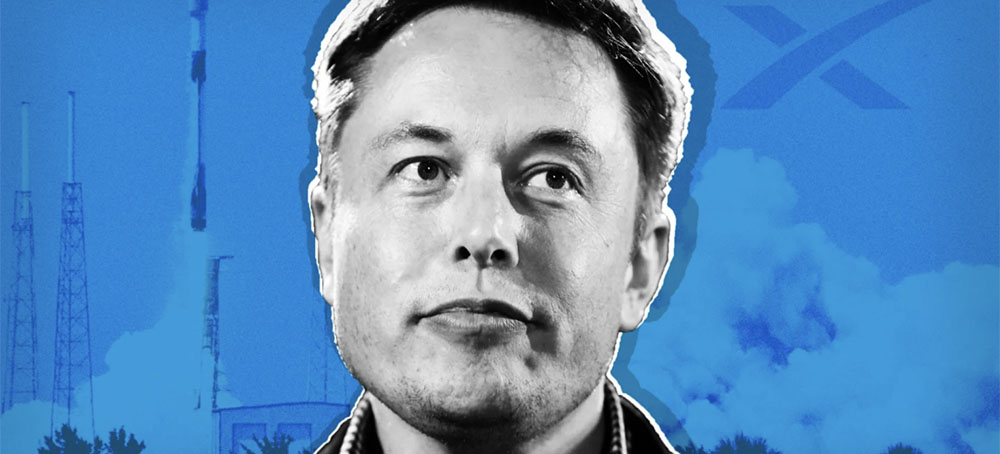
Tesla, Elon Musk Bring Power to Ukraine; Defy Russia, PutinElon Musk. (photo: Paul Hennessy/SOPA Images/LightRocket via Getty/Shutterstock/TS)

Tesla, Elon Musk Bring Power to Ukraine; Defy Russia, Putin
Daniel Kline, The Street
Kline writes: "Musk's motives may be hard to understand - sometimes it seems like he has a plan and sometimes it seems like he just wants attention - but he has made his feelings about Russia's invasion of Ukraine very clear."

Elon Musk has taken a bold stand when it comes to Russia's invasion of Ukraine.

Tesla (TSLA) - Get Tesla Inc Report CEO Elon Musk sometimes appears to vacillate between mad genius, impish prankster, and Batman villain. He's a talk first, think about the consequences later Twitter (TWTR) - Get Twitter, Inc. Report presence who has never hesitated to troll people or post things designed to provoke President Joe Biden, the SEC, or anyone else.

Musk's motives may be hard to understand -- sometimes it seems like he has a plan and sometimes it seems like he just wants attention -- but he has made his feelings about Russia's invasion of Ukraine very clear. The outspoken CEO has not only used his social media platform to speak out on behalf of the people of Ukraine, he has also supported them in more tangible ways.

Musk has sent multiple shipments on Starlink internet stations to help Ukrainians stay in touch with the world. He has also quietly sent some Tesla Powerwalls to Ukraine to help the war-torn country.

Tesla Brings Power to Ukraine's People

While many companies have made donations in Ukraine, Musk's Tesla has gone above and beyond. It has not only sent its solar-power battery systems to the country, it has also quietly shared a video on how to use them, according to one media report.

"The unlisted YouTube "Mobile Powerwall setup" video discovered by Electrek appears to have been made by Tesla, or at least by someone working alongside the electric automaker. Regardless of the official source, the video should prove very helpful to Ukraine amid these dark times," InsideEVs reported.

A Tesla Powerwall could potentially power a Starlink internet terminal for multiple days. If you add solar panels -- and Tesla provided the hookups to do that -- you could have long-term internet connectivity as well as power.

Musk Has Made His Position Very Clear

While a lot of companies -- pretty much every major American brand -- had suspended operations in Russia, most have done so quietly. McDonald's (MCD) - Get McDonald's Corporation Report, for example, has "suspended" its operations in the country, but that's a move that will reportedly cost the company $50 million a month.

So, while McDonald's and others have taken steps to not be supporting Russian President Vladimir Putin, they have been much more measured than Musk in their approach. Yes, they're not doing business in Russia (for now) but they're playing politician and setting themselves up to return as soon as possible.

Musk has not done that and has cast his support very directly to the people of Ukraine through direct action and by using his very powerful social media voice.

The CEO, however, has also made it clear that he sees this situation as a Putin problem and not something to hold the people of Russia responsible for.

Musk may sometimes come off as unfeeling or at least unthinking when it comes to his social media presence. In this case, he has taken bold action and made real moves on behalf of Ukraine. That's perhaps not unique among CEOs, but it's very rare in a world where global companies always keep an eye on their long-term bottom line even while doing the right thing during a global conflict.


READ MORE


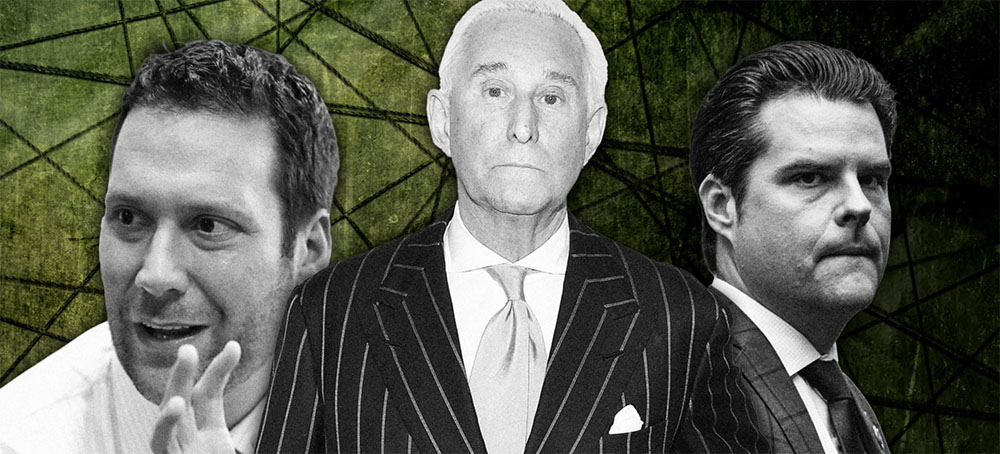
Roger Stone Has Been Playing All Sides of the Gaetz ScandalRoger Stone with Gaetz and Greenberg. (photo: Thomas Levinson/The Daily Beast/Getty Images)


Roger Stone Has Been Playing All Sides of the Gaetz Scandal
Roger Sollenberger, The Daily Beast
Sollenberger writes: "One of the most connected players in MAGA world just happened to advocate for pardons for three men tied to the Matt Gaetz sex investigation - and they're not on the same side."

One of the most connected players in MAGA world just happened to advocate for pardons for three men tied to the Matt Gaetz sex investigation—and they’re not on the same side.


Months before the public knew about the federal sex crimes investigation into Rep. Matt Gaetz, the man seemingly at the middle of everything in MAGA world—Roger Stone—was already in deep.

How deep? Enough, in classic Roger Stone fashion, to play all sides.

Stone has long been close not only with Gaetz, but also with Joel Greenberg, the congressman’s former best friend and “wingman,” who last year pleaded guilty to sex trafficking the same minor at the center of the Gaetz investigation.

But Stone also has unreported ties to a third Florida man in the saga. And, what’s more, he lobbied for pardons for all three men.

While there’s still no definitive accounting for Stone’s motivations, new documents and sources provide a clue—a seemingly improbable connection, involving one of the most bizarre chapters in an already bizarre scandal.

It’s already known that Stone lobbied for pardons for both Gaetz and Greenberg in the waning days of the Trump administration. But it wasn’t known that Stone also advocated for a pardon for this third man connected to Gaetz and Greenberg: Stephen Alford, a serial fraudster from the Florida panhandle.

That development was first revealed by The Washington Post in a draft memo published earlier this month. But the Post report didn’t mention Alford—his name only appears in a document the Post obtained and uploaded online—and the link hasn’t been explored.

Two months after Stone advocated for Alford’s absolution, that allegiance dissolved when Alford became Gaetz’s scapegoat for the investigation. (Stone also eventually blasted Alford as part of the “deep state.”)

Just weeks before, however, Stone was in Alford’s corner, lobbying for a pardon.

According to the Post, the veteran GOP operative wrote a draft memo to then-President Donald Trump—called the “Stone Plan”—after the Jan. 6 Capitol riots.

In the memo, Stone asked Trump to pardon a number of associates, elected officials, and MAGA luminaries, including Gaetz, who Stone said merited a preemptive pardon for trying to overturn the election.

The “Stone Plan” also confirms The Daily Beast’s reporting last spring that Stone advocated for a pardon for Greenberg. At the time, Stone denied pushing for a Greenberg pardon, claiming he “made no formal or informal effort in regard to a pardon for Mr. Greenberg,” and had declined Greenberg’s offer to “retain” him.

But what makes the Stone list of potential pardon recipients even more notable is the last name.

Right after Greenberg comes Stephen Michael Alford. Stone then adds, “I have no ‘clients’—these are just people I know have busted their ass to help you get elected President.”

While it’s unclear how Alford is connected to Stone—or how Alford is connected to Trump—he does have quite the record.

In the 2000s, Alford was convicted in Florida for fraud and grand theft in excess of $100,000. In 2015, he was indicted on a $6 million fraud and extortion scheme, and two years later was sentenced to five years in prison. He was released in March 2019 on 10 years probation, according to records with the Florida Department of Corrections, and those convictions would appear the likely subject of his pardon request.

Still, one of the biggest mysteries of Stone’s involvement with the Gaetz and Greenberg drama is now what Stone’s connection to Alford may be.

Alford isn’t wealthy, and there’s no public record of him “busting his ass” to elect Trump. Alford never even donated to the campaign. He hasn’t made any listed contributions at all since 2004, when he and his three children all maxed out on the same day to Republican House candidate Bev Kilmer, per federal records.

According to a person with direct knowledge of the events, however, Alford had one powerful friend: A Republican lobbyist close to Stone.

Weeks after Alford’s pardon request was declined, that lobbyist shared some more information: Matt Gaetz was in trouble. And the lobbyist, this person said, had the details, including images of Gaetz with young women at a sex party.

While it’s unclear how the lobbyist—an associate of Oleg Deripaska—came into this information, Stone had by that time known about the Gaetz allegations for months; Greenberg had told Stone all about their involvement with a 17-year-old, both over text messages and in a confession he drafted at Stone’s request, as part of the pardon process.

It didn’t take long for Alford to cobble together a plan—and it was a doozy: He would secure Gaetz a presidential pardon in exchange for $25 million, which Alford would supposedly use to repatriate an FBI agent taken hostage in Iran who has long been considered dead.

Alford and an associate pitched the Gaetz family on the deal. They gave Gaetz’s father a letter claiming that his son was soon to be indicted for sex crimes and had been photographed at orgies, offering a $25 million exit ramp.

That plan eventually landed Alford back in prison. But first, Gaetz and Stone saw an opportunity.

When The New York Times broke the investigation in late March last year, Gaetz used Alford’s ploy as ammo. He fired off a tweetstorm, claiming the Times report was a “planted leak” designed to torpedo an investigation into “criminal extortion” plot “to smear my name.”

The central figure in Gaetz’s narrative, however, wasn’t Alford; it was Alford’s lawyer, whose role was limited to holding the money in an escrow account while Alford negotiated the release.

That lawyer had one special characteristic: Three decades ago, he served as a DOJ prosecutor. And that fact equipped the narrative with a “deep state” hook—a Roger Stone special.

Gaetz doubled down that night on Tucker Carlson’s late-night Fox News talk show, explaining the convoluted “leaking” and “smearing” plot to a befuddled Carlson, who remarked that it was “one of the weirdest interviews I’ve ever conducted.”

The next day, Stone piped up to defend Gaetz, using the same language.

“The ‘leaked’ smear on Congressman Matt Gaetz is an extortion play and an effort to destroy the up and coming conservative leader who has the balls to call the left out,” Stone wrote in a social media post, the Sun-Sentinel reported. He repeated the refrain for weeks.

But that effort to “destroy” an outspoken conservative threat to the left was actually the work of a man Stone himself had just argued was deserving of presidential clemency—based on his fealty to the MAGA cause.

And it was right around this time that the Gaetz campaign started paying Stone.

On March 24, the committee paid Stone’s firm $5,000 for “strategic campaign consulting,” according to federal records. Days later, Gaetz’s father met with Alford’s lawyer, wearing a wire.

The campaign continued to pay Stone $5,000 a month, and Stone continued to accept it, despite what Greenberg had told him months prior. The payments stopped in May, however, not long after Gaetz hired two high-profile out-of-state criminal defense attorneys, and Stone went dark.

Lawyers for Alford, Greenberg, and Stone all declined to comment for this article.

A Gaetz spokesperson reiterated that the campaign knew Alford was working with the two other people in the Iranian hostage plan. (Neither of them has been charged with a crime.)

“Who else he was working with, including Roger Stone, is news to us,” the spokesperson said.

While the Gaetz spokesperson said they weren’t aware of Alford’s ties to Stone, they did not answer when asked whether Gaetz and Stone had ever discussed Alford, and if so, when. They also did not say when things went south with Stone.

But if it wasn’t clear how Stone felt after the campaign payments stopped, in January he pulled back the veil, skewering Gaetz after reports revealed that an ex-girlfriend had testified to the grand jury under an immunity deal.

“Bye Matt! Bye Bye,” Stone posted on social media, linking to a report about the testimony.

That signaled a major break in a longtime friendship. Gaetz and Stone go way back—with Greenberg rounding out a famous photo taken in July 2017.

Months later, the trio attended a pro-cannabis conference, where Gaetz claimed Stone had “drafted” him in “2013 or 2014” to help roll back cannabis regulations. Stone also appeared at a Gaetz fundraiser after the conference, and that same day, Greenberg used Venmo to send $500 to a woman Gaetz has allegedly paid for sex, as The Daily Beast previously reported.

And Greenberg continued to hew closely to Stone’s orbit.

According to the Times, Greenberg—who held elected office as Seminole County tax collector—got political firepower from a website run by a member of the Stone-adjacent Proud Boys neo-fascist group.

In 2020, just before Greenberg’s first indictment, fake social media accounts linked to Stone pushed false smears about Greenberg’s political challengers, the Times reported.

“Watch out Seminole county,” one account posted, adding “don’t open your door” to Greenberg’s opponent, who Greenberg had falsely smeared as a pedophile—a crime to which he would later plead guilty.

The post linked to an article on a website run by a Stone associate Greenberg had previously paid to write favorable articles, according to payments obtained by The Daily Beast. Three days after that post went up, Greenberg was indicted.

Today, Greenberg sits in federal prison. So does Alford, on fraud charges. Stone is fighting a $2 million federal tax evasion lawsuit while under investigation for his role in the Jan. 6 attack on the U.S. Capitol.

The Gaetz investigation is ongoing.

READ MORE


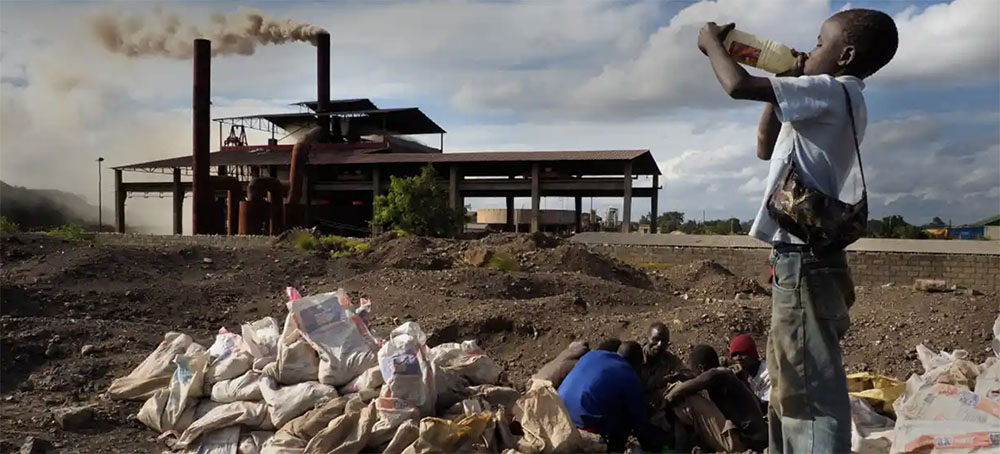
Millions Suffering in Deadly Pollution 'Sacrifice Zones,' Warns UN ExpertKabwe in Zambia, one of the toxic 'sacrifice zones' cited by the UN, where 95% of children have elevated levels of lead in their blood. (photo: Larry C Price/Larry C. Price)

Millions Suffering in Deadly Pollution 'Sacrifice Zones,' Warns UN Expert
Damien Gayle, Guardian UK
Gayle writes: "A UN expert has warned of the creation of pollution 'sacrifice zones' across the world, where tens of millions of people are suffering strokes, cancers, respiratory problems and heart disease as a result of toxic contamination of the environment."

Businesses blamed for rise of toxic hotspots hitting poor communities hardest

A UN expert has warned of the creation of pollution “sacrifice zones” across the world, where tens of millions of people are suffering strokes, cancers, respiratory problems and heart disease as a result of toxic contamination of the environment.

“There are sacrifice zones all over the world, in every region: in the north, in the south, in the east, in the west, in rich countries, in poor countries,” David Boyd told the Guardian.

Boyd, the special rapporteur on human rights and the environment, cited physical health issues, including cancer, heart disease, respiratory illness, strokes and reproductive health problems, as well as “incredible mental health problems associated with living in these places because people feel exploited, they feel stigmatised”.

All of this infringed their human rights, Boyd said. “Their rights to life, their rights to health, and … their right to a clean, healthy and sustainable environment. You cannot reconcile that fundamental right to a healthy environment with these absolutely horrific environmental conditions.”

In a report due to be presented to the UN human rights council on Thursday, Boyd says pollution contributed to twice as many premature deaths as Covid-19 in the first 18 months of the coronavirus pandemic.

Giving the death toll from pollution in that period is a staggering 9 million, the report adds: “One in six deaths in the world involves diseases caused by pollution, three times more than deaths from Aids, malaria and tuberculosis combined and 15 times more than from all wars, murders and other forms of violence.

“The toxification of planet Earth is intensifying,” Boyd’s report warns, pointing out that even as some harmful chemicals are banned or abandoned, overall production of chemicals doubled between 2000 and 2017, and will double again by 2030.

And while everyone was affected to some degree, some communities were being hit far more than others. “If you look at these places that I’ve highlighted in the report, pollution on our planet today is pervasive, it’s affecting everyone but it’s affecting some people in a really grossly unfair and disproportionate way,” Boyd told the Guardian.

“The United States, one of the wealthiest countries in the world, one of the wealthiest countries in all of human history, is home to one of the worst sacrifice zones on the planet. This place, it’s called ‘cancer alley’, in Louisiana, where there are more than a hundred oil refineries, petrochemical plants, etc,” he said.

“And guess where they’re located? In poor, predominantly black communities. It’s just, as I said, it’s unconscionable.”

Other sacrifice zones included:

Kabwe, Zambia, where 95% of children had elevated levels of lead in their blood, putting them at risk of lifelong intellectual impairment,

The Pata Rât landfill in Romania, where thousands of Roma people live and are exposed to arsenic, lead, mercury and other pollutants.

The French overseas territories of Guadeloupe and Martinique, in the Caribbean, where 90% of people were found to have the carcinogenic pesticide chlordecone in their blood.

Businesses were the main culprit, with most happy to overlook social and environmental costs in favour of their bottom line, Boyd said, adding that money was “the main barrier to addressing the climate crisis, to addressing biodiversity loss and to addressing pervasive pollution”. He called on governments to impose strong regulation on corporations causing pollution – and to stop spending an estimated $1.8tn a year on subsidies for environmentally damaging industries.

“[Oil and gas companies are] not going to voluntarily stop producing oil and gas; big coal companies are not going to voluntarily shift from being big coal companies to being big solar and wind companies: governments have to do that, that’s their job, it’s governments that have the obligations to respect, protect and fulfil our human rights,” Boyd said.

But there was cause for optimism, he said. Boyd’s report comes six months after the human rights council recognised for the first time that everyone had a human right to live in a clean, healthy and sustainable environment.

“And this is really a key point,” he said. Previous agreements on biodiversity, climate change and pollution were formerly unenforceable. “But guess what: when you weld the international environmental agreements together with human rights law, human rights law brings into the equation institutions, processes, accountability.

“That’s what’s really exciting about this UN recognition of a right to a clean, healthy and sustainable environment – it signals this union of human rights law and environmental law which can be an extremely powerful catalyst of the kinds of transformative changes that we so desperately need.”


READ MORE


Contribute to RSN

Follow us on facebook and twitter!

Update My Monthly Donation

PO Box 2043 / Citrus Heights, CA 95611


Top News | 'He’s Not Going to Run Unopposed': Sanders Rejects Schumer for Majority Leader

                                                               LOTS OF POSTS IGNORED BY BLOGGER..... OR REMOVED ON THEIR WHIM! ALL POSTS ARE...