One columnist called it "probably the toughest public criticism offered by a US administration towards Israel in my lifetime." |
|
Vice President JD Vance stunned observers on Thursday with some of the bluntest criticism issued to Israel by a US presidential administration in recent memory as Israeli Prime Minister Benjamin Netanyahu continues his attempts to sabotage peace with Iran.
Noting the indignance and defiance of Netanyahu and his cabinet in response to the memorandum of understanding signed this week by Trump—which calls on Israel to withdraw from Lebanon and end its ethnic cleansing campaign there—Vance said Israel’s leaders were in the midst of a “weird panic” and “freakout” during a New York Times interview on Thursday.
“You’re a country of 9 million people,” he said. “You can’t just kill your way out of solving every single national security problem that you have.”
It comes on the heels of Trump’s own criticism of Israel’s tactics in Lebanon earlier this week, describing its bombing of an apartment building—one of countless attacks on civilian infrastructure—as “vicious” and “too much,” before claiming that “without me, there would be no Israel.”
Vance went even further later on Thursday during a press conference at the White House, reminding Israel’s leaders that they’ve made their country an international pariah.
“My message to them would be twofold. No. 1: Donald J. Trump is the only head of state in the entire world who is sympathetic to the nation of Israel at this moment in time,” Vance said. “If I was in the cabinet of the Israeli government, I might not be attacking the only powerful ally that I have anywhere left in the entire world.”
In a style reminiscent of his infamous Oval Office meeting with Ukrainian President Volodymyr Zelenskyy last year, he later took Israel’s leaders to task over what he described as ingratitude for America’s support, which has included roughly $4 billion in military assistance each year and even more since Israel began its genocidal military campaign against Gaza in 2023 in response to Hamas’ October 7 attacks.
The weapons Israel uses, Vance stressed, “have been built by American hands and paid for by American tax dollars.” He added, “The problem for Israel is not Donald J. Trump and anybody in Israel who thinks their biggest problem is the president of the United States needs to wake up and smell the reality of the situation that the country is in.”
In a marked shift from earlier this year, when the administration had cosigned Israel’s attacks on Lebanon even at the cost of ceasefire negotiations, Vance on Thursday called on Israel to “respect this peace process” and called Israel’s attacks on civilians “unacceptable.”
Just as observers have been bewildered by Trump’s sudden acknowledgment of Iran’s rights to possess ballistic missiles and to pursue nuclear energy, many were similarly caught off guard by Vance’s abrupt acknowledgment of truths about Israel that have been apparent to most of the world for years.
“JD Vance is not changing the conversation about Israel in the US. He is changing the entire paradigm,” said Trita Parsi, the executive vice president of the Quincy Institute for Responsible Statecraft. “He is reminding the Israelis that they are alone and—though he doesn’t use this word—much disliked internationally. Israel should not undermine the only strong friend they have left.”
Washington Post columnist Shadi Hamid agreed that it was “probably the toughest public criticism offered by a US administration towards Israel in my lifetime,” adding that “we’ll see if it gets translated into action or if it’s just rhetoric, but it’s still much more than the Biden administration could ever manage.”
The naked cynicism of the flip-flop was apparent to many, given the Trump administration’s slavish deference to Israel up to the point that it became political poison.
College students who have said similar things to Vance about Israel’s killing of civilians have found themselves facing deportation, while International Criminal Court officials who have attempted to hold Israeli officials criminally liable for war crimes have found themselves sanctioned by the US.
That is to say nothing of Trump’s willingness to follow Netanyahu’s lead into a disastrous and unpopular war with Iran despite warnings from his own cabinet that he was being manipulated.
“It would be nice if they had this posture from January 2025,” journalist Zaid Jilani said of Vance’s comments on Thursday. “Might have helped save Trump’s presidency.”
Alexander Langlois, a contributing fellow at the anti-interventionist think tank Defense Priorities, described it as a deeply calculated maneuver to simultaneously show Israel who is boss in front of a nation growing wary of its influence while also reiterating America’s support.
“Vance is drawing a line. The White House is absolutely trying to use its power and influence to get not only Republicans, but Israel, in line,” he said.
Still, despite doubts, it was hard to overstate the gravity of the shift underway, at least rhetorically.
“It could all lead to nothing, or worse—a joint US-Israel resumption of the war,” said journalist Glenn Greenwald. “But there hasn’t been a week where American leaders have spoken so sternly, clearly, truthfully and decisively about Israel since... well, perhaps ever.”
"Trump is backing off from doing something incredibly stupid, so we celebrate." |
|
The Trump administration on Thursday backed off a widely criticized plan to dismantle a deep-sea monitoring system designed to provide crucial storm forecasting data while also tracking the health of coastal habitats and the impacts of the climate crisis on the world’s oceans.
In an announcement posted on its website, the US National Science Foundation (NSF) said it “will not proceed with further removal or descoping of equipment” from the Ocean Observatories Initiative (OOI), less than a month after it revealed plans to remove more than 900 instruments deployed along US coastlines.
NSF also said that it would continue planned maintenance operations on the remaining systems, while also creating plans to redeploy that Endurance Array, which is a set of long-term moorings set up in the Pacific Northwest, after it undergoes equipment servicing.
“NSF remains committed to ocean sciences,” the announcement concluded, “to responsible stewardship of its research infrastructure and to supporting the stakeholders that depend on it.”
The decision to end OOI drew bipartisan backlash in Congress, as the Republican-controlled US Senate on Wednesday passed a measure to block the administration from further removing ocean monitoring equipment.
The Trump administration on Thursday backed off a widely criticized plan to dismantle a deep-sea monitoring system designed to provide crucial storm forecasting data while also tracking the health of coastal habitats and the impacts of the climate crisis on the world’s oceans.
In an announcement posted on its website, the US National Science Foundation (NSF) said it “will not proceed with further removal or descoping of equipment” from the Ocean Observatories Initiative (OOI), less than a month after it revealed plans to remove more than 900 instruments deployed along US coastlines.
NSF also said that it would continue planned maintenance operations on the remaining systems, while also creating plans to redeploy that Endurance Array, which is a set of long-term moorings set up in the Pacific Northwest, after it undergoes equipment servicing.
“NSF remains committed to ocean sciences,” the announcement concluded, “to responsible stewardship of its research infrastructure and to supporting the stakeholders that depend on it.”
The decision to end OOI drew bipartisan backlash in Congress, as the Republican-controlled US Senate on Wednesday passed a measure to block the administration from further removing ocean monitoring equipment.
Sen. Jeff Merkley (D-Ore.), who led the Senate effort to block the Trump administration’s OOI plans alongside Sen. Lisa Murkowski (R-Alaska), described the removal of ocean monitoring systems as “supreme stupidity” that would destroy “a vital source of climate data.”
The timing of NSF’s decision to dismantle the system was particularly controversial given concerns over planetary heating and the growing threat of extreme weather, especially as the return of El Niño this year is expected to unleash larger and more damaging meteorological events in the near future.
In response to Thursday’s announcement, the Democratic National Committee’s Environment and Climate Council described the reversal on OOI as a rare sensible decision for a Trump administration that has been overtly hostile to climate science.
“Good news. But it’s a low bar,” the council wrote in a social media post. “Trump is backing off from doing something incredibly stupid, so we celebrate.”
"We witness not only a massive fossil fuel crisis but a vast upward transfer of wealth built on instability of fossil fuel markets and pain," said an expert at 350.org. |
|
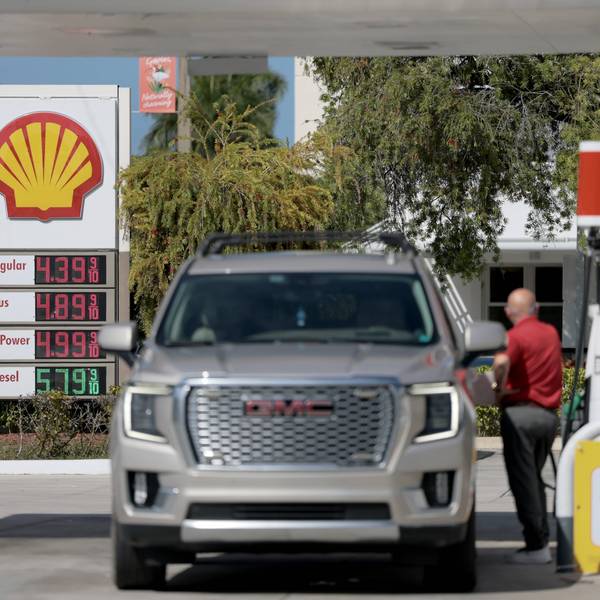
US President Donald Trump’s war with Iran may finally be reaching a close. But consumers and businesses around the world will continue to pay the price in the months ahead as still-elevated energy costs funnel hundreds of billions of dollars to fossil fuel giants.
That’s according to a report from the environmental group 350.org released Thursday, following Trump’s signing of a memorandum of understanding with Iran this week to begin the process of formally ending a war that has sent global oil prices skyrocketing and saddled ordinary people with record fuel prices.
The group estimated that just 110 days of war resulted in the transfer of an additional $374 billion from consumers and businesses into the coffers of oil and gas companies beyond what would have been expected had the war never been launched.
And while Trump claims his agreement to end the war this week will avert an “economic catastrophe,” there will likely still be tremendous pain even if the Strait of Hormuz reopens promptly.
Using oil and gas pricing scenarios from the International Monetary Fund’s April 2026 World Economic Outlook and data on global consumption, 350.org predicted that by the end of the year, consumers and businesses will spend an additional $199.8 billion on oil and $128.1 billion on gas above a non-war scenario, making for a grand total of more than $700 billion as a result of the war.
This, the group said, is a conservative estimate, as it does not even take into account knock-on effects. The war will ultimately end up costing much more when factoring in inflation across the rest of the economy, resulting from higher fuel costs or fertilizer shortages caused by the strait’s closure, which has affected food prices.
It also does not take into account the resulting effects on economic output or employment as rising costs and lower consumer spending force companies to tighten their belts.
“The oil and gas industry is draining billions from people and businesses on the back of a war that has killed thousands and pushed millions toward poverty and hunger,” said Andreas Sieber, head of political Strategy at 350.org.
“Even if the Strait of Hormuz reopens tomorrow, we should expect prices to remain above pre-crisis levels,” he said. “We witness not only a massive fossil fuel crisis but a vast upward transfer of wealth built on instability of fossil fuel markets and pain.”
While the war has brought it into starker relief, previous reports from 350.org have shown that even if the US had never attacked Iran, the continued global dependence on fossil fuels was resulting in trillions of dollars of avoidable costs each year, including $9.3 trillion to mitigate climate-related damages and air pollution-related deaths each year, costs that disproportionately fall on the world’s poorest.
In order to alleviate economic strain from the war, Sieber said, “governments should tax these excess profits now and use the revenues to protect people, cut bills, and rapidly deploy renewables that make households and small businesses less vulnerable to the next fossil fuel shock.”
Estimates of inflation also do not account for how the war has heightened global instability and poverty, which will require additional resources for humanitarian relief efforts. In late April, the United Nations Development Program estimated that even if the conflict had ended then, more than 32 million people worldwide would be pushed into economic precarity.
This is not to mention the resources that will need to be expended to address the harms caused by the war itself.
In exchange for negotiations on Iran’s nuclear program, a portion of the memorandum of understanding requires the US to work with “regional partners,” presumably other Persian Gulf allies, to scrounge up at least $300 billion to help Iran pay for reconstruction and economic development after the country was devastated by American and Israeli attacks on civilian infrastructure and millions were displaced.
As a report from the International Rescue Committee detailed last week, the Iran war has also had cascading effects on other conflicts and catastrophes.
“Six months ago, the IRC warned that a New World Disorder was emerging,” said David Miliband, the humanitarian group’s president and CEO. “Since then, disorder has not only grown but accelerated. A war with Iran. A million people have been forced to flee their homes in Lebanon. A brewing global food security catastrophe that risks plunging millions more people into acute hunger. An expanding Ebola outbreak. Defanged diplomacy and collapsing aid budgets.”
“The Iran war couldn’t have happened at a worse time,” Miliband said in a New Yorker article published Thursday. “It set off a chain of events that’s very damaging.”
"Trump currently owns this failed war," said one expert, "but if the Democrats help torpedo the MOU and war resumes, then they will co-own the next war." |
|
Supporters of a diplomatic resolution to the illegal war that US President Donald Trump launched against Iran earlier this year are pushing back against Democratic critics of the interim peace agreement signed on Wednesday, warning it is politically and morally foolish to attack efforts to end a conflict that has killed thousands and plunged the global economy into chaos.
“Would you rather go back to war?” Matt Duss, executive vice president of the Center for International Policy and a former adviser to Sen. Bernie Sanders (I-Vt.), asked Sen. Richard Blumenthal (D-Conn.), one of several Democrats joining war-hawk Republicans in openly decrying the new memorandum of understanding (MOU).
In a series of social media posts on Wednesday, Blumenthal pointed to “bipartisan condemnation” of what he called “a disgraceful deal” and “unconditional surrender” on the part of the US. The senator added that “anything like this deal will be dead on arrival in the Senate” and declared, “It must be approved here to have enforceable effect.”
Other prominent Democrats offered similar critiques. Sen. Adam Schiff (D-Calif.) said it is “hard to imagine a more thorough capitulation,” while Sen. Cory Booker (D-NJ) called the deal a “dangerous giveaway” to “this enemy,” referring to Iran.
“His war proved only one thing: that diplomacy was the answer all along.”
Trita Parsi, executive vice president of the Quincy Institute for Responsible Statecraft, warned Thursday that such criticisms of the interim peace deal imply that “a war should not be brought to an end until it has produced better terms—even when the war itself is failing.”
“Taken seriously, that logic leads to a dangerous conclusion: that a failed war must continue until the battlefield fortunes somehow improve and a more favorable outcome becomes attainable. Perhaps that day will come. Perhaps it never will. In the meantime, the costs—in lives, treasure, regional stability, and strategic credibility—are treated as secondary considerations,” Parsi wrote. “This is how endless wars are born.”
Parsi expressed disappointment at the rhetoric of some Democrats “because it echoes the same bad-faith tactics Republicans deployed” against the Obama-era Joint Comprehensive Plan of Action (JCPOA), which Trump ripped up in 2018, setting the stage for war.
“To be sure, Trump has invited some of this treatment. He spent years attacking Obama’s agreement with a barrage of misleading arguments and exaggerated claims,” Parsi noted. “But that does not make it wise for Democrats to return the favor. Trump currently owns this failed war, but if the Democrats help torpedo the MOU and war resumes, then they will co-own the next war. Trump’s disaster will become theirs as well.”
Many Democrats appear to understand that risk and are welcoming diplomatic progress—while also condemning the illegal war and its consequences for the US and the world.
“Matters of war and peace must rise above partisan politics,” said Rep. Joaquin Castro (D-Texas). “Democrats must not replicate Republicans’ irresponsible opposition to the Obama administration’s Iran nuclear agreement, which placed real constraints on Iran’s nuclear program before President Trump foolishly tore it up, setting the stage for this disastrous war.”
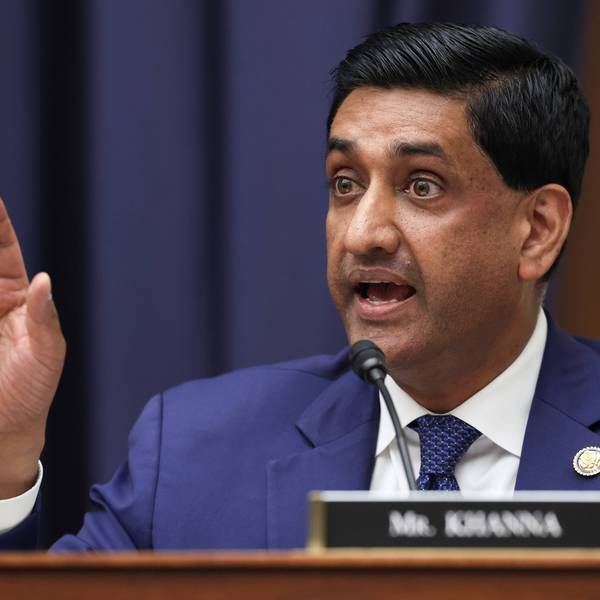
Rep. Ro Khanna (D-Calif.), in a Thursday morning appearance on Fox News, said the emerging deal between the US and Iran “is not as good as the JCPOA was,” while also expressing support for efforts to end the war.
Watch:
Rep. Jim McGovern (D-Mass.) wrote in a social media post on Thursday that “any move toward diplomacy and away from violence is welcome news,” calling Trump’s Iran war “reckless” and “illegal.”
“This war should be a lesson. The push for military adventurism and regime change by neocon war hawks was, unsurprisingly, an unmitigated disaster,” said McGovern. “After three months of death and destruction, the rest of us are now left paying the price. His war proved only one thing: that diplomacy was the answer all along.”
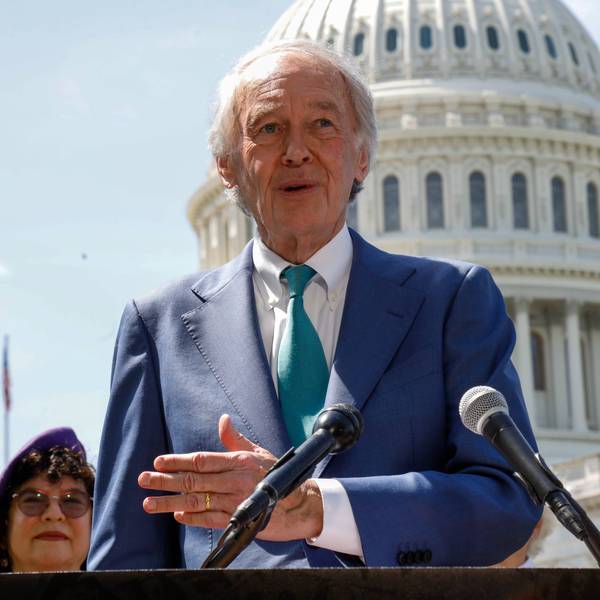
"Trump’s dangerous... boondoggle will not protect Americans. It’s just a giveaway to defense contractor buddies like Elon Musk," said US Sen. Ed Markey.
Democratic lawmakers are taking aim at President Donald Trump’s proposed “Golden Dome” missile defense system, which the Congressional Budget Office projected last month would cost $1.2 trillion to create, deploy, and operate over the first 20 years of its existence. Ten members of Congress, led by Sens. Ed Markey (D-Mass.) and Jeff Merkley (D-Ore.) and Reps. John Garamendi (D-Calif.) and Don Beyer (D-Va.), sent a letter to US Defense Secretary Pete Hegseth on Wednesday demanding information on the proposed project’s cost to taxpayers and its projected effectiveness. The letter begins by noting that officials working on the Golden Dome still have not shared key details about the project with the CBO, which the independent agency said has made it “impossible to estimate the long-term cost” of the system. “It is one thing to withhold design details or performance specifications of certain systems,” the letter says, “but it is quite another to withhold the entire system architecture that you expect Congress to approve and fund. Congress and the American public have a right to know what they are paying for.” The letter says that transparency about the system’s architecture is particularly important given the questions that have been raised about how successful it would be at halting missile attacks. This is especially true, the letter emphasized, given the administration’s insistence that the true cost of the system will be less than one-fifth of the CBO’s projections.
“Simply put, there is no way that a Golden Dome system that costs $185 billion could possibly live up to the promise of ‘forever ending the missile threat to the American homeland,’” the letter states. “According to CBO’s calculations, even a system that would cost $3 trillion would not meet that ambitious goal, which would need to be able to engage hundreds of missiles. If the administration has not scaled back its goals for the system, the current official price tag is woefully unrealistic.” The letter concludes by asking several questions about the project, including the administration’s estimated 20-year cost, the type of system architecture being planned, and the anticipated responses to the missile shield from rival nations including China and Russia. “We urge you to halt this dangerous plan,” the letter says, “and return to the more limited missile defense policies that have earned bipartisan support in the past.” In a separate social media post, Markey pointed out that the project is being used to funnel money to administration allies such as SpaceX CEO Elon Musk, who last week became the world’s first trillionaire and is promoting racist far-right political parties throughout the world. “Trump’s dangerous $1.2 trillion ‘Golden Dome’ boondoggle will not protect Americans,” Markey wrote. “It’s just a giveaway to defense contractor buddies like Elon Musk. We’re demanding answers from Hegseth on Trump’s trillion-dollar scam.”
|
|











No comments:
Post a Comment
Note: Only a member of this blog may post a comment.