Monday, December 19, 2022

FOCUS: Timothy Garton Ash | In Ukraine, I Saw the Greatest Threat to the Russian World Isn't the West – It's Putin


Reader Supported News
18 December 22

Live on the homepage now!
Reader Supported News

HELP, RSN RUN OVER BY A REINDEER! — December is supposed to be a good month for fundraising, however due to the major increase in online fundraising efforts by so many organizations coordinated for the year-end melee our donations are down significantly. Please do not forget RSN. Sincere thanks for those who have stepped up!
Marc Ash • Founder, Reader Supported News

Sure, I'll make a donation!


Vladimir Putin. (photo: The Hill)
FOCUS: Timothy Garton Ash | In Ukraine, I Saw the Greatest Threat to the Russian World Isn't the West – It's Putin
Timothy Garton Ash, Guardian UK
Ash writes: "The time has come to ask whether, objectively speaking, Vladimir Putin is an agent of American imperialism." 


The Kremlin’s imperial war has made its own culture and language a common enemy for people across its former empire

The time has come to ask whether, objectively speaking, Vladimir Putin is an agent of American imperialism. For no American has ever done half as much damage to what Putin calls the “Russian world” as the Russian leader himself has.

This thought came to me recently when I was in the Ukrainian city of Lviv, talking to Ukrainians made refugees in their own country by Putin’s war. “I was a Russian speaker until 24 February,” said Adeline, an art student from the now Russian-occupied town of Nova Kakhovka, referencing the date of Russia’s full-scale invasion earlier this year. Russia has failed to take over Ukrainian culture, she said, so now it has set out to kill it. Several other Ukrainian students told me they find “the spirit of freedom” in Ukrainian literature, but of subservience to power in Russian literature.

Tetiana, a refugee from the ruthlessly bombed and destroyed city of Mariupol, had suffered without heat, light or water in a cellar under constant bombardment, seen her best friend killed by a Russian missile, and then had a traumatic odyssey of escape. Tetiana not merely speaks much better Russian than Ukrainian; her mother is actually from Russia, as are her parents-in-law. The Russian president would consider her a Russian. So I asked her for her message to Putin. She replied that she would like to kill him.

Wherever I turned, in every conversation, there was a total rejection not just of the Russian dictator, not merely of the Russian Federation as a state, but of everything and almost everyone Russian. Polling by the Kyiv International Institute of Sociology shows that some 80% of Ukrainians had a positive attitude to Russia in 2013; by May 2022, the figure was just 2%. A university lecturer told me that his students now write “russia” with a small initial letter. “I don’t correct them.”

This may be unsurprising in Ukraine, a country suffering from a Russian war that is now primarily directed against the civilian population. But the same thing is happening across much of the territory of the former Russian (and subsequently Soviet) empire – which, since the early 2000s, Moscow has tried to reimagine as the russkiy mir, or Russian world.

In Georgia, a strong resentment of neoimperial Russia is more than understandable, since Russia has occupied roughly – a fifth of the country’s sovereign territory (in Abkhazia and South Ossetia) since 2008. But following the invasion of Ukraine, that hostility has enveloped almost all Russians. Ironically enough, this impacts the many tens of thousands of Russians who have fled to Georgia precisely to avoid being conscripted into fighting in Putin’s war against Ukraine. Georgians ask: why don’t you protest back home? Or as one banner put it, “Putin is killing people in Ukraine while Russians eat khachapuri in Georgia.” (Khachapuri is the distinctive Georgian cheese bread.)

The revulsion is also found in central Asian states that still have very close ties to Moscow. On YouTube, you can watch a magnificent excoriation of the bullying Russian ambassador to Kazakhstan, Alexey Borodavkin, delivered in fluent Russian by the Kazakh journalist Arman Shuraev. “Russophobia is all that you have achieved with your stupid actions,” he says. If Russia invades Kazakhstan as it has Ukraine, “the entire Kazakh steppe will be strewn with the corpses of your conscripts … You are idiots. You are cannibals who eat themselves.”

“Borodavkin,” he concludes, directly addressing the ambassador, “if you want to see Nazis and fascists in Kazakhstan, look in the mirror and you will see the main Nazi and fascist. Glory to Ukraine! Forward Kazakhstan!”

When Russia launched its full-scale invasion of Ukraine on 24 February, the Ukrainian journalist Olha Vorozhbyt tried to explain to an Indian public what was going on. “Could you imagine a Britain that claims India is in its empire?” she wrote in the Indian Express. “That is what Russia is doing now.” One can extend the analogy. Imagine that a revanchist, militarist British dictatorship instrumentalised the cultural notion of an “English-speaking world” to justify its reinvasion of India. That’s exactly what Putin has done.

The notion of russkiy mir was revived and repackaged in the late 1990s as a kind of Russian soft-power initiative (mir means peace as well as world). In 2007, a Russkiy Mir Foundation was created by presidential decree. This was presented as a Russian counterpart to the British Council or Germany’s Goethe-Institut, but the concept was then weaponised by Putin to justify his war of recolonisation in Ukraine. He explicitly mentioned the term in a speech justifying the annexation of Crimea in 2014.

The entirely predictable result: revulsion against his recolonisation wars has extended to the whole broader notion of a Russian-speaking world. Obviously, a comparison with the English-speaking world points up big differences as well. Britain’s empire was overseas, Russia’s a contiguous land empire. The ideology of a Russian world was always closely associated with the Russian imperial project, the Russian Orthodox Church (now headed by the ecclesiastical warmonger Patriarch Kirill) and autocracy. But if Britain had reinvaded India, the British Council wouldn’t be very popular either. Those who justify their wars in terms of culture will find their culture treated as an enemy.

Russian culture is thus a collateral victim of Putin’s self-devouring cannibalism. There was an alternative future in which Russian-speaking culture, like today’s English-speaking culture, may have become multiculturally enriched by authors and artists from all its former colonies. What would contemporary English-language literature be without authors from India, Africa and Oceania? And, after all, fine contemporary Ukrainian writers such as Andrey Kurkov write – or should I say wrote? – in Russian.

But we must keep our eyes on the main tragedy. Putin is trying to recover parts of the Russian empire by brute force and terror. He recently boasted that the Azov Sea has become an internal Russian sea, adding that even Peter the Great “had still to fight to gain access to [it]”. About 14 million Ukrainians, a staggering one-third of the country’s population, have been made homeless. Europe has seen nothing like this since 1945.

Even in Lviv, in the far west of Ukraine, I encountered frequent multi-hour power cuts, because Russia has destroyed about 50% of the country’s energy infrastructure. (You can donate to help Ukrainians get through the winter here.) What does Ukraine need most? Every single person I spoke to gave the same answer: weapons, weapons, weapons. Give us the tools, they say, and we will finish the job. And so we should.

In the end, Vladimir Putin will go down in history not merely as the man who failed to restore the Russian empire, but as the destroyer of the Russian world.

READ MORE


Contribute to RSN

Follow us on facebook and twitter!

Update My Monthly Donation

PO Box 2043 / Citrus Heights, CA 95611


FOCUS: Matt Stieb | Life Among the Twitter Damned


Reader Supported News
18 December 22

Live on the homepage now!
Reader Supported News

WE GO BROKE — If we turn our attention away from funding even for a moment ... we go broke. If we say “thank you” to our donors for donating, they think we have all the money we will ever need to run RSN and … we go broke. If we are not prepared to fight for every donation every day … we go broke. Don’t wait until — we go broke — to support RSN.
Marc Ash • Founder, Reader Supported News

Sure, I'll make a donation!


Elon Musk. (photo: Variety)
FOCUS: Matt Stieb | Life Among the Twitter Damned
Matt Stieb, New York Magazine
Stieb writes: "With a blizzard in the Twin Cities closing day care on Thursday, Aaron Rupar was keeping an eye on his 7-month-old when he got a rush of texts from friends asking why he was suddenly banned on Twitter. 'I was thinking, What could I have posted?' he said."  

With a blizzard in the Twin Cities closing day care on Thursday, Aaron Rupar was keeping an eye on his 7-month-old when he got a rush of texts from friends asking why he was suddenly banned on Twitter. “I was thinking, What could I have posted?” he said.

An independent journalist who formerly worked for Vox, Rupar is a staple on politics Twitter, grabbing notable clips from cable news and congressional hearings so his 800,000 or so followers don’t have to tune in all day. “At first, quite obviously I was dismayed because I use Twitter to run my business and it’s kind of my livelihood,” he said. After speaking with a Daily Beast reporter looking into the suspension, he started to figure it out. Earlier in the day, he had tweeted a link to a Facebook page called Elon Musk’s Jet, an account that tracks the flights of Twitter’s new owner based on publicly available data.

On Wednesday, Twitter had banned that account and 24 others that track planes of government figures and billionaires after Musk tweeted last month that the account devoted to his jet was protected by the platform’s free-speech policy. Apparently, by linking to Elon Musk’s Jet on another website, Rupar had violated Twitter’s new rule banning users from sharing people’s “live” location — a rule Musk then broke by posting the license plate of someone he alleges was stalking him.

Rupar was not the only journalist booted: Ryan Mac at the New York Times, Drew Harwell at the Washington Post, Donie O’Sullivan at CNN, Micah Lee at the Intercept, Matt Binder at Mashable, and independent journalist Tony Webster, all of whom cover Twitter, were also permanently suspended, as well as Keith Olbermann. It’s not entirely clear what caused the suspensions, though most of the people made some sort of reference to Elon Musk’s Jet. On Friday, Insider columnist Linette Lopez, who has long covered Musk’s businesses but had not tweeted location details about the plane, was suspended as well.

“It’s not like there was some mass purge,” said Binder, who found out he was banned after playing Lego Star Wars with his 7-year-old son. “These were definitely handpicked.” He thinks his suspension was because of his screenshot showing users what happens if they try to link to Elon Musk’s Jet on an outside site. Twitter displayed a message stating that users cannot post the link, similar to the message in 2020 blocking users from sharing a New York Post story on Hunter Biden. Binder said this was rich with irony due to the recent Twitter Files series promoted by Musk that excoriated Twitter’s old regime for that link ban.

Media outlets have taken the bans seriously. “Twitter’s increasing instability and volatility should be of incredible concern for everyone who uses” the site, a CNN representative said. Twitter did not respond to a request for comment, but Musk tweeted that the “same doxxing rules apply to ‘journalists’ as to everyone else.” On Thursday night, Twitter disabled its live-audio function Twitter Spaces after reporters Drew Harwell and Katie Notopoulos grilled Musk on the suspensions.

For independent reporters, a suspension, if permanent, would be a significant blow. “A journalist at CNN can still write stories for CNN, be on CNN, and has a network to support them, and that’s not really the case for me,” said Webster, who covers the police-accountability beat and has over 30,000 followers. “Twitter is how I’ve built a following over the years; it’s how I’ve connected with sources and gained a readership.”

“It would change the whole economics of what I’m doing to make a living,” Rupar said. “I thought, Wow, this is really kind of a big blow.”

In Twitter’s volatile Musk era — where accounts banned years ago are reinstated and new bans are sometimes overturned — it’s unclear if these suspensions will hold. After learning he was barred, Rupar said he found the contact of someone at Twitter who told him that the suspension was temporary and that the company is now determining how long his account will be offline. They also confirmed that the Elon Jet link was the reason for removal. On Friday, Musk posted a poll asking his followers if the “accounts who doxxed my exact location in real-time” should be reinstated immediately or in seven days. A majority of respondents said the accounts should be back online right now.

When he is reinstated, the suspension will probably change how Rupar operates on Twitter. “You want to be a bold truth-teller and not pull punches, but there’s the reality that I use Twitter as part of my livelihood, so it’s threading the needle,” he said. “I don’t want to get ahead of the game here because Elon could change his mind in two minutes and say, ‘These guys are gone forever’ with an after-the-fact rationale.”

For the time being, Rupar might get a short break from his normal schedule pulling clips for political observers online — at least he won’t have to binge the Sunday talk shows looking for clips that will sizzle online. “It might be an occasion to read a book,” he said.


READ MORE


Contribute to RSN

Follow us on facebook and twitter!

Update My Monthly Donation

PO Box 2043 / Citrus Heights, CA 95611


December 18, 2022 HEATHER COX RICHARDSON


A Sam Bankman-Fried Company that Was Not in Bankruptcy Has Gone Poof; Regulators Are Drawing a Dark Curtain


SUBSCRIBE TO THIS NEWSLETTER 


A Sam Bankman-Fried Company that Was Not in Bankruptcy Has Gone Poof; Regulators Are Drawing a Dark Curtain

By Pam Martens and Russ Martens: December 16, 2022 ~

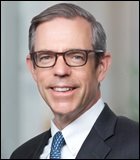
James L Bromley, Partner at Sullivan & Cromwell

James Bromley, One of the Partners at Sullivan & Cromwell Overseeing FTX Bankruptcy

Over the past week Wall Street On Parade has reached out to a number of individuals connected to FTX Capital Markets, the stock trading platform and SEC-registered brokerage firm that was majority owned by the indicted crypto kingpin, Sam Bankman-Fried. We’ve received two answers to our questions: Either, “I can’t talk about it” or “no comment.” Regulators have been just as tight-lipped. When we emailed one of the lawyers handling the bankruptcy process for FTX, James Bromley of Sullivan & Cromwell, the response came back from a crisis management/public relations firm, Joelle Frank. Their response was “decline to comment.”

Bankman-Fried’s ability to enter the regulated world of stock trading in the U.S. while, according to Justice Department prosecutors, he was operating a vast fraud, raises red flags about what other crypto firms may be doing or contemplating.

Despite all of the stonewalling, Wall Street On Parade has been able to significantly pull back the curtain at FTX Capital Markets. Here’s what we’ve discovered thus far.

The Wall Street self-regulator, FINRA, has documents on file showing that Sam Bankman-Fried is the indirect owner of 50 to 74 percent of FTX Capital Markets, which was purchased outright by an FTX related firm, West Realm Shires.

Despite the fact that the bankruptcy handlers for FTX are supposed to be maximizing value for the defrauded customers and investors, this brokerage firm has “ceased doing business” as of November 30 according to FINRA, just 19 days after the bankruptcy filing, and despite the fact that it was not part of the bankruptcy filing.

FINRA states that FTX Capital Markets had two primary business lines: “retailing corporate equity securities over-the-counter” and “arranging for transactions in listed securities by exchange member.” Bankman-Fried bought this brokerage firm, previously called RJL Capital, in August of last year. It had been in operation since 2011. The price he paid is unknown at this time.

In the declaration that the newly appointed FTX CEO, John Ray, filed with the bankruptcy court on November 17, he stated that “Based on the information that I have reviewed at this time” both FTX Capital Markets and an affiliated company, Embed Clearing LLC, are “solvent.” Neither firm was part of the bankruptcy petition.

If FTX Capital Markets was solvent, why wasn’t it sold quickly so that customer accounts could move easily to another SEC-registered brokerage firm, as is typically the case? If FTX Capital Markets was insolvent and Bankman-Fried used it also as his personal piggy bank, why wasn’t this mentioned in the SEC complaint filed against Bankman-Fried or the indictment filed by the Justice Department?

According to the FTX Capital Markets customer agreement, Embed Clearing was the entity that would execute the stock trades for customers; clear the trades; and custody the securities for the customers. Embed Clearing and its parent, Embed Financial Technologies, Inc., were also not part of the bankruptcy filing. According to a motion filed just yesterday in bankruptcy court, the court is being asked to authorize a quick sale of Embed Clearing and its parent. Notably, those in charge of the bankruptcy want to offer Embed for sale “free and clear of liens, claims, interests and encumbrances.”

A notice has been posted on the Embed Clearing website advising FTX Capital Markets’ customers as to how they can gain access to their account records. It reads in part:

“The Account Recovery Portal will let you:

“View current stock and cash balances

“Enter sell orders during market hours to dispose of current holdings at market prices

“Create a funding source to securely disburse funds to your requested bank account

“Retrieve account document such as statements, trade confirmations, and tax forms

“View transaction history*

“We appreciate your prompt action.

“The Embed Clearing Team

*For FTXCM customers: Your transaction history will include the deposits and withdrawals of cash that were settled automatically between your FTX US fiat balance and your brokerage account. Note that portfolio values are calculated using the prior trading day closing price.”

Based on this language, it suggests that only closing “sell” orders are being allowed and continued trading in the account is not being allowed.

Embed Clearing is also an SEC-registered broker-dealer and a member of the Securities Investor Protection Corporation (SIPC), the organization that in case of a brokerage firm failure protects securities in the account up to $500,000, including up to $250,000 protection for cash that is held in the account for the purpose of trading securities. If these Embed Clearing/FTX Capital Markets customer accounts are being processed as a SIPC liquidation, no regulator is willing to discuss it.

According to the FTX Capital Markets customer agreement, cash in the account was to be held by an unnamed, federally-insured bank. The most recent audited financial statement for the period ending March 31 for FTX Capital Markets states this:

“The Company’s cash is held at one financial institution which is insured by the Federal Deposit Insurance Corporation and at times may exceed federally insured limits. The Company has not experienced losses in such accounts and believes it is not subject to any significant credit risk on cash.”

FTX Capital Markets does not appear to have employed many licensed brokers or staff. The audited financial statement shows that the lease on its headquarters was only costing “$722 per month.” That will get you the office space the size of a large closet in lower Manhattan. (At the time of the audit the firm was located on Broad Street in the financial district in lower Manhattan.)

We called the current phone number listed by FINRA for FTX Capital Markets on multiple occasions this week. No one answers the phone and there is no voice message regarding whom to call to retrieve the assets in your account. Even more bizarre, the phone number that FINRA lists for the firm is the same phone number for a cricket company called DreamCricket. The man FINRA lists as the President of FTX Capital Markets, Venu Palaparthi, has a Twitter page listing himself as “Opening Batsman for DreamCricket.com.” Palaparthi’s LinkedIn profile shows him as Founder of DreamCricket.

Palaparthi’s LinkedIn profile indicates that he is a Fellow at the Center for Financial Markets and Policy at Georgetown University McDonough School of Business. We attempted to reach him there via email yesterday. The Center advised he is no longer affiliated with the Center.

While Palaparthi’s LinkedIn page does not show him employed at FTX Capital Markets, FINRA shows him registered at FTX Capital Markets since May 18, 2022 through the present. FINRA files are typically kept up-to-date with little more than a few days lag. We attempted to reach Palaparthi through multiple channels but have yet to receive a return email or phone call.

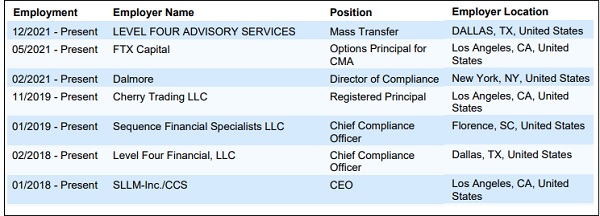
Adding to the bizarre nature of this firm, one licensed broker who FINRA lists as currently employed at FTX Capital Markets is Stacey Lynn Lavender (a/k/a Stacey Lynn Lavender-Mayes; a/k/a Stacey Lynn Mayes). FINRA shows Lavender simultaneously working at seven different firms. This includes serving as Chief Compliance Officer simultaneously at two firms: Sequence Financial Specialists LLC in Florence, South Carolina and Level Four Financial LLC in Dallas, Texas. Lavender is also listed as a Director of Compliance at Dalmore in New York City; as the CEO at a firm called SLLM-Inc./CCS in Los Angeles; as a Registered Principal at Cherry Trading in Los Angeles; and as an Options Principal at FTX Capital Markets.

FINRA records indicate that both Cherry Trading and FTX Capital Markets show recent requests to have SEC terminate their registration as a broker dealer as well as requests to terminate their state licenses. FINRA also shows that Cherry Trading is majority owned by an individual named Seiji Kawajiri through a company called SK World Group 1.

Anyone who has ever held a securities license through a major retail brokerage firm, such as Merrill Lynch, Morgan Stanley or Wells Fargo, knows that one has to get special permission to engage in any employment outside of your brokerage firm. It is highly discouraged because it can lead to conflicts of interest and an inability for your firm to monitor these outside activities. The possibility that someone would be allowed to work in the critical position of Chief Compliance Officer and Director of Compliance simultaneously at three firms while functioning as a CEO of another company, while finding time to be an options principal at a Sam Bankman-Fried operation, is beyond bizarre.

Lavender’s LinkedIn profile shows her working “full time” at Level Four Financial. Attempts to reach her by phone, in order to clarify the situation, failed. An email to her superior at Level Four Financial, inquiring if she is still employed there as Chief Compliance Officer, has yet to elicit a response.

Stacey Lynn Lavender Current Employment History at FINRA's BrokerCheck

Stacey Lynn Lavender’s Present Employers Listed at FINRA

Clearly, the American people still have very limited visibility on what Sam Bankman-Fried was up to in U.S. markets.

Related Articles:

No One Trusts the FTX Bankruptcy Case: News Outlets Intervene; Justice Department Trustee Demands Independent Examiner; SEC Orders Disclosures

Big Law Firm, Sullivan & Cromwell, Did Significant Legal Work for Bankrupt Crypto Exchange, FTX

LINK


Top News | 'He’s Not Going to Run Unopposed': Sanders Rejects Schumer for Majority Leader

                                                               LOTS OF POSTS IGNORED BY BLOGGER..... OR REMOVED ON THEIR WHIM! ALL POSTS ARE...