| ||||||||||||||||||||||||||||
|
| ||||||||||||||||||||||||||||
|
SUBSCRIBE TO THIS NEWSLETTER TO MONITOR FINANCIAL MARKETS
By Pam Martens and Russ Martens: May 26, 2022 ~
On Tuesday, the New York Fed’s trading desk released its annual report showing what it was up to in 2021. The New York Fed is the only one of the Federal Reserve’s 12 regional Fed banks to have a trading desk operation with speed dials to Wall Street’s trading houses, so we’re always interested in reading the “official” version of what’s been happening there.
The report is a deeply sanitized version of the facts on the ground. (For example, there is nothing in the report to indicate that the New York Fed has established a second trading floor near the futures exchange in Chicago.)
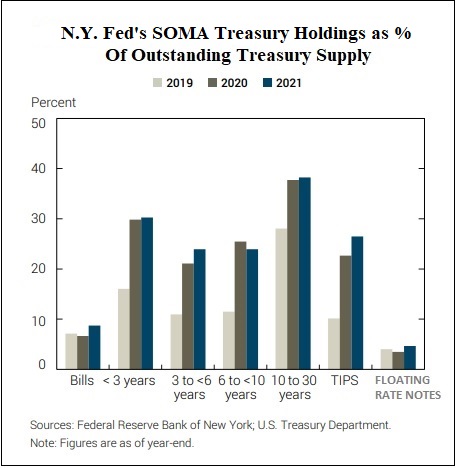
However, there is one paragraph in the newly-released report that took our breath away. It reveals that the New York Fed’s trading operation (officially called the System Open Market Account or SOMA) currently owns 38 percent of all outstanding U.S. Treasury Securities with 10 to 30 years remaining until maturity. (See the last two paragraphs on page 33 of the report.)
There are multiple reasons that this detail takes our breath away. First of all, the U.S. Treasury market is massive – at $22.6 trillion as of year-end 2021. That any one entity controls a big chunk of the market is deeply concerning. (The same report showed that the New York Fed’s trading desk owned 25 percent of all maturities of outstanding Treasury debt.)
The New York Fed’s trading desk owning 38 percent of the 10-30 year Treasuries is also deeply alarming because it is that maturity range that has a dramatic impact on the interest rate of the 30-year fixed-rate residential mortgage, the most popular mortgage among first-time homebuyers historically. It means that the New York Fed’s gobbling up of these 10-year U.S. Treasury Notes and 30-year U.S. Treasury Bonds, to the tune of 38 percent of the market, has created artificial demand for these instruments that would not otherwise exist. That, in turn, means that mortgage rates have been artificially held lower – much lower – than they would otherwise have been.
Even more alarming, it means that the recent announcements by the Fed that it will be reducing its purchases of Treasury securities and shrinking its balance sheet by reducing the amount of principal payments that are rolled over into new Treasury securities, is going to have a dramatic impact on residential mortgage rates.
The chart below shows how the 30-year fixed rate mortgage has risen since the Fed made its first announcement of QE tapering on November 3, 2021 and subsequent tapering announcements. The 30-year fixed rate mortgage has spiked from an average of 3 percent to 5.25 percent as of May 19 of this year – an increase of 75 percent. The dramatic spike in the rate over a period of just seven months has priced many first-time home buyers out of the market.

The Fed calls its purchases of Treasuries and other debt instruments “Quantitative Easing” or QE. The Fed embarked on three rounds of QE between 2008 and 2012 in an effort to stimulate the economy and get it back on a sound footing after Wall Street crashed the economy with its derivatives and subprime debt bombs in 2008.
When the repo market blew up in the fall of 2019, the New York Fed cranked up its QE operations again and ramped them up further when the pandemic hit in 2020. In June of 2020, the Fed began purchasing a total of $120 billion in debt securities each month, a larger amount than during the 2008 financial crisis.
The Fed’s balance sheet has grown from $924 billion on December 26, 2007 – prior to the financial crash of 2008 – to $8.99 trillion as of last Wednesday.

27 May 22
Live on the homepage now!
Reader Supported News
For many Mariupol residents, Russia’s brutal attack on the city was just the beginning. Next came the interrogations, humiliation, abuse, and forced deportations.
She had heard the rumors about a potential Russian invasion. “But everyone thought it was just some kind of panic. We didn’t understand how dangerous it was,” she said. “For the past eight years we have listened to the distant sounds of shooting and we understood that we were at war already.”
Mariupol had been the target of Russian forces in 2014 when President Vladimir Putin first invaded, using special forces and separatist proxies to occupy a swathe of territory the size of New Jersey. It saw some fighting on the streets then and was struck by a devastating missile barrage in January 2015. But in the years since, Mariupol had been largely out of firing range, as the hot phase of the war gave way to a grinding battle of attrition. Residents had grown relatively comfortable living adjacent to a static frontline. “We shrugged our shoulders, so to speak,” Oksana said.
But Feb. 24, she realized, was different. Soon Russian jets were flying overhead. As the bombing intensified, Oksana — who, like the other people in this story, requested that last names not be used — grew concerned about the safety of her children. Her ex-husband called and suggested they all meet at his parent’s apartment building, which was built after World War II and had solid walls and a basement. They grabbed a few personal items amid the explosions and ran.
But they didn’t feel safe there. When they heard that people were gathering in a fortified bomb shelter beneath the neighborhood’s House of Culture building, they decided to move.
Two days later, in the building’s underground rooms, she found other members of her family, including her 24-year-old niece Daria, along with some 60 other people. They didn’t know it at the time but they would all spend the next three weeks in the chilly shelter, in the dead of winter, without once stepping foot outside.
Food and water were scarce, the women said. Daria said the family relied on her grandfather, who had been a military doctor in Soviet times, to bring them bread and whatever else he was able to gather. They huddled together for warmth in the darkness, using a flashlight to illuminate the shelter when the electricity went out. Daria’s younger sister, Marina, sketched their experience in her diary, illustrating in gray pencil the dark and terrifying situation. Over the next days, the House of Culture’s walls were pounded with artillery shells. Daria feared the ceiling would collapse. “It became clear that this wasn’t a safe place. They were actually targeting the building,” she said.
Daria, a freelance book editor, said the 20 days they spent huddled a cold, dark bomb shelter “was a nightmare.”
But what came after was hell.
Daria and Oksana told POLITICO that they emerged from the shelter to find Russian troops silhouetted by the first sunlight they had seen in weeks.
The soldiers crammed their family with hundreds of other Ukrainians onto rickety buses, deprived them of food, water, and access to toilets, and trafficked them from their home, through a “filtration camp,” and across the border into Russia over the course of several days in March.
But their ordeal didn’t end there; while Daria was able to escape Russia within days with the help of local connections, Oksana and her two children were taken to a temporary housing facility deeper in Russia, where her captors said they should be “de-nazified,” a term stemming from President Vladimir Putin’s bogus justification for his invasion.
“They simply want to get rid of Ukraine and its people,” Oksana said.
A systematic campaign of forced displacement
Their ordeal is a microcosm of what is happening to more than one million Ukrainians in the Russian-controlled eastern regions.
The Kremlin’s soldiers are rounding up Ukrainians in areas they occupy and forcing them into camps, where they are separated from their families, stripped of their personal documents and sometimes their clothes, searched and interrogated by troops and security service agents, and pressured to incriminate their loved ones and smear the Ukrainian military. Often, they are trafficked across the border to guarded compounds in Russia hundreds or sometimes thousands of miles away from their homes, according to Ukrainian victims, U.S. and Ukrainian officials, and documents obtained by POLITICO.
In many if not most cases, these people do not want to be taken to Russia but are threatened with violence by armed troops, according Ukrainian authorities. Besides Daria and Oksana, POLITICO spoke with three people who were forcibly deported and processed through so-called filtration camps in Russia-controlled areas of eastern Ukraine before being taken across the border and placed in various buildings, including dormitories and penal colonies, where their freedoms are restricted. They confirmed details about the filtration camps but asked not to be quoted for this story because they have family still residing in Mariupol and other areas under Russian control and fear for their safety.
More than 1,185,000 Ukrainians, including 206,000 children — 2,161 of which are orphans — have been taken from eastern and southern Ukraine to Russia since the start of Putin’s invasion on Feb. 24, according to Lyudmila Denisova, Ukraine’s human rights ombudsman. Those figures closely align with Russia’s own figures, although Moscow has claimed the Ukrainians asked to be evacuated for their own safety. Despite evidence to the contrary, the Russian Embassy in Washington wrote on Telegram that the camps are “checkpoints for civilians leaving the zone of active hostilities.”
Foreign Minister Sergei Lavrov said that since late February about 1 million people, including many from areas of the Donetsk and Luhansk regions that have been under Moscow’s control since 2014, have been moved to Russia. Speaking to POLITICO in an interview at her Kyiv office last week, Denisova called what Russia is doing “forced deportation” and a “war crime.”
Documents provided by Denisova to POLITICO that she said were obtained by Ukraine’s intelligence services purport to show that Russia had plans in place for filtration camps and resettlement areas weeks before the invasion.
One document shows the deadline for bringing temporary holding centers across Russia to 100% readiness was Feb. 21. Another document dated Feb. 26, two days after Russian forces entered Ukraine, shows that 36 locations across Russian territory were prepared to hold at least 33,146 Ukrainians in 377 temporary shelters. The documents detail shelters located in five of Russia’s eight federal districts, including the North Caucasus, Siberia and the Far East. A handful are as far away as 4,500 miles from Mariupol, some are above the Arctic Circle.
POLITICO could not independently verify the authenticity of Denisova’s documents, but their contents align with intelligence from the U.S. and other Western governments about Moscow’s intentions, as well as reports from internationally recognized human rights groups — even Russia’s own government figures.
“All these documents and reports show that these were planned actions, these are systematic actions,” Denisova said. “This is a genocide of Ukrainian people, a war crime.”
President Joe Biden has also labeled Russia’s atrocities in Ukraine genocide. “It’s become clearer and clearer that Putin is just trying to wipe out the idea of being Ukrainian. The evidence is mounting,” he said last month.
According to Ukrainian government information, Russia is still forcibly deporting 15,000 to 25,000 Ukrainians from areas of eastern Ukraine under the control of Russian forces every day. Besides the benefit of emptying cities and towns in order to better conduct its war in Ukraine, Denisova believes that Moscow wants to replace Ukrainian residents of the cities under its control with Russians and fill some of Russia’s sparsely populated areas with Ukrainians. Both measures, she said, are meant to “Russify” Ukrainians and “erase our national identity.”
Oksana and Daria said their experience proves just that. They spoke to POLITICO by Skype from Latvia and Sweden, respectively, where both are now safe after escaping Russia. Their family’s story provides a rare glimpse inside Russia’s systematic deportation of Ukrainians and its filtration camps, or what the women and Ukraine’s government say are modern-day concentration camps. And it shows the excruciating lengths to which a few lucky Ukrainians have had to go to regain their freedom.
‘The first time I had seen the sunlight’
On March 15, after 20 days of hiding in the Mariupol shelter, Russian soldiers barged in, opened the bomb door, and ordered all the women and children to board buses that were waiting outside.
“I don’t remember clearly how many soldiers there were, because it was the first time I had seen the sunlight in many days,” Daria said. When her eyes finally adjusted to the brightness, she was able to see the destruction around her. “Everything was destroyed,” she said. In the chaos, a woman died of a heart attack because the soldiers wouldn’t provide her with medical care. Men were ordered to stay behind; Daria doesn’t know what happened to them. The Russians even separated an older disabled man from his wife.
Denisova, the human rights ombudsman, said the men are often taken to a separate location in Russian-occupied areas, where they are strip-searched and examined. “They look at their tattoos” for anything that might suggest they are part of the Ukrainian military or nationalist organizations. They also check for calluses and bruises on their arms and index fingers, signs that could indicate they had recently handled a gun.
“Many of the men are being forced to do manual labor, including sorting through the rubble of destroyed buildings, pulling out corpses,” Denisova said.
One place where they’ve been put to work, she said, is the site of the demolished Mariupol Drama Theater, where as many as 600 people sheltered in its basement may have been killed by a Russian airstrike on March 16.
The buses took Oksana and her children — as well as Daria and her sister Marina and the girls’ grandmother — east from Mariupol. The trip took several hours. Outside the windows was the devastation of war: shattered buildings, blown-up bridges, missile craters. They stopped at the village of Bezimenne, which translates as “Nameless,” about 15 miles west of the Russian border. Russian troops, emergency workers, and agents of the Russian Federal Security Service, the FSB, were waiting for them inside a series of tents, the women said.
Adults and children alike were photographed from various angles, fingerprinted and palm-printed like they were being booked for a crime, Daria said. Then everyone was forced to turn over their home addresses and passport information.
They also had to unlock and turn over their phones, which were plugged into a computer. All of their data and contacts were then downloaded, Oksana and Daria said. The Russians scanned through photographs and accessed social media accounts. It was all done to “check” whether they had “connections with the Ukrainian state or with military personnel,” Oksana said. Daria said they specifically asked her whether she was affiliated with Right Sector, a marginal right-wing militant group that Russia falsely claims is part of an extremist contingent that controls Ukraine.
Oksana said her children were also interrogated by FSB agents, who were particularly concerned about some photos her teenage daughter had on her phone from an art competition in which she placed second two years earlier. The competition was sponsored by Ukraine’s Ministry of Internal Affairs. “When they found these photographs, the immediate question was, ‘How are you related to this structure?’”
All of them were asked about the war. “They asked us, who is to blame? Who’s right and who’s wrong?” Oksana said.
The questioning lasted well into the night and long after they were exhausted, the women said. Some people gave answers that the Russians didn’t like; they were taken to a separate area and not seen again. The women believe they were moved to the city of Donetsk or other places where Russia’s local separatist proxies had detention centers.
Around midnight, Oksana and her children, along with Daria, Marina, and their grandmother were put back on the buses and driven further east, passing through the town of Novoazovsk, in the dark of night. The temperature was well below freezing and they had no blankets with them. They recalled shivering on the cold buses. It was 2:17 a.m. when they arrived at the Russian border.
Welcome to Russia
Another round of interrogations began immediately, this time by Russian border guards. Daria and Oksana were asked loaded questions about what they saw the Ukrainian army destroy, and with which weapons. “Of course, I said that we had been sitting in the bomb shelter all these days, so we didn’t see anything, we didn’t know anything,” Oksana said. After they answered the questions, Daria said, the guards would repeat them in a different order. “The questions were always the same. They were just trying to confuse people and get them to confess something,” Oksana said.
Each interrogation lasted between 30 minutes and an hour. There were hundreds of people to get through. The questioning finished around 11 am, and then they were back on the buses. Their next stop was Taganrog, a port city in Rostov Oblast.
There, some of the Ukrainians were given a choice: If they had passed the filtration camps and interrogations without raising any red flags and had means to go on their own, they could do so. Daria and her sister Marina were able to raise some money through friends and a burgeoning network of volunteers in Russia helping Ukrainians taken there. It was enough to get them a train to Moscow and eventually to St. Petersburg. From there they made their way to Ivangorod near the border with Estonia, where they were able to cross into Narva after a four-hour document check on March 20, five days after their forced evacuation east began.
Otherwise, the Ukrainians were taken further into Russia and placed in temporary housing facilities. Oksana, who had left her passport when she fled her apartment, was separated from her nieces and forced onto a train with her two kids that took them to Moscow and then onward to the city of Vladimir, more than 900 miles north of Mariupol.
When they arrived on March 19, they were met by a horde of Russian news crews from state-run television channels eager to show how authorities were helping Ukrainian refugees.
“We were tired, hungry, dirty, and of course unwashed. We had been in a basement for a month, we drove for days, and then we had these cameras and microphones stuck in our faces,” Oksana recalled. “I felt like I was in some kind of zoo.”
She said local authorities gave every family 10,000 rubles, or about $150, and told them they should be grateful for the assistance. Oksana and her children were escorted to a tiny room they would share for the next month.
During that time, Oksana said they endured at least four more interrogations. Every week an official from a government agency, including an agent from the FSB, came to ask them questions about their feelings toward the Ukrainian military. One told her she needed to get her children enrolled in school, which she reluctantly did because she felt they needed some semblance of normalcy after weeks of disruption.
But at school, Oksana said, her oldest daughter was teased by students for being a refugee and two teachers behaved in a “hostile” manner toward her for being Ukrainian. The curriculum included revisionist history lessons about how Ukraine wasn’t a real country but something that was created by Russia, and thus something that could — and should — be taken away.
One day, a group of Russian soldiers arrived with a television news team in tow and pulled Oksana’s daughter out of class. They took her and a few other Ukrainians into a small room where they began asking them to discuss how the Russian army had saved them.
“My daughter was just hysterical afterward,” Oksana said. “She didn’t want to be asked those questions and she didn’t want to be on camera. Then they used these pictures in their propaganda.”
“After that, after this incident, I just realized that there would be no life here,” she added.
Escape to the West
On April 18, she told her children to pack their bags. Using a special permission slip she had been given to allow her to find work in the city, she and her children left the housing unit, saying they were going to visit distant relatives nearby.
On April 20, they arrived in Ivangorod and attempted to cross into Narva, following in Daria’s tracks. But Russian border guards turned them away because Oksana didn’t have her passport. A second attempt the following day also failed. After seeking advice from an acquaintance, they managed to find another way — but it would take four days, two trains, and a taxi to get them safely into Latvia. Oksana asked not to disclose exactly how they managed to escape Russia over fears that disclosing the route could prevent other Ukrainians from doing the same.
Oksana, Daria and the rest of the family are now safely residing in Latvia and Sweden and being treated well by their host countries, they say they want to return to Ukraine — but only when it’s safe to do so.
“Home is home,” Oksana said. But recalling the Russian bombing of Mariupol, she sighed. “But what’s left of it?”
Special Coverage: Ukraine, A Historic Resistance
READ MORE
Follow us on facebook and twitter!
PO Box 2043 / Citrus Heights, CA 95611
|
|
|
|
|
|
|

28 April 22
Live on the homepage now!
Reader Supported News
Nineteen children and two adults were murdered in Texas. This is the country that gun-rights advocates have chosen.
This is the second-deadliest K-12 school shooting in U.S. history, after the December, 2012, massacre at Sandy Hook Elementary School, in Newtown, Connecticut, where twenty children and six educators were killed. Eventually, Sandy Hook also came to be seen as the graveyard of the gun-control movement: in 2013, a new assault-weapons ban, and also a bill to require universal background checks for firearm sales, failed in the Senate. If an entire classroom of dead first-graders could not spur even remedial action in Congress on gun control, nothing would. And nothing has.
A few months after Sandy Hook, the agitprop-documentary-maker Michael Moore, writing in HuffPost, imagined a scenario in which the parents of the victims leaked photographs of the classroom crime scenes to the press. If that were to happen, Moore argued, the horrifying images would have the same galvanizing effect on activist movements and public opinion as those of Emmett Till, in 1955, or Phan Thi Kim Phúc, in 1972. “There will be nothing left to argue over,” Moore wrote. “It will just be over. And every sane American will demand action.” (Just like that!) Sandy Hook parents swiftly shut Moore down, but there was a kernel of sense in his proposal—he was grasping for some method of defibrillation for a movement in arrest. Published images that represent school shootings are always heartrending and always the same: the surviving children filing out, some in tears, others in shock and excitement; the desperate parents; the sorrowful reunions. One of the many unforgivable obscenities of America’s gun obsession is how it can render the image of an anguished child and her caregiver, captured in real time as they absorb a life-altering trauma, as commonplace, interchangeable, even banal. Wait, which one is this again?
On Tuesday night, the poet Jana Prikryl shared the “Alas, poor country” passage from “Macbeth,” in which Ross laments that Scotland has become not a place to live but merely a place to die: “Almost afraid to know itself. It cannot / Be call’d our mother, but our grave . . . where violent sorrow seems / A modern ecstasy.” A modern ecstasy—and a habit, or a ritual, with its attendant ceremonies and scripts and rites. These always include cut-and-paste expressions of sympathy and concern from various bridesmaids of the National Rifle Association. Mitch McConnell, the Senate Minority Leader—who once said, following a school shooting in his home state of Kentucky, “I don’t think at the federal level there’s much that we can do other than appropriate funds” for school safety officers and counselling—tweeted that he was “horrified and heartbroken” by the tragedy at Robb Elementary School. Ted Cruz, the junior senator for Texas—who once ran a campaign ad that boasted, “After Sandy Hook, Ted Cruz stopped Obama’s push for new gun-control laws”—tweeted that he and his wife were “fervently lifting up in prayer the children and families in the horrific shooting.” Governor Greg Abbott—who last year signed seven pieces of gun-rights legislation into law, including one that permitted Texans to carry handguns without a license and another exempting the state from future federal gun restrictions—said that he and his wife “mourn this horrific loss and we urge all Texans to come together to show our unwavering support to all who are suffering.”
Politicians like these are routinely criticized for their hypocrisy and empty gestures—their “thoughts and prayers.” But, if only for the sake of rhetorical hygiene, we should go a step further. Republicans, as we know, get what they want. It is their best feature. They have vacuumed up the state legislatures, gerrymandered much of the country, stacked the Supreme Court and the federal judgeships, turned back the clock on L.G.B.T.Q. rights, paralyzed entire school districts with engineered panics over critical race theory and “grooming,” ended (or so it seems) reproductive rights as a constitutionally guaranteed freedom, and blocked all attempts at gun-control legislation. If the leaders of this political movement, which in Texas managed to ban most abortions and criminalize health care for trans kids in the space of a school year, took real offense to murdered children, they would never simply accept their deaths as the unfortunate cost of honoring the Founding Fathers’ right to take up muskets against hypothetical government tyranny. They would act. If America were not afraid to know itself, we could more readily accept that gun-rights advocates are enthralled with violent sorrow. This is the America they envisaged. It is what they worked so hard for. Their thoughts and prayers have been answered.
Special Coverage: Ukraine, A Historic Resistance
READ MORE
Follow us on facebook and twitter!
PO Box 2043 / Citrus Heights, CA 95611

28 April 22
Live on the homepage now!
Reader Supported News
Parents awaiting word on their kids were asked by police to provide DNA samples to help identify the children.
The request pointed to the obvious, horrifying conclusion that many of the children who had been killed were so grievously injured that it was likely impossible to identify their bodies.
How we got here should be obvious: the AR-15 rifle.
Much has been made of how easily the killer, Salvador Ramos, strode into a store and bought two AR-15s the week before the attack, an apparent birthday gift to himself. Anyone paying attention gets that the ease of purchase for such weapons — which are frequently used in mass killings — is an indication of how deep the gun problem in America runs.
It cannot be emphasized enough, however, exactly what the AR-15 is: It is a weapon of war. It was made to blow humans apart. It is successful in doing just that. The requests for DNA tests in Uvalde stand as a testament to the gun’s success, but the conclusion that the weapon excelled at blowing people apart was well documented by the U.S. military itself during early field tests.
During the Vietnam War, the U.S. conducted a survey into the impact of the AR-15 and its use on the battlefield. To put it bluntly, the survey found that the weapon, chambered with same .223 caliber rounds that Ramos used in Uvalde, was exceedingly good at killing human beings.
A copy of the survey, which was published in a Gawker story by my now-colleague Sam Biddle in 2016, shows that Viet Cong fighters hit with the weapon were frequently decapitated and dismembered, many looking as though they had “exploded.” A field report documented how an AR-15 had blown up a man’s head and turned another’s torso into “one big hole.” The weapon was lauded by soldiers on the battlefield for its effectiveness at killing adversaries and even cutting through dense jungle forest.
Some of the reports on Viet Cong soldiers killed with the weapon read like a matter-of-fact recounting from a horror film: “Chest wound from right to left, destroyed the thoracic cavity,” said the description of one AR-15-inflicted wound. “Stomach wound, which caused the abdominal cavity to explode,” said another.
Though it has become available domestically in the years since, the weapon was made for war — no matter what the National Rifle Association says — and was noted even at the time as being a significant escalation in the lethality of rifles.
It is hard to comprehend a weapon like this being used against small children in an elementary school. The impact of the AR-15, a tool designed not just for killing but for ripping apart adult human bodies in the most extreme manner, being turned on the small, delicate limbs and organs of young children does not need to be imagined. The parents waiting outside the school in Uvalde for news of their loved ones who were asked for DNA tests were being clued into something horrifying about the types of weapons floating around American society, so easily available that even a disturbed 18-year-old could get his hands on them.
In the aftermath of mass shootings targeting children, it is sometimes suggested that the public should be allowed to see the bodies. The impact of seeing actual flesh-and-blood children killed by assault rifles might shake the sensibilities of Americans enough that they enact serious changes to gun control laws that would make it less likely that AR-15s would be used again for such massacres.
Public aside, however, the reality is that the government has known for a long time what these weapons do. It has been sending AR-15s to wars abroad for decades and has documented in graphic detail the exploded and mangled corpses left behind. That such knowledge exists, and yet AR-15s are still commercially available for use by civilians in this country, tells you all you need to know about what pro-gun politicians are willing to tolerate.
The horrifying reality, which we all know, is that there will be another Uvalde sooner or later. The AR-15 is a demon that was unleashed on foreigners during wartime and has now returned as a demon to victimize innocent Americans, including the most innocent among us. A machine designed for the mass killing and maiming of other people — a design that had nothing to do with hunting or sportsmanship — should not be on American streets. At the minimum, no one in public life should be allowed to deny what it really does.
Special Coverage: Ukraine, A Historic Resistance
READ MORE
Follow us on facebook and twitter!
PO Box 2043 / Citrus Heights, CA 95611
LOTS OF POSTS IGNORED BY BLOGGER..... OR REMOVED ON THEIR WHIM! ALL POSTS ARE...


