Wednesday, April 20, 2022

RSN: Ken Klippenstein | Jared Kushner Flaunted His Influence With Saudi Arabia, Russia in Pitch to Investors


Reader Supported News
20 April 22

We Can’t Afford the Luxury of Failure

When we said no to the corporations and the moneyed interests we canceled our “option to fail.” The Same could be said of the times in which we live. We finish our funding-drives and we prevail because we must.

In peace and solidarity.

Marc Ash
Founder, Reader Supported News

Sure, I'll make a donation!


If you would prefer to send a check:
Reader Supported News
PO Box 2043 / Citrus Heights, CA 95611

Follow us on facebook and twitter!

Update My Monthly Donation


Reader Supported News
19 April 22

Live on the homepage now!
Reader Supported News

CONTINUE CHIDING US TO CONTRIBUTE — I truly don't believe enough have quite figured-out HOW much they need RSN … if they hope to see past the brain-washing of an a-moral, corporate-owned media oligopoly. Maybe I should just speak for myself, and say I need RSN in a major way. Seems like even our formerly-quite progressive NPR-affiliate has now "gone lame" on us. By the way, the post-article "comments" becoming ever-more important to me, in recent months. They're often-times superb! Continue chiding us to contribute. I'm sure it's vitally necessary -- if not much fun. Thanks so much.
Robert • RSN Reader-Supporter

Sure, I'll make a donation!


Then-White House senior adviser Jared Kushner stands among Saudi officials as then-President Donald Trump talks with Saudi Arabia crown prince Mohammed bin Salman at the White House on March 20, 2018, (photo: Jabin Botsford/Getty)
Ken Klippenstein | Jared Kushner Flaunted His Influence With Saudi Arabia, Russia in Pitch to Investors
Ken Klippenstein, The Intercept
Klippenstein writes: "Jared Kushner's new investment fund, Affinity Partners, nakedly touts the former Trump adviser's work with Saudi Arabia and his links to several Trump-era deals in the hope of raising money from Wall Street, according to a slide deck for the fund dated from December."

Affinity Partners boasts of “accelerating transformation through connectivity” in a slide deck obtained by The Intercept.

Jared Kushner’s new investment fund, Affinity Partners, nakedly touts the former Trump adviser’s work with Saudi Arabia and his links to several Trump-era deals in the hope of raising money from Wall Street, according to a slide deck for the fund dated from December. Last week, the New York Times reported that Kushner, Donald Trump’s son-in-law, won a $2 billion investment from Saudi Crown Prince Mohammed bin Salman’s investment fund for his own venture, just six months after he departed the White House.

The slide deck confirms the fund’s reliance on Kushner’s government experience and connections, particularly with regard to Saudi Arabia, to gin up business. The pitch to U.S. investors prominently advertises the team’s experience in the Trump White House, including on the Abraham Accords — a series of agreements that normalized formal diplomatic relations between Israel and some Arab countries — and a key oil production agreement reached with OPEC+, the oil cartel led by Russia and Saudi Arabia. “Aligned economic interests can solve intractable problems and create previously unrealized value,” reads one slide in the deck, which is marked “confidential.”

“Affinity’s unique network and experience makes us a differentiated partner for companies navigating the rapidly evolving global political and economic environment,” reads another. Affinity’s “value add” is depicted as a two-way arrow between “strategic partners/investors” and “target companies/operating businesses.”

The slides describe Kushner as “leading the negotiations on the historic OPEC+ oil agreement in April 2020 among the United States, Saudi Arabia, and Russia, which led to the largest oil production reductions in history as the Covid-19 economic crisis shocked global demand for the commodity.” Beyond smacking of revolving door politics, the reference to the agreement seems to hint at Kushner’s influence with the oil-rich Saudi kingdom. He traveled to the region earlier this year, meeting with Crown Prince Mohammed as well as the CEO of Aramco, Saudi’s national oil company.

It also contrasts sharply with U.S.-Saudi relations under President Joe Biden, who amid skyrocketing gas prices has repeatedly asked Riyadh to increase oil production to no avail. Saudi-Russia collusion to keep the global oil supply low has sent U.S. gas prices soaring to their highest levels in years, as the Intercept has previously reported. This has generated a bonanza of profits for Russia during its costly invasion of Ukraine, as well as punishing inflationary pressures in the U.S. Despite repeated entreaties from Biden for the Saudis to increase oil production, they’ve refused to budge. That’s unlikely to change. “Saudi has been very clear that it’s not increasing production,” Ellen Wald, a nonresident senior fellow at the Atlantic Council, told The Intercept. Riyadh wasn’t always so intransigent. In two election years — 2018 and 2020 — Saudi Arabia complied with then-President Donald Trump’s requests to increase and decrease production, respectively.

A spokesperson for Kushner denied there was anything untoward about Affinity’s pitch. “Jared was very successful in the private sector before he entered government, achieved great success in government, and many are confident he will enjoy continued success in his new venture,” the spokesperson told The Intercept in a statement. “Jared’s track record in government was unprecedented. His leadership and efforts led to the historic Abraham Accords, the [U.S.–Mexico–Canada Agreement] which was the largest trade deal in history, life changing criminal justice reform, Operation Warp Speed among many other achievements.”

The slides make repeated reference to Affinity’s “network,” which includes a bevy of Trump administration appointees depicted in a “Team Members” section. The pitch is light on details of the actual product, with business pablum peppered throughout: “Accelerating transformation through connectivity,” the slide deck begins.

A source in contact with multiple U.S. investors approached by Affinity said the investors were not attracted by the presentation and described their shock at how cavalierly it seemed to suggest influence peddling, a “value add” often handled with more subtlety in the investment world. “They said they’d never seen such a joke of a deck, openly talking about ‘networking’ and ‘networks’ — i.e., our corrupt insider contacts,” the source said on condition of anonymity to describe private discussions. “They’re bragging about ‘networks,’ they’re using cliches, with no serious investment discussion.”

Prior to the Saudi investment in Affinity, the Times reported, officials in the kingdom raised concerns about Affinity’s lack of experience in private equity, and the unsatisfactory results of due diligence reviews. They were also curious as to why the company didn’t yet have U.S. investors, which Saudi staff wrote was because “The Affinity principal would like to avoid media attention at this time.” According to the Times, documents “indicate that at this point Mr. Kushner’s venture depends primarily on the Saudi money.”

“Team Members” listed in the deck who served in the Trump administration include Avi Berkowitz, who served as an adviser to Kushner and helped with negotiations on the Abraham Accords, as well as retired two-star Gen. Miguel Correa, who served on Trump’s National Security Council. Correa, whose close ties to the leadership of the United Arab Emirates have been credited with helping to negotiate the accords, is also a team member in the Global Research and Geoeconomics division. (Correa even coined the phrase “Abraham Accords.”)

READ MORE


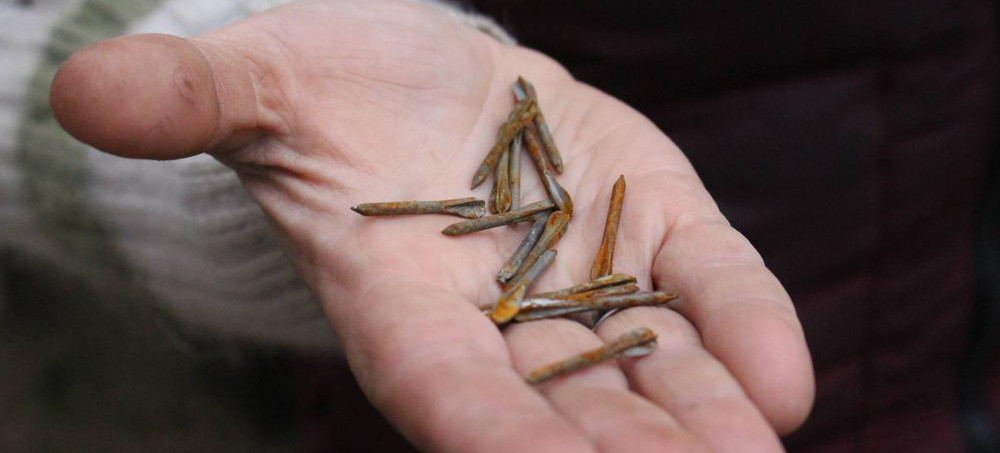
Lethal Darts Were Fired Into a Ukrainian Neighborhood by the ThousandsSvitlana Chmut holds fléchettes, small arrow-like projectiles dispersed by a Russian artillery shell, in Bucha, Ukraine, on April 16, 2022. (photo: Alex Horton/The Washington Post)

Lethal Darts Were Fired Into a Ukrainian Neighborhood by the Thousands
Alex Horton, The Washington Post
Horton writes: "At Svitlana Chmut's house outside Kyiv, there are carrots in her garden and deadly Russian mini-arrows in her yard."
READ MORE


Patrick Lyoya Shot in Back of Head by Officer While on Ground, Autopsy ShowsPeter Lyoya, center left, and members of his family lead hundreds of protesters through the Boston Square neighborhood during the Justice for Patrick Lyoya march in Grand Rapids on Saturday, April 9, 2022. (photo: Daniel Shular/MLive.com)

Patrick Lyoya Shot in Back of Head by Officer While on Ground, Autopsy Shows
Maya Yang, Guardian UK
Yang writes: "Lawyers for the family of Patrick Lyoya, a Black man killed by police in western Michigan, have released results from an independent autopsy."
READ MORE


Amazon Is Playing Dirty to Stop a Second Warehouse From UnionizingAmazon Labor Union organizers at the LDJ5 Amazon sorting facility on Staten Island, New York, which has a unionization election beginning April 25, 2022. (photo: Amazon Labor Union/Twitter)
Amazon Is Playing Dirty to Stop a Second Warehouse From Unionizing
Luis Feliz Leon, Jacobin
Leon writes: "In a massive victory, Amazon workers recently won a union at a warehouse in New York. So now the company is trying every trick in the union-busting playbook to throttle worker organizing at a second facility."
READ MORE


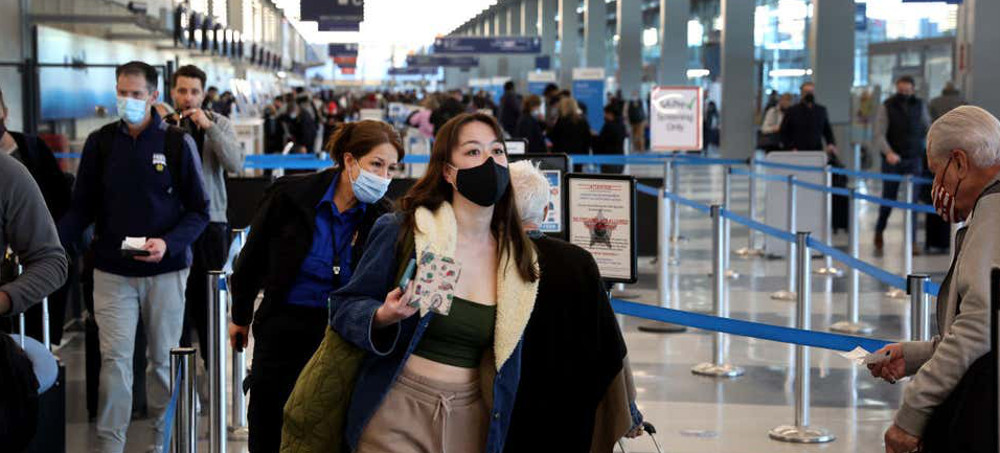
The Pandemic Isn't Over Yet, No Matter How Much We Want to Believe ItPeople go through TSA screening as they catch flights at O'Hare International Airport on March 11, 2022, in Chicago, Illinois. (photo: Scott Olson/Getty)
The Pandemic Isn't Over Yet, No Matter How Much We Want to Believe It
Murjani Rawls, The Root
Rawls writes: "Scrolling through my Twitter timeline yesterday, after a Florida judge struck down the mask mandate for public transportation, reminded me of the time former President George Bush spoke in front of the 'mission accomplished' sign in 2003."
READ MORE


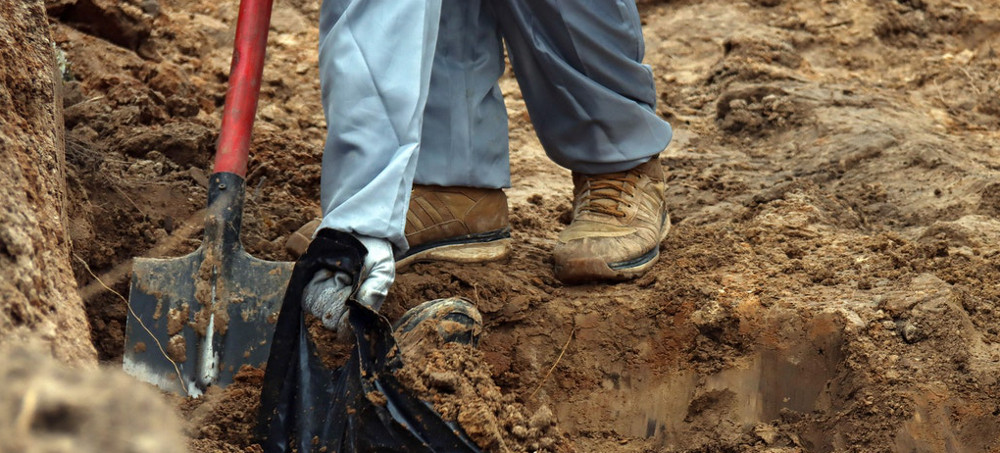
The Armenian Genocide Holds a Bitter Lesson for Those Who Weep for UkraineAn investigator pulls human remains from a mass grave in Bucha, Ukraine on April 13, 2022. (photo: Anatolii Siryk/Getty)
The Armenian Genocide Holds a Bitter Lesson for Those Who Weep for Ukraine
Jon Schwarz, The Intercept
Schwarz writes: "If there's one thing we can say for sure about the governments of the U.S. and Europe, it's that they sound upset about Russia's brutalization of Ukraine."
READ MORE


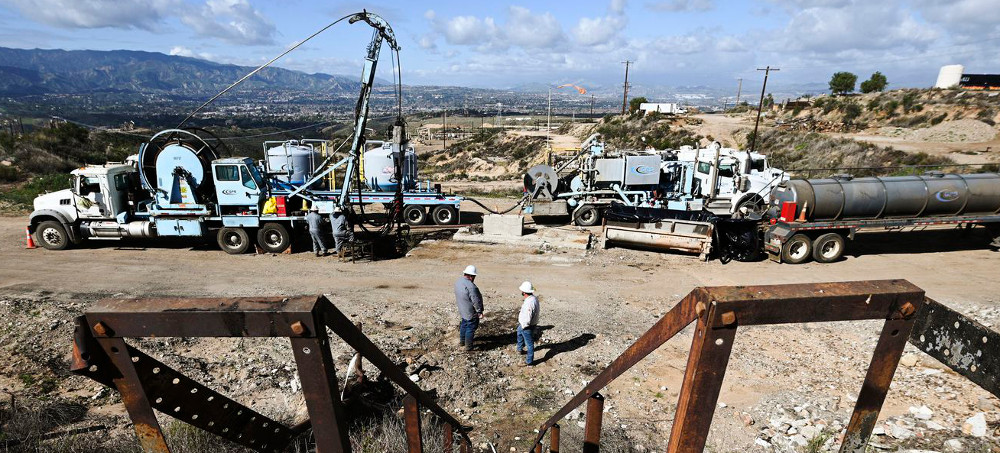
Geothermal: Clean Energy Is Buried at the Bottom of Abandoned Oil WellsA crew plugs abandoned oil wells at the Placerita Oil Field in Southern California. Abandoned oil and gas wells could be used to generate geothermal energy. (photo: Robyn Beck/Getty)

Geothermal: Clean Energy Is Buried at the Bottom of Abandoned Oil Wells
Neel Dhanesha, Vox
Dhanesha writes: "In case you missed it, our planet is in trouble."

The US is spending millions to explore a surprising source of untapped power.

In case you missed it, our planet is in trouble. The UN climate report from early April makes clear we’re on a path that will careen past the climate goals set in the Paris Agreement, and we need to cut carbon emissions — fast. But while solar and wind power are important (they are, after all, key parts of the Biden administration’s climate plan) they’re the kind of thing we’ve seen plenty of before, which means they’ll only get us so far. What we need, the UN report says, is new solutions. Which is why a pilot program recently detailed by the US Department of Energy (DOE) is particularly intriguing. If it works, it could help solve multiple problems at once, using an often-overlooked solution: geothermal energy.

Geothermal energy works on a simple premise: The Earth’s core is hot, and by drilling even just a few miles underground, we can tap into that practically unlimited heat source to generate energy for our homes and businesses without creating nearly as many of the greenhouse gas emissions that come from burning fossil fuels. However, drilling doesn’t come cheap — it accounts for half the cost of most geothermal energy projects — and requires specialized labor to map the subsurface, drill into the ground, and install the infrastructure needed to bring energy to the surface.

But the US, in the wake of an oil and gas boom, just so happens to have millions of oil and gas wells sitting abandoned across the country. And oil and gas wells, it turns out, happen to share many of the same characteristics as geothermal wells — namely that they are deep holes in the ground, with pipes that can bring fluids up to the surface. So, the DOE asks, why not repurpose them?

What’s old is new again

That’s exactly what the agency’s pilot program, called Wells of Opportunity: ReAmplify, aims to do, awarding a total of $8.4 million to four projects across the country that will each try to tap into some of those old wells to extract geothermal energy rather than gas or oil. If they work, they could be the key to not only reducing the country’s use of planet-damaging fossil fuels, but also helping answer the question of how to transition many of the more than 125,000 people who work in oil and gas extraction across the country into clean-energy jobs.

“The idea here is basically that you produce oil and gas resources for a couple of decades, and at the end of the production of oil and gas, you don’t completely retire the assets — you turn them toward heat production,” said Saeed Salehi, associate professor of petroleum engineering at the University of Oklahoma and the leader of one of the four groups receiving funding from the DOE. Oil and gas wells have a limited lifespan of a few decades, Salehi explained, after which they become depleted. Geothermal energy, if managed correctly, doesn’t have that problem. “The beauty is that this is a constant source of energy which is not going to change. It’s probably going to be [there] forever, as long as your well is functioning,” Salehi told Recode.

Salehi and his team at the University of Oklahoma want to use four wells owned by Blue Cedar Energy, a local company, for a concept called “direct use” — using hot water to heat nearby buildings. The water can either be extracted from existing underground reservoirs or, as the University of Oklahoma team is doing, pumped into the ground and brought back to the surface. Salehi and his team expect the water they pump into the wells to heat up to temperatures around 150 degrees Fahrenheit, after which it can be used to provide heating and cooling for an elementary and middle school located about a mile away from the wells, in the town of Tuttle.

“There’s a huge opportunity to use these wells for heating and cooling our communities,” said Lauren Boyd, program manager of the Enhanced Geothermal Systems program in the DOE’s Geothermal Technologies Office, which oversees the Wells of Opportunity grants. More than half of the energy used by American households — only 7 percent of which came from renewable sources as of 2020 — goes toward heating and cooling. Using the millions of abandoned wells scattered around the country to switch the source of that heating and cooling to geothermal energy, then, could lead to a decrease in greenhouse gas emissions.

Salehi and his team are focused on heating and cooling because converting energy from one form to another often leads to some energy getting lost in the process. Depending on the temperature of the water underground, “only probably about 10 percent of the energy you take out of the ground is going to come back as electricity,” said Jefferson Tester, a professor of sustainable energy systems at Cornell University. “But if you do it with heat, you can get 90 plus percent, easily.”

That heat wouldn’t only be useful in the winter, either: in the summer, water from a geothermal well could be used to drive a machine called an absorption heat pump to cool buildings, essentially extracting the heat from the building and putting it into the water. That water can then be pumped into underground reservoirs, which will store the extracted heat for the coming winter.

To be considered successful, the University of Oklahoma project has to produce at least one megawatt of energy in one year — which is roughly enough to power a few hundred homes. Salehi is confident they will easily surpass that goal. “Our intention is for these four wells to be used for at least the elementary and middle school,” Salehi said, “but based on the simulations and computational work we have done, it’ll be good enough for three schools.”

Can geothermal go the distance?

Some European countries already rely on direct use of geothermal energy on a large scale; Iceland, which is famously volcanically active (remember Eyjafjallajökull, which shut down European air travel for a few days in 2010?), uses its vast reserves of geothermal energy to heat 90 percent of its homes. But there are some drawbacks to direct use. Heat is quickly lost in transit unless pipes are well-insulated, explained Patrick Fulton, assistant professor of earth and atmospheric sciences at Cornell, so geothermal wells being tapped for direct use have to be near the buildings they’re going to service — usually within a few miles.

That distance limitation is why the three other projects receiving funding from this year’s DOE award are focusing on turning geothermal energy into electricity, which can travel much farther than heat. While wells located close to towns and cities may be better used for supplying heat through direct use, wells in remote areas might be better suited for generating electricity.

Take Transitional Energy, a Colorado-based company that received funding from the DOE to set up an electricity generation facility at the Blackburn oil field in Nevada. Unlike the other projects, Transitional will set up its operations on an oil field that’s still in operation — albeit at wells that have been in use for decades and produce very little oil. Most of what they produce, explained Johanna Ostrum, chief operating officer of transitional energy, is extremely hot wastewater, which is a natural byproduct of all oil and gas operations. “They’re just cycling a bunch of water through the system, trying to strip out negligible amounts of oil,” Ostrum told Recode.
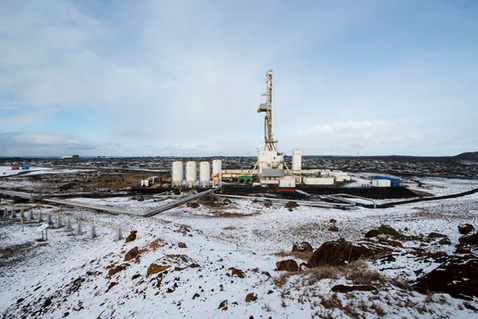

The Reykjanes geothermal power station in Iceland penetrates into one of deepest and hottest pits in the world, allowing the country to be nearly independent from fossil fuels.
(Halldor Kolbeins/AFP via Getty Images)
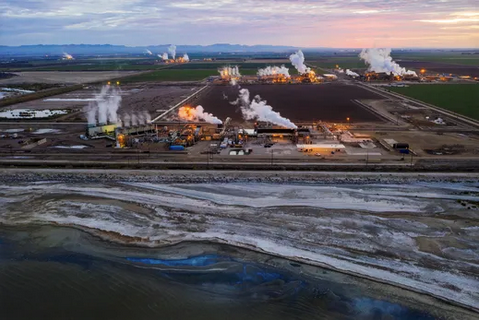

The Imperial Valley Geothermal Project is a complex of 11 geothermal power stations located near the Salton Sea in Calipatria, California.
(David McNew/Getty Images)

Once they’ve separated out the oil and gas, well operators spend considerable sums cooling and disposing of all that wastewater — and there’s often 10 times more of that water than extracted oil, Ostrum explained. Instead of letting that water — and its heat — go to waste, Transitional Energy plans to install machines called Organic Rankine Cycle Engines at the oil field that will turn that heat into electricity.

Organic Rankine Cycle Engines, which are about the size of walk-in refrigerators, work by passing hot water through a heat exchanger to heat a refrigerant, which then spins a turbine that creates electricity. The water cools down as it transfers its heat to the refrigerant, continuing onward down the path it would usually take out of the generator and into a disposal well; the refrigerant cools as it passes out of the turbine and past an air chiller, so it can be reused as the water keeps passing through the engine. At the Blackburn oilfield, where Transitional Energy is carrying out its test, that water will enter the same reservoir it came from — essentially creating a continuous loop of geothermal energy. “You take the same molecule of water and it just keeps going around and around, using the Earth as a radiator,” Ostrum said.

Like the University of Oklahoma project, Transitional Energy has a goal of generating at least one megawatt in a year — a goal Ostrum expects to hit by using the water from three to five wells. To begin with, the electricity generated will be used to provide power to an electric vehicle charger and operations at the oil field, which usually relies on local utilities or diesel generators to power machinery. It’s an alluring prospect for the operators of the oil and gas fields, Ostrum said; they see it as a way to take advantage of a heat resource that otherwise goes to waste.

In the short term, operating costs for the oil producers could go down, since they won’t have to depend on a utility to power their operations, and switching to geothermal energy would reduce the emissions involved in simply pumping oil and gas out of the ground. In time, Ostrum said, the goal would be for Transitional Energy to simply take over wells that no longer produce enough oil and gas to be economically viable and convert them entirely to geothermal operations.

A geothermal future

Ostrum is especially excited by the broader implications of her project. For one, Transitional Energy plans to connect electric vehicle (EV) chargers to their Rankine Cycle Engines. If scaled up, that could help expand rural EV charging, which is currently very limited — according to the Environmental and Energy Study Institute, the majority of rural areas and small towns have no EV chargers at all. More importantly, however, Ostrum thinks geothermal energy could create a new career path for oil and gas workers as the world transitions away from fossil fuels to clean energy.

“A lot of folks that I know work in oil and gas, and when we look at a decarbonized future, there’s not going to be jobs for those folks,” said Ostrum, who spent 15 years working in the oil and gas industry herself before losing her job during the pandemic. “I think geothermal is a really great place for them to land. Oil and gas workers know how to safely, efficiently, and economically produce fluid. They happen to be focused on the oil and gas part; I’m focused on the water part.”

Brett Dawkins, co-founder of Blue Cedar Energy, which owns the leases for the wells that will be used in the University of Oklahoma’s project in Tuttle, agrees. “All of the expertise that you would have as a petroleum engineer or a geologist will transfer over into the geothermal world,” Dawkins said.

Dawkins isn’t sure quite how much manpower would be needed to transition Blue Cedar Energy’s abandoned oil wells to geothermal energy. Ostrum, on the other hand, is confident workers at oil and gas wells would find new jobs extracting geothermal energy. “To keep the wells pumping or operating, we will need the same manpower that is used every day to run oil wells,” Ostrum wrote in an email. “The same amount of labor is needed to run an oil and gas well as to run a geothermal well.”

The possibility of generating a significant amount of energy from these abandoned wells is exciting. It’s still very much a nascent idea, though, so exploring its potential will take time. First, the projects need to prove their viability; the next year or so will be spent on planning and assessing the feasibility of turning oil wells into geothermal resources, after which energy generation will slowly ramp up. The biggest question is just how scalable these ideas are: One megawatt is, after all, a pittance compared to the country’s energy needs.

There are legislative hurdles to get around, as well. “One of the barriers I’ve been working on is the permitting,” said the DOE’s Boyd, who’s working with the National Renewable Energy Lab on a framework for transitioning an oil and gas lease to a geothermal lease. “Right now, it’s not straightforward,” Boyd told Recode. “There are some states that don’t even have geothermal regulations.”

It’s also unclear how widely those concepts can be applied across the country. Not every abandoned oil and gas well is going to be viable for repurposing to geothermal energy, Boyd said. The infrastructure at some abandoned wells might be too degraded to use for geothermal energy without a significant investment in retrofits, for example, or the underground temperatures at some wells may not be high enough to use for geothermal energy. Then there’s the question of distance: Connecting remote wells to the grid could prove too cumbersome, or there might not be enough wells located close enough to communities to set up for direct use.

Even if everything else falls into place, the final stumbling block, at least for Salehi’s team, could come in the form of homes and businesses that simply aren’t set up to use geothermal energy for direct use. While the end-user experience for someone with a direct use connection is the same as that for someone with a traditional HVAC system — essentially, hot or cold air blowing through vents in rooms — turning geothermal heat into that hot or cold air requires installing heat pumps or heat exchangers, the cost of which could prove prohibitive.

Still, even with all the caveats, the ReAmplify projects hold a lot of promise for cleaner energy and a more equitable clean-energy transition; the point of the pilot, after all, is to be a proving ground. But if they work, said Cornell’s Tester, it’s important not to think of geothermal energy as a magic bullet. “It’s not just a one-size, geothermal can do it all [solution],” Tester told Recode. “I don’t think we should be saying that as a profession, and neither should solar or wind.”

Instead, Tester said, Americans need to start thinking about our energy needs as interconnected systems with multiple parts to the solution. Instead of relying on one power source for everything, we should use solar and wind energy to power our appliances and electric vehicles, for example, while relying on geothermal energy to heat and cool many of our homes.

That’s going to require a shift in how we think about our energy sources, Tester said. In most of the country, the oil and gas extracted from a well can go toward heating and cooling homes, running appliances, and powering our cars; for a decarbonized future, that will have to change. “I don’t think we’ve gotten into a state yet of thinking of these things as systems,” Tester said. “I think that’s what we have to weave into the American mindset. It’s going to be a game, I think, for everybody to get all the renewables working together.”


READ MORE

Special Coverage: Ukraine, A Historic Resistance
READ MORE


Contribute to RSN

Follow us on facebook and twitter!

Update My Monthly Donation

PO Box 2043 / Citrus Heights, CA 95611


RSN: FOCUS | Volodymyr Zelenskyy: Liberation Without Victory


Reader Supported News
19 April 22

Live on the homepage now!
Reader Supported News

WE ARE GETTING INTO DEEP TROUBLE ON DONATIONS — RSN’s April Funding-Drive is largely being ignored. What we need to finish this, or any fundraiser is a drop in the bucket. But right now, there are few drops in the bucket. This way we have no chance.
Marc Ash • Founder, Reader Supported News

Sure, I'll make a donation!


Ukainian president Volodymyr Zelensky. (photo: Ronaldo Schemidt/Getty Images)
FOCUS | Volodymyr Zelenskyy: Liberation Without Victory
Anne Applebaum and Jeffrey Goldberg, The Atlantic
Excerpt: "A cheerful folk orchestra was performing for returning refugees at the main rail station earlier this week, on the day we arrived to meet Volodymyr Zelensky, the president of Ukraine. The normality is deceiving."

In a wide-ranging conversation at his compound in Kyiv, Ukrainian President Volodymyr Zelensky tells The Atlantic what Ukraine needs to survive—and describes the price it has paid.

Kyiv is halfway normal now. Burnt-out Russian tanks have been removed from the roads leading into the city, traffic lights work, the subway runs, oranges are available for purchase. A cheerful folk orchestra was performing for returning refugees at the main rail station earlier this week, on the day we arrived to meet Volodymyr Zelensky, the president of Ukraine.

The normality is deceiving. Although the Russians botched their opening campaign, they continue to bombard the capital and are now gathering in the east for a renewed attack on Ukraine. Zelensky has to prepare his country, and the world, for battles that could be deadlier than anything seen so far. The general in charge of the defense of Kyiv, Alexander Gruzevich, told us during a tour of the ravaged northwestern suburbs that he expects the Russians to try to return to the capital using intensified “scorched earth” tactics along the way: total destruction by ground artillery and air strikes, followed by the arrival of troops.

When we met Zelensky in Kyiv on Tuesday night, he told us the same thing: The optimism that many Americans and Europeans—and even some Ukrainians—are currently expressing is unjustified. If the Russians are not expelled from Ukraine’s eastern provinces, Zelensky said, “they can return to the center of Ukraine and even to Kyiv. It is possible. Now is not yet the time of victory.” Ukraine can win—and by “win,” he means continue to exist as a sovereign, if permanently besieged, state—only if its allies in Washington and across Europe move with alacrity to sufficiently arm the country. “We have a very small window of opportunity,” he said.

It was late in the evening when we met Zelensky at his compound. The surrounding streets were barricaded and empty, the building itself almost entirely blacked out. Soldiers with flashlights led us through a maze of sandbagged corridors to a harshly lit, windowless room adorned only with Ukrainian flags. There was no formal protocol, no long wait, and we were not told to sit at the far end of an elongated table. Zelensky, the comedian who has become a global icon of freedom and bravery, entered the room without fanfare.

“Hi!” he said, brightly, and then proceeded to complain about his back. (“I have a back, and that’s why I have some problems, but it’s okay!”) He thanked us for not filming the interview: Even though he’s been a professional television performer for all of his adult life, it’s a relief to occasionally go unfilmed.

On or off camera, Zelensky conducts himself with a deliberate lack of pretense. In a part of the world where leadership usually implies stiff posture and a pompous manner—and where signaling military authority requires, at a minimum, highly visible epaulets—he instead evokes sympathy and feelings of trust precisely because he sounds, in the words of a Ukrainian acquaintance, “like one of us.” He is a kind of anti-Putin: Rather than telegraphing a cold-eyed, murderous superiority, he wants people to understand him as an Everyman, a middle-aged dad with a bad back.

We started the interview by reminding Zelensky, the Jewish president of a mostly Orthodox Christian and Catholic country, that his words were going to appear on Good Friday on the Western calendar and just before the first seder of Passover, a holiday that marks the liberation of an enslaved nation from an evil dictator.

“We have pharaohs in neighboring countries,” Zelensky said, smiling. (The Belarusian president, Alexander Lukashenko, is, in the minds of many Ukrainians, a sort of deputy pharaoh to Putin.) But although Ukrainians face a formidable enemy, they are not longing for an exodus: “We’re not going anywhere.” Nor does Zelensky plan to spend 40 years wandering in the desert. “We already have 30 years of our independence. I would not want us to fight for our independence for another 10 years.”

Russia’s invasion has caused him to doubt whether it is still possible to associate religion with morality. “I do not understand when religious representatives of Russia”—here he meant the pro-Putin patriarch of the Russian Orthodox Church—“say they are faithfully empowering soldiers to kill Ukrainians.” Worse, “I cannot understand how a Christian country, the Russian Federation, with the largest Orthodox community in the world, will be killing people on these very days.” During the Easter season, the Russians are planning “a great battle in Donbas,” the Russian-occupied region in Ukraine’s far east. “This is not Christian behavior at all, as I understand it. On Easter they will kill, and they will be killed.”

As a result, many Ukrainians are going to spend the holy season under siege, hiding in basements. Others will not live to see the holiday at all. Just a few hours ago, early Friday morning, Russian bombs struck Kyiv again. “Ukraine is definitely not in the mood for celebration,” Zelensky said. “People usually pray for the future of their families and their children. I think that today they will pray for the present, just to save everyone.”

Much of Zelensky’s time is spent on the telephone, on Zoom, on Skype, answering the questions of presidents and prime ministers—often the same questions, repeated to a maddening degree. “I like new questions,” he said. “It’s not interesting to answer the questions you already heard.” He is frustrated, for instance, by repeated requests for his wish list of weapons systems. “When some leaders ask me what weapons I need, I need a moment to calm myself, because I already told them the week before. It’s Groundhog Day. I feel like Bill Murray.”

He says he has no choice but to keep trying. “I come and say that I need this particular weapon. You have it and here it is; we know where it is stored. Can you give it to us? We can even fly our own cargo planes and pick it up; we can even send three planes per day. We need armored vehicles, for example. And not one per day. We need 200 to 300 per day. These aren’t personal taxis, just for me; our soldiers need transport. Flights are available, the whole thing can be organized, we can do all the logistics.”

Later that night, one of Zelensky’s advisers texted us with a list of what, exactly, Ukraine needs to repel the invasion from the east:

Artillery, 155 millimeters

Artillery shells, 152 millimeters as many as possible

Multiple Launch Rocket Systems (“Grad”, “Smerch”, “Tornado” or M142 HIMARS)

Armored vehicles (armored personnel carriers, infantry fighting vehicles, others)

Tanks (T-72 tanks or similar tanks from the USA or Germany)

Air defense systems (S-300, “BUK” or western equivalents)

Military aircraft—MUST HAVE—to deblock our cities and save millions of Ukrainians as well as millions of Europeans)

It’s not that the various presidents and prime ministers who profess sympathy for the Ukrainian cause don’t want to help, Zelensky said: “They are not against us. They just live in a different situation. As long as they have not lost their parents and children, they do not feel the way we feel.” He makes the comparison to the conversations he has with the extraordinary defenders of Mariupol, the besieged port city where 21,000 civilians may have been killed so far. “For example, they say, ‘We need help; we have four hours.’ And even in Kyiv we don’t understand what four hours are. In Washington for sure they can’t understand. However, we are grateful to the U.S., because the planes with weapons are still coming.”

Zelensky’s chief of staff, Andriy Yermak, spoke with us later that evening, and also expressed his confusion about the pace at which the Biden administration moves. Washington is providing new weapons every day, and President Joe Biden just made an additional $800 million commitment to the defense of Ukraine. Yermak told us that he and Zelensky have strong relationships with many key American players—a break from the previous administration, which withdrew its ambassador just before Donald Trump’s “perfect phone call” with Zelensky (the call that triggered the first impeachment) and never replaced her. Biden, Yermak said, is “a man who can be trusted, not just a politician.” He had compliments for the secretaries of state and defense, and for leaders of Congress. And he praised Biden’s national security adviser, Jake Sullivan: “There is not a single minute when we did not speak specifically or in substance,” he said.

So everybody is great, but the weapons don’t come fast enough?

“Please tell me with whom else I should speak,” Yermak said.

Zelensky understands that his task is not merely to issue weapons requests and express urgency, but also to overcome old stereotypes of Ukraine as corrupt and incompetent, as well as the Russian propaganda that denies Ukraine the right to statehood. He wants to present an image of Ukraine as a modern and liberal state, one unified by a civic, as opposed to a purely ethnic, nationalism.

“The U.S., Britain, the EU, and European countries have always been skeptical of our development, of our ‘Europeanness,’” he said. But now “many of them have changed their view of Ukraine and see us as equals.” He has no time at all for international institutions. When he is asked about the role of the United Nations in defending Ukraine, one of its member states, from Russia, a member of the UN Security Council, he rolls his eyes and grimaces tragicomically. “Good thing we don’t have a video,” he says. “Just describe with words what you see on my face.” Both Zelensky and Yermak have been thinking and talking about what alternative international institutions might look like. Perhaps there should be a list of human-rights violations or war crimes that trigger automatic responses, Yermak suggested to us. Right now, the process of issuing statements, announcing sanctions, providing responses of any kind is too complex, too bureaucratic, and above all too slow.

But if Western leaders can frustrate Zelensky, Russians send him careering toward despair. He has, from time to time since the war began, spoken in Russian and addressed Russian audiences, something he is accustomed to doing: It’s what he once did for a living. His film and television production company was one of the biggest in the region, with an office in Moscow and viewers across the former Soviet Union.

His productive relationship with Russia and Russians came to an end in 2014, when people he had known for years stopped talking to him: “I just did not expect that people, a lot of partners, acquaintances—I thought they were friends, but they were not—just stopped picking up the phone.” Since then, many people he knows have changed, “become more brutal.” As Russia has shut down alternatives to state media—closing independent newspapers, television channels, and radio stations—Zelensky has found that his old acquaintances retreated further. “Even that small share of intelligent people, which was there, began to live in this informational bubble,” and he finds it very difficult to break through. “It’s the North Korean virus. People are getting absolutely vertical integrated messages. People don’t have any other way; they live in it.” He is clear about the author of the messages: “Putin has invited people into this information bunker, so to speak, without their knowledge, and they live there. It is, as the Beatles sang, a yellow submarine.”

Now, as Russian propaganda grows more baroque, he sometimes has trouble knowing how to process it. Perhaps that’s why he often leans on pop-cultural analogies: “The way they say that we’re eating people here, that we have killer pigeons, special biological weapons … They make videos, create content, and show Ukrainian birds supposedly attacking their planes. Putin and Lukashenko—they make it sound like some kind of political Monty Python.”

If Ukraine is to have a secure future, he says, the Russian information barrier will have to be broken. Russians don’t just need access to facts; they need help understanding their own history, what they have done to their neighbors. At the moment, Zelensky says, “they are afraid to admit guilt.” He compares them to “alcoholics [who] don’t admit that they are alcoholic.” If they want to recover, “they have to learn to accept the truth.” Russians need leaders they choose, leaders they trust, “leaders who can then come in and say, ‘Yes, we did that.’ That’s how it worked in Germany.”

Throughout the conversation, Zelensky displayed his gifts for spontaneity, irony, and sarcasm. He didn’t tell jokes, exactly, but he said that he cannot part with humor altogether. “I think that any normal person cannot survive without it. Without a sense of humor, as surgeons say, they would not be able to perform surgeries—to save lives and to lose people as well. They would simply lose their minds without humor.”

The same is true now for Ukrainians: “We can see what a tragedy we have, and it’s hard to live with it. But you have to live with it … You can’t be serious about what Russian politicians and Lukashenko say every day. If you take it seriously, you might as well go and hang yourself.”

Is Putin afraid of humor?

“Very much so,” Zelensky said. Humor, he explained, reveals deeper truths. The famous television series in which Zelensky starred, Servant of the People, mocked the pomposity of Ukrainian politicians, attacked corruption, and presented the little guy as a hero; many of his sketches were clever satires of political leaders and their attitudes. “Jesters were allowed to tell the truth in ancient kingdoms,” he said, but Russia “fears the truth.” Comedy remains “a powerful weapon” because it is accessible. “Complex mechanisms and political formulations are difficult for humans to grasp. But through humor, it’s easy; it’s a shortcut.”

Humor in Ukraine is now mainly of the darkest kind. At certain moments, Zelensky appeared stunned by the cruelty of it all. He tried to explain why he cannot feel—why most Ukrainians cannot feel—much sense of satisfaction in their underdog battlefield victories. Yes, they expelled the mighty Russian army from the northern part of the country. Yes, they killed, by their count, more than 19,000 Russian soldiers. Yes, they claim to have captured, destroyed, or damaged more than 600 tanks. Yes, they say they’ve sunk the flagship of the Russian Black Sea Fleet. Yes, they changed the image of their country, and their understanding of themselves. But the price has been colossal.

Too many Ukrainians, Zelensky told us, died not in battle, but “in the act of torture.” Children got frostbite hiding in cellars; women were raped; elderly people died of starvation; pedestrians were shot down in the street. “How will these people be able to enjoy the victory?” he asked. “They will not be able to do to the Russian soldiers what [the Russians] did to their children or daughters … so they do not feel this victory.” Real victory, he said, will come only when the perpetrators are tried, convicted, and sentenced.

But when will that be? “How long do we have to wait? It’s a long process, these courts, tribunals, international courts.”

Abruptly, he made it personal. He has two children, he reminded us. “My daughter is almost 18. I don’t want to imagine, but if something had happened to my daughter, I would not have been satisfied if the attack had been repelled and the soldiers had run away,” he said. “I would have looked for these people and I would have found them. And then I would feel victory.”

What would he have done when he found them?

“I don’t know. Everything.”

Then, as if remembering the role history has given him, as an avatar of democratic civilization confronting the cruelty of a lawless regime, he became reflective. “You realize that you want to be a member of a civilized society, you have to calm down, because the law decides everything.”

But he feels, viscerally, what so many Ukrainians feel. “There will be no complete victory for people who lost their children, relatives, husbands, wives, parents. That’s what I mean,” he said. “They will not feel the victory, even when our territories are liberated.”


READ MORE

Special Coverage: Ukraine, A Historic Resistance
READ MORE


Contribute to RSN

Follow us on facebook and twitter!

Update My Monthly Donation

PO Box 2043 / Citrus Heights, CA 95611


POLITICO NIGHTLY: GOP govs play final cards ahead of primaries


View in browser
 
POLITICO Nightly logo

BY MYAH WARD

Ohio Gov. Mike DeWine

Ohio Gov. Mike DeWine | Gregory Shamus/Getty Images

SLIDE TO THE RIGHT — In just two weeks, Ohio and Indiana will launch a busy portion of the 2022 primary calendar on May 3. And as the clock ticks down, GOP governors are gearing up for reelection across the country, making their final pitches to voters to show they’re still up for the job.

From Mike DeWine of Ohio to Oklahoma’s Kevin Stitt and Brian Kemp in Georgia, state leaders are enacting far-right policies, leaning into attention-grabbing and politically charged topics like abortion, guns and the southern border.

“In the months before and the weeks before a primary, you’re seeing governors and you’re seeing members of Congress really drive home messaging to their base — that they are conservative, they’re one of them, and they’re reflective of the values that come from the base,” veteran GOP strategist Doug Heye told Nightly. “This is sort of your last advertisement to your audience essentially.”

DeWine’s most recent ad, according to Facebook’s ad tracker, shows him signing the “Heartbeat Bill,” highlighting a “national leader in pro-Life Legislation.” Another ad says DeWine is “protecting your Second Amendment rights,” and one touts endorsements from Texas Gov. Greg Abbott and the National Border Patrol Council for DeWine’s views on immigration and the U.S.-Mexico border.

The Ohio Republican, who’s managed to successfully straddle the line between staying in former President Donald Trump’s good graces while not keeping him too close, will face off with three lesser-known conservatives who could potentially split the far-right vote, likely setting up DeWine for another term. The primaries are a good indicator of who’s going to be your next governor, Heye said. In the past few years, winning the primary means you have a strong chance of victory in November.

It’s worth noting that these governors each face their own unique set of challenges, and that they have their own styles for going about election-year strategy. Still, in many cases, the incumbent Republicans are shifting right, making their final plays to pull in base voters to beat out more conservative — and sometimes even Trump-backed — contenders.

Kemp is playing the same game in Georgia, making moves to loosen gun laws ahead of his May 24 primary. He signed a bill last week allowing Georgians to carry handguns without a license or background check, delivering roughly a month before he’s set to battle David Perdue, who won the former president’s endorsement after Trump turned on Kemp for refusing to challenge the state’s 2020 election results.

In Oklahoma, Stitt signed a near-total abortion ban last week and has vowed to sign “every piece of pro-life legislation” that goes before him.

And today, led by border state governors Abbott and Doug Ducey of Arizona, 26 governors announced the creation of a strike force to “secure” the U.S.-Mexico border. DeWine, Kemp, Stitt and Florida Gov. Ron DeSantis were among those who joined the effort.

As for the term-limited Ducey, Trump has blasted him as a “RINO” and endorsed Kari Lake, a former TV anchor who has become a frontrunner for governor. She still insists Trump won the state in 2020.

Other GOP governors’ motivations go well beyond 2022. DeSantis has made national headlines for his “Don’t Say Gay” law. And just last week, the potential 2024 candidate signed a 15-week abortion ban into law, once again building his national portfolio.

Abbott is another rumored 2024 contender who likes to keep his name on the big networks and in the White House briefing room. He’s sent multiple buses of migrants to Washington, D.C., this month, and he made headlines last week for his policy, which he has since ended, that increased truck inspections, gridlocking commercial traffic along the U.S.-Mexico border.

While 2024 hopefuls await a decision from Trump about whether he plans to run again, governors like DeSantis are simultaneously working to keep their current jobs while preparing for a potential White House bid, Heye said.

“They’re all putting themselves in the starting gate for a race that they may not run. But if you don’t put yourself in that position, then if there is a real race, you start from way behind,” Heye said. “The DeSantis’, the Ted Cruz’s and Nikki Haley’s of the world are very mindful of that. They have to go right up to the starting line, but they can’t say that they’re running.”

That’s because the first one who officially announces a run for the White House in 2024, Heye said, Trump will try to eliminate them.

Governors race predictions from POLITICO Election Forecast tool

To see how POLITICO foresees these governor’s races playing out, use our new Election Forecast tool. Ahead of the 2022 midterm elections, we predicted how every single midterm race will go — and things are looking good for the GOP. Use the tool to see which races you need to watch this year — and who we think will win each one.  

Welcome to POLITICO Nightly. Reach out with news, tips and ideas at nightly@politico.com. Or contact tonight’s author at mward@politico.com, or on Twitter at @MyahWard.


INTRODUCING DIGITAL FUTURE DAILY - OUR TECHNOLOGY NEWSLETTER, RE-IMAGINED:  Technology is always evolving, and our new tech-obsessed newsletter is too! Digital Future Daily unlocks the most important stories determining the future of technology, from Washington to Silicon Valley and innovation power centers around the world. Readers get an in-depth look at how the next wave of tech will reshape civic and political life, including activism, fundraising, lobbying and legislating. Go inside the minds of the biggest tech players, policymakers and regulators to learn how their decisions affect our lives. Don't miss out, subscribe today.


WHAT'D I MISS?

— White House readying more security assistance to Ukraine: President Joe Biden today said he would authorize additional security assistance to Ukraine as Russia begins its new offensive in the southeastern part of the country known as the Donbas region. Biden’s remarks came as he disembarked Air Force One in Portsmouth, N.H., where he promoted the bipartisan infrastructure package he signed into law in November. Asked by a reporter whether he would be sending more artillery to Ukraine, Biden responded in the affirmative, according to a White House press pool report.

Video player of Pentagon press secretary John Kirby

— DOJ punts mask ruling appeal to CDC: The Biden administration late today said it will appeal a federal judge’s decision striking down a mask mandate for public transportation if the Centers for Disease Control and Prevention deem the mandate necessary for public health. The announcement ultimately leaves next steps in the hands of the CDC, where there have been divides over how to proceed on a mandate that was already set to expire early May. There is growing consensus among White House and public health officials that an appeal would be impractical, two people with knowledge of the deliberations told POLITICO.

— DeSantis targets Disney’s self-governing status in escalation over ‘Don’t Say Gay’: DeSantis and Republicans in Florida are escalating their battle with the Walt Disney Co. amid fallout over a bill that banned classroom teaching of gender identity and sexual orientation in kindergarten through third grade . DeSantis announced that the GOP-controlled Legislature during this week’s special session will take up a bill that would dismantle the special district that has allowed Disney to operate its own local government in central Florida that is the home to Walt Disney World.

— Biden administration reverses Trump-era rule limiting scrutiny of environmental impacts: The White House finalized a rule that will once again require federal agencies to consider indirect and cumulative environmental impacts of their actions , including those related to climate change. The rule effectively restores portions of the long-standing rules for how agencies conduct environmental reviews under the National Environmental Policy Act that were altered by the Trump administration. It will allow agencies to expand consideration of environmental justice factors in decision-making — aligning with the stated priorities of the Biden administration.

— Democratic Party to ban its consultants from anti-union activity: The Democratic Party is in the process of banning its army of consultants from engaging in a wide array of anti-union activity following a report that one of its pollsters had helped Amazon combat organizing efforts , according to a document obtained by POLITICO. An addendum to any contract between a Democratic Party political committee and a consultant would forbid the consultant — or any of its parents, subsidiaries or affiliates — from participating in an array of activities. That includes union-busting, aiding an employer in a labor dispute or lobbying against union-backed legislation.

— Biden admin to rescind Trump ‘conscience’ rule for health workers: The Biden administration is preparing to scrap a Trump-era rule that allows medical workers to refuse to provide services that conflict with their religious or moral beliefs, three people familiar with the deliberations told POLITICO. A spokesperson for the Department of Health and Human Services confirmed that the policy change is underway, saying: “HHS has made clear through the unified regulatory agenda that we are in the rulemaking process.”

ASK THE AUDIENCE

Nightly asks you: As Americans adjust to the end of the federal transportation mask mandate, we want to hear about your experiences. Have you traveled on a plane, train or bus this week, and if so, tell us about the masking environment? Did you feel comfortable traveling? Send us your responses via our form, and we’ll include select answers in our Friday edition.


DON'T MISS ANYTHING FROM THE 2022 MILKEN INSTITUTE GLOBAL CONFERENCE: POLITICO is excited to partner with the Milken Institute to produce a special edition "Global Insider" newsletter featuring exclusive coverage and insights from the 25th annual Global Conference. This year's event, May 1-4, brings together more than 3,000 of the world’s most influential leaders, including 700+ speakers representing more than 80 countries. "Celebrating the Power of Connection" is this year's theme, setting the stage to connect influencers with the resources to change the world with leading experts and thinkers whose insight and creativity can implement that change. Whether you're attending in person or following along from somewhere else in the world, keep up with this year's conference with POLITICO’s special edition “Global Insider” so you don't miss a beat. Subscribe today.


NIGHTLY NUMBER

$3.5 million

The amount billionaire tech investor Peter Thiel donated to Protect Ohio Values, the super PAC backing Ohio Republican J.D. Vance, according to a person familiar with the contribution — part of a broader tranche of money that has come in to support the Senate candidate after last week’s Trump endorsement, which shook up a crowded and competitive race for the GOP nomination.

PARTING WORDS

New York City Mayor Eric Adams

New York City Mayor Eric Adams | Spencer Platt/Getty Images

TAX AND CONTEND — New York City Mayor Eric Adams pledged today to release unspecified “tax information,” but refused to say what that information would consist of and did not commit to releasing his tax returns themselves, Erin Durkin writes.

Adams, the mayor of the nation’s largest city, on Friday would not pledge to making his tax returns public — breaking with decades of custom by past mayors, as well as the governor and president.

When asked today why he was hesitating, Adams said he does plan to release information about his tax filings.

“No hesitation. We’re going to release tax information. No hesitation,” he told reporters at an unrelated press conference on Staten Island.

Pressed repeatedly on what that information would be and whether it would include copies of his tax returns, Adams would not say.

“Tax information. We’re going to release the tax information. Now remember, I’m not required. We know that, right? So let’s be clear on that. So let’s not give the impression that I’m required. I’m not required. But we will release tax information,” he said.

Did someone forward this email to you? Sign up here.


Follow us on Twitter

Chris Suellentrop @suellentrop

Tyler Weyant @tweyant

Myah Ward @myahward


FOLLOW US

Follow us on FacebookFollow us on TwitterFollow us on InstagramListen on Apple Podcast


 POLITICO, LLC 1000 Wilson Blvd. Arlington, VA, 22209, USA


rsn: FOCUS: Elizabeth Warren | Democrats Can Avoid Disaster in November


Reader Supported News
19 April 22

Live on the homepage now!
Reader Supported News

IF YOU NEVER DONATE — COME ON WITH IT, PLEASE! — In the category of people who can afford make a modest donation but never do lies the answer to all the funding problems this organization will ever have. If you can afford a modest donation, make it. That really fixes the donation problems quickly. With urgency.
Marc Ash • Founder, Reader Supported News

Sure, I'll make a donation!


Sen. Elizabeth Warren. (photo: Getty)
FOCUS: Elizabeth Warren | Democrats Can Avoid Disaster in November
Elizabeth Warren, The New York Times
Warren writes: "Democrats are the party of working people. Ahead of the 2020 election, we advanced ideas and plans that we believed would, in ways big and small, make our democracy and our economy work better for all Americans."

Democrats are the party of working people. Ahead of the 2020 election, we advanced ideas and plans that we believed would, in ways big and small, make our democracy and our economy work better for all Americans. Across this country, voters agreed with us — and gave us a majority in Washington so that we could deliver on those promises.

Republican senators and broken institutions have blocked much of that promised progress. Now Republicans are betting that a stalled Biden agenda won’t give Democrats enough to run on in the midterm elections — and they might be right. Despite pandemic relief, infrastructure investments and the historic Supreme Court confirmation of Ketanji Brown Jackson, we promised more — and voters remember those promises.

Republicans want to frame the upcoming elections to be about “wokeness,” cancel culture and the “militant left wing.” Standing up for the inherent dignity of everyone is a core American value, and Democrats are proud to do that every day. While Republican politicians peddle lies, fear and division, we should use every single one of the next 200 days or so before the election to deliver meaningful improvements for working people.

READ MORE


READ MORE

Special Coverage: Ukraine, A Historic Resistance
READ MORE


Contribute to RSN

Follow us on facebook and twitter!

Update My Monthly Donation

PO Box 2043 / Citrus Heights, CA 95611


How The Downballot reports on and analyzes polls

                                                                                                            LOTS OF POSTS IGNORED BY BLOGGER...