

Showing posts with label WORKPLACE SAFETY. Show all posts

Tuesday, March 2, 2021

POLITICO NIGHTLY: The GOP is the party of half-Trump


POLITICO Nightly logo

BY SAM STEIN

Presented by The American Health Care Association and National Center for Assisted Living (AHCA/NCAL)

With help from Renuka Rayasam and Myah Ward

BREAKING — President Joe Biden is withdrawing Neera Tanden’s nomination to be his budget director, he said in a statement this evening.

STIMULUS RESPONSE — Not all that long ago, Donald Trump was arguing for a $2 trillion Covid relief bill with $2,000 stimulus checks. Weeks ago, he pinpointed the GOP loss of the Georgia Senate seats on Mitch McConnell’s refusal to consider the measure.

Now Biden is pushing a massive stimulus bill of roughly the same size and with similar direct payments. And Republicans seem certain to oppose it en masse.

How could that be? The answer is, at once, simple. Being the opposition party carries certain responsibilities. But it also says a lot about the state of the post-Trump GOP.

The Republican Party, with notable exceptions, is content to have Trump remain its nominal leader. But it seems uninterested in holding on to the economic populism that Trump once embodied.

“Biden’s plan is the most popular thing Congress has done in 14 years,” said Saagar Enjeti, the co-host of The Hill’s Rising and a sort of pied piper of the neo-populist conservatives. “You have to understand how remarkable this is. We are talking about a bill with 60 percent Republican support. And we have an entire party united in opposition against that. At some point, you have to be like: ‘What the hell is going on here?’”

It’s impossible to pin Trump’s political appeal on any one feature or action. But it’s certainly fair to say he executed on an ambitious idea: that he could pry working class white voters further away from the Democratic Party. He did it with a mix of anti-immigrant demagoguery, not-so-subtle race baiting, and largely performative acts that traditional Republicans didn’t attempt, like fashioning himself a friend of unions, picking fights with corporations, vowing to protect entitlements, and flirting with support for a minimum wage hike.

Post-Trump Republicans appear far more comfortable extolling the cultural elements of Trumpism than the economic ones. That’s been evident in the Covid relief fight, during which members have made mostly hamfisted attempts to frame the legislation as a partial Big Tech bailout while falling back on decrying it as a “socialist wish list.”

It was also evident throughout the CPAC confab this past weekend in Orlando. Speaker after speaker scorned Big Tech, mocked the news media, questioned the integrity of U.S. elections, quite literally screamed about “cancel culture,” and seem fixated on affirming the gender identity of Mr. Potato Head. On occasion, they framed the future Republican Party as a working class one (blue jeans and beers, as the Cancun-deprived Ted Cruz put it). But rarely did they take the unorthodox economic positions Trump relished taking.

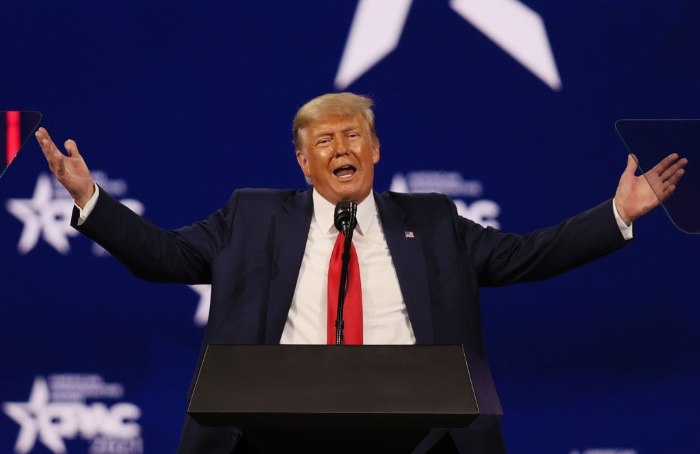
Former President Donald Trump addresses the Conservative Political Action Conference in Orlando, Fla.

Trump addresses the Conservative Political Action Conference in Orlando, Fla. | Getty Images

That included Trump himself, who made only a few half-hearted attempts to revive the populist themes that worked for him in the past. Biden’s immigration bill, he said at one point, was a “corporatist, Big Tech attack on hardworking citizens of every race, religion, color and creed.” Trumpism, he later defined, was about great trade deals and “support for the forgotten men and women who have been taken advantage of for so many years.”

And that was the totality of it.

For a party hoping to reclaim power, it’s a notable bet on the potency of grievance and culture wars. Twelve years ago, Republicans fashioned a different path out of the political wilderness. At the 2009 CPAC gathering, a backlash to the bank bailout was brewing. A Friday morning panel featuring a trio of young GOP House members was titled: “Bailing Out Big Business: Are We All Socialists Now?” The keynote speaker on Saturday, Rush Limbaugh, went out of his way to praise a new phenomenon known as the Tea Party as a reactionary force against bailouts.

Biden isn’t bailing out the banks (though, technically, neither did Obama — he extended the TARP authorities that passed under George W. Bush). And, for that reason, he may provide less fodder for the current crop of Republicans.

But what stands out is not just the absence of populist attacks against the current president, but how uncertain the current Republicans are about the posture they ought to be taking.

Last week, when it became clear that a $15 minimum wage would not be included in the Covid-relief bill, several senators offered alternative approaches. One of them was Josh Hawley (R-Mo.) — perhaps the national Republican most committed to a Trump-like populist approach — who said he’d support a $15 minimum wage for workers of corporations that had $1 billion or more in annual revenue. For good measure, he called it “The Blue Collar Bonus.”

A few days later, House Minority Leader Kevin McCarthy was asked about the general concept.

“I think it’s stupid,” he said.

Welcome to POLITICO Nightly. Here’s a fascinating history of side parts. Reach out with news and tips at sstein@politico.com and rrayasam@politico.com, or on Twitter at @samstein and @renurayasam.

A message from The American Health Care Association and National Center for Assisted Living (AHCA/NCAL):

Long term care providers are fighting to keep residents safe. While the vaccine is an important step, our work is not over. We must stand with frontline workers and continue to provide the resources they need to keep up the fight: https://saveourseniors.org

 
AROUND THE NATION

THE MASKS ARE OFF — Republican governors in Texas and Mississippi lifted statewide mask mandates and other Covid restrictions today, allowing all of their businesses to operate at full capacity. A senior administration health official told POLITICO that the White House believed the Texas and Mississippi announcements — posted on Twitter within 30 minutes of each other — were a “coordinated effort” by Republican governors, and that it expected to see similar moves in the coming days even as cases remain elevated throughout the country.

Texas Gov. Greg Abbott is up for reelection next year, but his political consultant told Nightly’s Renuka Rayasam that the order wasn’t an effort to gain national attention ahead of the next presidential election.

“He has done nothing secretly or publicly to get anything prepared for 2024. This is a media myth,” Dave Carney said. “If Gov. Abbott was interested in running for president, he would have accepted an invitation to CPAC and to the winter meeting of the RNC.”

EMPIRE STATE OF MIND — New York Gov. Andrew Cuomo is in hiding while the state’s attorney general launches an independent investigation into multiple allegations of sexual harassment. Renu Slack chatted with Albany Playbook writer Anna Gronewold today about what’s next. This conversation has been edited.

Does this come as a surprise to people who knew Cuomo or was his behavior an open secret?

It’s no secret that Andrew Cuomo is a hard-charging boss who enjoys wielding power. But I think there have been two reactions to the allegations this week. The first is disbelief: People have heard or seen him behave in uncomfortable or awkward ways over the years, but never thought it would rise to the level of sexual harassment.

The other is more ominous. It’s “of course.” Meaning that they’ve heard these stories multiple times and would be entirely unsurprised if more accounts emerge.

What’s the chatter among Democrats — do they want him to step down?

That’s tricky to boil down to a single reaction. There are certainly Democrats who want him to step down. That group is growing, but it’s so far mostly further-left progressives in the legislature who were already dissatisfied with his decades-long rule. I saw a Clubhouse room with some of these folks titled “Andrew Cuomo is a monster and it is time to go.” Not subtle.

Top Democrats in the Legislature and the state’s congressional delegation have held off going that far. On various levels they’ve broadly criticized the behavior reported and said they fully support the investigation that the attorney general’s office is launching. Still, the state legislature just announced they reached a deal to take back some of his emergency pandemic powers. They were looking at it before this stuff, but I think the general dissatisfaction gave them a push.

Any sense of whether he might try to thread the needle by not stepping down but not running for a fourth term?

I think if Cuomo steps down it means he has seen some sort of polling or hard evidence that there is no way he can survive this. But I think another one, two or five stories could be that trigger. If the next week is anything like the one we just had, some hard choices will probably have to be made over at the executive mansion.


DON'T MISS "THE RECAST": Power dynamics are changing. "Influence" is changing. More people are demanding a seat at the table, insisting that all politics is personal and not all policy is equitable. "The Recast" is our new, twice-weekly newsletter that breaks down how race and identity are recasting politics, policy, and power in America. And POLITICO is recasting how we report on this crucial intersection, bringing you fresh insights, scoops and dispatches from across the country, and new voices that challenge "business as usual." Don't miss out on this important new newsletter, SUBSCRIBE NOW. Thank you to our sponsor, Intel.


FIRST IN NIGHTLY

OPENING BELL — Biden is tapping a federal agency to facilitate vaccinations for teachers and child care workers. He is using his bully pulpit to push states to get shots into teachers’ arms by the end of the month. The administration is even considering creating a “school reopening” czar. And newly minted Education Secretary Miguel Cardona will launch his tenure on Wednesday with a visit to elementary schools that have successfully reopened, in a high-profile event with First Lady Jill Biden.

The extraordinary new measures are part of an intensified administration-wide push to open schools, as the Biden White House hurtles toward a 100-day self-imposed deadline to return children to the classroom, Emily Cadei and Natasha Korecki writes.

For weeks, the Biden administration has pegged school reopenings to two necessities: confirmation of its Education secretary and advancing a massive Covid-19 rescue package.

But with the White House on the cusp of clearing both those hurdles, there is still no expectation it would be enough to trigger children’s return to the classroom.

Instead, Cardona, whom Vice President Kamala Harris swore in as Biden’s Education secretary this evening, inherits a boiling political cauldron. Before today’s announcements, some unions were demanding vaccinations. Even with the new initiatives, it could take weeks for teachers’ to develop full immunity, depending on the type of vaccination used.

Beyond that, the administration is still trying to overcome muddled messaging early on regarding its reopening goals. And there are complicated, local disputes that are out of the White House’s control.


Advertisement Image 

 
WHAT'D I MISS?

— Biden accelerates vaccination timeline after manufacturing deal: Merck will manufacture doses of Johnson & Johnson’s coronavirus vaccine under an agreement that will move up the timeline for offering shots to most Americans by nearly two months , Biden announced today. “This country will have enough vaccine supply ... for every adult in America by the end of May,” Biden said in remarks delivered at the White House.

— U.S., EU slap Navalny sanctions on Russia: Brussels and Washington imposed new sanctions against senior Russian officials today , delivering a one-two punch at the Kremlin over the poisoning attack and jailing of opposition leader Alexei Navalny.

Nightly video player on Navalny sanctions

— From Providence to Commerce: The Senate voted overwhelmingly in favor of confirming Gina Raimondo as secretary of Commerce, tasking the former Rhode Island governor with a key role in reviewing the Trump administration’s trade policies.

— Gensler: SEC should consider corporate political spending disclosures: Gary Gensler, Biden’s pick to head the Securities and Exchange Commission, signaled that the agency would raise pressure on corporations to disclose their political spending activities.

— Justices seek compromise on voting-rights laws: Several members of the Supreme Court’s conservative majority seemed to search for a middle ground today in the most significant Voting Rights Act case the justices have taken up since the court struck down a critical part of that landmark law eight years ago.

— Labor watchdog backs calls for binding Covid-19 workplace safety standard: The Labor Department’s independent watchdog recommended that the Occupational Safety and Health Administration consider issuing Covid-19-specific safety rules employers would be required to follow, saying that would better protect Americans from exposure to the coronavirus.

TALKING TO THE EXPERTS

THE WAGE FORWARD — With the path toward boosting the minimum wage precarious, Nightly’s Myah Ward and Renu reached out to a group of experts to ask them about alternative proposals that the Biden administration should consider to help the working poor. The responses have been edited.

“The single most important support the Biden administration can offer the working poor is to expand their choice of schools for their children, and break the government school monopoly on educational opportunities for those in our inner cities and our poorest neighborhoods.” — Arthur Herman, senior fellow, Hudson Institute

“It is important that members of Congress and the Biden administration continue to fight for an increase in the federal minimum wage. Any parent relying only on their full-time, full-year federal minimum wage income to raise a child is doing so in poverty.

“The Biden administration’s focus needs to be on shepherding the American Rescue Plan into law. The bill’s proposals will dramatically cut child poverty and provide needed help to families with and without children. Looking forward, two important priorities need to be paid sick leave and a national paid family leave program. Paid time off is another way to support those working in low-wage jobs. And while we are decades behind the rest of the world, the country is ready for a national paid family leave plan.” — Betsey Stevenson, labor economist at the University of Michigan and former member of President Barack Obama’s Council of Economic Advisers

“A better way to support the working poor is for the government to provide workers with cash subsidies, possibly in the form of refundable tax credits. Unlike a minimum wage increase, that approach would not cause job losses. For example, Congress could increase the child tax credit, the child and dependent care tax credit, and the earned income tax credit. The Covid relief reconciliation bill moving through Congress would increase those credits on a temporary basis for 2021.” — Alan Viard, resident scholar, American Enterprise Institute

“The Biden Administration should support ‘Baby Bonds’, federal job guarantee, universal health care, increased federal education funding for low-income communities and student loan forgiveness. Low-income people spend a higher percentage of their income contributing to consumption (the largest portion of GDP) and along with all workers are the drivers of economic stability and growth. Only when the bottom half see growth instead of stagnation and break the cycle of poverty will we see progress for all.” — Carycruz Bueno, research associate at the Annenberg Institute at Brown University

“The Earned Income Tax Credit has been the most successful non-elderly anti-poverty program. Unlike the minimum wage, it is pro-work, supplementing the earnings of low-income families via a refundable tax credit (even if you have no tax liability you get a check for the full credit).

“The EITC could be improved in two ways. First, the marriage penalty should be reduced by increasing the income at which the EITC starts to phase out and making the phase out slower.

“Second, the EITC for a non-custodial parent should be enhanced by setting the maximum EITC equal to 50 percent of that for a one-child family and matching the phase-out incomes and rates for custodial and non-custodial parents. These approaches are better than a minimum wage hike because they do not harm small businesses and hiring, and are targeted much more carefully on the poverty population.” — Douglas Holtz-Eakin, president of the American Action Forum and chief economist of the Council of Economic Advisers under President George W. Bush from 2001 to 2002

“Here are three items that Congress and the White House can consider from a tax perspective that could help lower-income workers, with a focus on longer-run reforms:

“Simplifying and reforming the Earned Income Tax Credit and Child Tax Credit.

“Providing certainty in the tax code by proactively tackling upcoming tax changes over the next few years. For example, on the business side, making the soon-to-be phased-out full expensing provisions permanent would be pro-growth, boosting after-tax incomes for workers. On the individual side, these tax changes under the TCJA expire in 2025.

“Improving the tax system for gig economy workers and other contractors who have lower and variable incomes. Some ideas for helping these workers include providing a simplified expense deduction, lowering reporting thresholds and making them consistent, and allowing gig economy platforms to voluntarily withhold income and self-employment tax on workers’ behalf.” — Garrett Watson, senior policy analyst at the Tax Foundation

“Cancel student debt. Black and first-generation college students are more likely to take on debt to get through school, are more likely to default. Canceling student loan debt is also in the interest of intergenerational fairness and would open up greater possibilities of homeownership and enhance the ability to start a family.

“Federal child allowance paid monthly. This is already in the current fiscal package and is estimated to have a huge impact on child poverty. It will be a very big deal for millions of working class families.

“An affordable public health care option. Lower-income workers are far more likely to lack health insurance and therefore more likely to rack up debilitating bills in the event of illness or injury. A public option would also reduce the burden on small employers who lack bargaining power to cover their employees with affordable health care plans. Providing low cost health insurance would eliminate one of the greatest sources of economic insecurity and leading causes of personal bankruptcy.” — Julia Coronado, founder of MacroPolicy Perspectives and former economist at the Federal Reserve Board


JOIN WEDNESDAY FOR A PLAYBOOK INTERVIEW WITH NRCC CHAIR TOM EMMER : House Republicans surprised many observers in November flipping 15 seats and defeating several Democratic freshmen who delivered the House majority in 2018. Then the Jan. 6 insurrection set off an internal battle within the GOP, including among top House leaders. Join Playbook co-author Rachael Bade for a conversation with Rep. Tom Emmer (R-Minn.), chair of the National Republican Congressional Committee, to discuss his strategy for the 2022 midterm elections, President Donald Trump's role in the party, and the continued fallout from the assault on the Capitol. REGISTER HERE


THE GLOBAL FIGHT

EU VS. ITS MEMBERS — The EU is short on coronavirus vaccines, but today the European Commission faced an even shorter supply of answers to rising complaints from national capitals starting to look elsewhere for coronavirus inoculations.

In just the last few days, Denmark, Austria, Poland, Slovakia and the Czech Republic have joined Hungary in breaking ranks with the EU’s vaccination strategy by going beyond Europe’s borders for doses. In the process, they’ve unleashed a devastating barrage of criticism directed at the EU, saying their citizens simply can’t wait for the Commission to get its act together.

Confronted with the assault, the Commission today pleaded once again for understanding but offered no immediate solutions, other than to insist that it was confident in its approach. “The production and delivery of vaccines is a project that comes with a lot of obstacles,” spokesperson Stefan De Keersmaecker said at the midday news conference. “I think we have developed a successful vaccine strategy.”

EU national leaders, however, increasingly beg to differ. “Total shitshow,” German Finance Minister Olaf Scholz reportedly said of the EU vaccine program.

NIGHTLY NUMBER

95

The number of yes votes in the Senate, which confirmed Cecilia Rouse tonight as chair of the White House Council of Economic Advisers. She will be the first Black person to serve in that role in the body’s 74-year history.

PARTING WORDS

VERNON JORDAN’S CREED — Vernon Jordan during the 2008 Democratic presidential primary was facing the same exquisite pressures that many African Americans were, POLITICO founding editor John F. Harris writes.

As a veteran civil rights leader, he had been waiting for decades for the kind of triumph Barack Obama’s victory would represent. At the same time, he had known Bill Clinton and Hillary Rodham Clinton since the late 1970s. There was no real doubt that he would endorse her, and genuinely mean it.

Michelle Obama, as Jordan later recounted the story, was a bit sour about the choice. “Michelle,” he said, “I’m too old to let race get in the way of friendship.”

Race, friendship, and intense ambition to be a player at the highest levels of American political and corporate power were the three great themes of Jordan’s life, which began with a modest boyhood in segregated Atlanta, survived an assassination attempt by a racist gunman at 44 and ended at age 85 on Monday at his home in an elite enclave of Washington.

A message from The American Health Care Association and National Center for Assisted Living (AHCA/NCAL):

Nearly 100% of nursing homes have completed their second COVID-19 vaccine clinic. But until all long term care residents and staff are vaccinated, our fight is far from over. Long term care providers need additional resources, such as hiring more staff and increasing funding, in order to continue to best serve our nation’s greatest generation: https://saveourseniors.org/


Did someone forward this email to you? Sign up here.


Follow us on Twitter

Renuka Rayasam @renurayasam

Chris Suellentrop @suellentrop

Tyler Weyant @tweyant

Myah Ward @myahward


FOLLOW US


POLITICO, LLC 1000 Wilson Blvd. Arlington, VA, 22209, USA


Wednesday, October 7, 2020

RSN: FOCUS: David Sirota | Trump Reduced Workplace Safety Enforcement - Then Workers Died While Begging for Help


Reader Supported News
07 October 20


What Will You Do to Preserve Reader Supported News?

There is no way this organization can survive and function with out reasonable support - from our readership. Right now we are not getting that.

What will you do?

With urgency.

Marc Ash
Founder, Reader Supported News

Sure, I'll make a donation!


Update My Monthly Donation


If you would prefer to send a check:
Reader Supported News
PO Box 2043
Citrus Hts
CA 95611


Reader Supported News
07 October 20

It's Live on the HomePage Now:
Reader Supported News


IN A WORLD AWASH IN LIES ... Dear Marc, It was my pleasure to contribute. In a world awash in lies, RSN is a lighthouse beacon in a hazardous and stormy sea. Keep up the good work. / Bruce, RSN Reader-Supporter

Sure, I'll make a donation!


FOCUS: David Sirota | Trump Reduced Workplace Safety Enforcement - Then Workers Died While Begging for Help
Dipar Patel, a cashier at Hitt Mini Mart in Columbia, Missouri, worked 12-hour shifts during the early days of the Covid crisis. (photo: Alex Edelman/Getty)
David Sirota, Jacobin
Excerpt: "New data shows that COVID-19-related deaths followed after workers requested help from federal safety officials. Instead of helping, Donald Trump reduced enforcement of workplace safety laws."


o help their corporate donors boost profits and stock prices, Donald Trump and Republican lawmakers have pushed hard to force workers back into unsafe workplaces. During the pandemic, the GOP has brushed off science and reopened economies, demanded liability shields for employers, ended special pandemic unemployment relief, helped Amazon block a worker safety initiative, and encouraged states to punish workers who don’t return to their jobs.

For those forced back to COVID-19–infected workplaces, the Trump administration has weakened the agency that is supposed to be policing workplace safety. And now a new study shows the results: death rates spiked almost immediately after workers pleaded with that agency to help, but were likely ignored.

The analysis of Occupational Safety and Health Administration (OSHA) data comes from researchers at Harvard, Boston Children’s Hospital, and the Massachusetts Department of Public Health. It shows that “there is a correlation between OSHA complaints and COVID-19 mortality” — in specific, COVID-19–related complaints to the agency “are correlated with [COVID-19–related] deaths 17 days later.”

During the pandemic, researchers note that OSHA “has not issued any emergency or permanent standard specific to COVID-19 exposure at the workplace” and “had issued only four citations related to COVID-19.”

Meanwhile, the report notes that “the total number of federal OSHA inspections (of any kind) during 2020 has been reduced by two-thirds, compared to the same period in prior years.”

This graph shows how OSHA complaints almost perfectly reflected waves of coronavirus deaths. The graph tells the tragic story of workers crying out to OSHA for help, then being ignored, then dying:


A graph showing the correlation between national OSHA complaints and COVID-19 deaths per million.

“The Lowest Number of Inspectors in the Agency’s 48-Year History”

The situation at OSHA isn’t some random accident, and it isn’t just an agency hamstrung by the pandemic. It is the result of deliberate policy decisions.

A 2019 report from the National Employment Law Project found that workplace fatalities have hit a decade-high just as Trump has presided over a decline in OSHA enforcement activity. OSHA “now has the lowest number of health and safety inspectors in the agency’s 48-year history,” according to the study.

A 2020 report from the Center for Public Integrity found that OSHA has conducted fewer safety inspections under Trump than under Obama, even though the nation’s workforce has increased. That report also found that during the pandemic, OSHA inspections have dropped by roughly two-thirds.

At the same time, ProPublica reports that the Trump administration has “mothballed or outright killed” the Labor Department advisory boards that were created “to improve health, safety and whistleblower protections in nearly every facet of the workforce.”

Trump Reduces Deterrents to Unsafe Workplaces

These policy decisions have together reduced a key deterrent to corporate misbehavior.

For instance, the threat of a workplace inspection often incentivizes employers to adhere to safety standards. A 2012 study of California work sites found that “randomly inspected employers experienced a 9.4% decline in injury rates and a 26% reduction in injury cost” — and “no evidence that these improvements came at the expense of employment, sales, credit ratings, or firm survival.”

The Trump administration’s reduction in those inspections likely results in the opposite effect.

Similarly, the threat of big fines tells corporations that if they violate safety standards, they could face financial punishment. Under Trump, though, those fines have been minuscule during the pandemic, even as death rates have skyrocketed.

With OSHA failing to issue mandatory safety standards, “the agency hasn’t proposed a single penalty greater than $30,000 for coronavirus-related risks,” reports Politico.

In one instance that has prompted protests, OSHA fined meatpacking giant JBS just $15,000 after 290 workers were infected with the virus.

Workers Are Collateral Damage in Republicans’ Effort To Enrich GOP Donors

None of this makes any sense if the goal is protecting workers — but all of it makes sense if the goal instead is to protect the corporations that bankroll the Republican Party.

That is clearly the GOP’s top objective regardless of how many people are killed in the process — and you can even see it in the Supreme Court situation. Trump and Senate Republicans are right now trying to force lawmakers and congressional staff into the COVID-19 hot zone exploding in the US Capitol in order to try to install another corporate rubber stamp on the Supreme Court, which would ultimately boost corporate profits and crush workers.

Horrifying as that sociopathic plan is, it is merely a microcosm of the GOP’s larger project: their entire agenda is designed to force workers into unsafe workplaces in order to help their corporate donors.

Those donors want a right-wing Supreme Court, and they don’t care how many federal workers are killed to make that happen.

Similarly, they want an entire American workforce that is legally barred from suing employers, financially punished for refusing to return to unsafe workplaces, and unable to call the workplace cops when lives are put in danger.

In short, corporate interests want a legal system that turns workers into collateral damage in the quest for profit — and that’s exactly what the GOP is giving them.


READ MORE


Contribute to RSN

Update My Monthly Donation


Tuesday Afternoon Updates – Error 404: President Not Found

                                                                                                                                            ...