
Live on the homepage now!
Reader Supported News
DON’T FIDDLE WHILE RSN BURNS — We have many who help sustain RSN with their hard earned contributions, but many, many more never do. Join those who make Reader Supported News their own. Funding matters. Help out.
Marc Ash • Founder, Reader Supported News
Sure, I'll make a donation!

Robert Reich | Why Trump, Putin, Xi and Other Dictators Make Disastrous Decisions
Robert Reich, Substack
Reich writes: "Here's the paradox: The higher you rise in any hierarchy, your decisions are likely to have larger and larger consequences."
Here’s the paradox: The higher you rise in any hierarchy, your decisions are likely to have larger and larger consequences. Yet the higher you rise, the harder it is to get accurate feedback about your decisions.
I’ve worked with several presidents. All have made big blunders. I’ve also known and written about CEOs of big corporations who have made terrible mistakes. In every case, they had flawed systems for getting useful, accurate, and reliable feedback.
Donald Trump (whom I didn’t work with but watched his every move) had no reliable feedback. Why? Because he surrounded himself with toadies and sycophants who didn’t dare tell him the truth. He demanded that everyone around him confirm his preferred self-image of invincibility. His White House was filled with fawning lackeys (he fired anyone who didn’t grovel). He refused to hear bad news. He rejected the validity of negative media coverage.
As a result, Trump made among the dumbest decisions of any American president in history -- suppressing evidence of a potential crime, asking a foreign power for help with his reelection, inciting an attack on the Capitol. Some might say that all this was inevitable; it was built into his character. But his key character flaw was his unwillingness to hear anything negative. None of his horrific acts was necessary. Trump could have accomplished any number of goals far more easily had he not kept digging himself into ever-deeper holes. He was his own worst enemy.
Vladimir Putin is in a similar position. He has isolated himself and banned dissenting voices. He has placed obedient lapdogs even in the Fifth Service, which is supposed to provide him intelligence. So, like Trump, Putin has no reality check. According to a new report by a respected independent reporter with sources inside the Kremlin, the Fifth Service was “afraid of angering” Putin, so “simply told him what he wanted to hear.”
As a result, Putin’s attack on Ukraine has backfired terribly — on him. He badly overestimated the Russian military and underestimated Ukraine’s capacity to resist. Instead of weakening NATO, his attack has strengthened it. And now that the world’s democracies have cut off Russia’s access to the world banking system, Russia’s foreign exchange reserves have become nearly worthless.
Dictators like Putin are particularly vulnerable to inaccurate feedback. Instead of independent truth-tellers, they’re often surrounded by truth-deniers. Rather than experts and investigative journalists, their world is filled with pseudo-scientists and propaganda. In place of a free press, they have agitprop and disinformation.
Or look at China’s Xi Jinping. Why would he decide to enter into a “no limits” partnership with Moscow on the eve of Putin’s disastrous military campaign? Talk about blunders. Xi’s alliance with Russia has undermined China’s reputation and aggravated concerns among its neighbors about China’s global ambitions. It’s already prompted Taiwan to strengthen its defenses and pushed other regional powers such as Australia and Japan to declare their own interests in Taiwan’s security.
Trump, Putin, Xi — these men aren’t stupid. What’s stupid is their systems for making decisions. They don’t include naysayers. They have no way of eliciting, recognizing, or assessing useful criticism. All are trapped in halls of mirrors that reflect back at them what they want to see and hear.
The inverse relation between how high people rise in a hierarchy and the accuracy of the feedback they receive can be overcome if a leader aggressively seeks out dissenting views.
But it’s almost impossible to find dissenting views in a totalitarian system where dissent is often punished. One of the great virtues of a democracy is its multiple feedback loops – its many channels for expressing alternative viewpoints and voicing uncomfortable truths. After all, American democracy stopped Trump from doing even more damage than he did.
Yet when people like Trump, Putin, and Xi make terrible decisions, the world suffers. Worse: Putin and Xi have the power to blow up the world.
READ MORE
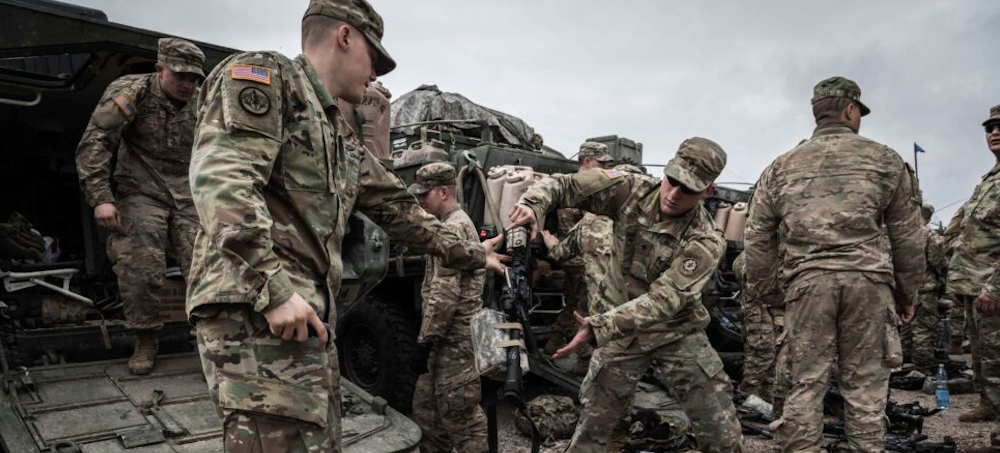 "Poland will present a proposal to organize a peacekeeping mission in Ukraine at the forthcoming NATO summit and European Council meeting, the government has announced." (photo: NFP)
Poland to Propose Ukraine Peacekeeping Mission at NATO Summit, Says PM
Reuters
Excerpt: "Poland will formally submit a proposal for a peacekeeping mission in Ukraine at the next NATO summit, Prime Minister Mateusz Morawiecki said on Friday."
READ MORE
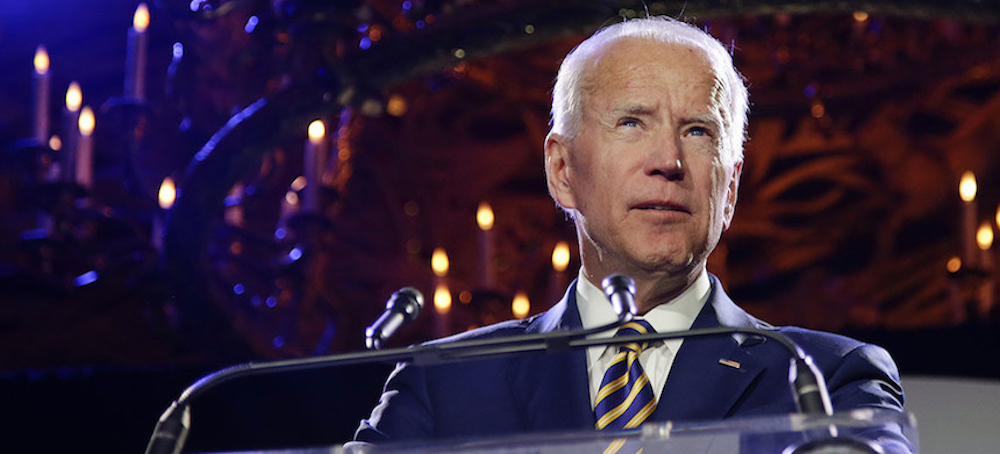 Joe Biden. (photo: Frank Franklin II/AP)
What Biden Got Right About Arming Ukraine - and Wrong About Sanctioning Russia
Murtaza Hussain, The Intercept
Excerpt: "As effective as sanctions are at driving Russians into poverty, it's uncertain whether they will affect the course of the war in Ukraine."
As effective as sanctions are at driving Russians into poverty, it’s uncertain whether they will affect the course of the war in Ukraine.
On Wednesday, the U.S. announced a flood of new weaponry into Ukraine, including advanced anti-aircraft weaponry and small arms aimed at helping the Ukrainian government repel Russia’s invasion. The weapons will almost certainly kill more Russian service members in Ukraine, adding to the thousands who are already believed to have died in the past few weeks. The arms may also, paradoxically, serve a more humanitarian purpose: helping bring the conflict to a stalemate and putting the Ukrainian government in a stronger position to negotiate an end to the war.
Ending the war by such a negotiated outcome could also serve to reduce civilian harm in a perhaps less expected way: providing an opportunity to end the economic warfare that is already doing damage to millions of innocent Russians.
The United States and its allies have waged the economic total war against Russia since the start of the invasion, quickly making Russia the most heavily sanctioned country on Earth. This economic offensive is already inflicting harm on everyday Russians, including those opposed to Vladimir Putin’s government. Yet as effective as these sanctions are at driving Russians into poverty, it’s uncertain whether they will affect the course of the war in Ukraine. Undeterred, the Russian military is still bombarding Ukrainian cities like Kharkiv and Mariupol with artillery and airstrikes on a nightly basis.
Paired with diplomatic pressure, military aid that helps the conflict reach a stalemate could end the war sooner by making it nearly impossible for the Russian military, which is already showing signs of exhaustion, to take major urban centers and win a decisive victory. With military victory off the table, negotiations could bring a meaningful end to the war, prevent a nightmare scenario of occupation and insurgency, and — crucially, for humanitarian purposes — allow many Russia sanctions to be lifted in exchange for concessions to Ukrainian sovereignty.
There are reasons for the international community to support taking a hard line in defense of Ukraine, including by providing them weaponry. What is at stake is not just one country’s sovereignty but the already-besieged post-World War II principle that large countries cannot simply devour their neighbors or reshape their borders through armed force. The final death of that principle on the streets of Ukrainian cities will make the world a more violent place than even what we see today. It will mean a regrowth of the violent jungle that characterized Europe during the period of the world wars — but spread over the entire planet.
The current, punitive approach of targeting ordinary Russians through economic warfare is likely to be both harmful and ineffective. Tailored sanctions against oligarchs and Russian officials involved in human rights abuses during the current war are warranted, but even the harshest such economic measures will not be enough to stop a regime that has already put its political credibility at stake in conquering Ukraine. Responding to Putin’s military aggression by denying ordinary Russians access to their life savings is a cruel non sequitur that does little to help Ukrainians.
The oft-unspoken aim of the present approach of trying to immiserate Russian society is that it will stoke so much discontent that it results in regime change. Yet the Russian masses have little say over their government or their leaders, who are glad to repress any serious dissent, so fomenting bottom-up revolutionary change seems extremely unlikely. Past sanctions campaigns against countries like Iraq and Iran have never resulted in such regime collapse. Even the Cuban government is still in power after decades under economic embargo.
Instead of toppling governments, there is even reason to believe that sanctions like those now being implemented on Russia can help solidify authoritarian leaders’ hold on power: forcing their middle classes to focus more on survival than political change, while regime-connected elites hoard resources and become gatekeepers to what remains of the economy. Some leaders of sanctioned countries have even turned sanctions into a means of ideological legitimization, portraying themselves as nationalist defenders against hostile foreign powers’ economic warfare.
Then there are the calls for a more robust, direct intervention against Russia. These ideas are nonstarters. The breathless calls for a NATO-backed no-fly zone fail to acknowledge that the policy would constitute an act of war, requiring direct targeting of Russian military assets. There is also the small but real possibility of nuclear escalation, a disaster that Cold War-era military officials avoided only with great care.
A significant boost to Ukrainian firepower might allow President Volodymyr Zelenskyy’s government to reach terms with Putin, spurring a negotiated end to the war short of surrender. Instead, the current balance could see something like what happened in Syria, where foreign powers provided enough weaponry to the opposition to keep it fighting but not enough to win or force a permanent stalemate. The result in Syria was that much of the country was destroyed over the course of a decade, while the Assad regime remained in power.
Letting the Ukrainian government fall while arming a long-term insurgency against Russian control — or even a lengthy, debilitating siege where the Ukrainians hang on, but only in pockets — could make the country permanently unstable, killing Russian conscripts and ordinary Ukrainians in huge numbers while failing to bring a return to peace. Ukraine would truly become a European version of Syria — or even Afghanistan during the war against the Soviets: the social fabric destroyed beyond repair and an incubator for far-right terrorist groups established in the wreckage.
Such an outcome would be a disaster for everyone. Putin would enrage the West by deposing or killing Zelenskyy, a liberal political leader now widely viewed as a hero for his role during the crisis, and imposing a puppet in his place. The misery of de facto occupation and insurgency in Ukraine would be accompanied by the misery that a broad sanctions regime imposed on Russians for years to come.
During the Cold War, Russia and the United States fought proxy battles all over the world that did not result in conventional war between the big powers, let alone nuclear escalation. Maintaining deconfliction hotlines and avoiding scenarios that lead to NATO and Russian troops shooting at each other directly are critically important. There is no scenario that significantly raises the risk of nuclear conflict that can be tolerated, but that doesn’t mean NATO countries are constrained from giving more serious help to Ukrainians.
It scarcely needs saying, but there are no good options today in Ukraine. Sending more arms to a country at war seems like a paradoxical way of lessening harm to innocent people. Raising our eyes beyond the short-term, however, there are reasonable grounds to believe that such a policy of bolstering the legitimate Ukrainian government could spare the lives of more people than letting the country collapse into Putin’s hands — or dooming 140 million Russian civilians to life under permanent economic siege.
A continued flow of arms is a logical step given the brutal reality of Russia’s continued attacks across Ukraine. Averting disaster may now depend on whether the Western countries can prevent the fall of Kyiv in the weeks to come. Simply put, sustainable peace in Europe will not happen without a strengthened Ukraine. There is still time to save the continent from returning to the savagery that it experienced in the 20th century. That time, however, is running out — and quickly.
READ MORE
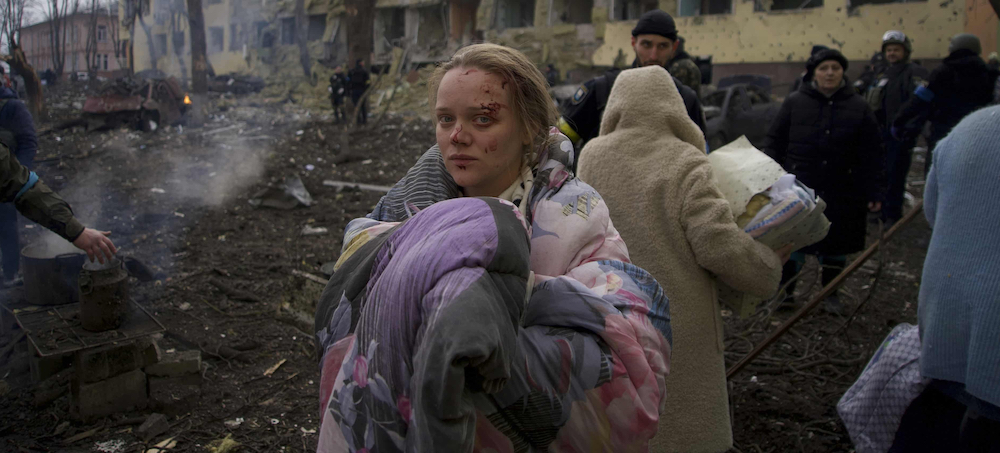 Mariana Vishegirskaya stands outside a maternity hospital that was damaged by shelling in Mariupol, Ukraine, March 9, 2022. (photo: Mstyslav Chernov/AP)
The Russians Were Hunting Us Down: The War on Journalism in Mariupol
Mstyslav Chernov, Associated Press
Chernov writes: "The Russians were hunting us down. They had a list of names, including ours, and they were closing in."
A reporter describes life under siege in the Ukrainian city and why it was so important to break the silence
The Russians were hunting us down. They had a list of names, including ours, and they were closing in.
We had been documenting the siege of Mariupol by Russian troops for more than two weeks and were the only international journalists left in the city. We were reporting inside the hospital when gunmen began stalking the corridors. Surgeons gave us white scrubs to wear as camouflage.
Suddenly at dawn, a dozen soldiers burst in: “Where are the journalists, for fuck’s sake?”
I looked at their armbands, blue for Ukraine, and tried to calculate the odds that they were Russians in disguise. I stepped forward to identify myself. “We’re here to get you out,” they said.
The walls of the surgery shook from artillery and machine gun fire outside, and it seemed safer to stay inside. But the Ukrainian soldiers were under orders to take us with them.
We ran into the street, abandoning the doctors who had sheltered us, the pregnant women who had been shelled and the people who slept in the hallways because they had nowhere else to go. I felt terrible leaving them all behind.
Nine minutes, maybe 10, an eternity through roads and bombed-out apartment buildings. As shells crashed nearby, we dropped to the ground. Time was measured from one shell to the next, our bodies tense and breath held. Shockwave after shockwave jolted my chest, and my hands went cold.
We reached an entryway, and armoured cars whisked us to a darkened basement. Only then did we learn from a police officer we knew why the Ukrainians had risked the lives of soldiers to extract us from the hospital.
“If they catch you, they will get you on camera and they will make you say that everything you filmed is a lie,” he said. “All your efforts and everything you have done in Mariupol will be in vain.”
The officer, who had once begged us to show the world his dying city, now pleaded with us to go. He nudged us toward the thousands of battered cars preparing to leave Mariupol. It was 15 March. We had no idea if we would make it out alive.
As a teenager growing up in Ukraine in the city of Kharkiv, just 20 miles from the Russian border, I learned how to handle a gun as part of the school curriculum. It seemed pointless. Ukraine, I reasoned, was surrounded by friends.
I have since covered wars in Iraq, Afghanistan and the disputed territory of Nagorno-Karabakh, trying to show the world the devastation first-hand. But when the Americans and then the Europeans evacuated their embassy staffs from the city of Kyiv this winter, and when I pored over maps of the Russian troop buildup just across from my hometown, my only thought was: “My poor country.”
In the first few days of the war, the Russians bombed the enormous Freedom Square in Kharkiv, where I had hung out until my 20s.
I knew Russian forces would see the eastern port city of Mariupol as a strategic prize because of its location on the Sea of Azov. So on the evening of 23 February, I headed there with my longtime colleague Evgeniy Maloletka, a Ukrainian photographer for Associated Press, in his white Volkswagen van.
On the way, we started worrying about spare tyres, and found online a man nearby willing to sell to us in the middle of the night. We explained to him and to a cashier at the all-night grocery store that we were preparing for war. They looked at us like we were crazy.
We pulled into Mariupol at 3.30am The war started an hour later.
About a quarter of Mariupol’s 430,000 residents left in those first days, while they still could. But few people believed a war was coming, and by the time most realised their mistake, it was too late.
One bomb at a time, the Russians cut electricity, water, food supplies and finally, crucially, the cell phone, radio and television towers. The few other journalists in the city got out before the last connections were gone and a full blockade settled in.
The absence of information in a blockade accomplishes two goals.
Chaos is the first. People don’t know what’s going on, and they panic. At first I couldn’t understand why Mariupol fell apart so quickly. Now I know it was because of the lack of communication.
Impunity is the second goal. With no information coming out of a city, no pictures of demolished buildings and dying children, the Russian forces could do whatever they wanted. If not for us, there would be nothing.
That’s why we took such risks to be able to send the world what we saw, and that’s what made Russia angry enough to hunt us down.
I have never, ever felt that breaking the silence was so important.
The deaths came fast. On 27 February, we watched as a doctor tried to save a little girl hit by shrapnel. She died.
A second child died, then a third. Ambulances stopped picking up the wounded because people could not call them without a signal, and they could not navigate the bombed-out streets.
The doctors pleaded with us to film families bringing in their own dead and wounded, and let us use their dwindling generator power for our cameras. No one knows what’s going on in our city, they said.
Shelling hit the hospital and the houses around. It shattered the windows of our van, blew a hole into its side and punctured a tyre. Sometimes we would run out to film a burning house and then run back amid the explosions.
There was still one place in the city to get a steady connection, outside a looted grocery store on Budivel’nykiv Avenue. Once a day, we drove there and crouched beneath the stairs to upload photos and video to the world. The stairs would not have done much to protect us, but it felt safer than being out in the open.
The signal vanished by 3 March. We tried to send our video from the 7th-floor windows of the hospital. It was from there that we saw the last shreds of the solid middle-class city of Mariupol come apart.
The Port City superstore was being looted, and we headed that way through artillery and machine gunfire. Dozens of people ran and pushed shopping carts loaded with electronics, food, clothes.
A shell exploded on the roof of the store, throwing me to the ground outside. I tensed, awaiting a second hit, and cursed myself a hundred times because my camera was not on to record it.
And there it was, another shell hitting the apartment building next to me with a terrible whoosh. I shrank behind a corner for cover.
A teenager passed by, rolling an office chair loaded with electronics, boxes tumbling off the sides. “My friends were there and the shell hit 10 metres from us,” he told me. “I have no idea what happened to them.”
We raced back to the hospital. Within 20 minutes, the injured came in, some of them scooped into shopping carts.
For several days, the only link we had to the outside world was through a satellite phone. And the only spot where that phone worked was out in the open, right next to a shell crater. I would sit down, make myself small and try to catch the connection.
Everybody was asking, please tell us when the war will be over. I had no answer.
Every single day, there would be a rumour that the Ukrainian army was going to come to break through the siege. But no one came.
By this time I had witnessed deaths at the hospital, corpses in the streets, dozens of bodies shoved into a mass grave. I had seen so much death that I was filming almost without taking it in.
On 9 March, twin airstrikes shredded the plastic taped over our van’s windows. I saw the fireball just a heartbeat before pain pierced my inner ear, my skin, my face.
We watched smoke rise from a maternity hospital. When we arrived, emergency workers were still pulling bloodied pregnant women from the ruins.
Our batteries were almost out of juice, and we had no connection to send the images. Curfew was minutes away. A police officer overheard us talking about how to get news of the hospital bombing out.
“This will change the course of the war,” he said. He took us to a power source and an internet connection.
We had recorded so many dead people and dead children, an endless line. I did not understand why he thought still more deaths could change anything.
I was wrong. In the dark, we sent the images by lining up three mobile phones with the video file split into three parts to speed the process up. It took hours, well beyond curfew. The shelling continued, but the officers assigned to escort us through the city waited patiently.
Then our link to the world outside Mariupol was again severed.
We went back to an empty hotel basement with an aquarium now filled with dead goldfish. In our isolation, we knew nothing about a growing Russian disinformation campaign to discredit our work.
The Russian embassy in London put out two tweets calling the AP photographs fake and claiming a pregnant woman was an actor. The Russian ambassador held up copies of the photos at a UN security council meeting and repeated lies about the attack on the maternity hospital.
In the meantime, in Mariupol, we were inundated with people asking us for the latest news from the war. So many people came to me and said: please film me so my family outside the city will know I’m alive.
By this time, no Ukrainian radio or TV signal was working in Mariupol. The only radio you could catch broadcast twisted Russian lies that Ukrainians were holding Mariupol hostage, shooting at buildings, developing chemical weapons. The propaganda was so strong that some people we talked to believed it despite the evidence of their own eyes.
The message was constantly repeated, in Soviet style: Mariupol is surrounded. Surrender your weapons.
On 11 March, in a brief call without details, our editor asked if we could find the women who survived the maternity hospital airstrike to prove their existence. I realised the footage must have been powerful enough to provoke a response from the Russian government.
We found them at a hospital on the frontline, some with babies and others in labour. We also learned that one woman had lost her baby and then her own life.
We went up to the seventh floor to send the video from the tenuous internet link. From there, I watched as tank after tank rolled up alongside the hospital compound, each marked with the letter Z that had become the Russian emblem for the war.
We were surrounded: dozens of doctors, hundreds of patients, and us.
The Ukrainian soldiers who had been protecting the hospital had vanished. And the path to our van, with our food, water and equipment, was covered by a Russian sniper who had already struck a medic venturing outside.
Hours passed in darkness, as we listened to the explosions outside. That’s when the soldiers came to get us, shouting in Ukrainian.
It didn’t feel like a rescue. It felt like we were just being moved from one danger to another. By this time, nowhere in Mariupol was safe, and there was no relief. You could die at any moment.
I felt amazingly grateful to the soldiers, but also numb. And ashamed that I was leaving.
We crammed into a Hyundai with a family of three and pulled into a three-mile-long traffic jam out of the city. Around 30,000 people made it out of Mariupol that day, so many that Russian soldiers had no time to look closely into cars with windows covered with flapping bits of plastic.
People were nervous. They were fighting, screaming at each other. Every minute there was a plane or airstrike. The ground shook.
We crossed 15 Russian checkpoints. At each, the mother sitting in the front of our car would pray furiously, loud enough for us to hear.
As we drove through them, the third, the 10th, the 15th, all manned with soldiers with heavy weapons, my hopes that Mariupol was going to survive were fading. I understood that just to reach the city, the Ukrainian army would have to break through so much ground. And it wasn’t going to happen.
At sunset, we came to a bridge destroyed by the Ukrainians to stop the Russian advance. A Red Cross convoy of about 20 cars was stuck there already. We all turned off the road together into fields and back lanes.
The guards at checkpoint No 15 spoke Russian in the rough accent of the Caucasus. They ordered the whole convoy to cut the headlights to conceal the arms and equipment parked on the roadside. I could barely make out the white Z painted on the vehicles.
As we pulled up to the 16th checkpoint, we heard voices. Ukrainian voices. I felt an overwhelming relief. The mother in the front of the car burst into tears. We were out.
We were the last journalists in Mariupol. Now there are none.
We are still flooded by messages from people wanting to learn the fate of loved ones we photographed and filmed. They write to us desperately and intimately, as though we are not strangers, as though we can help them.
When a Russian airstrike hit a theatre where hundreds of people had taken shelter late last week, I could pinpoint exactly where we should go to learn about survivors, to hear firsthand what it was like to be trapped for endless hours beneath piles of rubble. I know that building and the destroyed homes around it. I know people who are trapped underneath it.
And on Sunday, Ukrainian authorities said Russia had bombed an art school with about 400 people in it in Mariupol. But we can no longer get there.
READ MORE
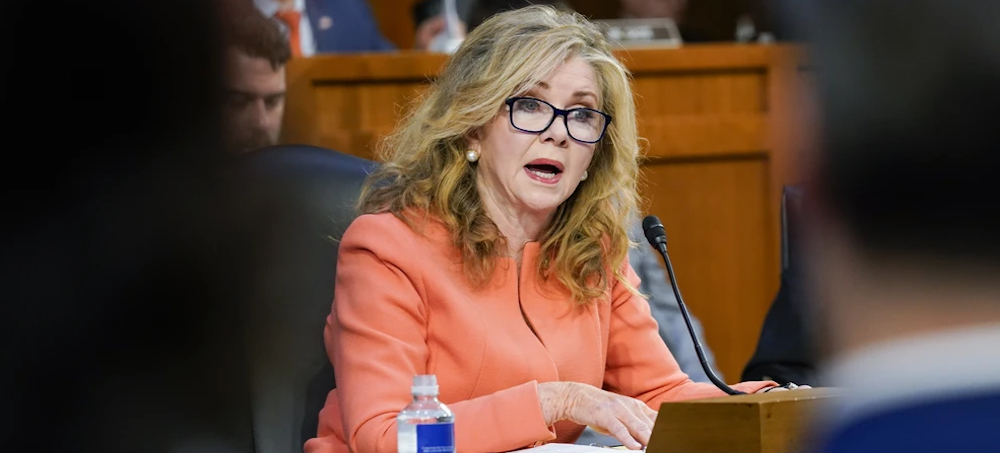 Tennessee senator Marsha Blackburn. (photo: J. Scott Applewhite/Getty Images)
GOP Senator Gives Preview of How Nasty Ketanji Brown Jackson's Hearings Will Be
Paul Blest, VICE
Blest writes: "Tennessee Sen. Marsha Blackburn was the last Senate Judiciary Committee member to give an opening statement in Judge Ketanji Brown Jackson's Supreme Court confirmation hearing, and she used it to throw Jackson under the bus of right-wing talking points ..."
“I can only wonder: What’s your hidden agenda?” Tennesse Sen. Marsha Blackburn asked Jackson, who was bound by the process to not answer.
Tennessee Sen. Marsha Blackburn was the last Senate Judiciary Committee member to give an opening statement in Judge Ketanji Brown Jackson’s Supreme Court confirmation hearing, and she used it to throw Jackson under the bus of right-wing talking points before the Supreme Court nominee even had a chance to speak.
After some brief niceties about Jackson’s role as a mother, Blackburn tore into the judge with a host of conservative grievances, including but not limited to: “progressive indoctrination” and critical race theory at a private Washington, D.C., school where Jackson serves on the board; the notion that Jackson is easy on child predators; and her defense of Guantanamo Bay detainees.
Blackburn got started with transphobic remarks about University of Pennsylvania swimmer Lia Thomas and repeatedly called transgender women “biological males,” saying that “those in power” are teaching young cisgender girls “their voices don’t matter.” Then she turned her sights on Jackson.
“Your public comments about ‘the transformative power of progressive education’... These are deeply concerning,” Blackburn said, before launching into an attack on Jackson for the policies at Georgetown Day School, where Jackson sits on the board.
“You serve on the board of a school that teaches kindergartners that they can choose their gender and teaches them about so-called ‘white privilege,’” Blackburn told the first Black woman to ever be nominated to a position on the Supreme Court.
Blackburn also criticized the school—and by extension, Jackson—for “push[ing] an anti-racist education program for white families,” and claimed parents were worried about the potential return of mask mandates to mitigate the COVID-19 pandemic.
Blackburn also said Jackson “consistently called for greater freedom for hardened criminals,” and slammed the judge for releasing incarcerated people from prison during the COVID-19 pandemic. Thousands of incarcerated people have died and hundreds of thousands more have contracted COVID-19 since the start of the pandemic, according to the COVID Prison Project.
“But your efforts to protect convicts began long before the pandemic,” Blackburn told Jackson.
“You used your time and talent not to serve our nation’s veterans or other vulnerable groups but to provide free legal services to terrorists to get out of [Guantanamo Bay] and get back to the fight,” Blackburn continued, as Jackson sat in front of her with a fixed expression. (Of the nearly 780 people ever detained at Guantanamo Bay, the vast majority were never charged or put on trial; more than two dozen people remain detained there despite not having been charged.)
“You also have a consistent pattern of giving child porn offenders lighter sentences,” Blackburn added, echoing an attack by fellow far-right Sen. Josh Hawley and falsely accusing Jackson of “saying publicly it is a mistake to assume child pornography offenders are pedophiles”—a reference to a 2012 U.S. Sentencing Commission meeting where Jackson was questioning experts during a hearing on child porn sentencing guidelines.
Blackburn also attacked Jackson as a radical who had a “hidden agenda.”
“I can only wonder: What’s your hidden agenda?” Blackburn asked Jackson, who was bound by the process to not answer. “Is it to let violent criminals, cop killers and child predators back to the streets? Is it to restrict parental rights and expand government’s reach into our schools and private family decisions? Is it to support the radical left’s attempt to pack the Supreme Court?”
Blackburn then cited a lecture at the University of Michigan Jackson gave in January 2020 in which she praised New York Times journalist Nikole Hannah-Jones—who developed the 1619 Project—as an “acclaimed investigative journalist” and described the project as “provocative.” Jackson’s lecture made the rounds on conservative media last week after the Daily Wire published the transcript.
“Is it your personal hidden agenda to incorporate critical race theory into our legal system?” Blackburn asked Jackson—who, again, was not allowed to answer.
Blackburn had indicated where her opening remarks would go in a video posted Sunday, during which she said the Supreme Court had made “constitutionally unsound” rulings such as Griswold v. Connecticut, a 1965 ruling which struck down state statutes barring married couples from obtaining and using contraceptives.
“It’s time for [Jackson] to speak up and let Tennesseeans know where she stands,” Blackburn said Sunday. “If she refuses to prove her commitment to following the Constitution as it is written, the Senate should refuse to offer her a seat on the Supreme Court.”
READ MORE
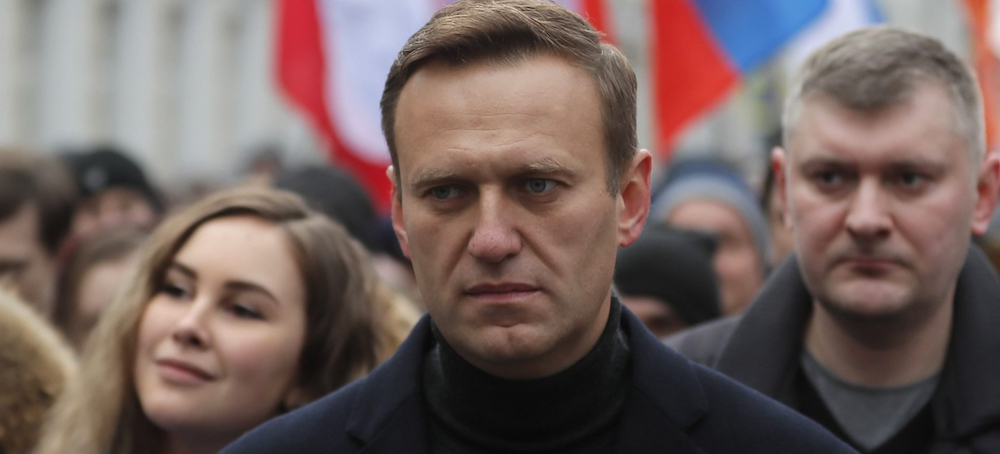 Alexei Navalny. (photo: Getty Images)
Navalny Sentenced to 9 Years in Prison by Russian Court
Associated Press
Excerpt: "Russian opposition leader Alexei Navalny was convicted of fraud and contempt of court and sentenced to nine years in a maximum security prison on Tuesday."
Russian opposition leader Alexei Navalny was convicted of fraud and contempt of court and sentenced to nine years in a maximum security prison on Tuesday, in a trial Kremlin critics see as an attempt to keep President Vladimir Putin’s most ardent foe in prison for as long as possible.
A judge also ruled that Navalny would have to pay a fine of 1.2 million rubles (about $11,500). Navalny can appeal the ruling.
Navalny, who is already serving 2½ years in a penal colony east of Moscow, had been accused of embezzling money that he and his foundation raised over the years and of insulting a judge during a previous trial.
The politician has rejected the allegations as politically motivated. The prosecution had asked for 13 years in a maximum security prison for the anti-corruption crusader and a 1.2 million-ruble fine.
It wasn’t immediately clear whether Navalny is expected to serve this sentence concurrently with his current one or on top of it, and which maximum security facility he will be transferred to and when.
Navalny’s Twitter account responded to the ruling with a quote from “The Wire” television series: “(Nine) years. Well, as the characters of my favorite TV series The Wire used to say: ‘You only do two days. That’s the day you go in and the day you come out.’ I even had a T-shirt with this slogan, but the prison authorities confiscated it, considering the print extremist.”
The trial, which opened about a month ago, unfolded in a makeshift courtroom in the prison colony hours away from Moscow where Navalny is serving a sentence for parole violations. Navalny’s supporters have criticized the authorities’ decision to move the proceedings there from a courthouse in Moscow, saying it has effectively limited access to the proceedings for the media and supporters.
Navalny, 45, has appeared at hearings wearing prison garb and made several elaborate speeches during the trial, decrying the charges against him as bogus.
Navalny was arrested in January 2021 immediately upon his return from Germany, where he spent five months convalescing from a poisoning he blamed on the Kremlin, a claim Russian officials vehemently denied. Shortly after the arrest, a court sentenced him to 2½ years in prison over the parole violations stemming from a 2014 suspended sentence in a fraud case that Navalny insists was politically driven.
Following Navalny’s imprisonment, authorities unleashed a sweeping crackdown on his associates and supporters. His closest allies have left Russia after facing multiple criminal charges, and his Foundation for Fighting Corruption and a network of nearly 40 regional offices were outlawed as extremist — a designation that exposes people involved to prosecution.
Last month, Russian officials added Navalny and a number of his associates to a state registry of extremists and terrorists.
Several criminal cases have been launched against Navalny individually, leading his associates to suggest the Kremlin intends to keep him behind bars for as long as possible.
READ MORE
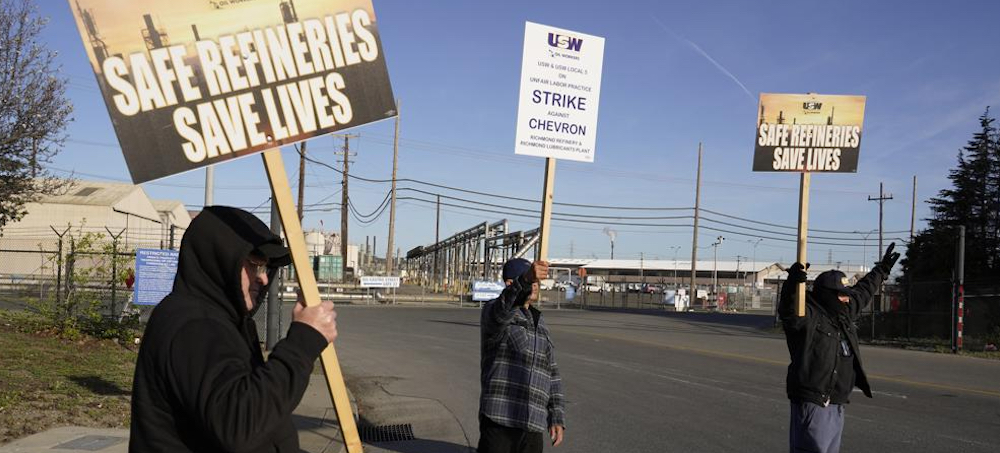 Operators hold up picket signs and acknowledge honking horns outside the Chevron Corp. refinery, Monday, March 21, 2022, in Richmond, California. (photo: Eric Risberg/AP)
Workers Go on Strike at California Refinery Owned by Chevron
Olga R. Rodriguez, Associated Press
Rodriguez writes: "More than 500 workers at a Chevron Corp. refinery in the San Francisco Bay Area went on strike early Monday over safety concerns and to demand a salary increase to keep up with inflation and the area's high cost of living."
More than 500 workers at a Chevron Corp. refinery in the San Francisco Bay Area went on strike early Monday over safety concerns and to demand a salary increase to keep up with inflation and the area’s high cost of living.
The strike affecting the refinery in the city of Richmond began at 12:01 a.m. It came after workers voted down Chevron’s most recent contract offer and the company refused to return to the bargaining table, the United Steelworkers union said.
Chevron said in a statement Sunday night that it has negotiated with the union for months and believes a contract offered by the company was fair and addressed union concerns.
The union said it had negotiated a national agreement for oil workers on wages and working conditions, but about 200 individual bargaining units still had to negotiate local issues.
USW Local 5 representative B.K. White, a refinery operator who has worked for the company for 29 years, said Chevron failed to address worker fatigue and a lack of staffing.
“If we had more people and could get a better pay rate, maybe our members wouldn’t feel obligated to come in and work as many as 70 hours a week to make ends meet. We don’t believe that is safe,” White said.
Chevron said that in Richmond, the union’s demands “exceeded what the company believes to be reasonable and moved beyond what was agreed to as part of the national pattern bargaining agreement.”
The company offered a 2.5% pay increase, but the union had asked for 5% to keep up with inflation and cost of living in the Bay Area, White said.
“It’s rough for the blue-collar worker in the Bay Area, and we asked for a 5% bump to help us out a little bit with our medical at Kaiser, which went up 23% last year,” White said.
White said the company has already brought in about 100 replacement workers who are not trained to run the plants.
“This is at the detriment of the city of Richmond and the environment,” he said.
The company said it brought in qualified replacements starting with Sunday’s night shift.
“The employees who are operating the refinery during the strike have satisfied the necessary requirements to perform their designated jobs (including receiving on-the-job training from experienced employees/operators) so that the refinery will be operated safely and in compliance with all applicable laws,” Chevron spokesperson Tyler Kruzich said in an email.
If the strike were to shut down the refinery, that could negatively affect gasoline prices in California — which has the highest regular gas price in the nation at $5.86 per gallon, according to the American Automobile Association.
However, Ken Medlock, director of the Center for Energy Studies at Rice University’s Baker Institute, said it is highly unlikely the strike would lead Chevron to shut down operations or raise prices.
“It is more likely that the refinery will run with a ‘skeleton crew’ until the labor contract issues can be resolved,” Medlock said in an email.
“California prices are already higher than other states due to the unique blend that must be sold in the state that limits arbitrage of imported gasoline from other regions, so there is ample incentive to keep the refinery running,” he added.
The old contract with Chevron in Richmond expired Feb. 1, and workers had been reporting to their jobs on a rolling 24-hour extension, the union said.
The San Ramon, California-based Chevron said on its website that the refinery employs 1,300 workers. The union represents about 600 employees who include machinists, pipefitters, lab technicians and warehouse workers, White said.
The refinery is one of largest in the state and processes about 240,000 barrels of crude oil a day to make gasoline, diesel and jet fuel and lubricating oils, products that are sold mainly in California.
Chevron said in a statement it is “fully prepared to continue normal operations” despite the strike.
“We anticipate no issues in maintaining a reliable supply of products to the market,” it said.
READ MORE
Special Coverage: Ukraine, A Historic Resistance
https://www.rsn.org/001/ukraine-a-historic-resistance.html
Contribute to RSN
Follow us on facebook and twitter!
Update My Monthly Donation
PO Box 2043 / Citrus Heights, CA 95611


