'I think we are all disappointed': Former Mashpee Wampanoag Tribal chairman convicted
Sarah Carlon Cape Cod Times
Published May 6, 2022
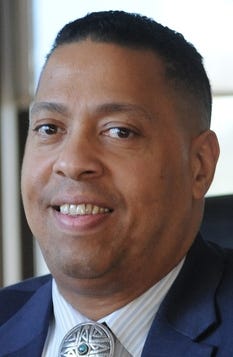
Former Mashpee Wampanoag Tribal Council Chairman Cedric Cromwell was convicted by a jury on bribery charges on Thursday in U.S. District Court in Boston.
Cromwell, 55, of Attleboro, former chairman and president of the tribe's Gaming Authority, was convicted on two counts of accepting bribes as an agent of an Indian tribal government official, three counts of extortion under color of official right and one count of conspiring to commit extortion, according to a press release from the Massachusetts U.S. Attorney's office.
David DeQuattro, 54 of Warwick, Rhode Island, and owner of the architecture and design firm Robinson Green Beretta Corp., which was under contract with the tribe to act as "owner's representative" for construction of First Light Resort and Casino in Taunton, was found guilty on one count of paying a bribe to an agent of an Indian tribal government.
Sentencing is scheduled for Sept. 9.
The indictment:Mashpee Wampanoag Tribal Council chairman indicted, removed from post
Mashpee Wampanoag Tribe sets in-person election date
Jessica Hill Cape Cod Times
Published Mar 24, 2021
MASHPEE — The Mashpee Wampanoag Tribe has set a new date for its general election after a Mashpee District Court judge found that mail-in voting was against the tribe’s constitution.
The election is set to take place in person on May 16.
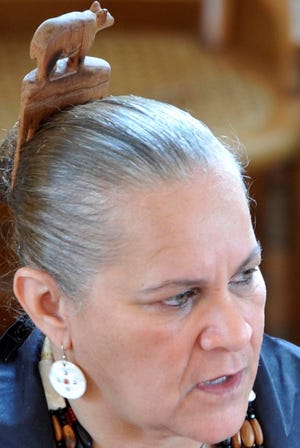
The Tribal Council set the date during its emergency meeting Monday, although the tribe’s Election Committee still has some work to do, Tribal Council Vice Chair Jessie “Little Doe” Baird said.
Tribal Council member Aaron Tobey Jr., along with two other tribal members, sued members of the Tribal Council and the Election Committee regarding the election, which was originally set for March 26. The Tribal Council and Election Committee decided to hold the election solely through mail-in ballots instead of in person in light of the COVID-19 pandemic.
Tobey and the other plaintiffs argued that it was against the tribe’s constitution, which states that voting in tribal elections shall be by “secret ballot cast at polls.” Mashpee Wampanoag Tribal Alternate District Court Judge Amanda L. WhiteEagle agreed.
On May 16, registered tribal voters will pick the next tribal council chairperson as well as other government positions. Nelson Andrews Jr., Kyle Bassett, Aaron Tobey Jr. and Brian Weeden are vying for chairperson.
Carlton Hendricks Jr. and Edwina “Winnie” Johnson-Graham are seeking the vice chair position on the tribal council. Ann Marie Askew and Cassie Jackson are running for tribal council secretary, and Kimberly Frye is running against incumbent David Weeden for a spot on the tribal council.
Charles “Bobby” Foster, Angela Marcellino, Winona Pocknett, Karen Edwards Siegel and Marie Stone are running to be the tribe’s next treasurer.
Mashpee Wampanoag tribal members sue over mail-in voting plan
Jessica Hill Cape Cod Times
Mar 2, 2021
MASHPEE — With the Mashpee Wampanoag Tribe’s general election only a few weeks away, a few members have raised concerns about the decision to hold the election exclusively through mail-in voting.
Tribal members Aaron Tobey Jr., Crystal Asiwe and Steve Helme are suing members of the Mashpee Wampanoag Tribal Council and the Mashpee Wampanoag Tribe Election Committee at the tribal court, arguing that holding the March 26 election through mail-in voting is against the tribe’s constitution.
“What my client is arguing, is that the constitution really prescribes the election process for the tribe,” attorney Jonathan Polloni, representing the plaintiffs, said in a phone interview, “and what’s happened is that the tribal council has really buried that process. That is significant and deserves a lot of caution.”
A preliminary injunction hearing will be held in the Mashpee Wampanoag Tribal District Court at 10 a.m. Tuesday regarding the lawsuit.
The election will determine who the next tribal chairman or chairwoman will be, as well as other positions in tribal government.
On Jan. 25, the tribal council passed an emergency tribal ordinance to address voting in the 2021 Regular Election during the COVID-19 pandemic. The ordinance allowed for the election to be held through mail-in voting and/or voting by ballot drop box.
In conjunction with passing that ordinance, the council also requested an advisory opinion from the Mashpee Wampanoag Supreme Court to determine whether voting by mail conflicts with the tribe’s constitution. The court has not yet made a ruling on that question.
That request was made in order to “bolster the tribal membership’s confidence in the integrity and legality of the modified voting method for the 2021 Regular Election,” according to the defendants’ brief filed Feb. 19 in opposition to the plaintiffs’ motion.
The plaintiffs argue that while the Mashpee Wampanoag Tribe Constitution provides for the adoption of ordinances, as well as emergency ordinances, the constitution requires voting by “secret ballots cast at polls” in all tribal elections and prohibits absentee voting, according to the plaintiffs’ complaint obtained by the Cape Cod Times.
“By permitting mail-in ballot voting, the Defendants have caused election irregularities that violate the Constitution and will affect the outcome of the election when it is held,” the complaint states.
The plaintiffs ask that the tribal court annul the election and require a new election be held in conformance with the constitution.
“The timing to experiment with mail-in voting is not now,” Tobey, a plaintiff, said in an interview, noting that information on past elections has been subpoenaed by a federal grand jury.
Helme, another one of the plaintiffs, said he does not understand why the tribe cannot follow the Centers for Disease Control and Prevention’s rules to allow both voting in person and mail-in voting for those who would like the option. He also thinks all tribal members should have a say in how the election will work.
The defendants, on the other hand, argue that the tribal council and election committee did follow the constitution, which does not require in-person voting. They argue that all-mail voting still ensures that ballots are cast at “polls,” as the constitution requires. They defined “polls” as the location where the committee designated mail-in ballots to be sent as well as the secure ballot drop boxes.
The mail-in election does not violate the rule against absentee voting, as all-mail voting is different from absentee voting, the defendants state in their opposition. That opposition brief was submitted by Alexandra Deal, the attorney for the tribal council members, and R. Reid LeBeau II, attorney for the election committee members. The attorneys did not respond to requests for comment Monday, nor did tribal council Vice Chairperson Jesse "Little Doe" Baird.
The defendants argued that voting in person could risk serious, and even deadly, health consequences.
“In the extraordinary time of a worldwide pandemic, the priorities and needs of the Tribe have changed,” their opposition states, “and the Tribal Council has determined that in-person voting on election day during a 3-hour window at a single polling location is no longer a tenable option for the 2021 Regular Election.”
The defendants also argued that the defendants, as members of the tribal council and election committee being sued in their official capacities, are immune from being sued as they are "entitled to sovereign immunity from unconsented (lawsuits) as officers of the tribe."
John “Jim” Peters Jr., a member of the Mashpee Wampanoag Tribe and executive director of the Massachusetts Commission on Indian Affairs, was also on the tribe’s constitution committee. One of the justifications for not allowing mail-in ballots, he said, was that tribal members live all over the country, and not everybody knows what is happening in Mashpee and might make uninformed decisions. But the constitution was never written to prevent the tribal council from having flexibility to meet the needs of the tribe, he said.
“I understand both sides of it,” he said. “Given the pandemic, it’s kind of difficult to require people to come to the tribal grounds and so forth.”
Grand jury subpoenas more documents from Mashpee tribe
Jessica Hill
Aug 29, 2020
MASHPEE — The Mashpee Wampanoag Tribal Council voted in an emergency meeting Friday night not to remove Chairman Cedric Cromwell. The vote came after the tribe received another subpoena related to a federal grand jury investigation.
On the meeting agenda, listed under executive session, was a discussion of “grand jury subpoena” with tribal attorney Benjamin Wish. Also on the agenda was an item labeled “committees, commissions, appointments, resignations and removals.”
The council voted 5-3, with one abstention, not to remove Cromwell from the position he has held since 2009, a source with knowledge of the vote told the Times.
As part of a grand jury investigation, the U.S. Attorney’s Office in Boston subpoenaed the tribe demanding records related to its elections and finances.
The Aug. 10 subpoena was signed by Assistant U.S. Attorney Christine Wichers on behalf of U.S. Attorney Andrew Lelling. In lieu of a tribal representative appearing physically in court before the grand jury Aug. 25, it requested all records be sent electronically to Wichers.
The subpoena requested all documents and records for the 2013 and 2017 tribal council chairperson elections. It requested a list of registered voters eligible to vote during those elections and a list of people who actually voted, along with the final certified election results.
It also called for documentation identifying the number of tribal members for each year between 2011 and 2020 along with any other annual census data.
The tribe also was to send any complaints it had received related to the elections, the candidate or any candidate’s campaign, and submit policies or rules related to campaign contributions and campaign expenditures.
Finally, the subpoena requested copies of all contracts between the tribe and the Robinson Green Beretta Corp. from January 2011 to the present. It also requested the minutes from January 2014 to the end of 2016 of all meetings of the committee that selected the corporation to work with the casino and from the committee that was authorized to terminate Robinson Green Beretta Corp.
The Robinson Green Beretta Corp. served as the owner’s project manager for the design and construction of the Mashpee Wampanoag Tribe Community and Government Center on Great Neck Road South, which was completed in 2012. It also took on the role of owner’s representative in 2014 for the tribe’s First Light Resort & Casino, according to the company website, working with the tribe and the Genting Group, the tribe’s financial backer.
The $1 billion casino project in Taunton is at a standstill amid a yearslong legal battle over tribal sovereignty. Without the projected millions of dollars in revenue, the tribe has struggled with its finances.
This latest subpoena comes about two months after a federal grand jury issued a subpoena requesting all personnel records for Cromwell, Treasurer Gordon Harris and former Treasurer Robert T. Hendricks, as well as Mark Harding, founder of construction company WampWorx, and Louis Catarina Jr., who helped manage development for the First Light Resort & Casino project.
The June 5 subpoena requested many of the tribe’s financial records, including copies of checks, expense reports and payments to other organizations. It also sought documents concerning any internal or external investigation or audit looking into any suspected theft, embezzlement or other wrongdoing by a tribe official, employee or contractor.
Last year, a federal grand jury subpoenaed Harris and Hendricks, but the reason is still unclear.
Federal grand jury investigations are traditionally secret, with about two dozen citizens serving as jury members to examine documents to determine if sufficient evidence exists that a crime occurred.
Cromwell and Harris also had faced allegations last year from some tribe members who accused them of wrongful conduct in connection with $500 million owed to the Genting Group.
In June 2019 a robocall circulated within the tribal community alleging that $250 million handled by the Mashpee Wampanoag Tribal Gaming Authority was unaccounted for.
In January 2019, the tribal council had taken a vote of no-confidence and stripped Cromwell of his financial responsibilities in connection with the tribe and the Mashpee Wampanoag Tribal Gaming Authority. Cromwell is president of that five-member board that oversees the tribe’s gaming operation.
The tribal council, however, voted in February 2019 to restore all of Cromwell’s financial responsibilities.
Last fall, some tribe members sought to recall Cromwell and Harris for malfeasance, but the tribe’s Election Committee canceled the recall election three days before it was to take place.
Cromwell did not respond to a request for comment Saturday. The U.S. Attorney’s Office for the District of Massachusetts also did not respond to a request for comment about the investigation.
Wish, the tribe’s attorney, said the tribe would comply with the grand jury’s requests for information.
'A triumph' Interior Department withdraws appeal in Mashpee tribe's land-in-trust case
Jessica Hill Cape Cod Times
Published Feb 19, 2021
In a big victory for the Mashpee Wampanoag Tribe, the U.S. Department of the Interior on Friday withdrew its appeal in U.S. District Court in the tribe's land-in-trust case.
“Today is sakôhsuwôk, a triumph,” said Jessie “Little Doe” Baird, the tribe's vice chairwoman, in a statement late Friday afternoon. The decision was a win "for the citizens of the Mashpee Wampanoag Tribe and our Ancestors who have fought and died to ensure our Land and sovereign rights are respected," she said.
The Department of Interior filed a motion Feb. 18 for the voluntary dismissal of its appeal, wrote Rachel Heron, attorney for the U.S. Department of Justice Environmental and Natural Resources Division.
The case was part of a long battle for tribal sovereignty, which stemmed from a $1 billion casino the tribe wanted to build in Taunton.
U.S. Rep. William Keating, D-Mass., also hailed the decision Friday.
"The claim that the Tribe of the First Light, the Tribe of the First Thanksgiving was not an original Native American Tribe has always been disingenuous," he said in a statement. "And the Trump Administration’s sudden attempt to remove their land from trust last March — in the midst of a pandemic — was heartless. We’re reassured that the Biden Administration’s action today clearly reflects the best interest of justice ..."
The tribe had asked the interior secretary to put about 151 acres of land in Taunton into trust so it could build a casino, as well as another 170 acres in Mashpee. While the assistant interior secretary approved it in 2015, neighbors of the proposed casino and others filed a lawsuit in opposition. They argued the government did not have the authority to take the land into trust in the first place.
In 2018, the Department of the Interior reversed itself, arguing the tribe was not under federal jurisdiction when the Indian Reorganization Act of 1934 was established. The tribe appealed, but a federal judge in Boston ruled in favor of the reversal.
Then in June 2020, U.S. District Judge Paul Friedman found that the 2018 decision was “arbitrary, capricious, an abuse of discretion and contrary to law.” He sent the case back to the Department of the Interior for “thorough reconsideration and reevaluation of the evidence.”
“We look forward to being able to close the book on this painful chapter in our history,” Baird said in the statement. “The decision not to pursue the appeal allows us (to) continue fulfilling our commitment to being good stewards and protecting our Land and the future of our young ones and providing for our citizens.”