
Showing posts with label OATH KEEPER. Show all posts

Monday, June 5, 2023

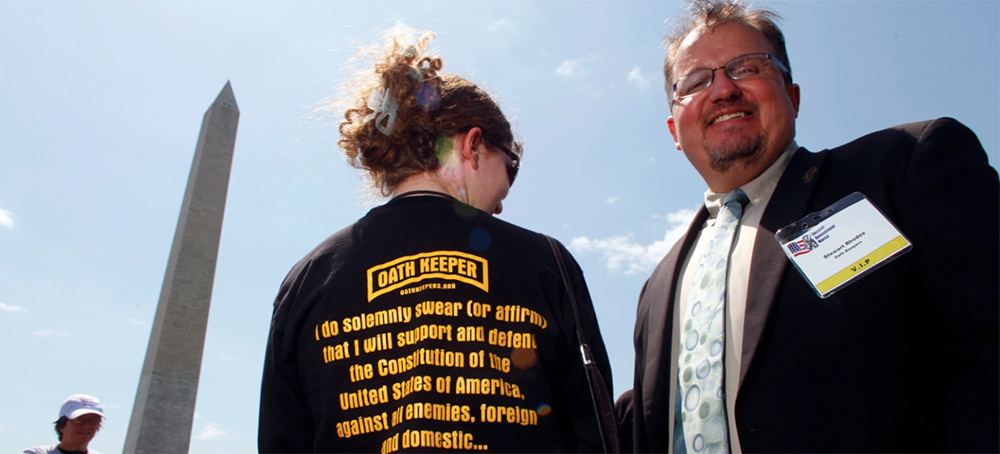
FOCUS: Stewart Rhodes | Oath Keepers Leader Stewart Rhodes Says He's a Political Prisoner. Republicans Are Listening.


Reader Supported News
05 June 23

Live on the homepage now!
Reader Supported News
WE NEED A SUCCESSFUL FUNDING DRIVE RIGHT NOW — 5 straight months of failing to cover operating costs have put RSN in financial jeopardy. We have-to-have a good fundraiser and we can’t even wait until later in the month, we need to get moving right now. Who can help out?
Marc Ash • Founder, Reader Supported News

Sure, I'll make a donation!


Stewart Rhodes, founder of the Oath Keepers, at the foot of the Washington Monument on April 19, 2010. (photo: Mark Peterson/Redux)
FOCUS: Stewart Rhodes | Oath Keepers Leader Stewart Rhodes Says He's a Political Prisoner. Republicans Are Listening.
Stewart Rhodes, The Intercept
Rhodes writes: "Tasha Adams won her divorce from Oath Keepers leader Stewart Rhodes last month." 


Oath Keepers Leader Stewart Rhodes Says He’s a Political Prisoner. Republicans Are Listening.


Tasha Adams won her divorce from Oath Keepers leader Stewart Rhodes last month. Three days later, she turned her attention to the Washington, D.C., courtroom where he was set to be sentenced for seditious conspiracy. Prosecutors had asked the judge to give him 25 years in prison for his role in connection with the attack on the U.S. Capitol on January 6; his attorneys had requested time served. Adams was on the government’s side. She’d been with Rhodes as he’d gone from a 25-year-old Army veteran with a high school education to a Yale-educated lawyer and then founder and leader of the Oath Keepers, which she’d helped him build. Now she considered him a threat to the nation, as well as to herself and their six children. She’d recorded a statement for the prosecution to include with their sentencing request. In it, Adams described Rhodes using a backhoe to dig escape tunnels in the yard, grabbing a daughter by the throat, and precariously waving a loaded handgun in the air before pointing it at his head. (Rhodes has denied similar allegations from Adams in the past.) “I think the best thing for Stewart is to be in a place where he can’t harm anyone, or he can’t manipulate more people,” Adams had said in the statement. She hoped the judge would give Rhodes as long a sentence as possible.

As she watched his hearing, though, she wondered if that wasn’t what Rhodes wanted too. She’d expected him to express some conciliation — support, perhaps, for police affected by the riot at the Capitol. Instead, he attacked his trial as rigged and antagonized the judge who’d decide his fate. “A steep sentence here won’t help or deter people,” he said. “It will make people think this government is even more illegitimate than before.” He called himself “a political prisoner.”

Adams was considering how the harsher a sentence Rhodes received, the greater a cause célèbre he’d become on the right. This, she told me, as she followed the hearing on Twitter, would increase his chances for a pardon in a future Republican administration. In fact, Rhodes’s sentencing was playing out as one skirmish in a larger battle to determine how the history of January 6 will be written. From behind the bench, District Judge Amit Mehta, a Barack Obama appointee who also sits on the powerful Foreign Intelligence Surveillance Court, told Rhodes, “You, sir, present an ongoing threat and a peril to this country, to the Republic, and the very fabric of our democracy.” In his remarks beforehand, Rhodes, 58, wearing an orange prison jumpsuit, had already issued his reply: “My only crime is opposing those who are destroying our country.”

Mehta sentenced him to 18 years in prison, the longest term handed down in a January 6 case to date.

The version of Rhodes that Adams described in her statement and divorce filing is a man driven by a will to control and influence, feeding off the adulation of crowds in public while keeping a tight grip on his family in their remote Montana home. These impulses are twisted inextricably with real fear in her stories: that stronger forces are coming for him, disaster is inevitable, his control is slipping. He imagines erecting tripwires outside the house that will trigger a blast of AC/DC music to alert him to the start of a federal raid. He leaves his children bruised from trainings in martial arts and knife fighting designed to teach them to fend off attack and rape. He warns darkly of apocalypse. The power goes out, and he outfits his teenaged son with a rifle and body armor and rustles his family out into the night.

The 2018 divorce filings were unsealed last month. Rhodes responded to Adams’s allegations, in a sworn affidavit, by saying that she and her attorney had “twisted over 23 years of facts in an attempt to accomplish Tasha’s true goal of keeping the children from me.” He noted that her request for a temporary protection order had been denied and claimed his infidelity was the real cause of the rift in their marriage. Yet Adams’s portrayal of Rhodes as someone engaged in a long-running and complicated dance with power offers one way to interpret the contradictions he embodied at his sentencing. He expressed deeply held fears of tyrannical government power, yet he’d also grabbed for it: In open letters before January 6, Rhodes urged Donald Trump to overturn the election and volunteered the Oath Keepers to help enforce this. He was declaring himself a dissident and preparing to begin a very long prison term. He also seemed to be appealing to those powerful enough to one day free him of it.

Trump, who has a commanding lead in Republican primary polls, has made clear in recent months that support for those who stormed the Capitol on January 6 will be not just part of his campaign, but its essence. In March, he held his first official campaign rally in Waco, Texas, home to a deadly 1993 standoff between the federal government and an armed Christian sect whose bloody end has long been a defining event for right-wing militant groups like the Oath Keepers. Standing on a stage at the start of the rally, Trump held his hand over his heart as loudspeakers played a rendition of the national anthem that had been recorded from jail by people arrested in connection with January 6. The recording, which is overlaid with Trump’s voice reciting the Pledge of Allegiance, is credited to the “J6 Prison Choir” and had reached No. 1 on iTunes two weeks before the rally. As Trump and the crowd stood in reverence, video of the attack on the Capitol played above him on a pair of jumbotrons.

In the first year after January 6, Trump had expressed sympathy for the rioters, but his backing wasn’t full-throated. When I met with Rhodes in January 2022, a week before his arrest, he told me he wouldn’t in the future vote for Trump, who he said had failed to support January 6 defendants and had used the Oath Keepers as “cannon fodder.” After his arrest, Sidney Powell, Trump’s onetime lawyer and a close ally, reportedly stepped in to fund the defense of Rhodes and three other Oath Keepers via her legal foundation, which had raised more than $16 million in the year following the 2020 election. Now Trump has made pardons for January 6 convicts a central promise of his campaign. “I hope Trump wins in 2024,” Rhodes said at his sentencing, adding that many on the right view January 6 defendants as “political prisoners” and “patriots.” For Republicans, the issue of pardons may become a litmus test showing not just the extent to which they’re willing to downplay or excuse what happened on January 6, but also how enthusiastically they’ll embrace it. It’s the most revealing question for every candidate in the primary just beginning to take shape: If you’re elected president, will you pardon people who’ve been convicted for January 6?

On the day Rhodes was sentenced, Ron DeSantis, currently Trump’s top challenger, was asked this question in a radio interview. “On Day One, I will have folks that will get together and look at all these cases, who are people who are victims of weaponization or political targeting,” he replied. “And we will be aggressive at issuing pardons.”

In his testimony at sentencing, Rhodes compared himself to Aleksandr Solzhenitsyn, the Nobel Prize-winning Russian dissident writer, who spent eight years incarcerated in Soviet prisons.

It reminded me of my first conversation with Rhodes in early 2020. I said I thought his frequent invocations of civil war were dangerous and that civil war is the worst thing in the world. He disagreed, saying the totalitarian nightmares that had unfolded under Adolf Hitler, Josef Stalin, and other dictators showed the need to fight a repressive government before it’s too late. He cited a passage from “The Gulag Archipelago,” Solzhenitsyn’s acclaimed book about his imprisonment:

And how we burned in the camps later, thinking: What would things have been like if every Security operative, when he went out at night to make an arrest, had been uncertain whether he would return alive and had to say good-bye to his family? Or if, during periods of mass arrests […] people had not simply sat there in their lairs, paling with terror at every bang of the downstairs door and at every step on the staircase, but had understood that they had nothing left to lose and had boldly set up in the downstairs hall an ambush of half a dozen people with axes, hammers, pokers, or whatever else was at hand?

FBI agents approached Rhodes outside a Texas hotel in May 2021 to serve a warrant for his phone. He handed it over, volunteered the passcode, advised the agents that he had a gun in his backpack, and told them that, if they ever needed to arrest him, they could call and he’d turn himself in. He went peaceably when the FBI eventually showed up to take him to jail. So perhaps he realizes that America is nowhere near the kind of dictatorship about which Solzhenitsyn was writing.

Or maybe he’d argue that, as it had been for all the prisoners Solzhenitsyn met in the gulag, submission was the only feasible choice, at least in the moment of arrest.

Rhodes has long considered himself a dissident, even at times on the right. He drew criticism from his group’s own members over his support for Edward Snowden and Julian Assange at a time when they were still heroes of the left. (“Your banner stating ‘Snowden honored his oath’ is sickening and infuriating,” read one letter of resignation I found in a cache of leaked Oath Keepers files. “I have honored my oath for 27 years and will not be associated with an organization that supports a traitor.”) During the George W. Bush administration, when his only claim to public notice was as a blogger, Rhodes was writing about the post-9/11 assault on civil liberties and the growth of the national security state and warning that America could be on a path to tyranny. His talk about dictatorship went into overdrive during Obama’s presidency — though by then it was infused with the blunter and dumber rhetoric of the Tea Party — and hyperdrive under Trump. His open letters to the then-president after the 2020 election called the day of its certification in Congress the last chance to stop the coming tyranny. He urged Trump to invoke the Insurrection Act, overturn the vote, and call up “the militia,” saying he and the Oath Keepers would be in D.C. to help.

Instead, Trump gave an incendiary speech near the White House and returned to the Oval Office. Protesters descended on the Capitol, and two columns of Oath Keepers joined the crowd as it surged into the building. Rhodes remained outside, comparing the rioters to America’s founding patriots in group messages on the encrypted app Signal. He was convicted of seditious conspiracy and two other charges after a trial in which prosecutors didn’t show that there’d been a plan among Rhodes and his members to storm the Capitol or that they’d played a role in the initial breach.

Defense attorneys often refer to the conspiracy charge as a prosecutor’s “darling” because it requires the government to show only that defendants agreed to carry out an illegal act and then took a step to further it. In Rhodes’s case, prosecutors argued that he’d given his members the idea that they needed to do something to stop the transfer of presidential power, and when the riot at the Capitol commenced, they’d seized the opportunity. They focused on the guns the Oath Keepers had stashed in Virginia as a contingency and on the kind of incendiary language I’d critiqued on our first call. They pulled from his Signal messages: “We aren’t getting through this without a civil war.” They also cited passages from his open letters to Trump: “If you fail to do your duty, you will leave We the People no choice but to walk in the founders [sic] footsteps, by declaring the regime illegitimate, incapable of representing us, destructive of the just ends of government — to secure our liberty. And, like the founding generation, we will take to arms in defense of our God-given liberty.” Those letters had been published on the Oath Keepers website, which, along with their accounts on Twitter and Facebook, has since been purged from the internet.

Among the many differences between Solzhenitsyn’s situation and Rhodes’s is this: The Russian writer didn’t have the tacit backing of potential future leaders of his country and a political movement with a near-even chance to soon retake power. Yet I imagine that Rhodes has kept in mind how Solzhenitsyn was arrested for political opinions expressed in letters to a friend. Afterward, as Solzhenitsyn recounts in “The Gulag Archipelago,” his writings were cast into a prison furnace and incinerated. “I had expressed myself vehemently,” he writes, “and had been almost reckless in spelling out seditious ideas.” At one point in his miserable imprisonment, he laments, “Only one life is allotted us, one small, short life! And we had been criminal enough to … drag it with us, still unsullied, into the dirty rubbish heap of politics.” Elsewhere, he takes solace in the fact that without his prison sentence, “I would not have written this book” and recounts how “very early and very clearly, I had this consciousness that prison was not an abyss for me, but the most important turning point in my life.”

The first time I spoke with Adams, in the summer of 2020, she asked me to keep the conversation off the record. (She’s since lifted that request.) “I don’t want anyone to know I talked with you,” she said, adding that her divorce proceedings were under seal and a gag order was in effect.

Her separation from Rhodes was only two years old. He’d left their small Montana community for Texas at the start of the year, and Adams was reassessing her views of him and the Oath Keepers after years writing blog posts for the group and helping with its administration.

It was always going to be a right-wing organization, she told me, but at its outset, it existed at the edge of mainstream politics. She and Rhodes had been die-hard supporters of the libertarian presidential candidate Ron Paul, volunteering on his 2008 campaign, and many of the group’s early members were drawn from those circles. Others came over from a web forum called the Mental Militia, whose mission statement held that “Mentalitians are people who believe that ‘consciousness works!’, and who prefer the art of reason over violence … And we are concerned about the direction of today’s industrialized, militarized, economized, high-tech, post-Atomic, government-controlled world.” Some, Adams said, had even been supporters of the anti-war liberal politician Dennis Kucinich.

She told stories in that conversation and others about the paranoia that had prevailed in the family’s remote Montana household: their fears that the home was bugged, waking up in the middle of the night to use the bathroom and tripping over piles of guns. At first, Adams found Rhodes’s conviction that the government was hunting him hard to take seriously, but after the Oath Keepers got involved in standoffs with federal agents at Bundy Ranch in Nevada and elsewhere, the FBI really did summon Rhodes to a meeting, and he really did find himself on what seemed to be a no-fly list, even as his group edged closer to the heart of Republican politics. By the second half of 2020, the Oath Keepers and other right-wing militants were patrolling racial justice protests and aligning with Trump over fears of antifascists and a stolen election. Adams struggled to say how much of his own dystopian talk Rhodes really believed: “Sometimes I think he did and sometimes he didn’t.” She noted the times he’d become convinced that “a world-changing event” was approaching and that he’d emerge as a leader within it.

Now Rhodes is living out the role he wrote for himself long ago, caught in the contradiction of someone both on the fringe and at the core of America’s power structure. As his sentencing approached, he kept up the drumbeat of his political prisoner narrative and at times, seemed to be working at cross-purposes with his own attorneys, who cast Rhodes as a beacon of community service, focusing on his time in the Army and the periodic disaster relief operations the Oath Keepers had conducted and urging that he be judged by those actions. Meanwhile, Rhodes wrote a 46-page letter from jail that was excerpted in the Epoch Times, a pro-Trump news outlet. In it, he said he had been convicted for “who I am” and “what I said.” He warned conservatives that his conviction was “only the beginning of a political persecution campaign aimed at all of you.” He concluded, “They can take my liberty and imprison my body, but they cannot imprison my mind.”

Before Rhodes’s sentencing, Thomas Massie, the iconoclastic, up-and-coming congressional Republican from Kentucky, tweeted, “Stewart Rhodes never entered the Capitol and didn’t commit acts of violence or destruction, yet he’s going to be sentenced Thursday for ‘seditious conspiracy’ … Weaponization of speech?” The idea taking hold on the right that people charged over January 6 are political prisoners feeds on real problems, such as the fact that many of them have been jailed for more than two years without trial, and on the embrace of tools such as censorship and conspiracy charges in the name of protecting democracy. It also feeds on the fervor of the Trump era and the election lie.

Part of the falsity of this movement is that it exists within its own sphere of power and on the coin-flip edge of controlling the country; they talk about the gulag as they set their sights on the presidency. I think about how, under Trump, the Justice Department used a conspiracy charge to threaten more than 200 people who’d protested against the inauguration with decades in prison because a smaller group of them had rioted. The charges against most were ultimately dropped, but only after they spent more than a year in legal jeopardy. I think about how the governor of Texas has vowed to pardon a man who shot a Black Lives Matter demonstrator dead in the street, the celebration of the Kenosha shooter, and laws like the one passed by the Republican statehouse in Iowa in 2021 that shields drivers who run their vehicles over protesters. I think about a country that, after the post-9/11 construction of a domestic surveillance and national security state, has facets of dictatorship already in place and how it always seems primed to tilt further down that path. I think about real dissidents and how badly we need them.


READ MORE


Contribute to RSN

Follow us on facebook and twitter!

Update My Monthly Donation

PO Box 2043 / Citrus Heights, CA 95611


Friday, May 26, 2023

Andy Borowitz | Desantis Hopes to Seem Like Normal Person by Appearing Next to Elon Musk


Reader Supported News
25 May 23

Live on the homepage now!
Reader Supported News

TIME TO THINK ABOUT WHAT RSN MEANS — Time is short, it’s late in the month and only a small percentage of our readers have donated so far. What brings you to Reader Supported News? What is that worth to you? You come here for a reason. Is it to be entertained or to be a part of something? What will you do?
Marc Ash • Founder, Reader Supported News

Sure, I'll make a donation!


Elon Musk stands outside Arnold Hall, April 7 2022, El Paso County, CO. (photo: Trevor Cokley/U.S. Air Force)
Andy Borowitz | Desantis Hopes to Seem Like Normal Person by Appearing Next to Elon Musk
Andy Borowitz, The New Yorker
Borowitz writes: "Ron DeSantis is hoping to seem like a normal person by appearing next to Elon Musk, the Governor's campaign has confirmed."
READ MORE


Oath Keepers Founder Sentenced to 18 Years in Jan. 6 Seditious Conspiracy CaseStewart Rhodes at the Capitol on Jan. 6, 2021. (photo: Ford Fischer/News2Share)

Oath Keepers Founder Sentenced to 18 Years in Jan. 6 Seditious Conspiracy Case
Ryan J. Reilly, Daniel Barnes and Gary Grumbach, NBC News
Excerpt: "The founder of the far-right Oath Keepers has been sentenced to 18 years in federal prison in connection with the Jan. 6 attack on the Capitol following his conviction on seditious conspiracy." 


Stewart Rhodes, who said after the Capitol attack that the rioters “should have brought rifles," received the longest sentence of any Jan. 6 defendant to date.

The founder of the far-right Oath Keepers has been sentenced to 18 years in federal prison in connection with the Jan. 6 attack on the Capitol following his conviction on seditious conspiracy.

The sentence for Stewart Rhodes is the longest imposed on a Jan. 6 defendant to date. In a politically-charged speech in the courtroom just before his sentencing, Rhodes called himself a "political prisoner" and said that when he talked about "regime change" in a phone call with supporters earlier this week, he meant he hopes that former President Donald Trump will win in 2024.

The judge disagreed that Rhodes had been locked up for politics, saying it was his actions that led to his criminal convictions.

“You, sir, present an ongoing threat and a peril to this country and to the republic and to the very fabric of this democracy," Judge Amit Mehta said before handing down the sentence.

Rhodes was convicted of seditious conspiracy in November along with Kelly Meggs, a fellow Oath Keepers member who will be sentenced later Thursday afternoon.

"They won't fear us until we come with rifles in hand," Rhodes wrote in a message ahead of the Jan. 6 attack. After the attack, in a recording that was played in court during his trial, he said his only regret was that they “should have brought rifles.”

Wearing an orange prison jumpsuit Thursday, Rhodes said he believes the only crime he committed was opposing those who are “destroying our country.”

Mehta told Rhodes that he was found guilty of seditious conspiracy “not because of your beliefs, not because you supported the other guy, not because Joe Biden is president right now,” but because of the facts of the case, and his actions before, during and after Jan. 6.

“You are not a political prisoner, Mr. Rhodes,” Mehta said.

Rhodes and Meggs were put on trial alongside Jessica Watkins, Kenneth Harrelson and Thomas Caldwell, fellow Oath Keepers who were convicted of obstruction of an official proceeding and aiding and abetting, but not seditious conspiracy. Watkins and Harrelson will be sentenced on Friday.

Rhodes took the stand in his case, saying at trial that the other members of the Oath Keepers were "stupid" to storm the Capitol and that he disagreed with those who went inside; Rhodes did not enter the building. “I had no idea that any Oath Keeper was even thinking about going inside or would go inside,” Rhodes said.

But the government also produced messages in which Rhodes said he thought that Jan. 6 was the last opportunity to stop what he saw as a takeover of the government.

"On the 6th, they are going to put the final nail in the coffin of this Republic, unless we fight our way out. With Trump (preferably) or without him, we have no choice," Rhodes wrote in a message ahead of Jan. 6.

He also celebrated Oath Keepers' actions in the immediate aftermath of the attack, after meeting with other members of the group at an Olive Garden in Virginia that night.

“Patriots, it was a long day but a day when patriots began to stand," Rhodes wrote the night of Jan. 6. "Stand now or kneel forever. Honor your oaths. Remember your legacy."

Prior to Thursday's sentence, Peter Schwartz, who was armed with a wooden tire knocker and engaged in a series of assaults on officers during the Capitol attack, had received the longest time behind bars for a Jan. 6 defendant: just over 14 years. Schwartz had 38 prior convictions.


READ MORE


Florida Mom Behind Amanda Gorman Book Ban Has Proud Boy LinksAmanda Gorman recited her poem 'The Hill We Climb' at President Biden's inauguration. (photo: Erin Schaff/The New York Times)

Florida Mom Behind Amanda Gorman Book Ban Has Proud Boy Links
Decca Muldowney and Kelly Weill, The Daily Beast
Excerpt: "The parent who got a Florida school to ban Amanda Gorman's inauguration poem has ties to the far-right Proud Boys and conservative firebrands Moms For Liberty." 


Daily Salinas attended multiple rallies with members of the far-right group prior to her activism against school library books.

The parent who got a Florida school to ban Amanda Gorman’s inauguration poem has ties to the far-right Proud Boys and conservative firebrands Moms For Liberty, The Daily Beast has confirmed.

The links, first highlighted by the Twitter account Miami Against Fascism, follow an exposé on Florida mom Daily Salinas by the Miami Herald. In an interview with the Herald, Salinas said she “is not for eliminating or censoring any books,” but wants materials to be appropriate and for students “to know the truth” about Cuba.

Salinas’ complaints led a Florida school to restrict access to The Hill We Climb, a book adaptation of the poem Gorman recited at President Joe Biden’s inauguration. The Bob Graham Education Center in Miami Lakes, Florida also pulled two other titles—The ABCs of Black History, and Love to Langston—from its elementary school section after a single complaint from Salinas, who has two children at the school, the Miami Herald first reported.

The complaints, reviewed by The Daily Beast, reveal that Salinas reported the books for things like “CRT and gender idiology [sic],” and “indoctrination.”

“Is not educational and have indirectly hate messages,” Salinas wrote of The Hill We Climb, which she incorrectly described as being authored by Oprah Winfrey (the book features a foreword by Winfrey). One of the pages Salinas complained about reads: “Somehow, we’ve weathered and witnessed / A nation that isn’t broken, but simply unfinished.”

A committee at the school decided to reshelve the books in the library’s middle school section, according to meeting minutes viewed by The Daily Beast, despite the books being recommended for younger readers.

Salinas, who filed complaints against five books, appears to be connected to multiple far-right organizations, attending events with Moms for Liberty and the Proud Boys.

Salinas did not return requests for comment. The Miami-Dade Moms for Liberty chapter did not immediately return a request for comment.

Salinas was removed by security from a Miami-Dade school board meeting in July 2022, according to video of the event, during an intervention by Moms For Liberty. The group disrupted the meeting to protest two sex education textbooks that had been previously approved by the board. Following petitions from parents, the board voted 5-4 to remove the books, effectively leaving the district without instruction materials for sex education.

An avid supporter of Ron DeSantis, Salinas worked as a volunteer on his “Education Agenda Tour” in August 2022, according to social media posts reviewed by The Daily Beast. That summer, DeSantis traveled the state boosting conservative candidates in school board elections and lambasting schools “indoctrinating” children.

However, Salinas’ politics appear to have gone beyond the right wing of the Republican party, veering into extremism and antisemitism.

In March of this year, Salinas shared a Facebook post entitled “The Protocols of the Learned Elders of Zion,” which included a series of anti-Semitic tropes about an alleged Jewish conspiracy to control the world. Salinas appears to have deleted the post on Wednesday, after it was flagged by the group Miami Against Fascism on Twitter. After the deletion, she posted a picture of an armed Israeli Defense Force soldier in front of a tank, with the words, “People never seen this.I love my Jewish people.”

Salinas, a registered Republican, appeared to become more politically active during the COVID pandemic, according to a review of her social media. In October 2020, Salinas was interviewed briefly on a segment by PBS Newshour about Florida voters.

“My biggest fear is, they talk about the Democratic Party. They talk about socialism, socialism and communism going in the same way,” Salinas said. She told PBS she had fled Cuba for the United States when she was 21 years old.

“The reason why we came here, I remember, I was little, and I say I need to live. It’s too much oppression and the dictator. So I don’t want this for my kids. I want my kids [to] keep their freedom,” she told the program.

In August 2021, Salinas attended a protest against masks in Miami-Dade schools, where she was photographed standing next to Enrique Tarrio, the former leader of the Proud Boys. Tarrio had already been implicated in the Jan. 6 Capitol attack, for which he was later convicted of seditious conspiracy. (Salinas has shared posts indicating she believes Jan. 6 defendants are political prisoners.)

Just over a year later, Salinas attended another rally organized by the Proud Boys in support of Christoper Morzon, a far-right extremist nicknamed the “Cuban Confederate.” At the protest in November, 2022, Salinas can be seen wearing a Ron DeSantis T-shirt and hat.

A month earlier, Morzon was physically assaulted in Hialeah, Florida, ending up in hospital. Immediately afterwards, Sen. Marco Rubio tweeted that the attack was politically motivated and that Morzon had been out canvassing for Rubio’s campaign. However, an incident report from the Hialeah Police Department made no mention of a political motive.

Nonetheless, right-wing groups rallied around Morzon, despite his history of racist and white supremacist beliefs. Morzon took part in the 2017 Unite the Right rally in Charlottesville, Virginia, which ended in the death of an anti-fascist protester. He was previously a member of the League of the South, a designated hate group, according to the Southern Poverty Law Center. (Morzon claimed to have resigned from the group in 2021 and disavowed his former views.) Salinas was also part of a select group of right-wing activists pictured with Morzon shortly after his release from hospital.

A review of Salinas’ social media posts reveal her involvement in other right-wing campaigns. In October 2022, she took part in a rally outside the Miami-Dade School Board offices with Citizens Defending Freedom (CCDF), a conservative advocacy group described by its critics as “Christian nationalist”. CCDF is linked to the Turning Point USA and Alliance Defending Freedom, the right-wing group beyond numerous anti-LGBT bills across the U.S.

Salinas attended the protest wearing a black t-shirt with the words “American Patriot’ emblazoned across it.

Salinas’ complaints against Gorman’s book are characteristic of a wave of attempted book bans across the country, spearheaded by conservative groups and a cohort of hyper-zealous activists; a May analysis by the Washington Post of 1,000 book challenges found that 11 people were responsible for most of the complaints.

Despite her disdain for Gorman and Langston Hughes’ poetry, there is one book for children that Salinas promotes on her social media: The Kid’s Guide to Ron DeSantis by Mike Huckabee—available for just $1.


READ MORE


Supreme Court Sharply Limits Federal Government's Ability to Police Pollution Into Certain WetlandsThe Supreme Court justices boosted property rights over concerns about clean water in a ruling in favor of an Idaho couple, Michael and Chantell Sackett, who sought to build a house near Priest Lake in the state's panhandle. (photo: Haraz N. Ghanbari/AP)

Supreme Court Sharply Limits Federal Government's Ability to Police Pollution Into Certain Wetlands
Jessica Gresko and Mark Sherman, Associated Press
Excerpt: "The Supreme Court on Thursday sharply limited the federal government's authority to police water pollution into certain wetlands, the second decision in as many years in which a conservative majority narrowed the reach of environmental regulations." 

The Supreme Court on Thursday sharply limited the federal government’s authority to police water pollution into certain wetlands, the second decision in as many years in which a conservative majority narrowed the reach of environmental regulations.

The outcome could threaten efforts to control flooding on the Mississippi River and protect the Chesapeake Bay, among many projects, wrote Justice Brett Kavanaugh, breaking with the other five conservatives.

The justices boosted property rights over concerns about clean water in a ruling in favor of an Idaho couple who sought to build a house near Priest Lake in the state’s panhandle. Chantell and Michael Sackett objected when federal officials identified a soggy portion of the property as a wetlands that required them to get a permit before filling it with rocks and soil.

By a 5-4 vote, the court said in an opinion by Justice Samuel Alito that wetlands can only be regulated under the Clean Water Act if they have a “continuous surface connection” to larger, regulated bodies of water. There is no such connection on the Sacketts’ property.

The court jettisoned the 17-year-old opinion by their former colleague, Anthony Kennedy, allowing regulation of what can be discharged into wetlands that could affect the health of the larger waterways.

Kennedy’s opinion covering wetlands that have a “significant nexus” to larger bodies of water had been the standard for evaluating whether permits were required for discharges under the 1972 landmark environmental law. Opponents had objected that the standard was vague and unworkable.

Environmental advocates said the new standard would strip protections from millions of acres of the wetlands across the country.

Reacting to the decision, Manish Bapna, the chief executive of the Natural Resources Defense Counsel, called on Congress to amend the Clean Water Act to restore wetlands protections and on states to strengthen their own laws.

“The Supreme Court ripped the heart out of the law we depend on to protect American waters and wetlands. The majority chose to protect polluters at the expense of healthy wetlands and waterways. This decision will cause incalculable harm. Communities across the country will pay the price,” Bapna said in a statement.

The outcome almost certainly will affect ongoing court battles over new wetlands regulations that the Biden administration put in place in December. Two federal judges have temporarily blocked those rules from being enforced in 26 states.

EPA Administrator Michael S. Regan said in a state that the Clean Water Act has been responsible for “transformational progress” in cleaning up the nation’s waterways. “I am disappointed by today’s Supreme Court decision that erodes longstanding clean water protections,” Regan said in a statement.

Damien Schiff, who represented the Sacketts at the Supreme Court, said the decision appropriately narrowed the reach of the law. “Courts now have a clear measuring stick for fairness and consistency by federal regulators. Today’s ruling is a profound win for property rights and the constitutional separation of powers,” Schiff said in a statement issued by the property rights-focused Pacific Legal Foundation.

In Thursday’s ruling, all nine justices agreed that the wetlands on the Sacketts’ property are not covered by the act.

But only five justices joined in the opinion that imposed a new test for evaluating when wetlands are covered by the Clean Water Act. Chief Justice John Roberts, Justice Clarence Thomas and Alito would have adopted the narrower standard in 2006, in the last big wetlands case at the Supreme Court. They were joined Thursday by Justices Neil Gorsuch and Amy Coney Barrett.

Kavanaugh and the court’s three liberal justices charged that their colleagues had rewritten that law.

Kavanaugh wrote that the court’s “new and overly narrow test may leave long-regulated and long-accepted-to-be regulable wetlands suddenly beyond the scope of the agencies’ regulatory authority.”

Justice Elena Kagan wrote that the majority’s rewriting of the act was “an effort to cabin the anti-pollution actions Congress thought appropriate.” Kagan referenced last year’s decision limiting the regulation of greenhouse gas emissions under the Clean Air Act.

In both cases, she noted, the court had appointed “itself as the national decision-maker on environmental policy.” Kagan was joined in what she wrote by her liberal colleagues Sonia Sotomayor and Ketanji Brown Jackson.

The Sacketts paid $23,000 for a 0.63-acre lot near Priest Lake in 2005 and started building a three-bedroom home two years later.

They had filled part of the property, described in an appellate ruling as a “soggy residential lot,” with rocks and soil in preparation for construction, when officials with the Environmental Protection Agency showed up and ordered a halt in the work.

They also won an earlier round in their legal fight at the Supreme Court.

The federal appeals court in San Francisco upheld the EPA’s determination in 2021, finding that part of the property, 300 feet from the lake and 30 feet from an unnamed waterway that flows into the lake, was wetlands.

The Sacketts’ own consultant had similarly advised them years ago that their property contained wetlands.


READ MORE


Highways Have Sliced Through City After City. Can the US Undo the Damage?The construction of U.S. 71 in Kansas City, Missouri, displaced thousands of residents and cut off predominantly Black neighborhoods from grocery stores, health care and jobs. (photo: Arin Yoon/The New York Times)

Highways Have Sliced Through City After City. Can the US Undo the Damage?
Mark Walker, The New York Times
Walker writes: "Mr. Roberts's journey is a small example of the lasting consequences stemming from the construction of highways slicing through urban neighborhoods in cities around the country."   


The Biden administration is funding projects around the country aimed at reconnecting communities that have been divided by transportation infrastructure.


Anthony Roberts set out to walk to a convenience store on the opposite side of a busy highway in Kansas City, Mo., one afternoon. It wasn’t an easy trip.

First, he had to detour out of his way to reach an intersection. Then he had to wait for the light to change. When the walk signal finally came on, he had little time to cross several lanes of traffic and reach the highway’s wide median. Finally, he had to make it across the other set of lanes to complete his trek.

“For a person who doesn’t have a car, it’s very hard, especially in the wintertime,” Mr. Roberts said. “No one wants to take a risk with their lives trying to cross the highway.”


READ MORE


UK Study of 1948 Israeli Massacre of Palestinian Village Reveals Mass Grave SitesThe Tantura families' committee hopes the investigation will lead to more inquiries into the events of 1948, which Palestinians call the Nakba, or catastrophe. (photo: Semanticscholar.org)

UK Study of 1948 Israeli Massacre of Palestinian Village Reveals Mass Grave Sites
Bethan McKernan, Guardian UK
McKernan writes: "An investigation into a massacre in a destroyed Palestinian village carried out by Israeli forces in the 1948 war surrounding Israel's creation has identified three possible mass graves beneath a present-day beach resort."


Researchers analysed cartographic data and aerial photos to identify three possible locations in former fishing village Tantura


An investigation into a massacre in a destroyed Palestinian village carried out by Israeli forces in the 1948 war surrounding Israel’s creation has identified three possible mass graves beneath a present-day beach resort.

Palestinian survivors and historians have long claimed that men living in Tantura, a fishing village of approximately 1,500 people near Haifa, were executed after surrendering to the Alexandroni Brigade and their bodies dumped in a mass grave believed to be located under an area that is now a car park for Dor Beach. Estimates have ranged from 40 to 200 people.

In recent years, a growing body of evidence for the Tantura massacre has generated significant controversy in Israel, where atrocities committed by Jewish forces in 1948 remain a highly sensitive subject: an Israeli-made documentary about what happened in the village faced widespread backlash on its release last year.

The extensive new investigation by the research agency Forensic Architecture identifies what it says is a second mass grave site in the former village of Tantura, as well as two more possible locations, in the most comprehensive research yet.

Forensic Architecture, based at Goldsmiths, University of London, analysed cartographic data and aerial photos from the British mandate era, cross referenced with archival and newly collected eyewitness testimonies from survivors and perpetrators and Israeli army records. The data was used to create 3D modelling determining the likely sites of executions and mass graves as well as the boundaries of previously existing cemeteries, and whether any graves may have been exhumed or removed.

The Tantura report was commissioned by Adalah, a Palestinian-run human rights group focusing on legal issues. Based on the findings, Adalah filed on Wednesday a first-of-its-kind legal petition in Israel on behalf of several Tantura families still in the country to demarcate the sites.

“It is hard to argue that there are no mass graves in Tantura. The families’ rights to visit these sites and the right to dignified burial have obviously been violated under both Israeli and international law,” said Suhad Bishara, Adalah’s legal director.

“What we hope with the filing is that it’s not a matter for the Israeli courts to decide ‘yes’ or ‘no’ on, but just how to facilitate access,” said Bishara.

Tantura’s previously identified mass grave was described as being located in an open field, near prickly pear bushes and three trees, and is now thought to be below the car park, although the site has not been exhumed or excavated.

The second grave site, in an orchard near to where the village square used to be, bears similarities to the first, and is also believed to now be under the concrete of a car park. In aerial photographs both appear to have been long, thin earth features about 3 metres by 30 metres long, oriented along an east-west axis, and at the northern boundary of an open field.

One possible execution site is believed to have been a courtyard behind the house of the Haj Yahya family. Human bones were reportedly found on the site years later, leading researchers to assess there may also be a mass grave there.

Adnan Al Yahya, now 92, was 17 when Tantura fell to Israeli forces. He has testified in several academic and journalistic publications over the years that he and a friend were forced by soldiers to dig a grave at the site and throw dozens of bodies in.

“I will never forget that day, it’s still very clear to me. I lost my belief in God that day,” Haj Yahya said on the phone from his home in Germany. “The world should know what happened to us in Tantura.”

The Tantura families’ committee and Adalah hope that the Forensic Architecture investigation will lead to more inquiries into the events of 1948, which Palestinians call the Nakba, or catastrophe. Approximately 700,000 people – about half the population – were expelled or fled from their homes in the war surrounding the creation of the Israeli state, and about 500 villages destroyed.

Forensic Architecture said the Tantura project is the first of a series of visual investigations the organisation is conducting into reported massacres related to the Nakba.


READ MORE


Baby Bison Euthanized After Being Handled by a Yellowstone Guest, Rejected by HerdA photo shared by the National Park Service shows a park visitor attempting to help a stranded bison calf reunite with its herd. The plan ultimately ended the animal's chance of survival. (photo: Hellen Jack/National Park Service)

Baby Bison Euthanized After Being Handled by a Yellowstone Guest, Rejected by Herd
Emily Olson, NPR
Olson writes: "Yellowstone National Park rangers euthanized a newborn bison calf after a visitor touched the animal, trying to help it catch up with its herd, the National Park Service said on Tuesday." 

Yellowstone National Park rangers euthanized a newborn bison calf after a visitor touched the animal, trying to help it catch up with its herd, the National Park Service said on Tuesday.

The herd had been crossing the Lamar River on Saturday evening when the calf got separated from its mother on the river bank, according to a press release from the agency. A man observing the scene approached the animal with apparent rescue intentions.

"As the calf struggled, the man pushed the calf up from the river and onto the roadway," NPS said. "Visitors later observed the calf walk up to and follow cars and people."

Park rangers repeatedly tried to reunite the calf with the herd, but the herd resisted.

The rangers later euthanized the calf, saying its persistence in approaching cars posed a hazard to guests, according to NPS.

NPS is investigating the incident and asking the public to share any relevant information to a tip line. The agency has yet to identify the man behind the incident, describing him as a "white male in his 40-50's, wearing a blue shirt and black pants."

Pending the outcome of the investigation, he could be charged with Class B misdemeanors, including disturbing wildlife, disorderly conduct (creating a hazardous condition) and approaching wildlife, according to Morgan Warthin, a spokesperson for Yellowstone National Park.

If found guilty of those charges, the man could face up to six months in jail and a $5,000 fine, Warthin told NPR.

Yellowstone requires that visitors stay at least 25 yards away from its two breeding bison herds, which collectively contained 5,900 animals at the last count in 2022. The park is the only place in the contiguous U.S. to have maintained a continuously free-ranging bison population since prehistoric times.

Yellowstone's herds were nearly poached to extinction in the late 1800s. Today, park guests can spot the animals nearly year-round and from the roadway in places like Wyoming's Lamar Valley, a confluence of rivers in the park's northeast corner.

NPS has frequently defended its policy of not interfering in the natural death of animals on public lands, including orphaned offspring.

"Our focus is on sustaining viable populations of native wildlife species, rather than protecting individual animals," reads an NPS webpage on the policy. "An animal's survival depends on its own daily decisions and natural selection."

Another Yellowstone bison calf was euthanized following human interference in 2016. Edward O'Brien of Montana Public Radio reported that two tourists placed the calf in their car and drove it to a nearby park facility because they "thought the animal looked cold and uncomfortable."


READ MORE


Contribute to RSN

Follow us on facebook and twitter!

Update My Monthly Donation

PO Box 2043 / Citrus Heights, CA 95611


Top News | 'He’s Not Going to Run Unopposed': Sanders Rejects Schumer for Majority Leader

                                                               LOTS OF POSTS IGNORED BY BLOGGER..... OR REMOVED ON THEIR WHIM! ALL POSTS ARE...