Activist Voices Missing From Corporate Coverage of UprisingsLORETTA GRACEFFO  Since the brutal police murder of George Floyd, protesters for racial justice have mobilized across the country, attracting a frenzy of media commentary. To gauge who got to take part in this discussion, FAIR looked at whose voices were featured in some of the most prominent and influential outlets. We counted the columnists in the Washington Post and New York Times editorial sections, as well as the people interviewed on network Sunday morning political talk shows, including ABC’s This Week, CBS’s Face the Nation, CNN’s State of the Union, Fox News Sunday and NBC’s Meet the Press. We found that establishment media overwhelmingly turned to columnists, pundits and government officials for interpretation of the uprisings—rather than to the activists facing tear gas on the frontlines. As a result, the protesters were denied the chance to present their demands in their own words, and the voices of those most impacted by police brutality went unheard. Activists’ op-ed absenceNowhere is media’s unwillingness to provide protesters with a platform more evident than in the opinion columns of the New York Times and the Washington Post, which were dominated by vague calls for justice and reform from neoliberal elites. 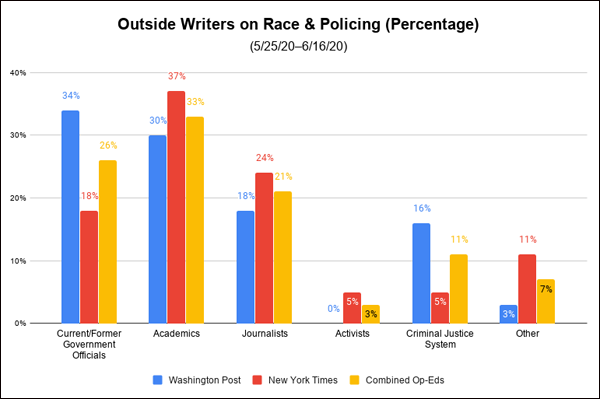
In the three weeks after George Floyd’s murder (5/25/20–6/16/20), the Post published 89 op-eds discussing race, policing and the uprisings at length. Some of the articles were penned by more than one person, resulting in 97 authors altogether. Out of these 97 authors, 61% were columnists for the Post and 39% were outside writers. Current or former government officials made up 34% of the Post’s outside writers. Academics were another 30%, and 18% were freelance journalists. 16% of the Post’s guest writers worked in the criminal justice system, including Benjamin Crump, the civil rights attorney for the Floyd family, and Marilyn Mosby, the state’s attorney for Baltimore. (See FAIR.org, 7/21/20.) Guest columnists also included a former federal prosecutor, a public defender, a former police officer and a former deputy chief of police (the latter two co-authoring a piece). The remaining outside writer featured by the Post was Hafsa Islam, whose father owns the Minneapolis restaurant Gandhi Mahal, which caught fire during the protests. In the same three weeks, the New York Times published 83 op-eds discussing George Floyd and the protests, featuring a total of 87 writers. Out of these, 56% were Times columnists and 44% were outside sources. The Times’ outside sources included 37% academics, 24% freelancers and 18% current or former government officials. 5% of the outside sources were people who worked in the criminal justice system (prosecutor Marilyn Mosby again, and former chief of police Brandon Del Pozo), while another 5% were activists (prison abolitionist Mariame Kaba and Thenjiwe McHarris, a strategist for the Movement for Black Lives) The remaining 11% included two medical sources, one member of the clergy and Melody Cooper, sister of Christian Cooper, the birdwatcher who was subjected to a racist swatting attempt in Central Park. Across both papers, in a total of 172 op-eds, only two organizers were afforded a platform—meaning that just 1% of the columns in the wake of these society-altering protests were written by the people who instigated the protests. 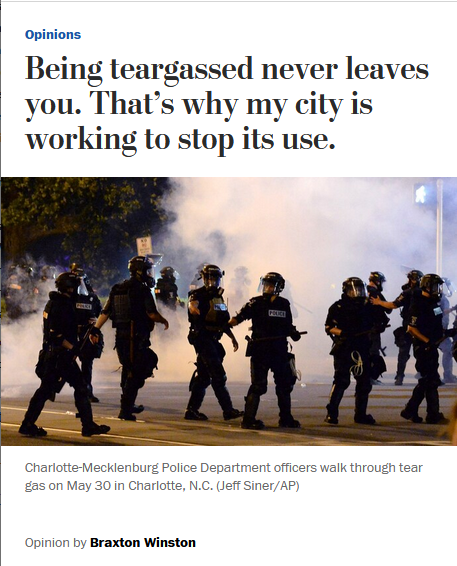 This column (Washington Post, 6/10/20) was one of the few about the protests written by someone who participated in the protests. The Post (6/10/20) did publish a piece by Braxton Winston, a member of the Charlotte, N.C., city council, about the author’s experience with tear gas at a protest. Though we counted him as a government official, this was one of the few times a participant in racial justice protests was given a chance to speak for himself. Even as the Post churned out numerous articles (6/1/20, 6/5/20, 6/11/20) comparing today’s domestic upheaval with that of the 1960s, veterans from past movements for racial justice—such as the Civil Rights movement, the Black Power movement, the Red Power movement or the Chicano movement—were not given space to share wisdom gained from their years of organizing against white supremacy. As a result of this exclusion, none of the op-eds published in the Times or the Post explored the idea of boycotts, strikes, direct action campaigns or any other disruptive tactics protesters might use to leverage their power during this unprecedented moment. The op-ed sections of the Times and the Post were lacking not only in historical insight from organizers, but also in global insight. The police murder of George Floyd sparked uprisings against racism, police brutality and state violence around the world, prompting countries to grapple with their colonial pasts and with ongoing inequalities exacerbated by the pandemic. But despite outpourings of solidarity from protesters across Europe, Asia, Africa and Latin America, the Times and the Post presented exclusively US perspectives. Missing first-hand experienceActivists weren’t the only ones who were overlooked by the Opinion sections of the nation’s two leading papers. In the three weeks after George Floyd’s murder, neither the Times nor the Post featured any op-eds written by the people who have suffered most directly at the hands of America’s racist law enforcement: those who have experienced police brutality, or people who have had loved ones murdered by police. Nor did they elevate the viewpoints of any people who are incarcerated, even though many incarcerated writers have been sharing their experiences publicly for years. Though many op-eds called for a nebulous “reimagining of police,” neither Opinion section highlighted community leaders who have for decades offered proven alternative to policing. Audiences were not given the chance to hear from former gang members who now combat gun violence through street outreach, or aboriginal Night Patrols in Australia, who mediate conflicts while also reducing Indigenous interactions with the criminal justice system. Instead, we heard from the usual cast of powerful incumbents, who seized the opportunity to boast about their accomplishments on a national stage. The Post published op-eds by Muriel E. Bowser, Val Demings, Condoleezza Rice, David Axelrod and a consortium of Democratic House managers in the impeachment trial of President Trump. Government officials featured by the Times included Stacey Abrams, Susan E. Rice, Tom Cotton, Gretchen Whitmer and Keisha Lance Bottoms. Despite the fact that activists have condemned many of these officials for their contestable records on race and policing, these op-eds were presented by media without context or criticism. As investigative journalist Justine Barron previously wrote for FAIR (6/21/20), these op-eds “give local leaders a chance to raise their national profiles without facing scrutiny.” Media’s reliance on government bureaucrats to shape public opinion also has the effect, as Julie Hollar (FAIR.org, 6/11/20) wrote, of “placing limits of the acceptable and the possible”—resulting in coverage that “acknowledges the drive to defund the police, but seeks to blunt its radical edge.” Even as thousands of protesters across the country flooded the streets calling for the defunding of police, editorial teams overwhelmingly gave these demands the cold shoulder. Out of 84 op-eds published by the Times in those three weeks, only three (5/30/20, 6/10/20, 6/12/20) explored defunding police as a viable step forward. Likewise, out of 89 Post op-eds discussing racism and police brutality at length, only three (6/7/20, 6/9/20, 6/9/20) pointed to defunding the police as a positive solution. Protesters sidelined on Sunday morningCorporate media’s unwillingness to provide protesters with a platform was also evident in network Sunday morning political talk shows. For the two weeks after the police murder of George Floyd (5/31/20–6/7/20), FAIR analyzed every episode of ABC’s This Week, CBS’s Face the Nation, CNN’s State of the Union, Fox News Sunday, and NBC’s Meet the Press. 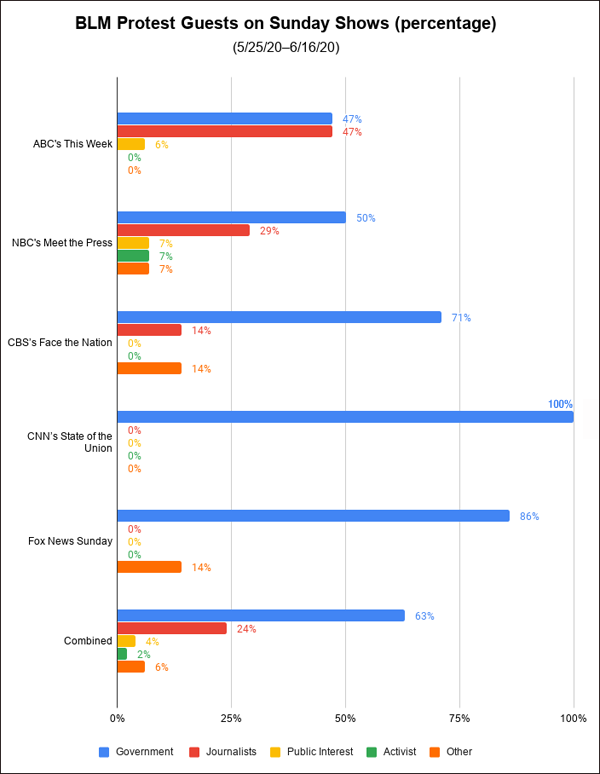
Out of the 54 one-on-one and roundtable guests on all networks, 63% were current or former government officials. The next most frequent guests were journalists, at 24%. Out of the 35 interviews with government officials, 12 appearances (35%) were made by current or former members of the US national security apparatus (FAIR.org, 6/26/20). 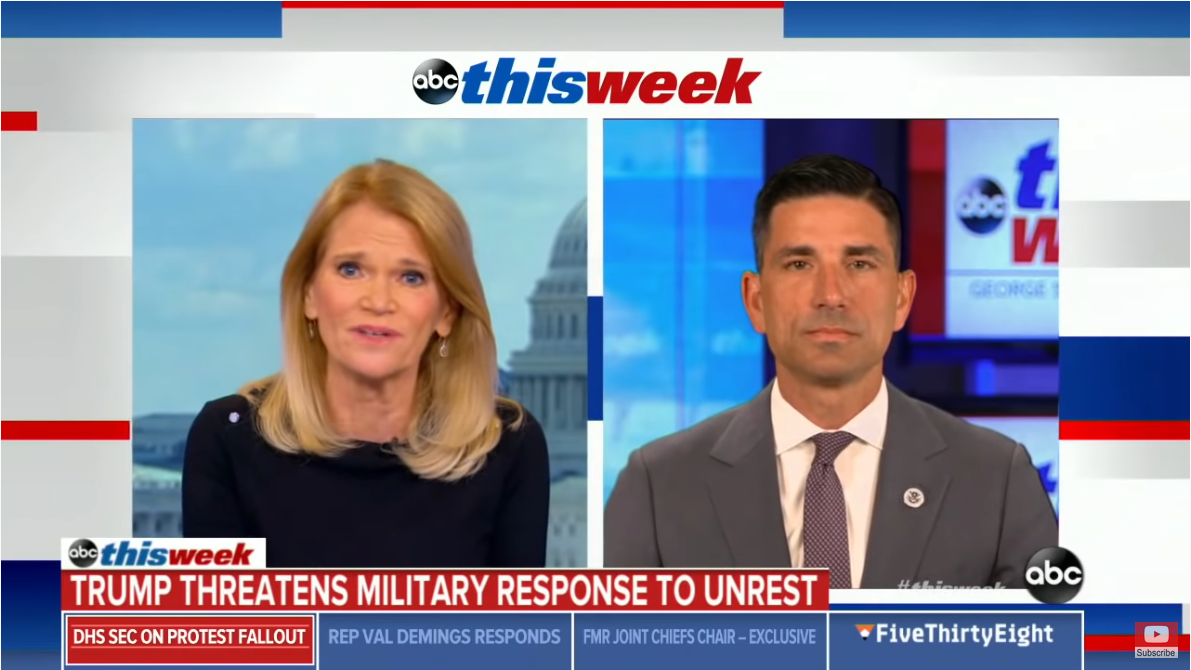 ABC's Martha Raddatz (This Week, 6/7/20) interviews acting Homeland Security Secretary Chad Wolf. Three of these guests—acting DHS Secretary Chad Wolf, US National Security Advisor Robert O’Brien and Attorney General William Barr—denied the irrefutable fact that there is systemic racism in law enforcement. On all three of these occasions, these false claims went virtually unchallenged by journalists, who posed the question as though it were a matter of opinion. One former government official interviewed on Fox News Sunday was Andy Skoogman, the current executive director at the Minnesota Chiefs of Police Association (5/31/20). On Skoogman’s LinkedIn page, he describes himself as a “strategic communications specialist” who helps organizations “simplify their complicated issues” and “manag[e] a crisis”—in other words, he works in PR as a paid spokesperson for police. Only 12% of the guests were not journalists or affiliated with the government. Academics were featured twice across all networks, making up 4% of the interviews. This included an interview with Dr. Cornel West on Fox News Sunday (5/31/20) and an interview with Lonnie Bunch III, founding director of the National Museum of African American History and Culture, on NBC’s Meet the Press (6/7/20). People representing public interest groups made up 4% of the coverage, including María Teresa Kumar, president of Voto Latino, who appeared on NBC’s Meet the Press (5/31/20) and Patrick Gaspard, president of Open Society Foundations, interviewed on ABC’s This Week (5/31/20) The remaining two guests were Floyd family attorney Benjamin Crump, who appeared on CBS’s Face the Nation (5/31/20), and Alicia Garza, the co-founder of Black Lives Matter, who appeared on NBC’s Meet the Press (6/7/20). Across all networks, Garza was the only person affiliated with Black Lives Matter who was given time to speak. Framing the protestsThe problem lies not only in which guests are afforded a platform, but also in the framing of the coverage and the questions that were asked. Throughout all the coverage, there was heavy focus on whether the protests were violent or nonviolent, rather than on the demands of the protesters. Protests that targeted property were rarely referred to in neutral terms—a subtle way of limiting the range of acceptable opinion. An instance of this occurred on ABC’s This Week (6/7/20), when journalist Martha Raddatz referred to “inexcusable criminal looting,” as if it should go without saying that such behavior must be condemned and punished. Though many organizers and academics have argued that looting is a justifiable form of protest in an empire built on the looting of Black and Indigenous people, this perspective was left out of the conversation. Most networks also denounced the Trump administration’s violent suppression of protesters. But the government officials responsible for deploying tear gas, tanks and secret police were given ample airtime on network news to defend their use of these methods, while protesters who supported destroying property were not. Though a significant amount of media’s coverage fixated on the possibility of “outside agitators,” “antifa”and the “radical left” hijacking the uprisings, these shows made no effort to investigate these claims by actually interviewing the people protesting on the streets about what brought them there. Instead, protesters’ voices were reduced to 10-second soundbites—mostly chants—in the news packages at the introduction of each broadcast. 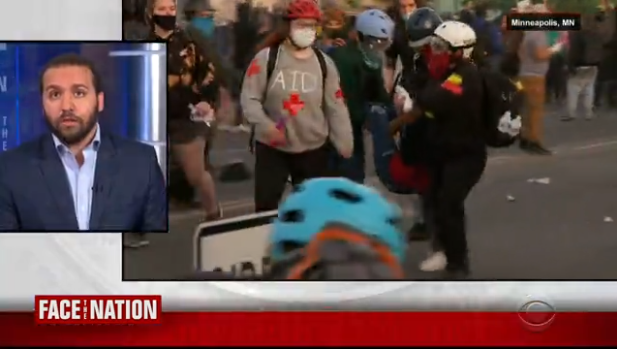 Face the Nation (5/31/20) interviews Washington Post reporter Wesley Lowery about what protesters are saying—rather than asking protesters what they have to say. This disconnect from the social organizing on the ground was made especially evident when CBS’s Margaret Brennan (5/31/20) asked Washington Post reporter Wesley Lowery, who has spent much of his career reporting on police violence and ensuing protests, about what activists were saying—rather than providing space for activists to speak for themselves: Brennan: I know you have been on the phone and speaking with some of the activists who are in the streets and cities around the country. What are they telling you? Lowery: You know, we're in this moment right now where all of us are asking... how do we stop what's happening in the streets?... And what the activists are saying is, you all haven't been listening to us.
Media miss the messageThe George Floyd protests are far from the only time corporate media has sidelined the voices of the people in favor of uplifting elites. Past FAIR studies have revealed that media consistently neglect to consult those most impacted by the policies being discussed—whether marginalizing immigrant voices in debates on family separation, or ignoring school workers in coverage about schools reopening. The gulf between media and the public was laid bare during the recent uprisings in Atlanta, where protesters mounted a CNN sign, raised a Black Lives Matter flag and broke down the doors of CNN’s headquarters, where a standoff with police ensued. For the duration of this incident, CNN’s team remained behind police lines—a questionable decision, considering that the police have posed a far greater threat to journalists during the uprisings than protesters. 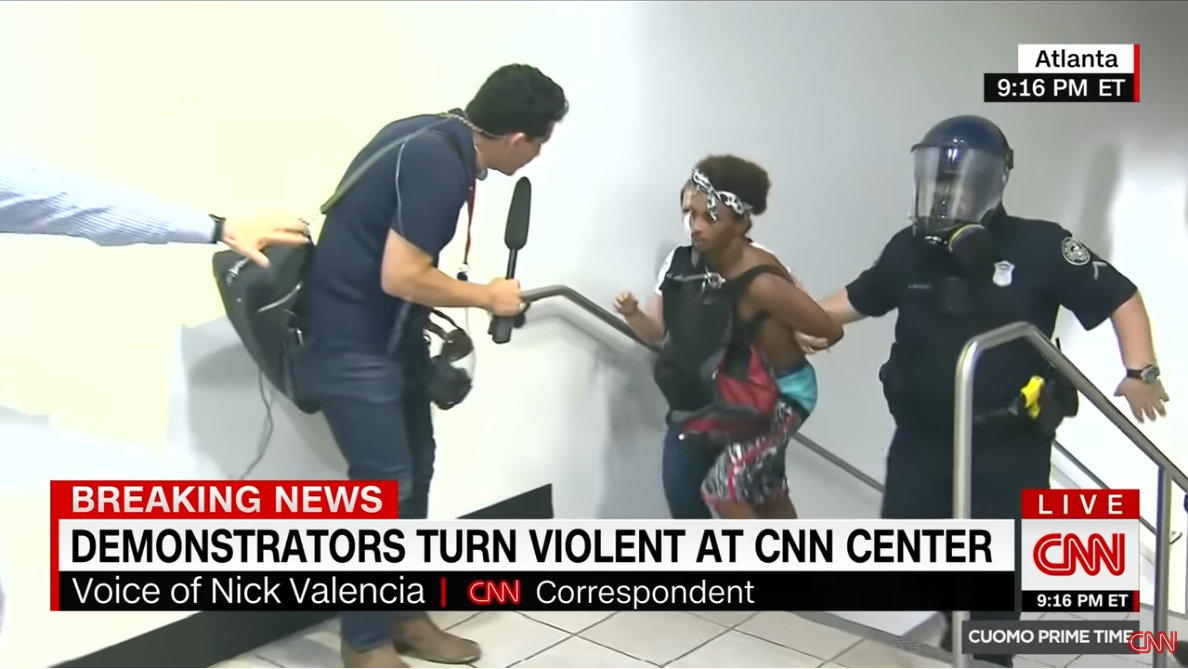 CNN's Nick Valencia (5/29/20) attempts to interview a protester being led away by police. To his credit, CNN reporter Nick Valencia (5/29/20) did attempt to interview a demonstrator who was being hauled away by the police—but, moments after, he stated: This is where we go to work everyday, journalists who are trying to tell the truth, trying to deliver information.... These demonstrators have decided to come here today to take out their frustration and their anger not just on the police, but, it seems, on our CNN Center as well.
Valencia can be forgiven for not analyzing the motivations of the crowd while the confrontation was unfolding. But even after the incident, media failed to explore why CNN might be the target of such opposition, portraying it as an act of senseless vandalism and rage, rather than a purposeful condemnation of CNN, corporate elites or media coverage of the uprisings. In most coverage of that night, the fact that the CNN Center also hosts a precinct of the Atlanta police department went unmentioned, and protesters' “Fuck CNN” chants went unaddressed. Later that night, as rapper Killer Mike delivered an impassioned plea for calm at a press conference alongside the mayor of Atlanta, he added: I love CNN...but I’d like to say to CNN right now: Karma’s a mother. Stop feeding fear and anger every day. Stop making people feel so fearful. Give them hope.
But as independent journalist Habib Battah pointed out in a piece for Jacobin (7/19/20), this criticism was cut out of CNN’s website and edited out of rebroadcasts. No ‘open mic revolution’In the Jacobin piece—headlined “Why Haven’t We Heard From Racial Justice Protesters in Their Own Words?”—Battah recounts a 2019 revolt in Lebanon. During these uprisings, Lebanese news channels amplified the voices of thousands of ordinary citizens with virtually no censorship, a phenomenon that he dubbed “an open mic revolution.” The result, he wrote, was that: Lebanese audiences heard a wide range of testimonies from people otherwise kept off television screens. Workers, students, teachers and mothers gave their own tearful accounts of injustice and everyday corruption. There were poetic, witty and downright crude insults and chants leveled at the country’s politicians and political parties. Names were named. Expletives went uncensored. Sitting in front of your television at home, it felt like you were right there in the square.
Moments like this in US media are uncommon, Battah points out—and when protesters’ demands are amplified, it is often because they fought for it themselves. Such was the case when activist Kendrick Sampson physically placed himself between an ABC reporter and a police commander being interviewed on the street, providing a counter narrative to police propaganda for nearly ten minutes. 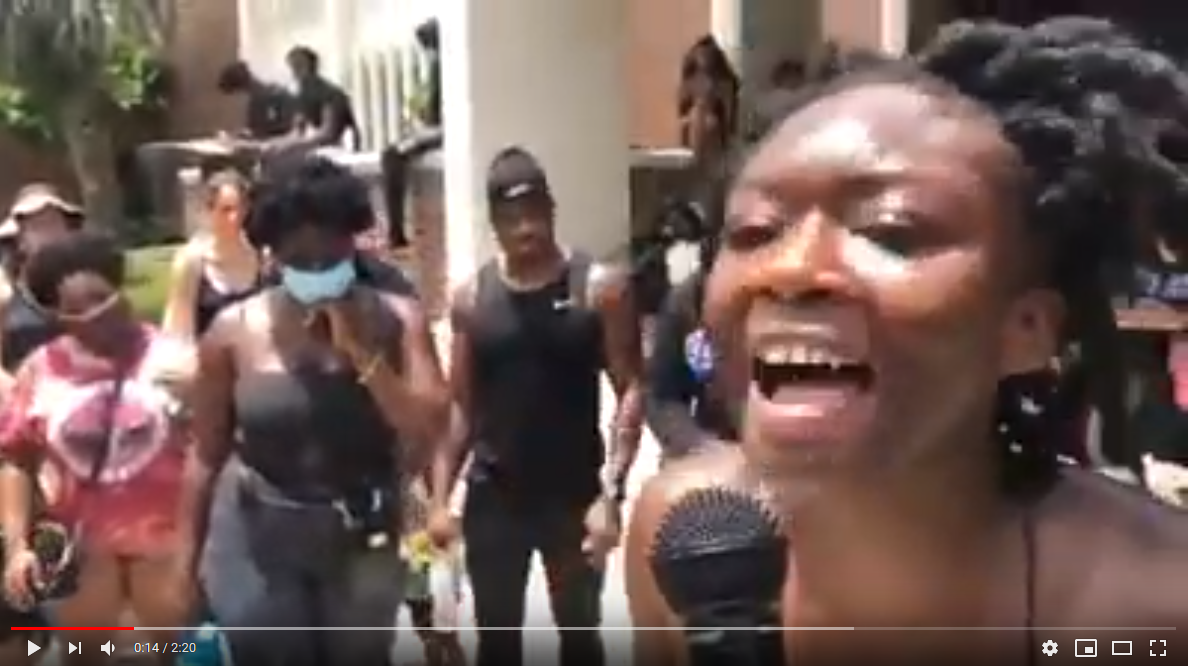 Oluwatoyin Salau (YouTube, 6/15/20): "My Blackness is not for your fucking consumption." Reading Battah's account of ordinary people’s anguished cries for justice, we could not help but think of Oluwatoyin Salau, a 19-year-old Black Lives Matter activist from Tallahassee who made headlines after a local man sexually assaulted and murdered her. Much of the coverage surrounding Salau’s murder included a video of her during the uprisings. The footage offers a rare glimpse of what an “open mic revolution” might look like in America; in it, Salau stands in front of the Tallahassee Police Department and looks directly at the camera, her voice hoarse with grief as she expresses something that no columnist or pundit can: Wherever the fuck I go, I am profiled. Look at my fucking hair—look at my skin, bruh. I can’t take this shit off. So guess what. Imma die by it. Imma die by my fucking skin. You cannot take my Blackness away from me. My Blackness is not for your fucking consumption.
Salau's testimony is raw and striking—but it’s safe to say that if not for her murder, the footage would not have been aired at all. Most of the time, media do not afford Black Lives Matter protesters the opportunity to express their pain and their vision for two whole minutes, without commentary or interruption. | 


 hen I began my water-only Fast to Defeat Trump on October 3, I had some idea about how I was going to feel as it progressed. I have done long water-only fasts before, though the last time, on the issue of the climate crisis, was 13 years ago, when I was 58 years old. On this one I’m 71. And though I’m a regular long-distance bicyclist and exercise guy, that’s getting up there in years, I know.





