| | |  | BY RENUKA RAYASAM | Presented by |  |
|
| With help from Natalie Fertig and Gavin Bade IT AIN'T EASY BEING VEEP — Vice President Kamala Harris’ first foreign trip, to Guatemala and Mexico, has drawn criticism from both Democrats and Republicans. Rep. Alexandria Ocasio-Cortez (D-N.Y.) said Harris’ comments calling on migrants not to come to the U.S. was disappointing. Congressional Republicans chastised her for not visiting the U.S.-Mexico border. The vice president’s team tried to set “modest expectations,” for the trip, which ends tonight, White House reporter and Playbook author Eugene Daniels told Nightly today. Even so, by handing her a portfolio that includes both immigration and voting rights, President Joe Biden has tasked Harris with handling some of the most intractable issues in politics today.
| 
| Eugene chatted with Nightly over Slack today about how Harris is handling the vice presidency so far, and what it might mean for her political future. This conversation has been edited. How do you think Harris has handled this trip? When NBC’s Lester Holt asked her to address Republican criticism , she responded that she hadn’t been to Europe, which struck me as odd. Yeah, the interview with Lester Holt hasn’t landed well at all. On the left, they are upset with Harris because she told people not to make the trek to the United States, which is the stance of the Biden administration. She hasn’t really said anything different from Biden or the DHS secretary. What’s taken over today is something they have been fighting for months: Republicans painting Harris as the border czar. So the news cycle today has been, “Why hasn’t she gone to the border?” “Don’t Republicans have a point?” Harris has clearly gotten frustrated with Republicans wanting to tie her to the border crisis. She’s in the Northern Triangle doing an interview about her role and people keep wanting her to go to the border, which isn’t a part of her role. So the frustration makes sense logically but politically, it doesn’t matter. By giving Harris these two big issues — immigration and voting rights — is Biden complicating her political future? I think he is, but that’s the gig when it comes to being vice president. You have to handle what the president hands you, and you will have to answer for the good and bad things that happened under the president. And it complicates any future run if things don’t go well in the end. Biden had to deal with that in 2020, over and over. However, that is also why it COULD be a big boon for Harris politically. If she’s able to change the status quo just a bit, it would be huge. That’s what immigration experts and advocates have told me. The bar is so high, but expectations are so low. Any chatter among the Harris set that Biden isn’t doing enough to set her up for the presidency in 2028? He knows how hard it is to be VP, right? He definitely does, but the official Harris line is that she needs to stay focused on her job before she even peeks at another run. But there are folks in the orbit, who aren’t in the White House, who are concerned about that, worried that she’s not going to have enough to point to when she runs. Welcome to POLITICO Nightly. Reach out with news, tips and ideas for us at rrayasam@politico.com or on Twitter at @RenuRayasam.
| |
A message from AARP: Congress: It’s time to let Medicare negotiate for lower drug prices. The President, Congress, and the American people agree: we need to lower prescription drug prices. Americans can’t afford to pay the highest prices in the world for their prescription drugs. Giving Medicare the power to negotiate will save hundreds of billions of dollars and reduce prescription drug costs for all Americans. aarp.org/FairRxPrices | | | | | | |
“There’s nothing Putin can do to make [the president] like him,” one former U.S. official familiar with Russia policy said. “Biden sees Putin as someone who is rational, thuggish — someone who is not confined by any sense of morality or concern over human rights or anything of that nature … just a cold, hard realistic assessment of the man.” — FROM NAHAL TOOSI’S POLITICO REPORT ON BIDEN’S RELATIONSHIP WITH VLADIMIR PUTIN, COMING WEDNESDAY MORNING |
| | |
| | DON'T MISS THE MILKEN INSTITUTE FUTURE OF HEALTH SUMMIT: POLITICO will feature a special edition of our Future Pulse newsletter at the 2021 Milken Institute Future of Health Summit. The newsletter takes readers inside one of the most influential gatherings of global health industry leaders and innovators who are turning lessons learned from the past year into a healthier, more resilient and more equitable future. Covid-19 threatened our health and well-being, while simultaneously leading to extraordinary coordination to improve pandemic preparedness, disease prevention, diversity in clinical trials, mental health resources, food access and more. SUBSCRIBE TODAY to receive exclusive coverage from June 22-23. | | | | | | | GROWING GREEN — Sustainability advocates have estimated that marijuana grow houses consume 10 percent of Massachusetts’ industrial electricity — about 1.5 percent of the state’s total power. That’s more electricity than 100,000 homes use in a year, consumed by an industry that got off the ground only at the end of 2018, Natalie Fertig and Gavin Bade write. Growing marijuana indoors can consume 2,000 watts of electricity per square meter, according to a report published by Lawrence Berkeley National Laboratory . Lettuce and other leafy greens, comparatively, need about 50 watts of electricity per square meter when grown indoors. Cannabis is the nation’s most energy-intensive crop. But the nation’s patchwork of cannabis regulations and the federal categorization of marijuana as a Schedule I controlled substance is exponentially worsening the plant’s environmental impact. Northern California and Southern Oregon are the nation’s historic outdoor cannabis growing regions, both because of their remote location but also because of their ideal climate for outdoor cultivation. But because cannabis remains federally illegal, and the federal government regulates interstate commerce, none of the legal cannabis grown in Oregon or California can cross state lines. Instead, each new state that legalizes recreational marijuana must also grow enough to meet consumer demand in that state. This would be like every state in America being required to grow all of the oranges consumed each year by its residents, rather than simply buying them from Florida. And in many states, the climate — or public health and safety concerns — necessitate growing the plants indoors. An indoor grow, on average, consumes 1.27 kilowatt hours of energy per gram of cannabis produced, according to New Frontier Data. Growing weed outdoors, meanwhile, uses just 0.07 kilowatt hours per gram — 18 times less. Regulators and activists are pushing the industry to become more efficient. Illinois mandated efficient LED lights for cannabis cultivation in 2019, and Colorado launched a program in January 2020 to transfer carbon dioxide from breweries into growhouses. The city of Boulder has even levied an extra tax on marijuana to account for its effects on climate. Reducing the environmental impact of cannabis in state-siloed markets is not simple — or cheap. Solar Therapeutics, a Massachusetts grow facility, spent millions of dollars to install solar panels and natural gas generators after the local utility said it would take more than two years to upgrade the nearby power grid to handle the new electricity demand. And those business expenses could have political consequences. Solar Therapeutics owner Edward Dow said he now hopes any federal legalization efforts roll out slowly, because he stands to lose serious market share to low-price West Coast cannabis if the federal government allows the drug to cross state lines. “If they made it open federally that quickly … I think it would be chaos,” Dow said. “That would throw so many monkey wrenches into the equation.” “I would think our elected officials would have more sense than [to legalize immediately] because that would cripple a market that’s pumping tens, hundreds of millions of dollars into new infrastructure and new industry,” he said. “Massachusetts — I’d like to think they’d protect their market as well.”
| |
| |  
| | | | | — Biden ends infrastructure talks with Senate GOP, starts engaging bipartisan group: The talks between Biden and GOP Sen. Shelley Moore Capito are over, according to an administration official. The president will now focus on working with a bipartisan group of 20 senators . Biden and Capito spoke for five minutes today, the West Virginia senator said, the final conversation in what’s been a stubborn deadlock over how to pay for a massive infrastructure bill and how large that measure should be. The two sides were about $700 billion apart after the GOP’s final offer. — Senators reveal further Capitol riot security failures in bipartisan report: Intelligence failures are only one facet of the first official congressional accounting of the Jan. 6 insurrection, a nearly 100-page report released this morning by a bipartisan duo of Senate committee leaders. The report raps the Capitol Police and federal agencies for security lapses leading up to and during the attack.
| 
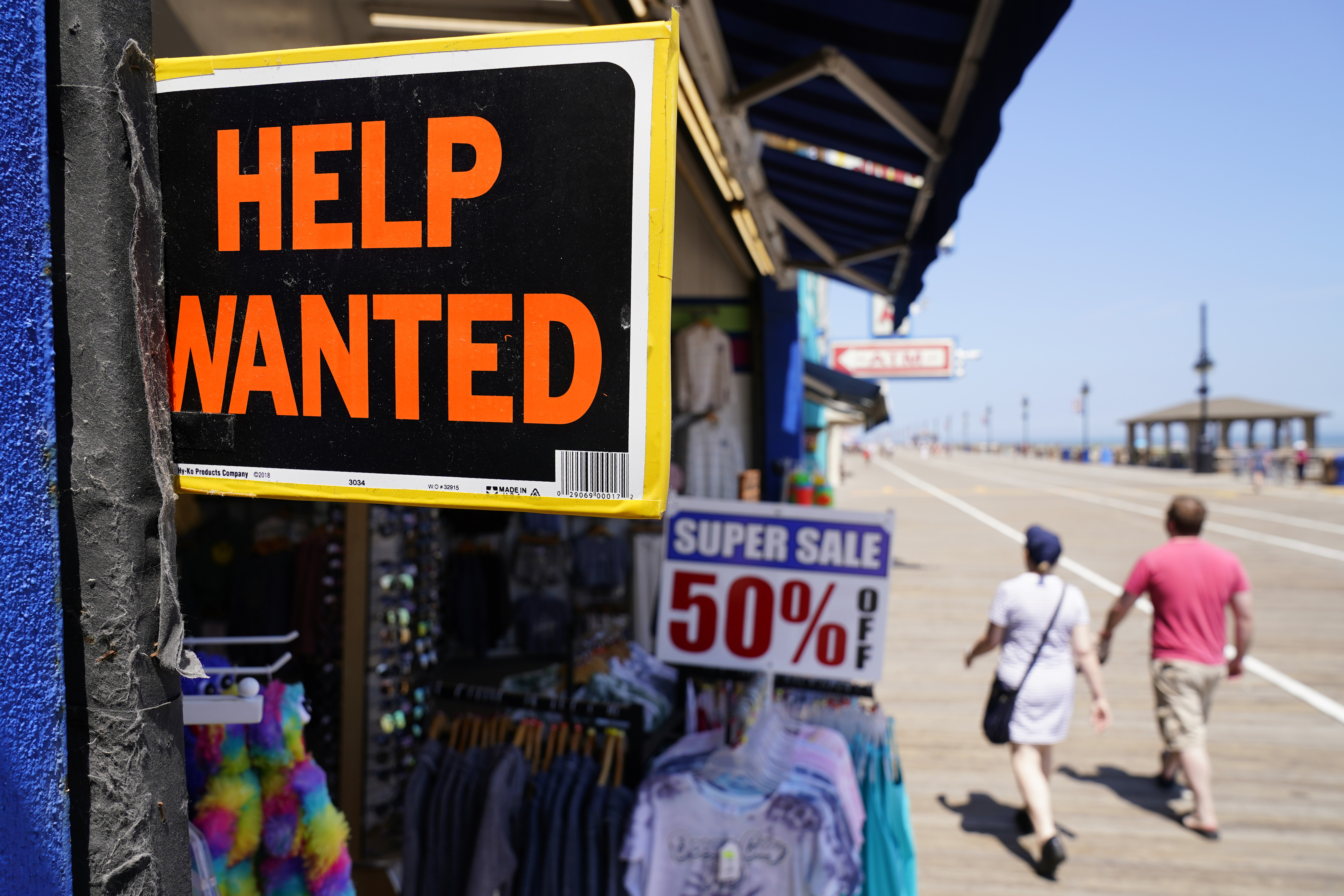
A man walks into 5th Avenue Deli and Grill in Mayfield Heights, Ohio. | Tony Dejak/AP Photo | — Job openings reached a record in April, as worker shortage concerns rose: U.S. employers had 9.3 million job openings available at the end of April, the Bureau of Labor Statistics reported today , the highest number recorded since the government started collecting the data in 2000. Employers hired 6.1 million workers in April, according to the monthly Job Openings and Labor Turnover survey, a small increase from the 6 million hired in March. — Dems call for taxing the ultrarich after report shows they don’t pay much: The IRS has opened an investigation into apparently leaked tax documents showing that ultra-rich Americans like Amazon founder Jeff Bezos, Tesla CEO Elon Musk and business tycoon Warren Buffett paid very little or no taxes. Democrats seized on the report to further their call for higher taxes on the wealthy. The revelations by ProPublica will undoubtedly put a sharp focus on the debate in Congress over raising taxes on wealthy people and revive calls for a wealth tax that supporters say would capture a greater amount of the assets held by the rich.
| | YOU’VE BEEN MANCHIN’D — Sen. Joe Manchin’s name has become synonymous with the act of upending Democrats’ ambitious legislative goals. His latest victim? A massive bill aimed at combating voter suppression. In the latest POLITICO Dispatch, voting rights and state politics reporter Zach Montellaro breaks down what exactly is in the measure — and why the moderate Democrat decided to tank it.
| | | | Nightly asks you: Are you a vaccinated person who has a family member or friend who refuses to get vaccinated? Tell us your story using our form. We’ll include select answers in a future edition.
| |
| | JOIN THURSDAY FOR A TALK ON RESETTING INTERNET PRIVACY: Calls for some type of national privacy law have gained traction in recent years. The U.S. has no overarching national law governing data collection and privacy. Instead, it has a patchwork of federal laws that protect specific data types, such as consumer health and financial information and the personal data generated by children. Join POLITICO for a conversation on tech, data and the future of user privacy, and the most viable path forward. REGISTER HERE. | | | | | | | MACRON SLAPPED — French President Emmanuel Macron was slapped by a man at a receiving line as he came out of a professional high school in southeastern France, according to a video circulating on social media. “A man attempted to hit the president. We have no further comment to make at this stage,” said an Elysée official. As Macron approached the receiving line, a person is seen slapping him in the face. Macron is immediately pulled away by his personal security officer. The president was seen a few minutes later with his wife, warmly and cheerfully greeting people at a second stop. Two men were arrested, according to an interior ministry official. Macron is visiting a town in southeastern France as part of a whistle-stop tour of the country.
| | | |
73 percent The percentage of likely Virginia Democratic primary voters who have a favorable opinion of former Gov. Terry McAuliffe, according to a Roanoke College poll released last week. In today’s primary, Democrats are poised to nominate two well-known white men: former Gov. Terry McAuliffe and state Attorney General Mark Herring. |
| | | MODERNA MUSIC APPRECIATION — The wait to be vaccinated can be a stressful time, so what better way to get in the mood for that jab than by listening to several hours of music lovingly compiled by a (fairly) senior British Conservative! Oliver Dowden, the U.K. culture secretary, has put together a Spotify playlist called “Songs To Get Vaccinated To” — and it’s a mixed bag, Paul Dallison writes. Dowden has made an effort in places, including some songs loosely related to vaccines/lockdown/a gradual return to freedom. His list opens with “Hit Me With Your Best Shot” by Pat Benatar; there’s a song by The Vaccines; there’s “The Cure” by Lady Gaga (but, sadly, nothing by The Cure); and “Feel Good Inc.” by Gorillaz. Others don’t work quite so well: “Jump Around” by House of Pain can presumably only be listened to after the requisite 15-minute wait following vaccination; “Jump In The Line” by Harry Belafonte could encourage queue jumping, which is extremely un-British; “Just Can’t Get Enough” by Depeche Mode sounds like having more than the required two jabs; and “Can’t Stop The Feeling” by Justin Timberlake suggests lingering Covid-19 symptoms. Yet more songs appear to be a rather desperate attempt to heap praise on the vaccination strategy of Boris Johnson’s government: “You Make My Dreams (Come True)” by Hall & Oates; “This is How We Do It” by Montell Jordan; and, with crushing inevitability, “We Are The Champions” by Queen. The playlist also contains “I Gotta Feeling” by the Black Eyed Peas, which at least suggests Dowden isn’t trying to be cool.
| |
A message from AARP: Congress: Act now to lower prescription drug prices. Every year, Medicare spends more than $129 billion on prescription drugs. Yet, it's prohibited by law from using its buying power to negotiate with drug companies for lower prices. This must change. Americans are sick and tired of paying three times what people in other countries pay for the same medicine, forcing many to choose between buying the prescription drugs they need and paying for food and rent. aarp.org/FairRxPrices | | | Did someone forward this email to you? Sign up here. | |
|
| | Follow us on Twitter | | | FOLLOW US
|
| |

 / msnbc
Download our new MSNBC app for the latest breaking news and daily headlines at a glance: https://www.msnbc.com/information/dow...
Follow MSNBC Show Blogs
MaddowBlog: https://www.msnbc.com/maddowblog
ReidOut Blog: https://www.msnbc.com/reidoutblog
MSNBC delivers breaking news, in-depth analysis of politics headlines, as well as commentary and informed perspectives. Find video clips and segments from The Rachel Maddow Show, Morning Joe, The Beat with Ari Melber, Deadline: White House, The ReidOut, All In, Last Word, 11th Hour, and Alex Wagner who brings her breadth of reporting experience to MSNBC primetime. Watch “Alex Wagner Tonight” Tuesday through Friday at 9pm Eastern.
Connect with MSNBC Online
Visit msnbc.com: https://www.msnbc.com/
Subscribe to the MSNBC Daily Newsletter: https://link.msnbc.com/join/5ck/msnbc...
Find MSNBC on Facebook:
 / msnbc
Follow MSNBC on Twitter:
 / msnbc
Follow MSNBC on Instagram:
 / msnbc
#Trump #Crime #Politics