
25 March 22
Live on the homepage now!
Reader Supported News

After World War II, the U.S. and its Western allies had amazing momentum, so democracy began spreading across the globe before getting bogged down by the Cold War and actually going in reverse in the 1960s, as a result of a wave of military and executive coups in Africa, Asia and Latin America. But another wave of democracy started in the mid-1970s, after the downfall of dictatorships in Portugal, Spain and Greece. Democracy also spread to Asia — and almost China in Tiananmen Square. Then the fall of the Berlin Wall in 1989 let loose another democracy wave in Eastern and Central Europe, and Russia.
But beginning in 2006, with the weakening of America because of two wars in the Middle East and the 2008 financial crisis — and the stunning economic rise of China — democracy went into “a global recession,” Diamond told me. “And China and Russia relentlessly pushed the narrative: ‘Democracies are weak and morally and politically decadent. They can’t get things done. Authoritarianism is the future.’”
The question now, Diamond added, is this: Was that Feb. 4 declaration by Xi and Putin — “spelling out all the reasons why their ‘democratic’ systems were superior to the bankrupt, feckless liberal democracies”— actually the high-water mark for their autocracies?
Because one thing is clear, quipped Diamond: The recent missteps of Putin and Xi “are giving authoritarianism a bad name.”
But for the authoritarian wave to be sustainably reversed, two big things are necessary. One is for Putin’s savaging of Ukraine to fail. That could cause him to lose power. To be sure, a Russia with no Putin could turn out to be no better — or even worse. But if it is better, the whole world becomes better if Russia has a decent leader in the Kremlin.
The second thing is even more important: It would be for America to demonstrate that it’s not just good at forging alliances abroad but that it can also build healthy coalitions again at home — to deliver good government, growth, uncontested transfers of power and a more perfect union. Our ability to do that in the past is what earned us the world’s esteem and emulation. That used to be us — and it can be again.
If it is, then my favorite lyrics from the musical “Hamilton” will be so relevant. It is when George Washington explains to Alexander Hamilton why he is voluntarily stepping down and not running for a third term:
Washington: “If we get this right/ We’re gonna teach ’em how to say goodbye,/ You and I——”
Hamilton: “Mister President, they will say you’re weak.”
Washington: “No, they will see we’re strong.”
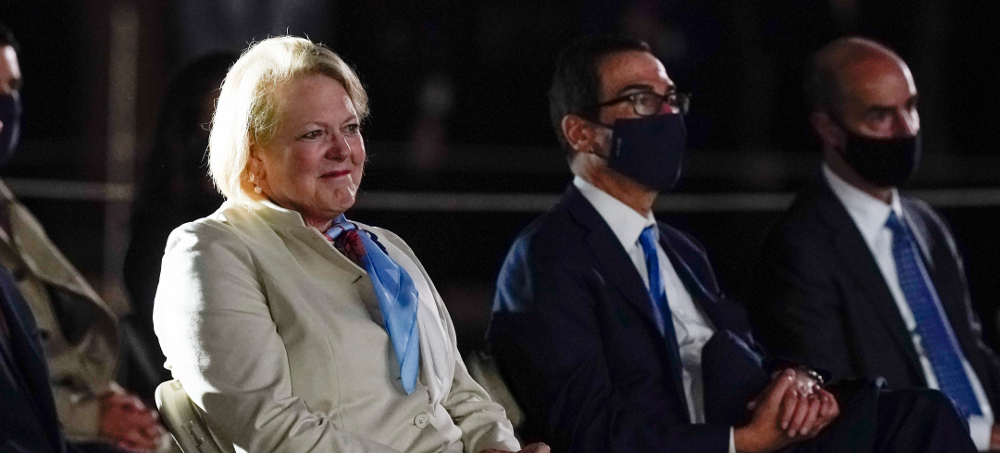 Virginia Thomas, a conservative activist married to Supreme Court Justice Clarence Thomas, repeatedly pressed White House chief of staff Mark Meadows to pursue unrelenting efforts to overturn the 2020 presidential election. (photo: Getty)
Those messages — part of 29 total messages obtained — reveal an extraordinary pipeline between Virginia Thomas, who goes by Ginni, and then-President Donald Trump's top aide during a period when Trump and his allies were vowing to go to the Supreme Court in an effort to subvert the election results.
The messages, which do not directly reference Justice Thomas or the Supreme Court, show for the first time how Ginni Thomas used her access to Trump's inner circle to encourage and seek to guide the president's strategy to overturn the election results — and how receptive and grateful Meadows said he was to receive her advice. Among Thomas' stated goals in the messages was for lawyer Sidney Powell, who promoted incendiary and unsupported claims about the election, to become "the lead and the face" of Trump's legal team.
The messages were among the 2,320 text messages that Meadows provided the House select committee investigating the Jan. 6 attack on the U.S. Capitol. The existence of messages between Thomas and Meadows — 21 sent by her; eight by him — have not previously been reported and were reviewed by CBS News and The Post. They were then confirmed by five people who have seen the committee's documents.
To read The Washington Post article, co-written by CBS News' Robert Costa and The Washington Post's Bob Woodward, click here.
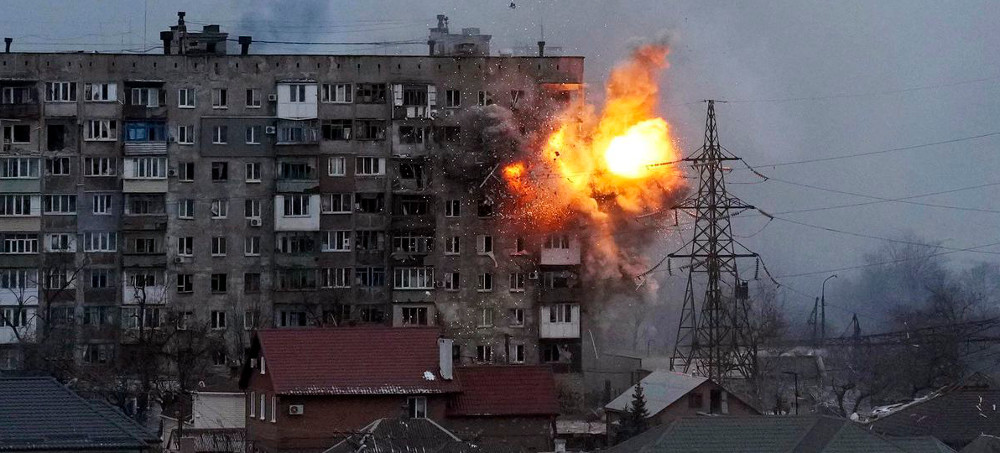 An explosion destroys the side of an apartment building after a Russian army tank opens fire in Mariupol, Ukraine, on March 11. (photo: AP)
Audio from the unsecured radio networks obtained by The Times show Russian troops discussing targets while advancing on the Ukrainian town of Makariv on February 27.
In one bit of radio chatter, a Russian is heard ordering a military member to "cover" residential areas "with artillery" once the "property" is removed, according to The Times' translation.
New York Times journalist Christiaan Triebert reported that "property" was likely code for "Russian personnel or equipment."
A Russian who identifies himself in the recording as "Yug-95" told soldier "Buran-30" that a "decision has been made to remove the first 'property' from the residential area," according to a translation by the New York Times.
He then instructed the soldier to "cover the residential area with artillery," The Times reported.
He repeated the orders twice, The Times reported.
Another clip reveals Russian soldiers appearing to yell at each other after they came under fire in Makariv.
"My situation is very tense, tanks are approaching," Buran-30 said in an intercepted radio conversation, according to The Times' translation. "I don't know whose tanks they are, cannot identify them. There is a drone over the area and the area is under fire from all directions."
He said he was under fire and that he was stuck, according to The Times, and was told to request air support, but it never happened.
According to The Times translations, Yug-95 then responded by saying "You fucking forgot about the fucking air support! You forgot! Over!"
The Times' audio-visual investigators teamed up with ham radio operators and open source groups to obtain the radio transmissions, the paper said.
The paper said the recordings "reveal an army struggling with logistical problems and communication failures."
It's unclear why Russian troops were using unsecured radio networks to communicate, but The Verge reported that it has become normal during Russia's invasion into Ukraine.
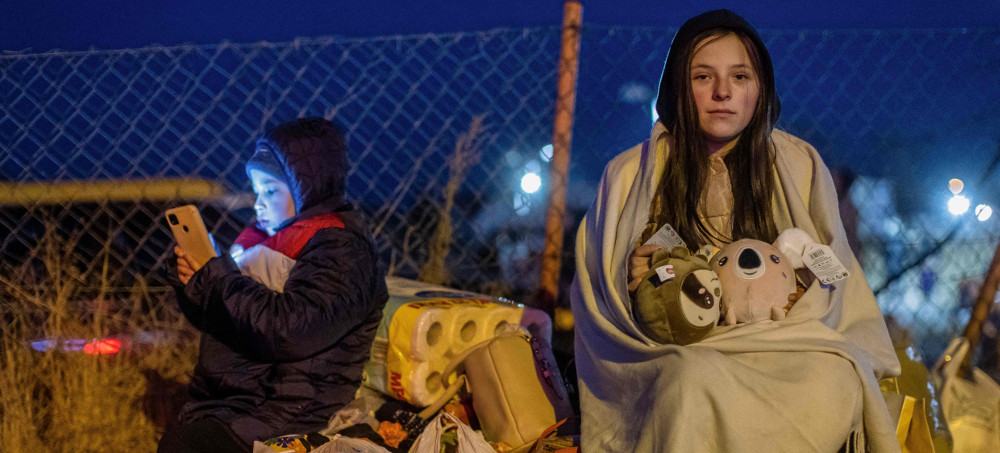 Helena (R) and her brother Bodia (L) from Lviv are seen at the Medyka pedestrian border crossing, in eastern Poland on February 26, 2022, following the Russian invasion of Ukraine. (photo: Wojtek Radwanski/AFP)
Volunteers patrol Polish border to fill what they say is a dangerous gap in protection for vulnerable refugees
“We’ve registered the first cases of [suspected] pimps preying on Ukrainian women near refugee shelter points in Lublin; accosting them, sometimes aggressively, under the guise of offering transport, work or accommodation,” said Karolina Wierzbińska, a coordinator at Homo Faber, a human rights organisation based in the Polish city of Lublin.
“These are not only men,” she said. “There are also women attempting to procure female refugees at bus stations.”
Wierzbińska said there had also been teams of people working together to try to lure women into unidentified cars.
“[We see teams] waiting for people arriving from Ukraine and pretending to offer rides or lodging to women distressed and exhausted from their journey,” she said.
“We’re also seeing multiple couples, typically a male and a female, having travelled to the border by car, attempting to lure women using similar tactics. We intervene in such cases by approaching the person acting suspiciously and asking them to register in our volunteer directory – in response to which they typically run away.”
Since Russia invaded Ukraine in late February, the Polish army – along with firefighters and police – have been on the border at Medyka, Poland’s busiest crossing with Ukraine, to organise and assist the thousands of refugees arriving every day.
The past few weeks have also seen the arrival of groups of men in military fatigues who claim to be there to protect women and children crossing the borders after aid organisations expressed fears that the refugee crisis would spark a wave of trafficking and exploitation.
Earlier this week, one such group of foreigners in camouflage could be seen unloading aid donations in a Medyka car park.
But the men, who slept in the car park in tents in sub-zero temperatures, are not Polish soldiers. Instead, they identified themselves as veterans of the French Foreign Legion.
The men said they had travelled thousands of miles to fill what they see as a dangerous vacuum in protecting women and children fleeing the war in Ukraine from trafficking.
“I couldn’t even focus, because that could have been my sister, my daughter,” said one individual attached to the vigilante group, who asked not to be identified but showed what appeared to be French Foreign Legion ID papers in his passport. “I think nothing’s being controlled,” he said. “I’ve seen women who are scared, and kids are showing up at the border and no one knows where the parents are. It’s such an easy target.”
Nearly a month into the war, security at Medyka is still precarious. Police on site have had a larger presence in recent days, to check the identity of volunteers and drivers offering lifts to refugees, but a huge number of cars pass without being stopped.
“The issue with human trafficking is that most of the transports that happen are not organised. They are volunteers who arrive from all kinds of places in their private cars. So at all the reception points, you have different organisations trying to set up a system of tracing and tracking,” said one Polish Red Cross volunteer, who asked to speak anonymously in order to be candid.
A spokesperson for the local police said they had no information about the vigilante group or their intentions, but denied there were any foreign soldiers at the border.
Volunteers at other refugee reception centres have also seen men in military uniforms unaffiliated with any official authority. On top of an already chaotic mix of aid groups, authorities and local volunteers, the arrival of individuals in military clothing creates confusion over who the official security forces are at the border points – a situation that helps traffickers, experts point out.
Many of the men refused to answer questions about their presence at the border. One individual, who had a French flag on his uniform, kept his face partly covered by a black neck gaiter and refused to give his name or explain his purpose at the border, only saying that he was there “to help”. All the men refused to be photographed.
Unicef, one of the aid groups working in Poland, said unvetted individuals acting in isolation from the Polish authorities were a concern. “I can’t speak for the authorities in Poland … [but] security is effectively their domain,” said Joe English, a Unicef spokesperson. “I think any kind of vigilantism is an unnerving development.”
More than 3 million people have fled Ukraine since the Russian invasion. Charities working at the border have said the increasing desperation of the women and children who are crossing over, many of whom have nowhere to go, has coincided with the appearance of suspected traffickers and sexual predators.
Ylva Johansson, EU commissioner for home affairs, said this week that there had been reports from aid groups of women disappearing and that the European Commission had launched a network of anti-trafficking coordinators. “We should not wait until we have proof of a lot of trafficking, because then it might be too late,” she said.
Missing Children Europe, an umbrella group for 24 child-protection organisations across Europe, told the Guardian that unaccompanied minors were continuing to disappear at the borders.
“There are so many children […] that we lost track of,” said Aagje Ieven, secretary general of Missing Children Europe. “This is a huge problem, not just because it means they easily go missing, and are difficult to find, but also because it makes trafficking so easy.”
According to Unicef, more than 500 unaccompanied children were identified crossing from Ukraine into Romania between 24 February and 17 March. It is one of several organisations that has called for improvements to screening at borders to keep children, particularly unaccompanied ones, safe.
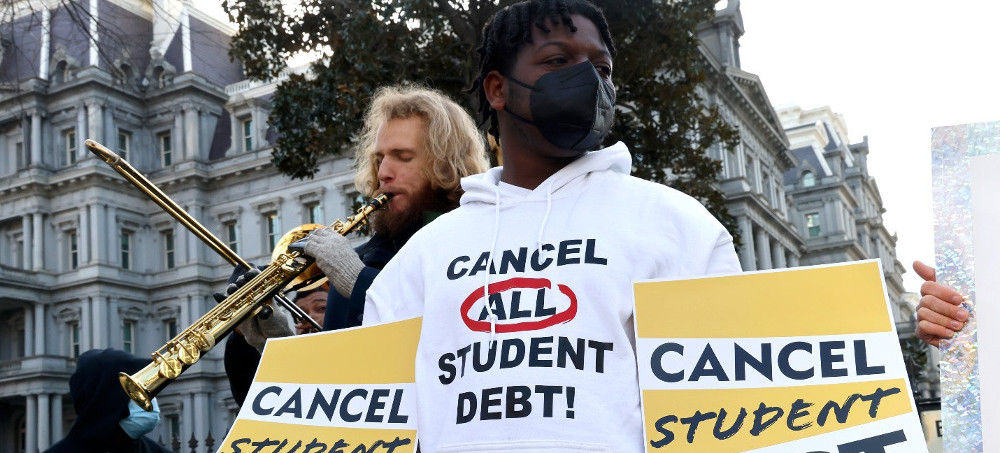 Student loan borrowers and the Too Much Talent Band demand President Joe Biden and Vice President Kamala Harris cancel student debt. (photo: Paul Morigi/Getty)
"We've got to make up for that policy mistake of the last 40 years by addressing the crushing burden of student debt that so many young people feel today and fixing the problem going forward by committing to debt-free college in the United States."
King, who served under President Obama, told CBS News his view stems from a reduction in federal investment in higher education over the last four decades, noting in the 1980s federal Pell Grants covered up to 80 percent of college tuition.
"We've got to make up for that policy mistake of the last 40 years by addressing the crushing burden of student debt that so many young people feel today and fixing the problem going forward by committing to debt-free college in the United States," King told the outlet.
An estimated 43 million Americans collectively owe at least $1.6 trillion, with the average borrower holding around $36,000 in federal student loans.
Federal loan payments are currently paused due to the coronavirus pandemic, but they are set to resume May 1. Lawmakers and advocates have called on the president to both extend the payment moratorium and forgive up to $50,000 per borrower.
Rep. Pramila Jayapal (D-Wash.) urged the president earlier this week to go even further and eliminate all student debt, noting another pause will insufficiently address the issue.
“Extending the payment pause just isn’t enough,” Jayapal wrote on Twitter. “We need to cancel every last penny of student debt, once and for all.”
The president signaled on the campaign trail and early in his presidency that he is willing to cancel up to $10,000 per borrower, and the administration has eliminated billions in loans already through borrower defense claims and policy overhauls.
But King said given the burdens caused by the coronavirus pandemic, the moves made toward loan forgiveness are not enough.
“We need more help from the federal government, and this is a way that we can really accelerate our economic recovery if President Biden would come forward now and cancel debt for all borrowers,” King said.
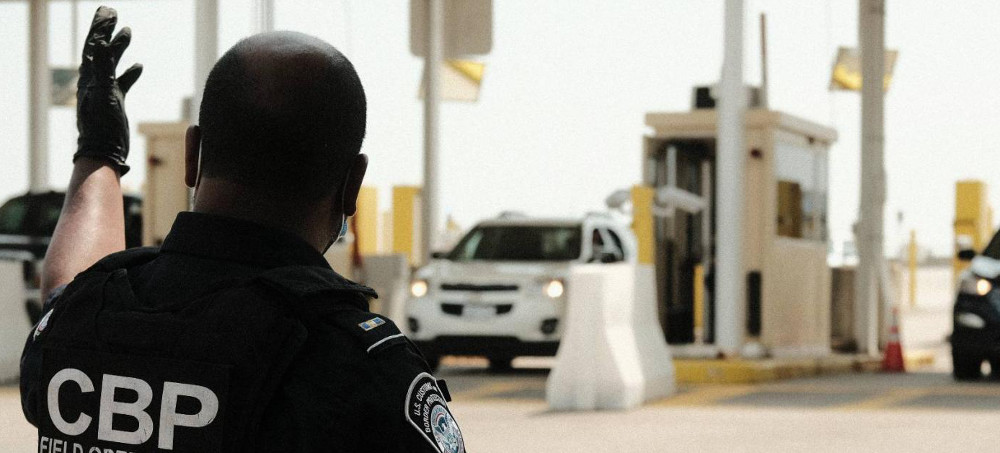 The three U.S. citizens said that when returning from abroad, they would be stopped by border officers and asked whether they are Sunni or Shia, which mosque they attend, and how often they pray. (photo: AFP)
Lawsuit filed by ACLU claims US violated religious freedoms of three Muslims for targeting, detaining, and questioning them based on their faith
The three US citizens alleged they would be subject to secondary screenings by border officers, during which they were asked questions including whether they were Muslim, whether they were Sunni or Shia, which mosque they attend, and how often they pray.
The lawsuit, filed by the American Civil Liberties Union (ACLU) in a district court in Los Angeles, claims their treatment amounts to religious discrimination under the Constitution, as it violates the First Amendment's right to freedom of religion - because other faiths are not similarly targeted with such questioning.
It also calls on the US Customs and Border Protection (CBP) agency to expunge the records of the three individuals, which the ACLU says are to be held in a database for up to 75 years and are accessible to US law enforcement agencies.
"Just as border officers may not single out Christian Americans to ask what denomination they are, which church they attend, and how regularly they pray, singling out Muslim Americans for similar questions is unconstitutional. Plaintiffs are entitled to full and equal membership in American society," the lawsuit says.
"By targeting plaintiffs for religious questioning merely because they are Muslim, Defendants' border officers stigmatize them for adhering to a particular faith and condemn their religion as subject to suspicion and distrust."
One of the plaintiffs, Abdirahman Aden Kariye, who is an imam at a mosque in Bloomington, Minnesota, said "whenever I travel back home to the United States, I'm anxious".
"I'm constantly worried about how I will be perceived."
During the occasions where Kariye was stopped and detained, he said he was asked questions by order officers including whether he was Salafi or Sufi, where he studied Islam, and what his views were on the 13th century Islamic scholar Ibn Taymiyyah.
As a result, Kariye said that he now no longer wears his Muslim prayer cap to the airport.
"It's terrible to feel you have to hide an essential part of who you are from your own government. I shouldn't be questioned because of my religion," he said in a statement.
The lawsuit says Kariye has also been put on a US government watch list.
"Religious questioning by border officers is unconstitutional, and it's past time for the government to be held to account," said Ashley Gorski, senior staff attorney with the ACLU's National Security Project. "This invasive questioning serves no legitimate law enforcement purpose, and conveys the harmful and stigmatising message that the US government views Muslims as inherently suspicious."
A US Customs and Border Protection (CBP) spokesperson told Middle East Eye that, as a matter of policy, it did not comment on pending legislation.
The Department of Homeland Security did not respond to MEE's requests for comment on the lawsuit.
Discrimination against Muslims
Muslim Americans have accused the government of targeting their communities since the 9/11 attacks. Informants have been sent to surveil local mosques, arbitrary watchlists have been created which restricted individuals' freedom of movement, and discrimination based on faith has been enshrined into policy.
Entire neighbourhoods in New York City were subject to raids and Muslims faced being arrested in the middle of the night, and being stopped and searched at "random" in the streets.
Many policies were also put forward to target individuals based on their Islamic faith, such as the National Security Entry-Exit Registration System (NSEERS), a programme created a year after 9/11 which targeted foreign nationals from 25 Muslim-majority countries.
Nearly two decades later, Muslim Americans and civil liberties groups are working to dismantle many of these discriminatory policies.
In 2019, a federal district judge ruled the US government's terrorist watchlist, which rights groups say listed as many as one million people, was unconstitutional.
Then, in 2020, the US Supreme Court ruled that Muslim Americans who were placed on the FBI's no-fly list were allowed to sue individual FBI agents who allegedly violated their religious freedoms.
In another Supreme Court case earlier this month, the nation's highest judicial body ruled narrowly in favour of the FBI in a case where three Muslim men from the state of California accused the agency of conducting illegal surveillance of them and their community after the 9/11 attacks.
However, the court did not rule broadly on whether the government could throw out the case using its state secrets privilege, allowing the case to continue at a lower level.
The ACLU's latest lawsuit similarly aims to remove a government practice it claims is unconstitutional.
"It is and always has been wrong to force Muslims, or any person of faith, to divulge their religious beliefs and practice to border officials," said Mohammad Tajsar, senior staff attorney with the ACLU Foundation of Southern California.
"The government's longstanding, discriminatory scrutiny of Muslim travellers must end now."
 Yachts, such as Roman Abramovich's "Eclipse," make up the biggest share of emissions for billionaires who own one. (photo: Lionel Cironneau/AP)
This framework made sense at the dawn of climate diplomacy. Back in 1990, almost two-thirds of all disparities in emissions could be explained by national rankings of pollution. But after more than three decades of rising income inequality worldwide, what if gaps between nation states are no longer the best way to understand the problem?
There’s growing evidence that the inequality between rich and poor people’s emissions within countries now overwhelms the country-to-country disparities. In other words: High emitters have more in common across international boundaries, no matter where they call home.
Analysts from the World Inequality Lab, which is led by the Paris School of Economics and University of California at Berkeley recently put forward an alternative assessment focusing more on varying measures of consumer income than gross domestic product. After a generation of poorly distributed gains from globalization, it turns out that personal wealth does more than national wealth to explain the sources of emissions. Climate progress means first curbing the carbon output of the wealthier among us.
Researchers at WIL drew on a range of data, from diet to car ownership, stock market investments and global trade to estimate individual carbon output. The top 10% of polluters – about 770 million people, roughly the population of Europe – are the climate equivalent of the world’s wealthiest decile who earn more than $38,000 a year, according to Oxfam. The trend is clear: Emissions generally rise with wealth.
The richest 1%— the more than 60 million people earning $109,000 a year—are by far the fastest-growing source of emissions. They live all over the world, with about 37% in the U.S. and more than 4.5% each in Brazil and China.
The rich and poor pollute differently
As people get richer, diets tend to diversify and meat consumption rises. We’d need a second Earth if everyone had the diet of an Australian or Brit. The average American in 2019 ate 53 pounds of beef—the most carbon intensive meat—according to USDA. But families in Argentina and Uruguay—where a lot of cattle are farmed—consumed even more than that, according to an industry website. Growing middle classes in developing countries from China to South Africa are eating more meat than ever.
Far higher up the income distribution, the emissions increase exponentially. The single-most polluting asset, a superyacht, saw a 77% surge in sales last year. An 11-minute ride to space, like the one taken by Amazon founder Jeff Bezos, is responsible for more carbon per passenger than the lifetime emissions of any one of the world’s poorest billion people, according to WIL.
One-tenth of all flights departing from France in 2019 were on private aircraft. In just four hours, those individually-owned planes generate as much carbon dioxide as an average person in the European Union emits all year. Four-fifths of the people on the planet never get on an airplane in their entire lifetime, according to market analysis by Boeing.
Owning a car, meanwhile, is one of fastest ways to enlarge an individual’s carbon footprint. SUVs were the largest contributor, after power, to the increase in global carbon emissions from 2010 to 2018, according to the International Energy Agency. In the U.S. there are about 84 cars on the road for every 100 people, compared with just 24 vehicles in India. But there’s often a huge divide within countries as well. In São Paulo, more than two-thirds of men in the poorest 10% will walk or cycle to work, emitting no carbon. That car-free lifestyle holds true of only about 10% among the Brazilian city’s richest 10%, according to a 2016 study.
When it comes to energy consumption, the difference can be even more stark. An average person in Nigeria uses about half as much electricity in a year as a U.S. high-definition television.
The world has changed, and so should the discussion of emissions
The huge gap between high and low emitters suggests the current nation-centered approach to cutting carbon needs to be rethought.
Lucas Chancel, a researcher at the Paris School of Economics who co-directs WIL, points to carbon taxes as an example. That policy has been deployed in many places as a regressive measure, meaning poorer people pay more as a proportion of their income. The further you look down the wealth distribution, the higher a percentage people pay for energy.
As more of the global poor become able to afford sport-utility vehicles, air travel, meat and other elements of the high-carbon lifestyle, political impediments to reducing these new emissions will likely rise. “There is a window of opportunity of a few years before things can completely go crazy,” Chancel says. “If we miss this window, it will be more socially complicated, because carbon policy will not be as concentrated on a small elite anymore. It will be widespread and it will impact the entire population.”
Addressing emissions inequality within countries is just as important as reducing pollution on a national level. WIL’s research shows that, for example, to even out carbon footprints in the U.S., its top emitters would have to cut pollution by 87% by 2030 while the bottom half could actually increase theirs by 3%.
The findings get to the heart of the landmark Paris Agreement, through which nations make commitments to cut emissions based on their abilities. If the U.S. just counted the emissions of the bottom half of its earners, it would already be on track to limit global temperature rise to 1.5C, the stretch goal of the Paris accord. On a national level, though, with the inclusion of wealthy Americans, the U.S. is falling far short. The same goes for France, India and China.
A Pathway to 1.5C
Individuals in the bottom 50% already live within their 2030 carbon budgets for reaching the Paris Agreement’s stretch goal
The inequality shift means policies should shift
Over the last two decades policy researchers have left a substantial library of strategies, options and tactics to put national greenhouse-gas pollution on a glide path to zero. The same isn’t true for wealthy individuals.
That’s started to change. A small group of researchers published a paper in Nature Energy in September that put forward five ways in which the global rich can leverage change much larger than themselves.
As consumers and investors, the choices of the wealthy can have outsize impact, especially on transport and housing. Just 1% of the world’s population is responsible for half the aviation emissions. Cars are the biggest source of per-capita emissions in the U.S. and the second biggest in Europe. Changing that, and much else, requires changing social norms. But creating demand for low-emission products such as electric vehicles and heat pumps can help subsidize a carbon-free path for others around the world to enter the middle class.
And just as companies generally decline to fully use their lobbying power, social capital and brand identities to press governments to take stronger climate action, rich people tend not to use the full extent of their influence: as role models, as corporate executives or board members, as citizens. Financing and supporting political campaigns, advocating for change within companies and lobbying governments directly all represent untapped levers for the carbon elite.
“If you’re in the top 10% you have the most power and possibility to help make those systemic changes happen,” says Kimberly Nicholas, a sustainability science professor at University of Lund and an author of the Nature Energy paper.
WIL’s data shows runaway emissions from a class of individuals—the top 0.001%—whose responsibility is so great that their decisions can have the same climate impact as nationwide policy interventions. Together, the top 10% of emitters generate more than four times as much carbon as the global average. They remain a significant source of warming even though many of those people saw a surprising decline in emissions between 1990 and 2019. That’s because the group largely consists of lower and middle classes in rich countries, who have often been left out of economic booms that have benefited their wealthier peers at home.
And while the 65% of the people who pollute the least have seen steady income gains—and consequently rising emissions—over the last three decades, they still contribute a relatively tiny share to global warming. A February study found that lifting hundreds of millions of people out of extreme poverty will only raise global emissions by less than 1%.
“Many people do not see themselves being part of either the problem or the solution but look for governments, technology and/or businesses to solve the problem,” wrote the authors of a 2020 Nature Communications journal article called “Scientists’ Warning on Affluence.” But that paper concluded people, not institutions, need to solve the problem. The organizations engaged in climate debates—governments, companies, NGOs—are ultimately legal or social structures made up by people. And if people don’t change, the institutions won’t either.
Carbon inequality math is so new, and so intimidating, that researchers assessing it are left mostly with questions. Perhaps the biggest one comes in the “Affluence” paper: “Can a transition to reduced and changed consumption be achieved while at the same time keeping economic and social stability?” As consumption and emissions continue rising, that remains very much an open question.
Special Coverage: Ukraine, A Historic Resistance
READ MORE
Follow us on facebook and twitter!
PO Box 2043 / Citrus Heights, CA 95611


