Showing posts with label INVASIVE SPECIES. Show all posts

Monday, September 4, 2023

TOP NEWS: GOP Shutdown Threat Raises Risk of 'Inhumane' Cuts to Food Aid


September 04, 2023


Top News


Rich Nations Have Delivered Mere 'Pittance' to Help East Africa Tackle Climate Crisis: Oxfam

"We have an abundance of clean, renewable energy," said one African activist. "But to unlock it, Africa needs funding from countries that have got rich off our suffering."

Jake Johnson

'This Is Absurd': Major Banks Continue to Fund Climate Chaos in Global South

ActionAid found that since the Paris agreement, banks have funded the largest Big Ag companies doing business in the Global South to the tune of $370 billion and the fossil fuel sector to the tune of $3.2 trillion.

Olivia Rosane

Global Biodiversity Panel Warns Humans' Introduction of Invasive Species Threatens Nature, Food Security

"With so many major drivers of change predicted to worsen," said one researcher, "it is expected that the increase of invasive alien species and their negative impacts, are likely to be significantly greater."

Julia Conley

GOP Shutdown Threat Raises Risk of 'Inhumane' Cuts to Food Aid

"House Republicans are listening to their most extreme members on steps that could slow the flow of relief and put us to the brink of a government shutdown," warned Democratic Rep. Rosa DeLauro.

Jake Johnson

Tens of Thousands in Seoul: 'Stop the Dumping of Radioactive Wastewater'

'It is time for the international community to step in and call out this clear breach of the international law'

Common Dreams staff

US to Begin Sending Controversial Depleted Uranium Shells to Ukraine

Peace groups have long campaigned for a ban on DU munitions

Common Dreams staff

More Top News


As Auto Strike Looms, Biden Admin Puts $15.5 Billion Toward Just Transition to EVs


'Powerful Example': California Now Largest Economy to Back Fossil Fuel Nonproliferation Treaty


'A Welcome Relief': Transportation Department Suspends Trump-Era LNG 'Bomb Trains' Rule


Watchdog Calls On Judge With Pharma Investments to Recuse From Drug Pricing Case


Trump's Last-Minute Attack on Old-Growth Trees Was Illegal, Judge Rules

VIEW ALL NEWS

MAKE A GIFT TO COMMON DREAMS.
Independent news is more important than ever.

DONATE TODAY

Opinion

What’s at Stake at the Africa Climate Summit?

We hope that the summit will prioritise the voices and concerns of us—young people, who are the ones who will inherit the consequences of climate inaction.

Gerance Mutwol

Expand Social Security to Honor US Workers

As traditional pensions continue to disappear, Social Security is more vital to American workers’ economic security than ever.

Nancy J. Altman

Let’s Raise the Standard for Workplace Accommodations This Labor Day

Disabled workers are a growing portion of the labor force and a vital asset to our economy, but pandemic-era accesibility gains could end up being temporary if we’re not careful.

Olivia Alperstein

VIEW ALL OPINION


Saturday, August 27, 2022

If You See This Jumping Worm, Kill It


WE BOUGHT SOIL FROM AUBUCHON THAT CAME FROM DOWN SOUTH AND HAD THESE WORMS - ONLY USED 1/2 OF ONE BAG AND CAN'T GET RID OF THE WORMS! BE CAREFUL!


If You See This Jumping Worm, Kill It


Earthworms are good for the soil, but so-called Jumping Worms, an invasive species from Asia, can devastate gardens and forests. Jumping Worms are spreading across North America. “Invasive species can really quickly do a number on native species that don't have defense mechanisms against their invader,” said Brad Herrick, an ecologist at the University of Wisconsin-Madison Arboretum. Herrick told Inside Edition Digital, “It's still early in the invasion, but it's happening fast."


Jumping worms spotted in Mass. again. Should you be worried about your garden?

The invasive species is known for thrashing around wildly, often jumping or flipping over.

If you see a worm thrashing around in your garden, take note: it could be an invasive species.

The invasive Asian jumping worm has been spotted in Concord, Massachusetts, in the Hugh Cargill Community Garden as well as personal gardens. Since the worms spread easily through transported soils, mulch, and compost, the town is warning nearby areas to keep an eye out.

The jumping worm sounds a little creepier than it is: the species is known for thrashing around wildly, often jumping or flipping over, and sometimes casting off the tip of the tail.

The jumping worm is an invasive species that originated in Asia and can alter soil qualities, making soil inhospitable to some plants and animals, according to Cornell University’s JWORM Working Group.

“They do this by consuming the upper organic layer of soil, which leaches nutrients and erodes the ground,” the group wrote. “This makes it hard for many plants (including garden plants) to grow and threatens even the most well-tended lawns. What’s worse — humans spread worms without realizing it, carrying jumping worm egg cases (cocoons) in soil, mulch, potted plants, landscaping equipment, and even the treads of shoes and tires.”

Though jumping worms have a seasonal life cycle and can’t survive the cold winter, their egg cocoons can. The eggs, which are about the size of a poppy seed, hatch in the spring and are usually visible by May if you’re looking for them. 

Since native earthworms are excellent for soil and garden health, it’s important to be able to recognize the jumping worm, and other invasive species, to know which worms to leave alone.

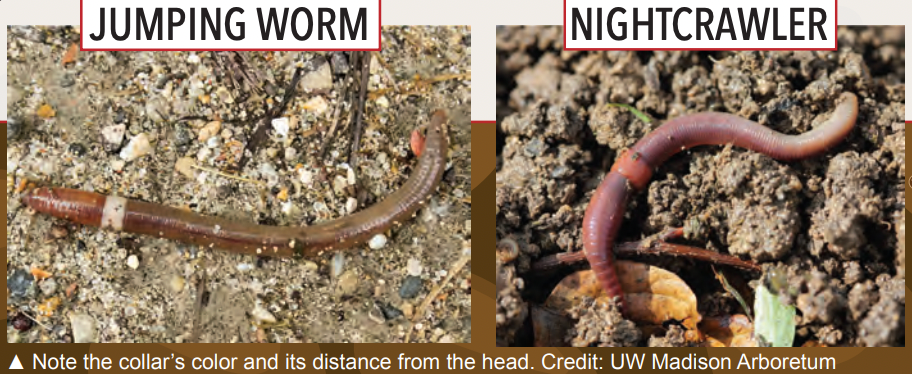
According to the working group, jumping worms are most often confused with another invasive species, the nightcrawler (what is it with these names?). Adult jumping worms have a “smooth milky-white collar close to the head,” whereas nightcrawlers have a “raised pink-red collar more central” on the worm’s body.

Jumping worms are being spotted more and more in the Northeast, and in September there were several reports around Massachusetts.

“If you find you have jumping worms, don’t share your mulch or compost,” Amy Pulley, proprietor of Wing and a Prayer nursery in Cummington, told the Daily Hampshire Gazette. “If you wish to share plants, wash the roots carefully and replant in sterile potting soil before selling or giving them away.”

So, what can you do? Check your plants and soil, clean your boots and gear, and learn how to recognize invasive worm species!


LINK


Sunday, June 21, 2020

Author urges gardeners to form one big 'national park'


About this website
DAILYHERALD.COM
Imagine if all the back and front yards -- and even patio container plants -- across the country were seen as one magnificent patchwork quilt, a ''Homegrown National Park."


Imagine if all the back and front yards -- and even patio container plants -- across the country were seen as one magnificent patchwork quilt, a ''Homegrown National Park." Home gardeners would join forces to bring back a variety of native plants to protect and nurture struggling birds, bees and other pollinators.
That's wildlife ecologist and entomologist Doug Tallamy's vision, as laid out in his most recent book, "Nature's Best Hope: A New Approach to Conservation that Starts in Your Yard" (Timber Press).
Tallamy, a professor at the University of Delaware, is urging everyone -- in cities, suburbs and rural areas -- to pitch in.
"This enormous new national park can absolutely make a difference," he said in an interview with The Associated Press, especially east of the Mississippi River, where the vast majority of land in the U.S. is privately owned.
While one home garden can have a welcome effect, he says, it would be a game changer if lots of people pitched in on different, connected parcels of land, replacing traditional lawns, imported ornamentals and invasive species that fail to provide habitat for native birds, butterflies and other pollinators with ecologically crucial trees like oaks and other native species, he says.
And even a single person acting boldly with this goal in mind could be a crucial source of inspiration for others around them.
Despite climate change, or perhaps partly because of it, Tallamy optimistically envisions the coming decades as "The Age of Ecological Enlightenment."
"I am an ecologist who makes this claim with confidence, because it is the only option left for Homo sapiens if we want to remain viable in the future," he writes in his book.
The pivot, he says, must start at home. You can make changes slowly on your own or hire a landscaper to make changes all at once, but embracing native plants and reducing lawn is the direction gardening must take to help the environment, he says.
Todd Forrest, vice president for horticulture and living collections at The New York Botanical Garden, agrees it's urgent that home gardeners focus on enhancing native biodiversity.
"Over the past few decades, advances in gardening equipment and techniques, increased access to a diversity of nursery-grown native plants, and rising environmental awareness among gardeners have made it more possible than ever before to harness all the joys of gardening to benefit the health of the planet," Forrest says.
Tallamy says it's easy to make a meaningful transition toward conservation-minded gardening.
"You can do it for free, bit by bit, as a hobby. And if you don't own property, you can help the process in local parks, in roof gardens or community gardens, and you can plant native species in containers on balconies or patios," he says.
His advice:
First, reduce the amount of lawn on your property. Tallamy suggests cutting the size of your lawn by half, retaining, for example, a narrow stretch in the front and just enough in the backyard to create a pathway. "You don't have to get rid of it, just reduce it," he says.
Second, plant an oak or hickory tree, both of which provide habitat for a huge diversity of native species. "You don't have to buy a tree, just plant an acorn. That's free," he says.
Third, put in plants that support a diverse community of pollinators, like native milkweed, pie weed or other native plants.
Fourth, get rid of invasive species. The worst are burning bush, barberry, Bradford pears, autumn olive, porcelain berries, bush honeysuckle and Kudzu, Tallamy says.
Fifth, add a bubbling water feature. "Any sort of bubbler where the water is kept clean is great for birds. It's just a magnet for them," he says.
Sixth, coordinate with your neighbors. "You don't have to do all these things on a single property, particularly if your property is small. Maybe your neighbor can plant an oak and you can put lots of native species in containers and install some kind of water feature," Tallamy explains.
As a whole, the Homegrown National Park should feature all these things on a loosely connected patchwork of land, he says.
"Admission to Homegrown National Park is free and there are no restricted seasons," he writes in his book.
"As you become familiar with the natural cycles that occur in your yard, you will start to anticipate them, subconsciously at first, but then as something you eagerly await."


Top News | 'He’s Not Going to Run Unopposed': Sanders Rejects Schumer for Majority Leader

                                                               LOTS OF POSTS IGNORED BY BLOGGER..... OR REMOVED ON THEIR WHIM! ALL POSTS ARE...