|


|
|
|
 |
Friends,
Donald Trump is spending most of this week, and much of the coming month or two, in a Manhattan courtroom facing criminal charges. He claims he’s being politically persecuted and is acting the part of a martyr. He wants the public to see a courageous individual versus a corrupt deep state.
Meanwhile, Joe Biden is spending much of the week in Pennsylvania, advocating for a tax hike on the rich and for strengthening unions. Then he’s back in Washington, trying to deal with the escalating conflicts in the Middle East. Biden has worked hard from the start of his presidency (recall his dangerous journey into Ukraine), and his workload appears to be intensifying. ...
Here's where we are at the end of the day: Seven jurors have been selected to serve on the jury. The remainder will be selected from 96 people who will return to the courthouse on Thursday morning when jury selection continues. That’s not bad for just over a day and a half of jury selection. Many people were predicting it could take weeks. My feeling this morning, when Preet Bharara and I taped The Insider Podcast, was that it would be about a week, maybe plus a few extra days. It looks like I may have been on the long side. Each side used up six of their peremptory challenges to get to this point, so they’ll be able to exclude fewer jurors from this point on, unless they can get the Judge to agree to remove them for cause. Trump was able to remove two jurors on that basis today, both after his lawyers raised social media posts that suggested, in one instance, that Trump should be behind bars. But the Judge cautioned that not every social media post that showed disagreement with Trump was sufficient to establish that a potential juror could not be fair and impartial. One juror, who posted a video of a post-2020 election celebration, explained she had done it both because it documented an important historical event and because it reminded her of the daily celebrations in New York City honoring first responders during the COVID pandemic. The Judge refused to strike her for cause, and Trump’s team had to spend a peremptory challenge to keep her off of the jury. The jury will be complete when 12 jurors and six alternates have been selected. The Judge cautioned Trump once today about intimidating jurors. Or, more precisely, he told Trump’s lawyers to have a talk with their client. Trump would do well to sleep more in court if this is the best he can manage when he’s awake. Expect the Judge to try and get through jury selection ahead of next Wednesday’s scheduled hearing on Trump’s gag order violations, at which point, all of this may come to a head.
As we've discussed previously, the dynamics of jury selection are very different depending on which side of the courtroom you're on. The defendant is looking for holdout jurors. It’s different for the prosecution. They have to be able to convince every juror that their evidence is proof of guilt beyond a reasonable doubt in order to get a conviction. They are looking to remove people who they believe won’t give them a fair shake. Lawyers often look at juries once they’re selected—prosecutors are notorious for this—and obsess about “juror number eight who crossed his arms over his chest tightly every time I spoke” and so on. But the reality is that for both sides, and especially on the prosecution side, you never get a perfect jury. You have to have confidence in the process and that 12 ordinary Americans who take an oath will honor it, that they will listen to the evidence and decide the case fairly. Lest you think that's not possible, remember that Paul Manafort was convicted by a jury that included people who counted themselves among Trump’s base. One of them told reporters afterward that although she supported the then-president, she had listened to the evidence and was persuaded that Manafort was guilty, so she voted to convict. There has been lots of talk about the possibility of a stealth juror—someone who pretends to be neutral but who, once seated on the jury, will refuse to vote to convict no matter how strong the evidence is. Yes, that’s an inherent risk prosecutors confront in our system—that a juror with a hidden agenda might lie their way onto a jury. There is a movement for jury nullification whose advocates encourage jurors to insert their own sense of justice in place of the laws they disagree with and refuse to convict even when there is incontrovertible evidence of guilt. Prosecutors use their skills to try and detect these jurors and prevent them from being seated on the jury. The prosecutors involved in jury selection in this case have the combined experience for this. But it’s also a reality that in this unlike-any-other case, Trump supporters are publicly soliciting potential jurors to protect him, like Podcaster Clay Travis who has been vocal on this point. Florida Congressman Byron Donalds, a Republican who apparently has vice presidential aspirations on the Trump ticket, also encouraged jurors to vote not guilty. New York law prohibits conduct designed to influence the outcome of a proceeding through communications with a juror or a potential juror.
The goal for Trump’s team is a jury that can’t reach a verdict, a jury that “hangs.” In the event that happens, before a mistrial is declared, the Judge would give a deadlock instruction. We use something similar called an Allen charge (named after the court case that authorized the use of this procedure) in the federal system, and I have seen it be very effective with juries that appear to be hopelessly deadlocked until they hear from the judge. The New York instruction reads, in part (it’s quite lengthy): “It is not, however, uncommon for a jury to have difficulty initially in reaching a unanimous verdict, and it is not uncommon for a jury to believe that they will never be able to reach a unanimous verdict. But, after further deliberations, most juries are able to reach a unanimous verdict. And, so, I will ask you to continue your deliberations. But before I do, I want to remind you that, when this trial began, many prospective jurors were called and questioned. Many were excused for one reason or another. But you ladies and gentlemen were selected to serve. That means that of all the prospective jurors called in this case, you were the ones in whom both sides expressed confidence. Both sides were convinced that each of you would be fair and impartial, that each of you would listen carefully to the evidence, to the arguments, and to the law, and that each of you would deliberate with your fellow jurors and work hard to reach a unanimous verdict that was consistent with the law and the evidence. Both sides continue to have confidence in you, as do. Members of the jury, you make up a very good jury. There is no reason to believe that the presentation of this case again would be to a jury that is any more intelligent, reasonable, hardworking, or fair than you are. I want to emphasize that I am not asking any juror to violate his or her conscience, or to abandon his or her best judgment. Any verdict you reach must be the verdict of each juror, and not mere acquiescence in the conclusion of others. But I am asking you to continue deliberating, and to resume your deliberations with an open mind. Start with a fresh slate. Do not feel bound by how you felt before — whether you favored conviction or acquittal. Have the courage to be flexible. Be willing to change your position if a reevaluation of the evidence convinces you that a change is appropriate. Do not, out of pride or stubbornness, adhere to an opinion or conclusion that you no longer believe is correct. Be honest with yourselves and with the other jurors. Listen to the other jurors and evaluate what they have to say. Do not let anything prevent you from carefully considering what they say. Remember that each of you made a commitment when you became a juror that requires you to reason and deliberate together to reach a fair and a just verdict based only on the evidence.” The admonition that no other jury would be in any better position to decide the case than they are and that they have an obligation to do their job often, but not always, hits the mark. In Trump’s case, not only must jurors must take an oath to serve, the public will learn what that evidence is and whether it is strong or not. And the jurors will have to deliberate as a group, which will lay bare anyone who refuses to deliberate in good faith. In a case like this one that will garner attention long after it’s over, fellow jurors would expose one of their number who unreasonably refused to convict. The threat of that story being public may also work to discourage stealth behavior on this jury. I’m a believer in the jury system and have seen it do justice time and time again. It is not perfect, and given Trump’s success at manipulating the legal system, prosecutors would do well to remain on guard. But there are encouraging signs among the jurors who have been selected so far.
That is precisely how we are entitled to expect this to work. We’re in this together, Joyce |
SUBSCRIBE TO THIS NEWSLETTER TO RECEIVE TIMELY REPORTS
THANK YOU SENATOR ELIZABETH WARREN!
By Pam Martens and Russ Martens: April 15, 2024 ~
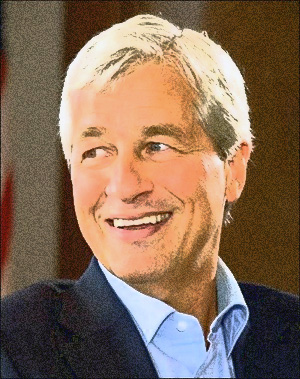
Jamie Dimon, Chairman and CEO of JPMorgan Chase
On October 27 of last year, JPMorgan Chase filed an 8K form with the Securities and Exchange Commission (SEC) advising that, for the first time ever, its long-tenured Chairman and CEO, Jamie Dimon, and his family, intended to “sell 1 million shares” of his common stock holdings in the bank in 2024.
The news made headlines because an insider selling a large amount of stock in any company – and particularly a bank with JPMorgan Chase’s serial history of running afoul of the law – can be a harbinger of bad news ahead for other shareholders.
Dimon didn’t wait long into 2024 to start dumping stock. JPMorgan Chase filed another SEC form this past February showing that Dimon had sold 821,778 shares of the bank’s common stock for $150,167,222.52, or an average share price of $182.73 – which was suspiciously close to the stock’s all-time high at that point.
Dimon has acquired the bulk of his shares in the same fashion as his former mentor, Sandy Weill, acquired his shares in Citigroup – through stock grants from his hear no evil, see no evil Board of Directors. (Dimon had, in his earlier years, been Weill’s first lieutenant at Citigroup.)
Weill stepped down as CEO of Citigroup in 2003. Just one day after stepping down as CEO, Citigroup’s obliging Board of Directors allowed Weill to sell back to the corporation 5.6 million shares of his Citigroup stock for $264 million. This eliminated Weill’s risk that his big share sale would drive down his own share prices as he was selling. The Board negotiated the price at $47.14 for Weill’s shares. Six years later, in the spring of 2009, Citigroup was a 99-cent stock and receiving the largest taxpayer and Federal Reserve bailout in U.S. history.
Between December 2007 and July 2010, Citigroup received the following bailouts to keep it afloat: The U.S. Treasury injected $45 billion of capital into Citigroup; there was a government guarantee of over $300 billion on certain of its assets; the FDIC provided a guarantee of $5.75 billion on its senior unsecured debt and $26 billion on its commercial paper and interbank deposits; and secret revolving loans from the Federal Reserve sluiced a cumulative $2.5 trillion in below-market-rate loans to Citigroup according to an audit released by the Government Accountability Office in 2011.
On May 9, 2011, Citigroup did a 1 for 10 reverse stock split to dress up the disaster of its share price history. For each 100 shares the shareholder held previously, he or she now owned just 10 shares. Citigroup investors who have held onto their shares since Weill’s stock sale in 2003 are down 87 percent at yesterday’s closing price of $59.68 – which is actually $5.97 adjusted for the reverse stock split.
In spin that is similar to Weill’s tactics, Jamie Dimon has, for more than a decade, attempted to brainwash Congress, the media, and the public at large by referring to his bank as the “Fortress Balance sheet.” His latest letter to shareholders uses the phrase five times – at one point phrasing it as an “unquestionable fortress balance sheet.”
And yet, in the same letter to shareholders, Dimon concedes that his bank’s federal regulators don’t have the same level of confidence in this so-called “Fortress.” Dimon writes that if the capital rules proposed by the FDIC, Office of the Comptroller of the Currency and the Federal Reserve are implemented, they “would increase our firm’s required capital by 25%.”
Another reasonable way to read that is that federal banking regulators, whose bank examiners have intensely examined the books of the bank, believe that JPMorgan Chase is undercapitalized by 25 percent and thus poses a potential systemic risk to the U.S. financial system until it bulks up its capital.
This capital battle is officially known as the proposed Basel III rules and Dimon is leading the charge to stop federal bank regulators from implementing the rules. Internal government documents show that Dimon and his Chief of Staff, Judith Miller, met separately with the following Fed Governors on December 15 to argue against the proposed rules: Fed Governor Adriana Kugler; Fed Vice Chair Philip Jefferson; and Fed Governor Christopher Waller.
According to Fed Chair Jerome Powell’s daily calendar, he met personally with Jamie Dimon on January 26, 2024 from 4:45 p.m. to 5:15 p.m.
Financial Times reporters Joshua Franklin and James Politi report that in mid March, Dimon met in a one-on-one meeting with Vice President Kamala Harris and separately with President Biden’s Chief of Staff, Jeff Zients.
At a Senate Banking Committee hearing on March 7, Senator Elizabeth Warren said that the 37 largest banks that would be impacted by the higher capital rules have “spent tens of millions of dollars running ads during Sunday night football and millions more for an army of lobbyists to try to twist arms here in Congress.”
The TV ads have been grossly misleading, making it sound as if the higher capital requirements at just 37 banks would hurt working families and farmers – ignoring that inadequate capital levels collapsed giant Wall Street banks in 2008 and put millions of innocent Americans out of work and in foreclosure as the U.S. economy collapsed along with the toxic debt bombs exploding at the banks.
Fed Chair Powell was the sole witness at the March 7 Senate Banking hearing. Warren told Powell this:
“Despite all you said last year when the banks failed about supporting Vice Chair Barr’s recommendations to strengthen rules for big banks, public reporting now says that you are driving efforts inside the Fed to weaken the capital rule. You even told the House Financial Services Committee representatives yesterday that you think it’s ‘very plausible’ that you withdraw the rule.”
Warren concluded with this zinger to Powell:
“You are the leader of the Fed and when the heat was on last year, you talked a lot about getting tougher on the banks. But now the giant banks are unhappy about that and you’ve gone weak-kneed on this. The American people need a leader at the Fed who has the courage to stand up to these banks and protect our financial system.”
For more key background on the Basel III capital proposal, see our reports below:
Jamie Dimon Hires Dodd-Frank Hatchet Man to Weigh Suing the Fed Over Proposed Capital Rules
LOTS OF POSTS IGNORED BY BLOGGER..... OR REMOVED ON THEIR WHIM! ALL POSTS ARE...


