Showing posts with label WIND & SOLAR. Show all posts

Wednesday, October 8, 2025

The World Turns to Wind and Sun - While Trump Bets on Coal


The World Turns to Wind and Sun - While Trump Bets on Coal

Renewables just surpassed coal on the global grid, as Trump doubles down on fossil fuel.


Something remarkable happened this year, and you probably didn’t see it splashed across cable news. For the first time in history, the world’s wind and solar farms generated more electricity than coal. It’s a quiet revolution, but one that may define the century ahead.

According to new data from the climate think tank Ember, renewable energy has finally outpaced fossil fuels in meeting the world’s growing appetite for power. In the first half of 2025, solar production jumped by nearly a third compared to last year, while wind generation rose more than 7%. Together, renewables supplied 83 percent of the increase in global electricity demand, enough to cause a small but historic decline in coal and gas use.

Anthony Davis' Substack is a reader-supported publication. To receive new posts and support my work, consider becoming a free or paid subscriber.


Contrary to Donald Trump’s claims, much of this progress has been driven by Asia’s two largest economies. China added more renewable capacity than the rest of the world combined, cutting its fossil fuel use by 2 percent in just six months. India grew its renewables more than three times faster than its electricity demand, reducing coal and gas use by 3.1 and 34 percent, respectively.

The International Energy Agency projects that this trend will only accelerate. By 2030, global renewable power could more than double, with solar energy alone making up 80 percent of that growth. Solar will dominate the expansion, but wind, hydropower, and bioenergy will all play supporting roles. Solar is also set to surge in economies like Saudi Arabia, Pakistan, and across Southeast Asia.

While much of the world races toward renewables, Trump, a climate change denier, is moving in the opposite direction. Electricity demand at home has outpaced the growth of clean energy, forcing a 17 percent increase in coal generation in the first half of this year. Then came another blow: on August 29, the Trump regime canceled twelve Biden-era transportation grants tied to offshore wind projects, diverting $679 million in funds to “other priorities.” The grants had been awarded under the Federal Highway Administration’s INFRA program and the Maritime Administration’s Port Infrastructure Development Program, both designed to modernize ports and enable large-scale wind infrastructure.

Transportation Secretary Sean Duffy defended the move, falsely claiming, “We are prioritizing real infrastructure improvements over fantasy wind projects that cost much and offer little.” The decision fits neatly into Trump’s broader energy playbook: revive coal, dismantle clean energy initiatives, and undermine international climate cooperation. It’s a vision rooted not in innovation but in nostalgia - for an economy and energy system that no longer exists.

While some leaders retreat to old habits, others are learning the hard truth that there are no shortcuts to decarbonization. Carbon offset programs, once hailed as a market-friendly solution to climate change, have largely failed. Research found that most offset projects either exaggerated their impact or credited emissions reductions that never truly happened. Some funded wind farms that would have been built anyway; others claimed forest protection while logging simply moved next door.

The implication is clear: you can’t outsource your way to a stable climate. The renewables surge, by contrast, is tangible. Wind turbines spin. Solar panels hum. The electricity flows. This is not an accounting trick or a line item on a balance sheet - it’s physical progress, measurable and immediate. And once the infrastructure is in place, energy prices will come down. Any negative headlines about climate initiatives, electric vehicles etc have been planted by the fossil fuel industry - they’ve been at this for years.

For the first time, clean energy is not a niche story or a promise for the future. It’s the backbone of the world’s power system, displacing fossil fuels in real time. And it’s happening despite political resistance, not because of it. If the past year marks the moment renewables overtook coal, it may also mark the moment political will fell behind technological reality. The world is racing toward clean power, but America, under Trump, is set to be left far behind.

Anthony Davis' Substack is a reader-supported publication. To receive new posts and support my work, consider becoming a free or paid subscriber.

Sunday, November 10, 2024

DON'T MISS: Germany: For First time, Wind and Solar Power Generation exceeds Fossil Fuels


Featured

Germany: For First time, Wind and Solar Power Generation exceeds Fossil Fuels

Ann Arbor (Informed Comment) – The Ember energy analysis firm reports that for the first nine months of 2024, Germany generated more electricity from wind and solar than from fossil fuels for the first time in history. Wind and solar combined accounted for 45 percent of electricity.

All in all, 59% of German electricity, almost six tenths, has come from renewables this year, with hydro the main source aside from wind and solar. In 2023, renewables only accounted for 52% of Germany electricity, so there has been a substantial advance. Half of that advance came from new solar installations, Ember says.

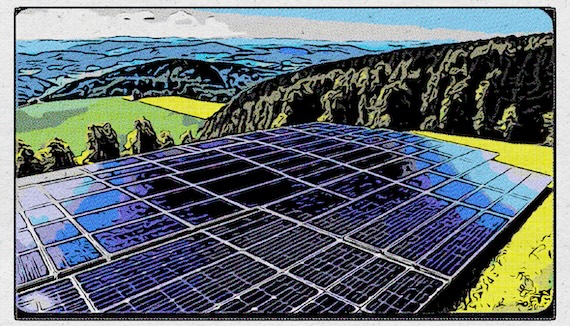
An amazing 11 gigawatts of new solar capacity has been added this year. As of mid-summer, Germany had 92 gigawatts of installed solar capacity, exceeding its 2024 goal of 88 GW.

Through the end of July, fossil fuel electricity generation plummeted 14.5% from the same period in 2024, reaching the lowest levels on record. The consumption of coal, the dirtiest fossil fuel, fell by 39% through September of this year compared to the same months in 2023.

Germany’s carbon emissions dropped by 10% in 2023 compared to the previous year, and are expected to fall again this year. If all industrialized countries met Germany’s performance, the climate crisis would be less severe. Energy-related carbon emissions in the US. fell last year, but only by 3%.

The rapid advance of solar, Ember explains, is the result of government policy changes, including the reduction in bureaucracy and easier permitting and “simplified grid connection for small PV systems,” as well as better remuneration for consumers who sell their electricity back into the grid.


“German Solar,” Digital, Dream / Dreamland v3 / Clip2Comic, 2024

Wind installations kept pace with those of the previous year, at 2.3 gigawatts. Wind-generated electricity was up 7% this year. Although wind’s progress was not as spectacular as that of solar, it still did make impressive advances, and there is a lot of capacity in the pipeline. Germany won’t quite meet its goals for total wind installations of 80 gigawatts this year, but those goals are the most ambitious in the European Union.

Winds have been anemic in the summer and fall, but are expected to pick up in the last two months of the year. Wind has had to be replaced with expensive fossil gas for the moment. Emissions will likely still fall, since electricity demand is lower. Wind plus battery will smooth out some of these fluctuations in the future.

There are also legal reasons for which wind will advance even more in future. Ember writes, “The German government has declared renewables to be in the overriding public interest, a privileged legal status which unlocks faster permitting and simplified procedures. Furthermore, German states are now required to allocate around 2% of their land for wind turbines.”

Ember doesn’t say so, but battery capacity is also rapidly increasing in Germany, where battery storage reached 9.9 gigawatts so far in 2024. Reuters reports that grid battery capacity in the country is up by 1/3 in 2024, an incredible advance. In the next two years, through the end of 2026, battery storage in Germany is set to increase five-fold, according to Clean Energy Wire. Battery storage allows solar energy to be captured during daylight and released at night.

CEW adds that “more than 80 percent of smaller photovoltaic rooftop systems are already being installed in combination with battery storage systems.” That combination is not nearly as common in the United States, but it should be.

Two big issues loom over Germany’s energy situation. One is the closure of the country’s nuclear plants at the insistence of the Green Party, which has been in government off and on (it is part of the present shaky coalition). Despite predictions of gloom and doom, the transition to wind, solar and battery has gone well.

Clean Energy Wire observes, “Decades of debates came to an end in April 2023, when Germany finally shuttered its last nuclear power plants after the energy crisis. One year on, predictions of supply risks, price hikes and dirty coal replacing carbon-free nuclear power have not materialised. Instead, Germany saw a record output of renewable power, the lowest use of coal in 60 years, falling energy prices across the board and a major drop in emissions.”

The other issue is the Ukraine War and Germany’s attempt to wean itself off Russian fossil gas. Germany cut its natural gas imports by nearly a third last year, and is pressing the EU to end imports of gas from Russia, still 20% of Europe’s usage. There isn’t any doubt that replacing both nuclear and fossil gas with wind, water, solar and battery is saving Germany money and allowing it energy independence from Russia.

In 2025, as Trump comes back into office, Americans should remember the cost savings offered by renewables, the environmental benefits of reducing carbon emissions and avoiding climate catastrophes, and the significance of energy independence for the US and its allies. Germany has overtaken Japan to become the world’s third largest economy.

About the Author

Juan Cole is the founder and chief editor of Informed Comment. He is Richard P. Mitchell Professor of History at the University of Michigan He is author of, among many other books, Muhammad: Prophet of Peace amid the Clash of Empires and The Rubaiyat of Omar Khayyam. Follow him on Twitter at @jricole or the Informed Comment Facebook Page


INFORMED COMMENT

Thursday, May 23, 2024

This Week's Good News: renewables now generate 30 per cent of the world’s electricity, olive ridley turtles in Australia and Bangladesh achieve record-breaking results and more!


Positive Environment News
 

Positive Environmental News 

23 May 2024


Renewables now generate 30 per cent of the world’s electricity

For the first time in history, the world generated 30 percent of total electricity from renewable energy sources last year, following a rapid increase in wind and solar power. 


Reusable PPE designed for safety, inclusivity and sustainability

AmorSui provides a sustainable alternative to single-use personal protective equipment with reusable and gender-inclusive wearables that protect both individuals and the planet.


A record-breaking milestone for olive ridley turtles in Australia and Bangladesh

In Bangladesh, conservation efforts have led to a 53 per cent increase in olive ridley turtle eggs, coinciding with the species' first-ever nesting discovery on Australia's east coast.


Shade-grown coffee: a triple win for birds, forests and communities

A Venezuelan project encouraging rural communities to produce shade-grown coffee has yielded significant benefits such as forest preservation, enhanced biodiversity and more.  


In case you missed it:


Registered Charity
Climate Active
 

Planet Ark acknowledges the Traditional Owners of the land on which we live and work. 

We recognise their continuing connection to land, water and community and pay respect to their Elders past, present and emerging.

 
FacebookTwitterInstagramLinkedInWebsite


Tuesday, April 2, 2024

Germany produced Record 175 TWh Energy with Wind, Solar in Past Year, as Wind Farms Surge

 
WE can CLEAN OUR AIR, REDUCE POLLUTION & REDUCE OUR 
DEPENDENCE ON FOSSIL FUEL....AND POCKET THE SAVINGS!

THE REST OF THE WORLD IS PROGRESSING....NOT THE US!  


Germany produced Record 175 TWh Energy with Wind, Solar in Past Year, as Wind Farms Surge

By Julian Wettengel | –

( Clean Energy Wire ) The year 2023 was the windiest in Germany in more than 15 years, providing excellent conditions for wind electricity generation, said Germany’s National Meteorological Service (DWD).

In 2023, the average wind speed across Germany at a height of 100 metres [yards] – a typical hub height for wind turbines in this country – was just under 6 metres [yards] per second (m/s), DWD said. Wind speeds were significantly higher than the long-term average, particularly in the winter months of January, November and December and reached the highest level since 2007.

Will renewables stop the climate crisis? | DW Documentary Video

Last year was also a good one for solar PV, but not a record year like 2022, DWD added. “From a meteorological perspective, 2023 was a successful year for the use of renewable energies in Germany,” DWD vice president Renate Hagedorn commented.

The expansion of onshore wind power in Germany is picking up again and it appears that a “politically caused” dent in newly installed capacity between 2019 and 2021 has been overcome, industry lobby group BWE said earlier this month.

Preliminary data by energy market research group AG Energiebilanzen (AGEB) showed that onshore wind turbines produced a record 114.2 terawatt hours (TWh) in Germany in 2023, while solar PV produced a record 61.1 TWh.

In January, the DWD had said that 2023 also marked Germany’s hottest year since records began in 1881, warning that the country had to “take intensive action to protect the climate and adapt to the damage caused by extreme weather events.”

Via Clean Energy Wire

Published under a “Creative Commons Attribution 4.0 International Licence (CC BY 4.0)” .

GERMANY CLEAN ENERGY


Friday, August 5, 2022

Huge 1,000MWh battery at site of closed coal plant gets NSW planning approval


Excerpt.
"A huge 500MW/1000MWh battery at the site of the shuttered Wallerawang coal fired power station near Lithgow has won planning approval from NSW state government authorities."
"The Wallerawang battery – to be developed by Greenspot – is one of the biggest of a number of big batteries proposed for NSW, the country’s biggest and most coal dependent grid, and which is plotting for a dramatic and rapid transition to renewables and storage."


A huge 500MW/1000MWh battery at the site of the shuttered Wallerawang coal fired power station near Lithgow has won planning approval from NSW state government authorities.

The Wallerawang battery – to be developed by Greenspot – is one of the biggest of a number of big batteries proposed for NSW, the country’s biggest and most coal dependent grid, and which is plotting for a dramatic and rapid transition to renewables and storage.

Planning approval was announced by the state planning authority on Thursday, noting it was located on the site of a former 1240MW coal generator that closed in 2014, on land that contained a recently harvested pine plantation, was shielded from nearby homes, and is close to existing energy infrastructure.

The Department of Planning also noted that the project would require a capital investment of $404 million, create 100 construction jobs, and provide $2 million in community enhancement projects via the local council.

Greenspot is likely to develop the battery in at least two stages, firstly with a 300MW facility – most likely with two hour storage, depending on market conditions – and hopes it can become part of a new industrial facility at the site.

It is located just outside the Central West Orana Renewable Energy Zone, where the first auctions for grid access rights for wind, solar and storage projects will be held later this year, but it is located on the main transmission line linking the zone with the major load centres in Sydney.

“The Central-West Orana Renewable Energy Zone is expected to unlock 3 gigawatts of wind and solar generation by the mid-2020s,” Greenspot CEO Brett Hawkins said in a later statement issued on Friday.

““We have secured an approval for a major energy storage project here at Wallerawang which can play a role in making that a reality.  We intend to team up with leading energy market players to move through the grid connection, financing and construction phases and ultimately to operation in the National Electricity Market.” 

Greenspot has said that it hopes a final investment decision can be made later this year, and if that is the case then the first stage of the Wallerawang battery operational could be operational by the summer of 2023/24, in time for the closure of the Liddell coal generator in the Hunter Valley.

There are several other large scale storage projects also proposed in the area, including the similar sized Great Western Battery proposed by Neoen, which has already built the two biggest batteries in Australia, the Victoria Big Battery near Geelong, and the Hornsdale Power Reserve in South Australia.

The Neoen project is still in the planning approval process, and would seek to plug into the same sub-station. It is not clear if both projects would go ahead at the same time.

Meanwhile, both EnergyAustralia (at Lake Lyell), and Atco (at Central West near Bathurst) also have proposals for large pumped hydro projects.

See RenewEconomy’s Big Battery Storage Map of Australia and its Pumped Hydro Energy Storage Map of Australia.


LINK


YOU DID THIS. We’re #3 on Audible!

                                                                                  LOTS OF POSTS IGNORED BY BLOGGER..... OR REMOVED ON THEIR ...