Showing posts with label VICTORIA AMELINA. Show all posts

Monday, August 7, 2023

FOCUS: Jon Lee Anderson | The Death of a Ukrainian Writer


Reader Supported News
07 August 23

Live on the homepage now!
Reader Supported News
“AS LONG AS SOMEONE ELSE PAYS FOR IT” — “I love what you do, as long as someone else pays for it.” An actual Reader comment that we received. A clue: What we do, depends on “public support.” That IS why people like it … because it’s uncorrupted. Yes fundraising sucks. But you do like the result. Help, we need it.
Marc Ash • Founder, Reader Supported News

Sure, I'll make a donation!


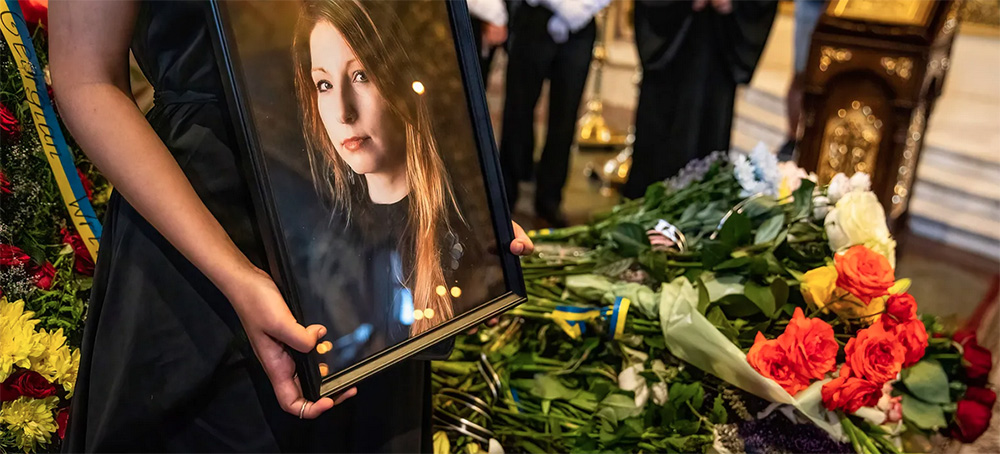
A person holding a photograph of a woman at a funeral. (photo: Alex Chan Tsz Yuk/Getty Images)
FOCUS: Jon Lee Anderson | The Death of a Ukrainian Writer
Jon Lee Anderson, The New Yorker
Anderson writes: "Victoria Amelina was a gifted novelist who put fiction aside to devote herself to documenting the atrocities of Putin’s war." 


Victoria Amelina was a gifted novelist who put fiction aside to devote herself to documenting the atrocities of Putin’s war.


On the evening of June 27th, in eastern Ukraine, four friends of mine stopped for dinner at the Ria Lounge, a restaurant attached to a shopping center in the city of Kramatorsk, in the embattled Donetsk region. They had spent the previous two days travelling around the area, speaking to the locals and getting a firsthand look at the war’s destruction. They had been on the road all day and were hungry by the time they reached Kramatorsk. At around seven o’clock, they found an outdoor table at the Ria, where they joined a large crowd of diners, including many families. The Ria was popular for its pizzas, and had a pleasant, informal atmosphere.

Just about half an hour later, as their food was being served, a medium-range Russian Iskander cruise missile hit the concrete roof of the restaurant and exploded. People screamed in pain and confusion; many were trapped under the roof, which had collapsed. At least sixty-one people were injured and thirteen died in the strike, among them several children, including fourteen-year-old twin sisters. Speaking on Russian television afterward, the head of the Duma Defense Committee, Colonel General Andrey Kartapolov, was exultant, saying, “The strike on Kramatorsk was a real beauty. I bow my head to those who planned it. Not a blow but a song. My old military heart rejoices.” It was, in fact, the second mass civilian atrocity caused by Russian forces in Kramatorsk since the invasion of Ukraine began. On the morning of April 8, 2022, a pair of Russian Tochka-U missiles hit the city’s main railway station, which was packed with more than a thousand people waiting for a train to evacuate the city; at least fifty-eight were killed, including seven children, and more than a hundred and fifty were injured. On that occasion, the Russian Defense Ministry first claimed the attack was a Ukrainian hoax, then insisted that the Ukrainians had carried it out themselves.

In the latest missile strike, three of my friends, all of them Colombians, escaped without major injuries. Héctor Abad, a writer from Medellín, was unhurt, as was Catalina Gómez Ángel, a longtime war correspondent who now spends much of her time in Ukraine. Sergio Jaramillo, a former senior government official and a lead negotiator during the peace talks with the FARC guerrillas, had a few cuts and bruises. But the fourth, Victoria Amelina, a Ukrainian novelist and poet, suffered grievous head injuries, and lost consciousness. She was taken to a local hospital and then, a couple of days later, to a better-equipped medical facility in the city of Dnipro. She did not regain consciousness, however, and was put on a life-support system. On the night of July 1st, we learned that she had died.

Victoria, who was originally from the western city of Lviv, was thirty-seven and had been living with her husband, an I.T. specialist, in Kyiv. They had a twelve-year-old son who, for safety, was living with her mother in Krakow. Victoria was a gifted writer, the author of two novels and a children’s book. Her second novel had been short-listed for the European Union Prize for Literature, in 2019, and she’d received the Joseph Conrad Literary Award, in 2021, but since the Russian invasion she had stopped writing fiction to devote herself to the war effort. She joined the efforts of PEN Ukraine, and received training from Truth Hounds, a war-crimes investigation group based in Kyiv that sent teams to document abuses in towns and villages that had been occupied by Russians.

She had already made an extraordinary discovery. Last September, Victoria took a trip to the city of Izyum, in northeastern Ukraine, following the Russian retreat from the area. There, she looked into the disappearance of Volodymyr Vakulenko, a Ukrainian poet and children’s-book author whom she knew. He had not been seen since Russian soldiers detained him in Kapytolivka, his home village, on Izyum’s outskirts, in March of 2022, and he was presumed dead, but little else was known. Victoria went to Kapytolivka, where Vakulenko’s father told her that his son had kept a diary of the occupation, which he had buried under a stand of cherry trees in the garden, evidently shortly before he was taken away. She managed to dig up the notebook, in which he described encounters with Russian soldiers—one of whom said that their mission was to build a “different Ukraine”—and the growing effects of hunger, from surviving mostly on potatoes from the garden. Later, his body was found in a mass grave in a forest outside the city, with those of more than four hundred other people, including nearly two hundred women. Many of the bodies bore evidence of torture. Vakulenko had been killed with two bullets from a Makarov pistol.

Even before the full-fledged invasion of Ukraine occurred, in February, 2022, Victoria was keenly aware of the fragility of her country and its culture, and sought to do something about it. In 2021, using some of her Joseph Conrad Award prize money, she organized a literary festival, in her husband’s birthplace in Donetsk—a village named New York. (The origin of the name is unknown, but it dates back to the nineteenth century. In 1951, during the Cold War, the Presidium of the Supreme Soviet changed it to Novhorodske, or “New City.” In July, 2021, Ukraine’s parliament voted to change it back.) For Victoria, choosing New York—a cultural backwater—for the festival was an act of intentional irony, but it was also political. She wanted to bring some respite to the front lines of the region, which had been under assault by Russian-backed paramilitary separatists since 2014—in a conflict that was largely ignored by the outside world but had smoldered ever since Vladimir Putin’s occupation and annexation of Crimea—and in which more than fourteen thousand people had died.

Victoria posted images of the first and only New York Literary Festival, in October, 2021, which was attended by writers from Lviv and Kyiv, many of whom had never been to the region before. In one photograph, people are milling around the courtyard of a small neoclassical building where the festival was housed. In another, taken more recently, after a missile attack, the same building is shown with its roof blown off. There is rubble in the courtyard, and it is empty of people.

Last year, Victoria won a “Documenting Ukraine” grant, from the Institute for Human Sciences, in Vienna. A few weeks before her death, she learned that she had been awarded a residential fellowship at Columbia University’s Institute for Ideas and Imagination, which provides for scholars, writers, and artists to spend a year in Paris. She was excited at the prospect of a war-free interlude in the French capital with her husband and their son—however long the war was to last, they would at least spend the coming year together in relative peace. She also intended to use the time to complete a book about efforts that she and other Ukrainian women were undertaking to uncover Russia’s war crimes in their country, entitled “War and Justice Diary: Looking at Women Looking at War.”

I first met Victoria last October, at the annual Lviv BookForum. Some of the writers who participated, including Victoria and me, went on to Kyiv, and she showed me around the capital. We visited a playground in a pretty park that had a statue of the nineteenth-century Ukrainian poet and national hero Taras Shevchenko at its center. The previous day, a Russian missile had struck the playground—fortunately, no children had been present. Victoria’s apartment was not far away; she told me that the park was her “favorite place in Kyiv.”

We met again this year, in January, at a literary event, the Hay Festival in Cartagena, Colombia. She was recovering from a bout of pneumonia that she had contracted on a trip to the recently liberated city of Kherson, but she attended along with other Ukrainians, including the novelist Andrey Kurkov; the human-rights lawyer Oleksandra Matviichuk, whose Center for Civil Liberties was the co-recipient of the 2022 Nobel Peace Prize; and Victoria’s close friend Sofia Cheliak, the young curator of the Lviv BookForum. It was in Cartagena that Victoria met Sergio Jaramillo, who was launching a consciousness-raising campaign called Aguanta Ucrania—or “Resist, Ukraine!”—by enlisting Latin American writers and intellectuals to denounce the invasion. (In Latin America, as in much of Africa and other parts of the Global South, there is widespread incomprehension about the war, and many on the left parrot the official Moscow line while lauding Putin’s regime as the moral inheritor of the Soviet government’s efforts to train, arm, and finance the national liberation movements that fought Western-backed governments in the nineteen-sixties and seventies.)

Catalina Gómez Ángel was also in Cartagena and met Victoria there. Last April, they met again, in Ukraine, and travelled to New York (the one in Donetsk). Victoria had not been back to the village since the invasion began, and she wanted to see it before she left for Paris. “She was saying goodbye,” Catalina said. “She felt guilty about leaving her country in wartime, but was also aware that she needed to spend time with her son.” In June, both women were at the Book Arsenal literary festival, in Kyiv, where Victoria presented a newly published volume of Volodymyr Vakulenko’s diary and his war poetry. In the book’s foreword, she had written, “As long as a writer is read, he’s alive.” Sergio and Héctor Abad were at the festival, too, and the four of them took part in a talk about Aguanta Ucrania. Sergio wanted to visit some of the frontline towns, and invited Héctor to join him. Catalina, who knows the terrain—and had a trusted driver and S.U.V.—offered to take them. At the last minute, Victoria decided to go, too.

Catalina had been particularly struck by Victoria’s caustic wit. She noted that she was “being deluged by invitations from around the world to come and speak about Ukraine, but only after Ukraine’s victory,” Catalina told me, adding, “But she said she wondered what victory would feel like, after so many deaths.”

Victoria’s moral clarity, determination, and love of country impressed me greatly. She now joins the ranks of those whose lives have been cut short by war, their truncated careers the source of what-if musings forever afterward. In Victoria’s case, I feel certain that her legacy, and her words, will endure, infusing a contemporary, combustive element to the Ukrainians’ growing sense of identity and nationhood. Her funeral was held on July 5th, at a cathedral in Lviv. That night, a Russian missile struck an apartment building in the city, killing ten civilians and wounding dozens more. Human Rights Watch called the strike “a possible war crime.”


READ MORE


Contribute to RSN

Follow us on facebook and twitter!

Update My Monthly Donation

PO Box 2043 / Citrus Heights, CA 95611


Friday, July 28, 2023

RSN: FOCUS | Historian Tim Snyder: 'Our Misreading of Russia Is Deep. Very Deep'


Reader Supported News
28 July 23

Live on the homepage now!
Reader Supported News

WE HAVE NOTHING COMING IN FOLKS — All donations have stopped. We can’t do this. Can anyone donate? Heading for a disaster on funding. Dire situation now.
Marc Ash • Founder, Reader Supported News

Sure, I'll make a donation!


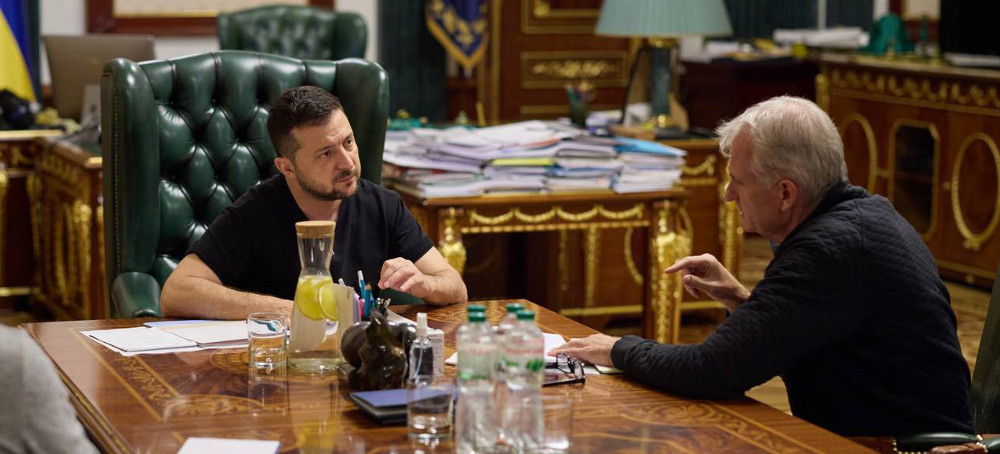
Ukrainian president meets with Yale University professor Timothy Snyder, Sep 2022. (photo: Official Website of President of Ukraine)
FOCUS | Historian Tim Snyder: 'Our Misreading of Russia Is Deep. Very Deep'
Sam Jones, The Financial Times
Jones writes: "The Yale professor on why the west got Putin wrong - and what the past tells us about the war in Ukraine."  


The Yale professor on why the west got Putin wrong — and what the past tells us about the war in Ukraine

Porzellan is crowded with a busy lunchtime crush of convivial Viennese spilling out of the bright, high-ceilinged room on to tables outside, all chiffon summer dresses and open linen shirts. Inside, amid the hum, I spot Tim Snyder looking into the middle distance, like the only motionless object in a long-exposure photograph.

He smiles thinly as we shake hands and I sit down.

Afterwards, I will inwardly curse myself for not suggesting that we postpone our lunch. Snyder has, only moments ago, found out about the death of his friend Victoria Amelina, the Ukrainian writer who was among the victims of a Russian missile strike on a packed restaurant in the Donbas city of Kramatorsk. Twelve others were killed in the same attack, children among them. Dozens more suffering life-changing injuries.

Snyder is visibly at a loss. I venture condolences, wincing at how crass they must sound.

Amelina, a feted novelist, had, since the war broke out, dedicated herself to documenting Russian war crimes in Ukraine, particularly against civilians. Shortly after the war began, she wrote of how Russia’s invasion evoked the destruction of Ukraine’s cultural and intellectual elite by Stalin in the 1930s. That she too has now been murdered, a century later, is the bitterest possible vindication of her warning, Snyder reflects: “It shows Russia’s war for what it is. A genocide.”

You might say that this was grief colouring judgment. But as becomes clear over the course of our lunch — which continues until long after the restaurant is cleared of other diners — Snyder, one of the most eminent historians of Ukraine and central and eastern Europe, does not lightly draw from our darkest well of historical remembrance in his characterisation of Vladimir Putin’s Russia.

Historians, of course, are not supposed to do this: to insert the past so boldly into the present. But then, we might also wonder — and we do, later during our lunch — what are historians supposed to do?

The waiter comes to take our drinks order and, alongside our sparkling water, I take a Gemischter Satz — the traditional field blend from the city vineyards. Snyder takes a wine spritzer.

Snyder, now 53, is the Richard C Levin professor of history at Yale. But he has in effect made Vienna his European home, ever since taking up a research position at the city’s Institute for Human Sciences in 1996, having just gained his doctorate from the University of Oxford. His first child was born here and, as he tells me, many of his happiest memories are from here.

Snyder has been chided as a perma-pessimist; a leading figure in a western liberal intellectual elite so browbeaten in recent years, the critique runs, that it is now hopelessly addicted to catastrophising.

But if anything, as we begin to discuss the war in Ukraine, the idea unspools that though it is an awful thing, it has also been the right thing: February 2022 was a second “1938 moment”, Snyder suggests, referring to the Munich conference of that year, when Britain and France fatally caved in to Hitler’s threats over Czechoslovakia.

“For me personally, the reference to 1938 is actually really important because that was a terrible mistake. Had Britain and France stood behind Prague, they would have made the second world war impossible — or at least in the form that it took,” Snyder says. “The war in Ukraine is horrible, but the fact that Russia wasn’t appeased is a sign that I’d like to think we have learnt something.”

In other ways, however, Snyder laments western policymakers’ long and still tortured reading of Russia — a problem that beset Barack Obama, and still afflicts Germany and France. “Our misreading of Russia is deep. Very deep,” Snyder says.

Snyder’s introductory course to Ukraine, given at Yale in autumn 2022, six months after Russia began its war, was put on YouTube. At the time of writing, the first of those lectures (there are 23) has alone garnered 1.3mn views. One prominent fan was Volodymyr Zelenskyy, who invited Snyder to Kyiv last year.

The war did not bring Snyder into the mainstream. In 2010, his book Bloodlands — a garlanded tour d’horizon of the Holocaust and other interwar genocides centred on the lands in which they happened, rather than the powers prosecuting them — made him one of the most prominent historians in his field. (That said, Richard J Evans, one of the world’s foremost historians of Germany, was a notably sharp critic. But it was his 2017 book On Tyranny that cast Snyder into America’s liberal intellectual firmament: interviewed on Amanpour, quizzed on the Daily Show, gushed over by Rachel Maddow. On Tyranny was a 128-page manifesto against Trump.

“I’m really not in it for the friction,” Snyder insists when I ask how he enjoys having become such a prominent figure in America’s culture wars. “I’m not an extroverted person at all . . . I’m very happy sitting in an archive for eight hours . . . That’s a great day for me.”

Our starters arrive. Snyder has chosen a dish of fried chilli prawns, served with wild herbs on focaccia. I have taken a beef tartare. It comes, despite my request, rather Germanically mild.

For somebody who finds the spotlight uncomfortable, Snyder seems drawn to it, and two more polemical books followed On Tyranny.

“I wrote [On Tyranny] because I felt I had to write it,” he says. And then adds: “I felt like I sort of messed up — like I hadn’t done enough and others hadn’t done enough and now Americans are going to mess up.”

It is a curious statement, and delivered with pained humility rather than bravado. As I turn to asking what made Snyder a historian in the first place, some of the pieces begin to fit into place. In Snyder’s own conception, a powerful sense of ethics is what motivates all of his work.

“I don’t agree with the view that some of my colleagues take that the only way to proceed is to just be a historian — it doesn’t speak to me. I became a historian by caring about a whole constellation of other things,” he says.

One of Snyder’s intellectual mentors — his supervisor at Oxford — was the British historian Timothy Garton Ash. “Imagine a theatre critic who is suddenly hauled up from the stalls to act in the play he meant to review,” Garton Ash wrote in a now famous 1995 essay on the role of intellectuals in public life, based on his own experiences in eastern Europe. “That kind of attitude is biographically normal for me,” says Snyder.

When he started out as a student, Snyder recalls, he had a more mercenary sense of what was intellectually valuable. He wanted to become an arms control negotiator, and saw history as a means of understanding the mechanics of great power politics.

But as he learnt more about states in eastern Europe — Poland and Czechoslovakia in particular, and their intellectual traditions, particularly under communist rule — he was drawn in a different direction. “Somehow here were these people in eastern Europe talking about everything except power, right? Because they couldn’t. They were interested in philosophy and literature and history. Even the people with physics degrees there were involved in this humanistic discourse.”

Snyder is now one of the very few historians capable of conducting original research across the region. He speaks 10 languages. “I think of history as having been this amazing liberatory form of education.”

By the time we finish our starters, our conversation has again turned to Russia and the urgency of putting more historical context in our public debate. Snyder is softly spoken, and gives the impression of having weighed his words with great consideration — but the ideas he advances are, to say the least, provocative. I bring up his initial analogy of the situation in Ukraine with 1938.

He pauses. “In the analogy we’re talking about, Russia is [Nazi] Germany. And I think that is generally productive as a comparison, but it’s also generally taboo. And the fact that it’s generally taboo has been one of our problems from the beginning.”

People are “weirdly hesitant” to call Putin’s Russia fascist, he says. “But there are many levels on which the analogy [with Nazi Germany] holds.”

For Snyder, the west’s lack of historical clarity on Russia has been a deadly mistake, and continues to be at the core of our misreading of Putin. He decries our ongoing focus on “pragmatic” solutions to the conflict, and a conceptualising of Putin as some kind of cynical, but ultimately relatable, power politician in the western mould.

Putin’s radical ideas have been catastrophically minimised in our analysis, Snyder believes. “Ideas, it turns out, matter. Until far too recently [western] policy discussions about Putin were shaped by our own ideas about technocracy and pragmatism and stability — categories which I think have already worn out their welcome.”

And yet, I say, the poisonous ideology of Hitlerism, even if dynamic, was arguably there from the outset, congealing in Hitler’s mind out of a soup of völkisch ideas in German society. Hitlerism, such as it was, went on to shape the modus operandi of the Nazi state. But with Putinism, is it not the case that the modus operandi — a cynical, power-hungry kleptocracy — has, conversely, arrived at the only ideology left that it can govern with?

Snyder is hesitant about this argument. For him, Putin’s ideas have been gestating for a much longer period; we were just blind to them. “When Putin returned to the office of the presidency [in 2012] you could see in his Russian-language proclamations, radio interviews and in print, a clear worldview, which is essentially the world view that has become more familiar to us since February 2022, according to which it’s not about states, it’s about civilisations; it’s not about interests, it’s about missions.”

Much of this ground is covered in his 2018 book The Road to Unfreedom, in which Snyder gives the early 20th-century Russian reactionary philosopher Ivan Ilyin centre stage as the animating intellect behind Putinism.

The waiter swings back with our main courses. Snyder has again made the better decision: an Eierschwammerl risotto, perfectly all’onda. It being high summer, it is Eierschwammerlsaison — chanterelle season — and every Viennese restaurant worth its salt is offering delicacies made with them. I have gone with a more robust chicken breast wrapped in bacon, which comes with broccoli florets — all a little bit Good Housekeeping in comparison.

So, I ask, is this Putin’s war, or is this Russia’s war? “This war is being fought by a lot of people who are not called Vladimir Putin,” Snyder says. “The person who pushed the button to fire that missile at Kramatorsk that killed Victoria and those children . . . the tens of thousands of Russian soldiers fighting and killing in Ukraine now . . . ”

It is a moral as well as an empirical point, he adds. “Putin is going to die, and when he does, does that mean everything else is forgiven? All of the crimes? The deportations, the kidnappings of children, the rapes of women, the castrations of men, the murder of Ukraine’s elite? How can any of that be processed according to the idea that this is his war alone?”

When we meet, barely a week has passed since the abortive rebellion by Wagner warlord Yevgeny Prigozhin — and so I am also curious to ask whether, given the fascist swerve of Russian society that Snyder identifies, we should not be careful what we wish for in cheering Putin’s demise?

“Putin is really not our problem,” Snyder responds. “I mean, the last 30 years have shown quite clearly that we don’t actually have much ability at all to influence Russia . . . time after time we have demonstrated we don’t change anything inside Russia.”

He continues: “I find the Prigozhin interlude honestly quite reassuring, because it shows us that there are Russians who perfectly well understand the situation in Ukraine; that Russians are also capable of completely forgetting about Ukraine when there’s a greater stress — when there’s an actual succession struggle going on, all they talk about is themselves.

“We drive ourselves round and round in anxious circles about what Russia is thinking about this war, and we’re not letting ourselves realise that the Russians will find ways out for themselves . . . They don’t need for us to have our focus groups and our studies and our exit ramps. Anthropologically speaking, our exit ramps are not applicable to their highways, if you’ll forgive that stupid metaphor?”

He quickly alights on a more elegant turn of phrase: “It’s two different fairy tales, as the Poles say.”

In Russia, the west seems to forget it is not seeing a mirror nation-state to its own. It is a different paradigm of power altogether, driven by “Weberian notions of charismatic leadership”, says Snyder.

“The thing is, Russia can’t have a domestic policy,” Snyder muses. “The elite have stolen all the money, all the laws are corrupted, and there’s almost no social mobility or possibility of change in most Russians’ lives, so foreign policy has to compensate and provide the raw material — the scenography — for governance.”

We both choose to skip dessert and take coffees instead. Now more composed, Snyder stretches out on the bench, hoicking one leg up and casting his arm along the back of it.

“History is a bit like maths,” he says. “The deeper you get the weirder it actually becomes. And more beautiful.”

More appreciation of it is urgently needed in our political discourse, he believes. “The problem is, you can’t really deal with first-rate political problems without history.”

For Snyder, with the end of the cold war, the western liberal political order relapsed into an ahistorical torpor. History, he says, “became cocktail party conversation”.

“It was the triumph of the means paradigm — the managerial paradigm [in politics],” he elaborates, “which said we don’t have to talk too much about the ‘why’ any more because we’ve got that all figured out.”

That has made the west more inept in its dealings around the world, and also weaker in its very democratic foundations because “without history . . . the most idiotic myths become normal. Like about America being great, or a baptism in Kyiv in the ninth century [A story favoured particularly by Putin to justify the synonymity of Ukraine with Russia].”

“History gives us more ways of looking,” he says.

By now Porzellan has emptied and the waiting staff are bustling about laying tables for dinner.

The past, in all its strangeness, often has ways of illuminating the present. Snyder points to our smartphones on the table: symbols of our technocratic triumph over the past. And yet, even Homeric myth has something to tell us about them. “In the Odyssey, the sirens are so irresistible because they have the power to sing to each sailor only about himself. Which is exactly the same algorithmic superpower that that thing has,” he muses.

“Maybe this is my super-conservative side, but if we all had a little more knowledge of history, we’d be better equipped to read the present.”


READ MORE


Contribute to RSN

Follow us on facebook and twitter!

Update My Monthly Donation

PO Box 2043 / Citrus Heights, CA 95611



YOU DID THIS. We’re #3 on Audible!

                                                                                  LOTS OF POSTS IGNORED BY BLOGGER..... OR REMOVED ON THEIR ...