| |||||||||||||||
| |||||||||||||||
| |||||||||||||||
| |||||||||||||||
| |||||||||||||||
| |||||||||||||||
| |||||||||||||||
| |||||||||||||||
| |||||||||||||||
| |||||||||||||||
| |||||||||||||||
| |||||||||||||||
| |||||||||||||||
| |||||||||||||||
| |||||||||||||||
| |||||||||||||||
| |||||||||||||||
| |||||||||||||||
| |||||||||||||||
| |||||||||||||||
| |||||||||||||||

Updated 6:16 AM EST, Wed February 22, 2023
In 2015, millions of people around the world tuned in to hear President Jimmy Carter announce that his cancer – metastatic melanoma – had spread to his brain, but he didn’t focus solely on his own disease. Rather, he used the international attention to talk about an illness he did not have.
Carter almost seemed more concerned about the health of people who did not have access to safe drinking water and were sick with a neglected tropical disease called Guinea worm.
“I would like to see Guinea worm completely eradicated before I die,” he said at the news conference. “I’d like for the last Guinea worm to die before I do.”
The 98-year-old is in hospice care and choosing to spend his remaining days at home with his family, his foundation announced Saturday – but over the course of his life, Carter has almost brought an end to a destructive parasite that has plagued humans for thousands of years.
When speaking with reporters a few years ago about his work in Nigeria, the Nobel Peace Prize recipient reminisced about a trip to a village that had many cases.
“We were traveling in a big motorcade,” he said in 2017. “We were driving along, and elementary school children had a big sign that says, ‘Watch out, Guinea worm. Here comes Jimmy Carter.’ That was almost as good as a Nobel Prize for me.”
Eradication is a high bar. In its entire almost 75-year history, the World Health vvvvv
Eradication is a high bar. In its entire almost 75-year history, the World Health Organization has certified only two diseases as totally eradicated: smallpox and rinderpest. WHO also considers two of the three strains of poliovirus eradicated.
Guinea worm may be close to joining that list, experts say.
The parasitic worm can cause debilitating pain and complications, disrupting lives and carrying a significant financial burden. About 3.5 million people had the parasite in the mid-1980s, when Carter turned his attention to the problem, but case numbers are down to just 13 as of 2022, according to preliminary totals from the Carter Center.
That a former US President decided to lead the effort to rid the world of a parasite that isn’t even found in the US speaks to the kind of leader he is, his team says.
“It’s an audacious and mind-boggling idea,” said Emily Staub, press liaison to health programs for the Carter Center. “I’m not just talking about just him. I’m talking about a whole bunch of people with the Carter Center that decided that they were going to eradicate a disease that has no vaccine, no immunity, no medication. It’s thousands of years old and has a one-year incubation. The odds are totally stacked against you. And the people that suffer from it speak thousands of different languages, and some have never had outsiders interact with them.
“President Carter just jumped in with two feet.”
Adam Weiss, director of the center’s Guinea Worm Eradication Program, said that in the 1980s, before he started working there, he was told that Carter Center staff were looking at where they could help eradicate disease.
At that point, the United Nations assistant secretary-general was Carter’s former drug czar, Dr. Peter Bourne. He visited the Carter Center to talk about diseases that came from contaminated drinking water, including Guinea worm. No one else wanted to take on the problem. Many considered it too daunting.
The Carter Center – whose motto is “wage peace, fight disease, and build hope” – decided it could tackle the Guinea worm challenge without duplicating others’ efforts.
“This was something nobody else was doing anything about, and he saw the magnitude of the problem and knew he had to act,” Weiss said. “You can’t turn your back on it once you see it.”
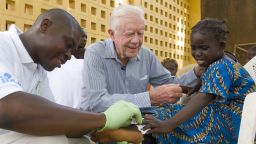
In his travels in Nigeria and Ghana, Carter had seen the effects of the disease firsthand. In one village he visited, nearly everyone had Guinea worm.
“I think like many of us, when when you’re confronted by a problem and you’re just so overwhelmed by the sheer magnitude of it, you know, he left knowing that he didn’t have a choice but to do something about it,” Weiss said.
Guinea worm disease is also known as dracunculiasis, which is Latin for “affliction with little dragons.” It’s caused by a parasite called Dracunculus medinensis, which infects humans and animals when they drink unfiltered water contaminated with microscopic water fleas.
When the water fleas die inside the human or animal, they release worm larvae that burrow through the stomach and intestinal wall, living and mating inside the connective tissue in the abdomen.
A pregnant female worm can grow up to 3 feet long and as wide as a strand of cooked spaghetti, according to the US Centers for Disease Control and Prevention.
About a year after the initial infection, when it’s time for the female to give birth, she moves to a place right below the skin, typically on the legs or feet. A blister forms and bursts, and the worm emerges slowly, causing great pain.
Health care workers say many people try to ease their pain by soaking the blister in water, but when the worm comes into contact with water, it releases millions of larvae to start the cycle again. Instead, they’ve had to offer education about how the parasites spread and make sure they know to keep drinking water clean.
The parasite has been a problem for humans at least as far back as ancient Egypt. In the 1700s, archeologists in Manchester found a calcified worm in a teenage mummy whose feet and lower legs had been amputated, perhaps in relation to the infection. Some scholars believe that when the ancient Israelites described being pursued by “fiery serpents” sent by the Lord in Numbers 21:6, they were actually describing the Guinea worm.
Besides the painful emergence of the worm, Guinea worm can cause fever and swelling. A person can also develop a secondary infection like sepsis or infections that can deform or lock the joints. Sometimes, the disability can be permanent, according to the CDC.
There is no treatment specifically for Guinea worm. People still use the same technique that’s been around for thousands of years: winding the worm around a small stick or piece of gauze as it emerges. The worm may come out in a few days, but it often takes weeks weeks to fully emerge, and the person removing it needs to be careful that it doesn’t break and cause additional infection.
The disease is disruptive and is a significant financial burden, as people are unable to work while the worm emerges. And because there’s no immunity from the parasite, they can catch it more than once.
Since the ’80s, Carter has worked with private and public partners to help eradicate the disease. He’s collaborated with local leaders, presidents, health ministries and international nonprofits like the Bill and Melinda Gates Foundation, the United Nations Children’s Fund and health agencies like WHO and the CDC.
In addition to raising money and awareness, the Carter Center set up village-based surveillance, educated the public about how the parasite spreads, distributed larvicides, helped provide support for the creation of clean new wells and handed out cloth-based water filters.
The filters came out of a lunch Carter had in 1989 with Seagram’s liquor heir Edgar Bronfman. Carter used a napkin to explain how to make the water safer. Bronfman, who owned a large part of the DuPont chemical company, had scientists design a material that could filter the water.
Carter was never a remote figurehead with the Guinea worm program, Weiss said. He was hands-on from the beginning and well into his early 90s. He could guide eight-hour meetings for three days in a row with local stakeholders and still be energized to take on the next task.
“I’m 41, and I was tired,” Weiss said. “But then he wouldn’t stop. He’d go on Jon Stewart and take a pipe filter and hold it up and talk about Guinea worm, and then he’d go talk to the House of Lords in the UK and ask them to help, and he’d explain that ‘if we can do this, if we work together and we put our technical and financial resources together, we can achieve great things.’ It takes a special person to do that.”
Carter’s trips to affected areas also helped. For example, after he visited to talk about the disease with Uganda’s president, Yoweri Museveni, the center’s program worked with locals to search for cases. They formed committees to coordinate efforts, drilled new wells and distributed larvicide and the DuPont filters. They also worked with local seniors who would guard local ponds to make sure no one contaminated the water and would fetch water for those who were sick.
“Those pond or dam guards are great, and they can then educate people when they come over and explain why they shouldn’t go into the water, and also distribute filters,” Weiss said.
Cater even negotiated a four-month “Guinea worm ceasefire” to Sudan’s civil war in 1995, giving health care workers an opportunity to access nearly 2,000 villages with cases. The workers distributed hundreds of thousands of cloth filters and millions of straw filters, enough for every person in Sudan. And it worked. By the time of its independence in 2011, South Sudan had zero recorded human cases and just one animal case. In 2022, there were just a handful of cases.
“Neglected tropical diseases are called neglected tropical diseases for a reason,” said Dr. Kimberly Paul, an associate professor of genetics and biochemistry at Clemson University, whose research focuses on another tropical disease: trypanosomiasis, or African sleeping sickness. “Neglected tropical diseases are devastating in the countries that they are endemic to, but the outside world is largely unaware of them. And there’s no economic market there for developing drugs or vaccines.
“To actually get rid of a disease entirely is just a huge challenge,” she added. “I am just impressed with the fact that they’re even started trying instead of just saying, ‘oh, no, there’s no way we can do that.’ “
It will be difficult to find the last remaining Guinea worm cases, Paul said, requiring “a lot of shoe-leather detective work.” If a village hasn’t had a case for years, residents may be tempted to go back to the old way of doing things. “I have a feeling that we’ll be close to eradication for a while,” she said, but she’s hopeful.
“Everybody deserves a life with dignity,” Paul said. “I’ve learned how corrosive these infectious diseases are in terms of reinforcing this cycle of poverty and kind of keeping those countries down. These efforts matter.”
Carter’s efforts have helped eliminate the disease in 17 countries, the Carter Center says, and averted at least 80 million cases among the “world’s poorest and most neglected people.”
WHO has now certified 200 countries, areas and territories as free of Guinea worm disease. To be certified, the country must report zero instances of transmission and maintain disease surveillance for at least three years in a row. Sudan is in the precertification stage, leaving only six countries that have not been certified disease-free.
The campaign has had ripple effects on efforts to fight several diseases, said Mark Suzman, CEO of the Bill & Melinda Gates Foundation.
Sign up here to get The Results Are In with Dr. Sanjay Gupta every Tuesday from the CNN Health team.
“President Carter never stopped changing lives for the better,” Suzman wrote in an email to CNN. “His compassion and heroic spirit inspired Gates Foundation leaders and employees throughout the years. We are proud to have partnered with him and the Carter Center to reduce and eliminate the burden of neglected tropical diseases to improve the health and lives of those living in greatest poverty.”
Team members like Weiss have watched how Carter’s efforts to work with local leaders in Africa to eradicate Guinea worm helped lead to lasting government structures in places like South Sudan.
The campaign has been to eradicate the disease, Weiss said, but Carter’s work leaves a broader legacy.
“It’s just amazing that President Carter with his convening power, and with all the awesome people he brought together over the years, have together brought human rights and safety and security and leadership opportunities,” Weiss said. “When he sits at the table, people understand that they need to accept ownership and responsibility and work together, and that brings accountability, and together people are motivated to make it better.”
https://www.cnn.com/2023/02/22/health/jimmy-carter-guinea-worm/index.html
In 2015, mill
LOTS OF POSTS IGNORED BY BLOGGER..... OR REMOVED ON THEIR WHIM! ALL POSTS ARE...