Showing posts with label STUDENT DEBT CANCELLATION. Show all posts

Monday, April 29, 2024

Here’s where we are on student debt cancellation.....


Warren for Senate


Usually, progress doesn’t follow a straight line. It takes twists and turns. It comes with stops and starts. But if we keep at it, we can make real change.

And student debt cancellation is a prime example. Naysayers dismissed it as pie-in-the-sky. A far-right Supreme Court laid down giant roadblocks. But families are now getting relief, with more on the way.

It can be hard to keep track of all the latest developments, so here’s a quick summary:

  • President Biden has now delivered $153 billion in student loan relief to 4.3 million borrowers, including nurses, teachers, and other public servants who’ve been paying down their debt for years and years already.
  • He’s launched a new income-driven repayment plan with 8 million enrollees, where most borrowers pay $0 a month.
  • And he just announced new proposals that would bring the grand total of Americans receiving relief to 30 million.

Even though right-wing extremists on the Supreme Court substituted their own ideology for the rule of law and blocked the president’s broad-based student debt cancellation plan, he’s still finding ways to lift this crushing burden off people’s shoulders.

And even though critics and cynics claimed that student debt relief was impossible when we first started talking about it, it’s now making a real difference in millions of Americans’ lives. With millions more to come.

Experts kept illuminating how student loan debt was holding people back from launching new businesses, becoming homeowners, and even starting a family.

Borrowers kept sharing their personal stories.

Activists and activists kept up the pressure on Washington.

I kept working alongside colleagues and organizers and this whole grassroots team.

Together, we took student debt cancellation from “impossible” to $153 billion of debt canceled — and counting.

We can keep following that same roadmap to make more change that reaches more families. Like ensuring universal child care. And tackling the housing affordability crisis. And making technical schools, community colleges, and public universities tuition-free.

It starts with growing our grassroots movement, person to person, one grassroots contribution at a time. Can you pitch in with a donation right now to keep up the fight for bold reforms that touch people’s lives?


If you've saved payment info with ActBlue Express, your donation will process automatically:

 
DONATE NOW: $15
DONATE NOW: $28
DONATE NOW: $50
DONATE NOW: $100
DONATE NOW: $250
OTHER AMOUNT
 

Thanks for being a part of this,

Elizabeth

DONATE
fbtwigyt

Paid for by Warren for Senate

All content © 2024 Warren for Senate, All Rights Reserved
PO Box 171375, Boston, MA 02117


Friday, January 19, 2024

January 19, 2024 (Friday) HEATHER COX RICHARDSON


January 19, 2024 (Friday)
President Joe Biden today signed the continuing resolution that will keep the government operating into March.
Meanwhile, the stock market roared as two of the three major indexes hit new record highs. The S&P 500, which measures the value of 500 of the largest companies in the country, and the Dow Jones Industrial Average, which does the same for 30 companies considered to be industry leaders, both rose to all-time highs. The third major index, the Nasdaq Composite, which is weighted toward technology stocks, did not hit a record high, although its 1.7% jump was higher than that of the S&P 500 (1.2%) or the Dow (1.1%).
Investors appear to be buoyed by the fact the rate of inflation has come down in the U.S. and by news that consumers are feeling better about the economy. A report out today by Goldman Sachs Economics Research noted that consumer spending is strong and predicted that “job gains, positive real wage growth, will lead to around 3% real disposable income growth” and that “household balance sheets have strengthened.” It also noted that “[t]he US has led the way on disinflation,” and it predicted further drops in 2024. That will likely mean the sort of interest rate cuts the stock market likes.
The economic policies of the Biden-Harris administration have also benefited workers. The unemployment rate has been under 4% for more than two years, and wages have risen higher than inflation in that same period. Production is up as well, to 4.9% in the third quarter of 2023 (the U.S. growth rate under Trump even before the pandemic was 2.5%).
The administration has worked to end some of the most obvious financial inequities in the U.S., such as the unexpected “junk fees” tacked on to airline or concert tickets, or to car or apartment rentals. On Wednesday the Consumer Financial Protection Bureau announced a proposed rule for bank overdraft fees at banks that have more than $10 billion in assets.
While banks now can charge what they wish if a customer’s balance falls below zero, the proposed rule would allow them to charge no more than what it cost them to break even on providing overdraft services or, alternatively, an industry-wide fee that reflects the amount it costs to deal with overdrafts: $3, $6, $7, or $14. The amount will be established after a public hearing period.
Ken Sweet and Cora Lewis of the Associated Press note that while the average overdraft is $26.61, some banks charge as much as $39 per overdraft. The CFPB estimates that in the past 20 years, banks have collected more than $280 billion in overdraft fees. (One bank’s chief executive officer named his boat “Overdraft.”) Over the past two years, pressure has made banks cut back on their fees and they now take in about $8 billion a year from those overdraft fees.
Bankers say regulation is unnecessary and will force them to end the overdraft service, pushing people out of the banking system. Biden said that the rule would save U.S. families $3.5 billion annually.
The administration has also addressed the student loan crisis by reexamining the loan histories of student borrowers. An NPR investigation led by Cory Turner revealed that banks mismanaged loans, denying borrowers the terms under which they had signed on to them. Rather than honoring the government’s promise that so long as a borrower paid what the government thought was reasonable on a loan for 20 or 25 years (undergrad or graduate), the debt would be forgiven, banks urged borrowers to put the loan into “forbearance,” under which payments paused but the debt continued to accrue interest, making the amount balloon.
The Education Department has been reexamining all those old loans to find this sort of mismanagement as well as other problems, like borrowers not getting credit for payments to count toward their 20 years of payments, or borrowers who chose public service not receiving the debt relief they were promised.
Today the administration announced $4.9 billion of student debt cancellation for almost 74,000 borrowers. That brings the total of borrowers whose debt has been canceled to 3.7 million Americans, with an erasure of $136.6 billion. Nearly 30,000 of today’s relieved borrowers had been in repayment for at least 20 years but never got the relief they should have; nearly 44,000 had earned debt forgiveness after 10 years of public service as teachers, nurses, and firefighters.
Biden has been traveling the country recently, touting how the economic policies of the Biden-Harris administration have benefited ordinary Americans. In Emmaus, Pennsylvania, last Friday he visited a bicycle shop, a running shoe store, and a coffee shop to emphasize how small businesses are booming under his administration: in the three years since he took office, there have been 16 million applications to start new businesses, the highest number on record.
Biden was in Raleigh, North Carolina, yesterday to announce another $82 million in support for broadband access, bringing the total of government infrastructure funding in North Carolina during the Biden administration to $3 billion.
On social media, the administration compared its investments in the American people to those of President Franklin Delano Roosevelt’s New Deal in the 1930s, which were enormously popular.
They were popular, that is, until those opposed to business regulation convinced white voters that the government’s protection of civil rights, which came along with its protection of ordinary Americans through regulation of business, provision of a basic social safety net, and promotion of infrastructure, meant redistribution of white tax dollars to undeserving Black people.
The same effort to make sure that ordinary Americans don’t work together to restore basic fairness in the economy and rights in society is visible now in the attempt to attribute a recent Boeing airplane malfunction, in which a door panel blew off mid-flight, to diversity, equity, and inclusion (DEI) efforts. Tesnim Zekeria at Popular Information yesterday chronicled how that accusation spread across the right-wing ecosystem and onto the Fox News Channel, where Fox Business host Sean Duffy warned: “This is a dangerous business when you’re focused on DEI and maybe less focused on engineering and safety.”
As Zekeria explains, “this narrative has no basis in fact.” Neither Boeing nor its supplier, Spirit AeroSystems, is particularly diverse, either at the workforce level, where minorities make up 35% of Boeing employees and 26% of those at Spirit AeroSystems, or on the corporate ladder, where the overwhelming majority of executives are white men. Zekeria notes that right-wing media figures have also erroneously blamed last year’s train derailment in Ohio and the collapse of the Silicon Valley Bank on DEI initiatives.
The real culprit at Boeing, Zekeria suggests, was the weakened regulations on Boeing and Spirit thanks to more than $65 million in lobbying efforts.
Perhaps an even more transparent attempt to keep ordinary Americans from working together is the attacks former Fox News Channel personality Tucker Carlson has launched against Vice President Kamala Harris, calling her “a member of the new master race” who “must be shown maximum respect at all times, no matter what she says or does.” Philip Bump of the Washington Post noted yesterday that this construction suggests that Harris, who identifies as both Black and Indian, represents all nonwhite Americans as a united force opposed to white Americans.
But Harris’s actions actually represent something else altogether. She has crossed the country since June 2022, when the Supreme Court overturned the 1973 Roe v. Wade decision that recognized the constitutional right to abortion, talking about the right of all Americans to bodily autonomy. That the Supreme Court felt able to take away a constitutional right has worried many Americans about what they might do next, and people all over the country have been coming together in opposition to the small minority that appears to have taken over the levers of our democracy.
Driving the wedge of racism into that majority coalition seems to be a desperate attempt to stop ordinary Americans from taking back control of the country.
WhiteHouse/status/1748091382370025914
Press Release: Bill Signed: H.R. 2872 | The White House
WHITEHOUSE.GOV
Press Release: Bill Signed: H.R. 2872 | The White House
Notes:
Twitter (X):
carlquintanilla/status/1748414959682240579
AndrewJBates46/status/1748422189857034691
WhiteHouse/status/1748091382370025914

clickable twitter links on nitter
comments: 
How did we get to this point where people are paying off student loans for over 20 years?! That’s close to a typical time frame for a home loan. Imagine trying to do both. This does not seem like the American Dream.

Great news Heather. If only the ones who should read it are watching FOX news, are mostly, I hate to say it illiterate and nothing will convinced them otherwise just like the insurrection was a walk in a park. Thank you for delivering this great post. I enjoyed reading it two or three times, in case I missed something. I wish you and your family a great weekend, well deserved 👏❤️


Love what this administration is doing to work for us, not the corporations and conglomerates. Great economic news. As far as the racist dog whistles being blown on the right, we need to call them out and push back. Time is long overdue.

I definitely sense an increase in pushback on some of these narratives. Glad for it! I’m inspired to call out Republicans’ nonsense with these reasoned arguments. Thank you for all you do to educate and help our country.

President Biden is getting so much accomplished. And I am resentful
of the false equivalency and disinformation that because of his age, puts him on the same level as the other guy - a deranged would-be dictator. There is no contest here.

Nice to see the student debt forgiveness story getting covered by the major media. Also, VP Harris was great on The View this week. Messaging about what the Biden administration is doing is starting to get out there. 


Friday, August 26, 2022

RSN: FOCUS: SCOTUS Will Probably Kill Student Debt Relief. But Biden Has a Backup Plan.


Reader Supported News
26 August 22

Live on the homepage now!
Reader Supported News

911 CALL FOR DONATIONS — It’s late in the month and we are far, far behind where we should be. We are struggling to avoid record-bad fundraising. A handful of donors can easily make this a good day. Be one please.
Marc Ash • Founder, Reader Supported News

Sure, I'll make a donation!


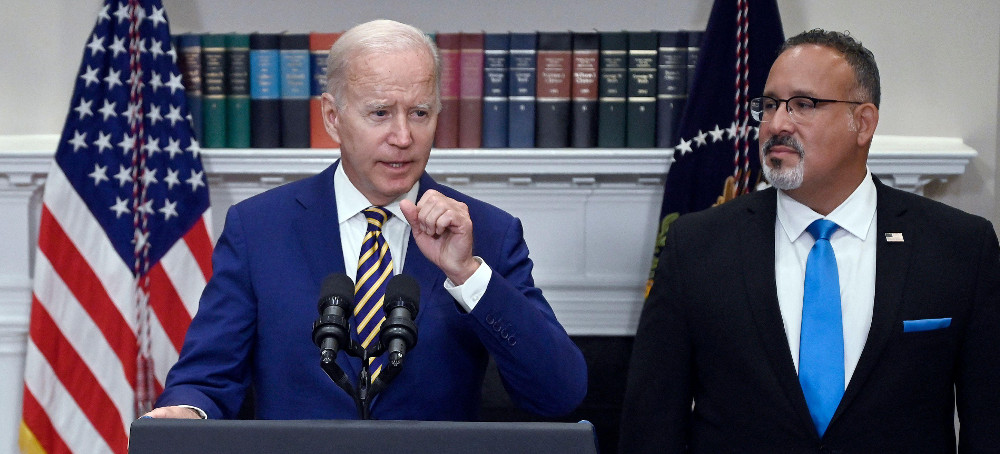
President Joe Biden announces student loan relief with Education Secretary Miguel Cardona on Wednesday. (photo: Olivier Douliery/Getty)
FOCUS: SCOTUS Will Probably Kill Student Debt Relief. But Biden Has a Backup Plan.
Mark Joseph Stern, Slate
Stern writes: "There are several paths to student debt relief, and even this partisan judiciary cannot block them all."


On Wednesday, President Joe Biden unveiled his long-awaited plan for student loan forgiveness. For borrowers making under $125,000 a year, the program will cancel $10,000 in student loan debt (and $20,000 for Pell Grant recipients). It will provide relief to 43 million Americans—if five justices on the Supreme Court let it take effect. Will they? The short answer is: probably not. But there’s good news for beneficiaries: The administration may have already identified another way to enact relief if the judiciary stands in the way of Plan A.

To understand where this is going in the courts as well as the likely workaround, recall a basic fact that many critics of Biden’s program do not appear to understand: The federal government forgives student loans all the time. Multiple statutes give the Department of Education sweeping authority to cancel loans for a broad range of reasons. Before Wednesday, the administration had already approved $32 billion in student loan relief for more than 1.6 million borrowers.* These actions did not provoke substantial controversy or litigation. Nobody raised a legal challenge when Biden canceled $5.8 billion in student loans for more than 323,000 disabled borrowers. Nobody raised a legal challenge when Biden announced rolling loan forgiveness for borrowers who entered public service—a plan that has already granted $10 billion in debt relief to more than 175,000 borrowers.

The Department of Education has tackled so much student debt already because Congress gave it a number of tools to do so. One of those tools is the Heroes Act, passed in the wake of 9/11. This law gives the secretary of education authority to “waive or modify” any provision of the law applicable to student aid programs “in connection with a war or other military operation or national emergency.” (Emphasis mine.) The secretary may exercise this power to “ensure” that borrowers “are not placed in a worse position financially” in relation to their loans because they were “affected” by the emergency. A “national emergency” is defined as any national emergency declared by the president. The ongoing COVID-19 pandemic surely qualifies, since Donald Trump declared it a national emergency and Biden has extended that declaration.

Congress intended the Heroes Act to apply swiftly and widely. It waived a number of procedural requirements that would slow down the education secretary’s efforts to grant relief. And it clarified that the secretary “is not required” to act “on a case-by-case basis,” allowing him to provide relief to an entire class of borrowers at once. The Trump and Biden administrations both used this law to freeze student loan payments during the pandemic.

Biden’s secretary of education, Miguel Cardona, already relied upon the Heroes Act to forgive $10 billion for public service borrowers. Now the administration is using the law as its basis for a much bigger, less targeted student debt relief program. This idea is not new: At the end of her tenure, Trump’s education secretary Betsy Devos tried to stop Biden from embracing it. She solicited a memo arguing that the Heroes Act does not permit “mass cancellation” of student debt. (In a twist, the memo was issued four days after DeVos resigned in protest of Jan. 6, and it violated basic procedural requirements.)

Under Biden, the Department of Education concluded that DeVos’ eleventh-hour memo was wrong, and that the agency can provide mass student loan cancellation because of the ongoing pandemic. The Justice Department’s Office of Legal Counsel agreed. It pointed out that under the Heroes Act, the secretary gets to decide when relief “may be necessary,” deferring to his view of who, exactly, needs financial help because of the emergency. And because this help need not be provided “on a case-by-case basis,” OLC found that the secretary can “proceed by categorical rules.”

Going by the plain language of the law alone, Biden’s plan is likely legal. Sure, it’s probably not how Congress envisioned the Heroes Act functioning. But the program fits into the text that Congress actually passed. These days, however, the Supreme Court no longer uses textualism to assess administrative actions. Instead, it asks whether a federal program involves a “major question”—which just means anything five justices deem a big deal. When handling a “major question,” the court demands an explicit grant of authority from Congress, even if existing law appears to permit the program already. As Justice Elena Kagan put it, the “major questions doctrine” serves as a “get-out-of-text-free” card that can “magically appear” whenever it serves the conservative majority’s “broader goals.” (Specifically, the dismantlement of the administrative state.)

There are at least three “major questions” that the Supreme Court could identify here. First, the majority might say that the ability to “waive or modify” aspects of the law does not allow the secretary to cancel payments. Second, the majority could say that COVID is not the kind of “national emergency” envisioned by the law. Third, the majority could say that an “affected” group must be smaller and more targeted than every low or middle-income American who lived through the pandemic.

This first line of attack would be very weak: Both Congress and the Department of Education have operated for years on the assumption that the secretary can permanently cancel some loans; SCOTUS could not abolish this power without wreaking havoc on the entire system. The second would be feeble, too: Whatever the court thinks about COVID, the Heroes Act is very clear that a presidential declaration of a national emergency triggers the law. What’s more debatable is the third potential line of attack. Can the secretary really just decide that COVID put 43 million non-wealthy Americans “in a worse position financially” in relation to their loans? It’s easy to imagine the Supreme Court ruling that the secretary must identify a more specific class of borrowers whose ability to pay off loans was demonstrably harmed by the pandemic.

If the court chooses this route, though, there’s a straightforward fix: Biden can simply announce that any borrower affected by the pandemic can apply for relief; if they can prove hardship, their debts get canceled. The Heroes Act, of course, says such “case-by-case” adjudication is unnecessary. And this method would increase administrative burdens while shrinking the pool of beneficiaries, since some eligible borrowers will fail to apply. But it would still help millions of people who will be in dire need to support when student loan payments resume in 2023. (There’s a direct analogy to Virginia Gov. Terry McAuliffe restoring felon voting rights one person at a time after the Virginia Supreme Court wouldn’t let him do it all at once.)

One last thing: It’s an open question whether anyone can sue against Biden’s program in the first place. In a persuasive and prescient analysis published this year in the Virginia Law Review, Jack V. Hoover argued that no one has standing to file suit against sweeping loan cancellation. To prove standing, a party would have to demonstrate concrete harm to them, and show how blocking cancellation would remedy that harm. Republicans complain that Biden’s program hurts taxpayers, but under Supreme Court precedent, taxpayers don’t have standing to sue. Former borrowers aren’t directly injured, nor can they show that forcing everybody else to pay off their loans would somehow benefit them. Congress is not allowed to sue just because it disagrees with a president’s interpretation of a statute. State governments aren’t injured, since forgiving federal loans imposes no burden on their finances or sovereignty.

Loan servicers, who are federal contractors, have the best case for standing because they profit from processing repayment and will therefore lose money under Biden’s plan. As Hoover noted, courts have generally refused to let contractors sue against federal regulations that hurt their bottom line. Contractors’ duty, after all, is to administer federal programs, and it’s debatable whether a new rule falls within their “zone of interest” solely because it hurts their profits. Moreover, the government spent more than $655 billion on federal contracts in fiscal year 2020 alone. If they could all sue “to protect their fiefdoms from regulatory change,” in Hoover’s words, they would guarantee “ossification” of the entire government.

In truth, though, certain key circuit courts and the Supreme Court seem to follow one standing rule: When a majority wants to decide a case on the merits, they find some justification to grant standing; when it doesn’t, they don’t. The Biden administration should proceed on the assumption that the conservative jurists, and ultimately the justices themselves, will be eager to shred the new program, and will therefore find that somebody, somewhere has standing. It should also consider its response when a Trump judge inevitably issues a nationwide injunction against debt cancellation and the Supreme Court’s conservatives uphold it. There are several paths to student debt relief, and even this partisan judiciary cannot block them all.


READ MORE


Contribute to RSN

Follow us on facebook and twitter!

Update My Monthly Donation

PO Box 2043 / Citrus Heights, CA 95611


Top News | 'He’s Not Going to Run Unopposed': Sanders Rejects Schumer for Majority Leader

                                                               LOTS OF POSTS IGNORED BY BLOGGER..... OR REMOVED ON THEIR WHIM! ALL POSTS ARE...