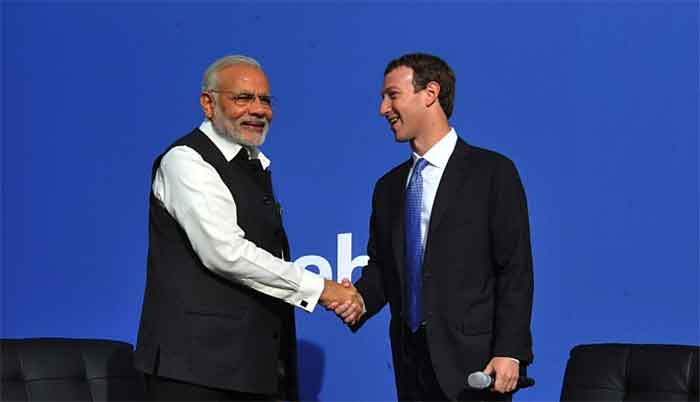
Belarus-born American writer Evgeny Morozov, a scholar of the political and social implications of technology, is among the early technology sceptics whose words have now proved prescient. Morozov had questioned the claim that the internet would challenge dictatorships even at an inconvenient time to do so. While thousands were out on streets during the Arab Spring, he delivered a Ted Talk on How Internet Aids Dictatorships. Considering that the Arab Spring protests had been organised and coordinated through social media, it quite a brave, even blasphemous, thing to do in those days.
Morozov’s 2011 book, The Net Delusion: The Dark Side of Internet Freedom, focuses on two delusions, namely, “cyber-utopianism” or the belief that the internet fosters an inherently emancipatory culture; and “internet-centrism” or the belief that every important question about modern society and politics can be framed in terms of the internet. His views were considered eccentric for the mood around the net was celebratory at the time. To cite another instance, the noted journal, MIT Technology Review, wrote in 2013 that new technologies would prove “deadly to dictators”.
How things change. Scholars and activists are now increasingly challenging “cyber utopianism” among policy makers and ordinary people. They are openly saying that social media is facilitating authoritarian regimes and exclusivist politics and strengthening the far right the world over. Neutral observers pointed out after right-wing strongman Jair Bolsonaro was elected President of Brazil, his supporters credited Facebook and WhatsApp with the win. During that election a massive disinformation campaign funded by a conservative pro-business interest group targeted the Opposition. In Brazil, WhatsApp is immensely popular; and it was deployed to create an ambience favourable to Bolsonaro even before the elections were announced.
In January 2019, Ronald Deibert, a professor of political science at University of Toronto and director of its Citizen Lab, unequivocally stated that social media “must bear some of the blame for the descent into neo-fascism”. A former cyber enthusiast, Deibert wrote an essay for the prestigious Journal of Democracy in which he lists “three painful truths” about social media. The truths are that social media businesses are built around personal data and their products designed to spy to push advertising our way; that users have consented to this situation, though not entirely wittingly. Deibert identifies the problem as social media tools being designed as “addiction machines”. They are programmed to make us feel a certain way, which has us returning for more. The third is that the attention-grabbing algorithms of social media platforms propel authoritarian practices that sow “confusion, ignorance, prejudice and chaos…” This manipulation undermines accountability and when combined with surveillance, these tools wield authoritarian control over us.
Recent revelations made in the Wall Street Journal about Facebook’s “partisan action in favour of BJP” and widening commercial ties with the government make Deibert’s “three painful truths” relevant to India. We have allowed a regime of personal data surveillance, become part of the “addiction machine” and ushered in a majoritarian regime via democratic means which has unleashed an “us” versus “them” politics of prejudice and ignorance. India has the biggest number of subscribers of Facebook, around 35 crore and growing.
Facebook, which is close to the Trump administration, facilitated training and assistance to Modi’s electoral journey, the WSJ article has revealed. That the social platform has been spreading fake news is already on the radar. The American company’s global government and politics unit had prompted strong critiques over this issue in the past. A WhatsApp-sponsored report, prepared in partnership with Queen Mary University had said that India’s 2019 elections are widely anticipated to be “WhatsApp elections”. With rapidly improving internet connectivity and rising smartphone penetration, the number of people using WhatsApp—also owned by Facebook—has soared since its India launch in mid-2010 to more than 20 crore, more than in any other democracy.
Political parties are capitalising on WhatsApp to expand their presence, but it has also been used to misinform voters in elections and become a tool to spread fake news—which has also led to serious violence in India. There is a real danger to the democratic process, The Conversation recently reported. Another survey in February found that “India has more fake news and internet hoaxes than anywhere else in the world.” A BBC report looked at a string of murders and growing anti-minority sentiments spread through online disinformation and fake news.
A large BBC study focussing on Kenya, Nigeria and India studied reactions to fake news and identified availability of low-cost data and growing nationalist sentiment as the reasons for fake news becoming widespread. Dr Santanu Chakrabarti, the head of audience insight at the BBC World Service, who conducted this study, said that the “rise of the Hindu nationalist prime minister, Narendra Modi, had made many Indians feel as though they had a patriotic duty to forward information.” According to him, Indians are seeking validation of their belief systems and on these platforms validation of identity trumps verification of fact.
It is quite clear that there is a hiatus between what Facebook claims about its community standards and how they are practised. Recall that not too long ago in Myanmar Facebook’s CEO apologised for spreading hate speech. The United Nations human rights experts investigating the crisis in Myanmar also declared that Facebook posts played a significant role in spreading hate speech in the country.
In his October 2019 speech at Georgetown University, Mark Zuckerberg had said that freedom of expression is a governing principle of his platform and that it prioritises free expression over all other values (including equality and non-discrimination). Now his platform stands accused of actively working with political parties and leaders, even with those who use Facebook to stifle opponents, sometimes using troll armies to spread extremist ideologies.
A high-level probe is needed to unpack the behaviour of the foreign company, expose the “brazen assault on India’s democracy and social harmony” that has come in its wake. India needs to be vigilant and find a way out of this crisis and the best option would be to constitute a Joint Parliamentary Committee to conduct a thorough and neutral investigation. All political parties which care for national sovereignty would support such an enquiry, considering the ramifications on our democracy. Another option could be to have a Supreme Court or Election Commission-monitored probe to see if the guardrails of India’s democracy are still intact.
Recently, the Delhi Legislature Committee on Peace and Harmony looked into the allegations against Facebook and has called its representatives to explain their position. The recommendations of such an enquiry are mainly symbolic but this is still a welcome step, which Opposition-ruled states can emulate in future.
The enormity of the challenge, when a behemoth’s role is in question, should not be underplayed, but it will take more than an enquiry to restore democracy. Deibert’s suggestions need to be taken seriously, and a comprehensive long-term reform should begin, extending from the personal to the political, from the local to the global. Our information environment has to be protected in the same way as our natural environment, like any territory we exercise stewardship over. And we must enhance public education on social media and its pitfalls, with media literacy, ethics, civility, and tolerance at their foundation.
The author is an independent journalist.
Originally published by NewsClick
Mark Zuckerberg, the founder and CEO of Facebook, claims to be against the use of his popular social media portal for spreading hatred. He said that there “is no place for hate speech or content that promotes violence.” Can we trust him? How serious is he to ensuring his claims? Is he ready to walk the talk?
After all, accusations have been made for a number of years that Facebook has been complicit in hate crimes against minorities in many parts of the world. Consider, e.g. the case of Buddhist Myanmar where genocidal crimes were committed since at least 2012. In August 2017, the Myanmar military launched a so-called “clearance operation” in Rakhine State (Arakan), home to Rohingya and other ethnic minorities. Over several weeks, soldiers committed atrocities in the region, killing thousands, committing mass rapes, burning villages to the ground, and forcing exodus of nearly a million Rohingya people (mostly to neighboring Bangladesh) that have been described by the international community as genocidal crimes.
In September 2018, in a report on the situation in Myanmar, the UN Independent International Fact-Finding Mission on Myanmar highlighted the role Facebook played in creating an enabling environment in the country for the commission of atrocities. In a March 2018 report on the Rohingya crisis, Marzuki Darusman, head of the United Nations Fact-Finding Mission on Myanmar, said Facebook “substantively contributed to the level of acrimony and dissension and conflict” in Myanmar. “Hate speech is certainly of course a part of that,” Darusman said.
Nathaniel Gleicher, Facebook’s head of cybersecurity policy, confessed that the platform covertly spread propaganda linked to the Myanmar military (Tatmadaw), further related to the Rohingya Muslim genocide. While Facebook is not directly involved in these vile acts, it sure gives a platform for hatred to grow and spread on a broader rate than it was ever possible in history.
Now with the breaking news of Facebook’s spreading anti-Muslim sentiments in India and assisting the ruling party, Bhartiya Janata Party (BJP), to create a hateful sentiment, the debate has once again resumed over Facebook’s credibility and power structure. Many Muslims have been lynched to death in the hands of Hindutvadi fascists in Modi’s India.
The Wall Street Journal (WSJ) found evidences of Hindutvadi fascist leaders like Kapil Mishra actively inciting violence in India and leading to the Delhi Riots 2020, without getting flagged on the social media platform. Another BJP leader T. Raja Singh from the state of Telangana openly called for Rohingya Muslims’ slaughter and threatened to demolish mosques. He is also accused of inciting violence and hatred against India’s Muslim community. While Facebook’s online security staff initiated a ban on his account, Ankhi Das, the Public Policy Director of Facebook India, stepped in to stop the ban.
According to the Wall Street Journal, Das expressed her support for the BJP and its leader, Indian Prime Minister Narendra Modi, in internal company communications. She celebrated Modi’s election victory in 2014 and disparaged his opponents in the rival Congress party. “It’s taken thirty years of grassroots work to rid India of state socialism finally,” Das said, praising Modi as a “strongman”. She also shared a post that described India’s Muslims as a “degenerate community”.
Das was motivated not to prevent hate speech because “punishing violations by politicians from Mr. Modi’s party would damage the company’s business prospects in the country.” These incidents belong to a sequential agenda of pushing forth the fascist Hindutvadi ideals in India, aligning with the country’s ruling party, which is a huge market of Facebook, with 290 million users. (In the face of much criticism, recently the social media giant is reported to have closed the account of Raja Singh for posts violating its policy on promoting violence and hate.)
Facebook’s shady role in Indian politics—kowtowing with Hindutvadi fascists, for a price—has been blazingly apparent for nearly a decade. But it has taken a devastating expose in The Wall Street Journal to reveal its true ugly color. The WSJ revelations, coming 115 days after Facebook invested $5.7 billion in Mukesh Ambani‘s Jio Platforms, shows how business power houses and tech giants from Nariman Point to Menlo Park are heavily invested in India’s current politics that exploits social and communal fault-lines.
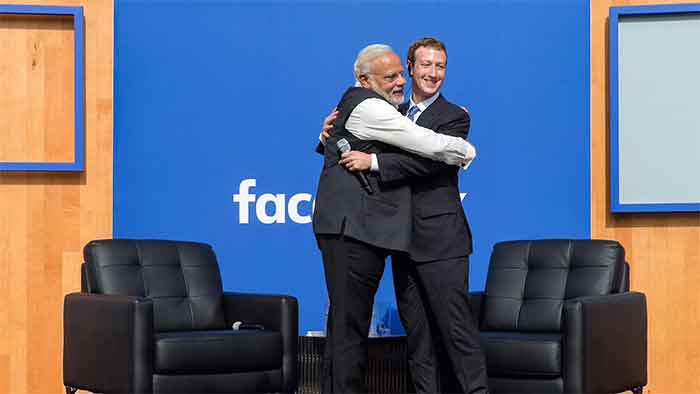
Such revelations from the WSJ shouldn’t surprise anyone. In July 2014, Facebook COO Sheryl Sandberg called on the prime minister in all saffron. During his visit to the USA in 2015, Narendra Modi gave a bear hug to Mark Zuckerberg before a townhall meeting at Facebook’s headquarters in Menlo Park, California.
Facebook’s collusion with BJP and the Modi government corroborates much of what appeared in a story in Bloomberg BusinessWeek in December 2017. That report, titled “How Facebook’s Political Unit Enables the Dark Art of Political Propaganda” revealed Narendra Modi‘s pre-2014 and post-2014 honeymoon with Facebook. It revealed that Modi had worked with Facebook’s “global government and politics team” which “actively works with political parties and leaders to stifle opposition sometimes with the aid of “troll armies” that spread misinformation and extremist ideologies.”
Among other things, the Bloomberg (2017) report said vis-a-vis Facebook three years ago:
“In India, the company [Facebook] helped develop the online presence of Narendra Modi who now has more Facebook followers than any leader.
“By the time of India’s 2014 elections, Facebook had for months been working with several campaigns. Modi relied heavily on Facebook and WhatsApp to recruit volunteers who in turn spread his message on social media.
“Within weeks of Modi‘s election, Mark Zuckerberg and Sheryl Sandberg both visited the nation as it was rolling out a critical free internet service that the government later curbed.
“As Narendra Modi‘s social media reach grew, his followers increasingly turned to Facebook and WhatsApp to target harassment campaigns against his political rivals. India has become a hotbed for fake news…
“The nation has also become an increasingly difficult place for opposition parties and reporters. In the past year, several journalists critical of the ruling party have been killed. Hindu extremists who back Modi’s party have used social media to issue death threats against Muslims or critics of the government.”
Facebook’s reluctance to curb hate speech has been all too apparent across the globe (from Brazil, Sri Lanka, Myanmar). In 2018, the Buddhist mob used Facebook to coordinate attacks against Muslim minorities living in Sri Lanka.
As a Jew, one can understand Mark’s soft corner for the Jewish state and Facebook’s lack of objectivity, capitulating to the Israeli narratives and taking side of the occupying criminal Zionist regime. The inflammatory speeches by settler Jews have drawn much less attention from (the Israeli government and) Facebook to shut down (or arrest) compared to the calls for Palestinian resistance.
According to a study, published by the Berl Katznelson Foundation, 122,000 Facebook users directly called for violence with words like “kill,” “murder” or “burn” against the Palestinians. “We have seen the impact of such incitement in the form of settler terror and trigger-happy soldiers executing injured Palestinians in the streets of the occupied state of Palestine,” said Saeb Erekat, secretary-general of the Palestine Liberation Organization, in a statement (September 2016) in which he flipped the Israeli narrative and called for international protection. Facebook didn’t meet Palestinian leaders to discuss their concern.
Different news portals have conducted several assessments and found that Facebook is allowing anti-Islam and anti-Muslim posts that align with its bias. In the face of criticism, Facebook claims not to increasing the reach of hate posts. But more problematically, it has either decreased the reach of or permanently suspended the accounts of many human rights activists. Not surprisingly, again, most of these activists are from Muslim-majority areas like Palestine and Kashmir that are facing oppression and persecution by some of the most sinister governments of our time. A 2019 report by +972 Magazine also noticed a trend of shutting down WhatsApp (which is now owned by Facebook) and Facebook accounts of about 100 journalists and activists, banning them from sharing updates of when Israeli warplanes attacked Gaza in November 2019. A similar bias is seen in the case of Kashmir, a Muslim majority disputed region between India and Pakistan. This selective approach and favoritism mostly rule out against Muslims, triggering a worldwide debate.
Facebook’s user policies and community guidelines talk of unity, harmony, and condemning hate speech with constant monitoring. But the recent investigation by the WSJ clearly shows that Facebook prefers to keep politics over social and moral responsibility when it comes to the issues regarding Muslim minorities. As a matter of fact, the social platform is guilty of shielding genocidal planners and executioners.
Last month, Facebook moved to block a bid by The Gambia in a US court, in which it sought disclosure of posts and communications via Facebook by members of Myanmar’s military and police. This legal step is related to a case brought by The Gambia before the International Court of Justice (ICJ), in which it has accused Myanmar of genocide against its Rohingya minority. Facebook urged the US District Court for the District of Columbia to reject the “extraordinarily broad” request, saying it would violate a US law that bars electronic communication services from disclosing users’ communications.
Although Facebook has stated that it supports “action against international crimes” by working with the appropriate authorities, Nicholas Koumjian, the head of United Nations Independent Investigative Mechanism for Myanmar (IIMM) – an investigative body established to collect and analyze evidence of serious international crimes committed in Myanmar, has recently complained that Facebook had failed to share “highly relevant” material that could be “probative of serious international crimes” with the investigators. Without such evidences from Facebook, it may be difficult to demonstrate Tatmadaw’s “genocidal intent” against the Rohingya.
One would have thought that Mark Zuckerberg, raised in a Reform Jewish household whose ancestors hailed from Germany, Austria and Poland, should know better than most human beings about the evil of hatred that had killed some six million Jews in Europe.
How is Mark’s Facebook any different than Julius Streicher’s Der Sturmer? Lest he forgot, Streicher was the first member of the Nazi regime held accountable for inciting genocide by the Nuremberg Tribunal. Much like Nazi-era Der Sturmer, today’s Facebook incites violence against the vulnerable. Neither Julius nor Mark killed anyone, but their media did the devil’s job that resulted in the suffering of so many human beings.
Julius was not a member of the military. He was not part of planning the Holocaust, the invasion of Poland, or the Soviet invasion. Yet his role in inciting the extermination of Jews was significant enough, in the prosecutors’ judgment, to include him in the indictment.
Chief Justice Jackson, chief counsel for the prosecution, spoke to the tribunal and explained to them the importance of what they were doing. He said, to paraphrase, that: “We are handing these defendants a poisoned chalice, and if we ever sip from it we must be subject to the same punishments, otherwise this whole trial is a farce.” Interestingly, in Jackson’s opening statement he claimed that the prosecution did not wish to incriminate the whole German race for the crimes they committed, but only the “planners and designers” of those crimes, “the inciters and leaders without whose evil architecture the world would not have been for so long scourged with the violence and lawlessness … of this terrible war.”
So, at Nuremberg, the ordinary Germans who threw Jews into crematoria were not tried, but only their leaders, who incited violence. It was not surprising, therefore, to find Julius Streicher included in that short list. He was found guilty of crimes against humanity at the Nuremberg War Crimes Trial and sentenced to death on October 1, 1946.
Can Mark Zuckerberg really expect us to believe that his social platform is innocent of the hate crimes propagated there and his hands are clean? With every new invention must come social responsibility for the consequences it brings – good and bad.
As of September 2020, Zuckerberg’s net worth is $111 billion, making him the 4th-richest person in the world. In recent years, he has visited many parts of the world and/or met leaders of many countries to grow his business, which he hopes to attract 5 billion users.
Has greed taken over Zuckerberg’s judgment to blur the distinction between what’s morally right and wrong? Or, is there a more deeper bigotry problem, esp. against Islam? It is worth noting here that in June 2010, Pakistani Deputy Attorney General Muhammad Azhar Siddique launched a criminal investigation into Zuckerberg and Facebook co-founders Dustin Moskovitz and Chris Hughes after a “Draw Muhammad” contest was hosted on Facebook. As we’ve seen, many Muslims don’t take such abuses and insults lightly. So, why fan the flame if one does not either gain from it or is not a bigot?
Mark is married to a Buddhist, Priscilla Chan. Myanmar has a Buddhist majority that is guilty of committing genocidal crimes against the Muslim minorities, esp. the Rohingya. Is there a connection again? It’s difficult to ignore such obvious signs.
Zuckerberg is also a philanthropist who has given away tens of millions of dollars for good causes. That’s encouraging news. But one will always question Mark’s sincerity when his earning is tainted with victims’ blood. Surely, he knows too well that Rohingya blood is on his hands. It is probably not too late to demand that Facebook and Mark’s philanthropic organization pay handsomely for the dignified rehabilitation of the long-suffering Rohingya victims of hate. The sooner the better! The Rohingyas are a forgiving nation; they will forgive and move on with their new lives.
Habib Siddiqui has a long history of a peaceful activist in his effort towards improving human rights and creating a just and equitable world. He has written extensively in the arena of humanity, global politics, social conscience and human rights since his student days in the 1980s. He offers a fresh and insightful perspective on a whole generation of a misunderstood and displaced people with little or no voice of their own.
SIGN UP FOR COUNTERCURRENTS DAILY NEWSLETTER
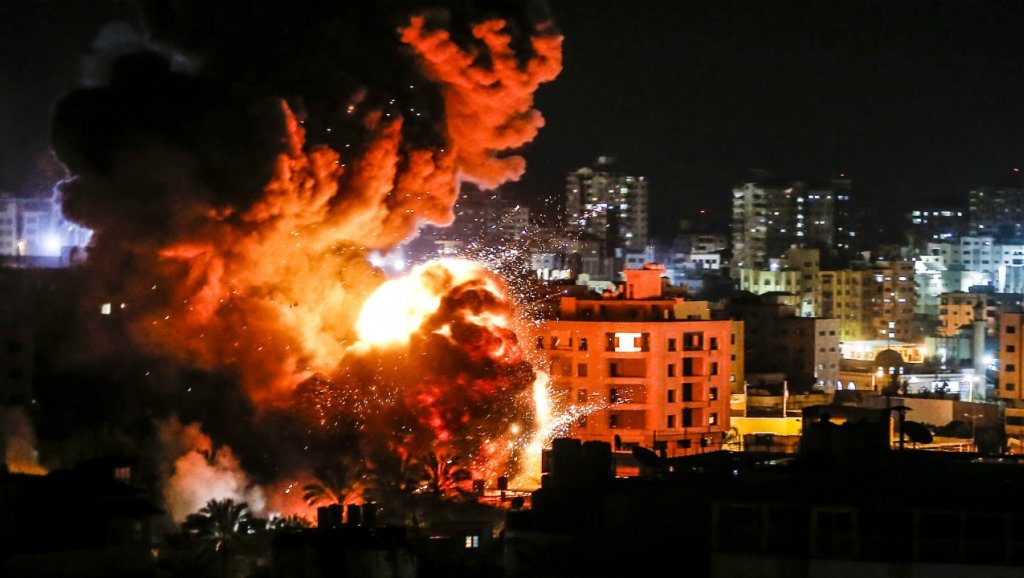
On August 31, 2020, Hamas announced that it had reached a ceasefire with Israel that would end the recent hostilities in Gaza. Since 6 August, the besieged Palestinian enclave was being bombed daily by the Israeli forces. In order to bomb Gaza, the “terror balloon” narrative has been used by the Zionist state. These so-called “terror balloons” are contraptions made from everyday materials, gas-soaked rags, home-made explosives and are used by Gazans as symbols of resistance against Israel. While Israel has dubbed the launching of balloons as “arson attacks”, they are merely indicators of the existential oppression suffered by Palestinians. Till date, no one has ever been killed or injured by these incendiary balloons.
Nevertheless, at the end of a meeting held on 9 August, 2020, commanders of Israel’s security services had concluded that “the continued launching of balloons will lead to a violent response even if this leads to a comprehensive escalation.” True to the statement, Israel’s response to symbolic acts of resistance has been particularly violent: On 13 August, 2020, an Israeli war drone launched a missile at Al Shate’ Elementary School for Boys in the West of Gaza, run by the UN Agency for Palestine Refugees (UNRWA); On 15 August, 2020, – the fifth night of Israeli bombings on Gaza- four Palestinian children were wounded. Defense Minister Benny Gantz has termed this destruction of civilian life as a change in the “equation of response” where he took “the balloon issue seriously”.
Reflecting on the sheer absurdity of Israel’s policy of disproportionate response, Ahmed Abu Artema, a writer living in Gaza and a researcher at the Center for Political and Development Studies, says: “Israel has tried to portray these balloons as akin to a military threat. By doing so, it has tried to devise new “rules.” Under those “rules,” Israel thinks it may respond to crude balloons with missiles launched from F-16 warplanes.”
The near-nightly reprisal raids conducted by the Israeli Defense Forces (IDF) on Gaza have gone unreported by the Western Media which is fixated on the Israel-UAE peace agreement. In this respect, a poem written by the Tunisian English teacher Olfa Drid serves as a painful reminder to our present-day world where every effort are made to erase the Palestinian struggle from the socio-political imaginary:
shelling
shelling
shelling
barren land,
fruitless trees,
wingless birds,
eclipsed sun,
miniscule corpses,
entombed hopes,
decapitated present,
castrated future
death ghost
death’s specter
&
global silence…
In addition to a 4-week long bombing, Israel barred the entry of construction materials to Gaza on 11 August; closed the region’s offshore fishing zone on 16 August; limited entry of goods to food and medicine only on 23 August ; and lastly, it banned fuel shipments to Gaza through the Kerem Shalom commercial crossing on 13 August, leading to the closure of the only electricity plant in the region five days later. With the closing of the power station, electricity supply was limited to three of four hours per day, causing serious disruptions of basic services. This disruption has proved to be fatal for some. On 1 September, 2020, 3 Gazan children passed away as a fire broke out because of a candle lit in their room. They were deprived of electricity due to the power outage and were forced to use candles.
Sami al-Amassi, president of the General Federation of the Palestinian Trade Union, said that fuel shortage in Gaza had the potential to destroy 90% of the local factories, which would lead to the unemployment of nearly 50,000 Palestinian workers. 500 factories would have shrunk to 20% of their production capacity if the ban on the entry of fuel was prolonged any longer. In addition to economic devastation, the power outage crisis had the capacity to jeopardize the lives of 120 newborns who needed neonatal care to survive.
Now, under the ceasefire agreement, Israel has opened its border with Gaza to allow for fuel shipments. The re-entering of fuel supplies has improved Gaza’s electricity supply from four to eight hours. Israel will also remove its maritime blockade and allow Palestinian fishermen to fish in the waters up to 25 kilometers off the Gaza coast. As part of the agreement, Qatar – whose envoy to Gaza al-Emadi helped to broker the ceasefire – will increase its monthly aid by $30 million. On its part, Hamas has to prevent the launching of incendiary of balloons and suspend its operations at the Israel-Gaza border.
The Brutal Blockade
While the ceasefire agreement has stopped significant escalation, the brutal blockade of Gaza continues. In the words of Michael Lynk, special rapporteur for the situation of human rights in the Palestinian territory occupied since 1967, “Gaza has been reduced to a humanitarian whisper,”; “Behind the current hostilities – the launching of rockets and incendiary balloons by Palestinian armed groups and the disproportionate use of targeted missile strikes by Israel – is the long-term impoverishment of Gaza by Israel’s 13-year-old comprehensive blockade. This amounts to collective punishment of the entire civilian population in Gaza, which adds immeasurably to the suffering of Gazans and wider tensions in the region.” Echoing Lynk’s views, Hamas spokesman Mushir al-Masry – on 30 August, 2020 – stated: “Palestinian factions do not accept that the residents of the Gaza Strip be subjected to gradual death as a result of the continued [Israeli] siege and aggression.”; “We have nothing to lose, and the enemy’s effort to exploit the humanitarian situation [in Gaza] and the coronavirus pandemic to advance its own policies and extend the blockade imposed on our Palestinian nation will not succeed,”.
In the current Coronavirus conjuncture, Gaza is being subjected to slow death as the impact of Israeli blockade manifests itself in the form of an epidemiological-economic crisis. With more than 500 confirmed Covid-19 cases, Gaza’s woefully underequipped healthcare is rapidly reaching it limits. In the besieged enclave, there are only 3.5 doctors for every 100,000 people and only 1.4 beds for 1,000 persons. According to the UN Office for the Coordination of Humanitarian Affairs (UN OCHA), hospitals in Gaza “have shortages of specialized staff in intensive care units and the laboratory infrastructure urgently requires upgrade to conform with strict biosafety standards”. This inadequate healthcare system, too, is systematically destroyed by Israel which – between 30 March 2018 and 31 December 2019 – killed 3 health workers, injured 845 health professionals and damaged 112 ambulances and 7 health facilities. Israeli blockade of Gaza has pushed up medicinal shortages dramatically, reaching more than 52% by January 2020. Furthermore, 71% of the needed medications that are vital for children and their mothers are not available.
In addition to a largely crumbling healthcare, Gaza has a severe water crisis, reducing access to clean water and making it difficult for families to wash their hands – a crucial step in halting the spread of Coronavirus. The coastal aquifer of the region – which provides 98% of water supply – has been polluted by over-pumping and wastewater contamination. As a result, 96.2% of water from the aquifer is undrinkable. 40% of the domestic water supply is lost on the way to consumers because of Gaza’s outdated infrastructure. Due to the deficiencies of the water supply network, 95% of the population has to rely on desalinated water which costs five times more than network water and is qualitatively unreliable, being prone to faecal contamination.
As a consequence of an inefficient water system, it is estimated that 28% of children’s diseases are due to contaminated water and polluted water is a leading cause of child mortality in Gaza. In spite of that, Israel has restricted the imports of 70% of the technical equipments such as pumps and water purification chemicals which are direly needed to maintain water supply in the region. The siege has allowed only 16% of the materials needed to “construct vital water infrastructure” to reach the Palestinian region.
Water crisis-caused insanitary conditions are compounded by the fact that most Palestinians in Gaza cannot afford sanitizers, gloves and masks. Some families have bought single masks and gloves for repeated use, thereby rendering them ineffective. This is a direct corollary of the Israeli blockade which has initiated a process of immiseration. In 2002, before the blockade, only 10% of Gazans were dependent on aid. In 2018, 11 years after the blockade was first enforced, 80% of Gazans were dependent on aid. The unemployment rate in Gaza is above 50% (one of the highest in the world), the poverty level is 53% and 70% of the population of the Gaza Strip is food insecure.
While the Covid-19 pandemic continues to spread in Gaza, the Israeli permit system is making matters worse for patients in need of medical care. In the Gaza Strip, all Palestinians require Israeli-issued permits to exit via Erez crossing. In the current period, Coronavirus-caused movement restrictions, the Palestinian Authority’s (PA) halt in coordination due to Israel’s annexation plan and the latter’s refusal to process permit applications besides urgent medical cases, have resulted in a 98.5% drop in the number of exits from Gaza via the Erez Crossing in June 2020. Commenting on this pressing issue, the NGOs Al-Haq, the Palestinian Center for Human Rights, Al Mezan Center for Human Rights, and the Cairo Institute for Human Rights Studies submitted an urgent appeal to the UN Special Procedures in June 2020 wherein they stated: “The current situation is a desperate one for Gaza patients, who face no avenue to access health services needed outside the Gaza Strip. Israel’s permit system, an integral part of the illegal closure of Gaza, is an arbitrary and unnecessary measure that unlawfully preconditions urgent and lifesaving care for thousands of Palestinians.”
The Israeli permit regime has particularly impacted children who have again got caught in the barbarity of a blockade. Jeremy Stoner, Save the Children’s Regional Director for the Middle East, says that “desperately sick children need to leave Gaza to survive – there is simply no other option. It’s cruel that children are dying or suffering extreme pain when they can receive treatment just beyond the checkpoints. With every day that passes, the window to help these children closes further”.
Suffocating Gaza
The implementation of a ceasefire agreement and the perpetuation of blockade is a reflection of Israel’s long-standing policy toward Gaza: maintain the region on the brink of a humanitarian catastrophe. For Israel, the preferred policy would have been to eliminate Palestinians. This sentiment was expressed by Former Israeli Prime Minister Yitzhak Rabin who –referring to Gaza – once said, “If only it would just sink into the sea.” Unable to commit a downright genocide, Israel has optimized violence: inflict suffering but avoid its extremes. Currently, we are witnessing the effective implementation of this strategy as Israel bombs and strangulates Gaza during the Covid-19 pandemic yet allows insufficient humanitarian aid to enter the region after the ceasefire agreement. Through this strategy, Israel is engulfing Gaza in a mist of slow violence where oppressive conditions have left the region in a death-like state.
In the contemporary period of Covid-19 pandemic, the Zionist strategy of slow violence against Gazans has accelerated. About 20,000 workers have lost their jobs amid the coronavirus pandemic in the Gaza Strip and around 50,000 families in the region are expected to become food insecure after losing their daily income. These economic losses are intimately interconnected with Israel’s Gaza blueprint which consists of destroying the enclaves’ internal productive base through a paradigm of unending siege and de-development.
As the Covid-19 pandemic in Gaza intensifies due to Israel’s policy of institutionalized impoverishment and blockade, the possibility of a change is increasing. An article published by the Institute for Palestine Studies acknowledges that the most powerful challenge to the status quo in Gaza is the region’s “steady and heart-wrenching collapse.” It further states, “A widespread humanitarian catastrophe, in the form of a famine or an outbreak of cholera, would swiftly turn the world’s attention toward Gaza.” Presently, the Covid-19 pandemic has the capacity to turn the world’s attention toward Gaza’s slow death and give an international impetus to the Palestinian liberation movement.
Yanis Iqbal is a student and freelance writer based in Aligarh, India and can be contacted at yanisiqbal@gmail.com. His articles have been published by different magazines and websites such as Monthly Review Online, ZNet, Green Social Thought, Weekly Worker, News and Letters Weekly, Economic and Political Weekly, Arena, Eurasia Review, Coventry University Press, Culture Matters, Global Research, Dissident Voice, Countercurrents, Counterview, Hampton Institute, Ecuador Today, People’s Review, Eleventh Column, Karvaan India, Clarion India, OpEd News, The Iraq File, Portside and the Institute of Latin American Studies.
Originally published in Eurasiareview.com
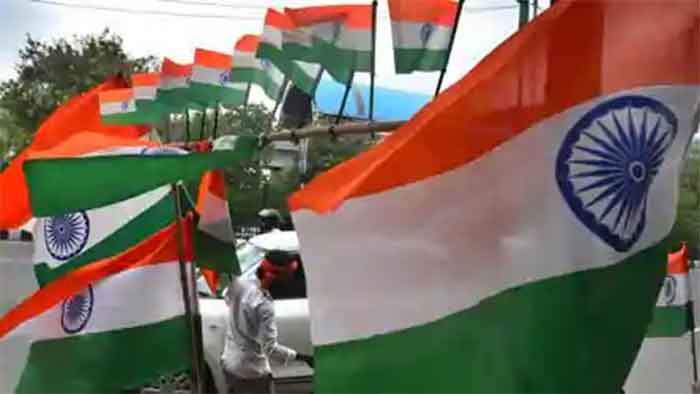
August 15, 1947 is a memorable day in the history of the British Empire since from that day onwards the sun started setting on the British Empire and India received its independence from the clutches of the British. What dreams we had for the future; what aspirations were built up for a young nation who could breathe free after being ruled by the British for over 190 years. At last we were free to think for ourselves and chart our own course to adulthood. The Constitution that we gave ourselves talked of freedom, liberty, equality, equity, rights, etc. and we were no more subservient to a foreign master. We decided to build a secular socialist republic where equality and human rights were important elements of the future India we dreamt.
The first shock that we got was when in 1975 Indira Gandhi declared an Emergency and put the country under an autocratic dictatorship taking away the democracy that we had sworn to protect at all costs. Random arrests and putting all opposition in jails became an everyday affair under this Emergency and the country wondered how a young democratic nation so easily succumbed to the vagaries of a personal dictator.
Sri Jayaprakash Narayan stepped in and the succeeding election denied Indira Gandhi the approval that she was seeking. Emergency period was over.
Today however under the Modi regime we see another type of undeclared Emergency in which we are mute spectators to the destructive steps being planned by a single individual Sri Narendra Modi as per his whims and desires. What kind of democratic set-up we are living in and how unknowingly we have reached this despicable position? The Government of today is not interested in hearing the voice of the people; they already assume and know what is good for
us and this country. The Constitution has been treated as a mere piece of paper which can be thrown away since our PM only knows what is good for this nation.
We are living in dark ages where democratic traditions have been buried so deep that people have forgotten what democracy is all about. Dissent is punished by non-bailable prison and the Courts look the other way when our human rights are trampled upon. What is right is what Modi thinks is right; the rest does not matter. We are forced to live in an undeclared dictatorship and so-called success belongs only to those who support the Government. The population in this subverted democracy has only on right – the right to vote for Modi. God forbid if you vote for someone else.
From 1947 to 2020 – a span of 23 years – where have we come? How did we get here? Is worse still to come? Let us not fool ourselves that we are world’s largest democracy. We are in reality what we are – a nation of ‘yes’ individuals ready to bow down to an unscrupulous dictator who constantly is worried about how more power can be taken so that all the followers sing his praise on a hungry stomach and should be happy on doles distributed with no guarantee of continued employment.
The night is pitch dark and there does not seem that the sun will ever come out.
In this situation all we can do is to keep on fighting the powers to be to regain our real independence and freedom. Prisons should be our comfortable homes and another independence movement has to be launched to get rid of the current malaise which seeks to make a diversity rich India into a US colony of similar dress, language, religion, taste, etc. thus wiping out our rich cross cultural heritage and astounding diversity. We have to go back, wipe our current slate clean, and restart our journey towards what we dreamt in 1947.
I apologise to the coming generation for the mess we have created. In 1947 when I was 6 years old we received a country of endless dreams. In 2020 at the age of 79 we are leaving a nation totally in tatters and who else but we are responsible for this.
Prem Verma Convenor. Jharkhand Nagarik Prayas



 he working definition of the ongoing brain seizure that is 2020 is either that Coloradans are being told by state authorities to


 resident Trump was having a normal one on Sunday morning, tweeting and retweeting 89 times over the course of three and a half hours. Many of them were tweets of polling numbers from obscure firms showing him in the lead after the Republican convention. But most of the tweets and retweets were incitement to violence among his true believers and complaints about "Democrat cities," an ongoing mantra which he seems to think is a slam dunk to get him re-elected.


 eyond its scientific backing, the notion that a COVID-19 patient might wind up with long-term lung scarring or breathing issues has the ring of truth. After all, we hear the stories, right? The virus can leave survivors explaining how they struggled to breathe, or how it can feel, in the


