Showing posts with label REFORESTATION. Show all posts

Sunday, March 13, 2022

RSN: Amy Westervelt | The US Government Doesn't Control Domestic Oil Production. But It Should.


Reader Supported News
12 March 22

Live on the homepage now!
Reader Supported News

PLEASE, SUBSCRIBE TO THIS NEWS ORGANIZATION — I cannot understand this. I have been a monthly subscriber (in a small amount) to RSN for awhile now. Even in the B.T. days (Before Trump), I could see how valuable a service RSN provides. Now we’re in the (D.T.) Days of Trump and how in the world people can’t or don’t understand how we need every sane voice, every defender of freedom, every true news outlet we can get to speak up and keep us informed is just beyond me. Please, subscribe to this news organization and let poor Marc Ash and his staff do what they need to do, keep writing and informing its readers. Thank you!
Julianna, RSN Reader-Supporter/a>

Sure, I'll make a donation!


Amy Westervelt | The US Government Doesn't Control Domestic Oil Production. But It Should.
Amy Westervelt, The Intercept
Westervelt writes: "This week, as President Biden banned the import of Russian oil and gas, fuel prices skyrocketed, and pundits and Substack bros across the land repeated the company line we all know by heart now: We need to drill more and increase production."

The oil and gas industry won’t increase production because it’s enjoying the profits from high prices.

This week, as President Biden banned the import of Russian oil and gas, fuel prices skyrocketed, and pundits and Substack bros across the land repeated the company line we all know by heart now: We need to drill more and increase production.

It’s a rallying cry that makes no sense. On top of the fact that there’s no such thing as an “immediate” increase in oil and gas production, if anything this crisis is one more reason to speed up the transition away from fossil fuels. And in the meantime, since the industry is going to blame the government for everything anyway, a little intervention would actually be helpful here, not to help the oil and gas companies but to rein them in and actually help the American public.

During the 1973 Arab-Israeli War, Arab members of the Organization of the Petroleum Exporting Countries imposed an embargo on exporting oil to the U.S. due to its support of Israel in the war. The result was rationing, miles-long lines at gas stations, a whole lot of headlines questioning our dependency on foreign oil, and ultimately a huge boom in energy efficiency and non-fossil energy in the U.S. The oil industry, of course, claimed that the shortages were all the government’s fault for refusing to let them drill more in the years preceding the embargo.

In 2012, when it was already clear that the fracking boom was headed for a bust, the fossil fuel lobby began pushing hard to lift the ban on exporting American oil and gas. The policy had been in place since that 1970s oil crisis in an effort to insulate Americans from the volatility of the global energy market. But suddenly, exporting was the industry’s last hope to maybe turn a profit on fracking, so the math changed. The story they told was one of national security and energy independence, a return to global superpower status. Their efforts paid off in 2015 when President Barack Obama lifted the ban.

When Donald Trump was elected in 2016, he became the most fossil fuel-backed president in U.S. history, an honor previously held by George W. Bush — and again the industry insisted it needed more land, fewer regulations, and more drilling. Under Trump the goal became not just “energy independence” but “energy dominance.” When Covid hit and the industry was suddenly sitting on mountains of oil barrels worth less than nothing, they seized on the opportunity to request further deregulation. Trump was only too happy to comply. In tracking the fossil fuel-requested subsidies, loopholes, and regulatory rollbacks during the Covid-19 pandemic, I counted well over 100, the vast majority of which remain in place. In fact, prior to leaving office, Trump tried to make as many of them as permanent as possible via executive order. Between those rollbacks and the lifting of the export ban, the oil and gas industry currently has more freedom to drill than it’s had since regulation began.

There are two important things to remember about how oil and gas production work: The government doesn’t place any production limits on oil and gas companies, and there’s no such thing as an immediate production increase. Oil and gas companies decide, all by themselves, whether or not to increase production, and new drilling now generally translates to oil and gas on the market in six to 12 months. A new fracking well takes six to eight months to produce oil, for example. Are there idle wells that could be productive again in less time? Sure. Are there some that were shut down during the pandemic that can be brought back online? Yep. But then we get to the real reasons oil companies aren’t drilling: It’s not government intervention, it’s a combination of money, labor, and materials (shocking, I know).

Like every other industry during the pandemic, the fossil fuel industry was hit by material and labor shortages. Except in the fossil fuel industry’s case, the labor shortage has been coming for a long time; recruitment and retention are hard when you’re in a dying industry. It was so bad last year that ExxonMobil CEO Darren Woods even floated the idea of pay raises, in a pandemic economy!

But even if labor were not a concern and the government threw all its resources into solving the industry’s material shortage problem, oil and gas executives don’t want to increase production because the high prices are working for them financially at the moment. They’ve said so explicitly, out loud and in public.

The big fracking companies — Devon, Pioneer, and Continental — burned by multiple boom and bust cycles over the years, pledged in February not to increase production until 2023. “Whether it’s $150 oil, $200 oil, or $100 oil, we’re not going to change our growth plans,” Pioneer CEO Scott Sheffield said during a Bloomberg Television interview. “If the president wants us to grow, I just don’t think the industry can grow anyway.”

In ExxonMobil’s February earnings call, Woods said the company’s focus remains on price per barrel over volume. “One of the primary objectives we’ve had in looking at the portfolio is less about volume and volume targets and more about the quality and profitability of the barrels that we’re producing.” he said. “That’s been the focus. And as we move forward, we’ll continue — you’ll continue to see the quality of the barrels or profitability of the barrels increase.”

According to Tom Sanzillo, director of financial analysis for the Institute for Energy Economics and Financial Analysis, what’s even more unusual than the industry’s hesitancy to drill, given the high prices per barrel, is the fact that they’re not buying up new land.

“Typically the price spike would occur and rather than pay dividends as robustly as they are paying now, they would buy up other assets and maybe increase production,” he said. “What’s happening now is not typical. They’re not buying up other assets, and they’re not drilling. What does that mean for the future? It’s hard to say. It’s possible they’re just biding their time, building confidence amongst investors and will increase production next year, but this is definitely not the typical response to a price spike.”

Instead, they’re banking that money, using it to make up for profits lost in the pandemic and mostly to conduct massive stock buybacks that keep their shareholders happy and might just bring investors back to fossil fuel for one more round.

Which brings us to the elephant in the room: the United States’s supposed energy independence. As a net exporter of oil and gas, that’s what the country was promised by industry. But you can’t have independence if you are ruled entirely by global commodity markets. The other big oil-exporting countries are able to use their production capabilities to protect themselves from sudden price changes because their fossil fuel industries are nationalized. Because the U.S. energy sector is entirely private, we have no such luck. For all the industry’s squawking about federal leases, only 10 percent of U.S. drilling happens on public land, the rest is on private land that the government has zero control over. And, again, there is no government entity overseeing production; it’s left entirely up to companies to produce as much or as little oil as they think will be profitable. The closest we have to a regulatory body on production is the Texas Railroad Commission, but even when oil prices went negative during the pandemic, the commission opted not to impose production limits.

Although Biden floated the idea of reinstating the export ban when he campaigned for president, his Energy Secretary Jennifer Granholm took that off the table almost immediately. It hasn’t reemerged in the Russia-Ukraine debates, and U.S. exports helped Europe absorb the sudden cutoff of Russian fuel supplies. But an export ban is not a terrible long-term plan. And since the industry is accusing the government of meddling with production anyway, why not call its bluff and start a real conversation about nationalizing the industry and marching it toward a transition to renewable energy? What we’re seeing now is an entirely unmanaged transition, unfolding in real time. It’s painful, and the future is completely unclear, but none of that has to be true.

READ MORE


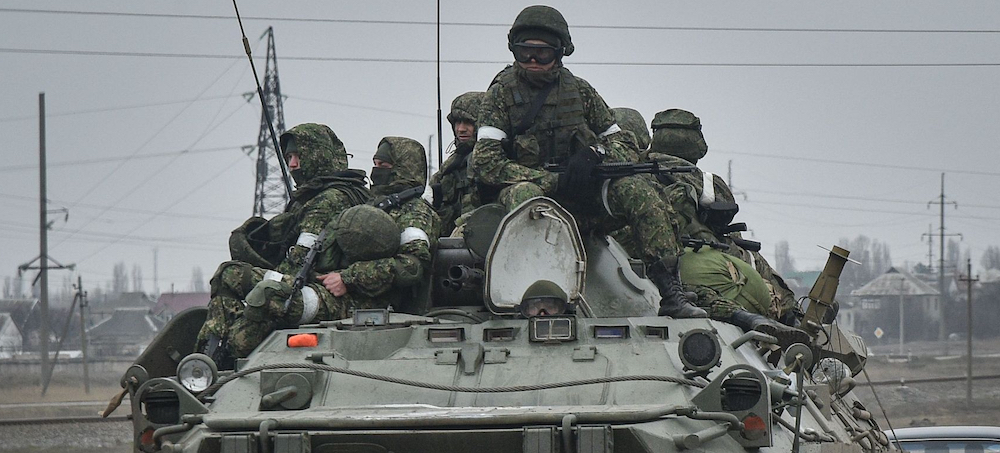
Ukraine-Russia War Latest News: Fighting Rages Near Kyiv; Moscow Threatens Weapons ShipmentsRussian soldiers move toward mainland Ukraine on a road near Armiansk, Crimea, Feb. 25. (photo: Shutterstock)

Ukraine-Russia War Latest News: Fighting Rages Near Kyiv; Moscow Threatens Weapons Shipments
NBC News
Excerpt: "Russia intensified its assault around Ukraine's capital Saturday, while continuing to bombard cities already under siege across the country and issuing new threats against the West."

Britain's defense ministry said in an intelligence briefing that Russian forces were around 15 miles from Kyiv's center.

Russia intensified its assault around Ukraine's capital Saturday, while continuing to bombard cities already under siege across the country and issuing new threats against the West.

Fighting raged and missile strikes hit outside Kyiv, with Russian forces appearing to make fresh progress in their slow advance on the capital.

Ukraine’s President Volodymyr Zelenskyy says he’s open for talks with Russian President Vladimir Putin in Israel ,but only if there is a cease-fire in place.

Zelenskyy said Saturday he told Israeli Prime Minister Naftali Bennett that he would be ready to meet Putin in Jerusalem. Bennett visited Moscow for a meeting with Putin and spoke repeatedly with Zelenskyy and the leaders of France and Germany as he sought to help mediate an end to the war.

Zelenskyy said Bennett informed him about his talks with Putin, adding that he can’t share details.

Putin has ignored numerous previous offers of talks from Zelenskyy.

Speaking at a news conference, Zelenskyy said the Russians could take the Ukrainian capital "only if they kill us all.”

READ MORE


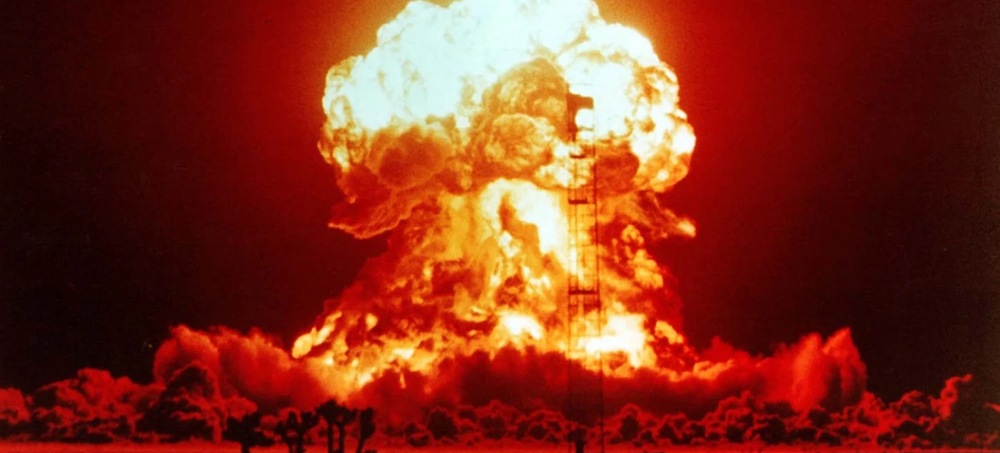
I Was a Nuclear Missile Operator. There Have Been More Near-Misses Than the World KnowsGround level view of a surface test of a nuclear device. (photo: Alamy)

I Was a Nuclear Missile Operator. There Have Been More Near-Misses Than the World Knows
Cole Smith, Guardian UK
Smith writes: "From 2012 to 2017, I worked as a US air force nuclear missile operator. I was 22 when I started. Each time I descended into the missile silo, I had to be ready to launch, at a moment's notice, a nuclear weapon that could wipe a city the size of New York off the face of the earth."

As a 22-year-old I controlled a warhead that could vaporize a metropolis. Since Russia invaded Ukraine, the public is waking up again to the existential dangers of nuclear weapons

From 2012 to 2017, I worked as a US air force nuclear missile operator. I was 22 when I started. Each time I descended into the missile silo, I had to be ready to launch, at a moment’s notice, a nuclear weapon that could wipe a city the size of New York off the face of the earth.

On the massive blast door of the launch control center, someone had painted a mural of a Domino’s pizza logo with the macabre caption, “World-wide delivery in 30 minutes or less or your next one is free.”

Since Russia invaded Ukraine, I’ve heard more discussions of nuclear war than I did in the entire nine years that I wore an air force uniform. I’m glad that people are finally discussing the existential dangers of nuclear weapons. There have been more near-misses than the world knows.

Greg Devlin was an airman assigned to an intercontinental ballistic missile (ICBM) team in Arkansas in 1980. One night he responded to a leak in the missile’s fuel tank. A young airman working in an ICBM launch tube had accidentally dropped a socket from his toolkit; the socket fell down the silo, ricocheted, and pierced a hole in the stage-one fuel tank. The missile’s liquid fuel exploded. Devlin was thrown 60ft down an asphalt road and watched as a massive fireball rose overhead.

The ICBM had a nine-megaton warhead – the most powerful single nuclear weapon in American history – on top. When the missile exploded, the warhead was thrown into the woods, disappearing into the night.

“I was stunned and in pain but I knew the nuke hadn’t gone off,” Devlin told me, “because I remembered those stories from Hiroshima where people had been turned into little charcoal briquettes. I was alive. That’s how I knew the nuke didn’t detonate.” Although the nuclear warhead didn’t explode, the accident still claimed the life of one airman and injured 21 others, including Devlin.

When I was training as a nuclear missile operator, my instructor told me the story of what happened in Arkansas that night in 1980. It’s a famous story within the missile community. Stories like these were a way of impressing upon young officers the integrity required to be a good steward of these weapons and a warning of how quickly things can go wrong. That warning was very much on my mind as I began my first “alert” down in the claustrophobic underground missile silo that housed the launch control center.

But somewhere along my way to nearly 300 nuclear “alerts” – 24-hour shifts in command of a launch crew – I began to brush the story off as a scare tactic for rookies. Similarly, I think that after the end of the cold war, the general public allowed the threat of nuclear warfare to recede into the background. The threat simply didn’t feel real to new generations like it did to those who grew up huddling under their desks during nuclear attack drills in elementary school.

And the young crews who steward this nuclear arsenal today aren’t immune from the post-cold war malaise. In 2013, during my first year on crew, 11 ICBM officers were implicated in a drug scandal. The following year, 34 ICBM launch officers were implicated in a cheating scandal on their monthly proficiency exams.

Deborah Lee James, the secretary of the air force at the time, said, “This was a failure of integrity on the part of some of our airmen. It was not a failure of our nuclear mission.”

In this attempt to save face, Secretary James revealed a state of dissonance that every nuclear missile operator lives with. We are told, day in and day out, that our integrity is crucial to the deterrent value of nuclear weapons and helps make the world a safer place. But what man or woman of integrity could possibly launch a nuclear weapon?

As the war in Ukraine is reminding us, life with nuclear weapons is not safer or more peaceful. If you study nuclear warfare, you’ll learn about “megatons” and nuclear yields, stockpiles and budget expenditures. These numbers quantify the enormous danger of nuclear weapons but also, in rendering that danger abstract, obfuscate it.

Greg Devlin has a different set of numbers from his experience with missiles. “Since that explosion I’ve had 13 spine surgeries and two spinal stimulators. I lived the last decade of my life on morphine,” said Devlin.

Nuclear weapons turn the most important parts of life into nothing more than numbers – which is exactly the thought process needed for a society that believes that launching a nuclear missile is a viable solution to conflict. Because in the wake of a nuclear attack there will be no individuals, only numbers.


READ MORE


Analysis | Mark Meadows, his wife, Debra, and their trailer-home voter registration

Mark Meadows Shows the Hypocrisy of Republicans on Voter Fraud
The Washington Post Editorial Board
Excerpt: "Strict voting rules for thee, but not for me. How else to summarize the revelations that Mark Meadows, the last White House chief of staff to President Donald Trump, and his wife voted in the 2020 election using the address of a mobile home in North Carolina where they did not reside?"

Strict voting rules for thee, but not for me.

How else to summarize the revelations that Mark Meadows, the last White House chief of staff to President Donald Trump, and his wife voted in the 2020 election using the address of a mobile home in North Carolina where they did not reside? Mr. Meadows, who was eager to promote Mr. Trump’s lies that mail-in voting is rife with fraud, never owned the residence. In fact, he might not have ever set foot in it.

Compare this case with that of Crystal Mason, the Texas resident who was sentenced to five years in prison for submitting an illegal provisional ballot in 2016 while on supervised release for a felony conviction. Ms. Mason, who is Black, maintains that she did not know she was unable to vote and that a poll worker handed her the provisional ballot even though she was not on the state’s voter rolls. “It was to make an example out of me,” Ms. Mason told the American Civil Liberties Union of her prosecution.

Would Ms. Mason have faced such punishment if she had Mr. Meadows’s position? Or his skin color? What “example” — beyond its value as evidence of rank hypocrisy — will be made of his absentee ballot?

For the past year, the Republican Party has gone to great lengths to restrict absentee voting in state legislatures, claiming that mail-in ballots allow nefarious actors to influence the elections. This was always misdirection; fraudulent behavior is extremely rare, and election audits have repeatedly shown that the few cases that do occur do not affect elections. Will Republicans now denounce one of their own for engaging in such activity?

Nor is Mr. Meadows the only Republican practitioner of a double standard. Many Trump officials who have decried mail-in voting have voted, well, through the mail. That includes Mr. Trump, members of his family, Vice President Mike Pence and Attorney General William P. Barr. Remember also that Mr. Trump specifically encouraged voters in the crucial swing state of Florida to vote by mail while simultaneously challenging absentee ballot rules in other states. And while plenty of elected Republicans claimed that the 2020 presidential election was stolen, none saw the same forces at work in their own elections — which appeared on the same ballot.

By now, it should be obvious: “Election integrity” is a hollow slogan for Republicans. They seek stricter voting laws in a haphazard attempt to dampen voter turnout for Democrats — efforts that might end up hurting turnout among their own supporters as well.

The goal of anyone who believes in democracy should be to make it easier for people to have a voice — not adding onerous requirements to vote by mail, tearing down ballot drop boxes and devising mechanisms to wrest away control of elections from local, nonpartisan officials. Republicans have done all of that. These are major transgressions. But smaller ones matter, too, which is why no one should look the other way when a prominent figure in their own party appears to fudge the truth about where he lives on his voter registration form.
READ MORE


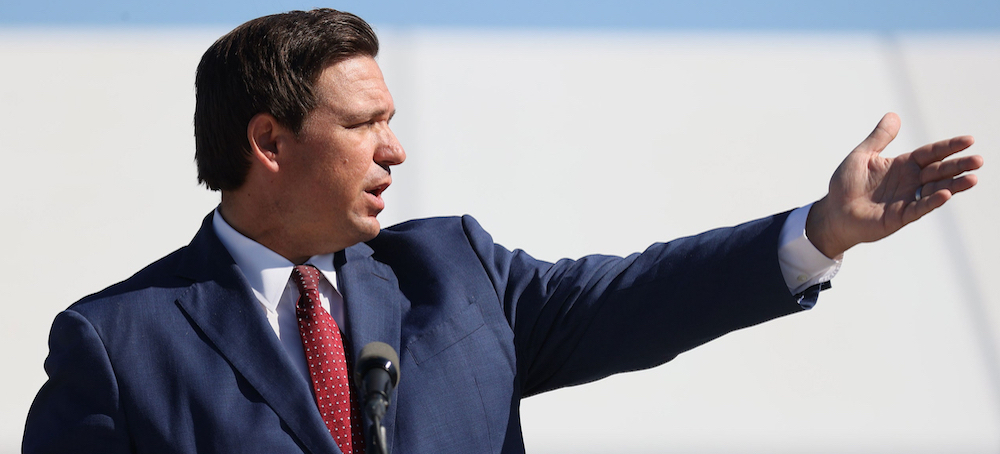
Florida Just Passed Its 'Stop WOKE' Anti-CRT BillGovernor Ron DeSantis of Florida. (photo: Joe Raedle/Getty Images)


Florida Just Passed Its 'Stop WOKE' Anti-CRT Bill
Paul Blest, VICE
Blest writes: "The Florida state Legislature approved a bill Thursday that aims to stifle conversations about race and gender in the school and workplace, and end the great scourge of our time: thoughtful considerations of privilege and racist oppression in America."

“This bill is not about individual freedom,” said a legislator who voted against it. “This is a continuation of a national agenda to whitewash history.”


The Florida state Legislature approved a bill Thursday that aims to stifle conversations about race and gender in the school and workplace, and end the great scourge of our time: thoughtful considerations of privilege and racist oppression in America.

The Florida Senate passed a bill modeled on an effort Gov. Ron DeSantis called the “Stop WOKE (Wrongs to Our Kids and Employees) Act” on a party-line vote Thursday. DeSantis is expected to sign the bill, which he unveiled last December with a speech in which he warped the famous Martin Luther King Jr. quote, about being judged not by the color of your skin but by the content of your character, into an attack on critical race theory (CRT).

The bill, called simply “Individual Freedom,” would prohibit schools and workplaces from using instruction material that teaches, among other things, that a person’s status as “privileged or oppressed is necessarily determined by his or her race, color, national origin, or sex.”

An earlier version of the bill would have made it illegal to teach lessons and materials that cause a person to “ feel discomfort, guilt, anguish, or any other form of psychological distress on account of his or her race, color, sex, or national origin.” The bill was amended last month to narrow the definition to prohibiting lessons that say a person “bears personal responsibility for and must feel guilt, anguish, or other forms of psychological distress” for systemic racism and sexism—something that’s actually happening in very few classrooms, if at all.

The intent of the bill, however, is clear. Similar to others around the country, it’s aimed at tackling CRT, “critical race theory,” an academic theory about America’s legal system that the right has turned into a bogeyman that’s allowed them to target diversity trainings and school curricula about racism both past and present.

Though the bill doesn’t explicitly name critical race theory, DeSantis has called the concept “state-sanctioned racism.” State Sen. Manny Diaz Jr., a Republican who sponsored the bill and is rumored to be in consideration to become DeSantis’ next education chiefsaid Thursday that “as the teacher, you should never know my politics. You should never know where I stand on those issues.”

But state Sen. Shevrin Jones, one of many Black Democratic legislators to register vocal opposition to the bill, said the effort was part of a national trend toward “revisionist history.”

“This bill is not about individual freedom,” Jones said Thursday. “This is a continuation of a national agenda to whitewash history all because we don’t want white children to feel uncomfortable about true Black history.”

State Sen. Bobby Powell, a Democrat, repeated several times that America “is indeed the land of the free and the home of the brave,” but noted it was also “the home of the slave.”

“Slavery happened,” Powell said. “Jim Crow happened. George Floyd happened… when you tell the story, tell it all.”

Florida has been busy this week fighting the conservative culture wars. The Senate passed what’s been dubbed the “Don’t Say Gay” bill, which similarly prohibits discussions about sexual orientation and gender identity in the classroom.

DeSantis has not yet signed the bill, but after the CEO of Disney—the state’s biggest driver of tourism—came out against the bill, the governor said Thursday that his state “won’t allow them to inject transgenderism into kindergarten,” and slammed the company as “woke.”

“You have companies, like at Disney, that are going to say and criticize parents’ rights, they’re going to criticize the fact that we don’t want transgenderism in kindergarten in first grade classrooms,” DeSantis told supporters in Boca Raton, according to Fox News. “And so in Florida, our policies got to be based on the best interest of Florida citizens, not on the musing of woke corporations.”
READ MORE


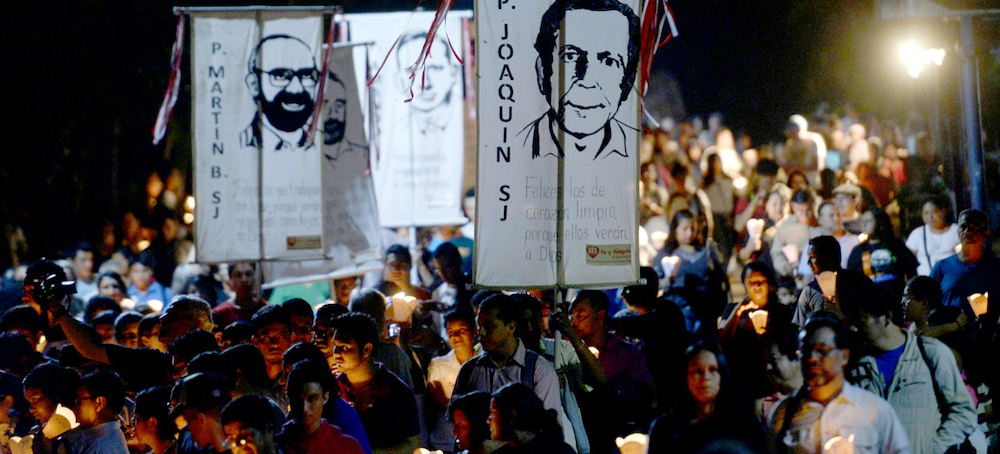
El Salvador Court Orders Arrest of Former President Over 1989 Priest MassacreCatholic faithful participate in a procession to commemorate the anniversary of the murder of the Rev. Ignacio Ellacuría, five other Jesuit priests and two employees at Central American University in San Salvador. (photo: Marvin Recinos/AFP/Getty Images)


El Salvador Court Orders Arrest of Former President Over 1989 Priest Massacre
Associated Press
Excerpt: "A court in El Salvador has ordered the arrest of former president Alfredo Cristiani in relation to the 1989 massacre of six Jesuit priests and two others by soldiers."

Alfredo Cristiani, who left the country in 2021, is accused of knowing of military plans to massacre six Jesuit priests

A court in El Salvador has ordered the arrest of former president Alfredo Cristiani in relation to the 1989 massacre of six Jesuit priests and two others by soldiers.

Prosecutors allege that Cristiani knew of the military’s plan to eliminate the priests and did nothing to stop them.

On 25 February charges were filed against Cristiani, who was president from 1989 to 1994, and a group of soldiers for alleged involvement in the murders. Cristiani and a former lawmaker, Rodolfo Parker, had been summoned to court on Tuesday, but did not appear.

“There is nothing left but to decree the detention against those persons because they did not appear in court and did not send lawyers,” the court’s resolution said.

Cristiani left El Salvador in 2021 after appearing before a special congressional panel investigating overpayments to former government officials.

When prosecutors reopened the priests’ case, his daughter, Claudia Cristiani, published some photos of her father and said they were in the land of the grandfather, meaning Italy, but it was unknown if he is still there.

In a statement released by his daughter, the former leader denied the allegations.

“The truth is I never knew of the plans they had to commit those killings,” Cristiani said. “They never informed me nor asked for my authorization because they knew that I would never have authorized that that Father [Ignacio] Ellacuría or his brothers were harmed.”

El Salvador’s attorney general’s office has accused Cristiani, Parker and a number of former high-ranking military officers of being behind the murders. A general amnesty passed in 1993 during Cristiani’s administration had prevented pursuit of those involved in war crimes until it was repealed in 2016.

On 16 November 1989 an elite commando unit killed the six priests – five Spaniards and one Salvadoran – along with their housekeeper and the housekeeper’s daughter in the priests’ residence. The killers tried to make the massacre appear as though it had been carried out by leftist guerrillas.

Nine members of the military were initially put on trial, but a court absolved seven of them. Two officers served short sentences but were released in 1993 under the amnesty.

After the supreme court found the amnesty unconstitutional, a judge ordered one of those officers, Col Guillermo Benavides, back to prison where he remains.

While the case stalled at home, a Spanish court in 2020 sentenced former Salvadoran Col Inocente Orlando Montano to 133 years for the priests’ killings.


READ MORE


In a National Park Plagued by Encroachers, Indonesia Tries a New Approach"For years, people have settled illegally in national parks around Indonesia, clearing the land and farming it in the hope they will eventually be granted legal title to it." (photo: Conservation Atlas)

In a National Park Plagued by Encroachers, Indonesia Tries a New Approach
Tonggo Simangunsong, Mongabay
Excerpt: "Suwardi, a 51-year-old from Indonesia's North Sumatra province, used to work as a laborer for a landlord who managed oil palm and rubber plantations in his home village of Harapan Maju, near Gunung Leuser National Park. He also cultivated a dream: to own his own farmland."

Suwardi, a 51-year-old from Indonesia’s North Sumatra province, used to work as a laborer for a landlord who managed oil palm and rubber plantations in his home village of Harapan Maju, near Gunung Leuser National Park. He also cultivated a dream: to own his own farmland.

One day, about four years ago, Suwardi thought he had an opportunity to get closer to his dream. A man who claimed to control a nearby plot of land, already cleared of vegetation and ready for planting, offered to let Suwardi manage it for a fair price.

The land lay inside the national park, but Suwardi saw that as only a minor hitch. Like other protected areas in the Southeast Asian country, this one was full of squatters, and with the man’s assurances Suwardi believed that even if he operated illegally for a while, he could one day obtain title to the land.

Soon, however, Suwardi came to regret his deal with a member of what he called a “land mafia,” a common expression in Indonesia for people who fraudulently exploit gaps in the land regulation system for profit, often through collusion with public officials. After two years of hiding from forest rangers, he decided to call it quits.

“I don’t want to be illegal anymore,” Suwardi remembers telling the other encroachers who condemned him for abandoning their group.

Suwardi may have turned his back on his fellow squatters, but he never said goodbye to his farmland, located in the Besitang area of North Sumatra province. Instead, he joined a government program that allows him to manage the land under certain conditions, even if it means he’s had to let go of his dream of one day owning it.

The program, known as “conservation partnership,” seeks to reduce conflict between conservation authorities and villagers living in the vicinity of protected areas, turning them into allies in restoring damaged ecosystems and offering them economic opportunities.

Since its establishment in 2018 by the Ministry of Environment and Forestry, the program has grown to encompass nearly 177,000 hectares (440,000 acres) of land at 69 sites across the Indonesian archipelago, including some of its best-known national parks, such as Tesso Nilo in Sumatra, East Kutai on the island of Borneo, Lore Lindu on the island of Sulawesi, and Halimun Salak on Java Island, according to Wiratno, the main official overseeing the program.

“Encroachment caused by poverty, lack of agricultural land and landless farmers must be resolved not through law enforcement but through the provision of management access,” Wiratno, the environment ministry’s director-general of conservation, told Mongabay.

Indonesia is home to the world’s third-largest area of rainforest, but it also has one of the highest rates of forest loss since the turn of the century.

Much of that deforestation has occurred illegally, within areas the government has designated as protected. Nearly a tenth of the country’s 22.1 million hectares (54.6 million acres) of “conservation forest” had been damaged as of 2012, Wiratno wrote in a memoir published that year about his time serving as head of Gunung Leuser, which he led from 2005-2007.

The forest in some protected areas has been almost entirely destroyed. Some three-quarters of Tesso Nilo National Park, for example, has been converted into illegal oil palm farms, according to WWF.

Gunung Leuser hasn’t fallen into such dismal straits, though the park hasn’t gone unscathed either. In recent decades, Gunung Leuser, a UNESCO World Heritage Site that’s home to orangutans, elephants, tigers and other endangered species, has lost rainforest across nearly 5% of its total area, much of it converted into illegal farms, according to the park’s management agency.

Efforts to crack down on so-called land mafia practices in Besitang, where the squatters are concentrated, have met with resistance. A 2011 eviction attempt resulted in a group of squatters setting fire to the park authority’s office there, according to a 2016 report by UNESCO and Tropenbos International Indonesia, an international nonprofit.

“The case of Besitang … reflects the experience of encroachment in other conservation areas,” Wiratno told Mongabay.

While illegal attempts to control protected lands are diverse, officials in North Sumatra say that in Besitang, land traffickers have staked claims to national parkland based on the presumption that it belonged to the Langkat Sultanate during the Dutch colonial period and therefore today belongs to the sultan’s descendants.

“These so-called geran datuk claims have for a long time led to the occupation of Leuser by land grabbers,” Selamat Indarjo, the official in charge of the park’s Besitang region, told Mongabay. “The claim has no basis, but many farmers believe it.”

The current sultan of Langkat expressed a similar view during a speech at the 2018 Conservation Forest Farmers Congress held in Besitang to kick off the conservation partnership program there.

“I’ve never heard of the term ‘geran datuk,’ but it’s been used to make a fool of people,” said Azwar Abdul Jalil Rahmad Shah al-Haj, the 14th sultan since the sultanate was established in 1568.

Also fueling the deforestation in Leuser, which straddles the administrative provinces of North Sumatra and Aceh, was a rebellion waged by separatists in the latter province from 1976-2005. The conflict pushed thousands of refugees into the national park, where many still remain.

At times, the refugee issue has been used as a cover for land mafia practices, according to Wiratno.

Land traffickers like those in Leuser often have connections in high places, making them exceptionally difficult to deal with. In Besitang, they typically operate by clearing forestland and then selling small plots to aspiring farmers like Suwardi.

After getting the land, Suwardi and dozens of other farmers formed a group they hoped would help them eventually obtain legal title to the land, an asset they could one day pass on to their children. They planted oil palm and rubber trees, cash crops that take several years to begin producing palm fruit and latex. Suwardi was one of the “front men” of the group, he said, which didn’t make it any easier for him to leave.

“They used to be my friends, but now they hate me,” Suwardi said. “They consider me a traitor.”

The conservation partnership program in Besitang currently spans 1,526 hectares (3,771 acres), including Suwardi’s 2-hectare (5-acre) plot.

Prior to joining the government-sanctioned “forest farmer group,” Suwardi and other squatters had to sign an agreement stating that the lands they were managing lie inside a national park and cannot be owned by individuals.

“Participating in the forest farmer group means admitting that the land they used to cultivate belongs to a national park,” said Masrizal Saraan, executive director of the Petai Foundation, an Indonesian NGO that helps run the conservation partnership program in Leuser.

Other participating NGOs are the Indonesian Forum for the Environment (Walhi), the country’s largest environmental advocacy group, and the Orangutan Information Center, based in Medan, the capital of North Sumatra province.

Some of the funds for the program come from Tropical Forest Conservation Action for Sumatra, a debt-for-nature swap scheme created by the U.S. and Indonesian governments. Debt-for-nature swaps allow portions of a country’s foreign debt to be forgiven in exchange for investing the money in conservation.

“If this program is oriented toward ecosystem restoration, I think it will be very good because it involves the community/farmers who have already been working in the Leuser area,” Panut Hadisiswoyo, the founder and director of the Orangutan Information Center, told Mongabay. “The approach is more humane because farmers can simultaneously receive economic opportunities by giving them access to plant secondary crops while restoring the area.”

The program is also intended to help meet Indonesia’s ambitious goals of redistributing 12.7 million hectares (31.4 million acres) of land within forest areas to local communities under the government’s “social forestry” program and reforesting millions of hectares.

While participating farmers are allowed to cultivate “traditional” crops and harvest non-timber forest products, such as rattan, beeswax, honey, and mushrooms, they are not allowed to grow rubber and oil palm, and are expected to cut down any that they have planted.

Some farmers, like Joneri, a father of three who began squatting in the park in 2014, have cut down their oil palms.

“I imagine that in the years to come, if all former encroachers replace oil palm plantations with hardwood plantations, this area will recover,” he told Mongabay.

Others are more reluctant to fell what they have planted. Groups like Petai have cut down illegal oil palms in some places, but it can be expensive for a local NGO to hire the workers required to do the job.

Suwardi has cut down some of his oil palms, but a few still stand on his farm. He planted them four years ago when he first started working the land, and they have recently started bearing fruit. The proceeds, he says, go a long way toward paying his children’s school fees; one of them is in university.

“If others cut theirs down, I’ll cut mine down too,” he said.

Even if Suwardi had to let go of his dream of owning the land, he said the most important thing now is being able to get the income from agriculture to support his family. He has planted nearly 1,000 forest trees such as durian, matoa and petai, and in the vicinity he can plant secondary crops, such as chilis, watermelons and oranges, to bolster the family’s income.

“I have a family and daughters who now need my support to [finish] their education,” he said. “I work to make money, not to have land.”

This article was originally published on Mongabay


READ MORE

Special Coverage: Ukraine, A Historic Resistance
https://www.rsn.org/001/ukraine-a-historic-resistance.html


Contribute to RSN

Follow us on facebook and twitter!

Update My Monthly Donation

PO Box 2043 / Citrus Heights, CA 95611


Friday, April 23, 2021

RSN: Andy Borowitz | Biden Announces Plan to Cut Carlson Emissions by Ninety Per Cent


Reader Supported News
23 April 21


The Friday-Saturday Donation Desert

Fridays and Saturdays especially in the spring and summer are the worst for donations. People want to get out and do things, which is understandable, but RSN’s fundraising efforts take a big hit.

Donating only takes a few seconds and it really helps us do this.

Who?

Marc Ash
Founder, Reader Supported News

Sure, I'll make a donation!


Update My Monthly Donation


If you would prefer to send a check:
Reader Supported News
PO Box 2043
Citrus Hts, CA 95611


Reader Supported News
22 April 21

It's Live on the HomePage Now:
Reader Supported News


A DONATION NOW WOULD BE OF IMMENSE HELP — We are making a maximum effort right now to finish the April funding drive. If there is any way you can jump in it would really help right now. Thanks to everyone in advance. / Marc Ash, Founder Reader Supported News

Sure, I'll make a donation!


Andy Borowitz | Biden Announces Plan to Cut Carlson Emissions by Ninety Per Cent
Fox host Tucker Carlson. (photo: Richard Drew/AP)
Andy Borowitz, The New Yorker
Borowitz writes: "In what might be the boldest initiative of his Presidency, Joe Biden announced that he would strive to cut Carlson emissions by as much as ninety per cent by 2025."

The article below is satire. Andy Borowitz is an American comedian and New York Times-bestselling author who satirizes the news for his column, "The Borowitz Report." 


n what might be the boldest initiative of his Presidency, Joe Biden announced that he would strive to cut Carlson emissions by as much as ninety per cent by 2025.

Underscoring the urgency of his proposal, Biden observed that Carlson emissions, even when compared to other notorious polluters like Sean Hannity and Laura Ingraham, were especially toxic.

The President’s ambitious plan, which includes retrofitting the nation’s televisions to automatically change the channel when Carlson appears, is unlikely to garner Republican support, but Biden remained undaunted.

“We owe it to our children and grandchildren to do this,” he said.

READ MORE


Voters line up at a polling station in Arizona. (photo: Pete Scholz/ABC)


Arizona Republicans to Begin Auditing 2020 Ballots in Effort to Undermine Election Results
Sam Levine, Guardian UK
Levine writes: "Nearly five months after Joe Biden was declared the official winner of the presidential race in Arizona, state Republicans are set to begin their own audit of millions of ballots, an unprecedented move many see as a thinly-veiled effort to continue to undermine confidence in the 2020 election results."

Audit will include a hand recount of all 2.1m ballots cast in Maricopa county in alarming consequence of Trump’s baseless lies


early five months after Joe Biden was declared the official winner of the presidential race in Arizona, state Republicans are set to begin their own audit of millions of ballots, an unprecedented move many see as a thinly-veiled effort to continue to undermine confidence in the 2020 election results.

The GOP-controlled state senate ordered the audit, set to formally get underway this week, which may be one of the most absurd and alarming consequences to date of Donald Trump’s baseless lies about the 2020 election. It will be executed by a private Florida-based company. It also reportedly will be supported from far-right lawyer Lin Wood and observers from the far-right news network One America News Network.

The audit will be solely focused on Maricopa county, the largest in the state and home to a majority of Arizona’s voters. Biden narrowly defeated Trump in the county, a crucial battleground that helped the president win Arizona by around 10,000 votes. The audit will include a hand recount of all 2.1m ballots cast in the county, a process expected to take months.

Trump and allies have claimed, without evidence, there was fraud in Maricopa county. But the county has already conducted two separate audits of the 2020 election and found no irregularities. The Republican decision to continue to investigate the results, months after they were certified by both county and state officials, extends the life of election conspiracy theories. The audit also comes as Arizona Republicans are advancing legislation in the state that would make it harder to vote by mail.

“They’re trying to find something that we know doesn’t exist,” said Arizona secretary of state Katie Hobbs, a Democrat, who serves as the state’s top election official. “It’s ludicrous that people think that if they don’t like the results they can just come in and tear them apart.”

David Becker, an election administration expert and the executive director of the Center for Election Innovation and Research, said the effort was so shoddy he was hesitant to acknowledge it as a legitimate investigation.

“I’ve never seen an ‘audit’ that was remotely similar, and given the fundamental flaws, I don’t think this process can even be described as an audit,” he said in an email.

Other voting rights groups have expressed similar concerns.

“At this point, additional audits will have little value other than to stoke conspiracy theories and partisan gamesmanship – or worse,” the groups, which included the Carter Center in Atlanta and the Brennan Center for Justice, wrote in a letter to the Arizona senate earlier this month. “In short, this appears to be a decision driven by politics rather than a search for the truth.”

Alarm over the audit has escalated in recent weeks after Republicans announced the firms that would be leading the effort. The company that will lead the audit, a Florida-based company called Cyber Ninjas, is led by Doug Logan, who supported several baseless conspiracy theories about the election. In December, he retweeted a post that questioned the validity of Maricopa’s ballot count and falsely said Trump may have gotten 200,000 more votes than were reported in Arizona, according to the Arizona Mirror, which first reported his involvement in the audit.

He also made statistical comparisons between elections in Venezuela and the 2020 race in a tweet that included a “stop the steal” hashtag, according to the Mirror. Cyber Ninjas is not accredited by the US Election Assistance Commission to inspect voting machines, the Washington Post reported.

“You’re bringing in this firm that’s on a treasure hunt,” Hobbs said. “They are not qualified, they don’t even know what they’re doing.”

It’s not clear how Cyber Ninjas was chosen to lead the audit. Karen Fann, the president of the Arizona senate, did not return a request for comment. In an interview with One America News Network, a far right news outlet, Fann said the audit was needed to answer questions about the 2020 election.

“It is our job to make sure those laws are followed to the T, that they are always above reproach, and if we find any mistakes, we need to fix it and or report it,” she told the outlet.

The Arizona state senate is renting a Phoenix arena to conduct the audit and there is growing scrutiny over how the process is being funded. While the state senate has allocated $150,000 towards the effort, it is also being backed by private donors. L Lin Wood, an attorney who promoted some of the most inflammatory lies about the 2020 election, told Talking Points Memo he had donated $50,000 to a fundraiser to support the effort. Wood also told the outlet that he hosted Logan at his South Carolina home last year.

“That should scare a lot of people,” said Martin Quezada, a Democrat in the Arizona state senate. “Who are the people that are gonna be donating to this? It’s already shown that this is the people who have an agenda and that agenda is to show that there was some sort of fraud, that there was a stolen election.”

It’s also unclear how much access media and other independent observers will have to the audit. Reporters will be prohibited from using pens and paper and will have to sign up to serve as official observers, a spokesman for the audit told an Arizona Mirror reporter on Wednesday. The Arizona Republican party also tweeted that the process will be live-streamed and that observers from One America News Network, the far fight outlet, would ensure nonpartisan “transparency”.

There is also concern the audit could lead to voter intimidation. In its statement of work, Cyber Ninjas wrote it had already performed “non-partisan canvassing” in Arizona after the 2020 election and knocked on voters’ doors to “confirm if valid voters actually lived at the stated address”. The company said it would continue that work during the audit “to validate that individuals that show as having voted in the 2020 general election match those individuals who believe they have cast a vote”.

Such activity could amount to illegal voter intimidation, a group of voting rights lawyers wrote to Cyber Ninjas and others involved in the audit earlier this month.

Quezada, the Arizona state senator, said it was impossible to separate the audit from the suite of voting restrictions in the Arizona state legislature that would make it harder to vote by mail. Among the most prominent is a bill that would essentially do away with a longstanding and popular practice in the state that allows any eligible voter in the state to automatically receive a mail-in ballot if they want. Another measure would require voters to provide identification with their mail-in ballot.

“They want to justify all of the changes that they are already proposing to election laws because they need to have some sort of legitimacy behind it to justify the severe restrictions they’re hoping to put in place here,” he said. “Every element of this audit, from the beginning, to the end, it just stinks to high hell.”

READ MORE


NYPD squad car. (photo: Serge Attal/Redux)


What Police Impunity Looks Like: "There Was No Discipline as No Wrongdoing Was Found"
Eric Umansky, ProPublica
Umansky writes: "To understand why police are so rarely held accountable for killings, you should know about Kawaski Trawick, and what didn't happen to the officer who shot him."

To understand why police are so rarely held accountable for killings, you should know about Kawaski Trawick, and what didn’t happen to the officer who shot him.

 jury’s conviction of former Minneapolis officer Derek Chauvin in the death of George Floyd is a historic moment, in large part because it’s an anomaly. Officers who kill civilians are rarely prosecuted, let alone convicted — many aren’t even disciplined by their departments.

To understand how police impunity works, it’s worth looking at another case, that of Kawaski Trawick.

Two years ago, Trawick was alone in his apartment in the Bronx when two New York City Police Department officers arrived in response to 911 calls about Trawick walking through the building with a serrated bread knife and a stick. Trawick, who had a history of mental health and drug issues, had locked himself out of his apartment but had gotten back in after firefighters pried open the door. When the police officers arrived minutes later, they pushed the door ajar and found Trawick, a personal trainer and dancer, standing near his stove, holding the knife and stick.

“Why are you in my home?” Trawick asked. Less than two minutes later, he lay dying on the floor. A few months ago, I examined what happened in those 112 seconds. Video from a body-worn camera shows one of the officers — Black and more experienced — repeatedly trying to stop his white, less experienced partner from using force.

“We ain’t gonna tase him,” Officer Herbert Davis told Officer Brendan Thompson, as Trawick stood about seven feet from them. Thompson fired his Taser anyway, which (as can happen) enraged Trawick, who ran toward the officers. Davis again tried to stop his partner, this time from shooting his gun. He briefly pushed Thompson’s gun down, saying, “No, no — don’t, don’t, don’t, don’t, don’t.”

Thompson fired three times, paused for a moment, and then fired a final shot. Trawick died almost instantly. You can see and hear it all for yourself, in a video we made using surveillance and body-worn camera footage. (Davis and Thompson both declined requests for comment.)

Last Wednesday marked two years since the shooting, so I checked in with the NYPD about it. The department had said late last year that it had finally finished its internal investigation and that the police commissioner — who has complete discretion over discipline, as many chiefs around the country do — would soon be deciding what to do.

Last week, the NYPD told me that Commissioner Dermot Shea had indeed ruled on the case. The officers were completely cleared. “There was no discipline as no wrongdoing was found,” the department said.

Here is the NYPD’s full statement. It noted that there was also a “tactical review” to determine “what, if anything, could have been done differently.”

Experts I spoke with pointed to a litany of poor decisions and tactics by the officers.

The officers could have tried to make a connection with Trawick, as the NYPD trains its officers to do, and at least answered his repeated questions about why they were there. They could have waited for help and “just closed the door,” as one former NYPD detective told me, since department policy is to “isolate and contain” people in crisis. They could have decided to not use force, as other officers did when they had encountered Trawick in a similar situation weeks before.

Thompson could have warned Trawick before firing his Taser, as the NYPD encourages officers to do so. After he used his Taser, Thompson could have kept it in his hand, rather than putting it on the ground and leaving himself with only his gun.

Yet as perplexing as the NYPD’s conclusion may seem, it is also the logical culmination of a series of decisions that have again and again narrowed the avenues for accountability.

The rare occasions in which officers have faced even the possibility of significant punishment have usually come after the public has seen what happened, for example, after a bystander filmed Chauvin’s knee on Floyd’s neck. Trawick’s killing happened out of the public eye. And the NYPD worked to keep it that way.

For a year and a half, it refused to release body-worn camera footage, arguing in response to a public records request and lawsuit that doing so would “interfere” with the department’s internal investigation and would be an “unwarranted invasion of personal privacy.”

But the NYPD did offer its perspective about what happened. “It appears to be justified,” one of the NYPD’s top officials told reporters the day after the shooting.

The police’s perspective shaped the early coverage. Citing “law enforcement sources,” the New York Post reported that a “musclebound man” who was “nicknamed ‘Chaos’” had been shot “when he charged at cops twice with a stick and a knife.” (Trawick was about 5 feet, 5 inches tall, and his family told me they’ve never heard that nickname. The video shows he ran at the officers once, after he was hit by a Taser.)

The NYPD eventually decided to release footage, after the Bronx District Attorney’s Office published it as part of a report last November that laid out its decision not to pursue criminal charges against the officers. The DA’s decision, too, was no surprise: Local prosecutors, who work closely with the police, are particularly hesitant to indict officers.

The DA’s report had troubling revelations buried inside it. While the report’s highlighted timeline didn’t mention it, the report revealed more than two dozen pages in that Davis had tried to stop his partner from shooting Trawick. It also disclosed that other officers had previously decided there was no need to use force when they answered remarkably similar calls involving Trawick. On page 36, the report cited those interactions as “examples of disparate outcomes that deserve mention.”

The DA’s report did not contain the full, unedited body-worn camera footage, and the NYPD initially continued to fight a lawsuit demanding it.

The day before a December hearing in the case, the NYPD sent the footage to the complainants, New York Lawyers for the Public Interest, because, after 20 months, the department’s internal review was complete. That footage, which the law firm shared with me, showed that as officers converged on the scene where Trawick lay lifeless, two of them told a sergeant that “nobody” had been hurt. “Just a perp.”

Shortly after ProPublica published a story about that, a lawyer working on the case for New York Lawyers for the Public Interest got a phone call from the city agency that investigates police misconduct against civilians. An investigator at the Civilian Complaint Review Board had a favor to ask: Could the lawyer please share the newly released footage with him? The investigator explained that the NYPD wouldn’t provide footage to the CCRB.

“I was shocked to get that call,” said the lawyer, Benjamin Reed, of Milbank LLP. “It’s disturbing that they had to come to us, after we had to fight with the NYPD for a year to get it. It’s just backwards. It’s obvious that they can’t properly oversee the NYPD if they can’t get footage.”

That is part of a long pattern of the NYPD obstructing the work of the overmatched agencies that are supposed to oversee it. In shootings and other serious incidents such as the Trawick case, the NYPD routinely refuses to give the CCRB footage and other records until the department’s internal investigation is over, which can take a year or more.

The delays can render the civilian board’s investigations effectively moot. The CCRB told me that its investigation into Trawick’s killing is still open, and that it has now received footage from the NYPD. But the police commissioner, who gets final say on punishment, has already decided there was no wrongdoing.

When I reported on the Trawick case last fall, one of the people I spoke with was Jonathan Smith, who worked on civil rights litigation at the Justice Department during the Obama administration and led the agency’s most significant investigations into police abuse. “This case is a lesson in how you don’t do one of these encounters,” he said, after reviewing the footage. “They should teach it in the academy.”

I reached back out to Smith to share the NYPD’s conclusion that there was no wrongdoing. “For them to find nothing wrong there,” he said, “it’s just stunning.”

Smith said it reminded him of another young man’s death he recently investigated for the city of Aurora, Colorado. Twenty-three-year-old Elijah McClain died after police officers twice put him in a chokehold and paramedics injected him with ketamine. The officers had stopped him after a 911 caller said McClain, who was walking down the street, “looked sketchy.”

Like Trawick, McClain wasn’t doing anything criminal. As in the Trawick case, local prosecutors decided not to indict the officers. And as in the Trawick case, an internal police investigation cleared the officers. (The independent review that Smith led concluded that the investigation had been “cursory and summary at best.”)

It’s all part of a pattern, Smith said: “Every department I’ve seen where there’s been a pattern of misconduct, you’ve also had a broken accountability system.”

There was one other call I made after learning of the NYPD’s decision. It was to Kawaski Trawick’s mother, Ellen Trawick. She had not heard about the department’s ruling.

“I just don’t understand it,” she said. “He hadn’t committed a crime. He hadn’t harmed anyone. They came into his own home and took his life for no reason. For them not to see that’s wrong, that’s just heartbreaking.”

Trawick and her family have filed a lawsuit against the city, the NYPD and the officers.

But a suit can only do so much. If there’s a settlement or a judgment, it’s likely the city and its taxpayers, not the officers or the NYPD, that will pay.

In response to the family’s action, city lawyers have placed the blame for Kawaski Trawick’s death squarely on Kawaski Trawick. As they put it in a filing last fall: “Plaintiff(s)’ culpable conduct caused or contributed, in whole or in part, to his/her/their injuries and or damages.”

I asked Ellen Trawick what outcome she is hoping for in the suit. “I want the officers held accountable for their actions,” she said. “They took Kawaski’s life. But from what you’re saying there’s nothing going to be done about it.”

READ MORE


Vials labeled 'COVID-19 Coronavirus Vaccine' are placed on dry ice in this illustration from December 4, 2020. (photo: Dado Ruvic/Reuters)


Meet the Texas Doctor Developing a "People's Vaccine" to Help Inoculate Billions Around the World
Democracy Now!
Excerpt: "What we need is a simple, easy-to-use, low-cost, some people call it people's vaccine for the world, because the task is daunting."

e look at the state of the pandemic and vaccine rollout in the United States and around the world with Dr. Peter Hotez, co-director of the Center for Vaccine Development at Texas Children’s Hospital and dean of the National School of Tropical Medicine at Baylor College of Medicine. Dr. Hotez is part of a team at Baylor University that is working with a private Indian company to develop a low-cost COVID-19 vaccine. The task of developing a simple vaccine is “daunting,” Dr. Hotez says. “We’re talking about 5 billion doses of vaccine. And the question is: Where do you get 5 billion doses of vaccine?” he says. “We’re trying to come through with something that uses the same old-school technology as the recombinant hepatitis B vaccine that’s been around for four decades.”

Transcript

This is a rush transcript. Copy may not be in its final form.

AMY GOODMAN: This is Democracy Now!, democracynow.org, The Quarantine Report. I’m Amy Goodman. Sign up for our daily news digest email by texting the word “democracynow” — one word, no space — to 66866 today. This is Democracy Now! I’m Amy Goodman, with Nermeen Shaikh.

While India is facing a public health catastrophe from surging COVID-19 cases, the United States reached a milestone Wednesday with the White House reporting it’s reached its goal of administering 200 million vaccine doses within President Biden’s first 100 days. He had originally aimed for 100 million. This comes as the U.S. and other wealthy members of the World Trade Organization continue to fight efforts, led by India, to force Big Pharma to waive patent rights to help address the crisis.

To talk more about the state of the pandemic in the United States and abroad, we’re joined by Dr. Peter Hotez, co-director of the Center for Vaccine Development at Texas Children’s Hospital, dean of the National School of Tropical Medicine at Baylor College of Medicine. He also has a new book out; it’s called Preventing the Next Pandemic: Vaccine Diplomacy in a Time of Anti-science. And he’s part of a team at Baylor which is working with a private Indian company to develop a low-cost COVID vaccine.

Dr. Hotez, welcome back to Democracy Now! We just finished talking —

DR. PETER HOTEZ: Thanks so much for having me.

AMY GOODMAN: It’s great to have you. We just finished talking with Rana Ayyub, The Washington Post opinions editor in India, describing the COVID storm that they are experiencing there. You are coming up with a plan for a low-cost vaccine, working with an Indian company. Can explain what this means? And what are the obstacles to it?

DR. PETER HOTEZ: Yeah, and it’s not only just for India. What we need is a simple, easy-to-use, low-cost, some people call it people’s vaccine for the world, because the task is daunting. We have 1.1 billion people in sub-Saharan Africa, roughly 650 million people in Latin America, at least, you know, close to half a billion or more in low-income areas of Asia. So, you multiply that times two, we’re talking about 5 billion doses of vaccine. And the question is: Where do you get 5 billion doses of vaccine? You know, the mRNA technology is extremely exciting, but it’s new. And whether or not you could ever scale it to that in time for this pandemic is really questionable. So, what else can we come up with?

There’s the adenovirus-vectored vaccines from AstraZeneca and J&J. There’s going to be some issues around vaccine acceptance. Hopefully, that will resolve. But in the meantime, we’re trying to come through with something that uses the same old-school technology as the recombinant hepatitis B vaccine that’s been around for four decades. It’s a microbial fermentation-expressed recombinant protein in yeast, and it looks really good. It’s in Phase — finishing now Phase 2 clinical trials in India, and great protection in nonhuman primates. And now working with Biological E., one of the big private companies, like Serum Institute of India, and they’re based in Hyderabad, they’re now scaling it up to a billion doses. And that’s really exciting. And hopefully it could be released for emergency use authorization by the summer in India.

But then, what about the rest of the world? Biological E. is committed to, I think, providing about 70% of its vaccines to the COVAX sharing facility. But could we get another group to come along and help us with another 4 billion doses? And it would be great if the U.S. government could have a role in that and help reassert some leadership in global health.

NERMEEN SHAIKH: Dr. Hotez, the Biological E. vaccine is reportedly going to cost only $1.50 per dose. Could you talk about why it is — some people have raised the question of why it is that a more accessible, cheaper vaccine, that could easily be transported and stored — why such a vaccine was not invested in earlier, not developed earlier, and whether that could have happened with investment from rich countries.

DR. PETER HOTEZ: Yeah, no, it’s an important — you ask probably the most important question. And we asked it ourselves, because we had been developing coronavirus vaccines for the last 10 years. We work on vaccines for diseases of the poor, that — vaccines that no one else will make. We have a vaccine for schistosomiasis in clinical trials, that’s a huge problem in Africa, for Chagas disease in Latin America. And we adopted a coronavirus vaccine program 10 years ago, because at that time nobody cared about coronavirus vaccines. It was also orphaned. And we figured out how to deliver the spike protein as a low-cost recombinant protein vaccine.

And when we got the COVID-19 sequence in January, our team, which is just co-headed by myself and Maria Elena Bottazzi — we’ve worked together for 20 years — we turned that around really quickly. And then we couldn’t raise money for it, because everybody was so focused on innovation. It was all about innovation, and they wanted mRNA and adenovirus-vectored vaccines. And I said, “That’s great, but what if you can’t scale it, or what if there’s a safety signal? Don’t you want a simple, low-cost vaccine as a backup?” And we just couldn’t get anybody to move. So I wound up raising money privately from philanthropies here in Texas, like the Kleberg Foundation and Tito’s Vodka, of all places, and the JPB Foundation. They came through. I raised about $4 or $5 million. And then we were able to make that — scale up that vaccine and transfer it to Biological E. I often think, though, if I hadn’t had to spend the first few months of the pandemic going out trying to raise money, we could have maybe had something ready to go right now.

So, you know, I think — I can’t complain about the vaccines that we do have. I myself have gotten the Pfizer-BioNTech vaccine, and I’m very grateful for it. But there wasn’t enough attention paid to an unfussy, simple, durable, easy-breezy vaccine for resource-poor countries, which is what we’ve been doing. And hopefully, now we can move this along pretty quickly. Now CEPI, the Coalition for Epidemic Preparedness Innovations, is really helping Biological E. They’re helping support the manufacture, and I’m really grateful for that. And so we’re trying to move as quickly as we can right now.

NERMEEN SHAIKH: Dr. Hotez, could you also talk about some of the other constraints on developing and disseminating vaccines widely? The U.S. has also come under criticism, in addition to patent rights, for maintaining patent rights on these vaccines — it’s also come under criticism for the ban that it’s placed on exporting the raw material for vaccines. Could you talk about what exactly that ban entails and how it’s impacting vaccine efforts around the world?

DR. PETER HOTEZ: Well, I don’t have a lot of details on the ban. One of the things I do know is the Biden administration, through the Quad meetings, I think, was able to relax some of those constraints to support Biological E. and allow some of those raw materials through. So, I’m very happy that they did that.

You know, the patent issue is one that I’m often asked about. And patents are important. One of the things I like to say, though, is, you know, the model of loosening patent restrictions was very much around small molecule drugs during the height of the HIV/AIDS pandemic. And, you know, companies like Cipla, they needed the freedom to be able to make antiretroviral drugs. And patents are important for vaccines, but the most important aspect of vaccines is actually knowing how to make vaccines and knowing how to do it under a quality umbrella with quality control and batch production records, and also having adequate regulatory authorities intact. And that actually tends to be a bigger hurdle than the patents. So, everybody focuses on the patents, based on those earlier models for small molecule drugs, but the forces and the barriers that are around vaccines is a bit different.

What we really need is to train human capital, people, who know how to do vaccines under a quality umbrella in the national regulatory authority, and help with the capacity building. So, the point is, even if you relaxed all the patent restrictions for all the vaccines tomorrow, I’m not certain how quickly that would translate into vaccines for the world for this pandemic. As a long-term issue, definitely it’s important, but right now I think we have to focus on, one, making low-cost, easy-to-use, durable vaccines available to people in resource countries — as I say, 5 billion doses, number one. And number two, let’s start working out that long process of building capacity.

Right now there are no vaccines made on the African continent, or, essentially, no vaccines; not much better in Latin America, a little bit better, but not much; same with the Middle East. And that’s why I served — in the Obama administration, I served as U.S. science envoy to help build up vaccine capacity for Muslim-majority countries in the Middle East and North Africa. It was really exciting to have the opportunity to do that. But we need to figure that out for the rest of the world. We’re still too dependent on the multinational companies for something to filter down.

And, you know, a lot of the innovation right now in the vaccines is not even coming from the big three vaccine companies — Merck, GSK and Sanofi. It’s nontraditional organizations, like Moderna and BioNTech and AstraZeneca, who are not vaccine companies but are accelerating these new technologies. And it’s really important. I think the innovation is really important. I just wish we had balanced the portfolio out a bit more with low-cost vaccines like ours.

AMY GOODMAN: Dr. Ashish Jha, who heads up the Brown School of Public Health, tweeted earlier today, “India is in the throes of a horrendous COVID surge Horrendous They are struggling to get more people vaccinated We are sitting on 35-40 million doses of Astra Zeneca vaccine Americans will never use Can we please give or lend them to India? Like may be now? It’ll help. A lot,” he said. I wanted to get your response to that, Dr. Hotez. Also, how much would it cost for the U.S. to invest? I mean, for God’s sakes, the U.S. is pulling out of Afghanistan. There are many congressmembers who were saying, “Cut the Pentagon budget.” You could take that money saved and pour it into vaccine development, ensuring vaccine equity in the world. So, that’s a two-part question — the AstraZeneca and how much money would it take for the U.S. to give, the way it pours money into weapons development and sales.

DR. PETER HOTEZ: Yeah, so, well, Ashish Jha is a good friend and colleague. He’s a great man. And we talk quite a bit. And I didn’t know he made that statement about the AstraZeneca vaccine, but I think he’s right. There’s no reason to hold onto it. And maybe there are other vaccine supplies that the U.S. can provide for India. And I think they should do that. But we should also remember the scale and scope of this problem right now. India, with a population of — what is it? — 1.2 billion people, they’re going to need 900 million to a billion doses to get — to vaccinate their way out of this. So, in some ways, it’s a drop in the bucket. Yes, they should do it, but, again, the real answer for the coming months is to help accelerate some vaccines like ours.

As far as redirecting budget, you know, who knows how the Office of Management and Budget works in any administration? But, you know, the amount of funding that we would need to scale up production for another 4 billion doses — because, remember, it’s a high-producing yeast strain. It’s low-cost. I think we could do it with a very modest budget. I talk a lot with my friend Jeffrey Sachs, who’s an international development economist, and whenever I tell him about the money we need, he sort of rolls his eyes, and he says, “Oh my god, this is — Peter, this is rounding error, the amount of dollars that you’re talking about. It’s so modest.” And so, if we can just mobilize some of that, I think it would be great.

NERMEEN SHAIKH: Dr. Hotez, very quickly, before we conclude, I’d like to ask you about a recent article you wrote for The BMJ journal, saying that the high death toll from COVID-19 has not arisen from SARS-CoV-2 transmission alone, but also anti-science forces promoting defiance against vaccines. And you talk about the globalization of this anti-vaccine movement. Could you just explain what that is and how that’s happened and how to counter it?

DR. PETER HOTEZ: Yeah, unfortunately, the other hat I wear is a leader in going up against anti-science groups — not by choice, but sort of by default, because in addition to being a vaccine scientist, I am the parent of four adult kids, and my youngest daughter Rachel has autism and intellectual disabilities. And a few years ago I wrote a book called Vaccines Did Not Cause Rachel’s Autism, which made me public enemy number one with the anti-vaccine groups. They call me now the “OG villain,” which I had to look up. It means “original gangster villain.”

And now what was sort of a fringe element — and you’re seeing this play out nightly now on conservative news outlets — they’re now mainstream among the conservative parties — in the U.S., our Republican Party. And that’s really scary. And then you’ve got the Russian government launching an entire program of what’s being called weaponized health communications, trying to discredit Western vaccines in favor of Sputnik V, or Sputnik 5. And now this is globalized, and you’re seeing the same kind of far-right, U.S. QAnon focus around the anti-vaccine movement now appearing in protests in Western European capitals.

So, I call this an anti-science empire. I tend to be a bit out there on this, in the sense that there’s not, by any means, consensus in the global community that it’s reached that stage. But, you know, I’m of the opinion that when so many lives were lost in the United States not only because of COVID-19, but of deliberate defiance to things like masks and social distancing — and now we have four independent news polls all pointing to the most vaccine-hesitant group in the United States are what are being called Republicans. Some polls call it white Republicans. And that is the reality. There’s been a politicization of the anti-science, anti-vaccine movement.

And we have to figure out a way to dial it back, bring it back. I’m trying to reach out to conservative groups whenever I can, just because we’ve let this thing get out of hand. Neither the U.S. government or the United Nations agencies has really wanted to confront this and really call it out and, you know, express concern to the Putin government and confront them on it, express concern in the U.S. about how we’ve allowed this to globalize. But we have to figure out a way to dial this back.

AMY GOODMAN: Dr. Peter Hotez, we want to thank you for being with us, co-director of the Center for Vaccine Development at Texas Children’s Hospital. Congratulations on your book, Preventing the Next Pandemic: Vaccine Diplomacy in a Time of Anti-science.

When we come back, it’s Earth Day. We’ll hear about The Red Deal. Stay with us.


READ MORE


U.S. president Joe Biden prepares to sign a series of executive orders, including rejoining the Paris Climate Agreement. (photo: Chip Somodevilla/Getty)

ALSO SEE: Biden Aims for 50 to 52 Percent Emissions Reduction by 2030


With an All-Hands-on-Deck International Summit, Biden Signals the US Is Ready to Lead the World on Climate
Marianne Lavelle, Inside Climate News
Lavelle writes: "The 40 leaders who will participate Thursday and Friday in the virtual summit organized by the White House face a monumental task: how to close the emissions gap."


hen President Donald Trump pulled the United States out of the Paris climate accord in 2017, pundits speculated about who would step in to fill the leadership void.

Many said it would be China, which had become the world’s biggest greenhouse gas polluter, but was rapidly deploying renewable energy and was eager to reduce the thick pollution choking its cities. Others predicted it would be states, cities, and businesses, which promised to step into the breach, with “We Are Still In” as their rallying cry.

Four years later, it is clear that while China ramped up clean technology and so-called “sub-national” actors maintained momentum toward emissions cuts, no leader emerged to steer the world anywhere near a path to meeting the Paris goal of holding warming to 1.5 degrees Celsius.

If nations meet all the commitments they have made so far under the accord, they will reduce annual global greenhouse gas emissions by 3 gigatons by 2030, according to the latest United Nations report on the so-called “emissions gap.” But to meet the 1.5-degree goal, as scientists say is necessary to avert climate catastrophe, yearly greenhouse gas pollution must be cut by around 30 gigatons by 2030, the U.N. report said. That would be three times the current annual carbon pollution of China.

That leaves a monumental task for the 40 world leaders who will participate Thursday and Friday in the virtual climate summit organized by the White House.

President Joe Biden called the Earth Day conclave to mark the United States’ return to the Paris accord, and more broadly, to reestablish global leadership on climate action. Not only is the U.S. unveiling a new, more ambitious goal for curbing carbon emissions—a 50 to 52 percent cut by 2030—it is urging other nations to do the same.

By scheduling the international meeting ahead of any roll-out of his anticipated domestic regulations on climate, Biden is sending a signal that what happens internationally is more important for the future of the planet than what happens in the United States. As Biden administration officials have said repeatedly, the United States currently accounts for only 15 percent of global emissions.

“The world is way behind where we need to be,” said John Kerry, White House special envoy for climate change said Wednesday at a Washington Post Live event. “And this is going to take very dramatic efforts for all of us to make up the difference.”

China: Both Powerhouse and Laggard

Kerry claimed a minor diplomatic victory ahead of the summit on a whirlwind diplomatic tour in Asia. On his visit to Shanghai over the weekend, China agreed for the first time to acknowledge the existence of a “climate crisis,” in a joint U.S.-China communique. The statement included no specific goals, but said both nations would develop their respective strategies for meeting their long-term targets ahead of the climate talks scheduled for November in Glasgow.

Last September, in a video address to the U.N., President Xi Jinping announced that China would aim to become carbon neutral before 2060. Although that is 10 years later than the target date set by developed nations, including the United States, it marked the first long-term climate target set by Beijing and was widely seen as a milestone.

But China, which is now home to half the world’s coal power capacity, continues to make plans to expand its fossil-fueled fleet. In 2018, China lifted the construction ban on new coal plants it had set just two years earlier, giving rise to fear that Trump’s retreat from climate policy was spurring backsliding elsewhere in the world.

At the same time, China clearly seized global leadership in clean energy, as the leading producer of solar photovoltaic equipment and the world’s largest PV installation market. China has half of the world’s jobs in solar PV, some 2.2 million, nearly 10 times the U.S. solar industry’s employment base.

China also was the world’s leading country for new wind energy installations in 2019, with all of its turbines supplied by Chinese manufacturers. China has 518,000 wind industry jobs, compared to 120,000 in the United States, according to the International Renewable Energy Association.

So China is coming into the summit as both a clean energy powerhouse and a laggard that is still spurring the build-out of dirty energy.

“Clearly, it’s a mixed bag,” said Alden Meyer, a senior associate at E3G, a European climate change think tank. “China has continued to ramp up its renewables, its investments in clean technologies and batteries. But at the same time they have continued to make investments totally inconsistent with their net-zero carbon dioxide pledge. So I think the real question—whether it’s at this summit or certainly before Glasgow—what more will China say about how it intends to live within the commitment that President Xi made.”

A Job Too Big for National Governments

At the summit, Biden also plans to put a focus on how cities, states and other sub-national actors can contribute to the drive to meet the Paris accord goals.

Among the scheduled speakers are New Orleans Mayor LaToya Cantrell, whose city adopted a clean electricity standard last year; Gov. Michelle Lujan Grisham of New Mexico, where updated building codes have ramped up the energy efficiency of new homes; and Claudia Sheinbaum, the mayor of Mexico City, Mexico, which is electrifying transit and taxi service with a goal of cutting transportation pollution by a third in three years.

In the United States, the states, cities, businesses, tribal groups, investors, faith communities and universities that have pledged deep cuts in carbon emissions represent nearly 70 percent of the nation’s gross domestic product, said Nathan Hultman, founder and director of the Center for Global Sustainability at the University of Maryland. In an analysis for the America’s Pledge project, Hultman and his colleagues concluded that their efforts could be critical in helping achieve a 50 percent U.S. reduction in greenhouse gas emissions by 2030.

“We’ve got to have a rapid global transformation over roughly the next decade, and what we’ve realized since Paris is that it’s really a job that’s even too big for just national governments to handle alone,” said Hultman, who served in President Barack Obama’s White House and helped develop the initial U.S. pledge under the accord.

Putting World Leaders on the Record

The White House has made clear that the climate summit—being held virtually across multiple time-zones—won’t include any bilateral meetings or dealmaking. Instead, the administration hopes countries will use the platform to make more ambitious commitments to cut greenhouse gas emissions by 2030. And even if new goals aren’t forthcoming this week, it will be an opportunity to rally support for new pledges prior to November’s meetings in Glasgow.

Summit attendees will include both members of what once was called the “Major Economies Forum,” the 17 nations that account for nearly 80 percent of the world’s greenhouse gas pollution, and smaller nations that are most vulnerable to climate change, like Bangladesh and Vietnam. The White House has said all 40 national leaders who were invited have indicated they will attend.

If nothing else, the summit will put world leaders on the record as to why they believe the international agreement they signed onto—one with no targets or timetables—is adequate to address the climate crisis. Some of the countries that have already achieved their original commitments—including China, India and Russia—did so because they set only modest commitments. Other countries that made strong goals—like Australia, Brazil and Canada—are not on track to meet them.

“It’s something that we understood in Paris—the commitments that were made there were not adequate,” said Meyer.

He said that’s why climate activists fought hard and successfully to build into the pact reassessment and ratcheting up of ambition every five years.

“That’s the political moment we’re in now,” Meyer said. “And even if we get as much as we could hope for done in the run-up to Glasgow, there’s still going to be more work to be done. We need to have a sort of continuous improvement if we’re going to have any chance of meeting the Paris goals.”

READ MORE


Waorani Indigenous people hold a banner that reads 'Our Territory, Our Decision' during a protest outside the Ministry of Natural Resources in Quito, Ecuador, May 16, 2019. (photo: Christina Vega/Getty)


It's Dangerous to Be an Environmental Activist in Latin America. A New Treaty Is Trying to Change That.
Ysabelle Kempe, Grist
Kempe writes: "A groundbreaking environmental treaty between Latin American and Caribbean countries goes into effect today, after almost eight years of planning and negotiations."

The agreement, which goes into effect on Earth Day, has been signed by 24 countries in Latin America and the Caribbean.

 groundbreaking environmental treaty between Latin American and Caribbean countries goes into effect today, after almost eight years of planning and negotiations.

The Escazú Agreement, named for the Costa Rican district where it was approved in 2018, is the first environmental treaty in the region, and the first in the world that includes provisions for environmental human rights defenders. The United Nations-facilitated agreement requires participating countries to prevent and investigate attacks against environmental activists, as well as improve public accessibility to environmental information and encourage public participation in environmental decision-making. It also acknowledges that living in a healthy environment is a human right, which could pave the way for participating countries to take stronger climate and environmental actions in the future.

Twenty-four of the region’s 33 countries have signed, or expressed interest in the agreement. It has been officially ratified by 12 — including Mexico, Argentina, Bolivia, Ecuador, and Nicaragua — making it binding in those countries.

“Its entry into force will mean that the mechanisms for cooperation and for accountability that are embedded in the agreement will begin to function,” said Marcos Orellana, the United Nations special rapporteur on toxics and human rights, who assisted in the development of the treaty. “This is very important because the agreement from its inception has been conceived as an instrument to strengthen capacities at all levels for environmental democracy.”

These mechanisms include requirements that countries improve vulnerable communities’ access to environmental information, as well as put in place up-to-date systems that allow citizens to easily find documents such as government reports, lists of polluted areas, and the text of environmental laws and regulations. “The idea is one-stop shopping for all the environmental information a person needs,” David Boyd, the United Nations special rapporteur on human rights and the environment, told Grist in an email. Boyd was not involved in the development of the treaty, but was an advocate for its ratification.

The Escazú Agreement also requires countries to publish nontechnical summaries of environmental projects and take timely action to prevent, investigate, and punish attacks on environmental human rights activists.

That last provision is particularly crucial in Latin America, where trying to protect the environment often means putting your life on the line — the region was home to more than half of environmentalists killed worldwide in 2018. Last year, for example, two employees at a Mexican butterfly reserve were assassinated, six Indigenous community members were killed at a Nicaraguan nature reserve, and an Indigenous land activist was murdered by an armed mob in Costa Rica. This violence is often associated with conflicts with loggers, petroleum workers, dam builders, gem and metal miners, and members of organized crime, many of whom have interests in controlling the region’s resource-rich lands.

“The importance of the agreement is that it recognizes there is an issue of impunity in Latin America, that a lot of crimes against Latin environmental defenders go unpunished,” said Marina Comandulli, a campaigner at the environmental human rights nonprofit Global Witness. “To a certain extent, if the states implement this agreement, we are hoping to see a reduction and investigation of the cases where Latin American environmental defenders have been subject to threats, attacks, or have even been killed.”

While she described the agreement as an achievement, Comandulli expressed concern that countries with high rates of violence against environmental activists — like Guatemala, Brazil, and Colombia — have signed but not yet ratified the treaty. Honduras, one of the world’s most dangerous countries for environmental activists, has not even signed it. “If they are not committed to implementing this agreement, that could actually prevent the agreement from being implemented in the way we were expecting,” she said.

The treaty’s goals could also be bolstered if companies choose to vocally support it, Comandulli said, since the region’s environmental activists are often stigmatized as anti-development. Some governments were hesitant to move forward with the agreement because they worried it would drive away business — corporate support could quell those fears.

International treaties are technically legally binding, but countries won’t be punished if they don’t follow through. The implementation of the agreement “rests on the good faith” of the participating countries, Orellana said, and there will be a compliance committee formed to “examine situations of noncompliance.” Camandulli expects implementation to vary in each country and hopes the participating parties can learn from each other as they move ahead.

“Human rights treaties, we see them as aspirations,” she said. “The implementation [of this treaty] will depend on a number of things, especially political will from governments.”

READ MORE


Krimej Indigenous Chief Kadjyre Kayapo looks out at a path created by loggers on the border between the Biological Reserve Serra do Cachimbo and Menkragnotire indigenous lands in Altamira, Para state, Brazil, Aug. 31, 2019. (photo: Leo Correa/AP)


Earth Day 2021: Why Reforestation Is a Crucial Part of Saving the Environment
Julia Jacobo, ABC News
Jacobo writes: "Climate change may be the focus of the environmental movement, but restoring the Earth, the theme of this year's Earth Day, will play a crucial role in keeping global temperatures down."

limate change may be the focus of the environmental movement, but restoring the Earth, the theme of this year's Earth Day, will play a crucial role in keeping global temperatures down.

The theme "focuses on natural processes, emerging green technologies, and innovative thinking that can restore the world’s ecosystems," according to the Earth Day Network. Every year, more than 18 million acres of forests are lost, according to the organization.

Re-planting the forests of the planet, which have been cleared in vast amounts to make room for homes, transportation and agriculture, chopped down for timber and scorched by wildfires, will aid in getting Earth back to its equilibrium in more ways than mitigating climate change, experts told ABC News.

Forests are essential to life on Earth

Forests and the benefits they provide are of critical ecological importance to the environment, Owen Burney, director of New Mexico State University's Forestry Research Center, told ABC News. They can alter the quality and quantity of drinking water. They capture and store carbon dioxide out of the atmosphere. They provide the most habitat for Earth's terrestrial species. And they provide irreplaceable recreational opportunities for humans.

"That list goes on and on," Burney said, adding that in New Mexico alone, forests supply up to 75% of all the water used by municipalities and agriculture. Most of the drinking water in the country comes from forested landscapes, said Brian Kittler, director of forest restoration for American Forest, a nonprofit that aims to protect and restore healthy forest ecosystems.

Reforestation is the top nature-based climate solution in the U.S., Kittler told ABC News. Solomon Dobrowski, professor of landscape ecology at the University of Montana, believes that forests play a "pivotal role" in finding solutions for biodiversity and climate change.

"Those are two of the largest challenges we face as a planet," Dobrowski told ABC News.

A population rebound of wildlife is already evident on the West Coast where nonprofit One Tree Planted has planned to plant 1 million trees from California to Oregon and Washington State, Matt Hill, president of the organization, told ABC News.

The domino effect began with the shade from the trees helping to cool and clean waterways, which has increased the presence of salmon and now the endangered Orca whales that eat them in the Pacific Northwest, Hill said.

It is essential to re-plant after wildfires

Wildfires in recent years have devastated enormous areas of land all over the world. Each year, wildfires in Brazil threaten more and more of its tropical rainforest. The bush fires that began blazing through Australia's east coast in late 2019 either killed or displaced nearly 3 billion animals. The wildfires on the West Coast last year, record-breaking in several states, scorched millions of acres in California alone.

The most effective solution would be to prevent wildfires from sparking in the first place, especially by protecting and managing existing forests properly to ensure the fuel load is not there, Burney said.

Re-planting trees in the land that was lost will help ensure the fires do not spread or burn so intensely the next time around. The soil provides moisture. Planting trees in clusters of "islands" with open areas in between will help limit a rapid spread as well, Burney said.

"If we begin to lose our forests, which we are because due to catastrophic events like wildfires, and we're not replanting, we are losing all those valuable resources," Burney said.

Why trees are so important in urban cities

Concrete jungles have been cleared of their natural landscape and vegetation, so what's the point of replanting them?

There are about 20 million acres of land in the U.S. that can be reforested as urban forests, Kittler said. But while planting trees in urban areas will not make much of a dent in storing carbon, the trees serve a different purpose, Burney said.

With all the asphalt, metal and car exhaust, these cities tend to trap in heat, which then evaporates the moisture from water and increases temperatures even more. The tree canopies or "sun umbrellas" provide shade, reflect the sunlight and prevent more heat from getting trapped in, which then improves the air quality. The trees also intercept noise pollution as well as dust and any other types of particles.

The holistic benefits of trees are even more important in a setting where there are so few, the experts said. In New York City, Central Park and the dozens of other parks throughout the five boroughs serve as an aesthetically pleasing place for people to congregate to.

Parks also help to foster the community by providing a retreat for residents and opportunities for volunteers to come together to care for them, Hill said.

"And so trees can be a big part of basically improving conditions for residents in cities," Dobrowski said.

Once land has been shifted to an urban landscape, it likely will never be a forest again, Burney said.

"If it becomes a road, good chance it's gonna stay a road," he said.

This is why One Tree Planted is looking to plant "random forests" in large urban areas such as Philadelphia, Detroit and New York City, in addition to its projects throughout the country, Hill said.

Lawmakers need to be smarter about zoning laws to achieve this, Burney said.

The socioeconomic impact of trees

The beautification aspect of living with trees nearby may offer a glimpse into the social divide and who gets to enjoy those views.

There is not an equitable distribution across all income brackets of an urban tree canopy, Kittler said.

Tree equity in cities is one of the issues the organization is trying to tackle because the urban heat island will continue to increase as the planet warms, Kittler said. The heat island is essentially a bubble of increased heat over an area resulting from the absorption from the radiation from the sun that is remitted at night, Dobrowski said.

"So having that shade is really, really important for people in cities, and if you look at a map of urban tree canopy in American cities, it correlates pretty well to income and actually race as well," Kittler said.

Areas with more mature trees and parks tend to be in the neighborhoods with high home values, which creates a number of public health implications, Kittler said. Taking shelter under the shade of a tree for some respite from the heat is "an irreplaceable service that trees provide," he said, but there also tends to be less pollutants in areas with more tree canopy, and higher electricity bills in those without.

Another benefit of large-scale tree-planting projects is that it creates jobs, Hill said. Sustainable management of forests could create $230 billion in business opportunities and 16 million jobs worldwide by 2030, the World Economic Forum's 2020 report on The Future of Nature and Business found.

What can be done

Building brand new forests provides scientists with an opportunity to approach the replanting strategically, Burney said, describing the process as "climate-smart reforestation."

Researchers have taken the idea of assisted migration -- for example, planting a species of tree that is native to the area but sourcing the seed from a little farther south -- to ensure that the forest will endure.

The reasoning is that, genetically, the seed source picked from the south will have evolved to withstand higher, drier temperatures, therefore giving the new forest the ability to withstand more heat as global temperatures continue to rise. It also ensures that the new plants do not utilize water too quickly, which could then create an overgrowth and provide fuel for any flames that may come through.

To really "drive climate change in the right direction," it will be necessary to plant trees "on a very large scale" -- to the tunes of "millions and millions of trees over millions and millions of acres -- to aid in the sequestration of carbon, Burney said. American Forest especially focuses on areas where a natural regeneration is unlikely, such as a forest completely destroyed by wildfire or a severe disease or insect event, Kittler said.

But the distribution of these forests needs to be strategic as well, Kittler said, adding that no one is suggesting to put forests in places like the Serengeti Plain, a savanna in Tanzania.

Efforts can be made on an individual level as well.

While donations are great, what is needed most is volunteers to get their hands dirty at tree-planting events, Hill said.

"When you plant a tree anywhere, it's having an overall benefit in so many ways -- soil quality, air quality, helping with the local biodiversity," Hill said.

Kittler described planting a tree as a "hopeful act" that is difficult to maintain.

"Caring for that tree for a long time, as it matures and grows, it's sort of an active, inactive commitment and an act of love," Kittler said.

Last year, the World Economic Forum launched an initiative to plant 1 trillion trees by 2030.

Burney would argue that every country in the world, even those that are well developed and well resourced, needs a level of reforestation beyond what is already been done. But it will take support from private industry to accomplish what needs to be done, and the fight needs to start now, he said.

"If we don't do it, the repercussions are huge. It's going to affect everyone," Burney said. "You think climate change is a big issue? What if we run out of water?"

READ MORE


Contribute to RSN

Update My Monthly Donation


Trump rips his own party in wild Memorial Day screed

  BLOGGER DIDN'T LIKE THIS POST -DON'T MISSS IT!     LOTS OF POSTS IGNORED BY BLOGGER..... OR REMOVED ON THEIR WHIM! ALL POSTS ARE A...