|


|
|
|

15 February 22
Many of our readers choose to assume that because RSN has not gone out of business, it can’t. It certainly can and that assumption makes it more likely, not less likely. Watch that false sense of security, it’s a killer.
We’re losing money again, not because we are spending more, because we are raising less.
Please take funding seriously.
Marc Ash
Founder, Reader Supported News
If you would prefer to send a check:
Reader Supported News
PO Box 2043 / Citrus Heights, CA 95611
Follow us on facebook and twitter!
15 February 22
Live on the homepage now!
Reader Supported News
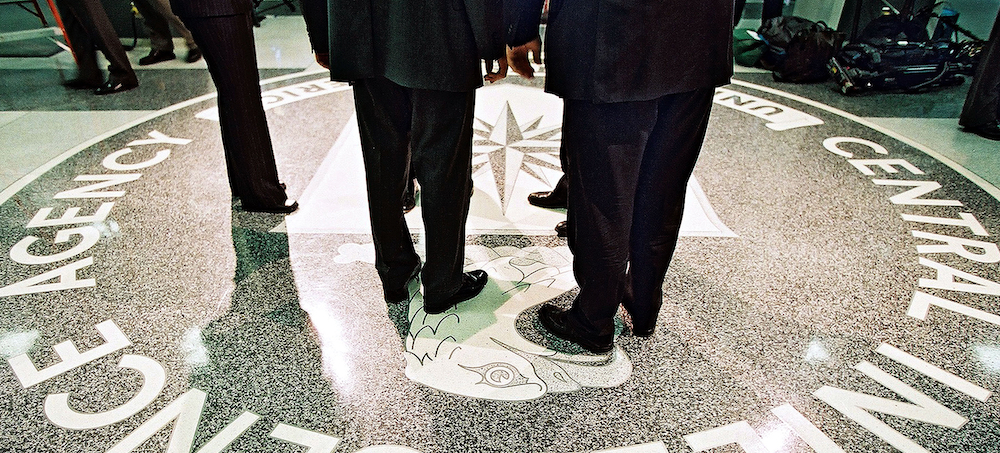
The CIA has operated above the law and resisted accountability throughout the century, and now we find out it’s been operating an illegal domestic spying program for years.
It’s food for thought ever since we learned last Thursday that the CIA has been carrying out its own bulk surveillance program that crossed over to the domestic front, stretching, if not outright violating, the legal ban on the agency carrying out domestic operations. The revelation came from a April 2021 letter, made public on Thursday, from Senators Ron Wyden (D-OR) and Martin Heinrich (D-NM), calling on the CIA to make “extensive declassifications” about the program, along the lines of earlier declassifications of NSA and FBI spying programs.
While the letter is heavily redacted, it gives us some strands of information. The senators run through the history, entirely blacked out, of Congress’ attempts “to limit and, in some cases, prohibit the warrantless collection of Americans’ records,” and notes that the CIA’s bulk data collection was going on “throughout this period.” This suggests the agency was collecting data on Americans at least as early as May 2014, when the House passed the USA Freedom Act to rein in NSA surveillance, and possibly even earlier when the bill was first introduced in October 2013.
The letter also charges that the program was run “entirely outside the statutory framework that Congress and the public believe govern this collection, and without any of the judicial, congressional or even executive branch oversight that comes with FISA collection.” In other words, the CIA program doesn’t even have the patina of oversight that other mass surveillance programs do, where the court established by the Foreign Intelligence Surveillance Act (FISA), meant to act as a watchdog, effectively serves as a rubber stamp that routinely allows all manner of oversteps.
Finally, the letter notes, “this basic fact has been kept from the public and from Congress,” and the “nature and full extent of the CIA’s connection was withheld even from the Senate select committee on intelligence.” Translation: not only was the CIA keeping this dubious program hidden from the public, it was misleading the very elected representatives the public entrusts with keeping an eye on this kind of thing.
We have too little information at this stage to say much more about the program. For its part, the CIA has insisted it kept Congress “fully and currently informed” about the program, which it casts as merely incidental collection of Americans’ data in the course of spying on foreigners. In simple terms, that means that while eavesdropping on or otherwise surveilling a target, the agency happened to collect the data of any American who was communicating with that target, whether via email, phone, or something else.
But the language of Wyden and Heinrich is far less sanguine. The two senators warn that Americans’ privacy concerns “also apply to how the CIA collects and handles information” in this program, and that there are “serious problems associated with warrantless backdoor searches of Americans.”
Sure enough, one of the documents released by the agency in response to the letter, a set of recommendations from the Privacy and Civil Liberties Oversight Board (PCLOB), notes that CIA analysts “are not required to memorialize the justification for their queries” into Americans — write down why they felt the need, and what gave them the right, to look at Americans’ data, in other words. “As a result, auditing or reviewing U.S. Person (USP) queries is likely to be challenging and time-consuming,” the PCLOB notes.
Whose word should we take on this? On one side we have the CIA, which, as former officer John Kiriakou has explained, puts deceit at the core of its operation, with agents “trained to lie all of the time.” On the other, we have Wyden, who is far from an alarmist or bomb-thrower, and if anything, errs on the side of institutionalism. For years, Wyden was tight-lipped about the shocking truth of the NSA’s bulk surveillance, refusing to breach his oath of confidentiality as a member of the Senate intelligence committee, even as the government flouted the law. He refused even to publicly correct then-Director of National Intelligence James Clapper, when he flagrantly lied under oath about the surveillance.
As that episode reminds us, this particular overreach is only the latest case of spy agencies, and the CIA in particular, acting in a way that’s above the law and contemptuous of oversight. The past two decades alone, we’ve seen the agency torture some folks (a violation of US law), lie to Congress about that torture, then later snoop on Senate staffers compiling a damning report about it, which its director also lied about once it was revealed to the public.
There should be a bipartisan push to, first, fully inform the public about this program, and then rein in both the CIA’s domestic spying and the agency as a whole. This should be a no-brainer for anyone across the political spectrum. Do conservatives really want the agency that spent years feuding with and trying to undermine their favorite president scooping up Americans’ private information with seemingly no oversight? And with Donald Trump having at least a fifty-fifty shot to win in 2024 or later, are liberals really comfortable with him and whomever he picks to head the CIA inheriting this program, especially after what we saw throughout 2020?
We wouldn’t know the full scope of Iraq War atrocities if Chelsea Manning hadn’t leaked documents to Julian Assange. We wouldn’t know about the NSA’s mass data collection if Edward Snowden hadn’t leaked documents to Glenn Greenwald. And we didn’t know about this CIA program until two senators released a letter to the public about it. Just imagine what else we don’t know.
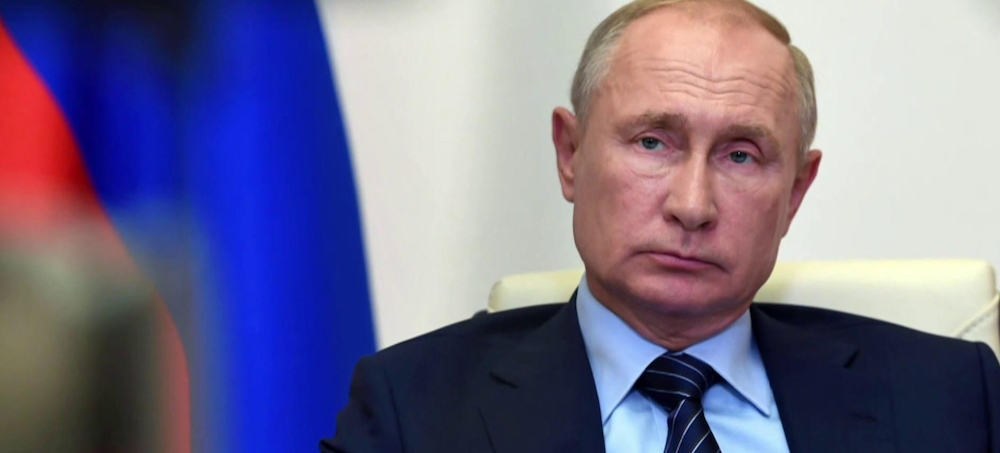 Vladimir Putin. (photo: Today)
Russian president signals prospect of talks with west as military buildup leaves world guessing about possible invasion
In a meeting in the Kremlin, the foreign minister, Sergei Lavrov, told Putin he believed there was still room for dialogue on Russian requests for a new security deal with the west, which have been made as Russia amassed 140,000 troops around Ukraine’s borders in recent weeks.
“It seems to me that our possibilities are far from being exhausted. They certainly should not continue indefinitely. But at this stage I would suggest that they continue and be intensified,” Lavrov told Putin.
Putin, who has taken to holding meetings with extreme social distancing owing to a fear of contracting Covid, gave his assent from the other end of an extremely long table.
The footage released from the meeting appeared carefully choreographed to send a message about Kremlin thinking.
“We warn against endless conversations on issues that need to be resolved today. Still, as the foreign minister, I should say that there is always a chance,” said Lavrov.
At the same time, a senior Russian diplomat told the Guardian that Russia would be within its rights to “counterattack” against Ukraine if it felt Kyiv was threatening the population of eastern Ukraine.
“We will not invade Ukraine unless we are provoked to do that,” said Vladimir Chizhov, Russia’s ambassador to the EU, in an interview in Brussels.
“If the Ukrainians launch an attack against Russia, you shouldn’t be surprised if we counterattack. Or, if they start blatantly killing Russian citizens anywhere – Donbas or wherever,” he said.
Donbas is the region of eastern Ukraine where Russia has armed and funded an insurgency since 2014, and where the Kremlin has handed out hundreds of thousands of Russian passports. In January, US officials briefed journalists on intelligence they claimed showed that Russia was preparing a “false flag” incident that could be used as a pretext for an intervention.
In this context, Chizhov’s words about a Russian response to a Ukrainian attack will sound ominous to western officials, especially as there is no sign Ukraine currently has any desire to attack its much larger and more powerful neighbour.
Russia has massed an estimated 145,000 troops along various stretches of its border with Ukraine, in Belarus where joint military drills are taking place, and in Crimea, annexed from Ukraine in 2014.
US officials said over the weekend that Russia had accelerated plans for an invasion and could launch a full-scale land and air assault as soon as Wednesday.
On Monday, the secretary of state, Antony Blinken, announced that the last few US diplomats in the Kyiv embassy would move west to Lviv, “due to the dramatic acceleration in the buildup of Russian forces”.
On Saturday, a senior state department official told reporters that a handful of American diplomats would stay in the capital “to be able to continue working closely with the Ukrainian government and to be able to ensure we’ve got the best possible information for our senior leaders and the president about what’s happening broadly in society”.
The change of mind two days later suggests that US security assessments have darkened still further.
“We don’t take this sort of action without the most thorough deliberation,” the state department spokesperson, Ned Price, said. “We are basing our assessment on what we are seeing on the ground with our own eyes, which is a continued unprovoked Russian buildup on the border with Ukraine, and no accompanying evidence of the de-escalation. It is a distinct possibility, perhaps more real than ever before, that Russia may decide to proceed with military action.”
On Monday night, the state department advised US citizens to “depart immediately” from Belarus and the breakaway Moldovan region of Transnistria, “citing the unusual and concerning Russian military activity” along their borders with Ukraine.
The Pentagon spokesperson, John Kirby, said that Putin “continues to advance his military readiness”. Russian forces around Ukraine, Kirby said, were doing “the things you’d expect one to do if one was planning on a major military action.”
Western diplomatic efforts to avert an invasion continued on Monday, with the German chancellor, Olaf Scholz, in Kyiv.
“The sovereignty and territorial independence of Ukraine are non-negotiable,” said Scholz, speaking alongside Ukraine’s president, Volodymyr Zelenskiy, after a bilateral meeting.
On Tuesday, Scholz will meet Putin in Moscow, a week after France’s Emmanuel Macron also visited both capital cities in an attempt to seek paths for de-escalation. In five hours of one-on-one talks over dinner in the Kremlin, Putin is reported to have spent a long time lecturing Macron on historical Russian grievances.
Putin has claimed that Ukraine joining Nato would inevitably lead to war between Russia and the alliance.
On Monday morning, Ukraine’s ambassador to Britain, Vadym Prystaiko, said Kyiv may consider giving up its ambition of Nato membership if it would help de-escalate the situation. The foreign ministry quickly said Prystaiko’s words had been taken out of context and other officials also played down the remarks.
While most western officials believe Ukraine has little chance of joining Nato any time soon, they are reluctant to publicly rule out the possibility.
“The Russian government is turning something into a big political issue that isn’t really currently on the agenda,” Scholz said in Kyiv.
After the US warnings of imminent military action, diplomats from numerous countries, including the US, Canada and Australia have evacuated from Kyiv and are running small emergency diplomatic missions from the western city of Lviv.
Many European countries, where there is some scepticism about the US warnings, have decided to keep a diplomatic presence in Kyiv. The British ambassador has also remained in Kyiv, along with a core team.
“It’s a big mistake that some embassies moved to western Ukraine,” Zelenskiy said on Monday. “It’s their decision, but ‘western Ukraine’ doesn’t exist. It’s united Ukraine. If something happens, God forbid, it will happen everywhere.”
In a video released on Monday evening, Zelenskiy said he was declaring Wednesday, the day American officials briefed could be the start of military action, as a day of national unity.
Most scheduled flights to Ukraine continued to operate on Monday after the government announced a $592m (£437m) fund to help keep Ukraine’s airspace open, as some insurers refused to cover aircraft after the US warnings. The Dutch airline KLM has stopped all flights to Ukraine, while Lufthansa has said it is considering a suspension.
The low-cost airline SkyUp, which had to divert a plane to Moldova on Sunday after the company that owned the plane banned it from entering Ukrainian airspace, said it had resumed ticket sales after coming to an agreement with the Ukrainian government.
“Negotiations with insurers have been difficult and our foreign partners continue to regularly assess their own risks and monitor the situation,” the airline said in a statement.
Zelenskiy and other Ukrainian officials have repeatedly called for calm, saying they see the threat on the border but do not believe Russia will launch a full-scale invasion and that the apocalyptic US messaging is only serving to create panic and chaos economic chaos.
“Keep calm. Don’t panic. This is not 2014, Ukraine has become stronger and better organised,” said the interior minister, Denys Monastyrsky, in a video address on Monday.
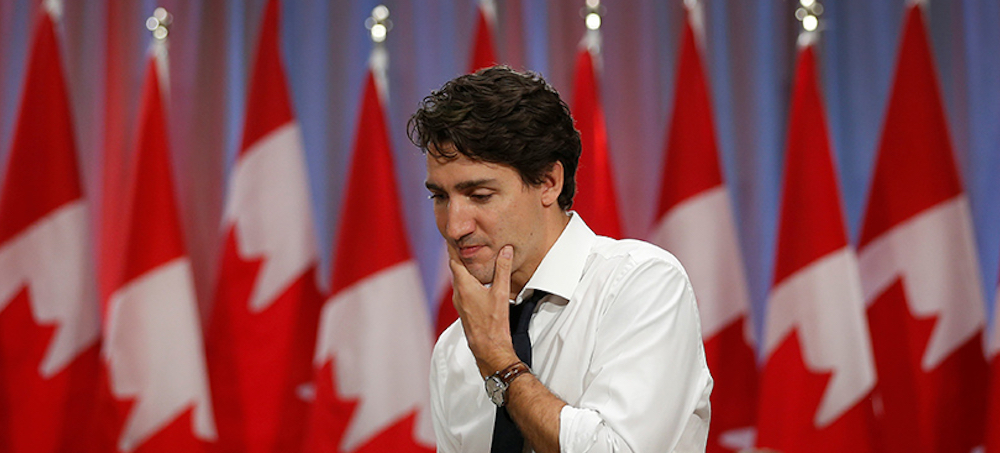 Canada's Prime Minister Justin Trudeau. (photo: Chris Wattie/Reuters)
In effecting the extraordinary powers, the federal government is moving forward with a wide-sweeping range of new measures to support the provinces, municipalities, and police forces currently facing continued demonstrations, but are also cracking down on some of the more systemic gaps exposed by the Freedom Convoy protests.
“Right now the situation requires additional tools not held by any other federal, provincial, or territorial law. Today, in these circumstances, it is now clear that responsible leadership requires us to do this,” the prime minister said on Monday, calling it a “last resort.”
Through these new powers the government is:
“I want to be very clear, the scope of these measures will be time-limited, geographically-targeted, as well as reasonable and proportionate to the threats they are meant to address,” Trudeau said, making it clear that for those still participating “the time to go home is now.”
The prime minister made the major announcement on Monday alongside Deputy Prime Minister and Finance Minister Chrystia Freeland, Justice Minister and Attorney General David Lametti, Public Safety Minister Marco Mendicino, and Emergency Preparedness Minister Bill Blair.
Speaking to the suite of unprecedented financial measures the government is taking, Freeland said the government is “following the money,” a reference to the controversial and largely halted fundraising efforts of convoy organizers that’s helped fuel their fight.
“We are today serving notice if your truck is being used in these illegal blockades, your corporate accounts will be frozen. The insurance on your vehicle will be suspended. Send your semi trailers home, the Canadian economy needs them to be doing legitimate work,” Freeland said.
“We cannot and will not allow illegal and dangerous activities to continue,” said the prime minister.
Moving ahead with the Emergencies Act comes after Trudeau consulted premiers and the Liberal caucus on Monday morning and spent part of his weekend in high-level federal meetings about enacting the never-before-used federal authorities.
The government will not be calling in the military—a move that has rarely been taken in the history of civilian demonstrations in this country—and if pursued down the line would happen separately through the National Defence Act.
“We are not preventing people from exercising their right to protest legally. We are reinforcing the principles, values and institutions that keep all Canadians free,” Trudeau said.
HOW THE COUNTRY GOT HERE
Blair first signalled that this move was coming on Sunday, telling CTV News that the government was prepared to step in once the situation exceeded what the provinces could handle, calling the situation a “significant national security threat.”
While the Ambassador Bridge in Windsor, Ont. has reopened, other border blockades persist including in Coutts, Alta. and Emerson, Man. Since Jan. 28, downtown Ottawa remains occupied with emboldened participants undeterred by the threats of “severe” consequences in the face of minimal police enforcement of the layers of laws, injunctions, and emergency orders already in effect.
On Monday, Mendicino described some of the scenes that have played out on Wellington Street in recent days as “completely lawless.”
Trudeau said it was evident there has been “serious challenges to law enforcement's ability to effectively enforce the law.”
On Monday, as the government was readying to enact the Act, trucks were on the move in the downtown core, condensing their presence in the parliamentary precinct. Acts of defiance and desecration persisted, with crowds blaring loud freedom-themed music and declaring the police-coined “red zone” that Ottawa Mayor Jim Watson has said the city has lost control of, their “home.”
“Here in our capital city, families and small businesses have been enduring illegal obstruction of their neighborhoods, occupying streets, harassing people, breaking the law. This is not a peaceful protest,” Trudeau said, promising financial support for the businesses who have been impacted.
“At the borders in different parts of the country, the blockades are harming our economy, and endangering public safety, critical supply chains have been disrupted,” Trudeau said.
Amid considerable international attention and endorsements from prominent Republican figures in the United States, Canadian Border Services Agency has been turning back non-Canadians trying to enter Canada to participate in blockades.
Some protesters CTV News has spoken to throughout the demonstrations in Ottawa have compared their permit-less and prolonged disruption to a wintertime Canada Day, and have expressed a willingness to stand their ground at all costs until all COVID-19 vaccine mandates and other public health restrictions are ended.
News of the Emergencies Act being in play did not appear to prompt any new concern, with convoy organizer Tamara Lich urging protesters and truckers to stand their ground.
“There are no threats that will frighten us. We will hold the line,” Lich said Monday at a press conference. “To our truckers and friends on Parliament Hill, do not give into fear and threats. Your courage has already exceeded all of our expectations and inspired an international movement. Be strong, show kindness. Love will always defeat hate. Hold the line.”
REACTION FROM PREMIERS, LEADERS
While provincial leaders are mixed on whether this extraordinary step is necessary to quell the demonstrations that are now stretching into their third week in the nation’s capital and impacting key Canada-U.S. border crossings, Trudeau said while the Act covers the entire country, the powers will only apply to regions that need them.
Ontario Premier Doug Ford declared a state of emergency in the province on Friday, invoking new emergency measures to levy stiffer fines and penalties on protesters, including a maximum penalty of $100,000 and up to a year imprisonment for non-compliance. “These occupiers, they're doing the total opposite of what they say they're there to do,” Ford said.
Alberta Premier Jason Kenney, however, is opposed to using the Act, saying the province has what it needs to address the Coutts, Alta. blockade that has been in place nearly as long as the Ottawa protesters. Joining him in opposition to this move are the premiers of Quebec, Saskatchewan and Manitoba.
“The view I have, which I conveyed to the prime minister… is that this is not necessary, at least for an Alberta context,” Kenney said, adding that he thinks Trudeau doing this will further inflame and potentially prolong the protests.
Trudeau said he also briefed opposition party leaders about these plans he says are aimed at protecting Canadians and “restoring confidence in our institutions.”
Though, interim Conservative Leader Candice Bergen—in the job less than two weeks after her predecessor Erin O’Toole was ousted by caucus in the midst of the protests—said consultation is not the same as collaboration.
“There are a number of things that the prime minister could have done. He certainly didn't help the situation by calling them names, by saying that their opinions were not acceptable… He continually escalated and inflamed the situation,” said Bergen, who has been among the more vocal Conservative supporters of the convoy protests, the only party in the House of Commons to take this stance.
Ahead of the announcement, NDP Leader Jagmeet Singh characterized enacting federal emergency measures as a failure of leadership, but said he supports enacting the exceptional authorities.
“The reason why we got to this point is because the prime minister let the siege of Ottawa go on for weeks and weeks without actually doing anything about it. [He] allowed the convoy to shut down borders without responding appropriately, and in doing so, has allowed the convoy to dig in, to get entrenched, to allow them to spread across the country,” Singh said.
POWERS EXPIRE IN 30 DAYS
Formerly known as the War Measures Act, the current iteration of the Emergencies Act passed in 1988 and has never been used, until now.
The last time these federal emergency powers were invoked under the then-War Measures Act was during the 1970 FLQ October Crisis, when Trudeau's father was the prime minister and was facing down domestic terrorists.
Federal officials will have to outline in a declaration why it feels the powers are needed given the circumstances on the ground.
This, and a motion for confirmation of the declaration of emergency, has to be presented within seven days to both the House and Senate. A cross-party and closed-door Parliamentary Review Committee will also be struck.
“Having now declared a public order emergency, we will table the declaration in Parliament as required,” Lametti said Monday, telling reporters the government is confident the clear conditions that needed to be met in order to declare a public order emergency have been met.
Once a declaration of a public order emergency is issued, it is considered in effect, and unless the declaration is revoked by Parliament or extended, it will expire after 30 days.
Lametti said it is the government’s hope that they can revoke the emergency order “much sooner.”
MPs are set to adjourn for a week on Friday and the Senate is not currently sitting until Feb. 22 so it’s possible one or both Chambers will have to be recalled to consider the declaration. The timeline for parliamentarians being engaged was still being worked out as of Monday evening.
Within 60 days of the declaration of emergency being expired or revoked, the government will have to convene an inquiry to study the use of the powers. The report stemming from this work will have to then be presented to Parliament within 360 days.
 A police officer. (photo: Adobe Stock)
ALSO SEE: Outrage as San Francisco Police Use Woman's DNA
From Rape Kit to Link Her to Later Crime
Boudin, who revealed details of his findings in an interview with The San Francisco Chronicle, said his office became aware of the practice last week when the San Francisco Police Department used DNA it had collected from a woman years ago as part of a rape exam in order to connect her to a recent felony property crime.
“Public safety demands that we support sexual assault survivors and end any practices that dissuade them from coming forward,” Boudin tweeted.
Rape kits are collected when a victim comes forward about a sexual assault crime. In the process of compiling the kit, an examiner gathers bodily fluids from the survivor to test for any evidence their attacker may have left behind.
Boudin says SFPD has been entering survivors’ DNA into a database to compare it to evidence from other crime scenes. His office is not aware of how many times a victim’s rape kit DNA has been used to arrest them, he said, but added that the database may hold thousands of victims’ DNA information collected over “many, many years.”
The SFPD reported more than 200 rape cases in San Francisco in 2021.
Police Chief Bill Scott told the Chronicle that he agrees that the issue Boudin raised is “sufficiently concerning” and said his staff is reviewing the matter.
Authorities “must never create disincentives for crime victims to cooperate with police,” he said, “and if it’s true that DNA collected from a rape or sexual assault victim has been used by SFPD to identify and apprehend that person as a suspect in another crime, I’m committed to ending the practice.”
SFPD has previously come under fire for mishandling rape cases, as have many police departments nationwide. Multipletimes in recent years, women have come forward with allegations that SFPD did not take their sexual assault cases seriously. The accusations eventually led to findings that the department had failed to test more than 700 rape kits from 2003-2013.
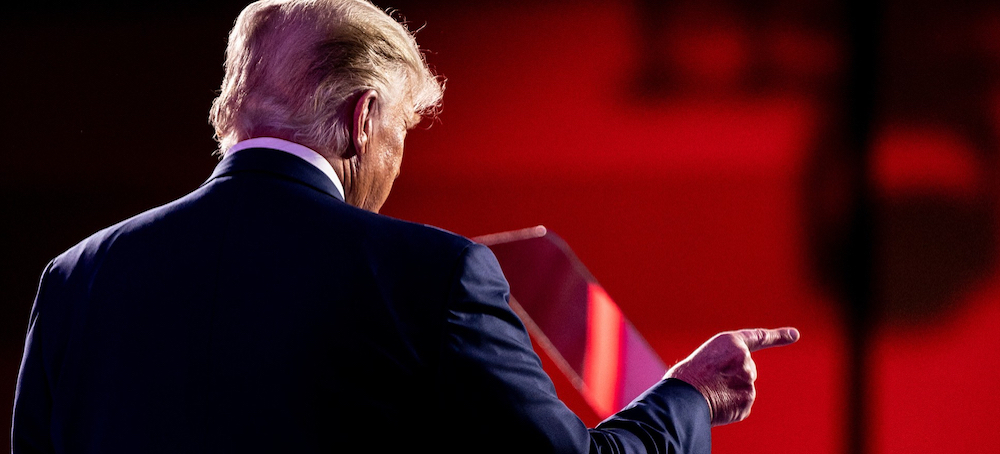 Donald Trump. (photo: Erin Schaff/NYT/Redux)
A Trumpist takeover of the battleground state is raising eyebrows over concerns of the end of ‘free and fair elections’
Trump and his allies are backing numerous candidates in the coming midterm elections across the US, including in other vital states like Arizona and Georgia.
But his intervention in Michigan raises particular eyebrows due to its role in helping Trump to win in 2016, before flipping back to the Democrats in 2020 and helping oust him from office.
The former US president and his close ally Mike Lindell, the My Pillow CEO, are giving strong backing to a Michigan lawyer and key promoter of debunked election fraud charges who is seeking the Republican nod to be the state’s next attorney general.
Trump plans to hold a fundraiser for lawyer Matthew DePerno on 8 March at his Florida Mar-a-Lago club, where Lindell told the Guardian he will speak to boost DePerno’s chances to be the Republican to take on Michigan’s Democratic attorney general, Dana Nessel.
Kristina Karamo, a community college professor who also peddled conspiracy theories about election fraud, and who never held elected office, has received Trump’s backing to be the Republican secretary of state candidate to challenge incumbent Democrat Jocelyn Benson in the fall elections.
The secretary of state plays a crucial role in overseeing elections, and Trump loyalists are investing heavily to capture several of these posts this year.
And early this month, Trump spoke at a fundraiser at Mar-a-Lago for the gubernatorial campaign of conservative commentator and business woman Tudor Dixon who has backed a vaguely defined “forensic audit” of the state’s election results which Joe Biden won by 154,000 votes.
Although Trump called Dixon “very special”, he is not yet made an official endorsement and she is one of 12 Republican candidates seeking to be the next governor.
Trump’s varying embraces of DePerno, Karamo and Dixon is emblematic of how he is helping candidates who repeat his false charges that he lost due to widespread fraud, and who could potentially help Trump sway results in key states should he run again in 2024.
According to a report from the election watchdog group States United Action, at least 11 candidates who have denied the 2020 results are valid are running for attorney-general posts in 10 states, and at least 21 election deniers are trying to win secretary of state races in 18 states, as of the end of January.
“Statewide leaders from both parties who protected the will of the voters in 2020 are being challenged by election deniers,” said Joanna Lydgate, the chief executive of States United Action. “Those candidates are campaigning on lies and conspiracy theories in determining whether the will of the voters is upheld – a dangerous contradiction.”
Both DePerno and Karamo have already garnered checks for $5,000 from a Trump Super Pac, according to public records. A Michigan Republican convention in April will decide which candidates get on the fall ballot to take on Democratic opponents, and an August Republian primary will choose the party’s gubernatorial candidate to oppose incumbent Gretchen Whitmer.
The Trump Super Pac overall backed a total of 14 Michigan candidates who challenged the 2020 results and roped in $65,000 from the Pac – more than any other state except Texas – according to campaign data.
DePerno’s candidacy has been especially controversial given his legal efforts promoting false fraud charges in a lawsuit against 23,000-person Antrim county. The DePerno lawsuit, which was filed on behalf of a local realtor, sought to obtain a forensic audit, but was rejected last May when a judge noted that an audit had been done and dismissed the suit which alleged election machines were purposely designed to produce fraud.
Antrim county, a Republican stronghold, was won by Trump after a preliminary tally that Biden won the county was quickly found wrong due to a clerical error, and corrected.
Some of DePerno’s fundraising to help fund audits in Michigan and Arizona, and apparently pay for personal legal expenses, have prompted scrutiny for their size and unknown donors.
One “Election Fraud Defense Fund” that DePerno used reportedly raked in $384,000 as of last July, and had an overall goal of $1m, some of which was expected to pay for a Michigan audit.
Lindell told the Guardian he has not donated funds to DePerno’s legal efforts or campaign and that he met DePerno when the lawyer was featured in Lindell’s film Absolute Proof, which early last year drew criticism for promoting dubious theories about the 2020 election results.
After the movie came out, DePerno and his family received “threats”, according to Lindell, which prompted him to give the lawyer “about $20,000 for security”.
Lindell has endorsed other candidates for attorney-general and governor posts in states such as Arizona, Georgia and Texas who echo Trump’s false claims of widespread fraud in the 2020 election.
When Trump endorsed DePerno last fall, he dubbed him a “super lawyer”, claiming falsely that he “exposed so much fraud in Antrim county, and many more places, in the 2020 elections”.
The Trump bash next month at Mar-a-Lago to help DePerno could raise tens of thousands of dollars for his campaign coffers, according to reported ticket prices. For $25,000, a donor can get a photo standing next to Trump and DePerno, while for $10,000 an attendee can have a photo taken next to Lindell and DePerno.
Those funds could prove useful: a Detroit News poll last month showed DePerno running behind Tom Leonard, who Nessel defeated in 2018, and who is hoping to challenge her again. According to the poll, Nessel led Leonard and DePerno.
Although Trump’s backing for DePerno seems to have drawn the most scrutiny, Karamo and Dixon have also generated controversies.
Karamo has said that Trump was the real winner of Michigan in 2020, and used her podcast on 7 January to push conspiratorial and false charges that far-left anarchists led the assault on the Capitol.
Last October, Karamo was one of several secretary of state candidates from various states who have embraced Trump’s election lies to speak at a Las Vegas meeting that featured people with QAnon conspiracy links.
Although Trump hasn’t formally endorsed Dixon, who has worked in sales and customer service at a steel company her father launched, Dixon has made no secret of her backing for Trump and hopes that he will bless her campaign.
“I think that we would be kidding ourselves if we didn’t say that his endorsement will absolutely frame every race in America,” she said last August.
Other Republican gubernatorial aspirants are also angling for Trump’s backing, including ex-Detroit police chief James Craig, who met with Trump last fall.
With Trump-backed candidates competing in Michigan and many other states, Lydgate of States United Action warned that it’s not a given any more that candidates for high office believe in “free and fair elections … the American people need to pay close attention to those races”.
 Protesters march on 60th Street in Sudan's capital, Khartoum. (photo: Getty Images)
At least one protester has been killed, medics say, as thousands rally to demand the release of prisoners and reject military rule.
Sudanese security forces fired tear gas as protesters rallied against the October 25 military takeover led by army chief General Abdel Fattah al-Burhan. Demonstrators in the capital Khartoum and its twin city of Omdurman also demanded the release of several political figures and pro-democracy activists arrested amid a crackdown on opposition groups.
“A male protester whose identity is yet to be known, has been killed by a cartridge in the neck … chest, fired by security forces while participating in today’s anti-coup march in Khartoum city,” the Central Committee of Sudan Doctors (CCSD) said in a statement on Monday.
The latest death takes the number of civilians killed in the crackdown since last year’s coup to at least 80, it added.
The military and police say they allow peaceful protest, that members of the security forces have had to defend themselves, and that casualties are being investigated.
Regular mass protests have rocked the troubled northeast African nation since the coup. The power grab derailed a fragile power-sharing agreement between the army and civilians negotiated after the 2019 ouster of longtime leader Omar al-Bashir, and despite international pressure, authorities have shown little inclination to compromise, as arrests of civilian leaders have proliferated lately.
Al Jazeera’s Hiba Morgan, reporting from Omdurman, said people gathered once again to voice their condemnation and anger at Sudan’s military rulers.
Protesters say they have been demanding “no negotiation with the military, no compromise, and that the military should return to the barracks”, Morgan said.
In Omdurman, protesters had planned to march to the legislative assembly to “show the military that they want a civilian government”.
Protests also took place in the eastern city of Port Sudan and in the western Darfur region, according to witnesses.
In Khartoum, protesters carried Sudanese flags and red balloons as well as banners that read: “Today is the nation’s love day” as the rallies coincided with Valentine’s Day.
Detentions
Since the coup, authorities have arrested dozens of activists who belong to so-called resistance committees that have been instrumental in organising protests.
“The number of people detained arbitrarily and without criminal charges has exceeded 100,” the Sudanese Professionals Association said on Monday.
The group, which also calls for anti-coup protests, said the detainees are aged between 16 and 60.
On Sunday, Sudanese authorities arrested Mohamed al-Faki, a civilian former member of the ruling Sovereign Council, which led the country under the 2019 power-sharing agreement.
Last week, authorities arrested ex-minister Khaled Omar Youssef and Wagdi Saleh, the spokesman of Sudan’s main civilian bloc, the Forces for Freedom and Change (FFC).
Those arrests came just a day after they joined an FFC delegation for talks with United Nations special representative Volker Perthes, as part of efforts launched last month to resolve Sudan’s deepening crisis.
Separately, detainees in Soba prison in Khartoum’s periphery began a hunger strike to protest against prison conditions, the CCSD said.
“Some have been detained without facing charges and others still await investigations,” this group said in a statement.
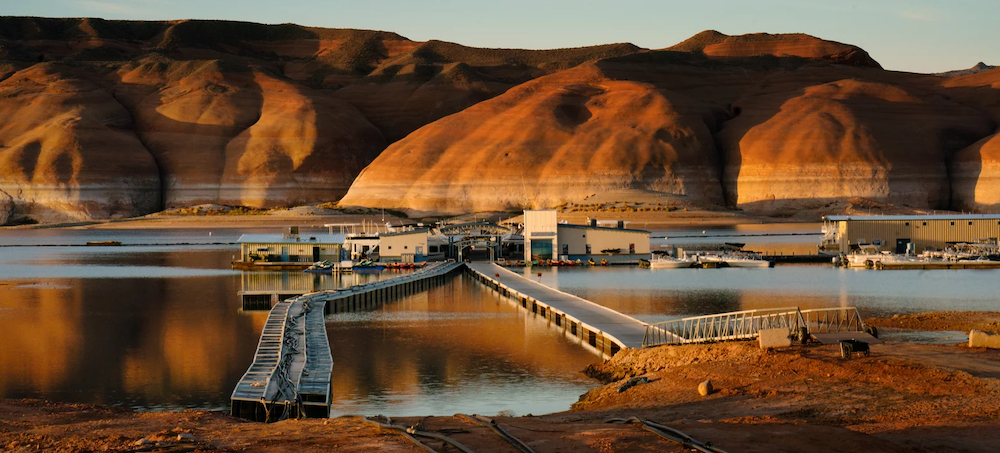 Water levels at Lake Powell, the United States' second-largest reservoir, have dropped by more than 150 feet during the ongoing megadrought. (photo: Claire Harbage/NPR)
The Western U.S. and northern Mexico are experiencing their driest period in at least 1,200 years, according to the new study, published in the journal Nature Climate Change. The last comparable — though not as severe — multidecade megadrought occurred in the 1500s, when the West was still largely inhabited by Native American tribes.
Today, the region is home to tens of millions of people, massive agricultural centers and some of the fastest-growing cities in the U.S. — all in an area where there's less water available than there was in the past, partially due to human-caused climate change.
"We have a society that's relying on there being the amount of water there was in the 1900s," said the study's lead author, Park Williams, a bioclimatologist at the University of California, Los Angeles. "But now with the number of water molecules available to us declining, it really is time for us to get real about how much water there is for us to use."
Williams looked at tree ring data from thousands of sites to conduct the research. The researchers sampled data collected from live trees, dead trees and wood beams preserved at Native American archeological sites. The tree rings gave Williams insight into drought events dating back to A.D. 800, around the time Charlemagne was being crowned emperor of Rome.
He identified four other megadroughts in that time period, the most notable being a 23-year drought that ended in the late 1500s. There were hopes during a wet 2019 that the current megadrought was following a similar pattern, Williams said.
"And then from summer 2020 through all of 2021, it was just exceptionally dry across the West ... indicating that this drought is nowhere near done."
It's time to "pull out all the stops" and plan for less water
Western water managers were again hopeful for a change at the beginning of this winter. In December, California's Sierra Nevada had record-breaking snowfall, and big snowstorms blanketed the northern Rockies. But a hot, dry start to the year has since dropped snowpack levels to below average in many places.
Lake Mead and Lake Powell, the country's two largest reservoirs, are filled at only about one-third of their total capacity. Communities, ranchers and farmers have depleted groundwater stores to meet demands.
Federal water managers declared the first-ever water shortage along the Colorado River last year, triggering cuts to some of the river's 40 million users. It was a recognition "that the hydrology that was planned for years ago — but we hoped we would never see — is here," said Bureau of Reclamation Commissioner Camille Touton.
"The Colorado River Basin no longer has the privilege of time," said Kim Mitchell, senior water policy adviser at Western Resource Advocates, an environmental nonprofit, after hearing about the new research. "It's imperative for water managers in the West to incorporate a smaller [Colorado] River into future operations and pull out all the stops in scaling up basin-wide conservation. Incremental solutions just won't be enough."
Human-caused climate change contributes to drought
Existing management guidelines for the Colorado River are set to expire in 2026. The seven states that draw from the watershed are negotiating with the federal government, Native American tribes and Mexico over what future management should look like.
Last December, Nevada, Arizona and California agreed to take less water from the Colorado River in an effort to prop up Lake Mead, and more cuts could follow.
"This is a wake-up call for everyone," Adel Hagekhalil, general water manager for the Metropolitan Water District of Southern California, told KUNC. "For all of us. We are facing a new normal when it comes to climate change."
Williams, the study author, said roughly one-fifth of the current megadrought can be attributed to human-caused climate change. Greenhouse gas emissions are warming the world, speeding evaporation and disrupting weather patterns.
He described water patterns in the West as a yo-yo — sometimes high, sometimes low. Climate change has put that yo-yo on an escalator heading down, he said, "and we cannot let ourselves get tricked by a few wet years into giving up on the progress we've been making."
"We actually have to change our relationship with water."
Follow us on facebook and twitter!
PO Box 2043 / Citrus Heights, CA 95611
LOTS OF POSTS IGNORED BY BLOGGER..... OR REMOVED ON THEIR WHIM! ALL POSTS ARE AVAILABLE ON MIDDLEBORO REVI...