Showing posts with label PENTAGON PAPERS. Show all posts

Wednesday, June 12, 2024

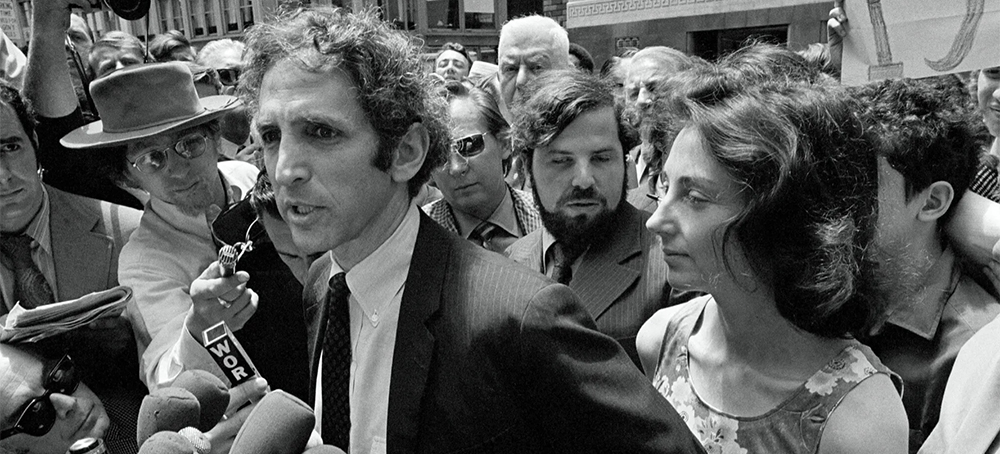
The Lasting Legacy of Truth-Teller Daniel Ellsberg


The Lasting Legacy of Truth-Teller Daniel Ellsberg

( Tomdispatch.com ) – On a warm evening almost a decade ago, I sat under the stars with Daniel Ellsberg while he talked about nuclear war with alarming intensity. He was most of the way through writing his last and most important book, The Doomsday Machine: Confessions of a Nuclear War Planner. Somehow, he had set aside the denial so many people rely on to cope with a world that could suddenly end in unimaginable horror. Listening, I felt more and more frightened. Dan knew what he was talking about.

After working inside this country’s doomsday machinery, even drafting nuclear war plans for the Pentagon during President John F. Kennedy’s administration, Dan Ellsberg had gained intricate perspectives on what greased the bureaucratic wheels, personal ambitions, and political messaging of the warfare state. Deceptions about arranging for the ultimate violence of thermonuclear omnicide were of a piece with routine falsehoods about American war-making. It was easy enough to get away with lying, he told me: “How difficult is it to deceive the public? I would say, as a former insider, one becomes aware: it’s not difficult to deceive them. First of all, you’re often telling them what they would like to believe — that we’re better than other people, we’re superior in our morality and our perceptions of the world.”

Dan had made history in 1971 by revealing the top-secret Pentagon Papers, exposing the constant litany of official lies that accompanied the U.S. escalation of the Vietnam War. In response, the government used the blunderbuss of the World War I-era Espionage Act to prosecute him. At age 41, he faced a possible prison sentence of more than 100 years. But his trial ended abruptly with all charges dismissed when the Nixon administration’s illegal interference in the case came to light in mid-1972. Five decades later, he reflected: “Looking back, the chance that I would get out of 12 felony counts from Richard Nixon was close to zero. It was a miracle.”

That miracle enabled Dan to keep on speaking, writing, researching, and protesting for the rest of his life. (In those five decades, he averaged nearly two arrests per year for civil disobedience.) He worked tirelessly to prevent and oppose a succession of new American wars. And he consistently gave eloquent public support as well as warm personal solidarity to heroic whistleblowers — Thomas Drake, Katharine Gun, Daniel Hale, Matthew Hoh, Chelsea Manning, Edward Snowden, Jeffrey Sterling, Mordechai Vanunu, Ann Wright, and others — who sacrificed much to challenge deadly patterns of official deceit.

Unauthorized Freedom of Speech

Dan often spoke out for freeing WikiLeaks publisher Julian Assange, whose work had revealed devastating secret U.S. documents on America’s wars in Afghanistan and Iraq. At the end of a visit in June 2015, when they said goodbye inside Ecuador’s embassy in London, I saw that both men were on the verge of tears. At that point, Assange was three years into his asylum at that embassy, with no end in sight.

Secretly indicted in the United States, Assange remained in the Ecuadorian embassy for nearly four more years until London police dragged him off to prison. Hours later, in a radio interview, Dan said: “Julian Assange is the first journalist to be indicted. If he is extradited to the U.S. and convicted, he will not be the last. The First Amendment is a pillar of our democracy and this is an assault on it. If freedom of speech is violated to this extent, our republic is in danger. Unauthorized disclosures are the lifeblood of the republic.”
Unauthorized disclosures were the essence of what WikiLeaks had published and what Dan had provided with the Pentagon Papers. Similarly, countless exposés about U.S. government war crimes became possible due to the courage of Chelsea Manning, and profuse front-page news about the government’s systematic violations of the Fourth Amendment resulted from Edward Snowden’s bravery. While gladly publishing some of their revelations, major American newspapers largely refused to defend their rights.

Such dynamics were all too familiar to Dan. He told me that the attitude toward him of the New York Times, which won a Pulitzer Prize with its huge Pentagon Papers scoop, was akin to a district attorney’s view of a “snitch” — useful but distasteful.

In recent times, Dan detested the smug media paradigm of “Ellsberg good, Snowden bad.” So, he pushed back against the theme as rendered by New Yorker staff writer Malcolm Gladwell, who wrote a lengthy piece along those lines in late 2016. Dan quickly responded with a letter to the editor, which never appeared.

The New Yorker certainly could have found room to print Dan’s letter, which said: “I couldn’t disagree more with Gladwell’s overall account.” The letter was just under 300 words; the Gladwell piece had run more than 5,000. While promoting the “Ellsberg good, Snowden bad” trope, the New Yorker did not let readers know that Ellsberg himself completely rejected it:

“Each of us, having earned privileged access to secret information, saw unconstitutional, dangerously wrong policies ongoing by our government. (In Snowden’s case, he discovered blatantly criminal violations of our Fourth Amendment right to privacy, on a scale that threatens our democracy.) We found our superiors, up to the presidents, were deeply complicit and clearly unwilling either to expose, reform, or end the wrongdoing.

“Each of us chose to sacrifice careers, and possibly a lifetime’s freedom, to reveal to the public, Congress, and the courts what had long been going on in secret from them. We hoped, each with some success, to allow our democratic system to bring about desperately needed change.

“The truth is there are no whistleblowers, in fact no one on earth, with whom I identify more closely than with Edward Snowden.

“Here is one difference between us that is deeply real to me: Edward Snowden, when he was 30 years old, did what I could and should have done — what I profoundly wish I had done — when I was his age, instead of 10 years later.”

As he encouraged whistleblowing, Dan often expressed regret that he hadn’t engaged in it sooner. During the summer of 2014, a billboard was on display at bus stops in Washington, D.C., featuring a quote from Dan — with big letters at the top saying “DON’T DO WHAT I DID. DON’T WAIT,” followed by “until a new war has started, don’t wait until thousands more have died, before you tell the truth with documents that reveal lies or crimes or internal projections of costs and dangers. You might save a war’s worth of lives.” Two whistleblowers who had been U.S. diplomats, Matthew Hoh and Ann Wright, unveiled the billboard at a bus stop near the State Department.

A Grotesque Situation of Existential Danger

Above all, Daniel Ellsberg was preoccupied with opposing policies that could lead to nuclear war. “No policies in human history have more deserved to be recognized as immoral. Or insane,” he wrote in The Doomsday Machine. “The story of how this calamitous predicament came about and how and why it has persisted for over half a century is a chronicle of human madness.”

It’s fitting that the events set for Daniel Ellsberg Week (ending on June 16th, the first anniversary of when Dan passed away) will include at least one protest at a Northrop Grumman facility. That company has a $13.3 billion contract to develop a new version of an intercontinental ballistic missile (ICBM), which — as Dan frequently emphasized — is the most dangerous of all nuclear weapons. He was eager to awaken Congress to scientific data about “nuclear winter” and the imperative of shutting down ICBMs to reduce the risks of nuclear war.

Five years ago, several of us from the Institute for Public Accuracy hand-delivered paperbacks of The Doomsday Machine — with a personalized letter from Dan to each member of the House and Senate — to all 535 congressional offices on Capitol Hill. “I am concerned that the public, most members of Congress, and possibly even high members of the Executive branch have remained in the dark, or in a state of denial, about the implications of rigorous studies by environmental scientists over the last dozen years,” Dan wrote near the top of his two-page letter. Those studies “confirm that using even a large fraction of the existing U.S. or Russian nuclear weapons that are on high alert would bring about nuclear winter, leading to global famine and near extinction of humanity.”

Dan’s letter singled out the urgency of one “immediate step” in particular: “to eliminate entirely our redundant, vulnerable, and destabilizing land-based ICBM force.” Unlike air-launched and sea-based nuclear weapons, which are not vulnerable to attack, the ICBMs are vulnerable to a preemptive strike and so are “poised to launch” on the basis of “ten-minute warning signals that may be — and have been, on both sides — false alarms, which press leadership to ‘use them or lose them.’”

As Dan pointed out, “It is in the power of Congress to decouple the hair-trigger on our system by defunding and dismantling the current land-based Minuteman missiles and rejecting funding for their proposed replacements. The same holds for lower-yield weapons for first use against Russia, on submarines or in Europe, which are detonators for escalation to nuclear winter.”

In essence, Dan was telling members of Congress to do their job, with the fate of the earth and its inhabitants hanging in the balance:

“This grotesque situation of existential danger has evolved in secret in the almost total absence of congressional oversight, investigations, or hearings. It is time for Congress to remedy this by preparing for first-ever hearings on current nuclear doctrine and ‘options,’ and by demanding objective, authoritative scientific studies of their full consequences including fire, smoke, nuclear winter, and famine. Classified studies of nuclear winter using actual details of existing attack plans, never yet done by the Pentagon but necessarily involving its directed cooperation, could be done by the National Academy of Sciences, requested and funded by Congress.”

But Dan’s letter was distinctly out of sync with Congress. Few in office then — or now — have publicly acknowledged that such a “grotesque situation of existential danger” really exists. And even fewer have been willing to break from the current Cold War mindset that continues to fuel the rush to global annihilation. On matters of foreign policy and nuclear weapons, the Congressional Record is mainly a compendium of arrogance and delusion, in sharp contrast to the treasure trove of Dan’s profound insights preserved at Ellsberg.net.

Humanism and Realism to Remember

Clear as he was about the overarching scourge of militarism embraced by the leaders of both major parties, Dan was emphatic about not equating the two parties at election time. He understood that efforts like Green Party presidential campaigns are misguided at best. But, as he said dryly, he did favor third parties — on the right (“the more the better”). He knew what some self-described progressives have failed to recognize as the usual reality of the U.S. electoral system: right-wing third parties help the left, and left-wing third parties help the right.

Several weeks before the 2020 election, Dan addressed voters in the swing state of Michigan via an article he wrote for the Detroit Metro Times. Appearing under a headline no less relevant today — “Trump Is an Enemy of the Constitution and Must Be Defeated” — the piece said that “it’s now of transcendent importance to prevent him from gaining a second term.” Dan warned that “we’re facing an authoritarian threat to our democratic system of a kind we’ve never seen before,” making votes for Joe Biden in swing states crucial.

Dan’s mix of deep humanism and realism was in harmony with his aversion to contorting logic to suit rigid ideology. Bad as current realities were, he said, it was manifestly untrue that things couldn’t get worse. He had no intention of ignoring the very real dangers of nuclear war or fascism.

During the last few months of his life, after disclosing a diagnosis of inoperable pancreatic cancer, Dan reached many millions of people with an intensive schedule of interviews. Journalists were mostly eager to ask him about events related to the Pentagon Papers. While he said many important things in response to such questions, Dan most wanted to talk about the unhinged momentum of the nuclear arms race and the ominous U.S. frenzy of antagonism toward Russia and China lacking any sense of genuine diplomacy.

While he can no longer speak to the world about the latest developments, Dan Ellsberg will continue to speak directly to hearts and minds about the extreme evils of our time — and the potential for overcoming them with love in action.

A free documentary film premiering now, “A Common Insanity: A Conversation with Daniel Ellsberg About Nuclear Weapons,” concludes with these words from Dan as he looks straight at us: “Can humanity survive the nuclear era? We don’t know. I choose to act as if we have a chance.”

Via Tomdispatch.com

INFORMED COMMENT

About the Author

Tomdispatch is intended to introduce readers to voices and perspectives from elsewhere (even when the elsewhere is here). Its mission is to connect some of the global dots regularly left unconnected by the mainstream media and to offer a clearer sense of how this imperial globe of ours actually works. www.tomdispatch.com

Sunday, August 20, 2023

June 16, 2023 HEATHER COX RICHARDSON


Wednesday, June 21, 2023

FOCUS: Trevor Timm | Daniel Ellsberg Was One of History's Most Consequential Figures


Reader Supported News

Live on the homepage now!
Reader Supported News

FIRE AND BRIMSTONE FUNDRAISING — We are starting to see some donations come in. Thank you. We are a long way from where we need to be. I deeply regret that we have to go to these extraordinary lengths to pull in minimal financing. I sincerely believe that is misguided. If RSN is a place you would like to be, start thinking seriously about what it takes to maintain it. Wishing us luck.
Marc Ash • Founder, Reader Supported News

Sure, I'll make a donation!


'His own story is also so cinematic, it’s almost hard to believe.' (photo: Reuters)
FOCUS: Trevor Timm | Daniel Ellsberg Was One of History's Most Consequential Figures
Trevor Timm, Guardian UK
Timm writes: "In All the President's Men, the classic film on the downfall of President Richard Nixon, the name 'Daniel Ellsberg' is not uttered once. And what a shame that is." 


May we all one day have as much courage – in life and in death – as Daniel Ellsberg


In All the President’s Men, the classic film on the downfall of President Richard Nixon, the name “Daniel Ellsberg” is not uttered once. And what a shame that is. Because for all the journalistic heroics of Woodward and Bernstein, it’s possible that there was no one more responsible for the only resignation of a president in American history than Daniel Ellsberg.

Ellsberg, the legendary Pentagon Papers whistleblower, passionate anti-nuclear activist and staunch press freedom advocate, passed away at the age of 92 on Friday. History should remember him as one of the 20th century’s most consequential figures. But we should also be reminded that his own story is also so cinematic, it’s almost hard to believe.

For those too young to remember (or like me, not born yet), Ellsberg was a brilliant Vietnam analyst who had worked for the likes of Robert McNamara and Henry Kissinger. A graduate of Harvard, he was in the upper echelon of the Washington DC elite, when he volunteered to go to Vietnam and slowly came to the realization he must do everything he can to stop the war – even if it meant going to prison. He would first help write, and then leak to the New York Times, what became known as the Pentagon Papers, a 7,000-page top secret government report that detailed two decades of lies about the Vietnam war.

His goal was to stop the war, but – at least at first – Ellsberg thought the leak of the Pentagon Papers was a failure. It was the summer of 1971, and the war initially continued on, unabated. Yet little did he know at the time, he had driven Nixon mad with rage and would ultimately lead to the president’s undoing.

You see, contrary to popular belief, the “Plumbers”, the criminal unit set up in the basement of the White House and currently the subject of an HBO miniseries, was not formed to break into the vaunted Watergate Hotel.

No, it was created to discredit Daniel Ellsberg.

Before the Democratic National Committee was even on the Plumbers’ radar, they were tasked with breaking into Ellsberg’s psychologist’s office to dig up dirt on him, a blatant crime that would surface at Ellsberg’s trial. As the history professor Christian Appy recently wrote, it’s just one of many seeds involving Ellsberg that sowed Nixon’s demise. Ellsberg’s impact can be even found in the draft impeachment articles against Nixon. The articles were never voted on by the full House of Representatives, because Nixon accepted the inevitable, and resigned. Article 2, section 2 of the charges read:

“[Nixon] has, acting personally and through his subordinates and agents, in violation or disregard of the constitutional rights of citizens, authorized and permitted to be maintained a secret investigative unit within the office of the President, financed in part with money derived from campaign contributions, which unlawfully utilized the resources of the Central Intelligence Agency, engaged in covert and unlawful activities, and attempted to prejudice the constitutional right of an accused to a fair trial.”

Every word of that refers to Daniel Ellsberg. To this day, there’s no evidence Nixon directly ordered the Watergate break-in, but there is direct evidence the White House tried to destroy Daniel Ellsberg through multiple illegal means. The psychiatrist’s office was just the tip of the iceberg in the government’s criminal scheme. Nixon’s aide would later try to bribe Ellsberg’s trial judge with the FBI director job, the CIA would illegally create psychological profiles of him, and the justice department had to admit it had overheard Ellsberg on warrantless wiretaps that they had lost or destroyed. They were crimes that would make even Donald Trump blush.

Ellsberg was not acquitted because a jury found him not guilty; his trial was thrown out for extreme government misconduct.

Ellsberg’s memoir about his foreign policy career, his personal transformation, and the Pentagon Papers saga, aptly titled Secrets, details this incredible story and so much more – including the nationwide manhunt for him that lasted almost two weeks, where the FBI could not catch him. He infuriated the feds by continuing to distribute more of the classified Pentagon Papers to newspapers around the country and appearing on national television with Walter Cronkite. (The Pentagon Papers also led to the most important press freedom decision in American history, and paved the way for the Guardian and others to be able to publish the Snowden disclosures.)

Secrets is absolutely engrossing and it was released to universal rave reviews – yet it flopped. It happened to be published in the fall of 2003, a few months after the start of the Iraq war, at the peak of this country’s unhinged patriotic fervor. He would later lament that none of the networks would invite him on television to talk about it.

Apparently, no one wanted to hear about a dissenter attempting to stop a war built on lies in George W Bush’s post-9/11 America.

The documentary about his journey, The Most Dangerous Man in America, was thankfully more successful, nominated for an Academy Award for best documentary in 2010. Yet shamefully, only 13 years later, it is almost impossible to watch. None of the major streaming services carry it, and you can’t even purchase it on Amazon or Google. (Tech executives if you’re reading: Fix this!)

In 2012, I was fortunate to co-found Freedom of the Press Foundation with Ellsberg and several other prominent press freedom advocates. He has been our stalwart board member and our inspiration ever since. Along the way, we became good friends. I got to set up his first encrypted conversation with Edward Snowden, discussed with him for hours about how to stop the abuse of the Espionage Act against whistleblowers, gave him feedback on his book about his days as a nuclear war planner, and even provided a little help when he decided to leak some additional still-classified information 50 years after the Pentagon Papers.

But what I may remember most about him now is not the principles by which he lived his life, but how he faced death. When I first heard from a mutual friend that he had inoperable pancreatic cancer, I was depressed – and I assumed he would be too. But when I got on a Zoom call with him the following night, I was shocked. He was in the best mood I’d ever seen him in – and he was not someone I would describe as normally downtrodden or brusk.

He greeted me with a giant grin, talking a mile a minute. He was hopped up on the caffeine from a hot chocolate, which he normally swore off because it kept him up all night. He talked about how lucky he was, at 92, to be feeling so well; how he did not fear death, as he had decades ago expected to spend the rest of his life in prison for the Pentagon Papers leak. Every day he had left, to him, was a blessing. And the entire time we were talking – and I mean the entire time, more than two hours – he was eating. First, it was a bagel with lox and cream cheese he was scarfing down between sentences. Then he asked me to hold on for a minute while he got a bacon sandwich from the fridge.

He explained that for the past decade or so he had been on a no-salt diet due to a heart condition, and it was excruciating. Earlier that day, his cardiologist, upon hearing of the terminal diagnosis, gave him permission to throw caution to the wind. And boy, was he going to take advantage. (I can neither confirm nor deny that he may have also told me that he dabbled in a certain mind-altering substance synonymous with the 1960s and 70s a couple days prior.)

He was, he said, very much looking forward to spending his last three to six months with his family, and especially his wonderful wife and inspiration, Patricia. But he was also adamant: he was going to work as hard as he could on the issues he cared about – nuclear proliferation, peace, reforming the secrecy system, the plight of whistleblowers – until his very last day. I got off the call feeling inspired. A few days later, he echoed the same sentiments in a touching public letter to his friends and supporters.

And he would certainly keep his vow. He spoke to the New York Times editorial board. He was on one of the Times’ podcasts. CNN’s Christiane Amanpour interviewed him for her entire show. He went on MSNBC with Mehdi Hasan. He was the lead guest on one of his favorite programs, Democracy Now with Amy Goodman. He did several podcasts with his longtime friend Noam Chomsky. I was lucky enough to be on a conference panel with him and the whistleblower Reality Winner just six weeks ago. And many more.

As he told Amanpour: “People say to live one day at a time, as though it were your last. I think that’s pretty hard to do – you have appointments to keep, people to say goodbye to. But, actually, one month at a time works very well … I’m having a very good time here.”

Like everyone who knew him, I’m sad he’s no longer with us, but I will try to take a page out of his book, and appreciate how much extra time he got on this earth. May we all one day have as much courage – in life and in death – as Daniel Ellsberg.


READ MORE


Contribute to RSN

Follow us on facebook and twitter!

Update My Monthly Donation

PO Box 2043 / Citrus Heights, CA 95611


Monday, June 19, 2023

FOCUS: Why Daniel Ellsberg Tried to Get Prosecuted Near His Life's End


Why Daniel Ellsberg Tried to Get Prosecuted Near His Life's End

Charlie Savage/New York Times
Why Daniel Ellsberg Tried to Get Prosecuted Near His Life's EndDaniel Ellsberg and his wife, Patricia. His disclosure in 1971 of the Pentagon Papers and its fallout left a stamp on history that defined the bulk of his life. (photo: Donal F. Holway/NYT)


When Daniel Ellsberg was 42, a judge threw out Espionage Act charges against him. At 90, he sought such charges again in hope of challenging their constitutionality.


In the last years of his long and remarkable life, Daniel Ellsberg, the disenchanted military analyst who famously leaked the so-called Pentagon Papers in 1971, wanted to be prosecuted. And he hoped I would help pave the way.

The charge he coveted was mishandling national security secrets under the Espionage Act, and his plan was to give me another classified document he had taken decades ago that he had held onto without authorization all this time. He wanted to mount a defense in a way that would offer the Supreme Court an opportunity to declare that law unconstitutional as applied to those who leaked government secrets to reporters. It is the same law former President Donald J. Trump is now accused of violating 31 times, though under very different circumstances.

Mr. Ellsberg’s disclosure in 1971 of the Pentagon Papers — a classified study of the Vietnam War showing that a generation of military and political leaders had lied to the public — and its fallout left a stamp on history that defined the bulk of his life.

But buried in some obituaries were glancing references to a 2021 episode in which he gave me a top-secret document about American military leaders’ push to carry out a first-use nuclear strike on China in 1958, accepting the risk that the Soviet Union would retaliate in kind on behalf of its ally, and that millions of people would die.

In examining his legacy, the scrutiny he tried to bring to the Espionage Act in making that disclosure also deserves attention.

“I will, if indicted, be asserting my belief that what I am doing — like what I’ve done in the past — is not criminal,” he told me, arguing that using the act “to criminalize classified truth-telling in the public interest” should be deemed unconstitutional.

The government has various tools to deter and punish unauthorized disclosures to reporters and the public, and for most of American history, it did not try to send leakers to prison. The Espionage Act has been on the books since World War I, but it was not until the second half of the 20th century that the government began trying to use it to charge leakers instead of spies — initially, to little success.

In 1957, the military included Espionage Act charges in the court-martial of an Army colonel for giving reporters information about a disputed missile program, but prosecutors dropped the charges. In 1971, the Justice Department obtained its first such indictment in the case against Mr. Ellsberg and a colleague who had helped him, Anthony Russo. But a judge threw out the charges, citing government misconduct and illegal evidence gathering.

A decade later, the Justice Department under the Reagan administration tried again, bringing Espionage Act charges against a defense analyst who had provided classified satellite photographs of a Soviet shipyard to Jane’s Defence Weekly. He was convicted. But it was so odd and unfair that only one person had been sent to prison for an act that had happened routinely for decades that President Bill Clinton pardoned him in 2001.

Starting midway through the George W. Bush administration and continuing under presidents of both parties, however, the Justice Department began routinely going after leakers using the Espionage Act. The law carries a harsh penalty — 10 years per count — and defendants are forbidden to suggest that juries acquit by arguing that their disclosures were in the public interest. Most defendants take plea deals to avoid the risk of lengthy sentences, foreclosing the opportunity for appeals challenging the constitutionality of using the law in such circumstances.

Mr. Ellsberg and I had talked about the government’s accelerating use of the law in 2014, when I wrote about how Edward J. Snowden, a former contractor for the National Security Agency who leaked secrets about surveillance activities, had joined the board of a nonprofit press freedom organization Mr. Ellsberg helped found. (Mr. Snowden, whom Mr. Ellsberg publicly embraced as a kindred spirit, has been living in Russia as a fugitive from Espionage Act charges.)

“The question — which hardly anyone realizes, I would say, is a question — is whether this application of the Espionage Act to people who are informing the U.S. public, not secretly informing a foreign power like a spy, is constitutional,” he told me. “The issue is hardly ever raised now. It wasn’t in my mind when I revealed the Pentagon Papers — I assumed I was breaking the plain language of that law, as I had been warned. And I was.”

In the years that followed, more reporters’ sources faced Espionage Act charges. And in 2019, the Justice Department under the Trump administration crossed a new line by obtaining an Espionage Act indictment of the WikiLeaks founder Julian Assange — not for leaking, but for soliciting and publishing leaks. The department under the Biden administration has kept those unprecedented charges; Mr. Assange has delayed a trial by fighting extradition in Britain, but keeps losing appeals there.

It was against that backdrop that Mr. Ellsberg called me on a sunny Saturday afternoon in the spring of 2021. At the time, I was watching a Little League game. I moved away from the low bleachers and lawn chairs to get out of earshot of other parents.

Decades ago, Mr. Ellsberg said, he had taken a second classified study based on internal government records, which he had not given to reporters at the time of the Pentagon Papers because it was about a different topic: when Communist Chinese forces shelled islands controlled by Taiwan in 1958, setting off a crisis. It showed that the world had come closer to nuclear war than the public had been allowed to know.

Was I interested in writing about it? I was.

In the weeks that followed, I carefully read the Taiwan study and consulted experts on the history of the 1958 crisis. As I worked on my article, Mr. Ellsberg and I spoke repeatedly. He preferred to talk by video call from his book-crammed home office in California. On one lengthy call, his wife, Patricia, joined us.

Part of his motivation, he said, was renewed tensions over Taiwan. He said it was likely that Pentagon war planners were again drawing up contingency plans to use nuclear weapons if China were to attack Taiwan and it appeared that conventional weapons were not enough to repel it. He thought the possibility of any such dire step warranted a public debate.

But another reason, he said, was that in openly confessing to retaining and disseminating the classified document without authorization, he hoped to be charged under the Espionage Act. He wanted to be a test case to put before the Supreme Court the constitutionality of how the Justice Department has used the law to punish leaks.

The provision against unauthorized retention of national security secrets, he pointed out, is so expansively written that, on its face, it could also be used to indict journalists, publishers and even readers of a newspaper article about a classified matter who tell a spouse about it or retain a clipping instead of turning it in to the authorities. Citing the chilling effect that the creeping expansion of the law has on what information the public gets in a democracy, he expressed disappointment that the Biden administration had not dropped the Espionage Act charges against Mr. Assange.

“It’s clearly overly broad and does not just apply to people like me who had a security clearance. Assange is now feeling the weight of that,” he said, adding: “For 50 years I’ve been saying to journalists, ‘This thing was a loaded weapon looking at you.’”

In short, at the age of 90, he was willing to risk the prison sentence he had been spared when he was 42. But as aggressive as the Justice Department has become in using the Espionage Act, it apparently wanted no part in going along with Mr. Ellsberg’s plan. The article published and drew some attention — but to his disappointment, no charges ensued.

“I was looking forward to arguing in court,” he told an interviewer in March, after he announced that he had been diagnosed with pancreatic cancer. “This is before I knew that my life would be shorter than I had expected.”


LINK

Top News | 'He’s Not Going to Run Unopposed': Sanders Rejects Schumer for Majority Leader

                                                               LOTS OF POSTS IGNORED BY BLOGGER..... OR REMOVED ON THEIR WHIM! ALL POSTS ARE...