Showing posts with label OFF SHORE WIND. Show all posts

Thursday, July 21, 2022

Biden visiting Somerset to highlight power plant's move from 'Filthy Five' to clean future


Biden visiting Somerset to highlight power plant's move from 'Filthy Five' to clean future


Dan Medeiros 

Published July 20, 2022 

President Joe Biden’s administration last month launched a federal-state partnership committed to growing the offshore wind power industry, with the specific aim of bolstering the supply chain needed to get wind farms up and running. 

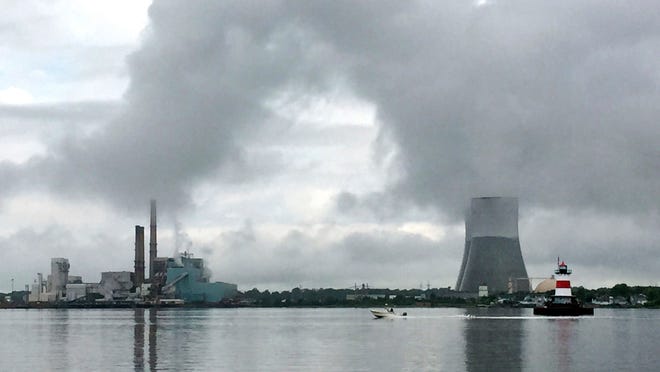
Brayton Point is a prime example of how energy production has evolved in recent decades. Once the home of a coal-fired facility so notorious for pollution it topped a list of the “Filthy Five” most environmentally harmful plants in the state, Brayton Point is now poised to be integral to the production and distribution of wind energy. 

That transformation fits ideally with the Biden administration’s stated goal of producing more wind energy and consuming less fossil fuels.

Live updates:Biden to visit Somerset and his trip to Brayton Point

Let’s take a look at how that transformation started, and where it's going: 
'The magic blue bin':Unfulfilled promise of single-stream recycling

Brayton Point's dirty history

Brayton Point Power Station was built by New England Power Co. on 306 acres of land in Somerset where the Taunton River meets Mount Hope Bay. Construction started in the late 1950s, with the plant commissioned in 1963. Its primary fuel source was coal brought in initially from mines in the United States and later by barge from Colombia – tens of thousands of tons, burned each week. 

By 1969, the plant had three power-generating units burning coal and producing just over 1,000 megawatts – but with falling oil prices at the time, the units were converted to burning coal or oil. A fourth unit was constructed in the mid-1970s that burned either natural gas or oil, bringing the plant to its total of 1,537 megawatts, enough to power about 1.5 million homes.  

Its first three turbines returned to burning coal in the early 1980s, and never went back to oil in its lifetime.  

Even in its heyday, Brayton Point was the focus of environmental scrutiny. In 1971, John Rego, the retired director of the Rhode Island Department of Natural Resources, filed a complaint with the Environmental Protection Agency urging it to study the plant’s effect on aquatic life in Mount Hope Bay. The plant drew in water from the Taunton River and Mount Hope Bay, heated it and used the steam to power its turbines, then spat the water back out at a much higher temperature – environmentalists were concerned that the plant was making the water inhospitable to wildlife. Others had serious questions about the plant’s effect on air quality, with critics blaming the plant for high rates of asthma and one report claiming the plant was the top emitter of carbon dioxide in the northeast U.S.  

Complaints would take decades to resolve. In 1995, a Rhode Island DEM study blamed Brayton Point for an “unprecedented loss” in Mount Hope Bay’s fish population of as much as 87%. The plant had been releasing 1.4 billion gallons of hot water back into the bay every day. The EPA cut short the plant’s permit to discharge water into the bay, kicking off a series of expensive improvements to the plant meant to reduce hazardous effects on the environment.  

The plant's owners finished construction of 500-foot cooling towers in 2011 meant to reduce the temperature of the water before it was discharged. But the improvements were not to last. By October 2013, mere weeks after buying Brayton Point, the plant’s new owners, Energy Capital Partners, announced plans to shutter the plant within the next four years.  

By May 2017, Brayton Point has received its last coal shipment. The plant was decommissioned and closed its doors. The power plant and new cooling towers were demolished two years later. 
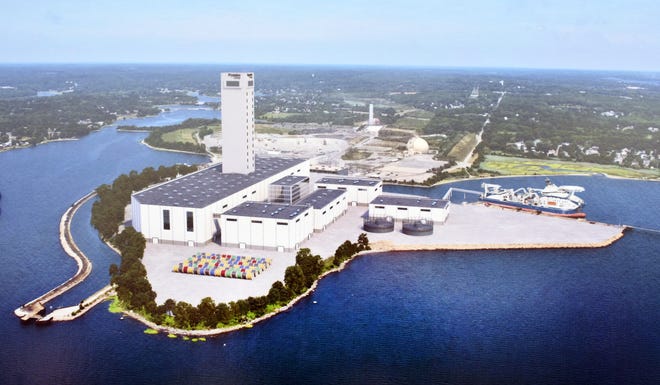
A rendering of the manufacturing facility coming to Brayton Point.

Brayton Point moves to wind energy

After its closing, and struggling with the loss of jobs and tax revenue, Somerset and state officials began the process of finding new uses for the 306-acre plot. The clear preference was its continued use as industrial land, but this time for the generation of clean energy. 

The site is currently owned by Commercial Development Co., and is now known as Brayton Point Commerce Center.  
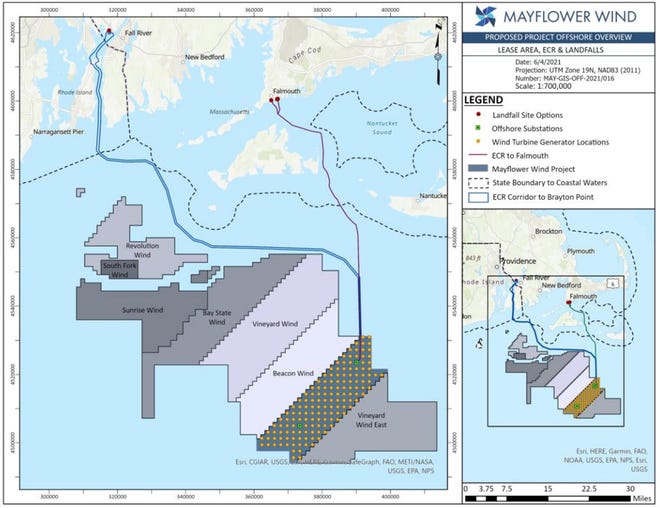
A map of Mayflower Wind's proposed project shows its location in the Atlantic Ocean, with connections to Brayton Point in Somerset.

What's next for Brayton Point:'People said this was never gonna happen': Brayton Point to reap benefits of offshore wind

Earlier this year, Brayton Point made significant strides in its transition from reliance on fossil-fuels to becoming part of the "green economy."  

Mayflower Wind, which is developing an offshore wind farm south of Martha’s Vineyard and Nantucket, has plans to funnel its power into the energy grid via a substation at Brayton Point. Prysmian Group, an Italian company that specializes in manufacturing electrical cables, bought 47 acres at Brayton Point to construct a facility to make submarine power cables for both the Commonwealth Wind project and the Park City Wind project. 

Take a virtual tour:Mayflower Wind's 3D model offers a glimpse at offshore wind project

Celebrating the announcement Prysmian Group's subsea transmission cable manufacturing plant that will be built at Brayton Point are from left, Gov. Charlie Baker, Dennis Arriola, CEO Avangrid, Lt. Gov. Karyn Polito, and Prysmian Group Senior Vice President Hakan Ozmen.

Both projects represent investments of hundreds of millions of dollars, legislators have said, with the promise of local jobs.  

The cable manufacturing facility is expected to open by early 2026. 

LINK

Thursday, May 19, 2022

POLITICO Massachusetts Playbook: Covid metrics are rising again. Now what?


View in browser
 
Massachusetts Playbook logo

BY LISA KASHINSKY

Presented by

PhRMA

MASK CONFUSION — Federal health officials now say a third of Americans live in counties where the risk of Covid-19 is high enough that they should consider masking up indoors in public. A new, even more contagious Omicron variant with the ability to evade immunity is driving wastewater and case rates in Massachusetts up to levels not seen since the tail end of the first Omicron surge in January.

Now a group of public health experts and community organizers, led by the Massachusetts Coalition for Health Equity, is urging the Baker administration to issue an advisory recommending people to mask up in indoor public spaces and avoid large gatherings. But the governor doesn’t seem keen on a widespread mask advisory or mandate.

Other infectious disease doctors are more focused on personal responsibility. With vaccines, boosters and therapeutics that range from monoclonal antibodies to antivirals like Paxlovid, mask mandates in schools or offices are “less relevant” now, Dr. Todd Ellerin, director of infectious diseases and chief of medicine at South Shore Health, said on this week’s episode of "The Horse Race" podcast.

“Masks definitely decrease transmission. Is it important to mask indoors? It is,” Ellerin said. “But it’s also the balance of the pandemic fatigue and knowing that a lot of us just aren’t going to mask anymore. I think that as long as people who are the most vulnerable are masking when they need to, I think mandates are less relevant now than they were before.”

Ellerin said getting vaccinated and testing remain key. But as the virus evolves, so does the logic about what vaccines are meant to accomplish.

“The goal is no longer to prevent infection in the general population,” Ellerin said. “It’s to prevent severe illness.”

GOOD THURSDAY MORNING, MASSACHUSETTS. Abortion rights groups from across the country are joining Sen. Ed Markey’s push to expand the Supreme Court.

Reproductive Equity Now’s Rebecca Hart Holder will join Markey, Rep. Veronica Escobar (D-Texas) and abortion rights groups from Ohio to Missouri on a press call today to discuss the court crusade that’s seen an uptick in interest since POLITICO published a draft Supreme Court majority opinion that would strike down Roe v. Wade. 

In Congress, six more representatives have signed onto the House version of the Judiciary Act in the days since the draft opinion dropped, bringing the total number of cosponsors to 56.

But House Speaker Nancy Pelosi has historically been cool to the concept. And Markey’s companion bill in the Senate remains stalled at just two cosponsors, Sens. Elizabeth Warren and Tina Smith (D-Minn.).

Still, as the potential rollback of Roe spurs abortion rights groups to push to expand the court, activists say upcoming rulings in other cases — like one that could limit the EPA’s authority to regulate certain emissions — could motivate more advocacy groups to join the call.

TODAY — Baker joins Arkansas Gov. Asa Hutchinson, New Jersey Gov. Phil Murphy, Delaware Gov. John Carney, New Hampshire Gov. Chris Sununu, North Carolina Gov. Roy Cooper and Vermont Gov. Phil Scott for a NGA discussion on computer science education at 9:15 a.m. at Hotel Commonwealth; a media availability follows at 10:30 a.m.

Boston Mayor Michelle Wu tours the Horace Mann School at 9 a.m., announces members of the Black Men and Boys Commission at 11 a.m. at City Hall and speaks at the U.S. Holocaust Museum Boston Luncheon at 12:30 p.m. Rep. Ayanna Pressley testifies on her FIX Clemency Act before a House Judiciary subcommittee at 9 a.m. GOP gubernatorial rivals Geoff Diehl and Chris Doughty are both on Bloomberg Baystate Business ahead of Saturday’s MassGOP convention. Former Boston Acting Mayor Kim Janey speaks and receives an honorary degree at MassArt’s commencement.

Tips? Scoops? Does anybody read this part? Email me: lkashinsky@politico.com.


A message from PhRMA:

Thousands of scientists in Massachusetts are creating ground-breaking treatments to fight everything from the common cold to cancer. Gov. Charlie Baker’s bill would let the government set prices on medications, limiting the amount of research scientists can do to create cures. More importantly, it might make some medications harder to get. Gov. Baker: let the scientists do their jobs, don’t discriminate against patients, and stop threatening access to medications. Go to SupportMassCures.com to learn more.

 
THE LATEST NUMBERS

— “Boston-area COVID wastewater data keeps shooting up, Massachusetts hospitalizations jump again,” by Rick Sobey, Boston Herald: “[T]he state Department of Public Health on Wednesday reported 3,948 new COVID cases, similar to last Wednesday’s total of 3,996 infections.”

DATELINE BEACON HILL

— ABOUT THAT GAS TAX HOLIDAY: Gov. Charlie Baker appears to be revving up his calls to suspend the state’s 24-cents-per-gallon gas tax as prices at the pump keep climbing.

“If we were to suspend the gas tax, the cost of gas would drop by 25 cents a gallon, and that would make a huge difference for a lot of those folks,” Baker told reporters in Salem yesterday, after telling Playbook earlier this week that Beacon Hill “should be talking about” a gas tax holiday.

— More: “As gas prices rise, food delivery drivers feel the sting,” by Zinnia Maldonado, CBS Boston: “Services such as Uber Eats and DoorDash have recently added temporary fuel surcharges as a way to help cut costs for drivers, but they say it doesn't help.”

— “House lawmakers to consider moratorium on constructing correctional facilities,” by Laura Crimaldi and Matt Stout, Boston Globe: “House lawmakers on Thursday are expected to vote on a plan that would impose a five-year moratorium on new construction for jails and prisons. The proposal, written into a $4.8 billion government operations bond bill, could upend Governor Charlie Baker’s potential plans to build a new women’s prison. A proposal for one has been under consideration since 2019, but administration officials said this week they had not decided whether to pursue the project.”

— “Massachusetts auto body techs demanding higher pay surround Beacon Hill,” by Matthew Medsger, Boston Herald: “Auto body repair mechanics crashed the State House Wednesday, joined by dozens of tow trucks circling the building, horns blaring, to push for a pay hike on what the industry says are the lowest-in-the nation reimbursement rates.”


STEP INSIDE THE WEST WING: What's really happening in West Wing offices? Find out who's up, who's down, and who really has the president’s ear in our West Wing Playbook newsletter, the insider's guide to the Biden White House and Cabinet. For buzzy nuggets and details that you won't find anywhere else, subscribe today.


VAX-ACHUSETTS

— “As COVID surges again, Boston hospitals are not — so far — strained like they were amid omicron,” by Christopher Gavin, Boston.com: “As Boston weathers another surge of COVID-19 cases, the city’s largest hospital systems have so far not felt the strain quite like what they experienced last winter — but officials are nonetheless concerned about rising cases, according to Dr. Bisola Ojikutu, executive director of the Boston Public Health Commission.”

— “New COVID-19 cases put Berkshire County among hardest-hit areas in continental U.S.,” by Larry Parnass, Berkshire Eagle: “New daily cases of COVID-19 in Berkshire County pushed the region this week to the top of national lists, second only to a Connecticut county in the continental U.S. As of Wednesday, even as newly confirmed cases fell, Berkshire County was behind only Middlesex County in Connecticut based on the number of new infections per 100,000 population, a standard measure.”

FROM THE HUB

— “Laptops were used in three Boston school assaults recently, raising concerns about student safety,” by Andrea Estes, Boston Globe: “They have been powerful educational tools, but in some Boston Public School students’ hands, Chromebooks have become something else lately: powerful weapons. Over less than a week — between April 28 and May 3 — three students at three different schools were struck in the head by Chromebook-wielding assailants. … But the school department did not report the incidents to the police, police reports show, leaving that job to the victims’ parents, and raising concerns that Boston schools are not doing enough to protect students.”

— “Homegrown food services coming to Boston Public Schools,” by Saraya Wintersmith, GBH News: “Mayor Michelle Wu announced Wednesday a new food services agreement for Boston Public Schools that represents the largest non-construction contract the city has awarded to a certified Black-owned business. Beginning July 1, City Fresh will provide breakfast, lunch, after-school meals, fresh snacks and summer meals for BPS. The contract carries a projected value of more than $17 million, according to the mayor’s office.”

— “Boston City Council passes resolution opposing state takeover,” by Christopher Huffaker, Boston Globe: “Boston City Council voted Wednesday afternoon to oppose a state takeover of the city’s schools, amidst the state’s second review of the district in less than three years. … Two councilors, Michael Flaherty and Frank Baker, opposed the resolution but allowed the unanimous consent needed to pass the order at the same meeting it was submitted. Flaherty and Baker both said they opposed a complete state takeover, but advocated for a ‘middle ground’ such as a partnership with the state or targeted interventions in particular areas of concern, like transportation and safety.”

— “Boston City Council tees up hearing on civilian flaggers, cites ‘systemic racism’,” by Sean Philip Cotter, Boston Herald: “City Councilors are bringing back the idea of civilian flaggers for construction projects, arguing that it’s a great way to help with Black unemployment in the city. City Councilor Kendra Lara entered the hearing order, which cited ‘systemic racism’ and the murder of George Floyd in her appeal for civilian flaggers.”


A message from PhRMA:

Advertisement Image 

 
CAMPAIGN MODE

— FIRST IN PLAYBOOK: Philanthropist and activist Barbara Lee is endorsing Salem Mayor Kim Driscoll for lieutenant governor, NAACP Boston Branch President Tanisha Sullivan for secretary of state and former Boston City Councilor Andrea Campbell for state attorney general. Lee previously endorsed Attorney General Maura Healey for governor.

— Jesse Lederman, vice president of the Springfield City Council and chair of the Democratic City Committee, has endorsed Quentin Palfrey for state attorney general.

— Two-dozen school committee members from across Massachusetts, including Somerville School Committee Chair Andre Green, have endorsed state Sen. Adam Hinds for lieutenant governor.

— FROM THE OPINION PAGES: “Numbers don’t lie: Even in Mass., GOP candidates are outpacing Democrats,” by Joan Vennochi, Boston Globe: “Direct from the very blue state of Massachusetts comes another warning to Democrats about voter discontent. According to Secretary of State William F. Galvin, individual Republican candidates running for statewide office have collected thousands more signatures than their Democratic opponents as part of the process required to get on the ballot.”

— “Healey for Governor team hires self-described undocumented political director,” by Matthew Medsger, Boston Herald: “Republican gubernatorial hopeful Geoff Diehl is blasting a new hire by Attorney General Maura Healey’s campaign who identifies himself as an ‘Undoc DREAMer’ on his social media profile, a charge the AG threw back at him as a taking page out of the ‘Trump playbook.’”

PLANES, TRAINS AND AUTOMOBILES

— WHEELS IN MOTION: The MBTA’s redesigned bus system would increase service by 25 percent overall and 70 percent on weekends, add more connections and improve service in places like Roxbury, Everett and Chelsea.

But the T is also heading for a fiscal cliff. So how can this decades-in-the-making revamp happen, financially speaking?

“We actually baked into our pro forma — our five-year kind of capital plan — the additional 25 percent increase in the operating budget that will start in five years, and we’ll kind of build up to that over the next five years,” Caroline Vanasse, project manager for the MBTA’s bus network redesign, said on this week’s episode of "The Horse Race." “If you hear our general manager or the secretary talk about this, they are committed to this and they are going to do what they can to ensure that we have those funds available to prioritize this initiative.”

Public meetings on the proposed redesign start tonight. A final map is expected in the fall, with the bus route overhaul set to begin in spring 2023 and roll out over a five-year period.

— “MBTA rolls out new fines targeting fare evaders,” by Christian M. Wade, Newburyport News: “The MBTA is proposing to set new fines for people who skip paying fares and cost the state’s public transit agency tens of millions of dollars a year. Under the proposed regulations, which were unveiled on Wednesday, the T police would be authorized to issue non-criminal citations to riders caught not paying their fares on buses, the commuter rail and subways. Violators will be hit with a $50 fine for the first violation, and $100 for subsequent violations. … Riders caught fraudulently misusing a reduced fare T card could be fined $75 for a first violation and $150 for subsequent offenses.”


DON'T MISS DIGITAL FUTURE DAILY - OUR TECHNOLOGY NEWSLETTER, RE-IMAGINED:  Technology is always evolving, and our new tech-obsessed newsletter is too! Digital Future Daily unlocks the most important stories determining the future of technology, from Washington to Silicon Valley and innovation power centers around the world. Readers get an in-depth look at how the next wave of tech will reshape civic and political life, including activism, fundraising, lobbying and legislating. Go inside the minds of the biggest tech players, policymakers and regulators to learn how their decisions affect our lives. Don't miss out, subscribe today.


DAY IN COURT

— “Monica Cannon-Grant, indicted for fraud in her management of charity Violence in Boston, requests speedy trial,” by Flint McColgan, Boston Herald: “Monica Cannon-Grant, the embattled head of the nonprofit Violence in Boston that prosecutors say she and her husband used as their own personal piggy bank, wants the government to get on with a speedy trial.”

— “U.S. Postal Service worker attempted to bribe Massachusetts supervisor with cash left in Dunkin’ bag to help distribute cocaine in mail, officials say,” by Heather Morrison, MassLive: “A mail carrier in Lowell attempted to bribe his supervisor to be part of a scheme to help distribute cocaine in the mail with cash hidden inside a Dunkin’ bag, officials say. However, the bribe didn’t work.”

— “Inside the Jasiel Correia trial with the man who put him behind bars,” by Dan Medeiros, Herald News: “In an interview with The Herald News, lead prosecutor Zachary Hafer dishes on Jasiel Correia, Gen Andrade and the one regret he has from the trial.”

IT'S NOT EASY BEING GREEN


LAME DUCK FINALLY IN A RUSH AFTER YEARS OF INACTION? 

— “Salem offshore wind facility gets major cash infusion from state,” by Dustin Luca, Salem News: “State leaders want the offshore wind industry up and running in Salem sooner rather than later, and they’re throwing $45 million at the city to take some immediate first steps. Gov. Charlie Baker, flanked by members of his administration and local officials, announced Wednesday during a press conference on Blaney Street wharf that $100 million from a $1.7 billion supplemental budget proposal would go toward port development in New Bedford, Salem and Somerset.”

MARIJUANA IN MASSACHUSETTS

— “Mass. House approves sweeping marijuana reforms on 153-2 vote,” by Dan Adams, Boston Globe: “The 153-2 vote in favor of the bill, which largely mirrors legislation approved by the state Senate in April, came on the same day regulators announced that total recreational pot sales in Massachusetts have surpassed $3 billion — underscoring the high stakes of any tweaks to the rules governing the industry. Among other provisions, the changes would allow cities and towns to opt in to hosting marijuana cafés, steer a significant chunk of state pot tax revenue to so-called equity applicants trying to get their small cannabis businesses off the ground, crack down on controversial local fees charged to marijuana operators while easing their state tax burden, and make it easier for former defendants to wipe away old marijuana charges.”

FROM THE 413

— “Amherst Town Council calls on Biden to cancel student debt,” by Scott Merzbach, Daily Hampshire Gazette: “Amherst’s Town Council is making an appeal to President Joe Biden to cancel all student debt, joining Northampton’s City Council in passing such a resolution.”

— POLLING TIME: UMass Amherst pollsters say backing for police reform and the Black Lives Matter movement is waning. Support for reducing funds for state and local police departments to instead spend on social services dropped to 31 percent from 38 percent, when compared to a similar poll the university conducted in April 2021, according to a new survey. Support for banning the use of military-grade equipment by state and local police also declined, dropping to 42 percent from 48 percent. But the survey also found that while support for these positions fell, opposition to them only increased marginally and in some cases decreased. A lot of people were undecided.


A message from PhRMA:

Massachusetts is a booming biotech ecosystem. Its scientists and researchers are developing ground-breaking treatments to fight everything from the common cold to cancer.

Gov. Charlie Baker’s bill imposes government prices on medications, which would then limit the amount of research scientists can do to create lifesaving treatments. By setting medication prices, it also means politicians decide which patients and diseases are more important than others.

State bureaucrats should not be playing doctor. When the government imposes artificial prices from the top-down, some patients can lose access to their medications. Seniors, the disabled, and the chronically ill are most vulnerable to these policies.

Gov. Baker: let the scientists and doctors do their jobs, don’t discriminate against patients, and stop threatening access to medications. Go to SupportMassCures.com to learn more.

 
THE LOCAL ANGLE

— “It is happening here: Massachusetts has a growing neo-Nazi movement,” by Phillip Martin, GBH News: “The Nationalist Social Club is a locally grown hate group that has been stepping out of the shadows and into the streets in and around Boston in recent months. 131 is alphanumeric code for ACA, or Anti Communist Action. … NSC-131 and the Patriot Front, another white supremacist group, have been the most active, according to anti-extremist researchers. The organizations compete with each other for attention across the region. Members of NSC-131 and the Patriot Front also took part in the Jan. 6 riot at the U.S. Capitol in Washington, D.C.”

— “Massachusetts confirms rare monkeypox case, the first in the US this year,” by Rick Sobey, Boston Herald: “A Massachusetts man who recently traveled out of the country has tested positive for the rare monkeypox virus infection and is now being hospitalized in Boston, health officials confirmed on Wednesday as an outbreak emerges in Europe."

— “McAnneny to step down as head of Mass. Taxpayers Foundation,” by Greg Ryan and Steph Solis, Boston Business Journal: “Massachusetts Taxpayers Foundation President Eileen McAnneny, one of the top advocates for businesses on Beacon Hill, plans to step down from the organization at the end of 2022. McAnneny has led the foundation since 2015, the first woman to do so in the organization’s 90-year history. The foundation’s board of directors has formed a search committee to find her replacement as president.”

HAPPY BIRTHDAY — to state representative candidate and Brookline Select Board Vice Chair Raul Fernandez; Sydney Simon of Rep. Seth Moulton’s office; NBC10/NECN's dynamic duo Alison King and Sean Colahan, and Stephanie Nigro.

Want to make an impact? POLITICO Massachusetts has a variety of solutions available for partners looking to reach and activate the most influential people in the Bay State. Have a petition you want signed? A cause you’re promoting? Seeking to increase brand awareness among this key audience? Share your message with our influential readers to foster engagement and drive action. Contact Jesse Shapiro to find out how: jshapiro@politico.com.


Follow us on Twitter

Lisa Kashinsky @lisakashinsky


Subscribe to the POLITICO Playbook family

Playbook  |  Playbook PM  |  California Playbook  |  Florida Playbook  |  Illinois Playbook  |  Massachusetts Playbook  |  New Jersey Playbook  |  New York Playbook  |  Ottawa Playbook  |  Brussels Playbook  |  London Playbook

View all our politics and policy newsletters

FOLLOW US

Follow us on FacebookFollow us on TwitterFollow us on InstagramListen on Apple Podcast


POLITICO, LLC 1000 Wilson Blvd. Arlington, VA, 22209, USA


Thursday, June 24, 2021

Harnessing the tides: The future of renewable energy could begin in Cape Cod Canal


Harnessing the tides: The future of renewable energy could begin in Cape Cod Canal


Beth Treffeison   Cape Cod Times
Published Jun 23, 2021

BUZZARDS BAY — Attached to a metal pole, a small tidal turbine resembling a metal rocket ship was placed Tuesday morning under the ripping currents of the Cape Cod Canal.

The tidal turbine could be the start of another form of renewable energy that would be able to provide electricity for decades to come. 

“It’s an industry that is well-poised to take off,” said David Duquette, CEO of Littoral Power Systems Inc., based in New Bedford, that provided the model tidal turbine for the demonstration Tuesday. “But it does have some cost constraints, which is why we are looking at things such as saving costs on civil works.” 

The tidal turbine, which was not producing electricity, was the first of its kind to be tested on the Bourne Tidal Test Site structure situated next to the railroad bridge near the Buzzards Bay side of the canal. It will be monitored using a camera system to see if it will affect fish and marine wildlife in the area.

“We wanted to spin up something in our backyard here — we’ll do it,” said Duquette before the turbine was launched.

The next generation of the device being tested in the canal will be deployed to Fairbanks, Alaska, where it will be tested in a “mightier” river, Duquette said. 

On Monday, two sensors were installed to monitor water conditions and fish behavior. Since video cameras require light to work, which at night would affect fish behavior, an acoustic camera was also deployed. 

The model tidal turbine was due to remain in the water for about 48 hours as cameras watch how it affects the environment around it, said John Miller, the New England Marine Renewable Energy Collaborative executive director. 

In past experiments, such as in Scotland or in the East River in New York, cameras have found that fish generally avoid the turbines, Miller said. 

Offshore wind: Following Vineyard Wind's final approval, Mayflower Wind is next up seeking permits

“I like to say (after) evolution through a billion years, fish have developed to work in the ocean. (When they see) a big thing with teeth, they know how to avoid something like that,” Miller said. “We still need to monitor that.” 

Tidal turbines are similar to wind turbines in that they have blades that turn a rotor to power a generator, according to the U.S. Energy Information Administration. They can be placed on the sea floor or a river where there is a strong tidal flow. Because water is about 800 times denser than air, tidal turbines have to be much sturdier and heavier than wind turbines. 

There are small test sites and there are big test sites for full-scale tidal turbines, Miller said. There have been instances in which turbines in a smaller tank have had their blades fall off when they are brought to full scale, he said. 

Looking to the future: Offshore wind projects the 'linchpin' of Biden's clean energy plan.

“They knew there was a need for something in-between,” Miller said. “This was designed to test something in the order of 10 feet in diameter.” 

As a solution, the energy collaborative installed the Bourne Tidal Test Site in 2018, and in 2019 got it up and running, said Miller. In 2020, the test site had two turbines scheduled to come, one from Canada and the other from California, but due to COVID-19 concerns, both plans fell through, he said.

The Cape Cod Canal has water traveling at around 4 to 5 knots, Miller said. 

“They say a 6-knot current force is equivalent to 400 mph wind,” Miller said. “They are testing these things in northern Canada and Ireland; they are basically developing them in a hurricane.”

Tidal turbines are able to power a lot of energy and electricity, but it is a tough environment and it is costly to build something to survive in that environment, Miller said. 

“You have to build something like a battleship, but battleships aren’t the most efficient things,” he said. 

Report to policymakers: 'Remove barriers' and 'go big' on offshore wind off Cape Cod

Engineers can build something to survive anywhere, Miller said. But you don’t want to put that much money into something that might not efficiently produce electricity, he said.

Why tidal turbines?

As a future alternative energy resource, tidal turbines are attractive for a couple of reasons, Miller said. The No. 1 reason is that they are predictable, he said. One can monitor the tide for hundreds of years ahead of time. 

Secondly, “they are out of sight, out of mind,” with most developers designing them to be under the water, he said. 

“In theory, (tidal turbines have) a tremendous amount of promise,” Duquette said. “That is a great promise — it is suitable for (energy) baseload unlike other renewable energies like solar and wind farms. It is too early to say whether the promise of all of that can really be extracted.” 

The demonstration was funded by the Seaport Economic Council. The grant to fund the test site is through a partnership between the Falmouth Economic Development Industrial Corporation and the energy collaborative. 

It cost  about $400,000 to install the test site, Miller said. The amount is a fraction of the cost of other test sites around the world that cost $30 million to well over $50 million, he said. 

“We get the state, the Commonwealth, into this business with this technology without the really extreme costs,” Miller said. 

Tidal turbines are about 10 years behind wind development, Miller said. The advantage that wind had is that it was able to start small and scale up. Due to the high costs involved in tidal energy, companies went straight to the big scale, creating a much bigger challenge, he said. 

The energy collaborative is a nonprofit corporation that educates and involves all stakeholders in the marine industry to promote the sustainable development of renewable energy in New England ocean waters, according to its website. The group spearheaded the movement to get the test site on the canal.

Before the tidal turbine was tested, local companies have used the site to monitor underwater test sensors, Miller said. 

The nonprofit is working with OpenCape to get broadband installed on the testing platform, Miller said. In past testing, sensors were using WiFi to transmit data, but it overwhelmed the system, he said. 

The energy collaborative is working on adding power to the platform, Miller said. Previously, they used a solar panel and battery to operate it, he said. 

In addition, getting power to the platform will act as a two-way street for getting power off the platform and onto the grid from the tidal turbines, Miller said. 

The companies building the turbines want to be able to say to investors that "they were able to put electrons on the grid," Miller said.


Top News | 'He’s Not Going to Run Unopposed': Sanders Rejects Schumer for Majority Leader

                                                               LOTS OF POSTS IGNORED BY BLOGGER..... OR REMOVED ON THEIR WHIM! ALL POSTS ARE...