Showing posts with label MUTATIONS. Show all posts

Tuesday, June 8, 2021

CC News Letter 08 June - Refer The Lakshadweep Issue To National Commission for Scheduled Tribes


Dear Friend,

Prior consultation with the National Commission for Scheduled Tribes (NCST) mandatory for policy changes in Lakshadweep

Kindly support honest journalism to survive. https://countercurrents.org/subscription/

If you think the contents of this news letter are critical for the dignified living and survival of humanity and other species on earth, please forward it to your friends and spread the word. It's time for humanity to come together as one family! You can subscribe to our news letter here http://www.countercurrents.org/news-letter/.

In Solidarity

Binu Mathew
Editor
Countercurrents.org


Appeal To President Of India: Refer The Lakshadweep Issue To National Commission for Scheduled Tribes
by E A S Sarma


Prior consultation with the National Commission for Scheduled Tribes (NCST) mandatory for policy changes in Lakshadweep


Rural Teacher Pedro Castillo Poised to Write a New Chapter in Peru’s History
Written by Medea Benjamin and Leonardo Flores


Castillo’s victory will be remarkable not only because he is a leftist teacher who is the son of illiterate peasants and his campaign was grossly outspent by Fujimori, but there was a relentless propaganda attack against him that touched on historical fears of Peru’s middle class and elites.


Atmospheric Carbon Dioxide Hits Highest Level in Over 4 Million Years
by Brett Wilkins


Scientists from the National Oceanic and Atmospheric Administration (NOAA) and Scripps Institute of Oceanography at the University of California, San Diego working at NOAA’s Mauna Loa Atmospheric Baseline Observatory in Hawaii said the May measurements—an
increase from 417 parts per million (ppm) in May 2020—mean that “the atmospheric burden of CO2 is now comparable to where it was during the Pliocene Climatic Optimum, between 4.1 and 4.5 million years ago, when CO2 was close to, or above 400 ppm.”


International Energy Agency report underscores inadequacy of US government response to climate change
by Ronan Coddington


The report, which is titled Net Zero by 2050, states that in order to achieve a carbon neutral world by that year producers will need to immediately stop any new fossil fuel production. This is only one of 400 “milestones” along the road to 2050, and its implausibility only underscores the difficulties of combining a rational, science-based response to the danger of climate change with the maintenance of global capitalism, driven by private profits and the interests of
rival nation-states.


126 Nobel Laureates and Experts Issue Timely Warning on Some Crucial Issues, But  Miss Other Urgent Concerns
by Bharat Dogra


While this statement makes several very important observations, it is really surprising and regrettable to find that it makes some omissions of very critical importance and  some issues of critical importance for resolving the present crisis  are more or less left out of this statement’s concerns. Hence while this statement deserves great attention for its several important and profound observations, it deserves attention also for the glaring omissions that have been made. For example the most important task of complete elimination of nuclear weapons ( and in fact all weapons of mass destruction) is hardly mentioned in this statement.


Educating for the future we want
by Stephen Sterling


We are approaching fifty years since the UN Conference on the Environment in Stockholm endorsed the key role of education, nearly thirty years since Agenda 21 proposed that education is “critical for achieving environmental and ethical awareness,” and five years since the SDGs set a target date of 2030. The ambitious UNESCO “Futures of Education” initiative promises a chance to reset direction and priorities. But to date, strong cultural inertia and the counterforce of neoliberalism have slowed progress, and the time is long overdue for holding Westernized education policy and practice to account. Now, efforts to transform education are greater than ever, but so, too, are the stakes and urgency. We need to move fast and with bold aspiration, while retaining critical reflexivity, as we create a new chapter in the evolution of our ways of educating on this—as yet—still beautiful planet.


Young farmers
in Ladakh: the future of our food
Written by Kunzang Deachen, Chozin Palmo and Jigmet Singge


Westernisation has come with a lot of glamour and promises of affluence, but today, many younger people are beginning to realise that the chase for modernity and glamour brings little more than dissatisfaction, disconnection, and feelings of addiction.


A People’s Vaccine Against a Mutating Virus and Neoliberal Rule
by Nicolas J S Davies


Ending international vaccine apartheid is not just a matter of altruism, or even justice. It is a question of whether we will end this pandemic before vaccine-resistant, super-spreading and deadlier variants fuel even more toxic new waves. The only way humanity can win this struggle is to act collectively in our common interest.


Universal Health Coverage and Unmet
Reproductive Health needs of Migrant Women at times of Pandemic COVID-19 in India
by Ujjwala Gupta


The spread of COVID in rural areas created a state of emergency due to ill-equipped infrastructure in Public Health system to handle spike in cases. This directed the Government to shift its priority deeming SRH activities as non-emergency, to respond to the needs of pandemic , consequently sidelining the reproductive health needs. Above that, seasonal migration disrupts the access to health care services in actual place of origin and also simultaneously creating missing and duplicity in public health records of antenatal, family planning and vaccination.


To avoid catastrophes India should adopt a risk minimization for all policy
by Sagar Dhara


COVID-19 is a gray rhino event, an event that is highly probable and with a large impact. It can be seen well in advance due to its size and early warning signs, but which are ignored. Now over a year into the pandemic, India remains completely unprepared for COVID-19’s second wave.


Major news, social media sites back online after massive internet outage
by Countercurrents Collective


Dozens of major websites — including The New York Times, CNN, Reddit, Spotify, Twitch, GitHub, gov.uk, Hulu, HBO Max, PayPal, Vimeo, Shopify — were beginning to return online Tuesday morning after crashing in an apparent massive internet outage.


Downward Social Mobility and Authoritarianism
by Jon Kofas


In the next economic downturn, the US already has a political party with the ideological and political makings of a native-style Fascist Party. Given the expanding local and state-base of the populist right wing, it will be very easy for any number of Republicans to rise to power as Fascist in ideology and policies, while claiming to represent democracy.


Twilight of the Pandemic? Bracing for a Surge of Trumpism or…
by John Feffer


Sure, I continue to worry about what the next wave of Covid-19 might look like. I fear both the continued lunacy of the Republican Party and the pallid incrementalism of the Democrats. But I’m heartened by the energy of people all over the world determined to beat back dystopia, take control of their lives, and transform the optimists’ credo of “hope and change”
into something a great deal more significant than a campaign slogan.


At His Best, Dilip Vengsarkar Could Sit In The Company of The All-Time Greats
by Harsh Thakor


Without doubt Dilip Vengsarkar is one of the finest batsmen ever to have graced a cricket field. This week we commemorate the feat of Dilip Vengsarkar becoming the 1st overseas batsman ever to score three consecutive centuries in test matches at Lords. It is a landmark that would inscribe a permanent place in the museum of cricket. We also coincidentally celebrate the 35th anniversary of India’s first win at Lords, the mecca of cricket.


Thursday, February 18, 2021

Study finds 7 newly-identified COVID-19 variants circulating in the United States


Study finds 7 newly-identified COVID-19 variants circulating in the United States

CNNWIRE By Maggie Fox CNN

Monday, February 15, 2021

Researchers said Sunday they have identified a batch of similar troubling mutations in coronavirus samples circulating in the United States. They've not only drawn attention to them; they've come up with a better shorthand for referring to them. They've named them after birds.

The mutations all affect the same stretch of the spike protein -- the knob-like extension on the outside of the virus that it uses to dock onto the cells it infects, the researchers wrote in a pre-print report. It's not peer reviewed yet, but researchers are rushing such findings online to share them quickly with other experts. 

The genetic stretch that is mutated, or changed, is called 677. The various changes are so similar that the researchers think evolution favors these particular variants. And it's in a troubling place, said Vaughn Cooper, director of the Center for Evolutionary Biology and Medicine at the University of Pittsburgh School of Medicine, who worked on the study.

"This stretch of Spike is important because of its proximity to a region key for virulence," Cooper told CNN via email.

"We actually think these mutations are relatively rare (compared to other types of mutation), but they are disproportionately selected when then occur," he added.

Average US daily COVID-19 cases dip below 100K for 1st time in months

The team has been reviewing genomic sequences deposited into GISAID, a global database that researchers are using to share genetic information about the virus. It's where scientists first noticed the rise of troubling new variants such as B.1.1.7, first seen in the United Kingdom, and B.1.351, first seen in South Africa.


"In late January of 2021, our two independent SARS-CoV-2 genomic surveillance programs, based at the University of New Mexico Health Sciences in Albuquerque, New Mexico and the Louisiana State University Health Sciences Center in Shreveport, Louisiana, each noticed increasing numbers of ... viruses carrying an S:Q677P mutation, and that this variant had increased in frequency in samples collected in late 2020 to mid-January," the researchers wrote.

What if COVID-19 never goes away? What scientists say about future of virus

That shorthand -- Q677P-- refers to the specific change in the amino acid making up that part of the spike protein.
They've identified seven similar mutations at 677 -- each one appearing to have arisen independently. They named them after birds to make it easier to identify them.

One, called Robin 1, has turned up in more than 30 US states, predominating in the Midwest, they said. A second "first appeared from a Oct 6, 2020 sample from Alabama and is named 'Robin 2' owing to its similarity to the parental Robin 1 sub-lineage," they wrote. It's mainly seen in the Southeast. One called Pelican was first seen in a sample from Oregon, and has since turned up in 12 other states as well as Australia, Denmark, Switzerland and India.


Pelican was the first variant that grabbed the attention of the researchers, in part because it was found in nearly 28% of samples from Louisiana and 11% of samples from New Mexico.

"The remaining Q677H sub-lineages each contain around 100 or fewer sequences, and are named: Yellowhammer, detected mostly in the southeast US; Bluebird, mostly in the northeast United States; Quail, mainly in the Southwest and Northeast; and Mockingbird, mainly in the South-central and East coast states," the research team wrote.

Can your employer force you to get vaccinated? The answer might surprise you

The United States has barely studied the genomic sequences of coronaviruses circulating, so if these variants have turned up so often in databases, they are probably very prevalent, the researchers said. The appearance of so many similar mutations at the same time is "remarkable," they said.

"These variants were not detected until mid-August 2020, but as of 03 Feb 2021 already account for over 2,327 of the 102,462 genomes deposited to GISAID from the USA," they wrote. That merits close attention, they said.

LINK


Saturday, January 23, 2021

RSN: Can the COVID-19 Vaccine Beat the Proliferation of New Virus Mutations?


Reader Supported News
23 January 21

It's Live on the HomePage Now:
Reader Supported News


JANUARY HAS BEEN A TRAIN-WRECK FOR DONATIONS, SO FAR — We’re down a good 50% from where we were at this time last month. That’s one thing we did not need and cannot sustain or survive. With less than a week to go it is nervous time for sure. Time and operating capital are running out. We need some support folks. Marc Ash, Founder Reader Supported News

Sure, I'll make a donation!


FOCUS: Can the COVID-19 Vaccine Beat the Proliferation of New Virus Mutations?
A healthcare worker and a patient. (photo: ABC News)
Lawrence Wright, The New Yorker
Wright writes: "All viruses change. sars-CoV-2 had been remarkably stable as it coursed around the world, being so well adapted to the human host."

 This stability allowed the development of vaccines that are finely targeted for vulnerable regions of the virus’s spike protein. In February, 2020, a new variant emerging from Italy proved to be more infectious than the original Wuhan variant. Scientists were on guard, expecting an assault of new mutations. “We were getting sequencing up and running” to detect new variants, Gregory Armstrong, the director of the Advanced Molecular Detection program at the Centers for Disease Control and Prevention, told me. “Then for ten months, it was crickets.”

Last September, just as the first vaccine candidates were undergoing their Phase III trials, an aggressive new variant began circulating in southeast England, centered in Kent, along the highway from London to Dover. On Halloween, England announced a monthlong lockdown, which was dramatically successful in curbing the spread of COVID-19 in other parts of the country, but not in the Kent corridor. There were already a number of distinct variants of the novel coronavirus, with a few genetic variations of little consequence. But the U.K. variant, initially labelled a “Variant Under Investigation,” contained twenty-three different mutations, including several on the spike protein; moreover, it was rapidly driving out competitors and becoming the predominant virus in the country, especially among younger people. On December 18th, it was upgraded to a “Variant of Concern.”

What made the U.K. variant so much more successful than the original virus? One possibility is pure chance. It could have been amplified through some superspreader event, like the variant that took root at an employee conference at the Boston biotech firm Biogen, in February, 2020, which eventually accounted for more than three hundred thousand infections. Or perhaps it got seeded in a school or a church, and spread rapidly among a tightly knit population. But, as researchers went back and studied the growth of the U.K. variant’s mutations through serum samples, they realized that neither of these hypotheses could account for the accelerated pace of the spread. “Some mathematicians modelled how the variant has spread, and they found it was between forty and seventy per cent more infectious,” John Brooks, the chief medical officer at the Centers for Disease Control’s COVID-19 Emergency Response, told me. The current hypothesis is that the Kent variant, now called B.1.1.7, has a mutation that switched an amino acid in the spike protein, allowing it to bind more tightly to the body’s ACE2 receptors. “That means it takes less virus to infect you,” Brooks said. “That tighter binding also means that it can replicate more efficiently.” Once infected with the new variant, a person will be shedding more virus than someone infected with another variant. “It’s a wicked cycle,” Brooks observed. B.1.1.7 quickly spread to dozens of countries. The ongoing mystery is why it is not more fatal, given its increased viral load. It may be just a matter of luck.

England entered lockdown once again. By the second week in January, one in thirty people in London was infected. The worrisome mutation in the B.1.1.7 variant affects the area of the virus where the antibodies that neutralize the disease do their work. The new mRNA vaccines present a modified spike protein to the body, alerting the immune system to a foreign invader and commanding the production of antibodies. It appears that B.1.1.7 partially alters the main target on the spike protein. That set off alarms in the public-health community, because such mutations could erode the effectiveness of the vaccines. Viruses are always looking for hidden opportunities that mutations create, much as hackers search out flaws in application codes.

A month after the new variant was uncovered in England, a similar lineage emerged in South Africa, called B.1.351. It quickly became the dominant variant in that country and began its own tour of the world. It has the same mutation as B.1.1.7, which allows it to adhere more tightly to the ACE2 receptors, but it also carries an additional mutation that is far more concerning. The mutation is denominated E484K, meaning that the amino acid, glutamic acid (code letter E), has been replaced by another, lysine (code letter K), in position 484 of the genetic sequence of the spike protein. This tiny alteration may possibly make the vaccine less effective against it. In a lab experiment, the E484K mutation caused greater than tenfold drop of immunity in the antibodies of some COVID-19 survivors. The vaccines that are being deployed now should still be effective, researchers have said, but clearly the virus is evolving new strategies that make it more contagious and less able to be corralled by a vaccine.

Yet another dangerous variant, B.1.1.28, turned up in Brazil. A forty-five-year-old health-care worker in the northeastern part of the country, who had no comorbidities, got COVID-19 in May of 2020. She was sick for a week with diarrhea, muscle aches, exhaustion, and pain while swallowing, but she fully recovered. Then, in October, a hundred and fifty-three days later, she fell ill again with COVID-19, and, this time, the disease was more severe.

“This made the hair on my neck stand up,” Brooks said. Like the South African variant, the Brazilian variant does have the mutation that makes it more infectious, and it also has the E484K mutation, which raises the unsettling possibility that “it could possibly overcome the vaccine, and it may reinfect.” He compares the coronavirus to the flu or the common cold, which are constantly changing, dodging the body’s immune system. Gregory Armstrong told me of an experiment to determine how many mutations it would take to create what is known as an “immune escape” strain. “They grew it up in tissue culture from a generic SARS-CoV-2 in dilute convalescent sera,” he said. “They were eventually able to grow one that had three mutations that conferred almost complete resistance” to the antibodies in the survivors’ blood.

“So how do we fight these mutants?” Brooks asked. “The best way is to suppress replication—and that means stopping infections.” The more replications that occur, the greater the number of mutations. Occasionally, a slight error in replicating the genetic code creates a mutant variant that spreads more successfully and, when that happens, evolution takes over. Stopping transmission blocks the opportunity for viral mutation; it’s the only thing that does. And the only means we have of standing in the way of the virus is vaccination. “It’s a race,” Brooks said. “We’ve got to get people vaccinated before more of these mutations occur.”

The World Health Organization says that herd immunity is reached when sixty to seventy per cent of the population has had the disease or a vaccination, although Anthony Fauci has upped the figure incrementally, now saying that a more reliable figure may be between eighty-five and ninety per cent. The increased transmissibility of the mutant variants makes the higher figures more likely.

The C.D.C. predicts that B.1.1.7 will be the predominant variant in the U.S. by March, and is warning overburdened hospitals to expect another surge, which will outrace the immunization process now underway. If stricter masking and social-distancing measures are not taken, and the vaccine is not given more time to make an impact, the coronavirus will become endemic. In fact, that appears to be happening already, with the proliferation of mutant variants, although stricter measures could mitigate the spread.

On January 19th, two preprint research papers were published. One had good news: the Pfizer vaccine (and because it is highly similar, probably the Moderna one) was just as effective in blocking the B.1.1.7 variant as the virus that originated in Wuhan. The other paper contained findings that Brooks and others have been dreading: the South African variant, B.1.351, has shown that it can escape the antibodies in the blood of previously infected persons. This suggests that the therapies that use what are called monoclonal antibodies—such as what President Trump received—could fail. The authors of the study, led by Kurt Wibmer, at the National Institute for Communicable Diseases, in Johannesburg, underscored the implications for the effectiveness of SARS-CoV-2 vaccines, which are based on immune responses to the spike protein. “These data highlight the prospect of reinfection with antigenically distinct variants and may foreshadow reduced efficacy of current spike-based vaccines.”

READ MORE


Contribute to RSN

Update My Monthly Donation


Monday, December 21, 2020

POLITICO NIGHTLY: Don’t worry about the mutation — yet


POLITICO Nightly logo

BY RENUKA RAYASAM

Presented by Harry's

With help from Myah Ward

BRITISH INVASION — This isn’t the first time the Covid-19 virus has mutated.

In February, the virus strain that spread in Europe had more than a dozen mutations to the spike protein, which the virus uses to enter cells. It’s highly contagious and quickly became the dominant form of Covid.

In November, Denmark’s government ordered the wipeout of the country’s 17 million mink because of a new Covid variant spreading among the animals.

Now it’s happening again. United Kingdom Prime Minister Boris Johnson effectively canceled holiday gatherings because of a British variant. New York’s Gov. Andrew Cuomo wants pre-flight testing for people traveling from the U.K. to New York.

The virus has been mutating at a rate of one to two changes a month.

Most mutations so far are related to how contagious the virus is and not necessarily how lethal it is. Covid vaccines that have been given preliminary FDA approval and those in development will likely still be effective against these new strains, said Mark R. Schleiss, a researcher at the University of Minnesota’s Institute for Molecular Virology.

Covid could evolve to render the current vaccine ineffective, but it would take years and multiple mutations. There’s almost no chance of a single mutation making the vaccine not work. Measles has remained stable for decades, so there hasn’t been a need to develop a new vaccine. But researchers had to develop a new pneumococcal vaccine about a decade ago after the disease mutated.

The vaccine rollout creates “selection pressure,” making it more likely that a variant resistant to the vaccine could emerge, said Dan Barouch, a Harvard medical school professor and the director at the Center for Virology and Vaccine Research at the Beth Israel Deaconess Medical Center. There are a lot of unknowns about the U.K. strain. “I’m not going to reassure you,” Barouch told Nightly this evening.

Still, Barouch reassured us: Researchers already know how to develop a Covid vaccine. So if they had to develop another shot because of a mutation, they could do it in less time than a year. The Moderna vaccine took 66 days to enter a clinical trial after the coronavirus was genetically sequenced.

The more the virus spreads, the more chances it has to mutate. So it helps when health officials tamp down outbreaks. “I don’t think we are going to face where we were back in March ever again because I don’t think we will be as stupid as we were in March,” said Howard Forman, a health policy professor at Yale. Schleiss points to his great aunt, who lived through the 1918 flu pandemic and still wore a handkerchief around her face whenever people came to visit. We may be wearing masks for a while, too.

There are still two big dangers. In the near term, the biggest one is that the virus is already spreading faster than any vaccine can be rolled out. Covid Exit Strategy stopped updating its map on Sunday night. They had already marked every state, except Hawaii, with dark red. The group said it would have to add two to three more shades to show the significance of the spread. On Saturday, 2,704 Americans died because of Covid, according to the Covid Tracking Project. It’s hard not to see how bad it would be if an even more contagious strain entered the country at a time when people are gathering for the holidays.

Over the long term, the danger isn’t a mutation of SARS-CoV2. It’s SARS-CoV3. Schleiss described virus mutations like apple variants: the difference between a Gravenstein and a Pink Lady. A new coronavirus would be like a persimmon or a kiwi.

“I’m very worried that we have become complacent that we are done with coronaviruses,” said Schleiss. “We just need to assume this will happen again some day.”

Around 200 of London's black taxi cabs are stored in a field in Epping, England. Many black cab drivers across the capital have lost work, because of the pandemic. According to the Licensed Taxi Drivers' Association, around 80 percent of black cabs have come off the road since June due to the lack of customers.

Around 200 of London's black taxi cabs are stored in a field in Epping, England. According to the Licensed Taxi Drivers’ Association, around 80 percent of black cabs have come off the road since June due to the lack of customers.

Welcome to POLITICO Nightly. Shelley Luther, the Dallas salon owner who defied Texas Covid restrictions, lost a runoff for a state Senate seat. We’ll be taking a holiday break from Thursday, Dec. 24-Friday, Jan. 1. We’ll be back and better than ever on Monday, Jan. 4. Reach out at rrayasam@politico.com, or on Twitter at @renurayasam.


A message from Harry's:

Introducing Harry’s new, sharper blades: From past experience with other brands, we’ve grown used to razor innovations often leading to higher price tags. Not this time around. Men’s grooming startup Harry’s just came out with their sharpest blades ever—without raising prices, breaking the traditional pattern of upcharging used by many razor companies. Learn more about Harry’s new, sharper blades and how you can give them a try, 100% risk-free.

 
FIRST IN NIGHTLY

VIRAL VACCINE LIES — False claims about the dangers of coronavirus vaccines were running rampant on social media even before Americans began receiving their first shots last week — and now the months-long rollout to the entire population is giving bad information even more room to fester, technology reporter Alexandra Levine writes.

It started with baseless rumors that the inoculations would kill or sterilize the recipients, alter people’s DNA or fail to keep up with virus mutations. Now it is expanding to more elaborate conspiracy theories in an era already rife with mistrust of government and other institutions. Social media companies are trying to keep up, but in many ways they’re already behind, given the monumental task of combating misinformation about a massive, first-of-its-kind public health crisis effort.

“The fact that it’s new, the fact that it’s uncertain, the fact that your local doctor and pharmacist can’t say to you, ’I’ve done this for 10 years now,’ or, ’We’ve done the flu vaccine forever’ — it’s going to add to the potential for misleading and downright malicious material online,” said disinformation researcher Paul Barrett, deputy director of the NYU Stern Center for Business and Human Rights.


EVERYONE IS TALKING ABOUT TRANSITION PLAYBOOK, SUBSCRIBE TODAY: A new year is quickly approaching. Inauguration Day is right around the corner. President-elect Joe Biden's staffing decisions are sending clear-cut signals about his priorities. What do these signals foretell? Transition Playbook is the definitive guide to the new administration and one of the most consequential transfers of power in American history. Written for political insiders, this scoop-filled newsletter breaks big news daily and analyzes the appointments, people and emerging power centers of the new administration. Track the transition and the first 100 days of the incoming Biden administration. Subscribe today.


ON THE HILL

JINGLE BILLS — Both chambers of Congress are now on track to approve a $900 billion coronavirus rescue package by the end of the night, capping a frenetic final week of negotiations and a last-minute computer glitch that delayed proceedings for half the day. The House will vote first on the package, which also includes a $1.4 trillion year-end spending measure, just hours after party leaders released the legislative text. The final vote in the lower chamber isn’t expected until roughly 10 p.m., guaranteeing a late night in the Senate.

Here are a few of the bill’s highlights:

— $166 billion in direct checks: Individuals making up to $75,000 a year will receive a payment of $600, while couples making up to $150,000 will receive $1,200, in addition to $600 per child.

— $120 billion in extra unemployment help: Jobless workers will get an extra $300 per week in federal cash through March 14. The legislation also extends employment benefits to self-employed individuals, gig workers and those who’ve exhausted their state benefits.

— $325 billion small business boost: Pandemic-ravaged small businesses would see a total of $325 billion, including $284 billion in loans through the Paycheck Protection Program, $20 billion for businesses in low-income communities and $15 billion for struggling live venues, movie theaters and museums.

Read Caitlin Emma and Marianne LeVine’s breakdown to see what else is in the $900 billion stimulus package.


Advertisement Image 

 
PALACE INTRIGUE

‘WHY BOTHER?’ As of this weekend, Trump has now waited longer than any president in nearly a century to sit down with his successor at the White House. And advisers to Trump say he and Biden may never come face to face , even on Inauguration Day, blowing up another American political ritual, Daniel Lippman and Theodoric Meyer write.

Those close to Trump believe inviting Biden to the White House or even talking to him would risk being perceived as conceding the race, which Trump has been loath to do as he mulls another run in 2024. The same factors could keep him away from Biden’s inauguration next month.

Biden and Trump have already gone longer without sitting down together than any president and president-elect since Herbert Hoover’s election in 1928, according to research by the Partnership for Public Service’s Center for Presidential Transition and POLITICO. Hoover left California by ship after Election Day on a diplomatic tour of Central and South America and didn’t meet with President Calvin Coolidge until Jan. 7, 1929.

FROM THE HEALTH DESK

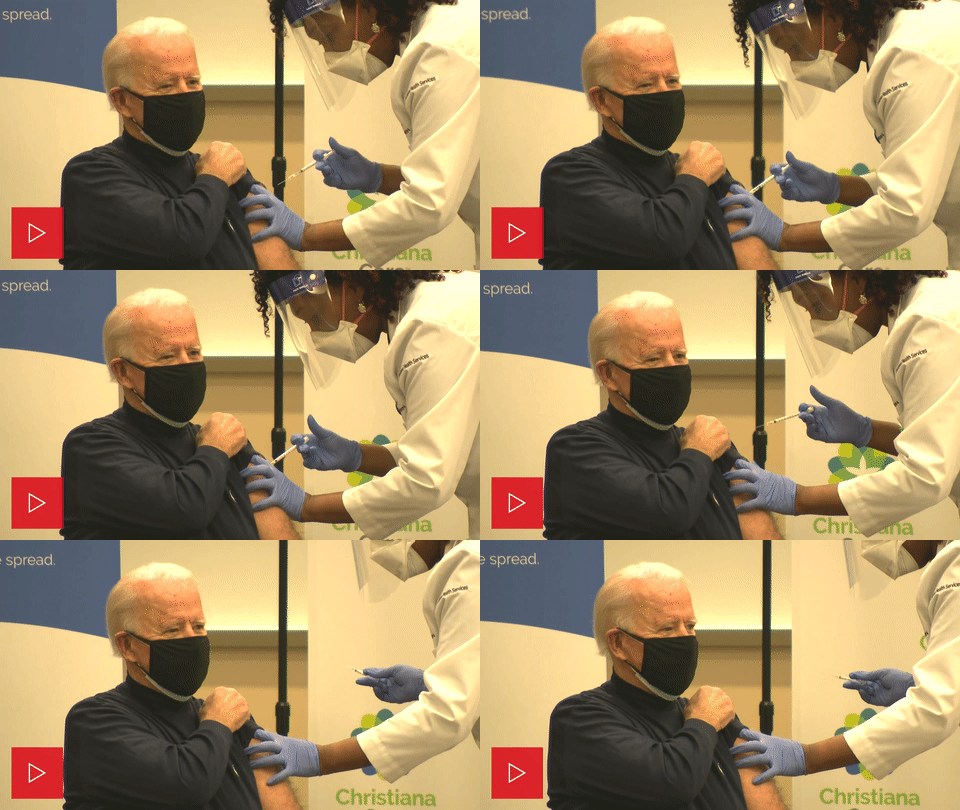
JOE GETS JABBED — The president-elect and incoming first lady Jill Biden received initial injections of the coronavirus vaccine today. “I’m doing this to demonstrate that people should be prepared when it’s available to take the vaccine,” Biden said. “There’s nothing to worry about. I’m looking forward to the second shot.”

The Bidens’ vaccinations come less than a week after a member of the press corps covering the transition and Rep. Cedric Richmond of Louisiana, the president-elect’s chosen director of the White House Office of Public Engagement, tested positive for Covid-19.

Richmond’s diagnosis is one of the closest known brushes with the virus for Biden, who at 78 is at a heightened risk of complications from the disease and has gone to considerable lengths to minimize the risk of exposure.

The Bidens received shots manufactured by Pfizer, one of two immunizations granted emergency authorization by the FDA earlier this month.

Nightly video player of President-elect Joe Biden receiving the coronavirus vaccine

BIDENOLOGY

Welcome to Bidenology, Nightly’s look at the president-elect and what to expect in his administration. Tonight, as Congress winds down the year by passing a massive bill right before Christmas, we dig into the POLITICO archives and explore Biden’s thoughts on using Christmas as an excuse to postpone votes. Here’s an adaptation from the Dec. 12, 2010 piece, “Biden: I understand Christmas”:

Vice President Joe Biden has no sympathy for senators who haven’t yet hit the malls.

In an interview on NBC, Biden called on Senate Republicans to ratify the New START Treaty this month and blasted lawmakers who have cited Christmas as a reason to postpone.

“Don’t tell me about Christmas,” Biden said. “I understand Christmas. I have been a senator for a long time.”

Biden noted there are 10 shopping days until Christmas. “I hope I don’t get in the way of your Christmas shopping, but this is the nation’s business,” he said. “This is the national security that’s at stake. Act.”

Sen. Jon Kyl (R-Ariz.) said Tuesday that getting START through the Senate would “disrespect” senators, staffers and their families by working up until Christmas. Sen. Jim DeMint (R-S.C.) on Wednesday told POLITICO that a vote as late as Christmas Eve was “sacrilegious.”


TUNE IN TO NEW EPISODE OF GLOBAL TRANSLATIONS: Our Global Translations podcast, presented by Citi, examines the long-term costs of the short-term thinking that drives many political and business decisions. The world has long been beset by big problems that defy political boundaries, and these issues have exploded over the past year amid a global pandemic. This podcast helps to identify and understand the impediments to smart policymaking. Subscribe for Season Two, available now.


AROUND THE NATION

THE NEW SOONER BOOM — Oklahoma used to be known for its harsh drug laws. In the latest POLITICO Dispatch, cannabis editor Paul Demko explains how one of the reddest states became the nation’s hottest weed market.

Play audio

Listen to the latest POLITICO Dispatch podcast

NIGHTLY NUMBER

4,224

The number of pages in the seven-book Harry Potter series, according to Scholastic. The funding and coronavirus stimulus bill released today is 5,593 pages long. (h/t Kyle Cheney)

PARTING WORDS

BARR’S CLOSING TIME — Attorney General William Barr seems at peace — if a bit downcast — over the prospect of leaving office while publicly at odds with Trump on several fronts. During a final news conference at Justice Department headquarters today, Barr did little if anything to hide his disagreements with the president on topics such as election fraud and the handling of the ongoing criminal investigation into Hunter Biden, Nick Niedzwiadek and Josh Gerstein write.

Below, a collection of some of Barr’s final thoughts:

On Hunter Biden: “I think to the extent there’s an investigation, I think that it’s being handled responsibly and professionally currently within the department. To this point I have not seen a reason to appoint a special counsel, and I have no plan to do so before I leave.”

On seizing voting machines: “I see no basis now for seizing machines by the federal government — wholesale seizures of machines by the federal government.”

On an election fraud special counsel: “If I thought a special counsel at this stage was the right tool and was appropriate, I would name one, but I haven’t and I’m not going to.”

On his second stint as attorney general: “I knew I was signing up for a difficult assignment at this department. There were rough times, and I came in because I felt that I could help lead the DOJ during this particular period. And I don’t regret that at all. I don’t regret coming in.”


A message from Harry's:

Harry’s just came out with its sharpest blades ever. But what do sharper blades mean for you? Well, guys who shave four times a week say that, with Harry’s new blades, their eighth shave is as smooth as their first. And yet, Harry’s didn’t raise prices—not even a little. Harry’s new, sharper blades are (still) just $2 each for an 8-pack. But you don’t have to take our word for it. Snag a Trial Set and decide for yourself. (And remember: if you don’t love your shave, just let them know and get a full refund. That’s their 100% Quality Guarantee at harrys.com).


Did someone forward this email to you? Sign up here.


Follow us on Twitter

Renuka Rayasam @renurayasam

Chris Suellentrop @suellentrop

Tyler Weyant @tweyant

Myah Ward @myahward


FOLLOW US


 POLITICO, LLC 1000 Wilson Blvd. Arlington, VA, 22209, USA


Weekend Edition | Despite Midterm Win, Will Dems Help GOP Pass 'Massive Giveaway' to Big Oil and Big Tech?

                                                              LOTS OF POSTS IGNORED BY BLOGGER..... OR REMOVED ON THEIR WHIM! ALL POSTS ARE ...