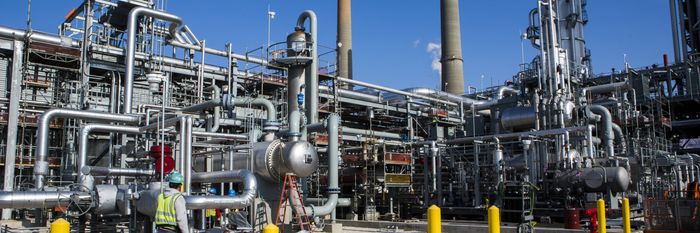
The Petra Nova Carbon Capture Project is seen on December 20, 2016 in Houston, Texas.
(Photo: Marie D. De Jesus/Houston Chronicle via Getty Images)
'Colossal Waste': US Leads Way in Public Spending on False Climate Solutions
"The fossil fuel industry delays climate action, distracts from real solutions that would end the fossil fuel era, and does everything in its power to squeeze the last drops of profit from a dying industry, at the expense of all of us."
Among the world's wealthiest countries, the U.S. leads the way in spending public money on so-called climate "solutions" that have been proven to "consistently fail, overspend, or underperform," according to an analysis released Thursday by the research and advocacy group Oil Change International.
The group's report, titled Funding Failure, focuses on international spending on carbon capture and fossil-based hydrogen subsidies, which continues despite ample data showing that the technological fixes have "failed to make a dent in carbon emissions" after 50 years of research and development.
The report details how five countries account for 95% of all carbon capture spending, with the U.S. investing the most taxpayer money in the technology, at $12 billion in subsidies over the last 40 years.
Norway comes in second with $6 billion going to carbon capture and storage, while Canada has spent $3.8 billion, the European Union has spent $3.6 billion, and the Netherlands has poured $2.6 billion into the technology, with which carbon dioxide emissions are compressed and utilized or stored underground.
"It is nothing short of a travesty that funds meant to combat climate change are instead bolstering the very industries driving it."
Harjeet Singh, global engagement director for the Fossil Fuel Non-Proliferation Treaty Initiative, toldThe Guardian that the subsidies amount to a "colossal waste of money."
"It is nothing short of a travesty that funds meant to combat climate change are instead bolstering the very industries driving it," said Singh.
While proponents claim carbon capture and storage reduces planet-heating carbon emissions, OCI notes, it was originally developed in the 1970s "to enhance oil production, and this remains its primary use," with the technology "barely" reducing emissions.
High-profile carbon capture failures in the U.S. include the Petra Nova project in Houston, Texas, which cost nearly $200 million in taxpayer funds and whose captured emissions were later used for crude oil production, and the FutureGen project, "which swallowed $200 million and never materialized."
"Investing in carbon capture delays the transition to renewable energy," reads OCI's report. "Instead of wasting time and money on technologies that do not work, governments must commit to justly and urgently phasing out fossil fuels before it's too late."
Despite the lack of data supporting the use of carbon capture, the group said, countries including the U.S. are "preparing to waste hundreds of billions of taxpayer dollars on these ineffective technologies, further benefiting the fossil fuel industry."
OCI highlighted how the U.S. and Canada, while ostensibly fighting the climate crisis, have spent a combined $4 billion in public money to explicitly "pay oil companies to produce more oil," with the subsidies going to carbon capture for "enhanced oil recovery."
The report also found that in addition to the $12 billion in taxpayer funds the U.S. has spent on carbon capture and fossil hydrogen—a leak-prone gas produced through energy-intensive processes that cause their own emissions—the government has spent an estimated $1.3 billion on the 45Q tax credit, which allows companies to write off tax for every ton of carbon dioxide they store underground.
The Inflation Reduction Act (IRA) increased the amount given to companies in 45Q tax credits from $35 to $60 per ton, meaning that the subsidy could grow to over $100 billion in the next 10 years.
OCI's Policy Tracker shows that overall public spending on carbon capture and hydrogen could grow by between $115 billion and $240 billion in the coming decades.
"We need real climate action, not fossil fuel bailouts!" said OCI in a post on social media.
The group's report also highlights that fossil fuel giants such as ExxonMobil have shifted from carbon capture skeptics to outspoken proponents of the technology—with the company bragging to investors that carbon capture and hydrogen would help its Low Carbon Business Unit make "hundreds of billions of dollars" and grow to be "larger than ExxonMobil's base business."
Exxon didn't launch its carbon capture efforts until 2018, having spent several years and hundreds of millions of dollars on another "climate solution" that ultimately failed: the use of algae to make biofuels.
Since then, Exxon has "pushed for direct government funding for carbon capture, particularly at the U.S. Department of Energy (DOE)," successfully lobbying for $12 billion allocated in the Bipartisan Infrastructure Bill in 2021 for "carbon management research, development, and demonstration."
Exxon also lobbied for the increased rate of the 45Q tax credit in the IRA and "played a 'central role' in drafting a 2019 DOE-sponsored report on carbon capture that determined Congress would need to create an incentive of around $90 to $110 per ton to support carbon capture deployment," according to OCI.
The Guardian on Thursday reported that Exxon still "chases billions in U.S. subsidies for a 'climate solution' that helps drill more oil," describing how the oil giant hosted an event at the Democratic National Convention earlier this month where senior climate strategy and technology director Vijay Swarup praised the IRA for helping Exxon pursue carbon capture and said: "We need new technology and we need policy to support that technology. We need governments working with private industry."
Exxon's enthusiasm for carbon capture, said OCI, is an example of how "the fossil fuel industry delays climate action, distracts from real solutions that would end the fossil fuel era, and does everything in its power to squeeze the last drops of profit from a dying industry, at the expense of all of us."
Bought & Paid for:
Scalise Took $40K in Campaign Cash From PAC of CEO Accused of Oil Price Rigging REPUBLICANS RECEIVED LARGE CONTRIBUTIONS!
IF YOU WANT TO WHINE & COMPLAIN ABOUT GAS PRICES, READ THIS:
excerpt:
The majority leader ranks fourth among all House lawmakers in 2023-24 campaign contributions from oil and gas interests, according to the watchdog OpenSecrets. His $325,833 in Big Oil contributions trails only Rep. August Pfluger (R-Texas), who took $572,421; former House Speaker Kevin McCarthy (R-Calif.), who received $335,399; and House Speaker Mike Johnson (R-La.), who got $328,019.
Because of legislation passed by President Biden and mostly Democrats, some of the renewable energy project across the country are pretty impressive and the figures justify the investment. Not only are we reducing greenhouse gases, but cleaning up the environment, saving money with CHEAPER RENEWABLES, but creating jobs as well.
There is now more SOLAR than DIRTY COAL!
Before the naysayers comment, EIA maintains charts, graphs and statistics that are worth reviewing: https://eia.maps.arcgis.com/apps/dashboards/77cde239acfb494b81a00e927574e430
ExxonMobil gets ripped to pieces in new spoof by Adam McKay's team at Yellow Dots Studios proving the need for serious action against the company gaslighting the public over disastrous climate change effects. John Iadarola and Sharon Reed break it down on The Damage Report.
Read more here:
In Satirical Spoof, Exxon Admits to Gaslighting Public on Climate Change - https://www.rollingstone.com/politics...
"In February, ExxonMobil CEO Darren Woods pointed a finger at the public for failing to solve the climate crisis — suggesting that consumers were to blame for the toxic carbon emissions produced by the oil giant. “The dirty secret nobody talks about is how much all this is going to cost and who’s willing to pay for it,” he declared during an interview with Fortune. “The people who are generating those emissions need to be aware of and pay the price for generating those emissions. That is ultimately how you solve the problem.” Woods, who has been at the helm of Exxon — one of the world’s top contributors to planet-heating greenhouse gas emissions — since 2017, faulted customers who weren’t willing to pay for the cost of cleaner fossil fuels. “When are people going to willing to pay for carbon reduction?” asked Woods. “We have opportunities to make fuels with lower carbon in it, but people aren’t willing to spend the money to do that.” In response to the supreme gaslighting by the CEO, Hollywood director Adam McKay‘s team at Yellow Dot Studios hit back at America’s largest oil and gas company (and third largest by revenue)."
**
Be part of the Dragon Squad as a YouTube channel member: http://go.tyt.com/join-tdr
Follow The Damage Report on Facebook: https://www.facebook.com/TheDamageRep...
Help build the Home of the Progressives http://tyt.com/JOIN
Subscribe to The Damage Report YouTube channel: https://www.youtube.com/thedamagerepo...
Follow The Damage Report on TikTok: https://www.tiktok.com/@thedamagerepo...
Follow The Damage Report on Instagram: http://www.instagram.com/thedamagerep...
Follow The Damage Report on Twitter: https://twitter.com/TheDamageReport#TheDamageReport#JohnIadarola#TheYoungTurks
240710__DR11Exxon
'All of Our Tricks Worked': Spoof ExxonMobil Ad Nails Just How Easy It's Been for Big Oil
"Do you have any idea how easy it is to get you off our backs with a little bullsh*t about your responsibilities to the planet?"
A new parody ExxonMobil advertisement released Tuesday by a group founded by Adam McKay—the Academy Award-winning writer and director of the blockbuster doomsday climate comedy Don't Look Up—mocks humanity for letting Big Oil get away with causing one of the biggest existential threats of all time.
"There's a world we all want to live in again. A world where the air is pure and crisp and clean and fills your lungs with joy. A world where you can drink water from any river or creek and your house will still be there tomorrow if it rains," the narrator of Yellow Dot Studio's latest parody video says in the two-minute clip. "Here at Exxon, we believe in that world, and we're working hard to make sure that our customers believe that we believe in that world."
"We understand the road has been bumpy, and we haven't always done the best we could," he says over footage of the Exxon Valdez disaster, in which more than 10 million gallons of crude oil were spilled in Alaska's Prince William Sound in 1989.
The voice-over continues:
Sure, our own scientists accurately predicted climate change 60 years ago. But we didn't want you to know about it. That's why we spent billions on ads and media manipulation covering it up, then we rigged the government so leaders in both parties would do our bidding, and yes, we did everything in our power to block clean energy tech so we could keep force-feeding you oil via expanding global infrastructure, monstrous vehicles, and disposable plastics and chemicals that don't go away. Ever.
The video follows the recent conclusion of a bicameral Senate investigation into Big Oil's decades of spreading climate disinformation and obstructing a green transition—after which lawmakers called on the U.S. Department of Justice to investigate fossil fuel giants. There is also a nascent movement urging state and local prosecutors to go after the oil and gas industry for climate-related deaths.
"And yes, every now and then you squawk about how evil we are, but then we drop gas prices a nickel and you shut right back up," the narrator says. "Do you have any idea how easy it is to get you off our backs with a little bullshit about your responsibilities to the planet? About your carbon footprint? Pretending plastic recycling actually makes a difference?"
"You're letting us get away with it, you dumb bitches" he adds mockingly. "All of our tricks worked. The world is a burning, out-of-control charnel house. The last generation to die of old age has already been born, and you still let oil executives freely show their face in public."
"We're just one company but you're 7 billion people," the video concludes. "Get off your asses and do something, you fucking peasants!"
Climate activists protest outside the New York State Supreme Court building during the Exxon trial on October 22, 2019 in New York City.
By Lisa Song, Illustrations by Max Guther, special to ProPublica
( ProPublica ) – Last year, I became obsessed with a plastic cup.
It was a small container that held diced fruit, the type thrown into lunch boxes. And it was the first product I’d seen born of what’s being touted as a cure for a crisis.
Now, the industry is heralding nothing short of a miracle: an “advanced”type of recycling known as pyrolysis — “pyro” means fire and “lysis” means separation. It uses heat to break plastic all the way down to its molecular building blocks.
While old-school, “mechanical” recycling yields plastic that’s degraded or contaminated, this type of “chemical” recycling promises plastic that behaves like it’s new, and could usher in what the industry casts as a green revolution: Not only would it save hard-to-recycle plastics like frozen food wrappers from the dumpster, but it would turn them into new products that can replace the old ones and be chemically recycled again and again.
So when three companies used ExxonMobil’s pyrolysis-based technology to successfully conjure up that fruit cup, they announced it to the world.
“This is a significant milestone,” said Printpack, which turned the plastic into cups. The fruit supplier Pacific Coast Producers called it “the most important initiative a consumer-packaged goods company can pursue.”
“ExxonMobil is supporting the circularity of plastics,” the August 2023 news release said, citing a buzzword that implies an infinite loop of using, recycling and reusing.
They were so proud, I hoped they would tell me all about how they made the cup, how many of them existed and where I could buy one.
Let’s take a closer look at that Printpack press release, which uses convoluted terms to describe the recycled plastic in that fruit cup:
“30% ISCC PLUS certified-circular”
“mass balance free attribution”
It’s easy to conclude the cup was made with 30% recycled plastic — until you break down the numerical sleight of hand that props up that number.
It took interviews with a dozen academics, consultants, environmentalists and engineers to help me do just that.
Stick with me as I unravel it all.
So began my long — and, well, circular — pursuit of the truth at a time when it really matters.
Given the high stakes of this moment, I set out to understand exactly what the world is getting out of this recycling technology. For months, I tracked press releases, interviewed experts, tried to buy plastic made via pyrolysis and learned more than I ever wanted to know about the science of recycled molecules.
Under all the math and engineering, I found an inconvenient truth: Not much is being recycled at all, nor is pyrolysis capable of curbing the plastic crisis.
Not now. Maybe not ever.
In traditional recycling, plastic is turned into tiny pellets or flakes, which you can melt again and mold back into recycled plastic products.
Even in a real-life scenario, where bottles have labels and a little bit of juice left in them, most of the plastic products that go into the process find new life.
It’s “very, very, very, very difficult” to break down plastic that way, said Steve Jenkins, vice president of chemicals consulting at Wood Mackenzie, an energy and resources analytics firm. “The laws of nature and the laws of physics are trying to stop you.”
Waste is heated until it turns into oil. Part of that oil is composed of a liquid called naphtha, which is essential for making plastic.
There are two ingredients in the naphtha that recyclers want to isolate: propylene and ethylene — gases that can be turned into solid plastics.
To split the naphtha into different chemicals, it’s fed into a machine called a steam cracker. Less than half of what it spits out becomes propylene and ethylene.
This means that if a pyrolysis operator started with 100 pounds of plastic waste, it can expect to end up with 15-20 pounds of reusable plastic. Experts told me the process can yield less if the plastic used is dirty or more if the technology is particularly advanced.
I reached out to several companies to ask how much new plastic their processes actually yield, and none provided numbers. The American Chemistry Council, the nation’s largest plastic lobby, told me that because so many factors impact a company’s yield, it’s impossible to estimate that number for the entire industry.
With mechanical recycling, it’s hard to make plastic that’s 100% recycled; it’s expensive to do, and the process degrades plastic. Recycled pellets are often combined with new pellets to make stuff that’s 25% or 50% recycled, for example.
But far less recycled plastic winds up in products made through pyrolysis.
That’s because the naphtha created using recycled plastic is contaminated. Manufacturers add all kinds of chemicals to make products bend or keep them from degrading in the sun.
Recyclers can overpower them by heavily diluting the recycled naphtha. With what, you ask? Nonrecycled naphtha made from ordinary crude oil!
This is the quiet — and convenient — part of the industry’s revolutionary pyrolysis method: It relies heavily on extracting fossil fuels. At least 90% of the naphtha used in pyrolysis is fossil fuel naphtha. Only then can it be poured into the steam cracker to separate the chemicals that make plastic.
So at the end of the day, nothing that comes out of pyrolysis physically contains more than 10% recycled material (though experts and studies have shown that, in practice, it’s more like 5% or 2%).
Ten percent doesn’t look very impressive. Some consumers are willing to pay a premium for sustainability, so companies use a form of accounting called mass balance to inflate the recycled-ness of their products. It’s not unlike offset schemes I’ve uncovered that absolve refineries of their carbon emissions and enable mining companies to kill chimpanzees. Industry-affiliated groups like the International Sustainability and Carbon Certification write the rules. (ISCC didn’t respond to requests for comment.)
To see how this works, let’s take a look at what might happen to a batch of recycled naphtha. Let’s say the steam cracker splits the batch into 100 pounds of assorted ingredients.
There are many flavors of this kind of accounting. Another version of free attribution would allow the company to take that entire 30-pound batch of “33% recycled” pouches and split them even further:
A third of them, 10 pounds, could be labeled 100% recycled — shifting the value of the full batch onto them — so long as the remaining 20 pounds aren’t labeled as recycled at all.
As long as you avoid double counting, Jenkins told me, you can attribute the full value of recycled naphtha to the products that will make the most money. Companies need that financial incentive to recoup the costs of pyrolysis, he said.
But it’s hard to argue that this type of marketing is transparent. Consumers aren’t going to parse through the caveats of a 33% recycled claim or understand how the green technology they’re being sold perpetuates the fossil fuel industry. I posed the critiques to the industry, including environmentalists’ accusations that mass balance is just a fancy way of greenwashing.
The American Chemistry Council told me it’s impossible to know whether a particular ethylene molecule comes from pyrolysis naphtha or fossil fuel naphtha; the compounds produced are “fungible” and can be used for multiple products, like making rubber, solvents and paints that would reduce the amount of new fossil fuels needed. Its statement called mass balance a “well-known methodology” that’s been used by other industries including fair trade coffee, chocolate and renewable energy.
Legislation in the European Union already forbids free attribution, and leaders are debating whether to allow other forms of mass balance. U.S. regulation is far behind that, but as the Federal Trade Commission revises its general guidelines for green marketing, the industry is arguing that mass balance is crucial to the future of advanced recycling. “The science of advanced recycling simply does not support any other approach because the ability to track individual molecules does not readily exist,” said a comment from ExxonMobil.
If you think navigating the ins and outs of pyrolysis is hard, try getting your hands on actual plastic made through it.
It’s not as easy as going to the grocery store. Those water bottles you might see with 100% recycled claims are almost certainly made through traditional recycling. The biggest giveaway is that the labels don’t contain the asterisks or fine print typical of products made through pyrolysis, like “mass balance,” “circular” or “certified.”
When I asked about the fruit cup, ExxonMobil directed me to its partners. Printpack didn’t respond to my inquiries. Pacific Coast Producers told me it was “engaged in a small pilot pack of plastic bowls that contain post-consumer content with materials certified” by third parties, and that it “has made no label claims regarding these cups and is evaluating their use.”
I pressed the American Chemistry Council for other examples.
“Chemical recycling is a proven technology that is already manufacturing products, conserving natural resources, and offering the potential to dramatically improve recycling rates,” said Matthew Kastner, a media relations director. His colleague added that much of the plastic made via pyrolysis is “being used for food- and medical-grade packaging, oftentimes not branded.”
They provided links to products including a Chevron Phillips Chemical announcement about bringing recycled plastic food wrapping to retail stores.
“For competitive reasons,” a Chevron spokesperson declined to discuss brand names, the product’s availability or the amount produced.
In another case, a grocery store chain sold chicken wrapped in plastic made by ExxonMobil’s pyrolysis process. The producers told me they were part of a small project that’s now discontinued.
In the end, I ran down half a dozen claims about products that came out of pyrolysis; each either existed in limited quantities or had its recycled-ness obscured with mass balance caveats.
Then this April, nearly eight months after I’d begun my pursuit, I could barely contain myself when I got my hands on an actual product.
I was at a United Nations treaty negotiation in Ottawa, Ontario, and an industry group had set up a nearby showcase. On display was a case of Heinz baked beans, packaged in “39% recycled plastic*.” (The asterisk took me down an online rabbit hole about certification and circularity. Heinz didn’t respond to my questions.)
This, too, was part of an old trial. The beans were expired.
Pyrolysis is a “fairy tale,” I heard from Neil Tangri, the science and policy director at the environmental justice network Global Alliance for Incinerator Alternatives. He said he’s been hearing pyrolysis claims since the ’90s but has yet to see proof it works as promised.
“If anyone has cracked the code for a large-scale, efficient and profitable way to turn plastic into plastic,” he said, “every reporter in the world” would get a tour.
If I did get a tour, I wondered, would I even see all of that stubborn, dirty plastic they were supposedly recycling?
The industry’s marketing implied we could soon toss sandwich bags and string cheese wrappers into curbside recycling bins, where they would be diverted to pyrolysis plants. But I grew skeptical as I watched a webinar for ExxonMobil’s pyrolysis-based technology, the kind used to make the fruit cup. The company showed photos of plastic packaging and oil field equipment as examples of its starting material but then mentioned something that made me sit up straight: It was using pre-consumer plastic to “give consistency” to the waste stream.
Chemical plants need consistency, so it’s easier to use plastic that hasn’t been gunked up by consumer use, Jenkins explained.
But plastic waste that had never been touched by consumers, such as industrial scrap found at the edges of factory molds, could easily be recycled the old-fashioned way. Didn’t that negate the need for this more polluting, less efficient process?
I asked ExxonMobil how much post-consumer plastic it was actually using. Catie Tuley, a media relations adviser, said it depends on what’s available. “At the end of the day, advanced recycling allows us to divert plastic waste from landfills and give new life to plastic waste.”
I posed the same question to several other operators. A company in Europe told me it uses “mixed post-consumer, flexible plastic waste” and does not recycle pre-consumer waste.
But this spring at an environmental journalism conference, an American Chemistry Council executive confirmed the industry’s preference for clean plastic as he talked about an Atlanta-based company and its pyrolysis process. My colleague Sharon Lerner asked whether it was sourcing curbside-recycled plastic for pyrolysis.
If Nexus Circular had a “magic wand,” it would, he acknowledged, but right now that kind of waste “isn’t good enough.” He added, “It’s got tomatoes in it.”
(Nexus later confirmed that most of the plastic it used was pre-consumer and about a third was post-consumer, including motor oil containers sourced from car repair shops and bags dropped off at special recycling centers.)
Clean, well-sorted plastic is a valuable commodity. If the chemical recycling industry grows, experts told me, those companies could end up competing with the far more efficient traditional recycling.
To spur that growth, the American Chemistry Council is lobbying for mandates that would require more recycled plastic in packaging; it wants to make sure that chemically recycled plastic counts. “This would create market-driven demand signals,” Kastner told me, and ease the way for large-scale investment in new chemical recycling plants.
I asked Jenkins, the energy industry analyst, to play out this scenario on a larger scale.
Were all of these projects adding up? Could the industry conceivably make enough propylene and ethylene through pyrolysis to replace much of our demand for new plastic?
He looked three years into the future, using his company’s latest figures on global pyrolysis investment, and gave an optimistic assessment.
At best, the world could replace 0.2% of new plastic churned out in a year with products made through pyrolysis.
ProPublica is a Pulitzer Prize-winning investigative newsroom. Sign up for The Big Story newsletter to receive stories like this one in your inbox.
ProPublica ProPublica is an independent, nonprofit newsroom that produces investigative journalism with moral force. We dig deep into important issues, shining a light on abuses of power and betrayals of public trust — and we stick with those issues as long as it takes to hold power to account.