Showing posts with label EPIDEMICS. Show all posts

Saturday, August 24, 2024

Palestinian Baby in Gaza Paralyzed by Polio, as Israel Rejects UN Ceasefire Call to allow Vaccinations


Displaced and Refugees

Palestinian Baby in Gaza Paralyzed by Polio, as Israel Rejects UN Ceasefire Call to allow Vaccinations

Ann Arbor (Informed Comment) – Julian Borger at The Guardian reports that the first verified case of type 2 poliovirus in 25 years in Gaza, in a baby, has resulted in the paralysis of the infant. It is only the first of many if the UN is not allowed to administer vaccines to 650,000 children in the Strip, which will definitely require a ceasefire. The Israeli authorities are refusing to consider this step.

There is no cure for polio once it is contracted. Its victims can be paralyzed or can die.

Without a ceasefire, UNICEF points out, you cannot get the families to line up their children to receive the vaccine by mouth. Some 95% of the infants in Gaza need to have the vaccine administered to prevent an outbreak, and they need two doses. Without a ceasefire, the aid workers cannot even safely move around to make arrangements for giving out the doses. The aid organizations want to use Deir al-Balah to store and distribute the vaccines, but the Israeli army has just once again ordered everyone out of it and has invaded it, risking destroying the remaining medical infrastructure there. Some 250,000 Palestinians have once again been expelled from their shelters since the beginning of August.

UNRWA head Philippe Lazzarini warned regarding Gaza, “Delaying a humanitarian pause will increase the risk of spread among children.” He suggested that some Israeli children could suffer from an epidemic, as well, but of course Israeli children have largely been vaccinated continually. Palestinian children had also been almost entirely vaccinated up until the Israeli total war on Gaza was implemented last fall.

UNICEF wrote of another war, Ukraine, “UNICEF helps vaccinate over 400 million children globally against polio every year, to eradicate polio worldwide. In Ukraine, UNICEF works to secure uninterrupted availability of life-saving vaccines for children and adults and to maintain high routine immunization coverage. As the war and subsequent displacement continues, gaps in immunization coverage put children’s health at risk.”

Although children in Ukraine are also at risk from polio outbreaks, the human toll of that war pales in comparison to Gaza. Some 2,000 children have been killed as a result of Vladimir Putin’s invasion of Ukraine.

Israeli Prime Minister Benjamin Netanyahu’s total war on the Gaza population has blown over 15,000 children to smithereens.

Whereas Putin’s Russia has been massively sanctioned for its illegal occupation and warfare in Ukraine by the US and most NATO countries, Israel’s government, which illegally occupied Gaza in 1967 and which has shown a reckless disregard for civilian life that may amount to genocide, has been given tens of billions of dollars by the Biden administration.

Type 2 polio vaccinations are substantially down over the past ten months, since the population and the aid workers have been constantly expelled from a succession of supposed safe zones by the Israeli military, medical facilities have been destroyed, and medicine deliveries have been made difficult or impossible by the bombings, artillery barrages, machine gun fire, drone strikes, lack of fuel and general chaos deliberately inflicted on the entire population by monstrously permissive Israeli rules of engagement — which entirely disregard the value of civilian, noncombatant life.


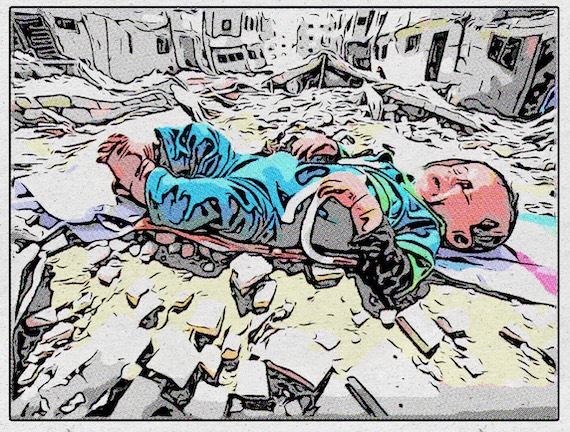
“Gaza Polio,” by Juan Cole, Digital, Dream / Dreamland v. 3 / Clip2Comic, 2024

Although Israeli authorities are allowing the delivery of the refrigerated trucks necessary for the vaccines, as well as the vaccine doses themselves, through the Kerem Shalom crossing, the aid workers are pointing out that these steps do no good at all unless there is a ceasefire that allows the aid workers to move around and give the vaccines to the children. Borger quotes Lazzarini as saying, “It is not enough to bring the vaccines into Gaza and protect the cold chain. To have an impact, the vaccines must end up in the mouths of every child under the age of 10.”

UNICEF points out that “The world has made tremendous progress against polio in the past three decades, vaccinating over 2.5 billion children and reducing cases by 99 percent. But this progress is fragile, and we cannot afford to lose focus. Millions of children are still missing out on routine vaccinations because of pandemic disruptions, conflict, climate disasters and displacement.”

It quotes Yuliia Dovjanych, Head Doctor at the ‘Dbayu’ medical centre “Infectious diseases do not disappear during the war. The fight against them is our ‘medical front’ where we must remain resilient. Therefore, we must continue to get vaccinated, take care of our health and the health of our children!” Some 11,520 civilians have been killed in the Ukraine war, whereas over 40,000 people have been killed in Gaza, a majority of them women and children.

At the medical front in Gaza, the war to save the children is going very badly. It will be lost without a ceasefire.

About the Author

Juan Cole is the founder and chief editor of Informed Comment. He is Richard P. Mitchell Professor of History at the University of Michigan He is author of, among many other books, Muhammad: Prophet of Peace amid the Clash of Empires and The Rubaiyat of Omar Khayyam. Follow him on Twitter at @jricole or the Informed Comment Facebook Page


INFORMED COMMENT

Saturday, July 27, 2024

Polio in Gaza: What does this mean for the Region and the World


EPIDEMICS

Polio in Gaza: What does this mean for the Region and the World

By Michael Toole, Burnet Institute | –

(The Conversation) – As war continues to devastate Gaza and its people, we learnt last week that a variant of poliovirus has been detected in the region. The virus was isolated in six sewage samples collected in late June from Khan Younis and Deir al Balah.

Most infections with poliovirus don’t cause symptoms, but a minority of those who contract the virus develop paralysis (paralytic polio).

No cases of paralytic polio have been reported in Gaza. But detecting the virus in wastewater is concerning nonetheless.

There are different types of polio

The cases of polio we’ve seen historically have generally been caused by “wild poliovirus”. For centuries, wild poliovirus affected both poor and wealthy countries, including Australia. The deployment of effective vaccines in the 1960s led to a dramatic decrease in cases in the following decades among those countries that could afford the vaccines.

The introduction of the Global Polio Eradication Initiative in 1988 enabled more equitable vaccination. There were only 12 cases of paralysis caused by wild poliovirus in 2023, in just two countries: Pakistan and Afghanistan.

However, as the number of wild poliovirus cases decreased there was an increase in cases of vaccine-derived poliovirus causing paralysis.

There are two types of polio vaccines: one is given orally, and the other by injection (the type used in Australia). The oral polio vaccine is based on a weakened virus – so it doesn’t cause disease, but can still reproduce. Vaccine-derived poliovirus emerges when people vaccinated with the oral polio vaccine excrete the vaccine virus in their stool and it spreads to other people.

Over time, it may mutate to become a virus that circulates and causes paralysis in populations with low levels of immunity. In 2023, there were 524 polio cases in 32 countries caused by vaccine-derived poliovirus.

It’s a strain of vaccine-derived poliovirus that has been detected in the wastewater in Gaza – type 2.

High vaccination coverage is key, but not always enough

The most important indicator of eradicating polio, both wild and vaccine-derived, is vaccine coverage. This is usually measured as the percentage of children under five who have received at least four vaccine doses, ideally 95%.

High vaccination coverage has been achieved by a combination of routine immunisation in early childhood plus national or local catch-up vaccination campaigns, particularly in areas where the virus pops up.

However, high vaccination coverage is not always enough to eliminate the virus.

Early in the 21st century, India and Nigeria were reporting the highest number of polio cases in the world. After an accelerated immunisation campaign in India, vaccine coverage rates were high by 2007 and cases were decreasing. But many cases continued to be reported in impoverished districts of western Uttar Pradesh (a state in northern India), where access to clean water and sanitation was poor.

Research shows a high level of pathogens in children’s intestines can make the absorption of the oral vaccine less effective, while unsanitary conditions make it easier for the virus to spread. After a sanitation and hygiene project began in 2007, the last case of polio in Uttar Pradesh occurred in 2010, and the entire country eradicated polio in 2014.

Wild polio was eradicated from Gaza more than 25 years ago. But it’s possible the re-emergence of vaccine-derived poliovirus is due to a combination of poor hygiene and sanitation, as we saw in Uttar Pradesh, and reduced vaccine coverage.

Polio vaccination coverage in the Palestinian territories was 99% in 2022. By the end of 2023, coverage had dropped to 89%. However, the data were not separated by each of the territories (the West Bank, East Jerusalem and Gaza), so coverage may be lower in Gaza.

Recent outbreaks

We saw the detection of a similar strain of poliovirus in wastewater in Jerusalem, London and New York in early 2022.

Parts of these cities have high concentrations of ultra-Orthodox Jews, which may have lower rates of vaccination than the overall population. In Rockland County, 65 kilometres north of New York City, a young, unimmunised Orthodox Jewish man became the first case of polio transmitted locally in the United States in 30 years.

There’s no evidence of vaccination hesitancy among Ultra-Orthodox Jews in Australia. However, there are other communities where vaccination rates are low, including some shires in the Northern Rivers district of New South Wales.

Communities with low vaccination rates, whatever the reason, are vulnerable to infectious diseases such as polio.

So where did this virus come from?

The oral vaccine used in Gaza has not contained type 2 since 2016, so it must have come from elsewhere.

In 2023, most outbreaks of type 2 vaccine-derived poliovirus were in the Democratic Republic of Congo, Yemen, Nigeria, Sudan and Somalia. There was also one case in Egypt, which borders on Gaza. Egypt could be the source of this virus, but we’ll need further investigation.

It’s unlikely to have come from Israel as there have been no detections of poliovirus in wastewater there since 2022.

What can the world learn?

First, we must not forget that poliovirus can cross borders and maintaining high vaccination rates in Australia and elsewhere is the most effective protective strategy. It’s also crucial to contain the virus inside Gaza. UNICEF and partners are preparing for a vaccination campaign focusing on young children.

Second, it’s important to maintain wastewater surveillance for polio, which is an early warning mechanism that can initiate public health action before symptomatic cases occur.

In 2022, Victoria was the only Australian state conducting routine polio wastewater surveillance until NSW adopted the practice when the outbreaks in Jerusalem, New York and London occurred. Wastewater surveillance is worthwhile in all states and territories.

Third, but not least, this should be a wake-up call highlighting the need to cease hostilities and provide unrestricted access by aid agencies to improve the provision of clean water, sanitation and effective health services throughout Gaza. This is an urgent global health priority.

Michael Toole, Associate Principal Research Fellow, Burnet Institute

This article is republished from The Conversation under a Creative Commons license. Read the original article.

Bonus video added by Informed Comment:

Gaza: WHO warns of potential polio outbreak | DW News Video

About the Author

The Conversation is an independent, not-for-profit media outlet that works with academic experts in their fields to publish short, clear essays on hot topics.


INFORMED COMMENT

Monday, January 2, 2023

FOCUS: David Waldstreicher | Rethinking the European Conquest of Native Americans


Reader Supported News
01 January 23

Live on the homepage now!
Reader Supported News


An image from the Library of Congress. (photo: Library of Congress)
FOCUS: David Waldstreicher | Rethinking the European Conquest of Native Americans
David Waldstreicher, The Atlantic
Waldstreicher writes: "The lore about Jamestown and Plymouth, Pocahontas and Squanto, leads many Americans to think in terms of tragedy and, eventually, disappearance. But actually, Indigenous people continued to control most of the interior continent long after they were outnumbered by the descendants of Europeans and Africans" 


In a new book by Pekka Hämäläinen, a picture emerges of a four-century-long struggle for primacy among Native power centers in North America.


When the term Indian appears in the Declaration of Independence, it is used to refer to “savage” outsiders employed by the British as a way of keeping the colonists down. Eleven years later, in the U.S. Constitution, the Indigenous peoples of North America are presented differently: as separate entities with which the federal government must negotiate. They also appear as insiders who are clearly within the borders of the new country yet not to be counted for purposes of representation. The same people are at once part of the oppression that justifies the need for independence, a rival for control of land, and a subjugated minority whose rights are ignored.

For the Finnish scholar Pekka Hämäläinen, this emphasis on what Native people meant to white Americans misses an important factor: Native power. The lore about Jamestown and Plymouth, Pocahontas and Squanto, leads many Americans to think in terms of tragedy and, eventually, disappearance. But actually, Indigenous people continued to control most of the interior continent long after they were outnumbered by the descendants of Europeans and Africans.

Much more accurate is the picture Hämäläinen paints in his new book, Indigenous Continent: a North American history that encompasses 400 years of wars that Natives often, even mostly, won—or did not lose decisively in the exceptional way that the Powhatans and Pequots had by the 1640s. Out of these centuries of broader conflict with newcomers and one another, Native peoples established decentralized hives of power, and even new empires.

In a previous book, The Comanche Empire, Hämäläinen wrote of what he controversially referred to as a “reversed colonialism,” which regarded the aggressive, slaving equestrians of “greater Comanchería”—an area covering most of the Southwest—as imperialists in ways worth comparing to the French, English, Dutch, and Spanish in America. There was continued pushback from some scholars when Hämäläinen extended the argument northward in his 2019 study, Lakota America. (The impact of his work among historians may be measured by his appointment as the Rhodes Professor of American History at Oxford University.)

What was most distinctive about these two previous books was that Hämäläinen so convincingly explained the Indigenous strategies for survival and even conquest. Instead of focusing on the microbes that decimated Native populations, Hämäläinen showed how the Comanche developed what he termed a “politics of grass.” A unique grasslands ecosystem in the plains allowed them to cultivate huge herds of horses and gave the Comanche access to bison, which they parlayed into market dominance over peoples who could supply other goods they wanted, such as guns, preserved foods, and slaves for both trade and service as herders.

Read: Return the national parks to the tribes

Hämäläinen treats Native civilizations as polities making war and alliances. In Indigenous Continent, there is less emphasis than in The Comanche Empire on specific ecosystems and how they informed Indigenous strategies. Instead, he describes so many Native nations and European settlements adapting to one another over such a wide and long time period that readers can appreciate anew how their fates were intertwined—shattering the simple binary of “Indians” and “settlers.” Indigenous peoples adapted strenuously and seasonally to environments that remained under their control but had to contend at the same time with Europeans and other refugees encroaching on their vague borders. These newcomers could become allies, kin, rivals, or victims.

Hämäläinen sees a larger pattern of often-blundering Europeans becoming part of Indigenous systems of reciprocity or exploitation, followed by violent resets. When Dutch or French traders were “generous with their wares” and did not make too many political demands, Natives pulled them into their orbit. Spanish and, later, British colonists, by contrast, more often demanded obeisance and control over land, leading to major conflicts such as the ones that engulfed the continent in the 1670s–80s and during the Seven Years’ War. These wars redirected European imperial projects, leading to the destruction of some nations, and the migration and recombination of others, such as the westward movement of the Lakota that led to their powerful position in the Missouri River Valley and, later, farther west. In this history, Indigenous “nomadic” mobility becomes grand strategy. North America is a continent of migrants battling for position long before the so-called nation of immigrants.

“Properly managed,” settlers and their goods “could be useful,” Hämäläinen writes. The five nations of the Iroquois (Haudenosaunee) confederacy established a pattern by turning tragic depopulation by epidemic into opportunities for what Hämäläinen calls “mourning wars” attacking weakened tribes and gaining captives. They formed new alliances and capitalized on their geographic centrality between fur-supplying nations to the west and north, and French and Dutch and, later, English tool and gun suppliers to the east and south. Hämäläinen insists that their warfare was “measured, tactical,” that their use of torture was “political spectacle,” that their captives were actually adoptees, that their switching of sides in wartime and the Iroquois’ selling out of distant client tribes such as the Delaware was a “principled plasticity.” This could almost be an expert on European history talking about the Plantagenets, the Hapsburgs, or Rome.

And there’s the rub. Hämäläinen, a northern European, feels comfortable applying the ur-Western genre of the rise and fall of empires to Native America, but imperial history comes with more baggage. Hämäläinen seems certain that Comanche or other Indigenous imperial power was different in nature from the European varieties, but it often seems as if Indigenous peoples did many of the same things that European conquerors did. Whether the Iroquois had “imperial moments,” actually were an empire, or only played one for diplomatic advantage is only part of the issue. Hämäläinen doesn’t like the phrase settler colonialism. He worries that the current term of art for the particularly Anglo land-grabbing, eliminationist version of empire paints with too broad a brush. Perhaps it does. But so does his undefined concept of empire, which seems to play favorites at least as much as traditional European histories do.

If an empire is an expanding, at least somewhat centralized polity that exploits the resources of other entities, then the Iroquois, Comanche, Lakota, and others may well qualify. But what if emphasizing the prowess of warriors and chiefs, even if he refers to them as “soldiers” and “officials,” paradoxically reinforces exoticizing stereotypes? Hämäläinen is so enthralled with the surprising power and adaptability of the tribes that he doesn’t recognize the contradiction between his small-is-beautful praise of decentralized Indigenous cultures and his condescension toward Europeans huddling in their puny, river-hugging farms and towns.

Hämäläinen notes that small Native nations could be powerful too, and decisive in wars. His savvy Indigenous imperialists wisely prioritized their relationships, peaceful or not, with other Natives, using the British or French as suppliers of goods. Yet he praises them for the same resource exploitation and trade manipulation that appears capitalist and murderous when European imperialists do their version. In other words, he praises Natives when they win for winning. Who expanded over space, who won, is the story; epic battles are the chapters; territory is means and end.

And the wheel turns fast, followed by the rhetoric. When British people muscle out Natives or seek to intimidate them at treaty parleys, they are “haughty.” At the same time, cannibalism and torture are ennobled as strategies—when they empower Natives. Native power as terror may help explain genocidal settler responses, but it makes natives who aren’t just plain brave—including women, who had been producers of essential goods and makers of peace—fade away almost as quickly as they did in the old history. As readers, we gain a continental perspective, but strangely, we miss the forest for the battlefields.

Read: Rez life

It’s already well known why natives lost their land and, by the 19th century, no longer had regional majorities: germs, technology, greed, genocidal racism, and legal chicanery, not always in that order. Settler-colonial theory zeroes in on the desire to replace the Native population, one way or another, for a reason: Elimination was intended even when it failed in North America for generations.

To Hämäläinen, Natives dominated so much space for hundreds of years because of their “resistance,” which he makes literally the last word of his book. Are power and resistance the same thing? Many scholars associated with the Native American and Indigenous Studies Association find it outrageous to associate any qualities of empire with colonialism’s ultimate, and ongoing, victims. The academic and activist Nick Estes has accused Hämäläinen of “moral relativist” work that is “titillating white settler fantasies” and “winning awards” for doing so. Native American scholars, who labor as activists and community representatives as well as academics in white-dominated institutions, are especially skeptical when Indigenous people are seen as powerful enough to hurt anyone, even if the intent is to make stock figures more human. In America, tales of Native strength and opportunistic mobility contributed to the notion that all Natives were the same, and a threat to peace. The alternative categories of victim and rapacious settler help make better arguments for reparative justice.

In this light, the controversy over Native empires is reminiscent of what still happens when it’s pointed out that Africans participated in the slave trade—an argument used by anti-abolitionists in the 19th century and ever since to evade blame for the new-world slaveries that had turned deadlier and ideologically racial. It isn’t coincidental that Hämäläinen, as a fan of the most powerful Natives, renders slavery among Indigenous people as captivity and absorption, not as the commodified trade it became over time. Careful work by historians has made clear how enslavement of and by Natives became, repeatedly, a diplomatic tool and an economic engine that created precedents for the enslavement of Black Americans.

All genres of history have their limits, often shaped by politics. That should be very apparent in the age of the 1619 and 1776 projects. Like the Declaration and the Constitution, when it comes to Indigenous peoples, historians are still trying to have it both ways. Books like these are essential because American history needs to be seen from all perspectives, but there will be others that break more decisively with a story that’s focused on the imperial winners.


READ MORE


Contribute to RSN

Follow us on facebook and twitter!

Update My Monthly Donation

PO Box 2043 / Citrus Heights, CA 95611


Saturday, February 1, 2020

CC News Letter 01 Feb- Brexit Day


Dear Friend,

Parliament Square is the site, muddied by rain, trodden by hundreds who have made it their celebratory space.  The Leave Means Leave official website had been busy for weeks, thrilled about January 31 and the fact that that Britain would finally be leaving that beastly collective they know as the European Union.  Those who promised to be in attendance were the usual suspects of the Little England brigade who had been so successful in convincing citizens that leaving the European Union was tantamount to gaining one’s freedom from a stifling oppressor.    Over time, the EU had become a figure no less savoury and vicious than Hitler, an achievement of branding if ever there was one.

Kindly support honest journalism to survive. https://countercurrents.org/subscription/

If you think the contents of this news letter are critical for the dignified living and survival of humanity and other species on earth, please forward it to your friends and spread the word. It's time for
humanity to come together as one family! You can subscribe to our news letter here http://www.countercurrents.org/news-letter/.

In Solidarity

Binu Mathew
Editor
Countercurrents.org


Brexit Day
by Dr Binoy Kampmark


Parliament Square is the site, muddied by rain, trodden by hundreds who have made it their celebratory space.  The Leave Means Leave official website had been busy for weeks, thrilled about January 31 and the fact that that Britain would finally be leaving that beastly collective they know as the European Union.  Those who promised to be in attendance were the usual suspects of the Little England brigade who had been so successful in convincing citizens that leaving the European Union was tantamount to gaining one’s freedom from a stifling oppressor.    Over time, the EU had become a figure no less savoury and vicious than Hitler, an achievement of branding if ever there was one.


Brexit, History & Ballot Choice
by
Thomas Kilkauer


In a mistaken version of Trump’s catch-cry “Make America Great Again” Make America Great Again, some British voters might have been led to believe that Brexit will Make Britain Great Again. They were convinced that the – never really – good old days of the British Empire would return by voting for Brexit. This is not to be. Capitalism and history have moved on. You can’t go home again.

In a mistaken version of Trump’s catch-cry “Make America Great Again” Make America Great Again, some British voters might have been led to believe that Brexit will Make Britain Great Again. They were convinced that the – never really – good old days of the British Empire would return by voting for Brexit. This is not to be. Capitalism and history have moved on. You can’t go home again. The world has seen three hegemonies of global capitalism emerging during the last three hundred years and then disappear. During the 17th century, the world saw Dutch trading and colonizing capitalism. Holland’s capitalism was taken over by British gunboats and slave-trading capitalism. This is not to say that the Dutch did not trade slaves. They did with a vengeance, but that is another story.
In the 18th and 19th century capitalism belonged to Britain. During those two centuries, Britain established an empire in which the sun never set, so the jingoist myth went. In continental Europe, meanwhile, during the 19th century imperialism meant three rather different things. For German capitalism, it meant unifying the country by customs unions, railways and military conquest,. Only in the year 1871, following the defeat of France by Prussia, the cluster of German-speaking states started to come close to what we call Germany today. Wilhelm of Prussia became the new Kaiser of the German Empire, crowned in (of all places) the Great Hall of Mirrors at Versailles. Capitalism demanded a unified economic space. Germany’s unified nation (the Reich), however,only coalesced towards the end of the 19th Century. Later German nationalism led to the most horrific excesses the world has ever seen, symbolized by one word: Auschwitz.
But the 19th Century meant something different for France. For the French, following the monarchy and the emergence of a revolutionary empire it meant, in Hegel’s dialectical terms, manifest in Napoleon’s Grand Army conquering “world spirit on horseback”reaching all the way from Paris to Moscow. If only for a brief time, until the emperor’s defeat at Waterloo, Europe was politically united, and could thereafter be conceived as a virtual common market, even when the new states became independent.  In sum, three significant things happened in the 19th Century, so far as Capitalism was concerned. Germany was busy with itself, France was busy with Europe, and Britain was busy with colonizing the rest of the world. In the end, of course, each of those empires imitated its rivals, and smaller states jockeyed for position within the new international order.
This came about contrary to the common belief that British people are reserved, the French talkative and abstract, and the Germans cold, insecure and obedient. But British imperialism was never reserved. The French were as grubby and grasping as anyone. The Germans pushed into Eastern Europe, built railways and fought among themselves.  It is said that Britain conquered every country it laid eyes on; the French taught everyone to speak French, love French food, and think French feelings; the Germans became idealists, swilled beer, and lusted after power.After more than a century of British colonialism and imperialism,the British and French Empires were in terminal decline by the end of the 19th Century. Germany, despite small colonies in Africa and the South Seas, expanded into a European-centred Reich—swallowing up half of Denmark, impinging on the Austro-Hungarians and establishing economic dominance in the Balkans.
Some say, the sinking of one of the world’s most advanced ships, the Titanic in the year 1912, marked the decay of European civilization. Others say, it was World War I(1914-18) that, despite Britain and allies winning, marked Britain’s decline, France’s weakening, and Germany’s inner turmoil in the wake of the Second Reich’s collapse. America grew stronger. By the conclusion of the Great War, it was no longer possible to say that British manufacturing ruled the roost, but instead that thanks to the systematic business principles of Frederick Taylor and Henry Ford’s conveyor-belt assembly factories introduced the so-called American Century American consumerism.
Sadly for British imperialists, then as now, many romantic illusions held about Britain are what they always were, that is, hallucinations. Meanwhile, back in the real world, with India’s independence after World War Two, Britain’s empire was well and truly gone; and the glory days crown jewellery of British colonialism a mere memory of a phantasm. In terms of Realpolitik, the industrial and military power of Uncle Sam (the USA) dominateda new era in world history.The 20th century saw the great struggle between  three ideologies: Fascism, Communism and Capitalism in the guise of Democracy Fascism, Stalinism, and capitalism. By the end of the last century, it was clear who the winner was: capitalism, but not necessarily democracy.
At the beginning of the year 2020, it might be safe to predict that the United States of America will carry on being a(and not the) dominant player. Still, it is even more safe to assume that Great Britain (and only precariously as the United Kingdom) without the European Union, thanks to Brexit, will not return to the glorious days of the hegemonic empire.England on its own will never again be a dominant player. John Bull (symbol of the nation of merchants and manufacturers) will not shape the remaining 21st century. For most people in the UK, the British Empire meant no more more than the fourteen-hour working day and child labour in William Blake’s Dark Satanic Mills. In other words, the rural workers and the urban proletariat did not go horseback riding with Jane Austin’s country gentry lovely Mr Darcy.Brexit is unlikely to bring those happy days back, not even for Boris Johnson’s upper class mates at Eaton.
Instead of fox hunts and village fetes, British men and women, then as now,had to fight for a living. They struggled for living wages and campaigned for workplace rights. In 1998, a British case went to the European Court of Justice (ECJ) concerning  an English woman who had been dismissed from her job while pregnant. The EJC decided in favour of the plaintiff.Shortly thereafter Britain’s Sex Discrimination Act was re-interpreted and eventually amended. With Brexit essentially a done deal (more or less, hard or soft), the EU is gone as a backstop for British Law Lords, and Boris Johnson, furnished with a sufficient electoral win, can proceed tom reform (that is, deform) England unwritten constitution.Some traditional work-place rights, we predict,will be turned back. After Brexit, British women, once again, can be fired for being pregnant, and shoppers can pick up delicious chlorinated chicken on the way home freshly imported from the USA, as EU food safety rules will no longer apply.
Having lost the security and strength of the EU through Get Brexit Done, Britain will find herself rather alone, if not isolated, in dealing with the coming of the five great challenges for the 21st century, challenges defined by people, technology, money, the media, and ideas, to wit:
  1. People: There will be a continuous flow of people within the British Isles (from north to south, west to east, etc.), to the UK, and out of the UK.Brexitas the done deal (or non-deal) will only marginally alter this process already speeded up during  the dreadfully-long and sluggish debates. Despite Brexit, or perhaps even because of, the flow of legal migrants, asylum seekers, desperate exiles, and pushy tourists will not stop. Migration has been a feature of Europe for a very long time. Brexit will not stop this. In fact, it might enhance the flow of people.

  1. Technology:There will be a flow of technology. Since the days of the steam engine, capitalism has been driven by technology. The movement of technology will be in terms of hardware, manufacturing components, technical know-how, and IT. But this movement is unlikely to be outward. Instead it will be inward. Britain will become a major importer of technology, not exporter.Even before the bills were passed in the House of Commons allowing Brexit to proceed, manufacturing had already begun to relocate into continental Europe leave the UKand this trend will continue and increase. Tesla’s new factory is shifting close to Brussels Berlin – not to Birmingham. This also means that post-Brexit Britain is unlikely to remain a technical, engineering, and information technology center. Continental Europe is a more likely candidate. And why not? It has the size, the infrastructure, and the money.

  1. Money:There will be a flow of money (national stock exchanges and commodity speculations). London will still be Europe’s finance centre. But several banks and financial institutions have already started to look for alternatives sites inside the EU. Some look at popular destinations the front-runners being Dublin because of the English language and Frankfurt because of its centrality, the European Central Bank, and its established banking system. Still, Frankfurt is considered to be boring. Finally, as said in the movie Casablanca,“we will always have Paris”with the greatest European culture but also a few language problems might be expected.

  1. Media:There will be flow of information (newspapers, magazines, satellite television channels, websites, the Internet). The English language provides a clear advantage for the city of London, rather than the rest of the UK. Nevertheless IT’s global techno-leader is the USA with GAFMA – Google, Apple, Facebook, Microsoft, and Amazon.

  1. Ideas:There is also a flow of ideas (human rights, environmentalism, free trade movements, fear of terrorism). Traditionally, Britain has been seen as a strong centre for such intellectual enterprises as human rights. However, on a global scale environmentalism, the UK remains a follower, lagging behind the EU, and particularly Denmark. Brexit is set to make this situation worse. Most European countries have understood that Britain’s much beloved free market cannot fix global warming. A government capable and willing to operate at an effective level remains to be found. Facing global warming means a big, powerful, and financial strong state, and the UK has just withdrawn from such an entity. Worse, Brexiteers, the British conservative party, its ideology of neoliberalism, and Boris Johnson all point in the exact opposite direction. Like Trump they are climate change deniers, or at least trivializers.

All this raises the really big question: with the British empire gone and virtually no chance of returning to it and the five challenges outlined above unsolved, why did the pro-Brexit groups and the Tory Party win on the 12th December 2019 happen at all? Perhaps Boris Johnson’s slogan Get Brexit Done!provided a convincing frame for enough people to understand the world of politics. In addition, Boris Johnson is a master of the blame-game. For years his job was to lash out at everything and anything on the EU. In the case of Brexit, he blamed the holdup on Labour even though opposition arose strongly from within his own party. The results of the recent election show that blaming (or scapegoating) others still works.
In analysing the defeat, US-democrats, Australia’s Labor Party, and Britain’s progressives are making the same mistakes over and over again – perhaps a traditional sign of insanity. They still believe in the Enlightenment myth that the truth will set us free. If we only tell the people the truth, they will vote for us. The mass of voters are rational human beings. This is wrong for two reasons: firstly, people do not get the truth. They get what the Murdoch media (Fox, the Sun, etc.) tells them is the truth; secondly, at least since Kahneman and Tversky (1970s and early 1980s), we know that voters make non-rational decisions. In the case of Brexit and Boris Johnson, they voted against their class interest and for nationalism, if not for outright racism. In the case of Trump, theyhis American base votes against its own best interests own interest.
Despite so much evidence to the contrary, many self-appointed election analysts hang on to the l’idée fixe that it is irrational to vote against your self-interest. True or not, people do that and they do it rather often. Otherwise, conservatives would not win elections in most countries as they are at the beginning of 2020. Consequently, progressives and their election analysts are once again shocked and surprised when voters do not cast their ballots as the pundits predict. These experts start infamous soul-searching, change their leaders, and beat their collective breasts, all without ever understanding what really happened. They fail to realize that whenever conservatives use Orwellian language, for example, they not only tell outright lies to the people and engage in elaborate and covert propaganda. They show their vulnerability. Despite the overwhelming media presence of conservative voices casting aspersions in almost every direction but the right one, this is the strategic flank to attack that is allowed to pass unnoticed.
Another issue progressive fail to realize is the fact that conservatives enforce message discipline. In other words, despite Abraham Lincoln’s warning that “You can fool some of the people all of the time, all of the people some of the time, but not all of the people all of the time,”  they stay on message: “Get Brexit Done!” Everyone knows the chant by heart now. “Make America Great Again!” – Everyone knows that too. And what do we hear from the other side? From Britain’s Labor Party and the US Democrats side: Zilch. A blank space.
Unlike Democrats (US) and Labour (UK), the Tories and the Republicans hammer away relentlessly the same simple message over and over again until they win. Winning elections isn’t a mind game for intellectuals. You win by finding the lowest common denominator: a message everyone understands, everyone knows, and everyone can vote for. It is not a sophisticated eight-course French menu. Instead, it is a bit like driving through McDonalds and being asked “Do you want that with fries?” Find the food everyone (except us intellectuals) likes and sell it. Don’t explain the good medical or moral reasons why they should become vegans. The Big Mac is a winning ticket. Conservatives have figured this one out long ago. And so they win elections: in the USA, in Brazil, in the UK, in Australia, in the Philippines, in Israel, in Hungary, in Poland, in the Czech Republic, in India. The list goes on.
With the backing of the Murdoch press, Trump, Boris Johnson, and their Australian counterpart Scott Morrison ScoMo were able to dish up politics in a way everybody could understand everyone understood. Trump, Johnson, and ScoMo presented cultural stereotypes and framed their single message accordingly. They were also convincing in presenting themselves as father figures who can protect the American/British/Australian people from invading foreigners, including lesbians, queers, transvestites and post-modernist non-binomials.
This does not mean that progressives everywhere should be like ScoMo, Trump and Boris Johnson. The opposite is the case. Progressives do not win elections by betraying their identity – by shifting to the right of the political spectrum. This is not what the electorate expects. Instead, progressives need to invent a believable message and stick to it. It needs to be an easily consumable message that has relevant values. For example, taxes are not bad. Taxes means that the fire brigade comes when you need it, that your roads are safe, that the rubbish is collected, the air is clean, and schools and hospitals are working.
In doing this, progressives face two opposing groups. Progressives face corporate and conservative media. Elections are a 2 against 1 (2:1) game. Progressives need to challenge conservative ideologies, such as that a hierarchical society is eternal and that a leader should always be obeyed. These are deeply anti-democratic concepts. Liberals and moderates need to challenge the old-fashioned right-wing idea that to be moral is to be obedient to authority. What makes progressive ideas moral is thoughtful and controlled disobedience. Challenging the immorality of authority makes one a good person. Progressives also need to destroy right-wing hallucinations, like the rich are good. The wealthy and the influential are not a natural elite. They will n ever fit through the eye of a needle. The poor are not poor because they lack discipline or are lazy. The poor do not deserve to be impoverished and disenfranchised and they should not serve the whims of the rich.
Today, right-wing thinking is applied to schools and universities. Conservatives know that without a culture war, they cannot win elections. Next to winning significant battles in the culture war, conservatives also have established a significant number of think tanks that hammer right-wing messages on TV day in and day out. In some cases, they write press releases that go straight into understaffed and underfunded newspapers, radio, and TV stations. They also had Cambridge Analytica, they still have Russian troll farms, and most importantly, they also have a polarizing propaganda-machine called Facebook, as well as Twitter (Trump’s preferred propaganda tool), WhatsApp, YouTube, etc.
Intellectuals from Albert Einstein to Stephen Hawking have never been on the side of closed-mind conservatives This is the point where progressives make one of their most crucial mistakes. They think the general population is like them. Most people are not intellectuals. They are not training the develop and understand complex and sophisticated arguments. They are not trained to spot contradictions. The mistake they make is a bit like what happens in Group think group thinking. They assume that everyone thinks like an intellectual. The vast majority does not think like that. Perhaps none other than Karl Marx understood this. He wrote a book for intellectualsDas Kapital (Capital) – Das Kapital – and he wrote (with his comrade-in-arms Friedrich Engels) a little pamphlet for everyone else – Manifest der Kommunistischen Partei – Communist Manifesto. Progressives are not going to win elections by producing Das Kapital-like programs. The tax program of the Australian Labor party is a great example. It was well thought-out and made a lot of sense but it was too complicated for the ordinary voter to figure out. Meanwhile, ScoMo’s falsehood “Labor is a high-tax party” registered with the punters. He won and Labor lost bitterly. Now we are stuck with him, as Australian burns.
Unlike nineteenth-century Karl Marx, many present-day left-leaning Liberals, Democrats and moderates appear to be trapped inside their own vicious circle, those who read the same newspapers and, hear the same long-winded speeches and analyse the same books, and hence are (at least to themselves) “smart”. Hence, too, we get the aforementioned just-tell-the-truth misconceptions. This fallacy is derived from a nun recognized delusion of the partly and party-based educated to think that everyone is an intellectual. As a consequence, many progressives end up talking about political party programs, not values like the right does. They insist on the correct program and policy instead of talking about hard-headed principles and moral values. They hammer these programs even when clear directions are called for.
It used to be said that intelligent people invented the alphabet and intellectuals have been abusing  it ever since. Progressives (not only self-identified but vilified as such by their opponents) can become rather regressive—they keep going back to what they once were taught was correct and praiseworthy. They neither listen to what ordinary people are complaining about, hear what their opposition says, and mock what they don’t understand. Ordinary people who work, feeland think (when they do) in the hard-nosed, nitty-gritty of their own lives, hear not what their educated leaders and would-be governors think they are saying, but what is done and proposed on their behalf, and they can smell out the rat, the stench of irrelevance and pious nothings. Thus we end up with a topsy-turvy political world where everyone seems to be talking past everyone else. When this happens, the sly and malicious take up their positions and set that world afire with mean-spirited, mendacious and exploitative policies.
Conservatives (both upper case and lower case), know that they want to change an open and democratic culture into an authoritarian regime. They try to frame all intellectuals as a despicable elite. On the other hand, they have been successful in attracting the poor (rural and urban, out-of-work and under-employed) and poorly-educated males. In America, without such a base, you can hardly win elections. In the UK, Boris Johnson attracted the same kind of disaffected and frustrated voters  in the North of England, to the (again!) great surprise of Labor.Trump was quite explicit, shouting to his audience when shouting,“I love the poorly educated.” “I love the poorly educated”.
Johnson exploited the new reality, that most of the old working –class and rural Labour members felt (perceived the image, felt the vibes, although they didn’t listen closely and understand the heart of the message) the party had betrayed their interests for those of the urban, highly-educated elite.  Given the right(right-sounding, right-wing) message, the“base”will vote against their own best interests. And they not only will promise to do so when interviewed or polled, they actualdoit at the ballot. And they do so regularly. Yet when they do it, progressives are puzzled about the question, How could they win?How could they vote for Brexit?Unless progressives get their message right and frame it in a way that everyone can understand, they will continue to wonder why the right wins election after election.
Thomas Klikauer is author of a forthcoming book on Germany’s new Nazi party, the AfD – Alternative for Germany to be published by Sussex Academic Press.


SARS, Wars And The Farce
by Satya Sagar


The global hype and scare around the coronavirus outbreak is reminiscent of similar panic over SARS, avian flu and swine flu in the last decade and half. Driven by half-truths, poor quality data, sensational media coverage these are pandemics of idiocy at best and geopolitical conspiracies at their worst. In this context we are reproducing an article on SARS, first published in 2003, written in the
context of the US war on Iraq at that time. It tells a tale that has become generic to all global health scares of our times.

Note: The global hype and scare around the coronavirus outbreak is reminiscent of similar panic over SARS, avian flu and swine flu in the last decade and half. Driven by half-truths, poor quality data, sensational media coverage these are pandemics of idiocy at best and geopolitical conspiracies at their worst. In this context we are reproducing an article on SARS, first published in 2003, written in the context of the US war on Iraq at that time. It tells a tale that has become generic to all global health scares of our times.
The depression hits me on a warm and humid Bangkok evening. I am just through with dinner in the city’s crowded Sukhumvit business district, my head full of the War on Iraq and I spot these people- with masks on their faces.
A couple of weeks ago anybody with a cloth covering his face in this city would have been branded a jihadi’ a possible Arab/Muslim/dark skinned/dark intentionedterrorist’. The city has been on alert well before the war on Iraq started to prevent `Arab looking’ people from doing bad things- for eg., looking Arab.
Just around the time of the Anglo-American attack on Iraq, if there were to be an `Arab’ behind a mask in Bangkok — the entire city would have been evacuated.
Apparently, not anymore. Respectable people wear masks now in Thailand, Singapore, Malaysia, Hong Kong. In fact mandatory they say to save yourself from SARS- the flu-like virus that has much of south-east Asia in deep panic. Tourists are canceling their trips in droves, schools are closing down, economies plunging, governments in crisis and the Chinese- oh those `super-contaminating Chinese’- are being spurned everywhere.
Suddenly, an irrational panic grips me. God- there is no escape.
If the Apostles of Armageddon running the White House do not get you some mysterious malevolent microbes will. For a fleeting moment, a deep frozen moment, I lose hope. We are finished. They will get us one way or the other.
This is what the new/OLD colonial world order is going to be all about- complete helplessness for us common citizens. Caught between SARS and THEIR Wars the only safe place is soon going to be- you guessed right- on planet Mars.
Yes, the people I saw wearing those masks have a right to protect themselves. I will not mock them in any way. To paraphrase Voltaire I do not believe these masks medically help them in any way but I will defend to death their right to wear them. And then there are so many of THEM out there who deserve to have a mask fixed on their faces permanently anyway (so we won’t have to `read their bloody lips’).
Yes, there are these microbes and many of them are dangerous. Yes, people have died and still continue to do so. And it is indeed true we really do not know which way this pandemic is going to turn out. There are constant references to the great Influenza outbreak after World War One which killed an estimated 20 to 40 million people. Is SARS going to be that big ?
I am no kin to any Indian sage and I cannot predict such things. But I am betting neither can the medical experts’ or themedia’ give us a real idea of what is going to happen. At this stage, given the sparse information on hand about SARS, it is all idle speculation- an activity that SOME people usually make lots of money out of.
Even assuming the deeply depressing thought that much of humanity is going to be wiped out by SARS over the next year (that is what the media is making it sound like) let us take a step back from this approaching abyss, take a deep breath (go ahead, do it while it is still safe) and reflect on a few questions about other aspects of this PANDEMONIUM of a pandemic.
First the CONTEXT: Why are we so full of fear only of THESE microbes and not those dozen other ways in which people die completely avoidable deaths ?
To anyone who is not already aware of these facts let me spell them out:
250,000 to 500,000 people die every year around the world due to ordinary influenza, the common `garden variety’ flu. In the United States alone, with a vaccine and medical care available, flu kills 36,000 people die every year.
Anywhere between 1 to 2.7 million die every year due to Malaria- a vast majority of them in Africa, particularly children
Tuberculosis kills 2 million people every year and 98 per cent of these in developing countries
HIV/AIDS claimed 3 million lives in 2002, including an estimated 610,000 children.
Traffic accidents kill 300,000 people every year in Asia alone.
The Anglo-American invasion of Iraq killed at least 10 to 15,000 Iraqi soldiers and over 2,300 Iraqi civilians in just the initial two weeks and maybe several hundred British and American troops.
And I am not even counting those millions who die of poverty and malnutrition around the globe annually. Every year the Indian media attributes hundreds of deaths to the cold wave’,the heat wave’, too much rain’ andtoo little rain’. The fact is these deaths have nothing to do with the weather- in my country there people die every hour, wantonly, in PERFECTLY good weather. We all know WHY.
I would say this. If we choose to cover our faces let it be in anger and in shame- not just due to some microbes alone.
The RECORD so far: Here is the latest status of the number of SARS cases worldwide and deaths so far since 1 November 2002 when the disease is supposed to have broken out in southern China. In almost six months since the outbreak a total of 4439 cases of SARS and `suspected’ SARS have been recorded in 26 countries and 263 people have died. The mortality rate due to SARS is estimated between 3 to 4 percent- but even this is not confirmed because the total number of real SARS cases is not yet known[i]. Nor is its exact method of transmission clearly understood- which is why wearing masks may not be a useful precaution at all.
The MEDICAL ESTABLISHMENT: The alarm bells about SARS started ringing only when the WHO issued a global alert in mid-March . A war of words broke out soon between the WHO and the Chinese health authorities- the latter being accused of hiding information’ about SARS in its first few months. The Chinese said something back, which nobody understood (they are never going to be asuperpower’ this way).
One of the big critiques of bodies like the WHO from health activists has been the way they have adopted a purely vertical’ approach to global health problems at the cost of a sustained, holistic and long-term approach. So whenever there is an outbreak or more usually anoutcry’ about a particular disease WHO and other global health officials organize a posse’, mobilize some resources, and ride into the wilderness ready tolasso’ the villain.
Once the `critter’ is temporarily caught or suppressed the issue is then mostly forgotten.
There is no attempt to even address underlying causes of new virus and diseases emerging for eg., due to super-intensive techniques of animal husbandry, recycling of animal offals in animal feed, the use of a variety of artificial hormones and growth-enhancers and of course from biological warfare experiments. Nor is there any attempt to mitigate the conditions, such as overcrowding, poverty and lack of housing infrastructure, under which infectious diseases such as SARS spread so rapidly. The WHO has failed to push policies that tackle other basic social and economic determinants of public health also — such as conflict, environmental pollution and privatization of health care.
The MEDIA: Has anybody really asked how much of the SARS scare is due to the media’s penchant for simplistic, alarmist reporting ? One of the first big’ SARS cases to make the headlines was that of Johnny Cheng, a Chinese-American businessman who died at a hospital in Hanoi, Vietnam after flying in from Hong Kong. Just a month ago Hanoi was one of theepicentres’ of the SARS pandemic going by media reports. No more. The country seems to have slipped down the hit list of `no go’ places with just 63 reported SARS cases and 5 deaths.
How did this super-contagious’,killer’ disease get contained in a crowded country like Vietnam with a very average public health system ? Nobody in the media is following the Vietnam story anymore because that is not on the map of the usual globe-trotting elites. Hong Kong, Singapore and Toronto are on that MAP and hence the panic about viruses traveling on the business class seat next to THEM. (If nothing else, maybe there is a great `success story’ out there in Vietnam, with details of how a poor, third world country has successfully contained this deadly new infectious disease.)
And what happened to the media follow up to the various other health scares we have had in the past decade all around the globe ? Bubonic plague in India, Ebola in Africa, the Mad Cow Disease in the UK ? And why was there virtually no coverage in the `international media’ of the influenza outbreak in Madagascar in mid-2002, where more than 27 000 cases were reported within three months and 800 deaths occurred despite rapid intervention ?
There is an apocryphal story going around this part of the world which shows how much of a media thing’ this SARS scare probably is. The question asked is why is this new form of flu being called the Severe Acute Respiratory Syndrome ?Severe’ and Acute’- two synonymous terms together — WHY ? Apparently- the termSevere’ was added (only in early March this year) to avoid an awkward acronym resulting from what was originally dubbed the Acute Respiratory Syndrome ? What’s the secret here- cover your face and save your — — ?
That story is most probably a bad joke-but let me tell you- I think so is the way the entire SARS scare is being reported and played out.
I AM NOT SAYING that the deaths due to SARS are not a real, serious tragedy or that it could not turn into a dangerous pandemic. Far from it. There is no moral mathematics involved here, please. Every human life is precious- Iraqi or American, Chinese or Singaporean. A very unique, irreplaceable Universe of its own- disappears forever with each physical death. All I am pleading for is some more PERSPECTIVE.
WHY are those dying of malaria, tuberculosis, HIV/AIDS and poverty in most developing countries every day not making the headlines ? Is it not because those who die unseen, unheard, untreated are not in the same league as the Gold Card holding frequent flyers of our world ? Is it not because there is such a `low probability’ of a TB infected African child coughing in the same air-conditioned corridors as our elites frequent ?
A couple of years ago a senior editor of one of India’s major newspapers, when asked by a women’s rights activist to publish a story about high rates of malnutrition among girl children, is reported to have refused and said ` The readers of our newspaper do not suffer from malnutrition’. Sure, Mr Let Them Eat Cake- but aren’t YOU and YOUR readers who are the CAUSE of malnutrition in India. ( Ahem, what I wanted to say was -’ Will someone pass me that cutting edge of the French Revolution !’)
When one hears stories such as these a question arises in my mind. This is just a nasty, nasty question that I just can’t get out of my head. COULD IT BE that those who die unseen, unheard, untreated are themselves MICROBES in the worldview of our Masters ? Has the microbe become a metaphor for the unwashed, unwanted millions who don’t fit into the corporate globalisation of our Empire builders ?
Good riddance, THEY suppose, of those teeming, troublesome microbes- of so little value to the Empire. Microbes, who cannot afford to BUY and have nothing to SELL.
And from this high point of MORAL CLARITY it is just a little leap away to identifying those other microbes that need to be dealt with. The bearded, turbaned, different, DISSIDENT, multi-tongued microbes. To be screened and searched at every airline check-point, discouraged, disinfected, disposed off like a dirty secret. Microbes, whose very EXISTENCE, is a form of biological warfare to SOME.
No, I really want to bring this subject up. However depressing the subject is to me and many of you reading this. It is important to see where our dear world is headed towards. A world in which there are perishable, pestilent MICROBES and there are those HUMAN BEINGS- moulded in the image of GOD.
OK, OK not all of us are microbes of course. Many of us are a slightly higher caste- tolerated, employed, paid, domesticated, sheep, cattle. And there is also that special category — well-fed, trained dogs. God bless the creatures- I really have nothing against their species. ( In fact, some of them are my best friends) But I can’t help objecting to the worst of canine qualities that many of these four-legged ones in our midst display. Whining and Dining with the Masters, Biting and Barking at the Poor.
I know all this is getting a bit too depressing and I don’t like it one bit. I have been reading too much Orwell these days, and that too, on the front pages of daily newspapers.
So how does one get out of this Animal Farm we all seem to be trapped in ? I would say- let’s go back to our roots and our traditions- the great traditions of the ancient microbes.
Think of it- the microbes- the first form of LIFE on Planet Earth.
Microbes- mating, multiplying, mutating into higher, more virulent forms of cognitive, COMBATIVE life. Weathering all storms, RESISTING all predators and surviving every sterile environment. Microbes evolving, exploring, EXPLODING till every form of LIFE finds its place under the sun.
I have got it figured now. What this globe really needs now is a Movement of All Microbes and the Mother of All Movements. A million MOAMS to match all THEIR murderous, misanthropic MOABs.
Satya Sagar is a journalist who can be reached at sagarnama@gmail.com
[i]When the SARS pandemic was finally declared over in 2005 the total  official SARS-related deaths, worldwide, stood at just 774.


Breaking News: Rama Denied Citizenship Based On NRC + CAA!
by Siddhartha Mitra


A short story


Centenary of Mook Nayak:  Young Ambedkarites Should Take Charge of New Media
by Vidya Bhushan Rawat


Today, in the one hundred years of Mook Nayak, important is to continue with autonomous publications. Let more flowers bloom and young Ambedkarites take charge of new media, use social media and engage in constructive debate.


Death Penalty And The Anti-Thesis Of It
by Sutputra Radheye


There is always a debate on whether capital punishment, to be specific death penalty, should be
abolished or retained for ordinary crimes. In my opinion, it should be abolished. In this view of mine, I don’t stand alone.    As of 2018, 142 countries have abolished death penalty either in law or practice. Whereas, 56 have retained the power, in which category India falls.

There is always a debate on whether capital punishment, to be specific death penalty, should be abolished or retained for ordinary crimes. In my opinion, it should be abolished. In this view of mine, I don’t stand alone.  As of 2018, 142 countries have abolished death penalty either in law or practice. Whereas, 56 have retained the power, in which category India falls.
So, why should it be abolished in India? Let’s try to answer the arguments the opposite motion often raises with facts, and set some alternative arguments that support the motion of abolishment.
First, it is irreversible. What if the judicial system committed a mistake, and someone is hanged based on it. Later, when the system realizes of its mistake, how will justice be served to a dead prisoner? When I claim the system can make mistakes, I would like to have the Supreme Court as my advocate, when it said, to cite an NDTV report, “To err is human and not one of us, who has held judicial office, can claim that we have never passed a wrong order,” a bench of justices Deepak Gupta and Aniruddha Bose said in their order passed last week.”So, if mistakes are made, who will be responsible for an innocent hanged? Or will he be just a collateral damage of the entire ‘good’ system?
Second, even if the judiciary system was spot on to order death penalty to a criminal, who can assure that the same legal judgment can’t be used as a precedent for other similar cases in other legal institutions? No-one, as it will be. Just like no one can guarantee that some of the other cases will not be fake, and meticulously well-planned to frame someone. In that scenario, if the same death penalty is ordered to an innocent, will it be justice?  Now, consider the first point and second point together, how dangerous does it sound? Just think once. And, for the idealists, let me tell you, false cases are a reality.
When we say precedent here, it means stare decisis, which is to stand by the decision, and is based on the principle that similar cases should be judged similarly, if I am not wrong.
Third, it is futile, and alienates a person from the first right of a human being- the right to life. Why is it futile? Because there is no scientific or empirical evidence of it acting as a catalyst in reducing the crime rate. On the other hand, a study carried out by Professor Michael Radelet and Traci Lacock of the University of Colorado showed how 88% of the leading criminologists believed death penalty to be futile. Also, the 2000 New York Times report ‘ABSENCE OF EXECUTIONS: A special report.; States With No Death Penalty Share Lower Homicide Rates’ agrees with abolishment motion when it writes, “…Indeed, 10 of the 12 states without capital punishment have homicide rates below the national average, Federal Bureau of Investigation data shows, while half the states with the death penalty have homicide rates above the national average. In a state-by-state analysis, The Times found that during the last 20 years, the homicide rate in states with the death penalty has been 48 percent to 101 percent higher than in states without the death penalty.”So, these facts are enough to prove the futility of the experiment.
Fourth, to my crude opposition to inhumanity, the supporters might argue of the criminal’s heinous crime, and the inhumanity of the act.  I agree to the part that considers it a heinous, brutal and inhumane act, but what we must understand is that law isn’t a medium of revenge, but of justice. Justice needs to be fair. Killing a person who killed someone is revenge with no practical, long term merit, but a fair amount of demerit. Also to point out, which crime is more heinous and which isn’t, how do we measure that? Even most alike crimes have differences, so how do we bring fairness while ordering justice? Another point that the supporters often claim to be the judgment in this case is the popular support. But, is the crowd voting in favor of it truly aware of the reality? To answer the same question- US Supreme Court Justice Thurgood Marshall suggested that support for capital punishment among citizens would decline if Americans were aware of the facts of its application (Mathew Robinson).
Fifth, the death penalty is sometimes discriminatory in nature and has its own set of prejudices as even the judicial personnel aren’t free from societal stereotypes. In the words of Marshall, “I believe the following facts would serve to convince even the most hesitant of citizens to condemn death as a sanction: capital punishment is imposed discriminatorily against certain identifiable classes of people; there is evidence that innocent people have been executed before their innocence can be proved; and the death penalty wreaks havoc with our entire criminal justice system”. Thus, something which has such a high probability of discriminatory and wrong judgments, why should India as a country endorse that experiment?
So, with these five arguments, I rest my case in support of abolishment of death penalty in favor of human rights of global citizens.
Sutputra Radheye is a poet and commentator who delve into the themes affecting the socio-eco-political scenario. His works have been published in prestigious platforms like ‘Frontier’, ‘Countercurrents’, ‘Janata Weekly’, ‘Culture Matters’ (UK), and many more throughout the years.


The deity of a destroyer!!
by Sonali Chanda


I’ve been locked for thousand days,
threatened by your guns,and you think you banished me in front of my children..
I born with an oath,not to be defeated ,you don’t know,
In a dark corner of tge green hills,I write your Last Supper..


If there is peace
by Sutputra Radheye


If there is peace-
where does it live?
how does it look?
when to look for it?


What Jan 30 says aloud to Jan 26
by Niranjan TG


The three bullets that reddened my day
at 5:12 in the evening
definitely belonged to that hunter.
When your day is again decorated
with weapons,
when you stand with your chest
thrust out in pride greeting them,
it is good to remember all this.


Weekend Edition | Despite Midterm Win, Will Dems Help GOP Pass 'Massive Giveaway' to Big Oil and Big Tech?

                                                              LOTS OF POSTS IGNORED BY BLOGGER..... OR REMOVED ON THEIR WHIM! ALL POSTS ARE ...