Showing posts with label EAST JERUSALEM. Show all posts

Wednesday, September 18, 2024

The Sphinx and the Sultan: How Biden’s Bear Hug of Netanyahu Caused Washington’s Near East Policy to Crash and Burn


Egypt

The Sphinx and the Sultan: How Biden’s Bear Hug of Netanyahu Caused Washington’s Near East Policy to Crash and Burn

I’m reprinting here my most recent Tomdispatch essay for The Nation Institute, on the possible emergence of a centrist Sunni bloc that aims to offset Israeli power in the region. Check out, as well, Tom Engelhardt’s essential introduction, here.

At least one thing is now obvious in the Middle East: the Biden administration has failed abjectly in its objectives there, leaving the region in dangerous disarray. Its primary stated foreign policy goal has been to rally its partners in the region to cooperate with the extremist Israeli government of Benjamin Netanyahu while upholding a “rules-based” international order and blocking Iran and its allies in their policies. Clearly, such goals have had all the coherence of a chimera and have failed for one obvious reason. President Biden’s Achilles heel has been his “bear hug” of Netanyahu, who allied himself with the Israeli equivalent of neo-Nazis, while launching a ruinous total war on the people of Gaza in the wake of the horrific October 7th Hamas terrorist attack on Israel.

Biden also signed on to the Abraham Accords, a project initiated in 2020 by Jared Kushner, the son-in-law and special Middle East envoy of then-President Donald Trump. Through them the United Arab Emirates, Bahrain, and Morocco all agreed to recognize Israel in return for investment and trade opportunities there and access to American weaponry and a U.S. security umbrella. Not only did Washington, however, fail to incorporate Saudi Arabia into that framework, but it has also faced increasing difficulty keeping the accords themselves in place given increasing anger and revulsion in the region over the high (and still ongoing) civilian death toll in Gaza. Typically, just the docking of an Israeli ship at the Moroccan port of Tangier this summer set off popular protests that spread to dozens of cities in that country. And that was just a taste of what could be coming.

Breathtaking Hypocrisy

Washington’s efforts in the Middle East have been profoundly undermined by its breathtaking hypocrisy. After all, the Biden team has gone blue in the face decrying the Russian occupation of parts of Ukraine and its violations of international humanitarian law in killing so many innocent civilians there. In contrast, the administration let the government of Prime Minister Benjamin Netanyahu completely disregard international law when it comes to its treatment of the Palestinians. This summer, the International Court of Justice ruled that the entire Israeli occupation of Palestinian territories is illegal in international law and, in response, the U.S. and Israel both thumbed their noses at the finding. In part as a response to Washington’s Israeli policy, no country in the Middle East and very few nations in the global South have joined in its attempt to ostracize Vladimir Putin’s Russia.

Worse yet for the Biden administration, the most significant divide in the Arab world between secular nationalist governments and those that favor forms of political Islam has begun to heal in the face of the perceived Israeli threat. Turkey and Egypt, daggers long drawn over their differing views of the Muslim Brotherhood, the fundamentalist movement that briefly came to power in Cairo in 2012-2013, have begun repairing their relationship, specifically citing the menace posed by Israeli expansionism.

The persistence of Secretary of State Antony Blinken in pressing Saudi Arabia, a key U.S. security partner, to recognize Israel at a moment when the Arab public is boiling with anger over what they see as a campaign of genocide in Gaza, is the closest thing since the Trump administration to pure idiocracy. Washington’s pressure on Riyadh elicited from Saudi Crown Prince Mohammed Bin Salman the pitiful plea that he fears being assassinated were he to normalize relations with Tel Aviv now. And consider that ironic given his own past role in ordering the assassination of Saudi journalist Jamal Khashoggi. In short, the ongoing inside-the-Beltway ambition to secure further Arab recognition of Israel amid the annihilation of Gaza has America’s security partners wondering if Washington is trying to get them killed — anything but a promising basis for a long-term alliance.

Global Delegitimization

The science-fiction-style nature of U.S. policy in the Middle East is starkly revealed when you consider the position of Jordan, which has a peace treaty with Israel. In early September, its foreign minister, Ayman Safadi, warned that any attempt by the Israeli military or its squatter-settlers to expel indigenous West Bank Palestinians to Jordan would be considered an “act of war.” While such anxieties might once have seemed overblown, the recent stunning (and stunningly destructive) Israeli military campaign on the Palestinian West Bank, including bombings of populated areas by fighter jets, has already begun to resemble the campaign in Gaza in its tactics. And keep in mind that, as August ended, Foreign Minister Israel Katz even urged the Israeli army to compel Palestinians to engage in a “voluntary evacuation” of the northern West Bank.

Not only is the expulsion of Palestinians from there now the stated policy of cabinet members like Jewish Power extremist Itamar Ben-Gvir; it’s the preference of 65% of Israelis polled. And mind you, when Israel and Jordan begin talking war you know something serious is going on, since the last time those two countries actively fought was in the 1973 October War during the administration of President Richard Nixon.

In short, Netanyahu and his extremist companions are in the process of undoing all the diplomatic progress their country achieved in the past half-century. Ronen Bar, the head of Israel’s domestic Shin Bet intelligence agency, warned in August that the brutal policies the extremists in the government were pursuing are “a stain on Judaism” and will lead to “global delegitimization, even among our greatest allies.”

Turkey, a NATO ally with which the U.S. has mutual defense obligations, has become vociferous in its discontent with President Biden’s Middle Eastern policy. Although Turkey recognized Israel in 1949, under President Recep Tayyip Erdogan of the pro-Islam Justice and Development Party interactions had grown rocky even before the Gaza nightmare. Still, until then their trade and military ties had survived occasional shouting matches between their politicians. The Gaza genocide, however, has changed all that. Erdogan even compared Netanyahu to Hitler, and then went further still, claiming that, in the Rafah offensive in southern Gaza in May, “Netanyahu has reached a level with his genocidal methods that would make Hitler jealous.”

Worse yet, the Turkish president, referred to by friend and foe as the “sultan” because of his vast power, has now gone beyond angry words. Since last October, he’s used Turkey’s position in NATO to prohibit that organization from cooperating in any way with Israel on the grounds that it’s violating the NATO principle that harm to civilians in war must be carefully minimized. The Justice and Development Party leader also imposed an economic boycott on Israel, interrupting bilateral trade that had reached $7 billion a year and sending the price of fruits and vegetables in Israel soaring, while leading to a shortage of automobiles in the Israeli market.

Erdogan’s Justice and Development Party represents the country’s small towns and rural areas and its Muslim businesses and entrepreneurs, constituencies that care deeply about the fate of Muslim Palestinians in Gaza. And while Erdogan’s high dudgeon has undoubtedly been sincere, he’s also pleasing his party’s stalwarts in the face of an increasing domestic challenge from the secular Republican People’s Party. In addition, he’s long played to a larger Arab public, which is apoplectic over the unending carnage in Gaza.

The Alliance of Muslim Countries

Although it was undoubtedly mere bluster, Erdogan even threatened a direct intervention on behalf of the beleaguered Palestinians. In early August, he said, “Just as we intervened in Karabakh [disputed territory between Azerbaijan and Armenia], just as we intervened in Libya, we will do the same to them.” In early September, the Turkish president called for an Islamic alliance in the region to counter what he characterized as Israeli expansionism:

“Yesterday, one of our own children, [Turkish-American human rights advocate] Ayşenur Ezgi Eygi, was vilely slaughtered [on the West Bank]. Israel will not stop in Gaza. After occupying Ramallah [the de facto capital of that territory], they will look around elsewhere. They’ll fix their eyes on our homeland. They openly proclaim it with a map. We say Hamas is resisting for the Muslims. Standing against Israel’s state terror is an issue of importance to the nation and the country. Islamic countries must wake up as soon as possible and increase their cooperation. The only step that can be taken against Israel’s genocide is the alliance of Muslim countries.”

In fact, the present nightmare in Gaza and the West Bank may indeed be changing political relationships in the region. After all, the Turkish president pointed to his rapprochement with Egypt as a building block in a new security edifice he envisions. Egyptian President Abdel Fattah al-Sisi made his first visit to Ankara on September 4th (following a February Erdogan trip to Cairo). And those visits represented the end of a more than decade-long cold war in the Sunni Muslim world over al-Sisi’s 2013 coup against elected Muslim Brotherhood Egyptian President Mohamed Morsi, whom Erdogan had backed.

Despite its apparent embrace of democratic norms in 2012-2013, some Middle Eastern rulers charged the Brotherhood with having covert autocratic ambitions throughout the region and sought to crush it. For the moment, the Muslim Brotherhood and other forms of Sunni political Islam have been roundly defeated in Egypt, Syria, Tunisia, and the Persian Gulf region. Erdogan, a pragmatist despite his support for the Brotherhood and its offshoot Hamas, had been in the process of getting his country the best possible deal, given such a regional defeat, even before the Israelis struck Gaza.

Netanyahu’s Forever War in Gaza

For his part, Egypt’s al-Sisi is eager for greater leverage against Netanyahu’s apparent plan for a forever war in Gaza. After all, the Gaza campaign has already inflicted substantial damage on Egypt’s economy, since Yemen’s Houthis have supported the Gazans with attacks on container ships and oil tankers in the Red Sea. That has, in turn, diverted traffic away from it and from the Suez Canal, whose tolls normally earn significant foreign exchange for Egypt. In the first half of 2024, however, it took in only half the canal receipts of the previous year. Although tourism has held up reasonably well, any widening of the war could devastate that industry, too.

Egyptians are also reportedly furious over Netanyahu’s occupation of the Philadelphi Corridor south of the city of Rafah in Gaza and his blithe disregard of Cairo’s prerogatives under the Camp David agreement to patrol that corridor. The al-Sisi government, which, along with Qatar’s rulers and the Biden administration, has been heavily involved in hosting (so far fruitless) peace negotiations between Hamas and Israel, seems at the end of its tether, increasingly angered at the way the Israeli prime minister has constantly tacked new conditions onto any agreements being discussed, causing the talks to fail.

For months, Cairo has also been seething over Netanyahu’s charge that Egypt allowed tunnels to be built under that corridor to supply Hamas with weaponry, insisting that the Egyptian army had diligently destroyed 1,500 such tunnels. Egypt’s position was given support recently by Nadav Argaman, a former head of Shin Bet, who said, “There is no connection between the weaponry found in Gaza and the Philadelphi Corridor.” Of Netanyahu, he added, “He knows very well that no smuggling takes place over the Philadelphi Corridor. So, we are now relegated to living with this imaginary figment.”

In the Turkish capital, Ankara, Al-Sisi insisted that he wanted to work with Erdogan to address “the humanitarian tragedy that our Palestinian brothers in Gaza are facing in an unprecedented disaster that has been going on for nearly a year.” He underscored that there was no daylight between Egypt and Turkey “regarding the demand for an immediate ceasefire, the rejection of the current Israeli escalation in the West Bank, and the call to start down a path that achieves the aspirations of the Palestinian people to establish their independent state on the borders of June 4, 1967, with East Jerusalem as its capital.” He also pointed out that such positions are in accord with U.N. Security Council resolutions and pledged to work with Turkey to ensure that humanitarian aid was delivered to Gaza despite “the ongoing obstacles imposed by Israel.”

To sum up, the ligaments of American influence in the Middle East are now dissolving before our very eyes. Washington’s closest allies, like the Jordanian and Saudi royal families, are terrified that Biden’s bear hug of Netanyahu’s war crimes and the fury of their own people could, in the end, destabilize their rule. Countries that, not so long ago, had correct, if not warm, relations with Israel like Egypt and Turkey are increasingly denouncing that country and its policies. And the alliance of U.S. partners in the region with Israel against Iran that Washington has long worked for seems to be coming apart at the seams. Countries like Egypt and Turkey are instead exploring the possibility of forming a regional Sunni Muslim alliance against Netanyahu’s geopolitics of Jewish power that might, in the end, actually reduce tensions with Tehran.

That things have come to such a pass in the Middle East is distinctly the fault of the Biden administration and its position — or lack of one — on Israel’s nightmare in Gaza (and now the West Bank, too). Today, all too sadly, that administration is wearing the same kind of blinkers regarding the war in Gaza that President Lyndon B. Johnson and his top officials once sported when it came to the Vietnam War.

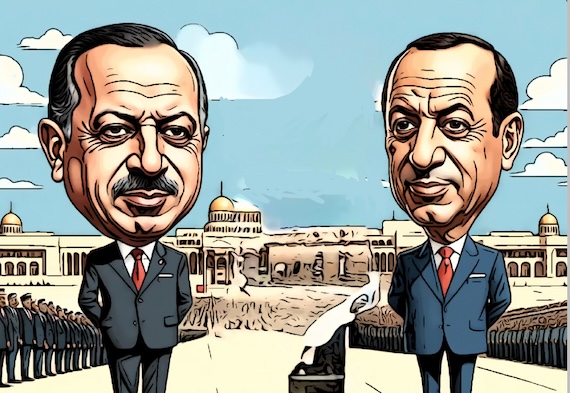
Featured Image: “Erdogan and al-Sisi,” Digital, Dream /Dreamland v3 / IbisPaint/ Clip2Comic, 2024

About the Author

Juan Cole is the founder and chief editor of Informed Comment. He is Richard P. Mitchell Professor of History at the University of Michigan He is author of, among many other books, Muhammad: Prophet of Peace amid the Clash of Empires and The Rubaiyat of Omar Khayyam. Follow him on Twitter at @jricole or the Informed Comment Facebook Page


INFORMED COMMENT

Friday, August 30, 2024

“Wipe it off the Face of the Earth!” Israel’s War on the United Nations and International Law


Israel

“Wipe it off the Face of the Earth!” Israel’s War on the United Nations and International Law

( Middle East Monitor ) – Departing Israeli Ambassador to the United Nations, Gilad Erdan, has clearly had an unpleasant experience at the world’s largest international institution. In an interview published in the Israeli newspaper Maariv on 20 August, the disgruntled envoy said that, “The UN building should be closed and wiped off from the face of the earth.” Whether Erdan realised it or not, his aggressive statement is an admission that his four-year career as Israel’s top UN diplomat was a failure.

In the interview, Erdan expressed his wish to become the head of Likud, the right-wing party of current Israeli Prime Minister Benjamin Netanyahu. His choice of words could have been his way of appealing to the right and far-right constituencies that feed on such aggressive rhetoric.

However, there is more to Erdan’s hatred for the UN than the mere frustration of a disappointed diplomat. Israel has had a long and troubled history with the UN and its associated institutions. According to Israel’s political discourse and victim narrative, the UN is an “anti-Semitic” organisation, a label often invoked when Israel faced even the slightest criticism.

Israel’s relationship with the UN is particularly odd because the occupation state was created by a UN resolution.

That resolution itself was a direct outcome of UN political intrigues and western pressure. On 29 November, 1947, the UN passed Resolution 181, calling for the partition of historic Palestine into a Jewish state and an Arab state. It assigned most of the land, 56 per cent, to the Jewish population, then a minority, and the rest to the Palestinian Arab indigenous people. Shortly afterwards, the Jewish Zionist leadership began a military campaign that saw the nascent state occupy most of Palestine and ethnically cleanse most of its population.

Israel was admitted as a full UN member on 11 May, 1949, while Palestinians native to the land remain stateless. Although Israel’s admission to the international body was conditional upon the acceptance of Resolutions 181 and 194 — covering the status of Jerusalem as an international body, and the right of return of Palestinian refugees — Israel’s violations of these and other resolutions have not been punished thanks to strong backing from Washington and other western powers.

In June 1967, the rest of historic Palestine was conquered. Again, hundreds of thousands of Palestinians were ethnically cleansed and, ever since, the Palestinians remaining in their land as either “Arab Israelis” or refugees have lived under a draconian system of military occupation, apartheid, siege and a constant state of war.

The ongoing Israeli genocide in the Gaza Strip is the culmination of all the injustices inflicted on the Palestinian people over the past eight decades and more. The war did not start on 7 October, 2023, nor will it end when a ceasefire is finally declared.

Aside from the November 1917 Balfour Declaration, wherein Britain pledged support for a “Jewish national home” in historic Palestine, UN Resolution 181, which allowed the establishment of Israel, could arguably be considered the genesis of ongoing Palestinian suffering.

Throughout this bloody, unjust history, the UN has neither penalised Israel for its violations of UN resolutions and other pillars of international law, nor granted Palestinians their long overdue justice. It has failed to implement or enforce any of its resolutions recognising the illegality of the Israeli occupation of Palestine.

Nevertheless, Palestinians continue to resort to the UN, since it is their only international platform that could constantly remind Israel, and the world, that Tel Aviv is an Occupying Power, and that international and humanitarian laws must apply to Palestinians as an occupied people. Such reminders were made frequently in the past, at the UN General Assembly and even at the Security Council, always to the annoyance of Israel and its western benefactors, especially the United States.


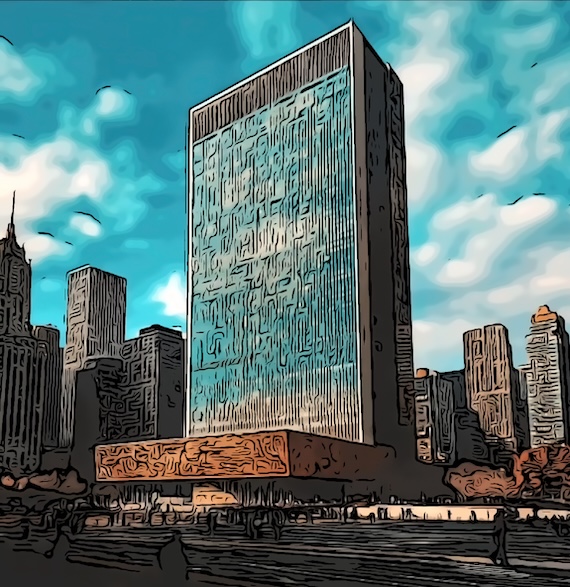
“UNO,” Digital, Midjourney / Clip2Comic, 2024

The latest solid legal position was articulated through an Advisory Opinion by the International Court of Justice (ICJ) on 19 July. After the testimonies and interventions made by at least 52 countries and countless experts, the ICJ resolved that

Israel’s occupation of the Gaza Strip and the West Bank, including East Jerusalem, is unlawful, along with the associated settlement regime, annexation and use of natural resources.

Although the UN has not made any difference in forcing Israel to end its occupation, dismantle illegal settlements or respect the basic human rights of Palestinians, the international institution remains a source of frustration for the occupation state.

Ever since its establishment on the ruins of Palestinian homes, Israel has worked to change the status of Palestine and Palestinian refugees, and constantly challenged the very term “occupation”. It has done its utmost to rewrite history, illegally annex Palestinian and Arab land, and build illegal settlements to establish permanent “facts on the ground”.

In 2017, it looked as if Israel was succeeding in its quest to cancel the Palestinian cause altogether when Washington recognised Israel’s fraudulent claims to Occupied East Jerusalem, the West Bank and the Golan Heights. The international community, though, did not follow suit, as demonstrated in the ICJ’s recent legal ruling. As far as the UN is concerned, Israel remains an Occupying Power, bound to international laws and norms.

For Palestinians, however, such facts remain devoid of practical meaning, while for Israel, the UN position is a major obstacle in the face of its blatant settler-colonial project. And this is why Erdan wants the UN “wiped off from the face of the earth”. Even if the angry Israeli diplomat gets his wish, nothing will alter this historic truth: Israel is and will remain a settler-colonial regime, and Palestine and its people will continue to resist, until justice is finally served.

The views expressed in this article belong to the author and do not necessarily reflect the editorial policy of Middle East Monitor or Informed Comment.

Via Middle East Monitor

Creative Commons License Unless otherwise stated in the article above, this work by Middle East Monitor is licensed under a Creative Commons Attribution-NonCommercial-ShareAlike 4.0 International License.

About the Author

Ramzy Baroud has been writing about the Middle East for over 20 years. He is an internationally-syndicated columnist, a media consultant, an author of several books and the founder of PalestineChronicle.com. His latest book is My Father Was a Freedom Fighter: Gaza’s Untold Story (Pluto Press, London).


INFORMED COMMENT

Thursday, August 22, 2024

Is Israel’s Far Right Wing Government Prolonging the Gaza Genocide as a Smokescreen for annexing the West Bank?


Israel/ Palestine

Is Israel’s Far Right Wing Government Prolonging the Gaza Genocide as a Smokescreen for annexing the West Bank?

( Middle East Monitor ) – Promises of “absolute victory” in Gaza are nothing but “gibberish”, according to Israeli Defence Minister Yoav Gallant. Gallant’s comments were not meant to be public, but somehow were leaked and published by Israeli media on 12 August.

The explanation of why Benjamin Netanyahu is pursuing a losing war in Gaza has been largely confined to the prime minister’s personal interests, not least the avoidance of corruption trials, preserving his extremist government coalition and avoiding an early general election. Still, none of these rationales explain the absurdity of continuing with a war which, in the words of former Prime Minister Ehud Barak, is “The worst failure in Israel’s history.”

What else could explain Netanyahu’s motive for the war? And why are his most crucial government allies, National Security Minister Itamar Ben-Gvir and Finance Minister Bezalel Smotrich, determined to prolong it? The answer may not lie in Gaza, but in the occupied West Bank.

While Israel is extending its failed military campaign in the Strip with no clear strategic objectives, its war on the West Bank is driven by very clear motives indeed: the annexation of the occupied Palestinian territory and the ethnic cleansing of large sectors of the Palestinian population. This is not only obvious through Israel’s daily actions in the West Bank, but also because of the clear statements made by Israel’s extreme far right government officials, including a commitment by Netanyahu’s own Likud party to “advance and develop settlement in all parts of the land of Israel – in the Galilee, Negev, Golan Heights and Judea and Samaria.” The latter, of course, is what Zionists call the West Bank.

An audio recording obtained by the Israeli group Peace Now conveyed the following remarks by Smotrich at a June 9 conference: “My goal is to settle the land, to build it, and to prevent, for God’s sake, its division… and the establishment of a Palestinian state.”

To do so, the far-right politician has assigned himself the job of “change(ing) the DNA of the system.” This “system” was put in place decades ago, following Israel’s military occupation of the West Bank in 1967. It began a slow but determined process of illegal annexation of Palestinian territories. The process included the establishment, in 1981, of the so-called Civil Administration.

This was and remains essentially a branch of the Israeli military.

However, it was described as “civil” as part of a government effort to convert a temporary military occupation into the permanent colonisation of Palestine. This entailed the practical annexation and continued expansion of the illegal Israeli Jewish settlements built on Palestinian land after the June 1967 Six-Day War.

The Oslo Accords in 1993-94 gave Palestinians nominal administrative control over small areas in the West Bank, designated as areas A and B. This necessitated the transfer of some of the Civil Administration’s responsibility to the newly-formed Palestinian Authority, based on the understanding that the PA will always prioritise Israel’s security. The arrangement allowed Israel to expand, unhindered, its illegal settlements in most of the West Bank and East Jerusalem, tripling both the size and population of the settlements between 1993 and 2023.

As Israel’s colonial plan in the West Bank reached its zenith, Netanyahu sought in 2020 to reinforce Israeli gains with the annexation of more than 30 per cent of the West Bank. Due to international pressure and growing Palestinian resistance, however, Netanyahu postponed his plan, albeit with the understanding that “annexation remains on the table”.

Without much fanfare, though, Israel swapped its hope for a sweeping de jure annexation of the West Bank with de facto control, through rapid seizures of Palestinian land and the expansion of its settlements, all of which are illegal under international law.

Although the Israeli military is faltering in Gaza, the genocide is being used as a smokescreen to finalise Israel’s settler-colonial plans in the West Bank.

This process was dubbed by Smotrich in 2017 as a “victory by settlement”. Now in a position of power and with access to a massive budget, he is making his life’s goal a reality.

For Smotrich’s dream to be realised, he needed to revitalise the once central role of the Civil Administration. In May, he invented a new position called “deputy head” of the administration, granting the position to his close associate Hillel Roth.

Now both men have unparalleled and sweeping rights to expand the settlements. Since coming to power in December 2022, Netanyahu’s latest government has approved 12,000 new housing units for illegal settlements, while ordering the demolition of thousands of Palestinian homes and other civilian infrastructure.

In the first three months of 2024, Israel declared nearly 6,000 acres of the West Bank to be “state-owned land”, and therefore made it eligible for settlement construction. The decision was described by the Israeli watchdog Peace Now as the “largest West Bank land grab in 30 years.”

The ethnic cleansing of Palestinians is already under way. According to the Norwegian Refugee Council, in the first half of 2024 alone, at least 1,000 Palestinians were forcefully displaced while nearly 160,000 were affected by home demolitions.

The Israeli war on the West Bank has come at a high price in Palestinian blood. As of 12 August, at least 632 Palestinians had been killed with 5,400 wounded in the West Bank alone, according to the Ministry of Health. When the war on Gaza is over, the war on the West Bank will grow more intense and bloodier, but with the clear strategic goal of annexing the whole territory, even though the International Court of Justice resolved on 19 July that Israel’s “annexation and… assertion of permanent control” in the West Bank is illegal.

To avoid an even greater war and genocide than that which is taking place before our eyes in Gaza, the international community must use all available means to enforce international law and bring to an end Israel’s brutal, genocidal occupation of Palestine.

The views expressed in this article belong to the author and do not necessarily reflect the editorial policy of Middle East Monitor or Informed Comment.

Via Middle East Monitor

Creative Commons LicenseThis work by Middle East Monitor is licensed under a Creative Commons Attribution-NonCommercial-ShareAlike 4.0 International License.

Featured Image: “Tank on the Moon,” Digital, Dream, Dreamworld v.3, 2024..

About the Author

Ramzy Baroud has been writing about the Middle East for over 20 years. He is an internationally-syndicated columnist, a media consultant, an author of several books and the founder of PalestineChronicle.com. His latest book is My Father Was a Freedom Fighter: Gaza’s Untold Story (Pluto Press, London).

INFORMED COMMENT

Thursday, July 4, 2024

Sharon Revisited: Netanyahu’s Ultimate Aim in Gaza and Why It Will Fail


Sharon Revisited: Netanyahu’s Ultimate Aim in Gaza and Why It Will Fail 


Israel never learns from its mistakes. 

What Israeli Prime Minister Benjamin Netanyahu is trying to implement in Gaza is but a poor copy of previous strategies that were used in the past by other Israeli leaders. If these strategies had succeeded, Israel would not be in this position in the first place. 

The main reason behind Netanyahu’s lack of clarity about his real objectives in Gaza is that neither he nor his generals can determine the outcomes of their futile war on the Strip, a war that has killed tens of thousands of innocent civilians. 

And, no matter how hard he tries, Netanyahu will not be able to reproduce the past. 

Following the Israeli occupation of Gaza, the West Bank and East Jerusalem in June 1967, Israeli politicians and generals saw eye to eye on many things. The government wanted to translate its astounding military victory against Arab armies into a permanent occupation. The army wanted to use the newly acquired territories to create ‘buffer zones’, ‘security corridors’ and the like, to strangulate the Palestinians even further. 

Both, government and military, found the establishment of new colonies to be the perfect answer to their shared vision. Indeed, today’s illegal settlements were originally planned as part of two massive security corridors projected by then-Labor Minister, Yigal Allon.

The Allon Plan was predicated on several elements. Among other ideas and designs, it called for the building of a security corridor along the Jordan River, and another along the so-called Green Line, Israel’s pre-1967 borders. The new demarcations were meant to expand the Israeli borders – which were never defined, to begin with – thus providing Israel with greater strategic depth. The plan was the original annexation scheme, which has been resurrected by Netanyahu in 2019, and is being advanced by current Finance Minister Bezalel Smotrich.

Netanyahu is also sorting through previous governments’ archives with the hope of finding a solution to his disastrous war in Gaza. Here, too, the Allon Plan is relevant. 

In 1971, then Israeli General Ariel Sharon attempted to implement Allon’s idea regarding complete control over Gaza, but with his own unique touch. He invented what became known as Sharon’s ‘five fingers’.  

The ‘fingers’ were a reference to military zones and colonies, which were meant to divide the Gaza Strip into sections, and to separate the southern city of Rafah from the Sinai region. 

To do so, thousands of Palestinian homes were destroyed throughout Gaza, particularly in the north. As for the south, thousands of Palestinian families, mostly Bedouin tribes, were ethnically cleansed to the Sinai desert. 

Sharon’s plan, an extension of Allon’s plan, was never fully implemented, though many aspects of it were carried out, at the expense of the Palestinians, whose resistance continued for many years. It is that resistance, expressed through the collective defiance of the population of the Strip, which forced Sharon, then a prime minister, to abandon Gaza altogether. He called his 2005 military redeployment, and subsequent siege on Gaza, the ‘disengagement plan’.

The relatively new plan, which Netanyahu rejected back then, and is trying to revive now, seemed to be the rational answer to Israel’s unsuccessful occupation of Gaza. After 38 years of military occupation, the experienced Israeli general, known to Palestinians as the ‘bulldozer’, realized that Gaza simply cannot be subdued, let alone governed. 

Instead of learning from Sharon’s experience, Netanyahu is trying to repeat the original mistake. 

Though Netanyahu has revealed little details about his future plans in Gaza, he has spoken often of retaining ‘security control’ over the Strip and the West Bank, as well. Israel will “maintain operational freedom of action in the entire Gaza Strip”, he said last February. 

Since then, his army began constructing what seemed to be a long-term military presence in central Gaza, known as the Netzarim Corridor – a large ‘finger’ of military routes and encampments that splits Gaza into two halves. 

Netzarim, named after a previous settlement south-west of Gaza City evacuated in 2005, also gives Israel control over the area’s two main highways, Salah al-Din Road and the coastal Rashid Road.

The Philadelphi Corridor, located between Rafah and the Egyptian border was occupied by Israel on May 7. It is meant to be another ‘finger’. Additional ‘buffer zones’ already exist in all of Gaza’s border regions, with the aim of fully suffocating Gaza and giving Israel total control over aid. 

Netanyahu’s plan is doomed to fail, however.  

The historical circumstances of the ’67 Israeli occupation of Gaza are entirely different from what is taking place now. The former emerged as an outcome of a major Arab defeat, while the latter is an outcome of Israel’s military and intelligence failure. 

Moreover, the regional circumstances are working in Palestine’s favor, and the global knowledge of Israel’s ongoing genocide in Gaza makes a permanent war nearly impossible. 

Another important point to keep in mind is that the current generation of Gazans is empowered and fearless. Its ongoing resistance is only a reflection of a popular reawakening throughout Palestine. 

Finally, the Israeli unity that followed the ’67 war is nowhere to be found, as Israel today is divided along many fault lines. 

It behooves Netanyahu to revisit his foolish decision to maintain a permanent presence in Gaza, as defeating Gaza proved to be an impossible task even for far superior military men of his country.  

Dr. Ramzy Baroud is a journalist, author and the Editor of The Palestine Chronicle. He is the author of six books. His latest book, co-edited with Ilan Pappé, is ‘Our Vision for Liberation: Engaged Palestinian Leaders and Intellectuals Speak Out’. His other books include ‘My Father was a Freedom Fighter’ and ‘The Last Earth’. Baroud is a Non-resident Senior Research Fellow at the Center for Islam and Global Affairs (CIGA). His website is www.ramzybaroud.net


America Isolated: Why Some Western Capitals Are Shifting Positions on Gaza

Some Western capitals are shifting their positions on Gaza. (Design: Palestine Chronicle)

By Ramzy Baroud

On June 6, Spain joined South Africa’s case at the United Nations top Court, accusing Israel of genocide.

This move followed a decision by Madrid and two other western European capitals – Dublin and Oslo – to recognize the state of Palestine, thus breaking ranks with a long-established US-led western policy.

As per American thinking, the recognition and the establishment of a Palestinian State should follow a negotiated settlement between Israel and Palestine, under the auspices of Washington itself.

No such negotiations have taken place in years, and the US has, in fact, shifted its policies on the issue almost entirely under the previous administration of Donald Trump. The latter had recognized as ‘legal’, illegal Jewish colonies in Palestine, Israel’s sovereignty over occupied East Jerusalem, among other concessions.

Several years into the Biden Administration, little has been done to reverse or fundamentally alter the new status quo.

More recently, Washington has done everything in its power to support Israel’s ongoing genocide in Gaza.

Aside from supplying Israel with the needed weapons to conduct its crimes in the Strip, the US has gone as far as threatening international legal and political bodies that tried to hold Israel accountable, thus ending the “extermination” of Palestinians in Gaza – a term used on May 20 by the International Criminal Court Chief Prosecutor Karim Khan.

Washington continues to behave in such a way despite the fact that Israel refuses to concede to a single US demand or expectation regarding peace and negotiations.

Indeed, Israel’s political discourse is deeply invested in the language of genocide, while the Israeli military is actively carrying it out.

The West Bank, where the bulk of the Palestinian state would supposedly take shape, is experiencing its own upheaval. Violence there is unprecedented compared to recent decades. Across the West Bank, tens of thousands of illegal settlers are torching homes, cars, and attacking Palestinians with total impunity, in fact, often alongside the Israeli army.

Yet, despite the occasional gentle reprimand and ineffectual sanctions on a few settlers, Washington continues to stand firmly by its declared policy regarding the two states and all the rest. Not a single mainstream Israeli politician, certainly not Prime Minister Benjamin Netanyahu and his government of extremists, is willing to entertain the very thought.

This is not surprising, as America’s foreign policy often goes against common sense. Washington, for example, fights losing wars simply because no US administration or president wants to be the one associated with failure, retreat or, worse, defeat. America’s longest war in Afghanistan is a case in point.

Due to the massive influence wielded by Israel, its allies on Capitol Hill, in the media, along with the power of lobbies and wealthy donors, Tel Aviv is clearly far more consequential to US domestic policies than Kabul. Thus, the continued US military and political support of a country that is being accused of genocide and extermination.

This reality, however, has created a political dilemma for Europe, which has often blindly followed US steps – or missteps – in the Middle East.

Historically, there have been a few exceptions to the post-WWII rule. French President Jacques Chirac defied US-imposed consensus when he strongly rejected Washington’s policies in Iraq in the lead-up to the 2003 war.

Such important, but relatively isolated fissures were eventually repaired, where the US returned to its role as the uncontested leader of the West.

Gaza, however, is becoming a major breaking point. The initial western unity in support of Israel, immediately after the October 7 events, has splintered, eventually leaving the US and, to some extent, Germany, committed to the Israeli war.

The strong, more recent stances by several western European countries accusing Israel of genocide and joining forces with countries in the Global South with the aim of holding Israel accountable, is a major shift unseen in many years.

It could be argued that the extent of Israeli crimes in Gaza has exceeded the moral threshold that some European countries could tolerate. But there is more to this.

The actual answer lies in the issue of legitimacy. Western leaders are not shying away in phrasing their language as such. In a recent piece, speaking on behalf of the ‘group of elders’, former president of Ireland Mary Robinson warned against the “collapse of international order”.

“We oppose any attempts to de-legitimize” the work of the ICC and ICJ, through “threats of punitive measures and sanctions.”

The Elders’ opposition, however, made no difference. On June 5, the US House of Representatives passed resolution H.R.8282 aimed at authorizing sanctions on the ICC.

References to the collapse of the legitimacy of the West-established international order have also been made by many others in recent months, including by UN Secretary-General Antonio Guterres.

In his statement on requesting arrest warrants for accused Israeli war criminals, Karim Khan himself made that reference.

For some in the west, the issue is not just about the Gaza genocide. It is also about the future of the west itself.

For a long time, Washington has succeeded, at least in the eyes of its allies, in keeping the balance between the collective interests of the West and a nominal respect for international institutions.

It is now clear that the US is no longer capable of maintaining that balancing act, forcing some western countries into adopting independent political positions, the future outcomes of which shall prove consequential.

    Top News | 'He’s Not Going to Run Unopposed': Sanders Rejects Schumer for Majority Leader

                                                                   LOTS OF POSTS IGNORED BY BLOGGER..... OR REMOVED ON THEIR WHIM! ALL POSTS ARE...