
17 June 22
Live on the homepage now!
Reader Supported News
WE NEED A GOOD DAY OF FUNDRAISING IN THE WORST WAY — It is a real battle at this point to get people donating. We are far behind where we need to be. A good day of fundraising would be a wonderful thing at this point. With urgency.
Marc Ash • Founder, Reader Supported News
Sure, I'll make a donation!
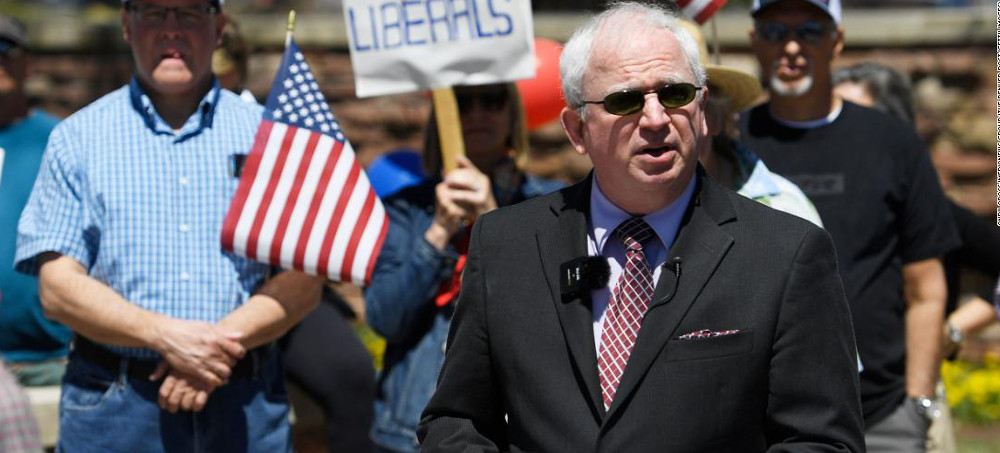
January 6th Committee to Seek Interview With Virginia 'Ginni' Thomas
John Wagner, Eugene Scott, Amy B. Wang and Mariana Alfaro, The Washington Post
Excerpt: "Rep. Bennie G. Thompson (D-Miss.), chairman of the House committee, said on Thursday that the panel plans to invite Virginia 'Ginni' Thomas, the wife of Supreme Court Justice Clarence Thomas, to be interviewed."
John Eastman, a conservative lawyer advising President Donald Trump, sought a presidential pardon after pushing a plan to overturn the 2020 election that he knew to be illegal, evidence and testimony showed during a hearing Thursday by the House select committee investigating the Jan. 6, 2021, insurrection. Eastman had aggressively pushed a plan for Vice President Mike Pence to use his authority to help overturn the results, but acknowledged to Pence attorney Greg Jacob that the plot violated the law and would lose at the Supreme Court “nine to nothing,” Jacob testified.
Meanwhile, Rep. Bennie G. Thompson (D-Miss.), chairman of the House committee, said earlier Thursday that the panel plans to invite Virginia “Ginni” Thomas, the wife of Supreme Court Justice Clarence Thomas, to be interviewed. People involved in the investigation say newly obtained email correspondence between her and Eastman have revealed that her efforts to overturn the 2020 election were more extensive than previously known. Thomas said in a media interview that she looks forward to talking to the committee.
READ MORE
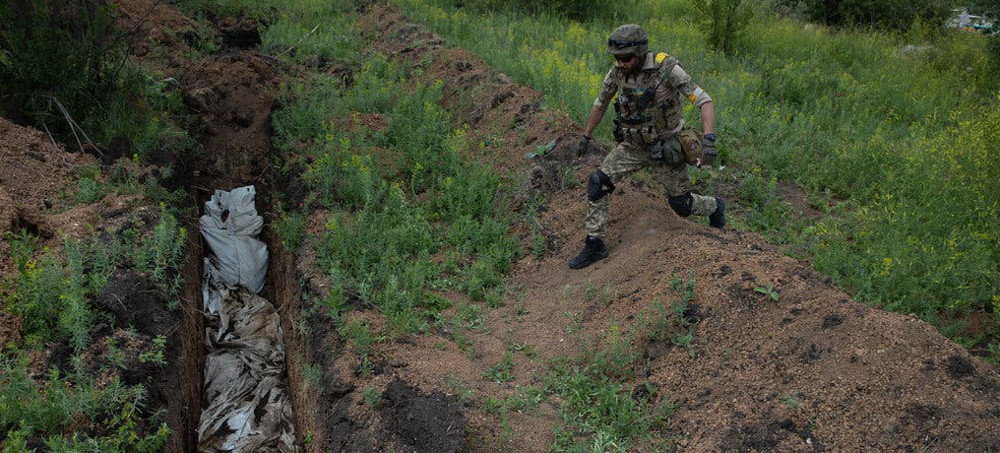 A Ukrainian soldier at a mass grave in the hills above the city of Lysychansk, in eastern Ukraine, on Thursday. (photo: Tayler Hicks/The New York Times)
Near Embattled Cities in Ukraine, an Uncovered Mass Grave Grows
Thomas Gibbons-Neff and Natalia Yermak, The New York Times
Excerpt: "A mass grave on the edge of this eastern Ukrainian city remains uncovered. Dirt mounds and yellow-petaled weeds surround a pit filled with a dozen or so body bags. They reek of death in the warm summer wind."
A mass grave on the edge of this eastern Ukrainian city remains uncovered. Dirt mounds and yellow-petaled weeds surround a pit filled with a dozen or so body bags. They reek of death in the warm summer wind.
The dead are civilians who were killed by shelling in recent months in the cities of Lysychansk and Sievierodonetsk and the nearby town of Rubizhne. They are heaped together because there are no relatives to claim and bury their bodies.
Standing above the grave, Pvt. Sergiy Veklenko, 41, explained why the bodies were still exposed: “All of our machinery that we had in the city’s inventory — excavators and all — was given to the army for digging trenches.”
As the war grinds into its fourth month and Ukrainian and Russian casualties mount well into the thousands of dead, it is clear that the trenches also have become graves for many soldiers.
Private Veklenko, a former police officer who joined the Ukrainian army when the war began, estimates that 300 people are buried in the mass grave. “We’ve been burying people here who died since April,” he said.
The grave is near a row of hills that is now home to Ukrainian artillery positions defending the city. The howitzers fired off and on through much of Thursday morning.
The number of civilians killed in Lysychansk and Sievierodonetsk, two cities separated by the Siversky Donets River, is unknown. As Russia solidifies control in Sievierodonetsk and shifts its focus to neighboring Lysychansk, civilian casualties there are sure to mount, unless Ukrainian forces retreat.
On Thursday, local officials said that at least four people had been killed in a Russian airstrike in Lysychansk. The attack happened in the morning, but it took several hours for the news to be posted in official Telegram channels, highlighting the difficulty of communicating what is happening in the city.
Lysychansk, an industrial city with a prewar population of 100,000, is largely cut off from the outside world, with no cellphone service or electricity. Local officials estimate that 40,000 people remain in the city, though there is no way to know the exact number.
Their reasons for remaining include the need to care for older relatives and, in some cases, even an unwillingness to part with pets.
“Each person does not want to give up their house,” said one woman who emerged from her home to receive supplies from a group of police officers and soldiers on Thursday. “And what about cats and dogs? What about elders? So we sit here.”
“You have to have a lot of money to evacuate, to pay for rent,” she went on, giving only her first name, Luda. “And they don’t allow pets in the rented apartments. I have two dogs and two cats, how can I abandon them? This is not an option, to cry after them later.”
Two people in her neighborhood were killed by shelling about a week ago, she said. They were buried in a patch of woods nearby, their graves marked with a cluster of wilting flowers.
In Sievierodonetsk, about 500 civilians have taken shelter in a large chemical plant, while fighting rages in parts of the city where Ukrainian forces still have control. Officials estimate that 10,000 civilians remain there.
Since the destruction of three bridges connecting the two cities, Ukrainian forces in Sievierodonetsk have had no easy escape routes. On Thursday, there were reports that Ukrainian troops who could cross the river were beginning to pull back to defend Lysychansk, which is on higher ground.
For troops and civilians in Lysychansk, one question lingers: What comes next?
One group of Ukrainian soldiers taking shelter in the basement of an apartment complex voiced hope that advanced rocket systems promised by the United States would arrive soon. The rockets’ longer range would allow them to hit Russian artillery positions. But until the weapons arrive, the soldiers said, the Russian artillery will be relentless.
“One hour feels like an entire day,” one soldier said.
READ MORE
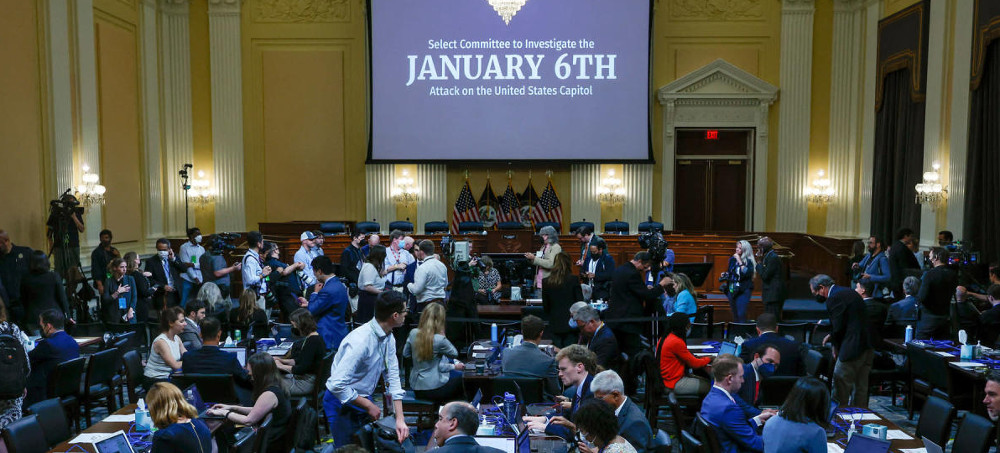 People arrive before the third hearing of the Select Committee to Investigate the January 6th attack on the U.S. Capitol, June 16, 2022, in Washington, D.C. (photo: Drew Angerer/Getty)
Even the 'Coup Memo' Author Knew Trump's Election Scheme Was Illegal
Ryan Bort, Rolling Stone
Bort writes: "'Coup memo' author John Eastman knew that he and former President Trump's scheme to get Mike Pence to block the certification of the 2020 election was illegal, and said so in front of Trump, according to testimony played during the January 6 committee's hearing on Thursday."
“I’ve decided that I should be on the pardon list, if that is still in the works,” John Eastman wrote in an email to Rudy Giuliani
“Coup memo” author John Eastman knew that he and former President Trump’s scheme to get Mike Pence to block the certification of the 2020 election was illegal, and said so in front of Trump, according to testimony played during the Jan. 6 committee’s hearing on Thursday.
“Did John Eastman ever admit in front of the president that his proposal would violate the Electoral Count Act?” investigators asked Greg Jacob, Pence’s former legal counsel.
“I believe he did on the fourth,” Jacob replied.
“That was Jan. 4, two days before the attack on Congress,” Cheney said of when exactly Trump knew it would be illegal for Pence to block the certification of the Electoral College.
Eastman was so worried about the illegality of the scheme that he, like multiple members of Congress, sought a preemptive pardon from Trump. “I’ve decided that I should be on the pardon list, if that is still in the works,” he wrote in an email to Rudy Giuliani.
The committee in its third hearing is examining Trump’s campaign to pressure Pence into illegally blocking the certification of the Electoral College. Pence refused, reportedly with the help of legal advice from J. Michael Luttig, a retired U.S. circuit court judge who is testifying on Thursday. Luttig, who is widely respected in conservative legal circles, was adamant on Thursday that the push to get Pence to block the vote count was illegal. “There was no basis in the Constitution or laws in the United States at all for the theory espoused by Mr. Eastman,” he said. “At all. None.”
“Foundational rule of law was supremely violated on Jan. 6, 2021,” Luttig added.
Jacob is also testifying before the committee. Jacob was reportedly in the room in the days before the attack when Trump and his allies tried to convince Pence to help overturn the election results. Jacob was also in touch with Eastman, the former Trump lawyer who authored the memo instructing Pence to halt the certification of the Electoral College. Jacob, too, did not believe Pence had the authority to block the count. “There is just no way that the framers of the Constitution, who divided and authority, who separated it out, who had broken away from George III and declared him to be a tyrant, there is no way they would have put in the hands of one person the authority to determine who was going to be president of the United States.”
“The history was absolutely decisive,” Jacob continued. “Part of my discussion with Mr. Eastman was, ‘If you were right, don’t you think Al Gore might have liked to have known in 2000 that he had the authority to just declared himself president of the United States? Did you think that the Democrat lawyers just didn’t think of this very obvious quirk that he could use to do that?'”
Jacob went into further detail about his communications with Eastman ahead of Jan. 6, making clear that Eastman was well aware that the plan wasn’t legally sound. He said Eastman even acknowledged that if the Supreme Court were to rule on the scheme, it would be struck down 9-0. Rudy Giuliani seems to have felt similarly. Former White House lawyer Eric Herschmann told the committee that on the morning of Jan. 6, Giuliani told him he was “probably right” that the plan was illegal. Hours later, Giuliani stood beside Eastman at the rally that preceded the Capitol attack and told Trump’s supporters that the scheme was legally ironclad.
Violence ensued, which as the committee revealed on Thursday, didn’t seem to be of much concern to Eastman. “I said, ‘You’re going to cause riots in the streets,’” Herschmann recounted of a conservation with Eastman. “He said words to the effect of, ‘There’s been violence in the history of our country to protect the democracy or to protect the republic.'”
It goes without saying that Trump was not happy Pence didn’t go along with the scheme. The committee revealed during its hearing last week that Trump told staff Pence “deserved” to be hanged as his supporters were attacking the Capitol.
READ MORE
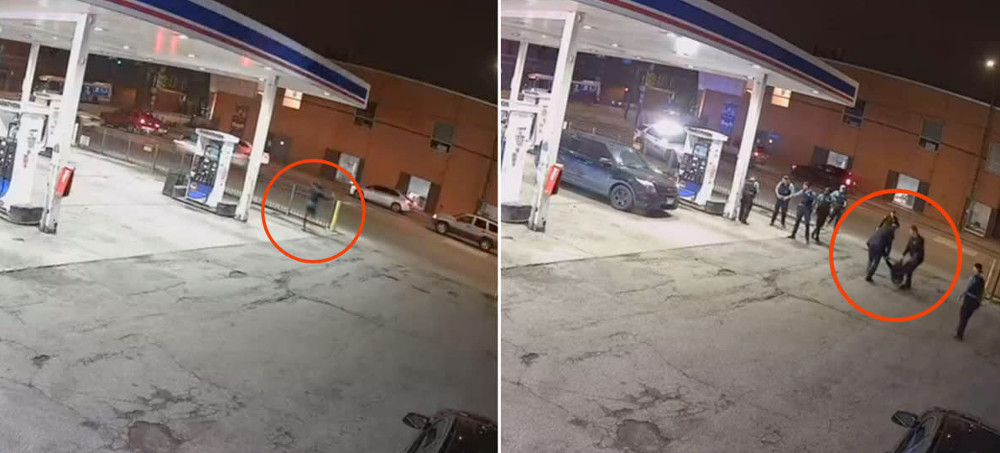 New video, obtained by The Daily Beast, appears to support claims that a 13-year-old Black teen put his hands up before he was shot in the back by Chicago police. (photo: The Daily Beast)
Video Shows Black Teen With Hands Up When Shot by Cop
Eileen Grench, The Daily Beast
Grench writes: "An unarmed 13-year-old Black boy had his hands raised in the air when he was gunned down by a Chicago Police Department officer in May, new surveillance video obtained by The Daily Beast shows."
New video, obtained by The Daily Beast, appears to support claims that a 13-year-old Black teen put his hands up before he was shot in the back by Chicago police.
An unarmed 13-year-old Black boy had his hands raised in the air when he was gunned down by a Chicago Police Department officer in May, new surveillance video obtained by The Daily Beast shows.
In the video, the teen—known only by his initials A.G.—ran off the sidewalk and into the light of a gas station parking lot with his hands raised in the air before turning around to his right.
It is then that the boy is shot by an officer and collapses to the cement in front of a gas pump.
After he was shot, the new video shows, two officers carried the teen to a different location by only two legs and a piece of clothing as his arm briefly dragged on the pavement—something Chicago Police Superintendent David Brown had previously claimed was to avoid harm from an explosion at the gas pump following the shooting.
But only moments after they had done so, a responding cop car careened into the gas station and crashed into the station’s sign, briefly drawing the attention of nearly all of the roughly 20 officers away from the teen.
A.G.—who ran after police tried to stop a car in which he was a passenger—has not been charged with any crime. No officers were fired on, and no weapon was recovered at the scene.
In a lawsuit filed by the family last month, the complaint charged that A.G. had complied with the officer’s instructions, and that while A.G. survived, “he has been permanently and catastrophically injured.”
“CPD officers did not render immediate aide to A.G., but instead callously dragged him across the pavement and then turned their attention to an uninjured officer who crashed into a sign at the gas station while arriving on scene,” read the complaint.
The youth—who enjoyed playing basketball and riding his mountain bike before the shooting, according to his lawyer—was initially hospitalized in critical condition at Stroger Cook County Hospital.
The teen is in danger of never walking again after sustaining a major spinal injury and “at this point doesn’t have movement of his legs.”
He also sustained major wounds to his esophagus, lawyer Andrew M. Stroth told The Daily Beast, and a piece of the bullet is still lodged in the boy’s back.
A.G. is currently at Shirley Ryan Ability Lab, a rehabilitation facility in Chicago, trying to regain his ability to walk.
“His wishes are to get healthy, his wishes are to walk, his wishes are to play basketball, his wishes are to ride his bike,” said Stroth.
“You got yet another Black young person shot in the back in a city that is under a federal consent decree, in a city that has not enacted a new foot pursuit policy that preserves and respects the sanctity of life.”
In a press conference 24 hours after the shooting, Chicago Police Superintendent David Brown would not say whether the boy had his hands in the air.
He later told reporters that an officer discharged his weapon and shot A.G. once.
One witness told ABC7 that the teen had complied with the demands of officers.
“They said, ‘Put your hands up, put your hands up!’ The boy’s hands were up. There’s other people out there that seen it. I got it all on my phone—his hands were up. He didn’t have a gun. They shot him for no reason,” the eyewitness said.
The Chicago Police Department did not immediately respond to requests for comment on the video.
When A.G. was shot, the incident became the latest in a series of teens being gunned down by Chicago cops.
Last year, another 13-year-old, Adam Toledo, was found to have been shot and killed while his hands were in the air. And in 2014, Laquan McDonald was killed after being shot 16 times by Chicago Police Officer Jason Van Dyke before multiple officers were implicated in a coverup.
Since Toledo’s death, also following a foot chase, the Chicago Police Department has not yet implemented a permanent foot pursuit policy—a cause of growing outrage amongst community members and advocates.
Police have alleged that A.G. was a passenger in a silver Honda Accord which they believe was involved in a carjacking the day prior. When he fled the vehicle, police pursued him to the gas station.
The driver, in both the Adam Toledo and A.G. incidents, got away.
Whether or not the unnamed officer had reason to shoot A.G. would be better weighed through the viewing of body-camera footage, as it would show the officer’s perspective, said policing expert Dr. Dennis Kenney, a professor at the John Jay College of Criminal Justice.
It “depends on whether or not a reasonable officer would perceive that he or she was at risk of either death or serious bodily harm,” he said.
The City’s Civilian Office of Police Accountability is currently investigating the case, but declined comment.
According to the family lawyer, A.G.’s mother is demanding the release of every video that exists. The City of Chicago has denied the family’s public records requests for video due to the fact that A.G. is a minor.
“Why are they not releasing this video? The mom wants video released,” said Stroth.
“If the city wants to be transparent then the city needs to release this video immediately.”
READ MORE
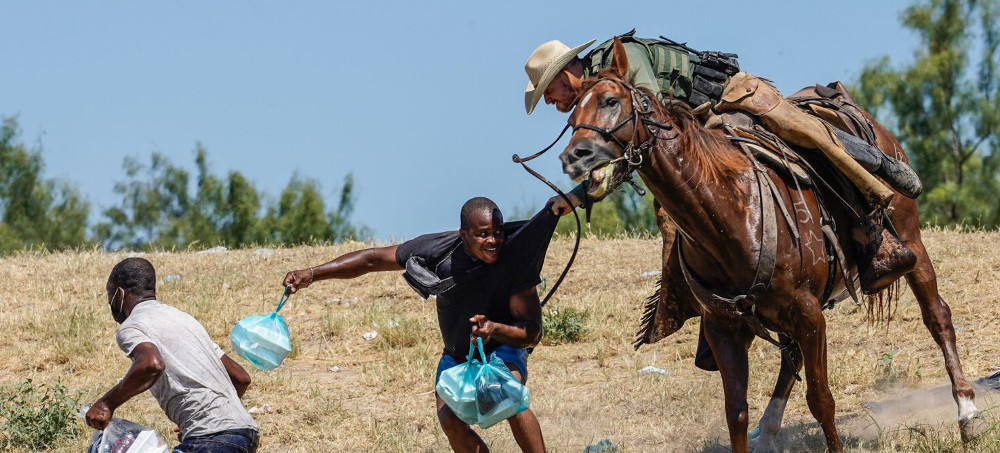 A mounted U.S. Border Patrol agent with a whip grabs a Haitian migrant on the banks of the Rio Grande in Del Rio, Texas, Sept. 19, 2021. (photo: Paul Ratje/AFP)
'Challenge Coin' Depicting Border Patrol Agent Grabbing Haitian Migrant Trigger Investigation
Hamed Aleaziz, Los Angeles Times
Aleaziz writes: "The photograph encapsulates the intensity of the clashes between Border Patrol agents and Haitian immigrants desperate to get into the United States."
The photograph encapsulates the intensity of the clashes between Border Patrol agents and Haitian immigrants desperate to get into the United States.
An agent on horseback leans over, grabbing a man by the shirt as a rein dangles.
Now an image mirroring the Sept. 19 photo by Paul Ratje of Agence France-Presse has appeared on a “challenge coin” typically collected by agents, law enforcement officials and aficionados.
“Whipping ass since 1924” is written along the coin’s border.
The Times obtained photos of the coin. Its other side says “Haitian Invasion” with crossed swords and the words “U.S. Border Patrol,” “Horse Patrol Unit” and “deflecting allegations for years.”
U.S. Customs and Border Protection, which includes the Border Patrol, is investigating whether the coin and a similar one, which have been advertised online, were sold by anyone from the agency. It is unclear who produced the coins or how widely they have been distributed.
If the coins are connected to Border Patrol agents, they could become the latest example of what immigrant advocates have said is a prevalence of offensive humor within the ranks, after Facebook posts making fun of dead migrants and lawmakers surfaced in 2019.
Some critics have raised the question of racism against Black immigrants. And the head of Customs and Border Protection has denounced the coins.
“These coins anger me because the hateful images on them have no place in a professional law enforcement agency,” CBP Commissioner Chris Magnus said in a statement. “Those who make or share these deeply offensive coins detract and distract from the extraordinarily difficult and often life-saving work Border Patrol agents do every day across the country.”
Immigrant advocates were similarly outraged at the coin and the seeming lack of empathy for Haitian migrants it indicates.
“I think this is a testament of how embedded anti-Black racism is in the very fabric of the system of our country,” said Guerline Jozef, head of the Haitian Bridge Alliance in San Diego. “For people who might be associated with CBP to feel emboldened enough to engrave the likeness of a human being abused or mistreated as a symbol of what the department stands for.... We see these coins as an endorsement of what happened, and those responsible must be held accountable.”
“Challenge coins” have long been a part of law enforcement culture, including at the Department of Homeland Security, which includes CBP. They are generally innocuous, honoring employees or special events, former officials said, and are sometimes exchanged with members of other agencies.
One former senior Homeland Security official, John Sandweg, said he got a coin with a buffalo on it after visiting an agency office in upstate New York and another with a picture of a border tunnel commemorating a drug task force.
But the coins depicting the Haitian immigrants crossed a line, he and another former lead Homeland Security official said.
The other coin under investigation contained the same image of the migrant and the agent on horseback, with the words “honor will always be first.”
“It’s just outrageously inappropriate,” said Sandweg, a former lead Homeland Security attorney and acting head of Immigration and Customs Enforcement under President Obama. “This kind of thing sullies the reputation of the department where a few bad apples are doing stuff that really shocks the conscience and is so far beyond what is appropriate and acceptable. It hurts the entire department’s reputation.”
“This is a shame that this was done,” said Gil Kerlikowske, who was head of U.S. Customs and Border Protection under Obama. “This kind of grotesque humor permeates ... a lot of professions, including in law enforcement groups.“
Kerlikowske and Sand-weg said that “challenge coins” are a big part of Homeland Security culture and are generally meant for camaraderie and celebration. Sandweg said that when he visited local agency offices, he was sometimes gifted a coin celebrating that location, including the one from Buffalo. Other coins were handed out to remember special occasions or to honor staffers.
Head offices, like those of the Homeland Security secretary or ICE director, also made their own coins to hand out to employees.
Sandweg said that the design of coins is often decided upon at a local office, then sent to coin makers. Government funds can be used if the coin is for an honorary award, he said.
“Almost no oversight is exercised on the design of the coins,” he added. “No doubt the use of any official seal in conjunction with this message violated DHS policy, but there was never much guidance or oversight out there on what the coins can say. Of course, nobody was ever so dumb and misguided as to create a coin like this.”
The “Haitian Invasion” coin was brought to CBP officials’ attention in recent weeks, said a source with knowledge of the situation.
In addition to the internal investigation, cease-and-desist letters will be sent to vendors who produce unauthorized challenge coins using a CBP trademarked brand.
CBP is also investigating the actions of the Border Patrol agents who targeted Haitian migrants, as in the incident depicted on the coins. Homeland Security Secretary Alejandro N. Mayorkas has promised to release the results of that investigation.
The Biden administration’s decision to begin the mass deportation of Haitians in September caused alarm among immigrant advocates and prominent Democratic politicians. Thousands of Haitians were expelled and continue to be removed from the country.
It typified, to many, the White House’s turn toward restrictive policies in a political crisis, this time prompted by media coverage of Haitians camping beneath a bridge in Texas.
Since September, the administration has relied on the Title 42 policy, which cites the pandemic, as a justification to remove Haitians and other asylum seekers arriving at the border.
Border Patrol agents have long faced allegations of excessive force. The Supreme Court issued a ruling this week that will shield agents from being sued over such allegations.
READ MORE
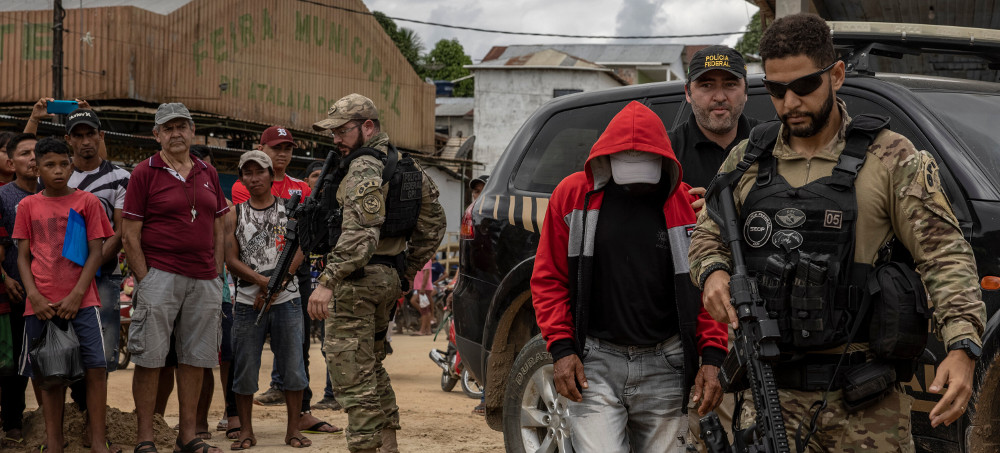 Police officers on Thursday escorted Amarildo da Costa de Oliveira, one of the two brothers accused of killing Bruno Pereira and Dom Phillps. (photo: Victoria Moriyama/The New York Times)
Fisherman Confesses to Killing Missing British Journalist Dom Phillips and Indigenous Expert Bruno Pereira in the Brazilian Amazon
Fabianno Maisonnave, Edmar Barros and Mauricio Savarese, Los Angeles Times
Excerpt: "Brazilian police said a fisherman has confessed to killing British journalist Dom Phillips and Indigenous expert Bruno Pereira in the remote Amazon, ending more than a week of searching as he led officers deep into the forest to where he buried their bodies."
ALSO SEE: Police Losing Narco War in Deadly Amazon
Region Where Duo Disappeared
Brazilian police said a fisherman has confessed to killing British journalist Dom Phillips and Indigenous expert Bruno Pereira in the remote Amazon, ending more than a week of searching as he led officers deep into the forest to where he buried their bodies.
After night fell Wednesday in the Javari Valley, near Brazil’s border with Peru and Colombia, search teams brought body bags to the docks at the city of Atalaia do Norte. Officials said an autopsy would be needed to confirm whether the remains are those of Phillips, 57, and Pereira, 41.
Police officials said at a news conference Wednesday night in the Amazon city of Manaus that the prime suspect in the case confessed the previous night and detailed what happened to the pair who went missing June 5. They said other arrests would be made soon in the case, but gave no details.
Brazilian Federal Police investigator Eduardo Alexandre Fontes said the prime suspect in the case, 41-year-old Amarildo da Costa de Oliveira, told officers he used a firearm to kill the men.
“We would have no way of getting to that spot quickly without the confession,” Fontes said of the place where police recovered human remains Wednesday after being led there by De Oliveira, who is nicknamed "Pelado."
Fontes said the remains were expected to be identified within days and, if confirmed as the missing men, “will be returned to the families of the two.”
“We found the bodies three kilometers" — nearly two miles — "into the woods,” the investigator said, adding that officers traveled about an hour and 40 minutes by boat on a river and 25 minutes overground in the woods to reach the burial spot.
De Oliveira’s family had said previously that he denied any wrongdoing and alleged that police had tortured him to try to extract a confession.
Another officer, Guilherme Torres of the Amazonas state police, said that the missing men's boat had not been found yet but that police knew the area where it purportedly was hidden by those involved in the crime.
“They put bags of dirt on the boat so it would sink,” he said. The engine of the boat was removed, according to investigators.
The news conference at Brazil's Federal Police headquarters in Manaus, the capital of Amazonas state, also included military leaders, who joined the effort to find Phillips and Pereira a few days after their disappearance was reported. Indigenous leaders who sounded the alarm over their disappearance and made searches deep into the forest from the first day were not invited.
Brazilian President Jair Bolsonaro sent a tweet Thursday saying, “Our condolences to family members and may God comfort everyone’s heart.
Bolsonaro has been a frequent critic both of journalists and Indigenous experts, and his government was accused of being slow to act in the disappearances. Before the bodies were discovered on Wednesday, he criticized Phillips in an interview, saying without evidence that locals in the area where he went missing didn't like him and that he should have been more careful in the region.
His main adversary in October's election, former President Luiz Inácio Lula da Silva, said in a statement that the killings “are directly related to the dismantling of public policies of protection to Indigenous peoples."
"It is also related to the current administration's stimulus to violence," said Lula, who leads in opinion polls.
The efforts to find the two were started by Indigenous residents in the region. UNIVAJA, an association of Indigenous peoples of the Javari Valley, mourned the loss of “two partners” in a statement Wednesday, adding that they had help and protection only from local police.
As the Federal Police announced they would hold a news conference, colleagues of Pereira held a vigil outside the headquarters of the Brazilian government's Indigenous affairs agency in Brasilia, the national capital. Pereira was on leave from the agency, known as FUNAI.
Pereira and Phillips were last seen on their boat in a river near the entrance of the Javari Valley Indigenous Territory, which borders Peru and Colombia. That area has seen violent conflicts among fishermen, poachers and government agents.
Developments began moving Wednesday when Federal Police officers took a suspect they didn't identify at the time out on the river toward search parties looking for Phillips and Pereira.
An Associated Press photographer in Atalaia do Norte, the city closest to the search zone, reported seeing police taking the suspect, who was in a hood.
On Tuesday, police said they had arrested a second suspect in connection with the disappearance. He was identified as Oseney da Costa de Oliveira, 41, a fisherman and a brother of Amarildo da Costa de Oliveira, whom police already had characterized as their main suspect.
Police investigators said Wednesday that Amarildo da Costa de Oliveira had not confessed to any participation in the crime, but that they had evidence against him.
Indigenous people who were with Pereira and Phillips have said that he brandished a rifle at them on the day before the pair disappeared.
Official search teams concentrated their efforts around a spot in the Itaquai River where a tarp from the boat used by the missing men was found Saturday by volunteers from the Matis Indigenous group.
Authorities began scouring the area and discovered a backpack, laptop and other personal belongings submerged underwater Sunday. Police said that evening that they had identified the items as the belongings of the missing men, including a health card and clothes of Pereira. The backpack was said to belong to Phillips.
Police previously reported finding traces of blood in Amarildo da Costa de Oliveira's boat. Officers also found organic matter of apparent human origin in the river that was sent for analysis.
Authorities have said a main line of the police investigation has pointed to an international network that pays poor fishermen to fish illegally in the Javari Valley reserve, which is Brazil’s second-largest Indigenous territory.
Pereira, who previously led FUNAI's local office in the region, took part in several operations against illegal fishing, which usually lead to seizure of fishing gear and fines for violators. Only the Indigenous inhabitants can legally fish in their territories.
“The crime’s motive is some personal feud over fishing inspection,” Atalaia do Norte Mayor Denis Paiva speculated last week while speaking to reporters, without elaborating.
Though some police, the mayor and others in the region link the pair’s disappearances to the “fish mafia,” Federal Police have not ruled out other lines of investigation, such as narcotrafficking.
Torres, the state police officer, reiterated that point Wednesday night, saying he could not discuss specifics of the investigation.
“We are working with several lines of investigation,” he said.
Phillips' wife, Alessandra Sampaio, said late Wednesday that the discovery of the bodies “puts an end to the anguish of not knowing Dom and Bruno’s whereabouts.”
“Now we can bring them home and say goodbye with love," Sampaio said in a statement. "Today, we also begin our quest for justice."
Pereira's wife, Beatriz Matos, paid tribute to him Thursday.
“Now that Bruno's spirits are strolling in the forest and spread on us, our strength is much bigger,” she said on Twitter.
READ MORE
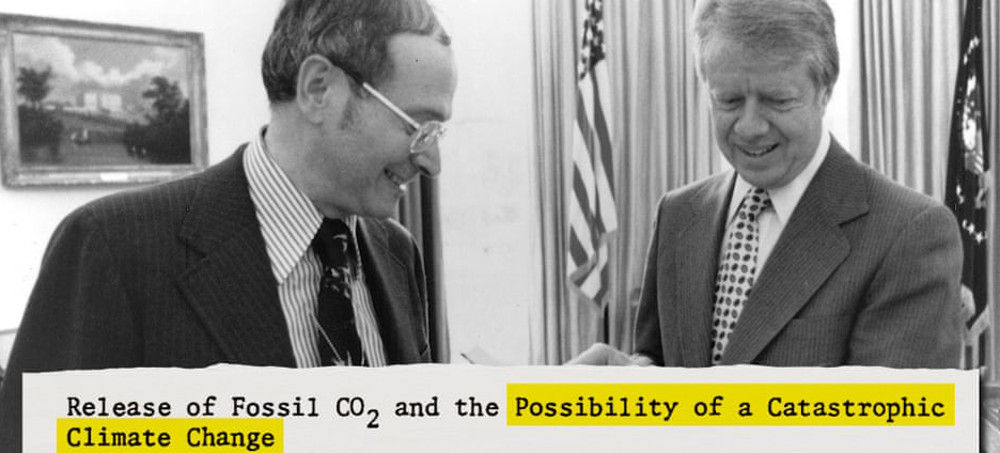 Frank Press, left, with President Jimmy Carter. Press wrote a letter to Carter warning of CO2 emissions causing 'catastrophic climate change.' (photo: The White House)
The 1977 White House Climate Memo That Should Have Changed the World
Emma Pattee, Guardian UK
Pattee writes: "In 1977 Star Wars hit movie theaters, New York City had a blackout that lasted 25 hours, and the Apple II personal computer went up for sale. It was also the year that a remarkable one-page memo was circulated at the very highest levels of US government."
Years before the climate crisis was part of national discourse, this memo to the president predicted catastrophe
In 1977 Star Wars hit movie theaters, New York City had a blackout that lasted 25 hours, and the Apple II personal computer went up for sale. It was also the year that a remarkable one-page memo was circulated at the very highest levels of US government.
Years before the climate crisis was part of national discourse, this memo outlined what was known – and feared – about the crisis at the time. It was prescient in many ways. Did anyone listen?
By July 1977 the president, Jimmy Carter, had only been in office for seven months, but he had already built a reputation for being focused on environmental issues. For one, by installing solar panels on the White House. He had also announced a national renewable energy plan .
“We must start now to develop the new, unconventional sources of energy we will rely on in the next century,” he said in an address to the nation outlining its main goals.
The climate memo arrived on his desk a few days after the Independence Day celebrations on July 4. It has the ominous title “Release of Fossil CO2 and the Possibility of a Catastrophic Climate Change.”
One of the first thing that stands out is the stamp at the top, partially elided, saying THE PRESIDENT HAS SEEN.
The memo’s author was Frank Press, Carter’s chief science adviser and director of the Office of Science and Technology Policy. Press was a tall, serious, geophysicist who had grown up poor in a Jewish family in Brooklyn, and was described as “brilliant” by his colleagues. Before working with the Carter administration, he had been director of the Seismological Laboratory at the California Institute of Technology, and had consulted for federal agencies including the Navy and NASA.
“Carter had a great respect for Frank [Press] and for science,” said Stu Eizenstat, who served as Carter’s chief domestic policy adviser from 1977 to 1981.
Press starts the memo by laying out the science of the climate crisis as it was understood at the time.
Fossil fuel combustion has increased at an exponential rate over the last 100 years. As a result, the atmospheric concentration of CO2 is now 12 percent above the pre-industrial revolution level and may grow to 1.5 to 2.0 times that level within 60 years. Because of the “greenhouse effect” of atmospheric CO2 the increased concentration will induce a global climatic warming of anywhere from 0.5 to 5°C.
These far-sighted assertions were in line with the climate science that originated the previous decade, when the US government funded major science agencies focused on space, atmospheric and ocean science. Research produced for President Lyndon B Johnson in 1965 found that billions of tons of “carbon dioxide is being added to the earth’s atmosphere by the burning of coal, oil, and natural gas”.
Press’s memo was on the mark. In 2021, for the first time ever, the atmospheric concentration of CO2 reached 420PPM, the halfway point to the doubling of pre-industrial CO2 levels that Press posited.
The potential effect on the environment of a climatic fluctuation of such rapidity could be catastrophic and calls for an impact assessment of unprecedented importance and difficulty. A rapid climatic change may result in large scale crop failures at a time when an increased world population taxes agriculture to the limits of productivity.
Press was right. We have indeed seen the catastrophic effects of a climatic fluctuation, in the form of increasingly severe weather events including droughts, heatwaves, and hurricanes of greater intensity. Meanwhile, in many parts of the world heating has already stemmed increases in agricultural productivity, and large-scale food production crises are thought to be possible.
The urgency of the problem derives from our inability to shift rapidly to non-fossil fuel sources once the climatic effects become evident not long after the year 2000; the situation could grow out of control before alternate energy sources and other remedial actions become effective.
This is correct. By the 2000s, the effects of the climate crisis had become apparent in some regions in the form of more deadly heat waves and stronger floods and droughts.
Natural dissipation of C02 would not occur for a millennium after fossil fuel combustion was markedly reduced.
Press is correct that CO2 can take “hundreds of thousands of years to be fully removed from the atmosphere by natural processes following its emission”, according to the Intergovernmental Panel on Climate Change. Scientists say that even if CO2 emissions were to be reduced to net zero, global temperatures would begin to stabilize, though not fall substantially.
As you know this is not a new issue. What is new is the growing weight of scientific support which raises the CO2-climate impact from speculation to a serious hypothesis worthy of a response that is neither complacent nor panicky.
But there were other currents mitigating against the sort of response Press calls for. “ The story of climate policy in the US, generally, is one of missed opportunities and unjustifiable delay,” said Jack Lienke, author of the book Struggling for Air: Power Plants and the “War on Coal.”
Many other issues may have seemed more pressing, or simply better understood. As Lienke writes in Struggling for Air, “At a time when Americans were still dying somewhat regularly in acute, inversion-related pollution episodes, it is unsurprising that legislators were more concerned with the known harms of sulfur dioxide and carbon monoxide than the uncertain, seemingly distant threat of climate change.”
The authoritative National Academy of Sciences has just alerted us that it will issue a public statement along these lines in a few weeks.
That public statement, released later that month, emphasized the importance of shifting away from fossil fuel energy and highlighted the urgency of starting to transition to new energy sources as soon as possible: “With the end of the oil age in sight, we must make long-term decisions as to future energy policies. One lesson we have been learning is that the time required for transition from one major source to another is several decades.”
So what happened? When Press’s memo made it to the president’s desk, James “Jim” Schlesinger, America’s first secretary of energy, also attached his own note in response:
My view is that the policy implications of this issue are still too uncertain to warrant Presidential involvement and policy initiatives.
Carter seems to have heeded this warning, and did not make much progress on climate crisis mitigation during his presidency. Yet he did sign some significant pieces of environmental legislation, including initiating the first federal toxic waste cleanups and creating the first fuel economy standards.
A significant challenge facing Carter was his own contradictory energy aims. Despite his goal of encouraging alternative energy, he also felt there was a national security interest in boosting US oil production in the wake of the 1973 oil crisis.
“We realized our dependence on foreign oil was dangerous and, very importantly, alternative energy was in its infancy,” Eizenstat said. “So Carter was both doing conservation and still encouraging more domestic oil and gas as a way of reducing dependence on foreign oil,” said Eizenstat. “As with all policy, you have conflicting goals.”
Still, it seems possible that if Carter had been re-elected, the world might have been in a better position regarding climate impacts today. One of the first things Reagan did after winning the election in 1981 was take down the White House solar panels. Meanwhile, the fossil fuel industry – whose scientists were already studying the ways that fossil fuels were changing the climate – started spending tens of millions of dollars sowing doubt about climate science.
Did the Press memo accomplish anything at all? For one person it was in fact a “transformational moment” – this was Eizenstat himself. He says it was instrumental in his own future work on the climate crisis, including his decision in 1997 to serve as the United States’s principal negotiator for the Kyoto global warming protocols.
Those protocols set the stage for the first international effort to tackle climate policy on a global level. So even if Press’s memo had a muted impact at the time, his warning wasn’t entirely ignored.
READ MORE
Contribute to RSN
Follow us on facebook and twitter!
Update My Monthly Donation
PO Box 2043 / Citrus Heights, CA 95611
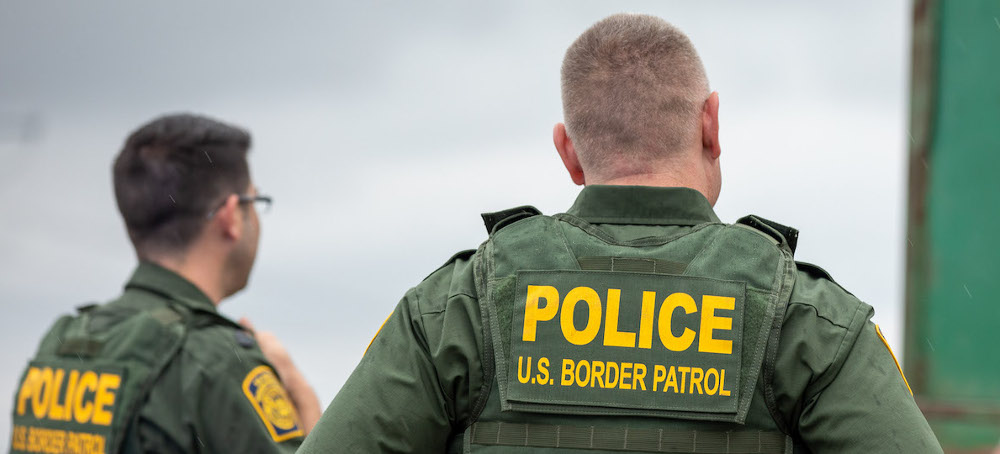 Officer Leonard Darnell George is accused of allowing vehicles stuffed with fentanyl, methamphetamine, cocaine and other drugs into the U.S. via the Mexico border. (photo: AP)


