Sunday, July 9, 2023

Need your help with something


Mark Kelly for Senate

Hey, it's Mark Kelly.

As many of you know, I served for 25 years in the United States Navy. I was lucky to work alongside people from many different backgrounds and every corner of the country.

Every day, we came together as a team to get the job done.

That's what the military does — you put aside your differences and put the mission first. That's what I aim to do in the Senate too. And that's why I'm writing today.

One of my colleagues — Alabama Senator Tommy Tuberville — is holding up 250 of our most senior military promotions. Generals and Admirals with long and distinguished careers. One of them would sit on the Joint Chiefs of Staff.

Why is Senator Tuberville doing this? Good question.

A new Pentagon policy provides leave for members of the armed forces when they have to travel to access reproductive health care, including abortions. He doesn't like it.

We've tried working through this with him, but he refuses to compromise. So, I'm coming to you.

Add your name here to tell Senator Tuberville to stop putting politics ahead of our national security. Threats emerge every day, and we need our best and brightest in the right spots and ready to face them.

ADD YOUR NAME

It’s vital to our national security that these promotions get moving as quickly as possible, so we need as many people to speak out on this as we can get.

Thank you for reading,

Mark


Paid For By Mark Kelly for Senate


Mark Kelly was a Captain in the U.S. Navy and astronaut. Use of his military rank, job titles and photographs in uniform does not imply endorsement by the Department of the Navy or Department of Defense and reference to NASA does not imply endorsement by the National Aeronautics and Space Administration.


July Has Already Seen 11 Mass Shootings. The Emotional Scars Won't Heal Easily


July Has Already Seen 11 Mass Shootings. The Emotional Scars Won't Heal Easily

Rhitu Chatterjee/NPR
July Has Already Seen 11 Mass Shootings. The Emotional Scars Won't Heal EasilyA candlelight vigil for the victims of a mass shooting. (photo: CNN)

Monday night, a gunman wearing a bulletproof vest killed five people in a southwest Philadelphia neighborhood. Two children — ages 2 and 13 — were injured.

Another shooting occurred the same night at a street festival in Fort Worth, Texas, killing three people and wounding eight.

One day earlier, in Baltimore's Brooklyn Homes neighborhood, a shooting at a block party killed two people and left 28 injured.

These are among the 11 mass shootings — defined as acts of gun violence injuring or killing at least four people — that have occurred this month, and 346 mass shootings since the beginning of the year, according to the Gun Violence Archive.

Mass shootings have been rising in recent years, as have other kinds of gun violence, making firearms a major public health issue. This year alone, more than 21,000 people have died due to gun violence. Of those deaths, 12,210 were suicides.

But the public health impact of gun violence extends far beyond those who are killed or injured. A far larger number of people are left grieving, traumatized, and at a risk of long-term struggles with a range of mental health issues.

"Any time a community is impacted by large-scale mass violence, the community is changed forever," says psychologist Robin Gurwitch at Duke University. "The names of those communities are now linked to mass violence, whether it is Sandy Hook, or whether it is Oklahoma City, Columbine. There are so many."

Studies show that people closest to gun violence, who witness it, or are injured, or who lose a loved one or an acquaintance, or even who have a loved one who was present at an incident, are at highest risk of mental health impacts, she adds.

A recent poll by KFF (formerly the Kaiser Family Foundation) found that a significant number of Americans have had a direct experience of gun violence. Nearly 1 in 5 adult respondents to the poll said they've lost a family member to gun violence, and a similar number said they have witnessed someone being shot. Those numbers are even higher in communities of color.

But recent research also shows that "members of the community are also impacted even if they didn't know someone," Gurwitch says.

A recent study by the Children's Hospital of Philadelphia found that children within a five-block-radius of a shooting were more likely to end of up in a hospital emergency room in the weeks after the shooting, with symptoms of mental health problems like anxiety and suicidal thoughts.

In the immediate aftermath of gun violence, people in affected communities often experience symptoms of "acute stress," says psychologist Julie Kaplow, executive vice president of trauma and grief programs and policy at the Meadows Mental Health Policy Institute in Texas.

"People are hyper vigilant, are on edge, may have trouble sleeping or eating, may be extremely nervous to leave loved ones," says Kaplow, who has assisted communities affected by both the Santa Fe high school shooting in 2018, as well as the mass shooting last year at an elementary school in Uvalde, Texas.

That sense of hyper vigilance due to gun violence is something that has spread across the country, according to Don Rodricks, a columnist at the Baltimore Sun. He remembers catching himself looking for the exits at a concert he attended with his family in recent years, "in case something were to happen," he told NPR's Steve Inskeep following the shooting in Baltimore on Sunday.

"It does affect how you think when you go out into the world," he added. "Young parents worried about their kids in school, whether there's going to be a mass shooting [at] a prayer service. I mean, 10-20 years ago, you wouldn't have thought about the danger in doing that."

The good news here, says Kaplow, is most people recover from these symptoms over time. But a significant minority, "typically 25% of individuals," she says, continue to experience symptoms long term.

"Some of those include re-experiencing — feeling like the event is happening all over again, avoidance, not wanting to talk about or think about what happened. Numbing, where they may literally feel like they don't have any feelings," Kaplow says.

Adults can also develop some behavioral health issues like substance abuse, social withdrawal and even suicidal thoughts.

And children who have experienced gun violence are also at a risk of long-term mental health issues, especially those with certain preexisting risk factors.

"For example, we know that kids who have experienced prior traumas or losses are at a higher risk for developing longer-term PTSD," Kaplow says. And these kids are more likely to be from communities of color, which are at a higher risk of experiencing chronic violence and also deaths from other causes.

"We also know that those that have very little social support or those who have already had significant mental health issues prior to the event like anxiety or depression."

Kids are also at a higher risk of long-term mental health problems when their parents and/or caregivers don't get the support they need, Kaplow explains.

"Children are sponges and they absorb everything they're seeing and hearing in their environment," she says. "And if that includes a caregiver who is very panicked or very anxious about what's going on, that can greatly impact how the child feels."

And so, providing social and mental health support to the adults in children's lives is key to helping communities recover from the trauma of gun violence, she says.

Long-term bereavement support is also key, Kaplow adds.

"We know that for these communities, while the trauma may recede over time, and it usually does, the grief remains. And that is an area that receives very little attention."

This is where community-based and faith-based organizations can play a big role in healing communities from the potential long-term effects of gun violence, she says.


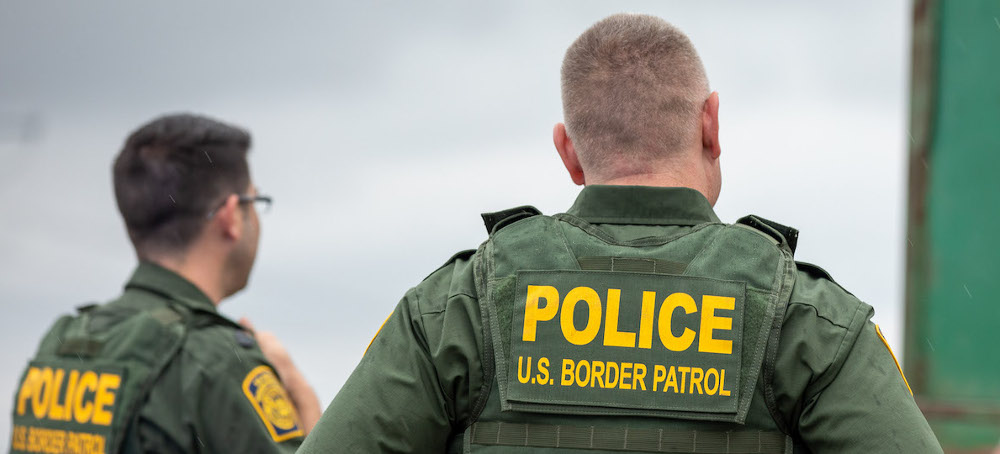
A Border Agent Was Just Charged With Taking Bribes From Cartels to Smuggle Drugs


A Border Agent Was Just Charged With Taking Bribes From Cartels to Smuggle Drugs

Emily Green/VICE
A Border Agent Was Just Charged With Taking Bribes From Cartels to Smuggle DrugsOfficer Leonard Darnell George is accused of allowing vehicles stuffed with fentanyl, methamphetamine, cocaine and other drugs into the U.S. via the Mexico border. (photo: AP)

Officer Leonard Darnell George is accused of allowing vehicles stuffed with fentanyl, methamphetamine, cocaine and other drugs into the US via the Mexico border.

Customs and Border Patrol Officer Leonard Darnell George was allegedly selective about the cars and trucks that were pulled over for revision on the U.S-Mexico border under his watch. That’s because he was getting paid by Mexico’s cartels to let through vehicles carrying fentanyl, methamphetamine, cocaine and other drugs into the U.S, according to new charges unsealed Monday.

Officer Darnell George “did directly and indirectly corruptly demand, seek, receive, accept, and agree to receive items of value in return for being induced to permit narcotics laden vehicles entry into the United States,” according to a press release from the U.S. Customs and Border Protection agency, which cited the indictment.

Federal prosecutors also charged him with possessing a firearm to facilitate drug trafficking.

If convicted, George faces a life sentence.

The case is the latest example of collusion with organized crime by branches of U.S law enforcement and security.

“It is the responsibility of all government employees to operate with the utmost integrity and do their best to foster and maintain the public's trust,” FBI San Diego Field Office Special Agent in Charge Stacey Moy said in a statement. “Anyone who violates that trust will be held accountable for their actions.”

“The vast majority of CBP officers are highly skilled, hard-working professionals dedicated to our mission of protecting the American public and we do not stand for those that would tarnish our badge,” Sidney Aki, Director of Field Operations for CBP in San Diego said in a statement.

But it’s not the first time that corruption has been highlighted within the Customs and Border Protection Agency and even the armed forces. For years, cases have highlighted corruption within their ranks, because agents and officers stand to profit from drug traffickers and migrant smugglers seeking to circumvent law enforcement.

In June, a veteran Border Patrol agent pleaded guilty to accepting bribes in exchange for using his Border Patrol uniform and patrol vehicle to smuggle people and drugs into the U.S. In January, a federal judge in Texas sentenced a Border Patrol agent to 121 months in prison for attempting to aid the trafficking of cocaine into the U.S. at a U.S.-Mexico checkpoint.

In 2019, more than a dozen Marines based at Camp Pendleton in Southern California ran a smuggling ring to bring migrants into the U.S.


If Banks Can Be Bailed Out, Student Debt Can Be Canceled


If Banks Can Be Bailed Out, Student Debt Can Be Canceled

Braxton Brewington/In These Times
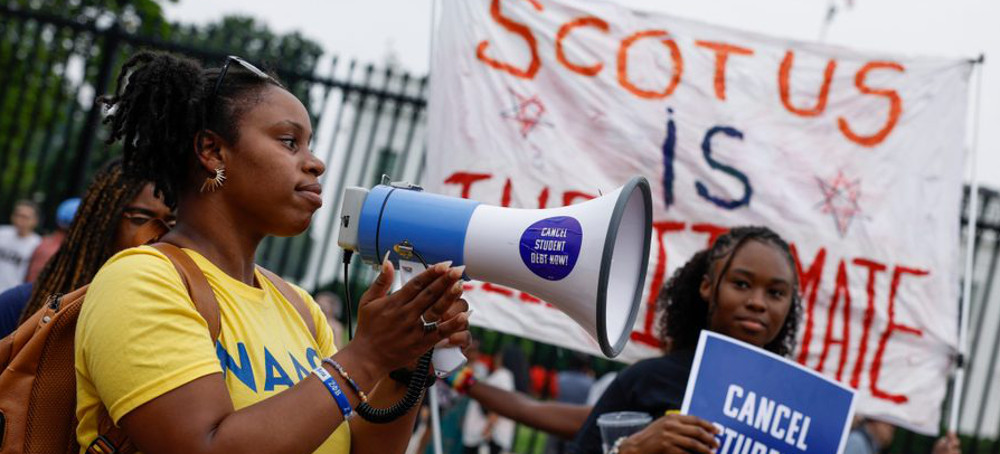
If Banks Can Be Bailed Out, Student Debt Can Be CanceledCici Gordon with the NAACP leads student debt relief activists in a chant in front of the White House after the U.S. Supreme Court struck down President Biden's student debt relief program on June 30, 2023, in Washington, D.C. (photo: Anna Moneymaker/Getty)

Biden must act now to make student debt relief a reality—no matter what the Supreme Court says.

Last month, in a hat-trick for right-wing litigants, the U.S. Supreme Court ruled in favor of structural racism, homophobia and mass indebtedness — in that order.

First, the conservative majority struck down affirmative action, ending race-conscious admissions programs for institutions of higher learning. Next, the Court slashed LGBTQ protections, ruling in favor of a plaintiff seeking to refuse services to a hypothetical gay couple. To bring the 2023 session to a close, the Court blocked $10,000 of student debt relief that more than 43 million Americans were counting on in the wake of pandemic-era hardships. According to six right-wing justices, while the HEROES authority grants the Education Secretary power to “waive or modify” student loans in an emergency, President Biden’s debt relief plan was too “significant” to be what Congress intended.

Just a year after overturning Roe v. Wade, these rulings serve as a stark reminder that this Court is on a warpath against the rights and freedoms Americans gained over decades of progressive political change.

In a press conference after the student debt ruling, a reporter asked Biden if this was a “rogue” Court. He hesitated, and then responded solemnly, “This is not a normal court.”

He’s not wrong, in the sense that judges don’t normally take luxurious gifts from billionaires with ties to the cases before them. But as for the radical decisions this Court has handed down, abnormality as a descriptor doesn’t go far enough. Justice Elena Kagan made it plain in her dissent: the ruling on student debt “violated the constitution.” To even hear the case in the first place, she wrote, “exceed[ed] the permissible boundaries of the judicial role.”

There’s another way the decision wasn’t normal. Typically a party seeks to remedy a concrete injury that they themselves suffered. But in Biden v. Nebraska, six Republican-controlled states sued on behalf of student loan servicer MOHELA, claiming that a loss of financial revenue to MOHELA harms the state of Missouri. The Court generally doesn’t “allow plaintiffs to rely on injuries suffered by” third parties. That’s one of the basic limits on federal judicial power. But this tenuous and debunked claim of financial harm was deemed sufficient to undo Biden’s initial iteration of student debt relief.

In a Roosevelt Institute report I co-authored, myself and fellow researchers revealed that after Biden’s student debt relief plan would have been implemented, MOHELA would earn more revenue than ever before — a direct contradiction to the Republicans’ claim that revenue would be cut nearly in half. How did such a flawed claim squeeze by the Supreme Court’s fact finding process? Well, they didn’t have one. In granting certiorari before judgment through the shadow docket, no court ever conducted a discovery — the legal procedure in which someone at the Court reviews the evidence. Every step of the way, Republicans’ lies were taken for truth.

To put it plainly, Republicans sued to stop Biden’s student debt policy simply because they didn’t like the policy. But we already have a process where grievances like these can be sorted — we call them elections. Now, if you’re a Republican that can place a bogus lawsuit before a sympathetic judge, you don’t need to make your case to voters, because the politicians with gavels and robes will decide on these issues instead.

It’s no wonder confidence in the Supreme Court is at a historic low, with more than half of Americans saying they want it to be structurally reformed. That will require a tectonic shift in the legislative branch — which is past due for major reforms itself. Until then, the executive branch can’t let the Supreme Court have the last word on such consequential issues. President Biden needs to be willing to act in the name of justice just as boldly as the Court is willing to undermine it.

Thanks to relentless grassroots pressure since the legal challenges to relief began, Biden announced he would take another go at student debt relief, this time by invoking the Higher Education Act — the exact authority advocates like the Debt Collective and progressive congress members have pushed for years. But still, he’s slow-walked the execution, and the White House has admitted that relief “could take some time.” Worse, he’s moving forward with resuming payments in the fall, inevitably harming the exact low-income borrowers whose debts he promised to cancel.

The Biden administration can and must implement student debt relief right away, acting swiftly before Republicans can concoct another frivolous legal challenge.

It doesn’t have to be this way. The Biden administration can and must implement student debt relief right away, acting swiftly before Republicans can concoct another frivolous legal challenge. Organizers are already working to push the White House to act fast.

We know it can be done. When Silicon Valley Bank crashed earlier this year, President Biden saved the bank and its financial investors within 72 hours. There was no political grandstanding over whether Section 13(3) of the Federal Reserve Act provided the authority to bail out venture capitalists. No internal hemming and hawing over whether negligent bank runs warranted “unusual and exigent circumstances.” There was just action.

It’s that sense of urgency and unwavering support that the Biden administration must now treat another constituency that’s too big to fail — over 43 million student debtors.

As Sen. Bernie Sanders (I-Vt.) put it, if the Supreme Court wants to “quit and run for office” on their extremist views, let them. But while they’re still one of the three branches of government, the other two must intervene.

LINK


The Alternative Facts of Robert F. Kennedy, Jr.


The Alternative Facts of Robert F. Kennedy, Jr.

David Remnick/The New Yorker
The Alternative Facts of Robert F. Kennedy, Jr.Robert F. Kennedy, Jr. (photo: Alessandro Bremec/NurPhoto)

The Democratic Presidential candidate talks about his right-wing admirers, his distrust of scientists and the media, and his belief that the C.I.A. was involved in J.F.K.’s death.

In November, 2007, the junior senator from Illinois, Barack Obama, appeared on ABC News for one of those soft-focus get-to-know-the-candidate segments. Obama admitted that, after he was at Harvard Law School for a while and felt “comfortable” among his hyper-ambitious classmates, he allowed himself to think that maybe he’d run for President someday. “Did you think to yourself, Barack, what kind of hubris is this?” the broadcaster Charlie Gibson said.

“I think if you don’t have enough self-awareness to see the element of megalomania involved in thinking you can be President, then you probably shouldn’t be President,” Obama said. “There’s a slight madness to thinking that you should be the leader of the free world.”

I was thinking about that moment last week, after finishing a long interview with Robert F. Kennedy, Jr., for The New Yorker Radio Hour. Kennedy is running for President as a Democrat. He is polling between eight and twenty-one per cent.

If there is a madness, slight or otherwise, in Kennedy’s bid, it is not confined to his hubris. He is roiling with conspiracy theories: S.S.R.I.s like Prozac might be the reason for school shootings, vaccines cause autism. There are many. To prepare for the conversation, I listened to some of Kennedy’s podcast sessions with the likes of Bari Weiss, Jordan Peterson, Russell Brand, and Joe Rogan. I watched his marathon announcement speech and tuned in to all the hosannas he was getting from a peculiar amen corner that includes Steve Bannon, Jack Dorsey, and Tucker Carlson. In his 2021 book “The Real Anthony Fauci,” Kennedy accuses Fauci, who was then the nation’s top infectious-disease doctor, of helping to carry out “2020’s historic coup d’état against Western democracy.” (The book has blurbs from Carlson, Naomi Wolf, Alan Dershowitz, and Oliver Stone.)

Kennedy’s habits of mind are MAGA-adjacent, but his manner differs from that of his Republican doppelgänger. Donald Trump is a bully—rude, swaggering, out to flatten his questioner under an avalanche of lies and volume. Kennedy is not rude. Rather, he is serenely convinced of his virtue and his interlocutor’s pitiful susceptibility to conventional wisdom. The experience of interviewing him and listening to his previous interviews, I found, was like settling in for a long train ride with a seemingly amiable stranger in the next seat. You ask a straightforward question and, an hour later, as you race by Thirtieth Street Station, in Philadelphia, he is still going on about the fraud of COVID vaccines and how he was unfairly “deplatformed” for spouting conspiracy theories. By the time you’ve pulled into Wilmington, he might be talking about how drugs known as poppers helped cause the AIDS epidemic, or how “toxic chemicals” might contribute to “sexual dysphoria” in children. As you head south, he is talking about being “censored” by Instagram, the F.B.I., and the Biden White House. New technologies like 5G towers and digital currencies are totalitarian instruments that could “control our behavior.” Wi-Fi causes “leaky brain.” After a while, you begin to wonder why you bought a ticket. But it’s too late. You’re pinned into the window seat.

This conversation has been edited for length and clarity.

Kennedy has never run for public office, but, at sixty-nine years old, he says that he has “been involved in almost every Presidential election during the last sixty years.” He has had a career as a conservationist and, more recently, as a litigator, author, and public speaker. Recently, he appeared in videos stripped to the waist, doing pushups and straining at a bench press. The conspicuous display, it can be reasonably supposed, was intended to draw comparisons with the sitting President, whose greatest liability is his age. Kennedy is ripped, that is true, but, like Trump, he had no experience as an elected official before seeking the White House. I asked how his experience qualified him to hold what is arguably the most consequential job on the planet.

KENNEDY: I’ve been around government and studying government since I was a little boy. I went to the 1960 convention. I’ve been to most of the conventions since. I was involved in the [1980] election with my uncle Edward Kennedy. I began writing about foreign policy when I was nineteen years old. My first article was for The Atlantic. I have a very, very strong vision and opinion about what our foreign policy should be. I’ve met with heads of state. I’ve been to a large portion of the countries. I’ve been to every country in Latin America. I’ve been to many of the countries in Africa and Asia.

Experience of attending conventions and being around politics is not the same as being involved in the making of policy, either as an executive or as a legislator or as a governor. Are you saying that that kind of experience is not necessary to be President of the United States? The one President I can think of who hasn’t had any experience at that level is Donald Trump.

Well, there’s nothing in the United States Constitution that says that you have to go to Congress first and then Senate second—or be a governor—before you’re elected to the Presidency of the United States.

Or even mayor of a small town. But you haven’t done any of it. Do you think that is irrelevant experience?

I think my life experience is absolutely relevant.

Among the obvious parallels between Kennedy and Trump is their disdain for “élites,” their suspicion of, in Trump’s words, the “deep state,” and their belief that traditional media and “cancel culture” threaten to silence them. With Kennedy, this is particularly curious. The Kennedys are the embodiment of dynastic power. Tens of thousands of books have been written about the family. It is impossible to imagine both the tragedy and the privilege Kennedy experienced as a child and adolescent. His uncle was murdered when he was nine. His father was murdered when he was fourteen. As a young man, he was kicked out of prep schools, got arrested for marijuana possession, was addicted to heroin, and still managed to graduate from Harvard. He now works as a lawyer, and his income last year was $7.8 million.

While Kennedy fashions himself as a warrior against the billionaire class, income inequality, and the corruption of institutions ranging from the intelligence agencies to the universities, he is a pure romantic about his own family. Camelot is his brand. As the polls appear to indicate, the Kennedy name still carries weight among Democratic voters.

You’re running as a Democrat for President, and I wonder, Who in the Democratic Party do you feel is kindred to you? Obviously not Joe Biden, but—A.O.C.? Or Joe Manchin? Or are you something new entirely? How would you define your ideology?

I’m something old. I’m a Kennedy Democrat. I believe in labor unions. I believe in a strong, robust middle class. I believe in racial justice, in policies that are going to actually help the lowest people on the totem pole.

I don’t think Joe Biden would disagree with any of that.

Well, then, why did he do the lockdowns? Lockdowns robbed four trillion [dollars] from the middle class and the poor in this country and transferred it to the super rich. We created five hundred new billionaires—a billionaire a day, every day. [Fact-checking Kennedy’s assertions is like chasing rabbits. This is a good example. The four-trillion dollar figure was likely an estimate for the price of the federal bailout. Many of the five hundred billionaires he seems to refer to rose up in other countries, especially China.]

Do you think he did lockdowns, or politicians did lockdowns, in order to enrich billionaires? That was the goal?

I think that, if they cared about the middle class in this country, they wouldn’t have done it. They wouldn’t have shut down 3.3 million businesses without due process, without just compensation.

Did they make mistakes, or were they carrying out some kind of perfidious plot?

No, I think that they made mistakes, which disqualifies them from continuing to do that job.

I’m finding it curious, and maybe even disturbing, that some of your early admirers include Trumpists like Steve Bannon, Michael Flynn, and Roger Stone. Do you welcome that, or do you think maybe—just maybe—someone like that is delighted that a strong Democratic opponent will wound Joe Biden and in the long run help Donald Trump?

I’m trying to unite the country, David. I’m not going to do what you do, which is to pick out people and say that they’re evil, they should be cancelled, or whatever. I’m a Democrat. I know what my values are. I’ve always spoken to Republicans my entire life. During all the years that I was a leader of the environmental movement, I was the only environmentalist who regularly went on Fox News. And, when Tucker Carlson recently did a special on endocrine disruptors, and he was condemned by the left, I thought that was crazy. I think what we ought to be doing is inviting people into our tent, without changing our values. I don’t change my values. I have the same values that my father had, that my uncle had, and that I have harbored and fought for since I was a kid. But that doesn’t mean I’m not willing to speak to people who don’t share those values. I think the kind of tribalism that you’re advocating is poisonous to our country. I think it’s toxic. It’s created a polarization, a division, in this country that is more dangerous than at any time since the American Civil War.

Isn’t there a difference between disagreement and—

What you’re trying to get me to do now is to lash out against other Americans. And what I’m saying is: I don’t agree with what those people represent in many parts of their lives. I don’t agree with it, and I don’t like it. But I’m still going to talk to them. I’m not going to cancel them. I’m going to invite them into my tent. If I can get them to support a vision of the idealistic America that I believe in—the same America that my father and my uncle believed in: an America without censorship; an America that fights for our Constitution; an America that is a moral authority around the world, that projects economic power around the globe rather than military violence—if I can get people to support that, I don’t care if they’re Republican or independent, or what they are. These are democratic values.

At what point do you say, with respect, that this is not about “tribalism” or “cancellation” or the terms that you’re using, but just an insistence on a certain level of decency and principle? Somebody like Alex Jones comes forward and he has nice things to say to you. At what point do you say, “You know what, Alex Jones, with all due respect, I don’t want your support”?

I’m not a cancel-culture guy.

That’s not cancel culture. That’s a principled insistence that he’s a bridge too far.

If you’re just saying you’re going to dismiss certain people because this human being is so irredeemable that I am going to exclude him or her from any future activity on the planet—I just don’t think that’s consistent with my spiritual beliefs. It’s not consistent with my political philosophy. I believe that we should invite our enemies into the tent with us to the extent that they want to break bread with us, that they may want to endorse some of the values that we hold dear.

Kennedy seemed to be talking not only about Steve Bannon or Alex Jones but about himself. “I believe in redemption,” he said. “I got an opportunity for redemption in my own life, and there’s plenty of people who had good excuses to write me off forever.”

Tell me about your own sense of redemption. I think you’re probably referring to problems with addiction.

I was a heroin addict for fourteen years. I’m lucky to be alive. People have plenty of reason to write me off forever because of the way I conducted my life during that fourteen-year period. And, when I was at Riverkeeper, I made a point of hiring people who were felons, who were convicted, who had served their time in prison. And that divided the organization. I believe in redemption. I don’t think we can dismiss human beings, no matter what they did earlier on in their lives. Everybody gets another chance. And what Jesus said is, Not only do you give them seven chances, but you give them seven times seven chances.

You suffered something that I think is just beyond imagination. When you were a small child, your uncle, the President of the United States, was murdered in full view of the world. Five years later, your own father, who was competing for the Democratic nomination for President, was murdered in full view of the world. I can’t quite imagine what effect that would have on a human being, a child who’s just growing up, and to live that life in the full view of the world. Later, you came to see both of those assassinations as conspiracies with the C.I.A. behind them. I want to know why you believe that when most do not, and how that has shaped your thinking in the rest of your life.

Are you saying that most Americans do not believe President Kennedy’s assassination was a conspiracy?

I want to know why you believe it. What leads you to believe it?

I don’t think anybody who has looked at my uncle’s murder seriously believes that the Warren Commission was correct. I’m a trial lawyer. I’ve tried hundreds of cases. I can guarantee you, looking at this case, that I could prove that my uncle’s death was caused by the C.I.A. I have enough evidence right now, without any depositions, to go to prove that my uncle’s death was the result of a conspiracy. And that the C.I.A. was involved—not only in the original conspiracy but in the sixty-year coverup—and continues to maintain the coverup.

What was the C.I.A.’s motivation?

They were angry at my uncle. Their initial anger came when he failed to invade the Bay of Pigs and provide air cover for [Cuban opponents of Fidel Castro], which they consider a betrayal. They had trained those men. Those men were dying on the beach. At that point, they believed that my uncle was a traitor to the United States. When my uncle and my father halted the raids on Cuba, after the missile crisis, they agreed as part of their agreement with Khrushchev during the missile crisis, to halt the raids from Miami by Alpha 66 and the other groups that were going into Cuba to halt them . . .

Kennedy believes that the evidence of C.I.A. involvement in “perpetrating my uncle’s death is overwhelming. The evidence of C.I.A. involvement with my father’s death is circumstantial, but very highly suggestive.” Talking about the murder of his father, Kennedy referred to a second gunman, stray bullets, and a mob lawyer whose body was later found “chopped up in a hundred pieces in an oil drum.” Kennedy visited Sirhan Sirhan, who was convicted of murdering his father, in prison, and supports his release.

I asked Kennedy if it was possible that his distrust of American institutions—regulatory agencies, the intelligence agencies, the medical establishment, the “mainstream media,” and more—was rooted in his view of the assassinations. “Not at all,” he said. It was only in the past decade or so, he said, that his interest was sparked by reading “JFK and the Unspeakable: Why He Died and Why it Matters” by James W. Douglass, which Oliver Stone has called “the best account I have read of this tragedy and its significance.”

Now, we were talking about President Biden before. First, just a short yes or no answer: Did you vote for him in the last election?

Yes, I did.

So what about the Biden Presidency, which came out of the Trump Presidency, obviously, so severely disappoints you that it causes you to run for President?

No. 1, the policies on the war. I think it’s very clear that this has little to do with protecting the Ukraine. It’s more to do with the neocon ambition of deposing Vladimir Putin, which I think is very problematic. I think regime change is always problematic, but, in the case of a country that has nuclear weapons, I would characterize it as close to insane. And it’s clear from President Biden’s direct statements that that is why he believes we should be in Ukraine.

So, if you were President now, would you withdraw military aid to Ukraine?

I would end the war. I would negotiate a peace.

And what would that peace look like?

Well, you never know that until you negotiate.

Would you allow a peace that allowed much of eastern Ukraine and Crimea to remain in Russian hands?

I don’t know what I would negotiate. I know that the Russians had come to two different peace agreements, both of which were eminently reasonable. And so I don’t—

What I’m asking is: what would be a reasonable peace?

Well, you know what, the answer to that question is strategic ambiguity. If I intend to be President of the United States, I’m not going to tell my adversary what my final negotiating position would be.

What about the voter?

I’m not going to—I’m going to negotiate. You negotiate a treaty.

When there was a political campaign [in 1968], your father said exactly what he would’ve done vis-à-vis the United States and Vietnam. As did Eugene McCarthy. [Both Kennedy and McCarthy said they wanted an end to the war in Vietnam.] Why is it unreasonable for you to—

I’m telling you exactly what I would do. I consider the terms of the Minsk accords fair. And that’s what Russia already offered to sign. Now, you know, we have worsened our position in the debate clearly through these ill-advised policies of encouraging war, of refusing to negotiate, of refusing to even talk to our adversaries. And my uncle, President Kennedy, again and again, told the country, You’ve got to put yourself into the shoes of your adversary. And he did that with Khrushchev. He put in a hotline in our home in Massachusetts and in the White House, so that he could pick up the phone and call Moscow, because he was scared of provoking a nuclear response. And, today, Russia has more nuclear weapons than we do. We are toying with Armageddon here.

At a town hall, just recently, you said that you were “proud” that Donald Trump likes you. Why is that? Donald Trump—I think you’ve criticized him in the past. I think maybe we can agree that he’s a threat to democratic norms and the rule of law. Why would you be proud that he likes you?

I’d be proud if President Biden liked me, and—

They’re quite different figures, no?

Well, President Biden has also acted against our Constitution, in many, many areas. You know, this is the first Administration in our history that has colluded with the press to censor Americans—directly out of the White House, including me by name. And my purpose, my intention—

How are you being censored out of the White House?

The White House was ordering the social-media sites to censor me. And in fact—

You’re everywhere in the press. You’re in what you call mainstream media. You’re on Joe Rogan. Who censored you?

I am, since I declared for President. But before that I was deplatformed. I was deplatformed completely, from . . . eight hundred thousand followers were taken away from me on Instagram at the behest of the White House.

So you’re equating President Biden’s attitude toward the Constitution and the law with former President Trump.

What do you think is worse, David? What do you think is worse: the White House using the F.B.I. to censor political dissenters, or whatever Trump has done?

But why do you think Donald Trump admires you? Are you not suspicious of that?

You know what? My job is not to drive people apart. I think what you guys have decided that you’re going to do, in the press, is create this polarization and feed the anger and feed the hatred. And I don’t want to do that.

So polarization is a bad thing. I understand that. But you’re also critical—

You belong to a class of élite journalists who once were the guardians of the press and the protectors of American values and the American middle class, and you now consider those people to be deplorable.

I don’t consider anybody to be deplorable. That’s somebody else’s vocabulary. And let’s talk about the word “élite” for a second. You come from a highly privileged background, eclipsing mine by some order of magnitude. Isn’t it a little rich for you to be calling people élites?

When I use the word “élite,” I’m talking about the people who are inside the Beltway, the press figures who are supposed to be speaking truth to power, but instead have become propagandists for the government. Who view their jobs as quashing dissent, and quashing political criticism of the government that they’re supposed to be actually criticizing.

Do you really believe this, or do you think it plays well?

Of course I believe it. I mean, I don’t think—

Then what press do you read to be informed? Do you get up in the morning and read the New York Times? Or the L.A. Times?

I read everything I can get my hands on.

O.K. But what would that be? What’s your go-to way to find out what happened in the world today and yesterday?

I read everything that I can get my hands on. I read the Times. I read the L.A. Times, although not religiously. And I read a lot of alternative press sources, which are now, you know, oftentimes better sources for unvarnished truth than the mainstream media.

Like what?

On what subject?

Well, foreign policy. Domestic policy.

Well, if I want to know about what’s happening in Ukraine, I might read Doug Macgregor’s site, or a number of other just alternative sites. I have a podcast where I interview people, and I interview people on both sides.

Douglas Macgregor is a retired Army colonel. Trump had hoped to nominate Macgregor as ambassador to Germany until his comments about Muslim refugees as “unwanted invaders” were repeated in the press. After Putin’s invasion of Ukraine last year, Macgregor spoke repeatedly on Fox News in defense of the action, adding that Russia had been “too gentle” in the early days of the war. The former Republican congresswoman Liz Cheney has characterized Macgregor as representing “the Putin wing of the GOP.”

I think I’m going to surprise you with the next question because I really—I’ll be very honest with you, I don’t want to engage you in deep detail on the question of vaccinations and your belief, stated in the past, that vaccines are responsible for autism to some degree. I have a child with quite severe autism, and, while no one would want to know the cause of autism more than I do, I frankly think, with respect, that you’ve been slinging around a lot of theories over time that don’t have any great credibility among scientists. And they do a lot of harm to a lot of people. I want to ask you this question: Do you not have any second thoughts about this? You seem to be altering your rhetoric about this very recently, saying that you just want to see vaccines tested. You seem to be shifting on this, without quite saying so.

I’ve never shifted on it. I’ve said from the beginning that I got involved with this issue, that’s what I wanted. I’ve always said, I’m not anti-vaccine. I want good testing with the vaccines, and I want good science. I’ve written about the science. I’ve read—I’m one of the few people that actually have read the science. You say that scientists don’t believe that—

No, they don’t.

Well, you know, the scientists all, at one point, believed that the COVID vaccine prevented transmission. And when I said, No, they don’t prevent transmission, because I read the monkey studies in May of 2020, and I saw that the amount of the concentration of the virus in the nasal pharynx of the vaccinated monkey was identical to the unvaccinated monkeys. And I said, These vaccines should be dead in the water. They won’t prevent transmission. [In fact, vaccines have proved highly effective against the worst outcomes of COVID-19, including hospitalization and death. The C.D.C. has reported that widespread vaccination in a population reduces the spread of the virus.] And I was deplatformed for spouting conspiracy theories. And because all the scientists said they’re going to prevent transmission. So, you know, I don’t necessarily believe all the scientists, because I can read science myself. That’s what I do for a living. I read science critically. That’s how I win cases. And I’ve read the science on autism and I can tell you, if you want to know. David, you’ve got to answer this question: If it didn’t come from the vaccines, then where is it coming from?


The Rich Are Crazier Than You and Me


The Rich Are Crazier Than You and Me

Paul Krugman/The New York Times
The Rich Are Crazier Than You and MeJack Dorsey, the founder of Twitter has endorsed RFK, Jr. and Elon Musk has hosted him on a Twitter spaces event. (photo: AP)

Robert F. Kennedy Jr. is a crank. His views are a mishmash of right-wing fantasies mixed with remnants of the progressive he once was: Bitcoin boosterism, anti-vaccine conspiracy theories, assertions that Prozac causes mass shootings, opposition to U.S. support for Ukraine, but also favorable mention for single-payer health care. But for his last name, nobody would be paying him any attention — and despite that last name, he has zero chance of winning the Democratic presidential nomination.

Yet now that Ron DeSantis’s campaign (slogan: “woke woke immigrants woke woke”) seems to be on the skids, Kennedy is suddenly getting support from some of the biggest names in Silicon Valley. Jack Dorsey, who founded Twitter, has endorsed him, while some other prominent tech figures have been holding fund-raisers on his behalf. Elon Musk, who is in the process of destroying what Dorsey built, hosted him for a Twitter Spaces event.

So what does all this tell us about the role of technology billionaires in modern American political life? The other day I wrote about how a number of tech bros have become recession and inflation truthers, insisting that the improving economic news is fake. (I neglected to mention Dorsey’s 2021 declaration that hyperinflation was “happening.” How’s that going?) What the Silicon Valley Kennedy boomlet shows is that this is actually part of a broader phenomenon.

What seems to attract some technology types to R.F.K. Jr. is his contrarianism — his disregard for conventional wisdom and expert opinion. So before I get into the tech-bro specific aspects of this weird political moment, let me say a few things about being contrarian.

One sad but true fact of life is that most of the time conventional wisdom and expert opinion are right; yet there can be big personal and social payoffs to finding the places where they’re wrong. The trick to achieving these payoffs is to balance on the knife edge between excessive skepticism of unorthodoxy and excessive credulity.

It’s all too easy to fall off that knife’s edge in either direction. When I was a young, ambitious academic I used to make fun of stodgy older economists whose reaction to any new idea was “It’s trivial, it’s wrong and I said it in 1962.” These days I sometimes worry that I’ve turned into that guy.

On the other hand, reflexive contrarianism is, as the economist Adam Ozimek puts it, a “brain rotting drug.” Those who succumb to that drug “lose the ability to judge others they consider contrarian, become unable to tell good evidence from bad, a total unanchoring of belief that leads them to cling to low quality contrarian fads.”

Tech bros appear to be especially susceptible to brain-rotting contrarianism. As I wrote in my newsletter, their financial success all too often convinces them that they’re uniquely brilliant, able to instantly master any subject, without any need to consult people who’ve actually worked hard to understand the issues. And in many cases they became wealthy by defying conventional wisdom, which predisposes them to believe that such defiance is justified across the board.

Add to this the fact that great wealth makes it all too easy to surround yourself with people who tell you what you want to hear, validating your belief in your own brilliance — a sort of intellectual version of the emperor’s new clothes.

And to the extent that contrarian tech bros talk to anyone else, it’s to one another. The tech entrepreneur and writer Anil Dash tells us that “it’s impossible to overstate the degree to which many big tech C.E.O.s and venture capitalists are being radicalized by living within their own cultural and social bubble.” He calls this phenomenon of venture capitalism “VC QAnon,” a concept that I find helps explain many of the strange positions taken by tech billionaires lately.

Let me add a personal speculation. It may seem odd to see men of vast wealth and influence buying into conspiracy theories about elites running the world. Aren’t they the elites? But I suspect that famous, wealthy men may be especially frustrated by their inability to control events, or even stop people from ridiculing them on the internet. So rather than accepting that the world is a complicated place nobody can control, they’re susceptible to the idea that there are secret cabals out to get them.

There’s historical precedent here. Watching Elon Musk’s descent, I know that I’m not alone in thinking of Henry Ford, who remains in many ways the ultimate example of a famous, influential entrepreneur and who also became a rabid, conspiracy-theorizing antisemite. He even paid for a reprinting of “The Protocols of the Elders of Zion,” a forgery that was probably promoted by the Russian secret police. (Time is a flat circle.)

In any case, what we’re seeing now is something remarkable. Arguably, the craziest faction in U.S. politics right now isn’t red-hatted blue-collar guys in diners, it’s technology billionaires living in huge mansions and flying around on private jets. At one level it’s quite funny. Unfortunately, however, these people have enough money to do serious damage.

The Child Labor of Early Capitalism Is Making a Big Comeback in the US


The Child Labor of Early Capitalism Is Making a Big Comeback in the US

Steve Fraser/Jacobin

The Child Labor of Early Capitalism Is Making a Big Comeback in the USChildren laboring at Johnson's Hulling Station, Seaford, Delaware, 1910. Photograph by Lewis Hine 1874–1940. (photo: Getty)


Child labor was common in urban, industrial America for most of the country’s history. It’s now making a disturbing comeback: lawmakers across the US are undertaking concerted efforts to weaken or repeal statutes that prohibit employing children.

An aged Native American chieftain was visiting New York City for the first time in 1906. He was curious about the city and the city was curious about him. A magazine reporter asked the chief what most surprised him in his travels around town. “Little children working,” the visitor replied.

Child labor might have shocked that outsider, but it was all too commonplace then across urban, industrial America (and on farms where it had been customary for centuries). In more recent times, however, it’s become a far rarer sight. Law and custom, most of us assume, drove it to near extinction. And our reaction to seeing it reappear might resemble that chief’s — shock, disbelief.

But we better get used to it, since child labor is making a comeback with a vengeance. A striking number of lawmakers are undertaking concerted efforts to weaken or repeal statutes that have long prevented (or at least seriously inhibited) the possibility of exploiting children.

Take a breath and consider this: the number of kids at work in the United States increased by 37 percent between 2015 and 2022. During the last two years, fourteen states have either introduced or enacted legislation rolling back regulations that governed the number of hours children can be employed, lowered the restrictions on dangerous work, and legalized subminimum wages for youths.

Iowa now allows those as young as fourteen to work in industrial laundries. At age sixteen, they can take jobs in roofing, construction, excavation, and demolition and can operate power-driven machinery. Fourteen-year-olds can now even work night shifts and once they hit fifteen can join assembly lines. All of this was, of course, prohibited not so long ago.

Legislators offer fatuous justifications for such incursions into long-settled practice. Working, they tell us, will get kids off their computers or video games or away from the TV. Or it will strip the government of the power to dictate what children can and can’t do, leaving parents in control — a claim already transformed into fantasy by efforts to strip away protective legislation and permit fourteen-year-old kids to work without formal parental permission.

In 2014, the Cato Institute, a right-wing think tank, published “A Case Against Child Labor Prohibitions,” arguing that such laws stifled opportunity for poor — and especially black — children. The Foundation for Government Accountability, a think tank funded by a range of wealthy conservative donors including the DeVos family, has spearheaded efforts to weaken child-labor laws, and Americans for Prosperity, the billionaire Koch brothers’ foundation, has joined in.

Nor are these assaults confined to red states like Iowa or the South. California, Maine, Michigan, Minnesota, and New Hampshire, as well as Georgia and Ohio, have been targeted, too. Even New Jersey passed a law in the pandemic years temporarily raising the permissible work hours for sixteen- to eighteen-year-olds.

The blunt truth of the matter is that child labor pays and is fast becoming remarkably ubiquitous. It’s an open secret that fast-food chains have employed underage kids for years and simply treat the occasional fines for doing so as part of the cost of doing business. Children as young as ten have been toiling away in such pit stops in Kentucky and older ones working beyond the hourly limits prescribed by law. Roofers in Florida and Tennessee can now be as young as twelve.

Recently, the Labor Department found more than one hundred children between the ages of thirteen and seventeen working in meatpacking plants and slaughterhouses in Minnesota and Nebraska. And those were anything but fly-by-night operations. Companies like Tyson Foods and Packers Sanitation Services (owned by BlackRock, the world’s largest asset management firm) were also on the list.

At this point, virtually the entire economy is remarkably open to child labor. Garment factories and auto parts manufacturers (supplying Ford and General Motors) employ immigrant kids, some for twelve-hour days. Many are compelled to drop out of school just to keep up. In a similar fashion, Hyundai and Kia supply chains depend on children working in Alabama.

As the New York Times reported last February, helping break the story of the new child labor market, underage kids, especially migrants, are working in cereal processing plants and food processing factories. In Vermont, “illegals” (because they’re too young to work) operate milking machines. Some children help make J. Crew shirts in Los Angeles, bake rolls for Walmart, or work producing Fruit of the Loom socks. Danger lurks. America is a notoriously unsafe place to work and the accident rate for child laborers is especially high, including a chilling inventory of shattered spines, amputations, poisonings, and disfiguring burns.

Journalist Hannah Dreier has called it “a new economy of exploitation,” especially when it comes to migrant children. A Grand Rapids, Michigan, schoolteacher observing the same predicament remarked: “You’re taking children from another country and putting them almost in industrial servitude.”

The Long Ago Now

Today, we may be as stunned by this deplorable spectacle as that chief was at the turn of the twentieth century. Our ancestors, however, would not have been. For them, child labor was taken for granted.

Hard work, moreover, had long been considered by those in the British upper classes who didn’t have to do so as a spiritual tonic that would rein in the unruly impulses of the lower orders. An Elizabethan law of 1575 provided public money to employ children as “a prophylactic against vagabonds and paupers.”

By the eighteenth century, the philosopher John Locke, then a celebrated champion of liberty, was arguing that three-year-olds should be included in the labor force. Daniel Defoe, author of Robinson Crusoe, was happy that “children after four or five years of age could every one earn their own bread.” Later, Jeremy Bentham, the father of utilitarianism, would opt for four, since otherwise, society would suffer the loss of “precious years in which nothing is done! Nothing for Industry! Nothing for improvement, moral or intellectual.”

American “founding father” Alexander Hamilton’s 1791 Report on Manufactures noted that children “who would otherwise be idle” could instead become a source of cheap labor. And such claims that working at an early age warded off the social dangers of “idleness and degeneracy” remained a fixture of elite ideology well into the modern era. Indeed, it evidently remains so today.

When industrialization began in earnest during the first half of the nineteenth century, observers noted that work in the new factories (especially textile mills) was “better done by little girls of 6-12 years old.” By 1820, children accounted for 40 percent of the mill workers in three New England states. In that same year, children under fifteen made up 23 percent of the manufacturing labor force and as much as 50 percent of the production of cotton textiles.

And such numbers would only soar after the Civil War. In fact, the children of ex-slaves were effectively re-enslaved through onerous apprenticeship arrangements. Meanwhile, in New York City and other urban centers, Italian padrones expedited the exploitation of immigrant kids while treating them brutally. Even the then-brahmin-minded, anti-immigrant New York Times took offense: “The world has given up stealing men from the African coast, only to kidnap children from Italy.”

Between 1890 and 1910, 18 percent of all children between the ages of ten and fifteen, about two million young people, worked, often twelve hours a day, six days a week.

Their jobs covered the waterfront — all too literally as, under the supervision of padrones, thousands of children shucked oysters and picked shrimp. Kids were also street messengers and newsies. They worked in offices and factories, banks and brothels. They were “breakers” and “trappers” in poorly ventilated coal mines, particularly dangerous and unhealthy jobs. In 1900, out of one hundred thousand workers in textile mills in the South, twenty thousand were under the age of twelve.

City orphans were shipped off to labor in the glassworks of the Midwest. Thousands of children stayed home and helped their families turn out clothing for sweatshop manufacturers. Others packed flowers in ill-ventilated tenements. One seven-year-old explained that “I like school better than home. I don’t like home. There are too many flowers.” And down on the farm, the situation was no less grim, as children as young as three worked hulling berries.

All in the Family

Clearly, well into the twentieth century, industrial capitalism depended on the exploitation of children who were cheaper to employ, less able to resist, and until the advent of more sophisticated technologies, well suited to deal with the relatively simple machinery then in place.

Moreover, the authority exercised by the boss was in keeping with that era’s patriarchal assumptions, whether in the family or even in the largest of the overwhelmingly family-owned new industrial firms of that time like Andrew Carnegie’s steelworks. And such family capitalism gave birth to a perverse alliance of boss and underling that transformed children into miniature wage-laborers.

Meanwhile, working-class families were so severely exploited that they desperately needed the income of their children. As a result, in Philadelphia around the turn of the century, the labor of children accounted for between 28 percent and 33 percent of the household income of native-born, two-parent families. For Irish and German immigrants, the figures were 46 percent and 35 percent, respectively. Not surprisingly, then, working-class parents often opposed proposals for child labor laws. As noted by Karl Marx, the worker was no longer able to support himself, so “now he sells his wife and child. He becomes a slave dealer.”

Nonetheless, resistance began to mount. The sociologist and muckraking photographer Lewis Hine scandalized the country with heartrending pictures of kids slaving away in factories and down in the pits of mines. (He got into such places by pretending to be a Bible salesman.) Mother Jones, the militant defender of labor organizing, led a “children’s crusade” in 1903 on behalf of forty-six thousand striking textile workers in Philadelphia. Two hundred child-worker delegates showed up at President Theodore Roosevelt’s Oyster Bay, Long Island, residence to protest, but the president simply passed the buck, claiming child labor was a state matter, not a federal one.

Here and there, kids tried running away. In response, owners began surrounding their factories with barbed wire or made the children work at night when their fear of the dark might keep them from fleeing. Some of the 146 women who died in the infamous Triangle Shirtwaist Factory fire of 1911 in Manhattan’s Greenwich Village — the owners of that garment factory had locked the doors, forcing the trapped workers to leap to their deaths from upper floor windows — were as young as fifteen. That tragedy only added to a growing furor over child labor.

A National Child Labor Committee was formed in 1904. For years, it lobbied states to outlaw, or at least rein in, the use of child labor. Victories, however, were often distinctly pyrrhic, as the laws enacted were invariably weak, included dozens of exemptions, and were poorly enforced. Finally, in 1916, a federal law was passed that outlawed child labor everywhere. In 1918, however, the Supreme Court declared it unconstitutional.

In fact, only in the 1930s, after the Great Depression hit, did conditions begin improving. Given its economic devastation, you might assume that cheap child labor would have been at a premium. However, with jobs so scarce, adults — males especially — took precedence and began doing work once relegated to children. In those same years, industrial work began incorporating ever more complex machinery that proved too difficult for younger kids. Meanwhile, the age of compulsory schooling was steadily rising, limiting yet more the available pool of child laborers.

Most important of all, the tenor of the times changed. The insurgent labor movement of the 1930s loathed the very idea of child labor. Unionized plants and whole industries were no-go zones for capitalists looking to exploit children. And in 1938, with the support of organized labor, President Franklin Roosevelt’s New Deal administration finally passed the Fair Labor Standards Act which, at least in theory, put an end to child labor (although it exempted the agricultural sector in which such a workforce remained commonplace).

Moreover, Roosevelt’s New Deal transformed the national zeitgeist. A sense of economic egalitarianism, a newfound respect for the working class, and a bottomless suspicion of the corporate caste made child labor seem particularly repulsive. In addition, the New Deal ushered in a long era of prosperity, including rising standards of living for millions of working people who no longer needed the labor of their children to make ends meet.

Back to the Future

It’s all the more astonishing then to discover that a plague, once thought banished, lives again. American capitalism is a global system, its networks extend virtually everywhere. Today, there are an estimated 152 million children at work worldwide. Not all of them, of course, are employed directly or even indirectly by US firms. But they should certainly be a reminder of how deeply retrogressive capitalism has once again become both here at home and elsewhere across the planet.

Boasts about the power and wealth of the American economy are part of our belief system and elite rhetoric. However, life expectancy in the United States, a basal measure of social retrogression, has been relentlessly declining for years. Health care is not only unaffordable for millions, but its quality has become second-rate at best if you don’t belong to the top 1 percent. In a similar fashion, the country’s infrastructure has long been in decline, thanks to both its age and decades of neglect.

Think of the United States, then, as a “developed” country now in the throes of underdevelopment and, in that context, the return of child labor is deeply symptomatic. Even before the Great Recession that followed the financial implosion of 2008, standards of living had been falling, especially for millions of working people laid low by a decades-long tsunami of deindustrialization. That recession, which officially lasted until 2011, only further exacerbated the situation. It put added pressure on labor costs, while work became increasingly precarious, ever more stripped of benefits and ununionized. Given the circumstances, why not turn to yet another source of cheap labor — children?

The most vulnerable among them come from abroad, migrants from the Global South, escaping failing economies often traceable to American economic exploitation and domination. If this country is now experiencing a border crisis — and it is — its origins lie on this side of the border.

The COVID-19 pandemic of 2020–22 created a brief labor shortage, which became a pretext for putting kids back to work (even if the return of child labor actually predated the disease). Consider such child workers in the twenty-first century as a distinct sign of social pathology. The United States may still bully parts of the world, while endlessly showing off its military might. At home, however, it is sick.


YOU DID THIS. We’re #3 on Audible!

                                                                                  LOTS OF POSTS IGNORED BY BLOGGER..... OR REMOVED ON THEIR ...