
29 October 22
Live on the homepage now!
Reader Supported News
CRUNCH TIME ON DONATIONS — 72 HOURS TO RAISE 7K! We need to raise 7K in 72 hours to finish the October fundraiser. Stop! Take a moment of your time to chip in. Think of how consistent and reliable RSN is, this site is for you. Sincere thanks to all.
Marc Ash • Founder, Reader Supported News
Sure, I'll make a donation!

Assailant Shouted 'Where Is Nancy?' in Attempted Assassination at Speaker's Home
Eugene Scott, Perry Stein, Paul Kane, Lisa Bonos and Aaron C. Davis, The Washington Post
Excerpt: "The husband of House Speaker Nancy Pelosi (D-Calif.) was violently assaulted with a hammer during an early-morning break-in Friday at the couple's San Francisco home, a chilling escalation in a string of violence and threats directed at political leaders across the country."
ALSO SEE: Paul Pelosi, Husband of Nancy Pelosi,
in Hospital With Skull Fracture After Attack
Paul Pelosi was taken to a hospital and underwent surgery to repair a skull fracture and 'serious injuries to his right arm and hands’
The husband of House Speaker Nancy Pelosi (D-Calif.) was violently assaulted with a hammer during an early-morning break-in Friday at the couple’s San Francisco home, a chilling escalation in a string of violence and threats directed at political leaders across the country.
The suspect, identified by police as 42-year-old David DePape, was searching for the speaker and shouted, “Where is Nancy?,” according to a person briefed on the case. The person spoke on the condition of anonymity to describe the details.
Paul Pelosi, 82, was taken to a hospital and underwent surgery to repair a skull fracture and “serious injuries to his right arm and hands,” according to the speaker’s office, and he is expected to make a full recovery.
The attack at the Pelosi home comes after a dramatic increase in threats since the attack on the Capitol on Jan. 6, 2021. This week alone, three men were convicted of aiding in a plot to kidnap Michigan Gov. Gretchen Whitmer. In a separate case, a man was convicted Friday of threatening to kill Rep. Eric Swalwell (D-Calif.). Earlier this year, a man was arrested with a gun near Supreme Court Justice Brett M. Kavanaugh’s home after making threats against the justice.
The Pelosi assailant’s exclamation of “Where is Nancy?” was a striking echo of the Jan. 6 attack when a pro-Trump mob could be heard chanting, “Nancy, Nancy” and “All we want is Pelosi” as they ransacked the building, overwhelmed police and sought to stop the counting of electoral college votes in Joe Biden’s win.
A law enforcement official familiar with the investigation said it is still too early to determine a motive for the attack, but the official said investigators are examining all indicators of a potential motive, including the suspect’s social media accounts. The official spoke on the condition of anonymity to talk frankly about the probe.
Blog hosted antisemitic writings
The Washington Post confirmed that a voluminous blog written under DePape’s name and filled with deeply antisemitic writings — as well as pro-Trump and anti-Democratic posts — was registered to a house in Richmond, Calif. where DePape lives, according to neighbors.
In a single day earlier this month, the blog had seven new posts. The titles included: “Balcks Nda jEwS,” “Were the Germans so Stupid?” “Who FINANCED Hitler’s rise to Power” “Gas chamber doors” and “I guess this is as good a time as any.” The latter implored Trump to pick former representative Tulsi Gabbard as his running mate for 2024.
On Oct. 19, the blog included writings about Kanye West: “Ya I remember the backlash and insults when you came out in support of Trump.”
In five additional posts that day, the blog published antisemitic videos, demeaning caricatures of Jews and expressed disbelief in the Holocaust. Two days ago, it was back at politics. A video was posted about the Steele dossier, and comments were made when the video was removed by YouTube.
The site was registered to an address in Richmond, Calif., about 16 miles from Pelosi’s home. Neighbors there said they knew DePape, and a recent post contained contact information for someone close to DePape. Reached using a phone number published on the blog, the person declined to comment.
San Francisco Police Chief William Scott said at a news conference that police responded at 2:27 a.m. Friday to a break-in at the Pelosi home. They found the assailant, who grabbed a hammer from Pelosi and attacked him in front of police. Police arrested DePape and he will be charged with attempted homicide, assault with a deadly weapon, elder abuse and burglary, according to Scott. DePape also was taken to a hospital.
Scott said the 911 dispatcher who responded to Pelosi’s call sensed the situation was serious and gave it higher priority. “This was a well-being check and she just knew there was more to it. So she alerted — she went that extra step — and because of it, she dispatched it at a higher priority than this type of call normally is and that led to a quicker response,” he said at a briefing Friday evening.
Nancy Pelosi, who has been fundraising and campaigning with Democrats around the country ahead of the midterm elections, was in Washington at the time, according to U.S. Capitol Police.
The speaker, who is second in line to the presidency, has a security detail provided by Capitol Police. Paul Pelosi, however, doesn’t receive protection from Capitol Police or any other government entity when he is not with the speaker, according to three people familiar with the security protocol.
“The Speaker and her family are grateful to the first responders and medical professionals involved, and request privacy at this time,” Drew Hammill, a spokesman, said.
Capitol Police in a statement said it was assisting the FBI and San Francisco police in investigating the break-in and attack. “Special Agents with the USCP’s California Field Office quickly arrived on scene, while a team of investigators from the Department’s Threat Assessment Section was simultaneously dispatched from the East Coast to assist the FBI and the San Francisco Police with a joint investigation,” the statement said.
The speaker, who had been in Zagreb, Croatia, earlier this week for a forum on Crimea and in Washington on Tuesday to meet with Israeli President Isaac Herzog, was in San Francisco on Wednesday morning for an event at the Golden Gate Bridge before returning to Washington.
On Friday afternoon, police had roped off the entire block around the Pelosis’ red-brick home with caution tape as TV reporters stood outside, filing their reports from the corner. The Pelosis live in Pacific Heights, a quiet, hilly neighborhood full of multimillion-dollar homes boasting majestic views of downtown and the San Francisco Bay. Many homes have security cameras and tall fences fortifying them. Several neighbors declined to comment on the day’s happenings.
Congress approved a $2.1 billion emergency security supplemental in July 2021 that largely went to beefing up security on Capitol Hill, making security improvements, and helping maintain police officers. In May 2021, Capitol Police reported that threats against lawmakers had increased by 107 percent since Jan. 6 compared to the prior year.
Rep. Pramila Jayapal (D-Wash.), who was recently threatened at her home, said Speaker Pelosi has been “very sympathetic to the need to get additional security for members.”
When a man with a pistol shows up outside a congresswoman’s house
“She really recognizes the changed threat to members in this environment and particularly after Jan. 6,” Jayapal said, referring to the 2021 attack on the Capitol.
Jayapal added that the need for security for family members “has been an ongoing concern” because they don’t receive protection from Capitol Police, and that it has been a challenge because such arrangements must be approved in the appropriations process by both parties.
Words of support, but also rhetoric
President Biden spoke to Nancy Pelosi to “express his support after this horrible attack,” White House press secretary Karine Jean-Pierre said in a statement.
“The President is praying for Paul Pelosi and for Speaker Pelosi’s whole family,” Jean-Pierre said. “He is also very glad that a full recovery is expected. The President continues to condemn all violence, and asks that the family’s desire for privacy be respected.”
Senate Majority Leader Charles E. Schumer (D-N.Y.) said in a statement that he conveyed his concerns in a call with the speaker, describing the attack as a “dastardly act.”
Other congressional leaders also expressed their shock and outrage while wishing Paul Pelosi a speedy recovery. Senate Minority Leader Mitch McConnell (R-Ky.) tweeted, “Horrified and disgusted by the reports that Paul Pelosi was assaulted in his and Speaker Pelosi’s home last night.”
Rep. Steve Scalise (R-La.), the No. 2 Republican in the House, echoed those comments in his own tweet, writing: “Disgusted to hear about the horrific assault on Speaker Pelosi’s husband Paul. Grateful for law enforcement’s actions to respond,” Scalise said. “Let’s be clear: Violence has no place in this country. I’m praying for Paul Pelosi’s full recovery.”
Scalise was gravely wounded in 2017 when a gunman opened fire as Republicans were practicing for the Congressional Baseball Game.
House Minority Leader Kevin McCarthy (R-Calif.) says he contacted the speaker, per a statement from his spokesman, Mark Bednar. “Leader McCarthy reached out to the Speaker to check in on Paul and said he’s praying for a full recovery and is thankful they caught the assailant,” the statement said.
But not every politician focused solely on the violent attack and Paul Pelosi’s health.
Campaigning with Virginia GOP House candidate Yesli Vega, Gov. Glenn Youngkin (R) condemned the violence but then suggested that Republican voters would send the House speaker back home to be with her husband.
“Listen, I want to stop for a minute and — listen — Speaker Pelosi’s husband had a break-in last night in their house and he was assaulted. There’s no room for violence anywhere, but we’re going to send her back to be with him in California. That’s what we’re going to go do,” Youngkin said.
The crowd cheered.
Later, in a statement to The Post, a spokeswoman for Youngkin, who has been floated as a potential 2024 Republican presidential candidate and has campaigned across the country for Republican candidates in the midterms, said the governor wishes Paul Pelosi “a full recovery and is keeping the Pelosi family in his prayers.”
Decades-long marriage
Paul Pelosi owns Financial Leasing Services, a San Francisco-based real estate and venture capital investment and consulting firm. He met his wife while studying at Georgetown University. She was a student at Trinity College at the time. The Pelosis have been married for 59 years and have five children.
He was in the news in August when he pleaded guilty to a misdemeanor charge of driving under the influence and causing injury stemming from a May car crash in Northern California.
In 2021, the Pelosi home in San Francisco’s Pacific Heights neighborhood was spray-painted and a pig’s head was left on the sidewalk in the early morning hours of New Year’s Day. The incident was apparently in criticism of Congress over insufficient coronavirus pandemic relief.
READ MORE
 David DePape, right, was arrested at the Pelosi home early Friday. (photo: Eric Risberg/AP)
Suspect in Pelosi Attack Spewed Conspiracy Sewage Online
Decca Muldowney and Will Sommer, The Daily Beast
Excerpt: "David DePape, 42, was arrested in the early hours of Friday morning at the Pelosi's San Francisco residence. He 'violently assaulted' Paul Pelosi, Nancy Pelosi's 82-year-old husband, with a hammer, according to police."
David DePape’s online history has uncovered a series of extreme right-wing opinions.
David DePape, 42, was arrested in the early hours of Friday morning at the Pelosi’s San Francisco residence. He “violently assaulted” Paul Pelosi, Nancy Pelosi’s 82-year-old husband, with a hammer, according to police.
Police said they are still investigating DePape’s motive for attacking Mr. Pelosi. But online screeds published on a personal blog may offer some insight into DePape’s mindset.
DePape’s blog posts are filled with a grab-bag of memes and videos advocating for right-wing causes. The blog—which took its name from a slang term for the word “friends” popular on the anarchic anonymous website 4chan—featured DePape’s thoughts on conspiracy theories about a global cabal.
DePape posted memes about the “Great Reset,” a belief popular with pro-Trump media figures that holds that world elites plan to destroy the economy and enslave humanity.
In another post, DePape advocated for the ridiculous belief, popular among supporters of the QAnon conspiracy theory, that Hillary Clinton sexually abuses children in Satanic rituals and murders her political foes. DePape filled his blog with antisemitic and racist references, including a post denying the Holocaust took place.
Elsewhere, the blog reads like a jumble of ideas popular on the broader right-wing internet in 2022. The blog features posts claiming that teachers who discuss LGBT issues in classrooms are sexual-predator “groomers.” DePape posted links to videos made by right-wing internet personality James Lindsay attacking drag queen events and other supposed “groomers.” DePape appears to have believed that progressive “wokism” was ruining the comic-book movies, complaining in a recent review of the movie Black Adam that “wokism destroys movies.”
“David has always had an opinion,” Teresa DePape, David’s step-mother, told The Daily Beast on Friday.
“I’m one of these people who thinks everybody has an opinion, and I was raised when sticks and stones would break your bones, but words will never hurt you,” she said. “But hammers are not words.”
On the blog, which was started in August 2022, DePape weighed in on popular right-wing talking points from the last year. He authored a post claiming George Floyd was a “deadbeat” who died of an overdose, and arguing that police officer Derek Chauvin was “owed damages.”
In several posts, he accused Amber Heard of “fabricating” evidence against Johnny Depp in their highly publicized trial. He shared a video arguing that Ukraine had provoked Russia into going to war, and rejected offers of peace. DePape repeatedly shared COVID disinformation, including links to stories about vaccine injury cover-ups, and mocking people who “bought into covid” as “mask tards.”
DePape’s blog makes no mention of Nancy Pelosi. In one post he describes Tulsi Gabbard as “only democrat candidate who WASN'T running on a platform of being an insane mentally unwell demagogue,” and encouraged Donald Trump to run with Gabbard as his vice-president in 2024.
Elsewhere, his views strayed in extreme misogyny. In one post DePape wrote, “woman [sic] are very problematic and should probably be banned from society,” and in another argued that, “Children should be take [sic] away from mothers given to fathers and the mothers should be forced to pay child support.”
Alongside these political screeds, DePape also shared intimate details of his personal life. He railed against his former partner, Gypsy Taub, who he accused of being “psychotic.” He also linked to YouTube videos he had filmed of birds and squirrels he described on his blog as “spirit” animals.
Taub is a well-known Bay Area nudist activist, who made headlines in 2017 when she stripped naked at a Berkeley City Council meeting. DePape and Taub lived together for some time in a house in Berkeley along with Taub’s three children, according to reports in the Oakland Tribune and SFGate. Taub is currently serving time at California Institution for Women, a jail in Chino, California, according to inmate records.
DePape was charged late Friday with attempted murder, burglary, assault with a deadly weapon, inflicting injury on an elder, and threatening the family member of a public official, among other charges, according to San Francisco jail records.
READ MORE
 Lula da Silva is hoping for a third term as president of Brazil. (photo: Alexandre Schneider/Getty Images)
Lula Widens Lead Over Bolsonaro Days Before Vote, Datafolha Says
Andrew Rosati, MSN
Rosati writes: "Former President Luiz Inacio Lula da Silva slightly widened his lead over incumbent Jair Bolsonaro just three days before Brazilians cast their vote in the presidential runoff, according to a Datafolha poll."
Former President Luiz Inacio Lula da Silva slightly widened his lead over incumbent Jair Bolsonaro just three days before Brazilians cast their vote in the presidential runoff, according to a Datafolha poll.
Lula would get 53% of valid votes, a measure that pulls out null and blank ballots, up from 52% last week. Bolsonaro would take 47%, down 1 percentage point, according to the survey published Thursday evening. Both movements fell within the poll’s 2 percentage-point margin of error.
The findings are in line with those of other major polling companies this week. They showed Bolsonaro’s momentum fizzling in the wake of campaign gaffes and incidents in the final days of the race. Campaign insiders and analysts say the episodes may have damaged the conservative president’s standing with key demographics ahead of a highly anticipated debate on Friday.
A separate survey published by AtlasIntel earlier on Thursday showed nearly identical results to Datafolha’s poll: Lula leading with 53.2% of valid votes, compared to Bolsonaro’s 46.8%.
Bolsonaro, 67, surprised pollsters with a better-than-expected showing in the first-round vote on Oct. 2. And he since launched a slew of economic measures to help close the gap behind Lula.
But a violent standoff between police and Roberto Jefferson, a onetime lawmaker and staunch supporter of the incumbent, rocked the nation and gave Lula, 77, an opening to capitalize on the Bolsonaro campaign’s blunders. The leftist leader has also tried to calm investors and Brazil’s business community on Thursday, pledging “clear and realistic” rules for fiscal policy if elected to a third term.
The two men will square off in a final televised presidential debate on Friday before Brazilians vote on Oct. 30.
Datafolha interviewed 4,580 people across Brazil between Oct. 25 and 27. AtlasIntel interviewed 7,500 Brazilians between Oct. 21 to Oct. 25, and its poll has a margin of error of 1 percentage point.
READ MORE
 Maryna Ponomariova, 6, whose left leg had to be partly amputated after a strike on her home in Kherson, Ukraine, learning to walk again with help from Nazar Borozniuk at Ohmadyt Children’s Hospital in Kviv. (photo: Brendan Hoffman/NYT)
Scarred by War, Ukraine's Children Face Years of Trauma
Megan Specia, The New York Times
Specia writes: "For countless Ukrainian children, the war has brought long-term physical and psychological injuries. Those who have suffered serious physical harm or the loss of a parent now face a challenging path forward."
For countless Ukrainian children, the war has brought long-term physical and psychological injuries. Those who have suffered serious physical harm or the loss of a parent now face a challenging path forward.
Using his small blue crutches, Daniil Avdieienko, 7, gestured toward two deep brown stains on the cement floor of the entryway to his apartment building.
The patch on the right, just inside the door, was his blood, he explained. Then he pointed at the other blood stain: “This is from my mother.”
Daniil and his parents were running to a basement shelter in central Chernihiv, a northern city where fighting raged in the early days of the war, when shrapnel struck him in the back. Eventually, he had to have 60 centimeters, or nearly two feet, of his intestines removed. Seven months later he is still recovering from his wounds, and will likely need several more surgeries, as will his parents, both of whom suffered serious leg injuries.
But while his physical injuries are on the mend, he is still grappling with the psychological trauma of the attack.
“I am scared when the siren is on,” he said softly as he sat with his parents, Nataliia Avdieienko, 32, and Oleksandr Avdieienko, 33, referring to the air raid alarm that warns of potential Russian strikes. “I am afraid because the tanks might be coming.”
The conflict in Ukraine has brought pain and hardship to tens of thousands of civilians, but among the more wrenching consequences is its effect on a generation of children like Daniil who will be confronting physical and psychological pain, many for the rest of their lives. For those who have suffered serious wounds or the traumatic loss of a parent, their path forward will be immensely challenging, experts say, as long-term psychological and medical support can be elusive in a country embroiled in conflict.
Daniil’s parents say his behavior has changed in noticeable ways. He now clings tightly to a teddy bear that he performs “surgery” on, they said, a reminder of his own numerous medical procedures.
He has lost interest in the matchbox cars he used to love, his father said. Instead, he plays war games with his stuffed toys, where sometimes they are fighting off Russian tanks, and sometimes killing imaginary zombies. He doesn’t like to leave his mother’s side. Thunder frightens him.
“It wasn’t like this before the war,” Mr. Avdieienko said.
Still, Daniil has also come a long way since the attack in March, thanks in part, his mother said, to exceptional care from Ohmadyt Children’s Hospital in Kyiv. Immediately after the attack, the family members had been rushed to three different hospitals, but in April they reunited at Ohmadyt, the country’s leading pediatric hospital. There, Daniil was able to see specialist doctors and psychologists, before being released and returning home to Chernihiv at the end of the summer.
Dmytro Holovachuk, one of the orthopedic surgeons who treated Daniil, said the pediatric doctors here are increasingly treating wounds they never saw in children during peacetime. The high velocity and destructive power of modern weapons can leave children with large and complex injuries to bones and soft tissue.
“We didn’t have any experience with how to treat such severe children’s injuries,” said Dr. Holovachuk, adding that doctors across the country are now sharing their expertise and regularly learning new treatment options, sometimes with international guidance.
Dr. Holovachuk said he was equally concerned about how the war has reached into the psyche of the nation’s youngsters. Aside from being injured themselves, many have lost parents or other family members.
“These events will definitely affect the whole generation of kids, that’s for sure,” he said. “These kids don’t have the ability to study properly, they don’t feel comfortable in their homes, they don’t have the ability to eat well.”
Olena Anopriienko, the director of the hospital’s psychology department, said the staff is trying to instill a sense of normality and security as much as is possible. Children who stay for longer periods attend the on-site “Superhero School” to keep their education going and take part in weekly activities, like concerts and painting classes, intended to lift their spirits.
Many of the youngsters suffer from severe anxiety or PTSD, she said.
“If it’s a war trauma, it is very difficult to provide the sense of safety for that child,” she said. “Because the child understands that the war is not over.”
Despite their ordeal, many children push ahead with resolve, and even alacrity. Maryna Ponomariova, who is 6, has been working closely with psychologists, physical therapists and teachers since she came to Ohmadyt hospital this summer, weeks after a devastating May 2 attack on her home in the southern Kherson region.
Her left leg had to be amputated below the knee because of shrapnel wounds, and she is now learning to walk again.
Maryna grins widely, her tongue pushing against the space left by her missing two front teeth, as she walks up the hallway, a tiny prosthetic fitted to her left leg. She walks with determination, and with the assistance of her favorite rehabilitation doctor, Nazar Borozniuk, who makes her laugh even as she completes difficult exercises.
It’s her enduring positivity that has carried her and her family this far, said her mother, Nataliia Ponomariova.
“The doctor who we are working with now, he told us the truth, he told us it would be difficult,” she said. “It’s hard to make prosthetics for little kids, but there is no other way.’’
“She has faced and accepted the fact she is going to have an iron leg, she understands she had to go on and that she will be all right,” Ms. Ponomariova, 41, added.
Still, a series of strikes in central Kyiv in recent weeks, close enough to be clearly heard at their temporary housing, left Maryna shaken, her mother said.
“When she saw this, it hit her again,” Ms. Ponomariova said of the bombing. “The psychologist has been working with her, but then it was all reversed again. She was screaming that morning.”
While the anguish has reached children across the country, those living nearest the battle lines in the south and east have experienced some of the worst of the war.
Kateryna Iorhu, 13, sat on the couch in the newly rented apartment she shares with her aunt, grandmother and younger sister in Kyiv, lifting the leg of her lilac-colored sweatpants to show where an explosion ripped large chunks of flesh from her bone.
Metal pieces of shrapnel poke up under her skin like small pebbles. They lodged themselves there in April, when Kateryna, who is from a village in the Donetsk region, was struck as she was trying to flee with her family.
But Kateryna and her younger sister Yuliia, 9, carry an even more painful burden. The girls were at a train station in Kramatorsk in April with their mother, Maryna Lialko, and their aunt, waiting to travel to the safety of the country’s west, when a missile plunged into the crowd standing outside.
Yuliia and her aunt were inside the station. A stranger shielded Kateryna with his body, likely saving her life even as he lost his own. The family found their mother’s body in the city morgue the next day.
Maryna Lialko had raised the girls alone after their father left the family, their grandmother, Nina Lialko, said.
“She was devoted to these two girls,” she said.
Kateryna was discharged this fall from Ohmadyt hospital, where she received psychiatric and physical therapy, and the girls are now in Kyiv living with their grandmother and aunt.
The aunt, Olha Lialko, said she has seen a shift in their personalities. Kateryna is increasingly turning inward; she speaks very little and struggles to maintain eye contact. Yuliia still can’t fully comprehend the loss.
“Katya is very closed; she keeps it all to herself,” Olha Lialko said. “Yuliia is missing mom a lot. She needs attention, she likes to cuddle.”
The family is trying to help the girls process their loss. And occasionally they see glimpses of the girls they knew before the war.
They dye their hair wild colors and play with makeup. They fight as only sisters can, and cling closely to each other for company.
But no one knows what will come next for them. Their life is on hold. They attend school online and have few friends in the new city. The family is unable to return home to Donetsk but unwilling to commit to staying in Kyiv.
“It will be very difficult for them to live without her,” their grandmother said. “This life has no sense at all.”
READ MORE
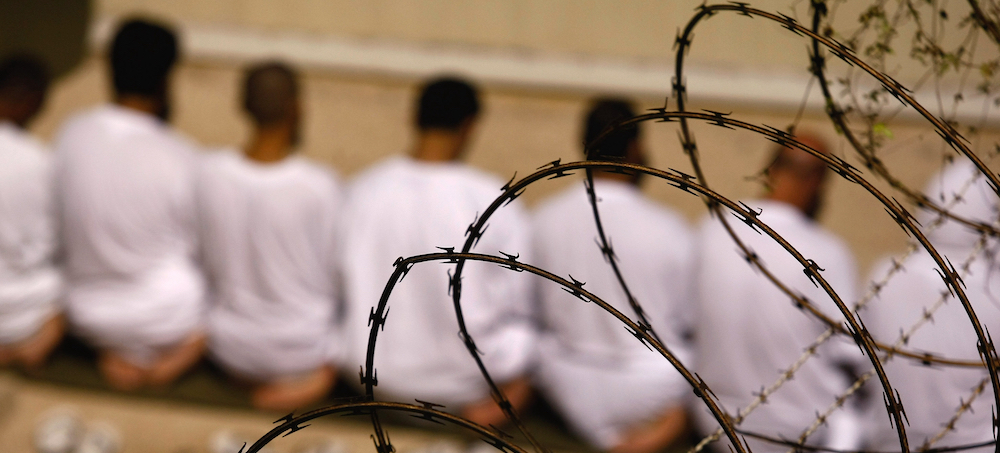 The Guantanamo Bay Detention Camp. (photo: CNN)
Guantanamo's Oldest Inmate Released After 19 Years Without Trial
Al Jazeera
Excerpt: "The oldest inmate at the United States-run Guantanamo Bay detention facility in Cuba Saifullah Paracha has been released to his home country Pakistan after nearly 20 years of detention without trial, the South Asian country's foreign ministry said."
Businessman Saifullah Paracha, who was arrested in 2003 and accused of financing al-Qaeda, was never charged like most prisoners.
The oldest inmate at the United States-run Guantanamo Bay detention facility in Cuba Saifullah Paracha has been released to his home country Pakistan after nearly 20 years of detention without trial, the South Asian country’s foreign ministry said.
“The Foreign Ministry completed an extensive inter-agency process to facilitate the repatriation of Mr Paracha,” the ministry said in a statement on Saturday.
“We are glad that a Pakistani citizen detained abroad is finally reunited with his family.”
Businessman Paracha was arrested in 2003 in Thailand and accused of financing the armed group, but he has maintained his innocence and claimed a love for the US.
In May, the US approved Paracha’s release concluding only that he was “not a continuing threat” to the US.
Like most prisoners at Guantanamo, Paracha – aged 74 or 75 – was never formally charged and had little legal power to challenge his detention.
The secretive US military prison was established in the wake of 9/11 to hold suspected al-Qaeda members captured during the invasion of Afghanistan in 2001.
But of the 780 inmates held during the US’s so-called “war on terror”, 732 were released without charge. Many of them were imprisoned for more than a decade without legal means to challenge their detention.
Nearly 40 prisoners remain in the world’s most infamous detention facility, which has become a symbol of human rights abuses.
Paracha’s return home on Saturday comes after US President Joe Biden last year approved his release, along with that of another Pakistani national Abdul Rabbani, 55, and Yemen native Uthman Abdul al-Rahim Uthman, 41.
Biden is under pressure to clear out uncharged prisoners at Guantanamo and move ahead with the trials of those accused of having direct ties to al-Qaeda.
Among the roughly 40 inmates left are several men who allegedly had direct roles in 9/11 and other al-Qaeda attacks.
Paracha, who studied in the US, had an import-export business supplying major US retailers.
US authorities accused him of having contact with al-Qaeda figures, including Osama bin Laden and Khalid Sheikh Mohammed.
In 2008, Paracha’s lawyer said the businessman had met bin Laden in 1999, and again a year later, in connection with the production of a television programme.
Reprieve, a UK-based human rights charity, described Paracha as a “forever prisoner”.
Since it first opened, Guantanamo has become notorious for human rights abuses and the fact that the US administration did not consider its prisoners to be entitled to any protection according to international laws.
READ MORE
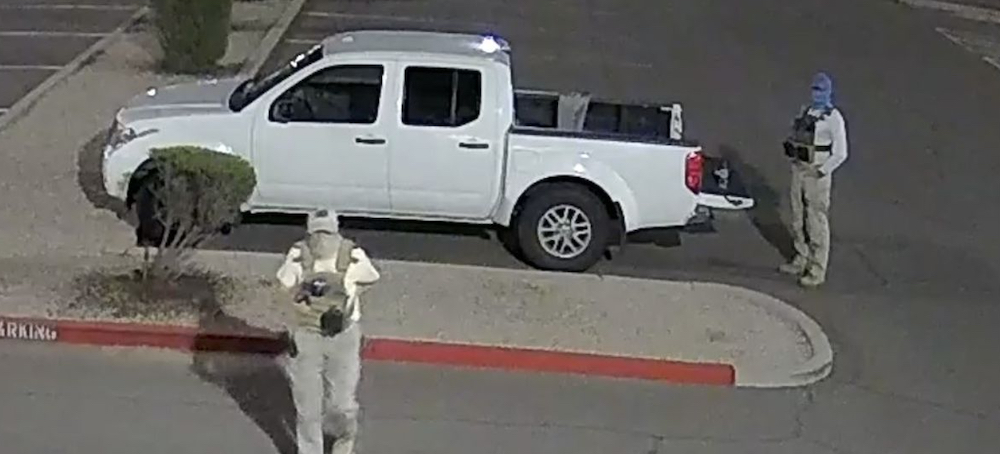 At least three groups that make baseless claims of widespread voter fraud are encouraging untrained volunteers to engage in the effort. (photo: Andrew Selsky/AP)
Masked Poll Watchers Are Showing Up at Voting Sites With Handguns and Kevlar Vests
Ryan Teague Beckwith and Margaret Newkirk, Bloomberg
Excerpt: "Two people armed with handguns and wearing tactical military gear, balaclavas masking their face and the license plates on their cars covered, stood watch over a ballot drop box during early voting last week in Mesa, Arizona."
Elections officials say incidents limited and voters should come to polls
Two people armed with handguns and wearing tactical military gear, balaclavas masking their face and the license plates on their cars covered, stood watch over a ballot drop box during early voting last week in Mesa, Arizona.
This scene, reported by the Maricopa County Elections Department on Friday, is one that some elections officials and law enforcement fear might spread as believers in Donald Trump’s false claims that a second term as president was stolen from him through voter fraud amp up activity ahead of the Nov. 8 election.
Other agitator election deniers are filming voters dropping off ballots, photographing their license plates and confronting them in parking lots outside early voting locations in Arizona and Michigan, according to Marcia Johnson-Blanco, who is overseeing election protection efforts for the Lawyers' Committee for Civil Rights Under Law.
At least three groups that make baseless claims of widespread voter fraud are encouraging untrained volunteers to engage in the effort. One effort, funded by Michael Flynn, Donald Trump’s first national security adviser and a former Army general in Iraq 20 years ago, is specifically recruiting military veterans and police officers to monitor voting.
For now, the agitators’ efforts are sporadic, and elections officials stress that most voters are unlikely to be affected in the hopes of tamping down any public fears about voting in person.
But they are preparing. Local police are being trained on state and federal voter intimidation laws. Voting rights groups are advising the public on how to report incidents, civil rights groups are filing lawsuits and US attorneys around the country are appointing staff prosecutors to keep an eye on threats and intimidation.
A coalition of left-leaning groups called Election Defenders has also been training volunteers in eight states on how to counter efforts to intimidate voters and elections officials from early voting through final certification.
Attorney General Merrick Garland vowed at a press briefing Monday that the Justice Department would fight voter intimidation.
"The Justice Department has an obligation to guarantee a free and fair vote by everyone who's qualified to vote and will not permit voters to be intimidated," he said.
The efforts are already leading to lawsuits. The Arizona Alliance for Retired Americans and Voto Latino sued in federal court, arguing that the election denial group Clean Elections USA encouraged voter intimidation at drop boxes in Maricopa County, while the League of Women Voters filed a separate lawsuit.
Clean Elections USA founder Melody Jennings did not respond to a request for comment, but she has posted on the conservative Truth Social website that at least one of the people photographed in Mesa was not associated with her group. In the past, however, Jennings has said that poll watchers should gather in large groups to be a “deterrent.”
The incidents come as claims that electoral losses are naturally the result of fraud have become standard among Republican candidates, with 225 candidates for governor, secretary of state, attorney general or Congress on the ballot who have either baselessly said the 2020 election was stolen or cast doubt on its legitimacy.
They are being fueled by false conspiracy theories shared online about widespread voter fraud, especially at drop boxes, as well as a debunked film from right-wing commentator Dinesh D’Souza, whom Trump pardoned for making illegal campaign contributions.
Elections officials have long allowed partisan observers at polling places, but they are typically required to undergo training and wear identifying badges and are barred from talking directly to voters. Local political parties usually name the poll watchers, and they can be removed for violating the rules.
But the freelance effort is different. The participants are not vetted by state or local officials, have no approved training on voter intimidation laws and are gathering around unstaffed drop boxes, a practice that election deniers call “tailgating.”
They are also being called to action by groups that have embraced false claims about voting, including Clean Elections USA, Audit the Vote and the Flynn-linked group One More Mission, as well as election denier candidates like Arizona Secretary of State nominee Mark Finchem, who tweeted out a call for supporters to “watch all drop boxes” in order to “save the Republic.”
“Ballot drop boxes are open for much longer than polling places. They aren’t staffed and they are often placed in locations that make them vulnerable for people to act in a way that you would probably not see in a polling place,” said Suzanne Almeida, who is heading a voter intimidation hotline for the advocacy group Common Cause.
Elections officials who staff polling places are also typically trained in how to de-escalate conflict when someone attempts to intimidate voters.
Some groups are looking to train local police who might be called to a confrontation at a drop box.
In Georgia, former elections official Chris Harvey is leading an effort with the state’s Peace Officer Standards and Training Council as well as a nationwide effort through the Committee for Safe and Secure Elections to plan and coordinate law enforcement’s handling of potential election disruption.
Officers resisted the outreach at first, saying they didn’t want anything to do with politics, Harvey said. “We tell them it’s not a political thing. It’s the law. You are not for or against anyone. You are just enforcing the law.”
Georgia is one of 13 states that will be passing out pocket-sized cards to police officers to carry with the laws on election interference printed on them.
“A lot of cops, you say there’s something going on and the first response would be send a lot of cops,” he said. “But there are places where that’s not seen as a good thing. We’re telling them you might consider plain clothes officers in some of the places where we think we might have a problem. The point is doing it intelligently, with the minimal force necessary.”
READ MORE
 Pollution from a factory. (photo: Science Focus)
In Yet Another Ominous Climate Change Warning, Greenhouse Gases Reach Highest Levels Ever
Denise Chow, NBC News
Chow writes: "The amount of carbon dioxide and two other greenhouse gases in Earth's atmosphere hit record highs last year, the World Meteorological Organization said in a report published Wednesday."
The U.N. weather agency published the alarming report less than two weeks before world leaders gather for the U.N. Climate Change Conference.
The amount of carbon dioxide and two other greenhouse gases in Earth's atmosphere hit record highs last year, the World Meteorological Organization said in a report published Wednesday.
Carbon dioxide, methane and nitrous oxide are the three main greenhouse gases responsible for trapping heat in the atmosphere and driving global warming. The WMO’s latest Greenhouse Gas Bulletin, published annually, found that concentrations of all three reached new highs last year — a worrying trend and a sign that the world is not doing enough to fight climate change.
“WMO’s Greenhouse Gas Bulletin has underlined, once again, the enormous challenge — and the vital necessity — of urgent action to cut greenhouse gas emissions and prevent global temperatures rising even further in the future,” Petteri Taalas, the WMO’s secretary-general, said in a statement.
The increase in atmospheric carbon dioxide from 2020 to 2021 was larger than the average annual growth rate over the past decade, according to the report. The WMO also said last year's rise in methane levels was the biggest year-on-year jump since such measurements began almost 40 years ago.
Measurements for carbon dioxide, methane and nitrous oxide in 2021 were all above pre-industrial levels, “before human activities started disrupting natural equilibrium of these gases in the atmosphere,” the WMO said.
Concentrations of carbon dioxide, in particular, are closely monitored as an indicator of how humans are influencing Earth's climate. Burning fossil fuels releases carbon dioxide and other greenhouse gases that trap heat in the atmosphere.
A separate report released Wednesday by the United Nations warned that the world is “nowhere near” hitting its targets to cut greenhouse gas emissions, with the planet on track to see temperatures rise to 2.5 degrees Celsius (4.5 Fahrenheit) above pre-industrial averages by the end of the century.
World leaders are set to gather in Egypt in less than two weeks for the United Nations Climate Change Conference, known as COP27, or the 27th “conference of parties” under the U.N. Framework Convention on Climate Change.
This year’s meeting, which opens Nov. 6, will involve negotiations among countries over how to meet their emissions-cutting targets, what adaptation efforts to focus on and how to provide funding to countries least responsible for global warming and most affected by climate change.
The WMO’s report adds urgency to the talks. It found that concentrations of carbon dioxide in the atmosphere last year hit 415.7 parts per million, which means that for every 1 million molecules of gas in the atmosphere, more than 415 were carbon dioxide.
In 2020, the planet enjoyed a temporary reduction in carbon emissions because of coronavirus lockdowns around the world, but the WMO said there are indications that global carbon dioxide levels are continuing to rise this year.
The report also found that concentrations of methane, a potent greenhouse gas, were 1,908 parts per billion last year and that concentrations of nitrous oxide hit 334.5 parts per billion.
Human activities, including agriculture, coal mining and oil and gas production, account for around 60% of global methane emissions, researchers have said. Although it's not clear why methane concentrations jumped significantly last year, the WMO said the increase appears to be the result of “both biological and human-induced processes.”
Nitrous oxide is the third-largest contributor to climate change after methane and carbon dioxide. Agriculture, industrial activities, the burning of fossil fuels and other human activities account for around 43% of nitrous oxide emissions.
The WMO said concentrations of the greenhouse gas rose slightly more last year than from 2019 to 2020, faster than the average annual growth rate over the past decade.
The agency’s report uses data from a network known as Global Atmosphere Watch, which measures greenhouse gases and atmospheric composition.
Taalas said the report’s findings indicate that “time is running out.”
“The continuing rise in concentrations of the main heat-trapping gases, including the record acceleration in methane levels, shows that we are heading in the wrong direction,” he said in the statement.
READ MORE
Contribute to RSN
Follow us on facebook and twitter!
Update My Monthly Donation
PO Box 2043 / Citrus Heights, CA 95611


