
28 June 20
We have two days to go in April and we are really hurting for basic funding. Slow down, pull over and help out.
It really matters.
Marc Ash
Founder, Reader Supported News
Founder, Reader Supported News
If you would prefer to send a check:
Reader Supported News
PO Box 2043
Citrus Hts
CA 95611
Reader Supported News
PO Box 2043
Citrus Hts
CA 95611
28 June 20
Barr Forms Task Force to Counter 'Anti-Government Extremists'

Matt Zapotosky, The Washington Post
Zapotosky writes: "Attorney General William P. Barr on Friday directed the formation of a task force that will be dedicated to countering 'anti-government extremists,' escalating federal law enforcement's response to the violence that has sometimes marked nationwide protests against police brutality and racism."
READ MORE

A supporter wears a 'It's OK to be White' shirt as he listens to President Donald Trump speak during a campaign rally at the BOK Center on June 20, 2020 in Tulsa, Oklahoma. (photo: Nicholas Kamm/Getty Images
Trump Retweets Video Showing Supporter Yelling "White Power": "Great People"
Daniel Politi, Slate
Politi writes: "President Donald Trump wanted to thank his supporters Sunday morning, and did so by retweeting a video that included one of them shouting 'white power.'"
Daniel Politi, Slate
Politi writes: "President Donald Trump wanted to thank his supporters Sunday morning, and did so by retweeting a video that included one of them shouting 'white power.'"
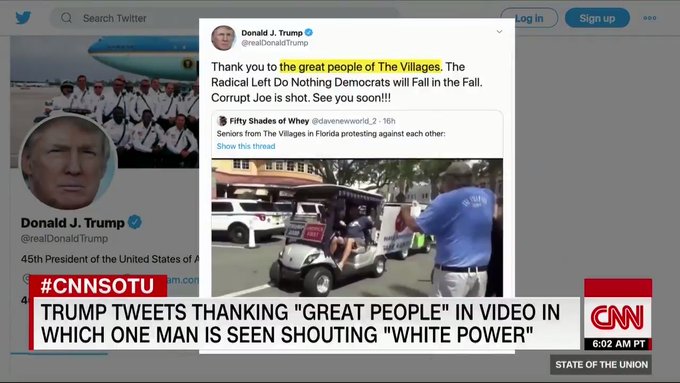
Trump expressed his thanks to the “the great people of The Villages,” a community in Florida, where supporters of the president apparently held a golf cart parade in his honor and verbally clashed with protesters who lined up on their route. The first bit of the video shows protesters yelling “racist” at a couple driving in a golf cart with a “Trump 2020” and “America First” signs. The man driving the golf cart gives a thumbs up and yells back, “White power!” The man protesting seems to see that as a recognition that his racist label is accurate, “There you go, white power.”
Thank you to the great people of The Villages. The Radical Left Do Nothing Democrats will Fall in the Fall. Corrupt Joe is shot. See you soon!!! https://t.co/4Gg1iGOhyG
— Donald J. Trump (@realDonaldTrump) June 28, 2020
The video also includes other clips, apparently of the same pro-Trump golf-cart parade in which protesters and supporters of the president yelled slurs and insults at each other. In one clip, for example, a woman yells, “Nazi, racist pig” at Trump supporters. Secretary of Health and Human Services Alex Azar was asked about the video and the president’s retweet on Sunday morning. “I’ve not seen that video or that tweet, but obviously neither the President, his administration nor I would do anything to be supportive of white supremacy or anything that would support discrimination of any kind,” Azar said on CNN’s State of the Union.
“I’ve not seen that video or that tweet, but obviously neither the President, his administration... would do anything to be supportive of white supremacy,” HHS Sec. Alex Azar reacts to a video Pres. Trump shared of a man with Trump campaign posters chanting "white power" #CNNSOTU

711 people are talking about this
Trump retweeting the video and praising his supporters comes amid reports that the president’s allies have been calling on him to tone down his rhetoric at a time when his poll numbers appear to be plummeting. So far, though, the president hasn’t seemed too eager to take the advice and instead has apparently chosen to focus on appealing to his base.
Update at 12:50 p.m.: President Donald Trump deleted the tweet about three hours after posting it. This is the video Trump had retweeted while writing, “Thank you to the great people of The Villages. The Radical Left Do Nothing Democrats will Fall in the Fall. Corrupt Joe is shot. See you soon!!!” White House spokesperson Judd Deere issued a statement that said: “President Trump is a big fan of The Villages. He did not hear the one statement made on the video. What he did see was tremendous enthusiasm from his many supporters.”
Seniors from The Villages in Florida protesting against each other: pic.twitter.com/Q3GRJCTjEW
— Fifty Shades of Whey (@davenewworld_2) June 27, 2020
NEW: Trump appears to have deleted his quote-tweet of a video of a supporter yelling "white power" at protesters. axios.com/trump-tweet-wh…

 NEW: White House spokesperson Judd Deere on Trump's now-deleted tweet: “President Trump is a big fan of The Villages. He did not hear the one statement made on the video. What he did see was tremendous enthusiasm from his many supporters.” axios.com/trump-tweet-wh…
123 people are talking about this

Steve Bannon in Washington DC in November 2019. (photo: Alex Wong/Getty Images)
Bannon Aims to Make a Comeback in Circle of Trump Influencers Ahead of Election
Daniel Strauss, Guardian UK
Strauss writes: "As an election approaches, Steve Bannon and his allies are trying to return the former chief White House strategist to media circles known to influence the president's thinking."
READ MORE
Daniel Strauss, Guardian UK
Strauss writes: "As an election approaches, Steve Bannon and his allies are trying to return the former chief White House strategist to media circles known to influence the president's thinking."
READ MORE

William Faulkner. (photo: Carl Mydans/The LIFE Picture Collection/Getty Images)
How Mary Trump Found Herself in the Hot Mess of a Faulkner Novel
Malcolm Jones, The Daily Beast
Jones writes: "Doing it once could be chalked up to an inside joke. Doing it twice? That's as good as saying, this is not just a story. This is her story."
READ MORE
Malcolm Jones, The Daily Beast
Jones writes: "Doing it once could be chalked up to an inside joke. Doing it twice? That's as good as saying, this is not just a story. This is her story."
READ MORE

Trump's rally in Tulsa. (photo: Doug Mills/NYT)
Workers Removed Thousands of Social Distancing Stickers Before Trump's Tulsa Rally, According to Video
Joshua Partlow and Josh Dawsey, The Washington Post
Excerpt: "In the hours before President Trump's rally in Tulsa, his campaign directed the removal of thousands of 'Do Not Sit Here, Please!' stickers from seats in the arena that were intended to establish social distance between rallygoers, according to video and photos obtained by The Washington Post and a person familiar with the event."
EXCERPTS:
The removal contradicted instructions from the management of the BOK Center, the 19,000-seat arena in downtown Tulsa where Trump held his rally on June 20. At the time, coronavirus cases were rising sharply in Tulsa County, and Trump faced intense criticism for convening a large crowd for an indoor political rally, his first such event since the start of the pandemic.
As part of its safety plan, arena management had purchased 12,000 do-not-sit stickers for Trump’s rally, intended to keep people apart by leaving open seats between attendees. On the day of the rally, event staff had already affixed them on nearly every other seat in the arena when Trump’s campaign told event management to stop and then began removing the stickers, hours before the president’s arrival, according to a person familiar with the event who spoke on the condition of anonymity to discuss internal matters.
In a video clip obtained by The Washington Post, two men — one in a suit and one wearing a badge and a face mask — can be seen pulling stickers off seats in a section of the arena. It is unclear who those two men are. When Trump took the stage on Saturday evening, the crowd was clustered together and attendees were not leaving empty seats between themselves.
The actions by Trump’s campaign were first reported Friday by Billboard Magazine.
As rally preparations were underway, Trump’s campaign staff intervened with the venue manager, ASM Global, and told them to stop labeling seats in this way, Doug Thornton, executive vice president of ASM Global, told the magazine.
“They also told us that they didn’t want any signs posted saying we should social distance in the venue,” Thornton said. “The campaign went through and removed the stickers.”
The director of the Tulsa Health Department, Bruce Dart, had recommended that the event be postponed until it was safer. A number of city residents and business owners brought a lawsuit against the venue manager, ASM Global, seeking to require all attendees wear masks and adhere to social distancing guidelines from health authorities.
The Oklahoma Supreme Court rejected that suit.
On June 13, a week before the rally, Oklahoma Gov. Kevin Stitt (R) wrote to the venue management saying he understood that Trump’s campaign “has presented plans to ASM Global in order to accommodate capacity crowds during a political rally.”
Stitt noted that Oklahoma was in “Phase 3” of its reopening plan and Trump’s rally “proceeding as planned is consistent with the guidance” of that plan. Stitt’s letter added that “we have also encouraged event licensees to refer to the general CDC guidelines for more information about COVID-19.”
Two days before the rally, the managers of the BOK Center had asked the Trump campaign to provide a detailed written plan outlining the “health and safety” measures it intended to use to prevent the spread of coronavirus.
Before the rally, Murtaugh said in an emailed statement: “We take safety seriously, which is why we’re doing temperature checks for everyone attending, and providing masks and hand sanitizer. This will be a Trump rally, which means a big, boisterous, excited crowd. We don’t recall the media shaming demonstrators about social distancing — in fact the media were cheering them on.”
As the crowd entered the day of the rally, the Trump campaign handed out masks and small bottles of “Make America Great Again 2020” branded hand sanitizer.
Trump had told North Carolina Gov. Roy Cooper (D) during a May 29 phone call that he would not hold a socially distanced convention in Charlotte because he had never had an empty seat since he came down the escalator at the start of his presidential campaign in 2015.
Neither Trump nor the White House asked that the stickers be removed, said a senior White House official. While campaign staff and some attendees wore masks during the rally, many rallygoers did not.
At least six members of the Trump campaign advance staff have tested positive for the coronavirus, including two Secret Service employees. Dozens of Secret Service officers and agents who attended the Tulsa rally were ordered to self-quarantine.

Lazarus Chakwera waves to a crowd as he arrives at his last campaign rally, in Lilongwe, ahead of the rerun general elections. Chakwera on June 27, 2020 was declared winner with 59 percent of the vote. (photo: Gianluigi Guercia/AFP)
After Historic Election, What Next for Malawi?
Al Jazeera
Excerpt: "Malawi opposition leader Lazarus Chakwera has been sworn in as the country's new president after beating the incumbent Peter Mutharika in an historic rerun vote."
READ MORE
Al Jazeera
Excerpt: "Malawi opposition leader Lazarus Chakwera has been sworn in as the country's new president after beating the incumbent Peter Mutharika in an historic rerun vote."
READ MORE

Fossil fuel emissions. (photo: DWalker44/Getty Images)
Rolling Back Environmental Protections Under Cover of the Pandemic
Rachel Golden Kroner, Scientific American
Kroner writes: "In Malaysia, it's happening so a housing development can be built. In Albania, it's to make room for an airport. And in both Brazil and the United States, it's to extract more minerals and fossil fuels."
Rachel Golden Kroner, Scientific American
Kroner writes: "In Malaysia, it's happening so a housing development can be built. In Albania, it's to make room for an airport. And in both Brazil and the United States, it's to extract more minerals and fossil fuels."
EXCERPT:
Some of these actions threaten endangered species and could fragment vital ecosystems. Others increase risks to indigenous communities. Some may lead to the release of significant amounts of carbon dioxide into the atmosphere, accelerating the pace of climate change. Many are flying under the radar while the pandemic and the struggle for racial justice understandably absorb public attention.
In one particularly egregious example, the government of Canada’s province of Alberta has proposed to remove protective status for 175 provincial parks , following a quiet amendment that removed the requirement for public consultation in these types of decisions.
Wherever they are happening, these rollbacks to protected areas can increase the likelihood of future pandemics. We know that land use change is the most significant driver of emerging infectious zoonotic diseases, like the virus that caused COVID-19. That is why leading public health experts are urging governments to protect nature as a part of their pandemic prevention strategies, something that protected areas do by definition.
By opening up protected areas to development, we don’t just undermine our efforts to care for protected places. We run the risk of creating the conditions for another pandemic, even while we’re still dealing with the current one. We also further risk locking in a harmful trajectory for our climate, when we know that climate change disproportionately affects communities of color.
This is why governments around the world must stop harmful environmental rollbacks, especially at a moment when the public cannot adequately participate in the decision-making process. Instead of exploiting this moment to scale back protected areas, governments should follow the EU’s example and use economic recovery efforts to scale them up.


 r


